

Key Takeaways
Read the disagreements as a map of what consciousness research assumes.
A field without consensus. Susan Blackmore built the book from conversations with about twenty philosophers, psychologists, and neuroscientists. They disagree not only about answers, but about what the question means. Some treat experience as an additional fact that brain science cannot explain; others expect a sufficiently complete account of brain function to dissolve the mystery. The same divisions shape arguments about zombies, the self, free will, animal minds, and survival after death.
Follow the fault lines. The book's value is not a final verdict. It is a guided tour of how different starting assumptions produce different theories, and how experts explain those assumptions in their own words. Disagreement can expose an unclear question, though it does not make every answer equally well supported.
What's useful about this format is that it makes hidden premises audible. A claim about consciousness may sound scientific while quietly assuming that experience is separate from brain activity, or it may sound dismissive while assuming that function exhausts experience. The conversations invite readers to ask what would count as evidence for each position. Their limitation is also instructive: a lively exchange can reveal disagreement without resolving it. Intellectual openness is strongest when paired with a clear distinction between empirical findings and metaphysical interpretation.
Make consciousness experimentally tractable by comparing what is seen and unseen.
Compare changing perception. In binocular rivalry, different images are shown to each eye. The physical input stays present, yet perception alternates between the images. Researchers can compare brain activity when a person reports seeing one image with activity when the other dominates. These neural correlates of consciousness are brain processes that reliably accompany a particular conscious experience. The method turns consciousness into something researchers can study alongside unconscious processing, rather than relying only on abstract debate.
A useful, partial map. Bernard Baars describes conscious information as becoming broadly available to other brain processes, while visual studies find activity associated with object recognition and reported perception. But correlation is not yet an explanation of why activity feels like anything. The experiments narrow the question and guide further tests; they do not settle the dispute over subjective experience.
This strategy shows how a hard-to-measure phenomenon can be approached through controlled contrasts. The same stimulus can be present while reported experience changes, which helps separate sensory input from what a subject perceives. The method also makes its limits visible: reports are evidence about experience, not a transparent window into it, and an associated brain pattern does not by itself explain why experience occurs. The strongest research design treats first-person reports, behavior, and neural measurements as complementary rather than interchangeable.
Ask whether experience is extra before claiming the brain explains it.
Name the disputed remainder. David Chalmers calls the problem of explaining subjective experience from physical processes the hard problem. He distinguishes it from questions about perception, memory, and behavior, which he calls easier because they concern functions scientists can investigate. Ned Block similarly distinguishes phenomenal consciousness, the felt quality of experience, from access consciousness, information available for reasoning and report.
Three competing answers. Chalmers argues that experience may be fundamental rather than reducible to brain facts. The Churchlands, Francis Crick, and Daniel Dennett reject the idea that an extra ingredient is required, expecting neuroscience to explain or deflate the apparent gap. John Searle says brains cause conscious states, while treating those states as features of the brain system. The disagreement turns on whether a complete account of function leaves anything essential unexplained.
This distinction prevents a common argument from slipping between meanings. Evidence that attention, memory, or report depends on particular brain processes does not automatically answer whether felt experience is fully explained. Conversely, calling experience irreducible does not yet provide a mechanism or a testable account of its relation to the brain. The debate is productive when each side states what would count as explanatory success. It becomes circular when one camp treats experience as self-evident proof of an extra fact and another defines that fact away in advance.
Treat perception as active sampling, not a complete inner photograph.
The scene exceeds memory. Change blindness occurs when a large alteration in a visual scene goes unnoticed if it happens during a blink, eye movement, or brief interruption. In one kind of demonstration, a short blank separates two images; people can miss a conspicuous change until it is pointed out. Kevin O'Regan uses such findings to challenge the idea that the brain stores a richly detailed picture of the whole visual world.
Look, move, and check. O'Regan's sensorimotor theory treats seeing as a capacity grounded in how sensory input changes with possible movements. The world itself supplies detail that can be inspected when needed. This radical interpretation is not the only one: change blindness shows limits on detection and memory, but does not prove that perception contains no internal representation.
The practical insight is a humbler model of attention: apparent visual richness need not mean that every detail is continuously represented in the head. O'Regan's account connects perception to action and to the stable ways the environment responds when the body moves. That connection also resembles the broader idea that cognition can use external surroundings as a resource. Still, missed changes are not evidence that nothing is seen until queried. They show that attention, memory, and perception interact in ways ordinary intuition tends to overstate.
Investigate the self as a brain-built perspective, not a hidden pilot.
A model feels like a self. Thomas Metzinger describes a transparent self-model: the brain's representation of the organism and its perspective, experienced as reality rather than recognized as a model. It can help coordinate perception and action, but it does not establish a permanent inner observer. The self-model may also shift with circumstances, such as behaving differently among friends than at a formal family breakfast.
Useful does not mean unreal. Blackmore and several interviewees question whether a fixed self can be found in experience or in the brain. Brain damage can alter memory, personality, and awareness, making the self's dependence on biological processes concrete. Yet describing the self as constructed does not mean that pain, identity, or relationships are imaginary in the everyday sense. It means that the felt center of experience may be an activity of the system, not a separate entity inside it.
The model perspective offers a way to take subjective identity seriously without imagining a tiny spectator behind the eyes. It also helps explain why selfhood can feel stable while changing across time and social settings. A useful caution is that constructed systems can be real and consequential: maps are constructed too, but they guide action. The question is not simply whether the self is real or false, but which aspects of self-representation support coordination, memory, responsibility, and social life.
Do not confuse the feeling of willing with proof of causal authorship.
Agency can be misattributed. Daniel Wegner argues that the feeling of conscious will is an inference, not a guarantee that a conscious thought initiated an action. In one experiment, a person moved a shared cursor with a partner while hearing object names. When a name came just before the partner guided the cursor to that object, the participant was more likely to feel responsible for the movement. The timing encouraged a mistaken sense of authorship.
Useful, but fallible. Wegner sees this sense of agency as a practical way to label actions and assign responsibility, while acknowledging that it can misfire. Other contributors define free will less extravagantly: Dennett links it to acting on reasons, and the Churchlands distinguish controlled behavior from behavior outside a person's control. The book separates metaphysical freedom from ordinary capacities to choose and act.
Wegner's experiments matter because they show that the experience of agency can be manipulated by timing and context. That weakens the assumption that feeling in control proves how an action was caused. It does not, however, show that people never deliberate or that choices have no consequences. A useful distinction is between ultimate self-creation, which several speakers doubt, and the practical ability to respond to reasons, learn, and regulate behavior. Those capacities remain relevant to ethics even in a causally organized brain.
Pair disciplined first-person observation with public measurement.
Experience can be studied carefully. Francisco Varela's neurophenomenology combines first-person descriptions of experience with measurements such as EEG or brain imaging. He argues that people need training to report subtle mental states reliably, much as technical observation in any field requires practice. Rather than averaging every response together, researchers can compare detailed reports from individual trials with brain activity.
Lucid dreams offer a test case. Stephen LaBerge showed that lucid dreamers can signal from within a dream using planned eye movements. Recordings placed those signals during REM sleep, supporting the claim that lucid dreaming occurs while the person is asleep, not merely in a half-awake state. Such studies make subjective reports more testable, though they do not make introspection infallible or establish that every reported inner state has been interpreted correctly.
The pairing is stronger than either method alone. Brain measurements can constrain what a report plausibly refers to, while careful reports can identify distinctions that broad behavioral measures miss. LaBerge's dream signals illustrate how an experience can leave a measurable trace without reducing the experience to that trace. The methodological challenge is training without encouraging participants to report what researchers expect. Good work therefore needs shared procedures, independent checks, and room for reports that do not fit the preferred theory.
Set animal-consciousness boundaries by evidence, not human resemblance alone.
Behavior offers clues, not certainty. Christof Koch points to flexible learning in bees, which have roughly a million neurons, as a reason not to assume that consciousness requires a human-sized brain. Petra Stoerig argues that many animals plainly have forms of experience, while warning that their experiences need not match ours. Her work on blindsight also shows that people can use visual information without reporting ordinary visual awareness.
The boundary remains disputed. Vilayanur Ramachandran takes a much narrower view, linking full-fledged qualia to human capacities for self-reflection, language, and meta-awareness. These competing positions make animal consciousness a scientific and ethical problem: behavior can support an inference, but no outside observer can directly inspect another creature's experience. The interviews leave readers with competing criteria, not a settled ranking of species.
This debate exposes a risk in using human abilities as the default measuring stick. Flexible learning, sensory systems, and neural organization can differ greatly across species, so a single human-centered test may miss forms of experience that are organized differently. At the same time, behavioral sophistication alone cannot prove subjective feeling. The careful position is neither automatic human equivalence nor automatic denial. Multiple lines of evidence can guide ethical caution while researchers acknowledge uncertainty about where experience begins.
Treat quantum proposals as hypotheses, not explanations by exotic vocabulary.
A bold physical proposal. Roger Penrose and Stuart Hameroff suggest that quantum processes in neuronal microtubules may contribute to consciousness. Their account connects quantum computation and the collapse of quantum possibilities with conscious moments and choice. Hameroff further speculates that quantum information could persist in some form after death. These claims reach beyond the more conventional search for neural patterns that track perception and awareness.
A theory still needs a bridge. The proposal's supporters say it can be tested, while critics such as Patricia Churchland argue that invoking quantum mechanics does not explain why a physical process should feel like something. John Searle makes a similar caution: adding a second mystery may not resolve the first. The book presents the theory as a striking, controversial possibility, not an established account of consciousness.
The proposal has one scientific virtue: it identifies physical mechanisms that could, in principle, be investigated rather than stopping at a declaration that consciousness is mysterious. But a mechanism is not yet an explanation of experience. The account must show why the proposed quantum events connect to particular qualities of feeling, and how those links differ from ordinary neural accounts. This is a useful standard for evaluating ambitious theories generally: specificity and possible tests are strengths, while explanatory reach must be demonstrated rather than implied by technical language.
Analysis
The book's central achievement is not a consensus theory, but a clearer map of why consciousness research repeatedly divides. The same observation can be interpreted as evidence for different claims: a neural pattern may correlate with a reported experience, explain access to information, or still leave the felt quality untouched. Those are not equivalent explanatory targets. Blackmore's persistent questioning makes the ambiguity visible, especially when speakers move between experience, report, attention, and brain activity as if they were interchangeable.
The strongest scientific thread is methodological. Binocular rivalry, blindsight, change blindness, lucid-dream signaling, and brain imaging turn vague intuitions into contrasts that can be investigated. Yet these methods also expose a limit: reports are indispensable but fallible, and neural correlates do not automatically settle what consciousness is. The book's most productive challenge is therefore to combine first-person description with behavioral and biological evidence while refusing to mistake any one measure for the whole phenomenon.
Its greatest weakness is the risk of false balance. A conversation gives speculative quantum theories and extensively studied perceptual phenomena comparable narrative space, although they do not have comparable evidential support. The reader must separate the value of asking a question from the strength of an answer. Likewise, the hard problem is a useful label for a genuine conceptual dispute, but it can harden into a presupposition that experience must remain beyond explanation. The rival danger is defining experience away before explaining it.
The personal questions give the scientific debate its stakes. If agency is a constructed feeling, responsibility still concerns capacities for learning and control. If the self is a model, relationships and suffering do not become trivial. If animals may experience, uncertainty matters ethically. The book's durable lesson is not that consciousness has been solved, but that claims about minds carry consequences, and should be judged by both their evidence and the assumptions they smuggle in.
Review Summary
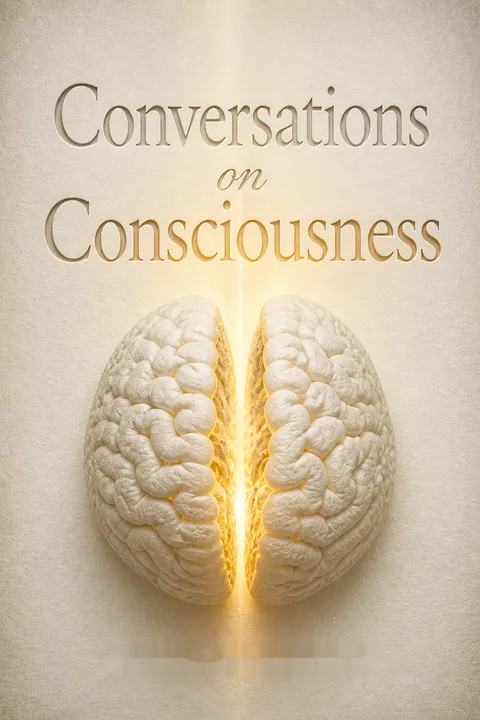
Conversations on Consciousness presents interviews with leading thinkers on consciousness, exploring topics like free will, zombies, and the nature of subjective experience. Readers found it an accessible introduction to the field, praising Blackmore's insightful questions and the diverse perspectives presented. While some felt it was repetitive or outdated, many appreciated the book's ability to spark deep reflection on consciousness. Critics noted the lack of clear answers but acknowledged this reflects the current state of consciousness research. Overall, it's considered a thought-provoking overview for both newcomers and those familiar with the subject.
People Also Read








Glossary
Hard problem
why experience feels like somethingDavid Chalmers uses this term for the challenge of explaining subjective experience in terms of physical processes. It is contrasted with questions about functions such as perception, memory, and behavior, which can be investigated by explaining how they work. The disagreement is whether a complete functional account would also explain why those processes are accompanied by felt experience.
neural correlates of consciousness
brain activity accompanying experienceNeural correlates of consciousness are brain processes that occur in association with a particular conscious experience, or with being conscious rather than unconscious. Researchers look for them using methods such as brain imaging and single-cell recording. A correlation can identify relevant activity, but does not by itself establish whether that activity causes experience, constitutes it, or explains its subjective quality.
Global Workspace Theory
information made broadly availableBernard Baars's theory describes a cognitive system in which information that becomes conscious is made broadly available to other processes in the brain. A theatre and spotlight metaphor illustrates the idea: a limited selection is prominent, while many other processes shape it or use it unconsciously. The metaphor is not meant to imply a literal inner audience or a single place where consciousness occurs.
Cartesian theatre
imagined inner viewing stageDaniel Dennett uses this term for the tempting picture that information in the brain arrives at a central place where consciousness happens and an inner observer watches it. He rejects this model because it relocates the mystery rather than explaining how experience works. The related term Cartesian materialism describes a materialist account that still assumes such a central display.
phenomenal consciousness
the felt quality of experienceNed Block uses phenomenal consciousness for the subjective, what-it-is-like aspect of a mental state. It concerns the felt quality of seeing a color or experiencing pain, rather than whether information is available for reasoning or report. Block distinguishes it from access consciousness, though other researchers dispute whether the distinction marks separate phenomena or separable concepts.
access consciousness
information available for reasoningAccess consciousness is information that is available to guide thought, reasoning, and report. Block distinguishes it from phenomenal consciousness, which concerns the felt quality of experience. A state could, in principle, have a subjective quality without being fully available for deliberate reasoning, so the distinction helps separate conscious feeling from cognitive access.
change blindness
missing a visual alterationChange blindness is the failure to notice a change in a visual scene when the change occurs during a blink, eye movement, or brief interruption. It challenges the intuition that a detailed, stable representation of the whole scene is continuously available. Researchers use it to study attention, visual memory, and how perception depends on active inspection.
transparent self-model
self-representation mistaken for realityThomas Metzinger uses this term for the brain's representation of the organism and its perspective. The model is transparent because it is experienced as the self and not as a representation constructed by the brain. It can guide perception and action without implying a separate, permanent observer hidden inside the body.
neurophenomenology
linking experience reports and neuroscienceFrancisco Varela's approach combines careful first-person descriptions of experience with third-person measurements of brain activity. It treats trained observation as a potential source of useful data, while connecting reports to methods that other researchers can assess. The aim is to coordinate the study of lived experience with neuroscience, rather than excluding either perspective.
lucid dream
dreaming with awareness of dreamingA lucid dream is a dream in which the dreamer realizes, while still dreaming, that the experience is a dream. Stephen LaBerge used planned eye movements as signals from within dreams, then compared those signals with sleep recordings. The method provided evidence that lucid dreams can occur during REM sleep rather than only during partial awakening.
blindsight
visual response without reported sightBlindsight occurs when people with damage to primary visual cortex report being unable to see stimuli in part of their visual field, yet can sometimes guess features such as location, orientation, or movement above chance. The condition reveals that visual information can guide responses without ordinary reported vision. Researchers disagree about what it shows about awareness.
Chinese room
symbol use without understandingJohn Searle's thought experiment imagines a person following rules to respond to written Chinese symbols without understanding Chinese. The responses could appear fluent from outside, although the person manipulates symbols without grasping their meaning. Searle uses the example to challenge the claim that executing the right computer program is sufficient for understanding.
FAQ
What's Conversations on Consciousness about?
- Exploration of Consciousness: The book is a collection of interviews with leading thinkers in consciousness studies, exploring their theories and perspectives.
- Diverse Perspectives: It includes insights from philosophers, neuroscientists, and psychologists on consciousness, free will, and the mind-body problem.
- Key Questions: Central questions include "What is consciousness?" and "How does it relate to brain activity?"
Why should I read Conversations on Consciousness?
- Engaging Dialogues: The book presents complex ideas in an accessible format, making it suitable for both lay readers and those familiar with the field.
- Insight from Experts: Readers gain access to thoughts from prominent figures like Daniel Dennett and Francis Crick, enriching their understanding of consciousness.
- Current Relevance: The discussions reflect ongoing debates in philosophy and neuroscience, making it a timely read for anyone interested in the mind.
What are the key takeaways of Conversations on Consciousness?
- No Consensus on Consciousness: The interviews reveal a lack of agreement among experts, highlighting the complexity of defining consciousness.
- Mind-Body Problem: The "hard problem" of consciousness is a recurring theme, questioning how brain processes lead to subjective experiences.
- Role of Qualia: The concept of qualia, or the subjective quality of experiences, is debated, with differing opinions on its significance.
What are the best quotes from Conversations on Consciousness and what do they mean?
- "Consciousness is a real working theatre." - Bernard Baars: This suggests consciousness is an active space where mental processes are displayed.
- "You’re just a pack of neurons." - Francis Crick: Emphasizes a materialistic view, suggesting experiences are reducible to neural activity.
- "The hard problem is the difficulty of understanding how physical processes in the brain can possibly give rise to subjective experiences." - Susan Blackmore: Highlights the central challenge in consciousness studies.
What is the "hard problem" of consciousness discussed in Conversations on Consciousness?
- Definition: Coined by David Chalmers, it refers to explaining why and how we have subjective experiences.
- Distinction from Easy Problems: Easy problems involve cognitive functions, while the hard problem focuses on qualitative aspects.
- Philosophical Implications: Raises questions about reality and suggests consciousness may be a fundamental aspect of existence.
How do different contributors view the relationship between consciousness and the brain in Conversations on Consciousness?
- Neural Correlates: Many emphasize identifying brain activities that correlate with conscious experiences.
- Emergence vs. Reduction: Some argue consciousness emerges from complex processes, while others see it as tied to neural activity.
- Functionalism Debate: Differing views on whether consciousness can be fully explained through brain functions.
What is the significance of "qualia" in the discussions within Conversations on Consciousness?
- Definition: Qualia are the subjective, qualitative aspects of experiences, like the redness of red.
- Debate on Existence: Some defend the reality of qualia, while others argue they are unnecessary for understanding consciousness.
- Implications: Central to the hard problem, challenging the reductionist view of consciousness.
How do the contributors address the concept of free will in Conversations on Consciousness?
- Determinism vs. Free Will: Many lean towards determinism, suggesting actions are influenced by brain states and environment.
- Illusion of Free Will: Some argue the feeling of free will is an illusion, with decisions predetermined by unconscious processes.
- Moral Responsibility: Raises questions about moral responsibility if free will is an illusion.
What role does personal experience play in understanding consciousness according to Conversations on Consciousness?
- Subjective Experience: Personal experience is crucial in shaping understanding, with contributors reflecting on their own thoughts.
- Introspection and Science: Some advocate introspective methods, while others argue for empirical approaches.
- Impact on Life Choices: Studies of consciousness influence personal lives, decisions, and philosophical outlooks.
How does Conversations on Consciousness address the potential for artificial consciousness?
- Possibility of AI Consciousness: Explores whether machines could achieve consciousness, with differing opinions on feasibility.
- Criteria for Consciousness: Debates on what criteria would define a conscious machine, referencing human consciousness complexity.
- Ethical Implications: Raises ethical questions about treatment and responsibilities towards conscious machines.
What future directions do the contributors suggest for consciousness research in Conversations on Consciousness?
- Interdisciplinary Approaches: Advocates for collaboration between neuroscience, philosophy, and psychology.
- Technological Advances: Highlights the importance of new technologies, like brain imaging, in uncovering consciousness.
- Continued Exploration: Expresses optimism about future discoveries, emphasizing the ongoing quest to understand consciousness.
How do different contributors define consciousness in Conversations on Consciousness?
- Varied Definitions: Perspectives range from biological bases to experiential aspects.
- First-Person vs. Third-Person: Importance of both subjective experiences and objective observations in defining consciousness.
- Consciousness as a Process: Some suggest it is a dynamic process influenced by cognitive and neural mechanisms.
About the Author
Other books by Susan Blackmore


Download PDF
Download EPUB
.epub digital book format is ideal for reading ebooks on phones, tablets, and e-readers.








