

Plot Summary
Coffee with Lady Jane
At Lochdubh’s fishing school, instructors John and Heather Cartwright welcome a small group of paying guests, including Lady Jane Winters, a wealthy widow who immediately treats the village constable, Hamish Macbeth, as an unwelcome servant.
Hamish ignores her scorn and gets his coffee anyway. During casting practice, Lady Jane carelessly runs over the packed lunches, tangles a line around American guest Marvin Roth’s neck, and knocks young Charlie Baxter into the mud.
Alice Wilson, a shy London secretary, finds an ally in barrister Jeremy Blythe, then watches him leave with the polished Daphne Gore. As the group begins to resent Lady Jane, Alice overhears Marvin threaten her. The holiday already has the shape of a gathering in which every insult may matter.
The fishing lesson sets up the novel’s social trap: strangers are brought close together, then asked to perform competence and good breeding in public. Lady Jane disrupts that managed setting by making other people’s embarrassment her entertainment. Hamish’s response is revealing too. He appears indolent, but refuses to be cowed by a titled visitor, and his comic disregard for her authority contrasts with the guests’ more anxious efforts to protect their standing. Alice, meanwhile, reads every social gesture as a verdict on her worth. The fishing school turns manners into evidence, because each guest’s reaction to humiliation exposes what they most fear losing.
Alice Chases a Different Life
On the second day, rain sends Alice onto the loch with Heather and Charlie rather than Jeremy. Heather’s patient coaching helps Alice land a trout, but Alice claims she caught it alone when Jeremy praises her. She wants his admiration as much as she wants to escape her ordinary life in London.
Their closeness falters when she accidentally hooks his jacket, and he angrily sends her away. Later, Lady Jane makes a pointed reference to Alice’s childhood trouble with the law, confirming that she has been digging into the guests’ pasts.
Alice fears the story will reach Jeremy and destroy the future she has imagined with him. That night, Charlie finds a discarded Austrian letter linking the Cartwrights to people Lady Jane had harmed before, and Hamish senses trouble gathering around the class.
Alice’s first catch gives her a brief experience of earned confidence, but her lie shows how quickly she converts achievement into a bid for acceptance. Fishing asks her to learn through mistakes; romance, as she imagines it, asks her to conceal them. Lady Jane’s knowledge turns a minor childhood offense into a weapon by making Alice feel watched and exposed. The Austrian letter broadens the danger beyond individual shame: the Cartwrights may have a business at risk, not merely pride. Charlie’s decision to keep the paper also matters. His curiosity makes him an accidental witness, while Hamish’s unease suggests that the village constable notices patterns even when he seems to be doing nothing.
Jane Finds the Weak Spots
Lady Jane’s remarks grow more precise as the class moves through another day of fishing. She needles Hamish about his family, unsettles Jeremy and Daphne with an insinuation about their past, and reminds the group that she can reach beyond the hotel.
Alice and Jeremy briefly draw closer; he kisses her and speaks of his political ambitions, giving her a glamorous future to imagine. That evening, Major Peter Frame arrives boasting of three salmon.
Lady Jane punctures his triumph by revealing that a local ghillie had led him to fish trapped in a shrinking pool, already dying, and that a gull had wounded one. The major’s borrowed glory collapses in front of the group. Lady Jane’s talent is not simply discovering secrets. She knows how to expose them at the moment they will hurt most.
Lady Jane’s power depends on timing and audience. She does not need formal authority when she can make each person feel that a private failure is about to become public knowledge. The major’s inflated fishing story is a small deception, but her exposure of it demonstrates how easily status can be manufactured and then withdrawn. Alice’s growing attachment to Jeremy follows the same logic: she mistakes his attention and political promise for a secure place beside him. Meanwhile, Hamish’s defiance unsettles Lady Jane’s usual performance. He recognizes that her cruelty works by making people police themselves, and his refusal to show proper fear briefly interrupts her control of the room.
The Pool Gives Up Jane
The next morning, the class climbs to the Keeper’s Pool for John’s casting demonstration. When Charlie slips, John turns away to make sure the boy is safe; his line catches something heavy in the current. He reels in what he first takes for a log, then sees Lady Jane’s bloated body beneath the ledge.
A fishing leader is wound around her neck, and chains have been wrapped around her legs to hold her underwater. Hamish arrives and treats the scene as murder, while Detective Chief Inspector Blair comes from Strathbane to take charge and pushes the village constable aside.
Hamish quietly learns from his Fleet Street cousin that Lady Jane was a newspaper columnist who researched holidaymakers’ secrets. Blair’s team finds a torn piece of photograph, but no one yet knows what it connects to.
The discovery transforms the group’s private fantasies of silencing Lady Jane into a fact with legal consequences. The fishing leader is an especially intimate instrument: a tool meant to make a fly land delicately becomes a means of strangulation. The chains make an accidental fall untenable, and the group’s shared dislike of the victim instantly expands the suspect list. Blair’s arrival establishes a conflict over who is qualified to interpret the village. He sees Hamish’s quiet manner as incompetence, while Hamish understands that local knowledge can reveal what formal procedure misses. Lady Jane’s hidden occupation gives the murder a wider motive, but her method of working ensures that nearly everyone present has something to conceal.
Every Guest Has a Secret
As Blair questions the fishing party, Hamish learns that John and Heather knew Lady Jane planned to damage their school. John admits he confronted her and threatened to kill her, giving the couple a serious reason to hide what they knew.
Hamish also discovers that Lady Jane had been targeting the other guests: Marvin Roth’s old sweatshop scandal, Jeremy’s Oxford affairs and political ambitions, Daphne’s painful history with a Spanish waiter, and Alice’s juvenile court warning. Alice tells Jeremy about her past and sleeps with him, believing honesty has secured their bond; he offers comfort without the commitment she hopes for.
The major’s false fishing story, Charlie’s family conflict, and Amy Roth’s carefully polished account of her Southern background all remain in play. Hamish keeps investigating after Blair orders him to stand aside.
This stage makes the mystery psychological rather than merely procedural. Lady Jane’s intended column would have converted private histories into public identities, so each suspect fears not only punishment but being reduced to one humiliating episode. The Cartwrights’ silence is rooted in economic dependence on the school, while Alice’s is bound to class anxiety and romantic hope. Jeremy’s response exposes the asymmetry between them: he can accept her vulnerability without offering the future she imagines. Hamish’s inquiry works by treating shame as a motive without assuming that shame proves guilt. His restraint matters. He lets people disclose themselves, then compares their explanations with the material evidence.
The Major Is Let Go
Blair finds that Major Frame once attacked a club secretary and had falsely implied that he served in wartime combat. The detective treats the old assault and Lady Jane’s public humiliation of the major as grounds for arrest, but Hamish recognizes that neither establishes murder.
The major is released. On the river, Daphne lands a salmon of her own, and her wealthy family background catches Jeremy’s attention; Alice sees his loyalties begin to shift. Hamish’s private life also edges into view.
Priscilla Halburton-Smythe, the landowner’s daughter he admires, helps him obtain messages from her father’s estate office, despite the Colonel’s plans to match her with John Harrington. That night Hamish finds Amy searching the glade where the group waited after Jane’s body was found, then discovers a scrap of blue fabric nearby.
The major’s arrest illustrates how a plausible character sketch can masquerade as proof. His temper, his false military claims, and his public disgrace make him easy to accuse, but Hamish resists the satisfaction of a tidy answer. The same insistence on appearances shapes Alice’s romantic plot: Jeremy’s attention follows the prestige represented by Daphne’s family, leaving Alice to revise her hopes in real time. Priscilla’s help offers Hamish a contrasting intimacy, built on practical trust rather than fantasy, though her father’s matchmaking keeps their future uncertain. Amy’s presence at the murder site is the first observation that points beyond reputation and toward behavior. The fabric scrap gives Hamish a physical clue, but not yet its meaning.
A Blue Scrap Misleads
Hamish follows the blue fabric to Mrs Baxter, who admits she tore it from her dress and left it near the pool. She had threatened Lady Jane after learning the columnist was asking about Charlie, and feared that her son might be blamed.
Hamish tells her Charlie could not have overpowered the victim and persuades her to leave him with his aunt rather than draw him deeper into her panic. The planted scrap removes one false trail but leaves the photograph fragment unexplained. Using messages Priscilla obtained, Hamish contacts relatives and a New York reporter.
He learns that the fragment points to a little-known Brooklyn beer sold around Mafia gambling clubs, and that an Amy once worked as a stripper there. He gathers the fishing party, prepared to test his theory against the people who have been hiding behind their respectable stories.
Mrs Baxter’s false clue grows from protective fear, but it risks doing precisely what she hopes to prevent: making Charlie a central suspect. Hamish distinguishes a mother’s panic from evidence and responds by securing the boy’s living situation, not simply extracting a confession. This is characteristic of his policing. He treats the vulnerable person as part of the case’s human reality rather than collateral to it. The photograph inquiry then shifts attention from local rivalries to a distant, concealed history. Hamish’s network of relatives and reporters becomes an alternative investigative tool, useful because Lady Jane’s subjects cross social and national boundaries. His theory remains uncertain, so he must create a situation in which the suspect can confirm or deny it.
Hamish Names the Killer
Hamish assembles the guests and describes the motives each could have had before explaining that the photograph fragment belongs to a Brooklyn beer advertisement. His cousin’s information links the image to an Amy who stripped in Mafia clubs, and Hamish concludes that Amy Roth concealed that past behind her story of being born into the Blanchard family.
He says Lady Jane had confronted her with a photograph and that Amy strangled her, weighted the body with chains, then destroyed the columnist’s papers.
To force a response, Hamish invents a poacher witness who supposedly saw Amy near the murder site. Amy recognizes that he is bluffing, but the accusation lands on the secret she wanted kept. She admits she killed Lady Jane, insisting the woman had crossed her personally. Marvin stands by Amy as Blair’s officers take her away.
Hamish’s solution joins inference to performance. The beer clue and the New York history give Amy a plausible connection to the torn photograph, but his supposed eyewitness is invented; he gambles that her fear of exposure will outweigh her ability to remain silent. That gamble is morally uneasy, yet it reflects the novel’s central contest over who controls a story. Lady Jane used private knowledge to corner people, while Hamish uses a staged certainty to make one person stop hiding behind a public persona. Amy’s motive is not reduced to her past alone: she describes a personal provocation, while Marvin’s continued loyalty refuses the simple assumption that exposure must destroy intimacy.
Epilogue
By Sunday, the surviving guests are ready to leave Lochdubh. Alice still wears Jeremy’s ring, but he drives away with Daphne and denies that he proposed. Humiliated, Alice disappears from the hotel; Hamish finds her sitting alone on a roadside rock and brings her back from despair with blunt kindness. Charlie is allowed to remain with his aunt, away from his mother’s anxiety.
Hamish and Charlie later go fishing together, while Priscilla passes in a Rolls-Royce with John Harrington. Hamish watches her go, still unable to speak plainly about what he wants. The fishing school prepares for its next class, and the village returns to its routines, though Hamish has proved far more capable than the outsiders assumed.
The aftermath refuses a neat romantic reward. Alice has mistaken sex, a ring, and Jeremy’s temporary tenderness for a promise; his departure forces her to separate the dream of social ascent from the person who failed to honor it. Hamish helps her without pretending that rejection is trivial, and his unsentimental care becomes more reliable than Jeremy’s polished attention. Charlie’s new arrangement with his aunt offers a quieter form of repair, grounded in safety rather than adult performance. Hamish’s final sight of Priscilla keeps his own desire unresolved. The murder is solved, but the emotional ending favors practical kindness over the fantasies that first drew the guests to one another.
Analysis
The novel builds its mystery around the social life of shame. Lady Jane’s victims do not share a single class or history, but each has learned to manage an acceptable public self: the major’s military legend, Alice’s imagined ascent, the Roths’ polished biographies, and the Cartwrights’ hard-won business. Her planned column threatens to turn those performances into permanent public identities. The murder therefore grows from more than dislike. It emerges from the fear that exposure will take away the future each person is trying to construct.
Fishing provides the book’s governing structure and its sharpest irony. It requires patience, attention, and a willingness to accept that a line may catch nothing. The guests instead try to control appearances: Alice exaggerates her catch, the major embellishes his, and Lady Jane treats knowledge as a hook with which to pull people into view. Hamish’s method is closer to fishing itself. He watches, waits, and revises his assumptions when a convenient suspect fails to fit the evidence. His investigative competence is inseparable from his social humility; he notices people others dismiss, including Charlie and Alice, and recognizes that care can produce more truth than intimidation.
The book is also skeptical about romantic and class fantasies. Alice imagines Jeremy as a route into a more luminous life, while Jeremy’s attention follows advantage and appetite. Her eventual disappointment hurts, but Hamish’s intervention helps her distinguish rejection from worthlessness. Priscilla’s subplot offers a quieter counterpoint: she faces pressure to accept a socially approved marriage, while Hamish struggles to admit his own hopes. Neither romance is resolved through grand declarations. The novel leaves its characters with the less theatrical work of choosing whom to trust, what to protect, and which stories about themselves they can finally stop believing.
Review Summary
Death of a Gossip introduces Hamish Macbeth, a laid-back Scottish village constable who proves more shrewd than he appears when investigating a murder during a fly-fishing trip. Readers enjoy the Highland setting, quirky characters, and Hamish's charm, though some find the plot weak and characters stereotypical. The book is described as a light, cozy mystery with humor and an old-fashioned feel. While not universally loved, many readers find it an enjoyable start to the series and look forward to more Hamish Macbeth mysteries.
People Also Read

Characters
Hamish Macbeth
The watchful village constableHamish is Lochdubh’s tall, red-haired constable, outwardly easygoing and apparently more interested in coffee, fishing, and his animals than promotion. Beneath that idleness is a sharp observer who remembers details, reads silences, and understands how village relationships shape what people will admit. He is devoted to supporting his parents and younger siblings, which helps explain why he has chosen a modest post rather than ambition elsewhere. His humor protects him from bluster, especially from officials who mistake informality for stupidity. Hamish also has a tender, uncertain side, most visible in his feelings for Priscilla Halburton-Smythe. He tends to act before he explains himself, but his instincts are anchored in care for the people his investigations might otherwise overlook.
Alice Wilson
The hopeful London outsiderAlice is a nineteen-year-old secretary from Liverpool who arrives at the fishing school hoping to become more sophisticated and to attract Jeremy Blythe. She is observant and emotionally intense, but class insecurity makes her treat clothes, accents, money, and romantic attention as measures of her worth. Her imagined future often outruns what she knows about the people around her. Fishing gives her a more grounded form of confidence: she learns through awkward practice and experiences pleasure that does not depend on anyone’s approval. Alice’s longing is not foolish so much as unprotected; she wants love and escape at once, and has trouble distinguishing a man’s desire from his promise. Her sensitivity also lets her recognize how humiliating Lady Jane’s scrutiny feels.
Lady Jane Winters
The weaponized society gossipLady Jane is a society widow with a loud manner, an appetite for conversation, and a habit of finding the sore place in whoever stands before her. She treats other people’s discomfort as proof of her own social command, using insinuation and selective knowledge to make a room turn against itself. Her title gives her a visible kind of status, but her real influence comes from making people imagine what she might reveal next. The guests resent her, yet many also fear her judgment because they already measure themselves by the standards she invokes. Lady Jane is not content merely to observe hypocrisy; she actively stages it, choosing moments when an exposed weakness will produce maximum shame.
Amy Roth
The polished American guestAmy is Marvin Roth’s third wife, a poised American with a soft manner and an athletic streak that shows when she fishes. She presents herself as a member of an old Southern family and is alert to the social advantages that story provides. Her calm can make her seem accommodating, but her reactions to Lady Jane reveal a harder, more guarded temperament. Amy understands how much a reputation can determine whether someone is welcomed or dismissed, and she is careful about the history she allows others to see. Her marriage to Marvin is affectionate, though it sits within his political ambitions and her own desire to retain control over her identity.
Marvin Roth
The ambitious New YorkerMarvin is a wealthy New Yorker who travels with his wife, Amy, and hopes to enter politics. He is outwardly deferential to Amy, but anger flashes when he feels she or their future is threatened. His past business dealings make him wary of publicity, and he is skilled at presenting himself as respectable. Marvin’s blunt speech and impatience with the Highlands mark him as an outsider, yet his loyalty to Amy gives his ambition a more private counterweight. He wants to protect their marriage and his prospects, and Lady Jane’s appetite for damaging information places both under pressure.
Jeremy Blythe
The polished political hopefulJeremy is a handsome young barrister from a privileged family, socially at ease and accustomed to being forgiven. He offers Alice attention that feels unusually generous to her, while his ambition encourages him to calculate how relationships and reputation might affect his future. He is not a simple villain: he can be warm and funny, but his warmth does not necessarily carry the commitment Alice assigns to it. Jeremy’s history with women has left him vulnerable to exposure, and he responds to that danger with self-protection. His ease among wealthy people contrasts with Alice’s effort to belong, making their attraction unequal from the beginning.
Daphne Gore
The composed wealthy anglerDaphne is a stylish, wealthy guest who travels with Jeremy and initially seems to have effortless command of the group. Her dry wit can turn cutting, particularly when tension rises, and she is not immune to the social games she criticizes. Behind her composure is a past that has made romance and public judgment painful subjects. Fishing gives her a challenge she can claim for herself, away from inherited status and other people’s assumptions. Daphne’s relationship with Jeremy is complicated by mutual history and overlapping ambition, while Alice sees her as both rival and embodiment of the life she wants.
John Cartwright
The nervous fishing instructorJohn runs the Lochdubh fishing school with his wife, Heather, and is a dedicated angler who becomes anxious when teaching strangers. He takes pride in his technical knowledge but depends heavily on Heather’s practical judgment and business sense. The school is more than a source of income: it is the shared project around which their marriage and daily life have been built. John’s fear of public humiliation makes him vulnerable to Lady Jane’s threat to damage the business. His temperament is gentler than his anger suggests, but under pressure he can say things that make him look guilty.
Heather Cartwright
The school’s steady organizerHeather is John’s wife, a skilled angler and the quiet organizer who made the fishing school financially successful. She manages pupils with patience, especially beginners like Alice, and often prevents John’s nerves from overwhelming his teaching. Her motherly manner should not be mistaken for passivity: she understands the business and protects the life she and John have built. Heather is deeply loyal to her husband, but that loyalty also makes her anxious when the school is threatened. She tries to keep the group functioning even after the holiday becomes dangerous.
Charlie Baxter
The guarded young pupilCharlie is a twelve-year-old angler whose sharp, assessing manner hides the strain of his parents’ divorce. He is skilled at fishing and impatient with condescension, especially from adults who assume he is too young to understand what is happening. His affection for his aunt and his uncertainty about his mother’s return make questions of home more pressing than the holiday itself. Charlie notices details and acts on curiosity, sometimes without grasping the consequences. Hamish’s unforced kindness gives him a rare adult companion who neither patronizes nor interrogates him.
Major Peter Frame
The blustering anglerMajor Frame is a small, aging guest who clings to his military title and tells stories that cast him as a brave man of the old school. His pride depends on appearing both competent and honorable, so Lady Jane’s mockery strikes directly at the identity he has built. He can be theatrical and vain, yet he is also generous with fishing advice and capable of genuine kindness toward Charlie. The major’s relation to truth is complicated by his hunger for admiration, making it difficult for others to know when his confidence reflects experience and when it is performance.
Priscilla Halburton-Smythe
The landowner’s independent daughterPriscilla is the attractive daughter of Colonel Halburton-Smythe, who owns much of the surrounding land. She is direct, playful, and more independent-minded than her father’s plans for her marriage allow. Her friendship with Hamish mixes teasing affection with a willingness to help him when he needs access to information. Priscilla can move easily through upper-class settings, but she is not wholly shaped by them; she questions the expectation that a woman’s future must be arranged through a suitable match. Her self-possession contrasts with Hamish’s shyness, leaving him unsure how to interpret her warmth.
Mrs Baxter
Charlie’s anxious motherMrs Baxter arrives in Lochdubh worried about her son and quick to interpret events through the pain of her divorce. She wants to protect Charlie, but her anxiety often overwhelms his wishes and makes ordinary decisions feel like emergencies. Her relationship with him is strained by his loyalty to his aunt and his wish for a stable home. She is not skilled at hiding fear, which leaves her vulnerable to suspicion when the investigation turns toward family motives.
Detective Chief Inspector Blair
The dismissive senior detectiveBlair is the senior detective sent from Strathbane to lead the murder inquiry. He values command, formal procedure, and the authority of his rank, and he assumes Hamish’s relaxed manner means the constable lacks ability. Blair is energetic and experienced, but his certainty can make a convenient suspect seem more persuasive than the evidence warrants. His friction with Hamish gives the investigation a second contest: not only who committed the crime, but who is permitted to define what counts as useful knowledge.
Rory Grant
Hamish’s Fleet Street cousinRory works at a London newspaper and is one of Hamish’s far-flung relatives. He supplies background information when the investigation reaches beyond local knowledge, while grumbling about the favors Hamish asks of him.
John Harrington
Priscilla’s approved suitorHarrington is the polished son of a lord whom Colonel Halburton-Smythe considers a suitable match for Priscilla. His confidence and social standing make him a visible alternative to Hamish’s modest, village-centered life.
Plot Devices
Lady Jane’s concealed column
Turns secrets into leverageLady Jane presents herself as a society widow, but she has been gathering private histories for a newspaper column that exposes the people she meets. The concealed occupation explains why she researches strangers before and during the fishing course, and why nearly every guest fears what she might publish. The column gives the murder a shared motive without making any one person automatically guilty. It also gives Hamish a way to understand the group’s unusually intense hostility: the guests are not merely irritated by a rude woman, they believe she can permanently reshape their reputations.
The torn photograph
Connects a scrap to a pastInvestigators find a small fragment of a photograph near the murder scene. It shows part of a woman’s head and a partial advertisement, too little to identify either at first. Hamish treats the fragment as a clue to the victim’s research rather than as a decorative detail. By following the advertising text toward a local Brooklyn beer brand, he links the image to a concealed history outside Scotland and gains a way to test Amy Roth’s account of herself. The clue matters because it carries Lady Jane’s investigation into the physical scene.
Leader and chains
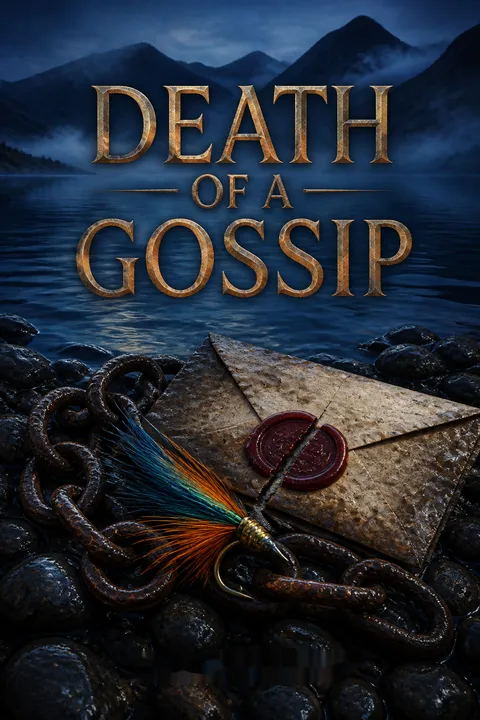
Fishing gear becomes evidenceLady Jane’s body is found with a fishing leader around her neck and chains around her legs. The leader connects the killing to the school’s central activity, while the chains show that someone deliberately tried to keep the body submerged. Both details initially widen suspicion because the guests all handle fishing equipment and know the local waters. Hamish reads them as evidence of a staged drowning, not an accident. Their ordinary presence at the fishing course makes the murder method feel close to the group rather than imported from outside.
Hamish’s family network
Local curiosity travels farHamish’s relatives and acquaintances are spread across Britain and abroad, allowing him to ask questions that the small village cannot answer. He uses a Fleet Street cousin for newspaper background and contacts in New York to investigate the fragment and Amy’s past. These informal connections contrast with Blair’s official channels, which are slower and shaped by hierarchy. Hamish’s network does not hand him a complete solution; it supplies fragments that he must interpret alongside behavior, timing, and local observation. The device shows why his apparent provinciality is an investigative advantage.
Hamish Macbeth Series





About the Author
Download PDF
Download EPUB
.epub digital book format is ideal for reading ebooks on phones, tablets, and e-readers.








