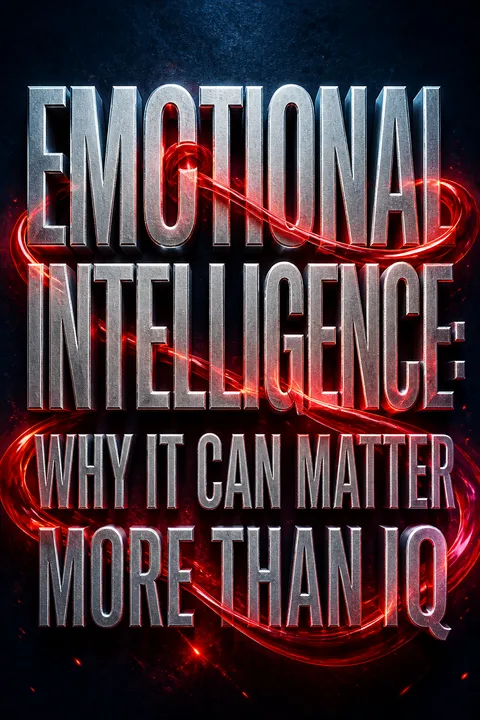


Key Takeaways
IQ can open doors, but emotional skill helps you stay on course
Ability needs a pilot. Daniel Goleman argues that academic intelligence alone poorly predicts how people manage work, relationships, and setbacks. One high-scoring student attacked a teacher after receiving a B, while studies of Harvard graduates and high-school valedictorians found that top academic performance did not guarantee greater career success or happiness. Emotional intelligence, or EI, is the capacity to notice and manage feelings, motivate oneself, understand others, and handle relationships effectively.
Do not reverse the statistic. The book cites estimates that IQ accounts for at most about 20 percent of life success. That does not mean EI explains the other 80 percent. Goleman explicitly rejects that popular misreading: opportunity, social class, luck, and many other factors matter. The point is narrower and more useful: emotional abilities can help people make better use of their intellectual abilities.
What's valuable here is the shift from ranking intelligence to asking what enables it to work. Attention, persistence, and collaboration are not decorative extras; they shape whether knowledge can be applied under pressure. At the same time, EI should not become a new all-purpose score that blames individuals for structural barriers or treats charm as competence. The book's own correction of the 80 percent myth is essential. Emotional skill matters, but its contribution varies by task, context, and the opportunities a person actually has.
Treat feelings as information, not as enemies of reason
Emotion prepares action. Goleman presents feelings as evolved signals that ready the body for recurring challenges: fear draws attention toward danger, anger energizes defense, and sadness can create space to adjust to loss. On a train sinking after a collision, parents Gary and Mary Jane Chauncey focused on rescuing their daughter before saving themselves. Their action may look irrational from a narrow survival calculation, yet emotion gave their choice its human meaning.
Head and heart cooperate. The book describes emotional and rational processes as interconnected systems. Feelings can supply priorities and lessons from experience, while reflection can question whether an impulse fits the situation. Fear on a snowy Colorado road helped Goleman stop before a crash ahead, but a startled father's fear led him to shoot his daughter by mistake. Emotion is indispensable guidance, not infallible judgment.
This is a useful correction to the fantasy that good decisions require emotional neutrality. In practice, priorities depend on what matters, and feelings help assign that importance. The strongest version of the argument is not that emotion is wiser than reason, but that reasoning without any valuation can become aimless. The difficult question is calibration: fear can protect, but it can also overgeneralize. A sound decision process listens to emotional signals, then checks them against context, evidence, and consequences.
Name the feeling before it names your next move
Notice the inner weather. Self-awareness means recognizing feelings as they arise, rather than discovering them only after they have driven an action. Goleman describes a samurai who learns that his fury is taking control when a Zen teacher points out his anger; simply seeing the feeling changes his response. The specialized term alexithymia describes difficulty identifying and putting words to emotions. A surgeon in the book could discuss events clearly but could not tell what he felt, leaving him unable to make ordinary choices.
Feelings carry data. Neurologist Antonio Damasio's term somatic marker refers to a bodily feeling that flags a choice as promising or risky, drawing on past experience. Such signals can narrow an overwhelming range of options. They are clues, not verdicts: naming anxiety or aversion makes it possible to ask what experience produced it and whether the present situation truly matches.
A label can create psychological distance without dismissing the experience. That small distinction supports metacognition: the ability to observe a thought or feeling rather than automatically obey it. The bodily signal also offers a useful bridge between abstract reasoning and lived experience. Still, intuition can encode bias as easily as wisdom. A gut reaction deserves attention, particularly when it is strong, but it should be treated as a hypothesis to examine rather than proof about another person or a future outcome.
Cool the body before arguing with the story
Alarms can misfire. Goleman calls an emotional hijacking a sudden takeover in which an intense feeling drives action before reflective thought has caught up. The amygdala, a brain structure involved in emotional processing, can react rapidly to a rough or partial signal. That speed helped ancestors respond to danger, but it can mistake a present-day slight for an old threat. Once anger escalates, each hostile thought can intensify the next.
Interrupt the escalation. The book challenges the idea that venting anger reliably clears it. Replaying the grievance or lashing out can fuel the reaction. Better options include stepping away from the trigger, using exercise or relaxation to lower arousal, and reconsidering the assumptions behind the anger. For repetitive worry, notice the loop early, relax the body, and test whether the feared outcome is likely or actionable. Persistent or severe distress may require professional treatment.
The sequence matters: regulation is harder when the body is already mobilized for confrontation. A pause is not avoidance if it makes a more accurate conversation possible. This also explains why arguments conducted at peak arousal often become debates about character instead of problems that can be solved. The advice is strongest when paired with accountability. Cooling down should make it easier to address a real injury, not become a technique for silencing justified anger or postponing a necessary boundary.
Practice delaying impulse to protect long-range goals
Small waits reveal skills. In psychologist Walter Mischel's marshmallow test, four-year-olds could eat one treat immediately or wait for a larger reward. Some distracted themselves or turned away from temptation; others ate at once. In follow-ups described by Goleman, children who waited tended to show stronger social and academic skills as adolescents. The book reports a 210-point gap in average SAT scores between the groups with the longest and shortest waits.
A prediction is not destiny. The test is evidence about self-regulation, not a verdict on a child's future or proof that waiting alone causes success. The anniversary edition also cites a large New Zealand study in which childhood self-control predicted adult health, finances, and civic outcomes, and children who improved their control by age eight did as well as those who had started stronger. Delaying gratification can be practiced, not merely demanded.
The memorable lesson is that self-control often depends on managing attention, not on staring down temptation with heroic willpower. That insight connects the experiment to study habits, spending, and conflict: changing what captures attention can make a chosen goal easier to follow. The results also require care. Family stability, resources, and trust in the promised reward can affect whether waiting seems sensible. Treating the test as a measure of character would erase those conditions and turn a developmental finding into a simplistic moral ranking.
Choose challenges just beyond your current skill to reach flow
Focus can feel rewarding. Flow is a state of deep absorption in an activity, where attention is concentrated, self-conscious worry recedes, and the work itself feels satisfying. Psychologist Mihaly Csikszentmihalyi found that flow is most likely when a task stretches existing ability without overwhelming it: too little challenge brings boredom, too much brings anxiety. Skilled performers often reach this state through sustained practice, not through effortless talent alone.
Motivation changes performance. Goleman describes hope as believing there are workable routes toward a goal, and optimism as interpreting setbacks in ways that leave room for action. A swimmer who received falsely negative feedback improved on a second attempt, while more pessimistic teammates worsened. Neither attitude guarantees success. The practical aim is realistic confidence: identify a next step, use feedback, and keep adjusting rather than treating one failure as a permanent description of ability.
Flow connects emotional regulation with the design of work: people concentrate more readily when demands and skills are in productive balance. That has implications for classrooms and jobs, where a task that is perpetually too easy or too punishing can suppress engagement. Optimism is most useful when it generates experimentation rather than denial. Some obstacles are not solved by reframing, and acknowledging constraints can be part of effective planning. Hope is not certainty of success; it is the ability to search for a viable route.
Read the feeling beneath the words to make empathy useful
Listen beyond sentences. Empathy is the ability to recognize what another person may be feeling, often through tone, facial expression, posture, or silence. Robert Rosenthal's PONS test showed people short scenes with some communication cues removed, then asked them to identify the emotion. Across more than seven thousand participants in the United States and eighteen other countries, skill at reading nonverbal signals was associated with better adjustment and relationships, not higher IQ scores.
Care begins with attunement. Psychologist Daniel Stern uses attunement for a caregiver's response that reflects the emotional quality of an infant's experience, not just the infant's visible action. Repeated responsiveness can help a child feel understood and learn to respond to others. Empathy also supports helping behavior and moral concern, but it needs self-awareness: a person overwhelmed by their own anger may have little attention left for someone else's distress.
Empathy is not mind-reading. It is a disciplined attempt to infer another person's state while remaining open to correction. That makes it relevant to caregiving, teaching, negotiation, and public life, where stated preferences may not capture someone's full experience. Nonverbal cues are informative, but they are culturally shaped and easy to misread. The best empathic response combines observation with a respectful check: a tentative interpretation can invite clarification, while a confident assumption can become another form of not listening.
Repair conflict early, before criticism hardens into contempt
Disagreement has patterns. In John Gottman's studies of couples, repeated personal attacks, contempt, defensiveness, and withdrawal were warning signs of a relationship under strain. In one sample, his laboratory observations predicted which couples would divorce within three years with reported accuracy of 94 percent. Goleman contrasts a global insult with a specific complaint: describe the action, its effect, and the change being requested. A partner who feels heard may be more able to engage than one who feels condemned.
Teams need the same skills. An airline crash described in the book followed a captain's fixation and a crew's fear of speaking up. At work, useful criticism identifies a problem and offers a path forward, rather than humiliating the recipient. Groups also need trust and cooperation to use members' expertise. Emotional skill is not niceness at any cost; it supports candid information, repair, and coordinated action.
The connection between intimate relationships and organizations is structural: in both, people must exchange unwelcome information without destroying the channel that carries it. Specific feedback helps separate a correctable behavior from a person's identity. The prediction statistic is striking, but it comes from a particular research setting and should not be mistaken for a universal diagnostic test. Nor should communication advice imply equal responsibility where coercion or abuse is present. In safer relationships, though, repair attempts can keep a manageable dispute from becoming a verdict on the whole bond.
Treat emotional support as part of health care, not a cure
Distress reaches the body. Goleman reviews evidence that stress hormones and nervous-system activity interact with immune and cardiovascular processes. A meta-analysis combining 101 studies associated chronic distress, including anxiety, hostility, and prolonged sadness, with roughly twice the risk of several illnesses. The book also reports that socially isolated people faced elevated health risks, while emotional support was linked to better outcomes in studies of heart patients and people with serious illness.
Care is not magical thinking. These findings do not show that positive thoughts cure disease or that patients cause their illness by feeling badly. They support practical care: help patients understand treatment, address depression or anxiety when present, and offer meaningful social support. Goleman's account of cancer support groups is powerful, but survival findings from a particular study should not be generalized as a substitute for medical treatment.
The section's strongest contribution is ethical as much as biological: a patient is a person experiencing illness, not merely a malfunctioning body. Emotional support can improve communication, adherence, and the experience of care even when its effect on disease progression is uncertain. That distinction protects the insight from two errors, dismissing distress as irrelevant and promising that attitude controls medical outcomes. Good care makes room for emotion without burdening patients with responsibility for outcomes they cannot command.
Repeated childhood interactions shape emotion, but do not seal fate
Home is an emotional classroom. Children learn from how adults respond to fear, anger, sadness, and mistakes. Goleman contrasts parents who dismiss or punish a child's distress with emotional coaches who name the feeling, take it seriously, and help the child choose a response. The book also describes behaviorally inhibited children who are unusually wary of novelty. Some became less timid when loving caregivers helped them face manageable challenges rather than shielding them from every discomfort.
Trauma needs safety. After a school shooting in Stockton, children replayed the event in games and showed persistent fear. The book describes recovery from trauma as requiring a sense of safety, a tolerable way to revisit what happened, and support for rebuilding ordinary life. Childhood experiences can influence emotional habits, but the brain remains capable of learning. Later relationships and therapy can help revise responses, even when old sensitivities do not disappear entirely.
Developmental plasticity is a hopeful idea because it rejects both fatalism and the expectation that change should be instant. Repeated practice matters, but its effects depend on whether children have safety, resources, and responsive adults. Exposure to manageable difficulty can build confidence; overwhelming exposure without support can deepen distress. The distinction is crucial. Emotional coaching is not simply instructing a child to calm down. It means first recognizing what the child is experiencing, then helping them find a response that fits their age and circumstances.
Teach emotional literacy as prevention, not remedial discipline
Practice skills before crises. Social and emotional learning, or SEL, teaches children to recognize feelings, manage impulses, understand others, communicate, and resolve conflicts. In one classroom, a teacher helped two boys turn an argument over a group exercise into a calmer exchange by clarifying what each meant and making the hurt behind a label visible. Programs also teach concrete routines for stopping, naming a problem, considering options, and choosing a response.
The evidence extends beyond behavior. The anniversary edition cites a meta-analysis involving more than 750,000 students: school-based SEL was associated with fewer behavioral problems, better attendance, and an 11 percent advantage in academic achievement scores. Such programs can also address skills implicated in aggression, loneliness, and depression. They work best when practiced across school, home, and community, not delivered as a one-off lecture. They complement academic teaching and cannot replace mental-health care or action on poverty and violence.
SEL treats emotional competence as teachable infrastructure for learning and civic life, rather than as a private virtue children either possess or lack. The classroom example shows why practice matters: a skill becomes available when a real disagreement supplies a reason to use it. Program quality and context remain decisive. A short course cannot undo unsafe homes, discrimination, or chronic deprivation. The strongest case for SEL is therefore not that it fixes every cause of distress, but that it gives more students usable tools while wider institutions address the conditions surrounding them.
Analysis
Emotional Intelligence is an expansive synthesis rather than a narrow theory. It moves from brain circuitry to everyday self-management, then carries its argument through couples, workplaces, medicine, parenting, trauma, and schools. Its central achievement is to make feeling relevant to thought without treating emotion as either a defect to suppress or an oracle to obey. The memorable examples work because they show emotional skills at high stakes: a pilot whose crew cannot challenge him, a marriage trapped in criticism and withdrawal, a child who learns whether distress will be met with care.
The book's strongest enduring claim is practical: emotional capacities affect attention, choice, learning, and cooperation, and can be improved through experience. Its broadest claims need more restraint. IQ's limited predictive power does not prove EI explains what IQ cannot, and some historical neural descriptions simplify complex systems into a neat contest between emotional and rational brains. Many early examples also rely on observational associations, small samples, or claims that should not be treated as universal causal estimates. The anniversary introduction usefully corrects the exaggerated belief that EI accounts for 80 percent of success and acknowledges multiple models of the construct.
A modern reading should distinguish emotional ability from personality, social polish, and organizational competency. Measuring a person's capacity to identify emotion is not the same as judging whether their behavior is ethical or effective. Emotional sensitivity can serve care, but it can also be used to manipulate; resilience can mean recovery, but it should not become an excuse to tolerate harmful conditions. The book is most persuasive when it treats EI as a set of learnable capacities nested within relationships and institutions, not as a master key to every outcome. Its educational vision follows from that view: teach emotional skills alongside academic content, while recognizing that caring instruction complements rather than replaces structural support and clinical care.
Review Summary
Emotional Intelligence explores the importance of EQ over IQ for success in life. Goleman argues that understanding and managing emotions is crucial for personal and professional relationships. While some found the book insightful and practical, others criticized its dated views and lack of actionable advice. Many readers appreciated Goleman's scientific approach and real-life examples. The book's impact on education, business, and personal development is widely acknowledged, though some felt it was repetitive and overly dense in parts.
People Also Read







Glossary
Emotional intelligence
Skill with emotionA set of abilities for recognizing one's own feelings, regulating emotional responses, using motivation toward goals, understanding other people's emotions, and managing relationships. Goleman's book popularized the term and connects these abilities to decision-making, learning, work, health, and education. The book discusses several models; it does not claim that one score explains overall success.
Emotional hijacking
Emotion-driven takeoverA sudden, intense emotional reaction that drives attention and action before reflective thought has fully assessed the situation. Goleman uses the term for episodes such as explosive anger or fear. The response can be protective when danger is real, but it can also rely on an inaccurate resemblance to past events and lead to actions later regretted.
Alexithymia
Difficulty naming feelingsA specialized psychological term for difficulty identifying and describing one's emotions. A person may notice bodily sensations or general distress without being able to distinguish anxiety from anger or sadness. Goleman presents alexithymia as a deficit in emotional self-awareness that can also make it harder to recognize what others are feeling.
Somatic marker
Bodily decision signalAntonio Damasio's term for a bodily feeling associated with a possible choice, shaped by emotional learning from past experience. A somatic marker can draw attention toward an opportunity or away from a perceived risk, helping narrow an unwieldy set of options. It is a signal that can inform deliberation, not a guarantee that a choice is correct.
Flow
Absorbed optimal engagementMihaly Csikszentmihalyi's term for deep absorption in an activity, with focused attention, reduced self-consciousness, and satisfaction in the activity itself. Goleman describes flow as most likely when a task challenges a person's skills without overwhelming them. Boredom can result when demands are too low, while anxiety can result when demands exceed ability.
Attunement
Matching another's feelingDaniel Stern's term for a caregiver's response that conveys an understanding of a child's emotional state. Attunement does more than copy a child's behavior: it responds to the feeling behind it. Goleman uses the concept to explain how repeated moments of emotional responsiveness can help children feel understood and develop expectations about relationships.
PONS (Profile of Nonverbal Sensitivity)
Test of cue-readingA test developed by Robert Rosenthal that measures how accurately people identify emotions from nonverbal communication. Participants view short scenes in which channels such as speech, facial expression, or body movement are restricted. Goleman describes studies linking stronger performance with better emotional adjustment and social relationships, independently of academic test scores.
Marshmallow test
Test of delayed rewardWalter Mischel's experiment in which young children could take a small reward immediately or wait for a larger one. Researchers observed how children managed temptation and later assessed aspects of their development. Goleman uses the study to illustrate impulse control and long-term goal pursuit, while the result is best understood as a developmental association rather than a fixed verdict on a child's future.
Social and emotional learning
School-based emotional skillsAn educational approach that deliberately teaches students emotional awareness, self-management, empathy, relationship skills, and responsible decision-making. Goleman argues that these capacities belong alongside academic subjects and should be practiced in real interactions, not confined to lectures. Evaluations cited in the anniversary edition associate SEL programs with behavioral improvements and stronger academic outcomes.
FAQ
What's Emotional Intelligence: Why It Can Matter More Than IQ about?
- Focus on Emotional Intelligence: The book explores emotional intelligence (EI) and its significance in personal and professional success, arguing it can be more crucial than traditional IQ.
- Scientific Basis: Daniel Goleman uses research from psychology and neuroscience to explain how emotions influence thoughts and behaviors, affecting decision-making and interpersonal skills.
- Practical Applications: It provides insights into developing and applying emotional intelligence in various contexts, such as education, workplace dynamics, and mental health.
Why should I read Emotional Intelligence: Why It Can Matter More Than IQ?
- Understanding Human Behavior: The book offers a deeper understanding of how emotions shape interactions and decisions, emphasizing the importance of emotional skills in personal and professional contexts.
- Improving Relationships: By learning about EI, readers can enhance empathy, communication, and conflict resolution skills, leading to healthier relationships.
- Personal Growth: It provides tools and strategies for developing emotional intelligence, leading to greater self-awareness, emotional regulation, and overall well-being.
What are the key takeaways of Emotional Intelligence: Why It Can Matter More Than IQ?
- Four Domains of EI: Goleman identifies self-awareness, self-management, social awareness, and relationship management as key domains of emotional intelligence.
- Importance of Empathy: Empathy is crucial for understanding and responding to others' emotions, essential for building strong relationships and fostering cooperation.
- Emotional Hijacking: The book discusses how intense emotions can overwhelm rational thought, emphasizing the need for managing reactions to make thoughtful decisions.
What is emotional intelligence (EI) as defined by Daniel Goleman?
- Definition of EI: Emotional intelligence is the ability to recognize, understand, and manage our own emotions while also recognizing, understanding, and influencing others' emotions.
- Components of EI: Goleman outlines five components: self-awareness, self-regulation, motivation, empathy, and social skills, each contributing to effective emotional functioning.
- Learnable Skills: Emotional intelligence is not fixed; it can be developed through practice and education, encouraging readers to enhance their emotional skills actively.
How does Daniel Goleman explain the relationship between IQ and EI?
- IQ vs. EI: Goleman argues that while IQ is important for academic success, EI plays a more significant role in navigating social complexities and achieving personal goals.
- Success Factors: Emotional intelligence can account for up to 80% of success in various life domains, highlighting the need to prioritize emotional skills alongside cognitive abilities.
- Complementary Skills: IQ and EI are not mutually exclusive; they complement each other, with strong emotional intelligence compensating for lower IQ and vice versa.
What are the practical applications of emotional intelligence discussed by Daniel Goleman?
- In the Workplace: Emotional intelligence enhances leadership, teamwork, and employee satisfaction, with organizations seeing improved productivity and reduced turnover.
- In Education: Integrating emotional intelligence training into school curricula can lead to better academic performance and healthier social interactions.
- In Personal Life: Applying emotional intelligence skills in daily life can improve relationships and personal well-being, with techniques for self-regulation and empathy leading to more fulfilling interactions.
How can one develop emotional intelligence according to Daniel Goleman?
- Self-Awareness Practices: Engage in mindfulness and reflective practices to enhance self-awareness, such as journaling or seeking feedback from others.
- Emotional Regulation Techniques: Use strategies like deep breathing, cognitive reframing, and taking breaks during stressful situations to manage emotions effectively.
- Empathy Development: Actively listen to others and try to understand their perspectives, with activities like volunteer work enhancing empathy.
What role does emotional intelligence play in leadership according to Daniel Goleman?
- Effective Leadership: Emotional intelligence is critical for inspiring and motivating teams, fostering a positive work environment.
- Decision-Making: Emotionally intelligent leaders balance rational analysis with emotional awareness, considering the emotional impact on their team.
- Conflict Management: Leaders with strong EI can mediate disputes and maintain team cohesion, essential for organizational success.
What are the psychological impacts of emotional illiteracy as discussed in Emotional Intelligence?
- Mental Health Issues: Emotional illiteracy can lead to higher rates of anxiety, depression, and other mental health disorders.
- Social Isolation: Individuals lacking emotional skills may struggle to form meaningful connections, leading to loneliness and isolation.
- Poor Decision-Making: Without the ability to manage emotions, individuals may act impulsively or irrationally, impairing judgment and decision-making abilities.
How does Daniel Goleman connect emotional intelligence to health?
- Stress and Health: Emotional health is linked to physical health, with chronic stress leading to various health issues.
- Psychosomatic Illnesses: Unresolved emotional issues can manifest as physical ailments, with emotional management improving overall health.
- Preventive Measures: Developing emotional intelligence can lead to healthier coping mechanisms for stress and anxiety, resulting in better health outcomes.
What are the social implications of emotional intelligence as discussed by Daniel Goleman?
- Reducing Violence: Teaching emotional intelligence in schools can reduce violence and bullying by fostering empathy and conflict resolution skills.
- Community Building: Emotional intelligence enhances community relationships, leading to stronger social bonds through better communication and understanding.
- Cultural Sensitivity: It promotes understanding and cooperation in diverse societies, helping navigate cultural differences effectively.
What are the best quotes from Emotional Intelligence: Why It Can Matter More Than IQ and what do they mean?
- “It is with the heart that one sees rightly; what is essential is invisible to the eye.”: Emphasizes emotional insight over rationality, crucial for understanding human experiences.
- “Anyone can become angry—that is easy. But to be angry with the right person, to the right degree, at the right time, for the right purpose, and in the right way—that is not easy.”: Highlights the complexity of managing emotions effectively, underscoring the need for emotional intelligence.
- “The emotional brain is the source of our feelings, and it is the source of our actions.”: Reflects the central theme that emotions significantly influence behavior, reminding of the power emotions hold over decision-making processes.
About the Author
Other books by Daniel Goleman



Download PDF
Download EPUB
.epub digital book format is ideal for reading ebooks on phones, tablets, and e-readers.








