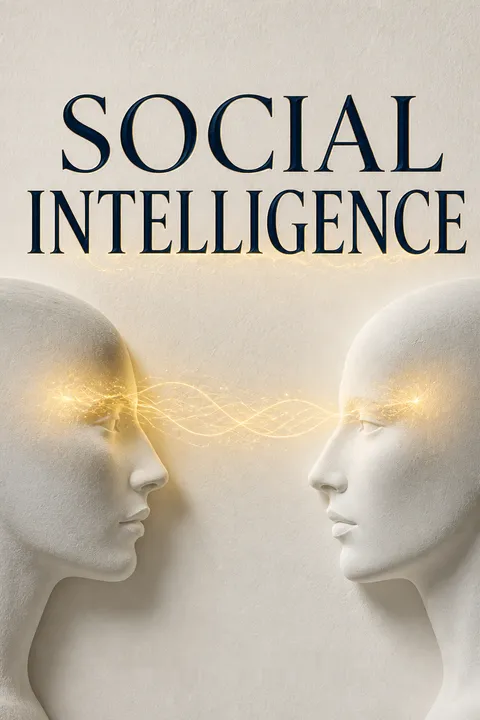


Key Takeaways
Treat every encounter as a two-way biological exchange, not background noise.
Moods travel between people. The book's central claim is that humans are built for connection: in an interaction, one person's expressions, voice, and behavior can shift another person's feelings and bodily state. A furious security guard left Goleman tense long after their encounter. In a very different setting, a soldier facing an agitated crowd lowered weapons, knelt, and smiled; the crowd's mood softened enough for the soldiers to leave safely.
Connection cuts both ways. Goleman calls the sum of these small transfers an emotional economy: interactions leave people with a net emotional gain or loss. Repeated exchanges with close companions can influence stress responses and, through those responses, bodily systems. The social brain is not one isolated brain region. It is a network that helps coordinate how people perceive, feel, and respond to one another.
The useful shift is from treating relationships as scenery to treating them as part of the conditions under which people think and feel. This resembles feedback in a coupled system: each person responds to the other's state, and the exchange can settle or escalate. That framing makes everyday conduct consequential without making every encounter a medical event. The neural language should be read as a developing account of mechanisms, not proof that a single interaction directly changes a person's genes or health.
Build rapport with attention, warmth, and natural timing, not imitation.
Rapport is jointly made. Psychologist Robert Rosenthal's model identifies three ingredients: mutual attention, shared positive feeling, and coordinated nonverbal behavior. In a study of therapy sessions, the therapist and client showed more synchronized physiological patterns when the client felt understood. A beloved waitress displayed the same principle by adapting her pace and manner to different customers, rather than serving everyone with one fixed persona.
Follow the other person. Synchrony includes timing, turn-taking, posture, gaze, and the rhythm of speech. It tends to arise spontaneously when people are engaged. Experiments found that people often mirror another person's movements without noticing, but deliberate, mechanical imitation can feel false and may reduce liking. The practical move is to give someone full attention, respond to what they actually communicate, and let coordination emerge rather than perform it.
Rapport is not a trick for getting compliance. Its three ingredients explain why polished body-language mimicry can feel less connecting than genuine attention: the other person may register the mismatch between a copied gesture and an unresponsive conversation. The model also helps explain why warmth can make difficult feedback easier to hear. Still, smooth synchrony is not the same as agreement or trustworthiness. A conversation can be coordinated and pleasant while avoiding a necessary disagreement.
Make room to notice suffering; attention is the first step toward help.
Urgency can make people invisible. At Princeton Theological Seminary, 24 of 40 students passed a man groaning in apparent pain. Students who believed they were late were less likely to stop than those who thought they had time. Even the students preparing a sermon about the Good Samaritan were not more helpful. Their attention was captured by the next obligation, not the person beside them.
Noticing can spread. In another scene, commuters stepped over a motionless man on subway stairs until Goleman stopped. Other passengers then joined in, bringing food and water and calling for help. The book's point is not that every need can be met, but that empathy has little chance when attention is elsewhere. Crowded streets and social assumptions can narrow awareness; deliberately pausing can interrupt that pattern and make a need visible to others.
This insight connects compassion to the design of attention. A person can endorse generosity and still fail to act when haste, distraction, or ambiguity crowds out perception. The subway example also shows how behavior can change a group's interpretation of a situation: one person stopping signals that help is appropriate. That does not mean the first responder bears sole responsibility for structural problems, such as inadequate care for unhoused people. Individual attention matters, but it cannot substitute for organized support.
Measure social intelligence by care and skill, not charm alone.
Knowing is not enough. Goleman defines social intelligence as being intelligent about relationships and within them. His model has two parts. Social awareness includes primal empathy, attunement, empathic accuracy, and social cognition. Social facility includes synchrony, self-presentation, influence, and concern. The distinction matters because a person can read others well and still use that knowledge to manipulate them.
Skill needs a moral direction. A middle-school boy met a sarcastic taunt by acknowledging his weak soccer skills, naming his strength in art, and complimenting his antagonist's athletic ability. The potential fight turned into an offer to help him play. By contrast, the Dark Triad describes narcissistic, Machiavellian, and psychopathic traits that can include social cunning alongside limited empathy or concern. For Goleman, wise relating requires not just influence but regard for the other person's needs.
The model makes an important distinction between interpersonal effectiveness and interpersonal goodness. A skilled negotiator, salesperson, or leader may be perceptive without being humane; measuring only the ability to predict reactions risks rewarding manipulation. Concern supplies an ethical test: does social skill account for the other person's interests, or merely exploit them? At the same time, concern alone is not enough. Good intentions need accurate understanding and practical competence to produce useful help.
Choose relationships that steady your body, not merely fill your calendar.
Relationship quality matters. Goleman argues that emotional support can buffer stress, while chronic conflict can intensify it. In one study, people with an ongoing personal conflict were 2.5 times as likely to develop a cold after controlled exposure to a virus. People with the fewest close relationships were 4.2 times as likely as those with richer social connections to get sick. The contrast suggests that connection is not simply the number of people nearby; the emotional character of those ties matters.
Stress has bodily pathways. Prolonged distress can keep stress-response systems active, affecting immune and cardiovascular functioning. The book also describes caregivers under sustained strain whose immune-related gene activity was lower than that of comparison participants. These findings do not make affection a cure or conflict a diagnosis. They do support treating reliable companionship, practical help, and relief from chronic hostility as meaningful parts of a healthy life.
The strongest implication is not that people should optimize every relationship as a health intervention. It is that social support belongs among the conditions that shape a person's capacity to cope, much like sleep and workload. A calendar full of contacts may still leave someone lonely if those encounters lack trust or intimacy. The evidence also needs careful interpretation: illness, stress, behavior, and relationships influence one another, so associations do not establish a simple one-way cause.
Early care shapes emotional habits, but learned patterns can be revised.
Genes respond to experience. In a study of genetically similar mice tested in different laboratories, behavior varied across settings, including how anxious the animals appeared. The finding challenged the idea that genes alone determine behavior. Epigenetics describes how experiences and surroundings can alter gene activity without changing the DNA sequence. Research on rat pups also found that more maternal licking and grooming was associated with stronger stress regulation and different behavior in adulthood.
Temperament is not a life sentence. Early caregiving helps shape how children manage distress and seek connection. Jerome Kagan found that among children identified as inhibited in infancy, about 70 percent no longer showed timid behavior in early adulthood, even though their underlying sensitivity to novelty remained. Supportive experiences and practice helped them respond differently. The book's message is not that parenting controls every outcome, but that relationships can influence development and offer a basis for change.
This account replaces a false choice between nature and nurture with an interaction: a biological tendency can shape experience, and experience can in turn affect how that tendency is expressed. That is a more useful model than either genetic fatalism or the claim that every difficulty reflects parenting. The evidence also varies in strength. Animal studies can reveal plausible mechanisms, but they cannot establish that the same developmental details apply unchanged to humans.
Treat love as attachment, desire, and caregiving, not one fused feeling.
Love has distinct ingredients. The book describes three interacting systems: attachment, which draws people toward sources of comfort; caregiving, which motivates protection and support; and sexuality, which fuels desire. A strong romantic bond can involve all three, but they do not always rise together. A partner may feel desire without dependable care, or deep attachment without much sexual interest.
Old strategies can collide. Goleman describes three common attachment styles: secure, anxious, and avoidant. In the American samples he cites, roughly 55 percent were classified as secure, 20 percent anxious, and 25 percent avoidant. An anxious partner may seek discussion and reassurance, while an avoidant partner may withdraw from intense emotion. Neither pattern is a complete account of a person, but recognizing the mismatch can help couples stop treating different ways of handling distress as proof that one partner does not care.
Separating attachment, caregiving, and desire helps explain why the word love can conceal very different needs. It also discourages the expectation that one partner should meet every emotional, sexual, and practical need in exactly the same way. Attachment styles are best used as flexible descriptions, not permanent labels: behavior can vary by relationship and circumstance. The numbers offer a snapshot of the cited samples, not a universal census of how people love.
Put people in their performance sweet spot: challenged, focused, and safe.
Pressure has a tipping point. Goleman presents performance as an inverted U. Too little challenge breeds boredom; a manageable level sharpens attention and motivation; excessive anxiety disrupts working memory, learning, and flexible thought. The brain's stress response can shift control away from deliberate planning toward automatic reactions. A tense classroom, for example, can make students fear public embarrassment more than they attend to the lesson.
Connection supports learning. Maeva, a sixth-grader who could barely read, had been labeled disruptive. Her teacher Pamela recognized that frustration was driving the behavior, provided help, and built a caring relationship. Maeva stayed in class, passed her courses, and made rapid progress in reading. The point for teachers and managers is not to remove all difficulty. It is to create enough security and support that challenge feels workable rather than threatening.
The inverted U is a practical reminder that motivation is not improved by turning pressure up indefinitely. People need enough challenge to engage, but not so much that attention is consumed by fear. A supportive relationship can make demanding work feel safer without making it easier in the trivial sense. The curve is a broad model, not a precise universal setting: people differ, and the best emotional state also depends on the task.
Correct harm by rebuilding connection, not by rehearsing exclusion.
Punishment can teach the wrong lesson. Goleman contrasts harsh, isolating youth prisons with Missouri's smaller residential programs, where teens lived in supervised groups, practiced communication, and formed relationships with caring adults. The book reports a three-year recidivism rate of 8 percent for that program, compared with 30 percent in Maryland; these state comparisons may not use identical measures. The broader argument is that detention can either reinforce distrust and aggression or teach self-control and social responsibility.
Repair makes consequences human. Restorative justice asks offenders to face the effects of their actions and, where possible, make amends. In one example, young men who had burned a historic bridge heard community members describe the damage and expressed remorse. For young people leaving custody, multisystemic therapy works in everyday settings, helping them build support and avoid risky influences. The goal is correction in the fullest sense: learning how to live differently.
The section reframes public safety as more than incapacitation: it asks what habits and relationships an institution is cultivating. A setting that rewards vigilance and force may make short-term control easier while deepening the very behaviors communities want to reduce. Restorative approaches also require safeguards. Victims should not be pressured into contact or forgiveness, and program results depend on careful evaluation rather than hopeful anecdotes alone.
Reduce Us-Them hostility through real bonds and shared work.
Distance lets stereotypes harden. A meta-analysis discussed in the book combined 515 studies involving 250,493 people across 38 countries. It found that meaningful friendships across group boundaries were associated with lower prejudice; casual contact alone had less impact. In a jigsaw classroom, each student holds information classmates need to solve a shared assignment. Cooperation can replace a threatening outsider with a valued teammate, as happened for Carlos, a Mexican-American student who was mocked for his accent before classmates depended on his contribution.
Bias is not fixed. Goleman describes implicit bias as an automatic association that can shape judgment without matching a person's stated beliefs. Research cited in the book suggests these associations can shift with positive examples and experience. Forgiveness, meanwhile, is not the same as excusing harm or reconciling with an offender. Across personal and group conflicts, the larger task is to expand who counts as worthy of attention, fairness, and concern.
The most persuasive bridge from intergroup theory to practice is shared dependence: cooperation changes what people need from one another, while sustained friendship gives that cooperation emotional depth. Contact is not automatically healing, especially when status and power remain unequal or interaction is coercive. A fair shared task needs conditions that let each participant contribute meaningfully. The distinction between forgiveness and reconciliation also matters: personal release may help an injured person without settling public questions of truth or repair.
Analysis
Goleman's organizing move is to treat the interaction, rather than the isolated individual, as a unit of psychological explanation. That shift links fleeting social cues to larger patterns: emotional contagion can alter a conversation, repeated interaction can shape expectations, and institutions can either cultivate connection or normalize detachment. The book's most actionable contribution is not any single brain finding. It is a relational ethic grounded in a practical observation: people influence one another's emotional state, often before either person can explain what is happening.
The argument gains reach by moving across scales. The same concern with attunement appears in a caregiver's response to an infant, a teacher's treatment of a struggling student, a manager's effect on a team, and a community's response to young offenders. This creates a coherent case for social design: classrooms, workplaces, hospitals, and correctional programs should be judged partly by the kinds of relationships they make possible.
The science needs proportionate confidence. The book was published in 2006, when social neuroscience was a young field. Brain imaging identifies activity associated with tasks, but activity alone does not prove a specific mental mechanism. Mirror-neuron findings, animal research, hormone studies, and correlations between relationship quality and health do not all provide the same degree of evidence. The book sometimes moves quickly from these distinct forms of evidence to a broad biological story. Its own appendices acknowledge that the social brain is distributed and that the high-road, low-road distinction simplifies complex systems. That caveat does not erase the central insight. The safest conclusion is not that every conversation rewires the brain or determines health, but that repeated social environments can shape behavior, stress, and opportunity. Biology gives relationships stakes; it does not make them destiny. The strongest version of the book combines empathy with institutional realism: caring interactions matter, and durable change also requires resources, fair rules, and accountable systems.
Review Summary
Social Intelligence explores the neurological basis of social behavior and relationships. Goleman discusses concepts like emotional contagion, attachment styles, and empathy. Readers praise the book's insights into human connections and their impact on health and wellbeing. Some find it academically dense, while others appreciate the scientific backing. Criticisms include its length and lack of practical advice. Overall, reviewers value the book's exploration of social dynamics and their significance in various aspects of life, from personal relationships to leadership and education.
People Also Read





Glossary
Social intelligence
Relational awareness and skillGoleman's term for being perceptive and effective within human relationships, while also acting with concern for others. His proposed model combines social awareness, such as empathy and understanding social situations, with social facility, such as synchrony, influence, self-presentation, and care. It is broader than social knowledge alone because it includes how people actually interact.
Social brain
Networks for social interactionA shorthand for the distributed neural systems that coordinate how people perceive, feel, and respond to one another. It is not a single brain organ. Different networks contribute to such activities as reading expressions, sharing emotion, regulating impulses, and choosing a response, with the exact combination depending on the interaction.
Low road
Fast, automatic processingGoleman's label for rapid, largely unconscious processes that register emotional and social signals and can prompt an immediate response. These processes help people detect expressions, mimic movements, and catch moods quickly. They are efficient but can misread ambiguous situations; deliberate reflection can revise an initial reaction.
High road
Deliberate, reflective processingGoleman's label for slower, conscious processes that support reflection, planning, and regulation of immediate emotional reactions. The high road can reinterpret a situation and select a response suited to broader goals. It works alongside automatic processes rather than replacing them, and the distinction is a simplifying model of overlapping brain systems.
Emotional economy
Net emotional effects of interactionThe accumulated gain or loss in feeling produced by interactions with a person, during a conversation, or across a day. A sharp exchange can leave a negative aftereffect, while a warm or humorous interaction can improve a person's mood. The concept emphasizes that ordinary encounters carry emotional consequences beyond their stated purpose.
Rapport
Attuned, positive connectionA quality that emerges between people when they share attention, positive feeling, and coordinated nonverbal interaction. Rapport can make conversations feel smooth and can support collaboration. It is not simply politeness, agreement, or deliberate mimicry; it depends on a responsive exchange in which both people seem engaged.
I-It
Treating someone as an objectMartin Buber's term, used by Goleman for interactions in which one person relates to another mainly as a role, tool, or obstacle, rather than attending to that person's subjective experience. I-It relations range from routine detachment to exploitation. They can be useful for professional boundaries, but become harmful when human recognition is needed.
I-You
Meeting another as a personBuber's term for a relationship of genuine attention in which another person's feelings and perspective matter in their own right. Goleman connects it with empathy, mutual responsiveness, and the experience of feeling understood. Such connection need not be constant or intimate; ordinary relationships move between personal engagement and practical, role-based interaction.
Dark Triad
Three exploitative personality patternsA framework grouping narcissism, Machiavellianism, and psychopathy. These patterns differ, but can share self-centeredness, manipulation, aggression, or limited concern for others. Goleman uses the framework to show why social cleverness is not sufficient evidence of social intelligence: a person may read and influence others while disregarding their well-being.
Mindsight
Inferring another's inner stateA term coined by Daniel Siegel for the capacity to notice and interpret mental states in oneself and others. People infer thoughts, feelings, and intentions from expressions, tone, context, and behavior. Goleman uses the idea to explain everyday empathic accuracy and why difficulty understanding other minds can make social interaction confusing.
Secure base
Reliable support for explorationIn attachment theory, a dependable person who offers comfort and protection when needed, giving someone confidence to explore, learn, or take on challenges. For children, caregivers often provide this role. Adults may also find a secure base in a partner, friend, teacher, or mentor who offers support without taking over.
Social epigenetics
Social experience influencing gene activityGoleman's label for the possibility that relationships and other social experiences influence how genes are expressed, without changing the DNA sequence. The idea draws on epigenetic research about environmental effects on gene activity and applies it to caregiving and stress. The human implications are complex and should not be read as proof that relationships determine genetic outcomes.
Inverted U
Performance peaks at moderate challengeA model in which performance rises as challenge and arousal increase from low levels, reaches an effective middle range, then falls when pressure becomes overwhelming. Goleman applies it to learning and work: boredom can weaken attention, while excessive anxiety can impair working memory and flexible thought. The curve is a broad guide, not a fixed formula.
FAQ
What's Social Intelligence: The New Science of Human Relationships about?
- Exploration of social connections: The book examines how our brains are inherently designed for social interaction and the critical role emotional connections play in our lives.
- Neuroscience insights: It integrates findings from social neuroscience to show how relationships influence our biology and emotional well-being.
- Practical applications: Goleman provides insights into how understanding social intelligence can enhance personal relationships, workplace dynamics, and societal interactions.
Why should I read Social Intelligence by Daniel Goleman?
- Enhance interpersonal skills: The book offers valuable insights into improving social awareness and emotional intelligence, essential for personal and professional success.
- Understand human behavior: It helps readers grasp the neural mechanisms driving social interactions, aiding in navigating complex social situations.
- Promote healthier relationships: Applying the book's concepts can help foster meaningful connections and reduce social disconnection.
What are the key takeaways of Social Intelligence?
- Wired to connect: Our brains are designed for social interaction, crucial for survival and well-being.
- Emotional contagion: Emotions can be contagious, affecting our mood and behavior through interactions with others.
- Importance of empathy: Developing empathy is vital for building strong relationships and fostering a supportive social environment.
How does Daniel Goleman define social intelligence in Social Intelligence?
- Definition of social intelligence: It is the ability to understand and manage relationships effectively, including social awareness and social facility.
- Components of social intelligence: Primal empathy, attunement, empathic accuracy, and social cognition enhance our ability to connect with others.
- Two-person psychology: The focus shifts from individual emotional intelligence to how interactions shape experiences and relationships.
What role does empathy play in Social Intelligence?
- Foundation of relationships: Empathy is a fundamental component of social intelligence, enabling deep connections with others.
- Enhances communication: It improves communication, allowing for meaningful interactions and reducing misunderstandings.
- Health benefits: Empathetic relationships can lead to better mental and physical health, highlighting the importance of emotional connections.
What is the emotional economy mentioned in Social Intelligence?
- Interpersonal emotional transactions: The emotional economy refers to the net gains and losses from interactions, influencing mood and well-being.
- Emotional afterglow: Positive interactions can create an emotional afterglow, while negative encounters can cause lasting distress.
- Impact on daily life: Understanding the emotional economy helps navigate social interactions more effectively, leading to healthier relationships.
How does Goleman explain emotional contagion in Social Intelligence?
- Emotions are contagious: We can "catch" emotions from others, significantly impacting our mood.
- Role of the amygdala: The amygdala detects emotional cues and triggers responses, often unconsciously.
- Social implications: Recognizing emotional contagion helps manage emotions and respond effectively to others' feelings.
What is the concept of social epigenetics in Social Intelligence?
- Influence of relationships on genes: Social epigenetics shows how interactions affect gene expression, impacting health and behavior.
- Environmental factors: Relationships can modify gene function, leading to changes in physical and mental health.
- Long-term implications: Nurturing relationships can have lasting positive effects on biology, emphasizing social connections' importance.
How does Social Intelligence relate to emotional intelligence?
- Overlap of concepts: Social intelligence is a subset of emotional intelligence, focusing on interpersonal skills and interactions.
- Importance of both: Both are crucial for success in personal and professional relationships, aiding communication and conflict resolution.
- Practical applications: Goleman provides strategies for enhancing both, encouraging empathy and improved social skills.
What methods does Goleman suggest for improving social intelligence?
- Practice empathy: Actively practice empathy by understanding others' perspectives through attentive listening and open communication.
- Enhance emotional awareness: Become aware of personal emotions and their impact on interactions to manage responses better.
- Foster connections: Build and maintain supportive relationships, engaging in community activities to enhance social intelligence.
How does Social Intelligence address the impact of social connections on health?
- Health benefits of relationships: Strong social connections lead to better physical and mental health outcomes, reducing stress.
- Negative effects of isolation: Social isolation is linked to increased health risks, emphasizing the need for nurturing social ties.
- Biological mechanisms: Social interactions influence biological processes like immune function, motivating prioritization of relationships.
What are the best quotes from Social Intelligence and what do they mean?
- "We are wired to connect." This emphasizes the innate human need for social interaction and relationships.
- "Emotions are contagious." Highlights the influence of emotional exchanges, underscoring mindfulness of emotional states.
- "All real living is meeting." Reflects Buber's philosophy, suggesting true connection arises from genuine interactions.
About the Author
Other books by Daniel Goleman






Download PDF
Download EPUB
.epub digital book format is ideal for reading ebooks on phones, tablets, and e-readers.








