

Key Takeaways
Track who controls central Europe, because its power repeatedly sets Europe's terms.
The central hinge. In 1450, the Holy Roman Empire was not a unified nation, but its location and resources made it the place where European rivalries converged. France sought influence there to weaken Habsburg encirclement. England depended on friendly states in the Low Countries and the Empire as a defensive barrier. Sweden, the Ottomans, and later Russia also treated German lands as crucial to their security. What happened in this contested center could change the balance across the continent.
The map keeps returning. German unification in 1871 concentrated this power in one state. After 1945, Germany was divided, and Berlin became a front line in the Cold War. NATO and European integration were built partly to contain German power and partly to enlist it. Reunification restored Germany's central weight, making its choices pivotal again during the euro crisis.
What's striking is that centrality here is political, not destiny. German lands matter because neighboring powers connect their security to them, and because institutions determine whether that position becomes a bridge or a battleground. This is a useful corrective to histories that treat national borders as fixed containers. The same territory can serve as buffer, prize, or partner under different arrangements. Yet the focus on Germany can also compress the agency of smaller states, whose choices sometimes redirect the larger powers rather than merely reflect them.
Treat public consent as strategic capacity, not a peacetime luxury.
Consent can mobilize. The Dutch provinces built a durable union while fighting Spain because they accepted shared taxes and coordinated defense. In England, parliamentary cooperation helped fund wars and later supported a credit system that let a relatively small country sustain major campaigns. Participation did more than restrain rulers: it gave taxpayers a stake in national policy and made the state more credible to lenders.
Representation is no guarantee. Poland's liberum veto let a single noble block the Sejm, preventing collective decisions on taxation and defense. Prussia took the opposite route: the Great Elector curtailed the estates' authority and built a larger army. Both cases show the pressure of security, but not a universal winning formula. England's parliamentary strength and Russia's autocratic mobilization could each produce military power, through sharply different political bargains.
The book treats institutions as machinery for converting resources into action. That is more precise than asking whether democracy or autocracy is inherently stronger. Participation can improve legitimacy and credit, but veto points can also freeze decisions; concentrated authority can move quickly, but may misread public costs until resistance erupts. The decisive question is how a state coordinates burdens with consent. This model also cautions against calling a political system efficient solely because it can raise an army. Efficiency without correction mechanisms can conceal errors rather than solve them.
Keep Germany capable of defense, but prevent any one power from mastering it.
Westphalia sought a balance. The 1648 settlement ended the Thirty Years War by protecting the rights of the Empire's territories and recognizing several religious confessions. Foreign powers guaranteed parts of the arrangement, limiting the chance that one ruler could turn Germany into a base for European domination. The Empire was meant to preserve internal peace and resist outside predators, but not become powerful enough to dominate its neighbors.
The dilemma survived. The German Confederation created in 1815 was likewise intended to deter France and Russia without allowing a single German state to control the whole. Its weakness became obvious during the crises of the 1830s and 1840s. After Prussia unified most of Germany in 1871, France and other powers feared the new concentration of strength. Europe repeatedly faced the same problem: fragmentation invited intervention, while unity created anxiety.
This is a classic security dilemma: measures taken by one actor for protection can look like preparation for domination to others. The book's account makes institutional design central, not ornamental. A federation can constrain a powerful member while still allowing coordinated defense, but only if its rules are credible and its members accept them. The difficult question is who guarantees the guarantors. Outside powers may stabilize a settlement, yet their own interests can turn guarantees into leverage or intervention.
Read overseas empire as a European power instrument, not a separate story.
The first voyages faced east. Columbus sought a route to Asia partly to outflank Muslim powers and recover the Holy Land. The discovery of the Americas redirected that project into colonization and rivalry among European states. Under Charles V, New World bullion helped finance wars in Europe, while English attacks on Spanish shipping aimed to disrupt the resources supporting Habsburg armies.
Global contests reinforced European ones. During the Seven Years War, Britain concentrated forces in Germany partly to tie down French troops while expanding its position in North America. Later, British and French competition in Africa and the Middle East was also shaped by concerns about power in Europe. Overseas possessions supplied money, markets, manpower, and prestige, but could also stretch states beyond their means. Their value depended on what they enabled or denied in the European balance.
The book refuses a clean division between European history and imperial history. Resources move across oceans, but their strategic meaning is made in relation to competing states. That approach also complicates moral stories of exploration: religious goals, commercial motives, and security calculations could coexist in the same voyage. The limit is that a European strategic lens can make colonized peoples appear mainly as resources or obstacles. A fuller global account would also ask how those populations shaped, resisted, and redirected imperial plans.
A foreign-policy defeat can make a regime's domestic authority collapse.
Strategic failure entered public debate. After England lost its French holdings in the fifteenth century, citizens and parliament demanded to know who was responsible. In the seventeenth century, English critics of Charles I linked the monarchy's failure to defend Protestant allies in Germany to threats against English liberties. The resulting conflict at home was not detached from foreign affairs: critics saw the king's policy as a danger to the country's security and religious order.
The pattern recurs. In France, the monarchy's inability to repair its finances and its loss of diplomatic standing helped make the crisis of 1789 more explosive. In Russia, military failure in the First World War discredited the tsar and contributed to revolution in 1917. Foreign policy alone did not cause these upheavals, but it exposed failures of leadership and sharpened disputes over who should decide national policy.
What's powerful is the feedback loop: governments pursue security to preserve authority, but perceived failure can make authority look undeserved. This helps explain why war and diplomacy become domestic arguments, not merely specialist concerns. The account is strongest when it shows a specific link, such as parliamentary criticism of the Stuarts or the Russian army's failures. The causal claim needs restraint, though. Economic hardship, social conflict, and political organization also matter. Foreign-policy failure can accelerate a crisis without being its single origin.
Unification fixes fragmentation, then forces neighbors to renegotiate the balance.
One state changes the equation. After the American Civil War, the Union could expand westward without the former North-South divide blocking national policy. In Europe, Bismarck's victories created a united German Empire with about 41 million people, larger than France and rapidly industrializing. Prussian-led unification ended the political fragmentation that had repeatedly exposed German lands to outside intervention, but it also created a continental power that its neighbors had to reckon with.
Strength invites counterweights. France feared the new empire; Russia and Britain watched its growth closely. Germany's leaders, in turn, worried about encirclement and sought alliances, overseas influence, and later a larger economic sphere. The book's argument is not that unity inevitably produces aggression. Rather, unification changes the incentives around it. Without trusted institutions and credible limits, neighbors may treat defensive preparations as evidence of future expansion.
The comparison between American and German unification highlights how state consolidation can release resources previously trapped in internal conflict. But political outcomes depend on what the new state does with that capacity. The same increase in coordination can support infrastructure, welfare, and collective security, or enable coercion. The strategic risk comes when neighbors cannot distinguish one purpose from the other. This is why assurances alone often fail: a durable settlement needs observable limits, reciprocal benefits, and institutions that make restraint more credible than sudden reversal.
Watch universal ideals turn into expansion when leaders equate security with control.
Revolution widened its mission. French revolutionaries initially claimed to defend liberty and peoples' right to choose their government. Yet the Republic annexed neighboring territories and established satellite regimes, arguing that France could not remain safe while hostile powers surrounded it. Under Napoleon, expansion became a way to secure what earlier expansion had acquired. Hitler's demand for eastern Lebensraum took this logic to a genocidal extreme: conquest, racial domination, and the destruction of whole populations were treated as necessities for German security.
Security has no natural stopping point. When leaders define safety as eliminating every possible threat, each new conquest creates fresh borders and fresh vulnerabilities. The book shows that ideals and strategic calculation were often intertwined, not that one was always a disguise for the other. The danger arises when a state's claims to universal security deny neighboring peoples any independent right to feel secure.
This is the book's sharpest warning about the politics of necessity. A government can sincerely believe its values are universal and still impose them by force, especially when it sees its own survival as dependent on reshaping neighboring societies. The distinction between defensive and offensive action then becomes difficult to maintain. But the argument should not flatten all interventions into the same category: liberation from occupation and conquest for racial empire are morally and politically different. The useful test is whether affected populations gain agency or merely change rulers.
Treat peace treaties as pauses unless borders, power, and legitimacy align.
Versailles contained without reconciling. After the First World War, Germany lost territory, faced disarmament and reparations, and was monitored by the League of Nations. Yet the United States never joined the League, and German revisionism remained powerful. In the 1920s, Locarno eased tensions in western Europe but did not settle Germany's eastern borders. A treaty could reduce immediate danger while leaving the next conflict built into the arrangement.
Concessions can reward misreading. In 1938, Britain and France allowed Hitler to take the Sudetenland, believing the settlement might preserve peace and address a legitimate grievance. Instead, the agreement weakened Czechoslovakia and encouraged further German demands. These cases do not mean every compromise fails. They show that a durable settlement requires more than signed borders: it needs enforcement, a plausible security balance, and enough legitimacy that major parties do not see revision as their only route to safety.
The contrast between Versailles, Locarno, and Munich shows that diplomacy cannot substitute for political judgment. A treaty is only as durable as the parties' willingness to uphold it and the costs they attach to breaking it. Yet enforcement by itself is not enough: a settlement perceived as permanent punishment may generate its own revisionist coalition. The harder task is to combine deterrence with a path to status and security for former adversaries. That balance is especially difficult when one power is much stronger than its neighbors.
Bind German power into Europe, but make the union answerable to its citizens.
Integration was a security choice. After 1945, West Germany's coal and steel were placed under shared European management, and NATO tied its defense to the United States and its neighbors. The European Defence Community failed in 1954, but the European Economic Community grew, and reunification in 1990 was accepted alongside deeper European integration. The aim was to make German power useful to the common system rather than available for unilateral control.
The unresolved test is political. The euro expanded economic integration without creating a matching common fiscal authority or a fully accountable European government. The debt crisis of 2010 to 2011 exposed the strain: Germany carried exceptional influence, while European institutions lacked the consent and capacity to settle disputes decisively. Simms ends with questions, not predictions, about whether Europe can make collective power both effective and democratically answerable.
The postwar settlement succeeded partly because it combined external guarantees with German democratic institutions and economic recovery. That combination is more durable than simply keeping a strong state weak. Yet monetary union without shared political accountability creates a distinct problem: decisions with major consequences can appear to be imposed by institutions citizens cannot readily change. The lesson is not that every policy requires a single European state. It is that the more power is pooled, the clearer the channels of consent, responsibility, and correction must become.
Analysis
Simms's central achievement is to make European history legible as a connected security system rather than a sequence of national stories. The Holy Roman Empire, Prussia, and the German states become a changing hinge: rival powers seek influence there, German fragmentation invites intervention, and German unification generates new fears about concentrated power. This framework connects events often treated separately, from Ottoman pressure and the Reformation to the American Revolution, the world wars, and the Cold War.
Its strongest explanatory move is to link foreign policy with domestic institutions. War finance, parliamentary consent, conscription, welfare, and political legitimacy appear not as separate themes but as ways societies respond to external danger. The result complicates simple claims that either democracies or autocracies are inherently more effective. Participation can mobilize resources and expose failure, while centralized states can act quickly but suppress information and dissent.
The same lens creates a limitation. Germany's centrality can become so powerful an organizing principle that events elsewhere are interpreted chiefly through their consequences for the German balance. This risks reducing colonial societies, eastern European states, and regional movements to strategic instruments, even when their own aims alter the system. The author recognizes agency and contingency, but the broad narrative sometimes compresses the difference between a state's security concern and its public justification for coercion.
The book's most important present-day implication is institutional. European integration has helped bind German power to a wider order, but common money, foreign policy, and defense require different forms of shared authority. When economic risks are pooled without clear democratic responsibility, the burden of integration can appear unequal and fragile. The book does not show that Europe must become a federal superstate. It does show that a union cannot indefinitely ask citizens to accept collective constraints while leaving collective power opaque. Europe's recurring challenge is to make security cooperation legitimate enough to endure disagreement, not merely strong enough to survive a crisis.
Review Summary
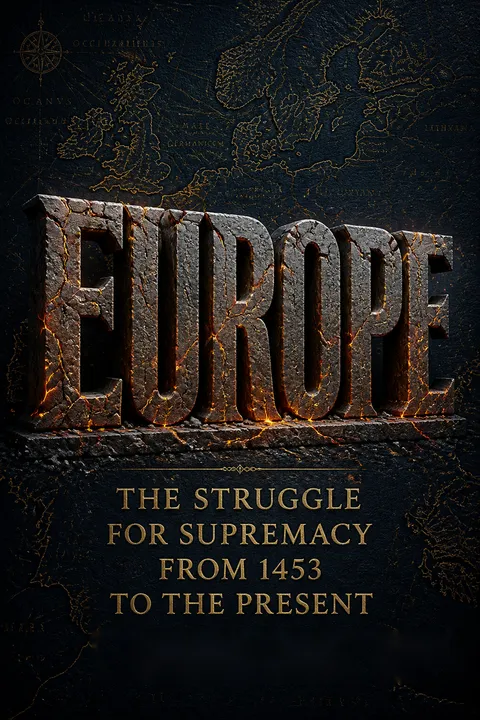
Europe: The Struggle for Supremacy, from 1453 to the Present is a comprehensive history of European geopolitics. Readers praise Simms's focus on Germany's central role and the balance of power, though some find the dense information challenging. The book is commended for its insights into current events and broad historical perspective. Critics note an overemphasis on Germany and foreign policy. Overall, it's considered an ambitious, scholarly work that provides a unique lens on European history, despite occasional difficulties in readability.
People Also Read




Glossary
Mittellage
Germany's central strategic positionA German term for the country's position in the middle of Europe, between major powers and competing fronts. In the book it means more than geography: centrality provides access and influence, but also exposes German states to encirclement, invasion, and pressure from both east and west. It shapes recurring German efforts to seek buffers, allies, or strategic depth.
Universal Monarchy
One power dominating EuropeThe feared or desired condition in which a single ruler or dynasty commands Europe and claims authority over the wider Christian or Roman political inheritance. The idea appears in disputes involving the Habsburgs, France, the Ottomans, and later other powers. Rivals often used the charge of seeking universal monarchy to justify balancing coalitions and intervention.
German Question
How German power is organizedThe recurring problem of how German lands should be politically arranged and how their power should fit into Europe's balance. It includes disputes over fragmentation versus unification, Austrian or Prussian leadership, and whether a strong Germany could be contained without making it vulnerable to outside domination. The question remains central after German partition and reunification.
Westphalian settlement
The 1648 German peace frameworkThe arrangements made at the end of the Thirty Years War, principally through the treaties of Münster and Osnabrück. They regulated relations among Catholic, Lutheran, and Reformed territories, protected rights within the Empire, and allowed outside powers to guarantee the settlement. In Simms's account, the system was meant to preserve Germany while preventing any power from dominating it.
Zollverein
Prussian-led German customs unionThe customs union that linked Prussia with many German states beginning in the 1830s. It reduced internal trade barriers and strengthened economic ties, while Prussian leaders expected commercial integration to encourage political alignment and improve collective security. The union demonstrated that economic cooperation could prepare the ground for political change, but did not automatically produce national unity.
Ostpolitik
West German policy of eastern engagementThe policy associated with Chancellor Willy Brandt of negotiating practical agreements with the Soviet bloc and East Germany. It accepted the realities created by partition in order to reduce tension, ease contacts between Germans, and improve relations with eastern European states. Its advocates treated accommodation as a possible route toward change, not simply as permanent acceptance of division.
Lebensraum
Nazi demand for eastern living spaceA Nazi geopolitical and racial doctrine calling for German territorial expansion, especially into eastern Europe and the Soviet Union. It presented land, food, and raw materials as necessary for German survival, while treating existing populations as obstacles to removal, enslavement, or murder. The concept joined strategic expansion to racial conquest and the Holocaust.
Helsinki Final Act
1975 European security agreementAn agreement signed by the United States, the Soviet Union, and European states that recognized existing borders and established principles for cooperation. It also committed signatories to respect human rights and fundamental freedoms, including movement and belief. Soviet leaders valued the recognition of postwar borders, but dissidents invoked the rights provisions to challenge repression.
Download PDF
Download EPUB
.epub digital book format is ideal for reading ebooks on phones, tablets, and e-readers.








