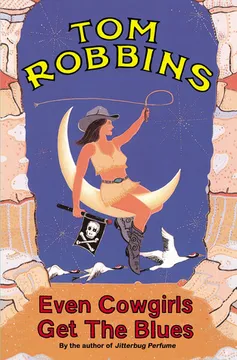


Plot Summary
The Thumb That Flagged Cars
Born in South Richmond with enormous but healthy thumbs, Sissy Hankshaw grows up hearing that her hands make her useless. Her family cannot afford surgery, and the other children turn her difference into a joke. Alone in the woods, she practices hitchhiking on birds, clouds, and passing cars until a driver finally stops.
She makes the road her refuge, accepting rides on the condition that the vehicle keeps moving. When her parents consider sending her to a carnival, Sissy leaves home with food in her coat and catches a northbound ride. She has no destination to reach. The act of leaving, and the freedom her thumbs make possible, is the beginning of her life’s work.
Sissy’s first freedom is not a destination but a practice. The thumb that others read as incapacity becomes an instrument for choosing movement, while the car turns a dangerous world into one she can enter on her own terms. Her acceptance of unwanted male attention complicates any simple portrait of liberation: she negotiates danger through a rule of her own, not through safety. The novel’s central tension begins here. Society wants her difference corrected or displayed, while Sissy builds an identity by using it.
The Road Becomes Her Stage
Years of relentless hitchhiking make Sissy famous among travelers, though fame does not pay for food or worn shoes. In New York, the Countess, an eccentric tycoon whose fortune comes from feminine hygiene products, hires her as a model. From 1962 to 1968, Sissy appears in his advertisements, her hands carefully kept outside the frame.
She continues traveling, perfecting hitchhiking as a discipline rather than a way to get somewhere, and eventually grows tired. With little money, she checks a reservation-town post office for the Countess’s mail and receives an invitation to meet a watercolorist. The letter brings her back to Manhattan, where the Countess hopes to turn her long independence toward a different kind of encounter.
The Countess profits from a contradiction: Sissy’s body sells products designed to correct women, but the feature that most unsettles viewers must remain invisible. Her image becomes commercially useful through selective omission. Meanwhile, Sissy refuses to treat the road as an instrument of social advancement. The Countess can offer employment and access, yet he cannot make her value them as he does. Her exhaustion matters because even a self-chosen life of motion has bodily costs; the invitation arrives when her old freedom no longer feels effortless.
Julian’s Asthmatic First Date
The watercolorist, Julian Gitche, is a Mohawk artist educated at Yale. When he meets Sissy in the Countess’s building, an asthma attack leaves him unable to speak; his friends treat him and bring the group to his apartment. Sissy falls asleep there, then wakes as Julian’s friends, Howard and Marie Barth, undress her and turn the room into a sexual encounter.
She watches, fascinated, before leaving their bed to sleep beside Julian. Over three days, he tries to persuade her that her wandering life is aimless, while she insists that hitchhiking itself is what she has chosen. Their intimacy falters when Julian cannot consummate it, and Sissy leaves. At Christmas, his declaration of love brings her back. They marry in January.
The first encounter scrambles familiar roles: Julian’s illness makes him vulnerable, while Sissy is treated as an object by the Barths before she can decide what she wants. Her curiosity is genuine, but so is her eventual departure. Julian offers care and intellectual companionship, yet his impulse to explain Sissy also threatens to contain her. Their marriage begins not because their differences are solved, but because each mistakes the other’s need for a form of recognition. That unresolved bargain will shape their life together.
A Ranch Built on Powder
After nine months of marriage, Sissy and Julian have grown tense inside their orderly New York apartment. The Countess interrupts their routine with a job: he wants Sissy in Dakota to model for a whooping crane advertisement and report on his troubled Rubber Rose Ranch. The ranch is supposed to be a beauty retreat, but Bonanza Jellybean, a young runaway who became its cowgirl boss, has replaced the male ranch hands with women.
The Countess admits he approved the change after realizing that the cowboys were disrupting guests’ stays, though he now fears Jelly has taken control. Julian objects when Sissy insists on hitchhiking there. She leaves anyway, treating the assignment as both paid work and a chance to move freely again.
The Countess’s business makes the ranch a miniature of the novel’s larger conflict: women are invited to improve themselves for a market that still defines their value through men. Jelly’s takeover exposes the contradiction in the Countess’s benevolence. He can support women’s labor when it serves his enterprise, but he is unsettled when they decide what the enterprise should become. Sissy’s choice to hitchhike is also a marital boundary. Julian sees it as rejection; she sees it as the condition that lets her remain herself.
Jellybean’s Cowgirl Country
Miss Adrian, the ranch manager, collects Sissy from the road and complains that Jellybean’s cowgirls have taken over the guests’ exercise and diet programs.
Jelly welcomes Sissy with a substantial breakfast and explains why she fought to become a cowgirl: adults treated the role as make-believe for girls, even though boys could pursue the real work of ranching. She has gathered women who want more than beauty treatments or service jobs. At the Rubber Rose, they ride, tend livestock, argue, and share a life that the surrounding culture had told them was unavailable.
Sissy listens as Jelly describes her purpose, while Miss Adrian tries to preserve the Countess’s original program. The ranch’s divided loyalties become Sissy’s first real glimpse of its revolution.
Jelly’s dream is not simply a demand for equal access to an existing career. She has made the role tangible by organizing a workplace in which women perform the skilled, visible labor reserved for men. Yet the ranch remains entangled with beauty culture and the Countess’s money. That tension prevents Jelly’s project from becoming a clean utopia. Sissy recognizes a kindred refusal in Jelly, but their aims differ: Sissy has built a private vocation, while Jelly has made a place where others can attempt theirs.
Whoopers at Siwash Lake
The cowgirls have been managing the ranch while wildlife filmmakers prepare to record whooping cranes at Siwash Lake. Sissy and Jelly leave their clothes on a hillside and watch the water together, then become lovers. Their intimacy is tentative at first, but it deepens into an encounter that leaves them both less guarded.
A flock of great white cranes arrives at the lake, and the women hear the birds’ trumpetlike calls as the filmmakers’ hidden cameras miss the two of them. The cranes are still a rare migrating flock, not yet confined to the ranch. Their presence connects Sissy’s fascination with birds to Jelly’s effort to make a cowgirl’s life real, while an approaching visit from the Countess threatens to interrupt both.
The scene joins erotic discovery to ecological attention without making either a metaphor that cancels the other. Sissy and Jelly’s desire is personal, embodied, and uncertain; the cranes are vulnerable creatures with their own lives and habits. Their proximity creates wonder, but also foreshadows a risk: the ranch’s wish to protect or possess what it loves may reproduce the control it opposes. For Sissy, the encounter is a new kind of movement, one that asks her to stay present with another person rather than pass through.
The Ranch Breaks Open
When the Countess arrives, Jelly tells the beauty-ranch guests and staff that those who want to stay as working cowgirls may remain, while the rest must leave. The cowgirls strip and advance on the Countess, then set fire to the sexual-reconditioning building and smash the beauty facilities. Sissy, frightened by the upheaval and unsure where her loyalties belong, escapes toward Siwash Ridge.
A strange, bearded man appears on the slope. Sissy raises her oversized thumb, and he lets her hitch a ride up the mountain. He is the Chink, a Japanese American hermit who has made his home in a cave above the ranch. He brings her inside, where a strange mechanism called the clockworks waits in the darkness.
The uprising makes the ranch’s conflict physical: Jelly rejects a business model that treats women as clients to be repaired, while the Countess watches the enterprise become unrecognizable. Sissy’s retreat is not cowardice so much as a response to divided attachment. She cares for the Countess, Jelly, and the life each represents, and cannot yet choose a side. The Chink’s appearance offers neither rescue nor a new authority. Instead, his cave opens another scale of experience, where Sissy’s ability to hitchhike becomes a way to approach the unknown.
The Clockwork Hermit’s Lessons
The Chink feeds Sissy in his cave and shares his bed; their connection is sexual, playful, and unlike her urgent intimacy with Julian. Around them, the clockworks is not a precise instrument but a jumble of metal that strikes at irregular intervals. The Chink offers no reliable doctrine, and Sissy leaves after three days with more questions than answers.
Back in New York, Julian presses her for an account of the ranch, while she struggles to explain her bond with Jelly and the hermit. She has returned to the apartment, but not to the person she was before. The Countess abandons his crane commercial, and Julian’s unease grows as Sissy’s old habits of movement no longer satisfy her.
The clockworks offers an alternative to the measured schedule of ordinary life, but it is not a tidy escape from time. Its unpredictable clangs give Sissy an experience that cannot be reduced to a lesson. The Chink’s intimacy likewise resists the romantic script of rescue or instruction. Yet the trip has consequences: Sissy brings back attachments that do not fit Julian’s model of marriage. Her new confusion is not a failure to understand herself; it is evidence that the categories she once used have become too small.
A Clinic Hears the Chink
In Manhattan, Sissy and Julian struggle with domestic life. Julian dislikes her clumsiness and keeps trying to make her into a conventional wife. When Sissy releases the birds in his apartment, he takes her to Dr Goldman’s clinic. There she meets Dr Robbins, a young intern who is more interested in her account of freedom than in treating her thumbs as a defect.
Sissy tells him how the Chink escaped Japanese American incarceration at Tule Lake and was sheltered by the Clock People, an isolated community whose daily ritual centers on a hidden clockworks. The Chink eventually left them to build his own irregular clock on Siwash Ridge. Dr Robbins finds Sissy’s story more valuable than the clinic’s diagnosis and asks to hear more.
The clinic turns a private conflict into a contest over who has the authority to define health. Julian and Dr Goldman treat normality as the desired endpoint; Dr Robbins sees that an imposed cure can erase the very capacities that sustain Sissy. The Chink’s history enlarges the novel’s political frame, connecting individual freedom to wartime incarceration and an alternative community’s rituals. Yet neither the Clock People nor the clinic supplies a final answer. Sissy’s narration matters because it lets experience remain complicated rather than forcing it into a case history.
Two Thumbs Turn Violent
After leaving the clinic, Sissy hears that the whooping cranes have disappeared during migration. The Countess realizes the cowgirls may know where the flock is and threatens to tell the authorities. Sissy strikes him repeatedly with her thumbs, leaving him gravely injured, and knocks his dog aside when it attacks her.
She flees New York, then accepts a ride from a driver who pulls a gun and prepares to assault her. Sissy crushes his penis and strikes his face with her thumb, escaping the wrecked van. Shaken by the two violent encounters, she decides that if society insists she is abnormal, she will seek normality. She returns to Richmond and finds the surgeon who once examined her.
Sissy’s thumbs have been tools of movement and self-definition, but here they become weapons. The violence is not presented as a triumphant liberation: she is horrified by what she has done and reaches for normality as a refuge from the consequences. Yet the immediate threat in the van makes clear that a society demanding her conformity does not reliably protect her. Her choice is therefore compromised from the start. She wants safety, but the operation will require her to surrender the body through which she has made a life.
A Thumb Left Behind
Dr Dreyfus has lost his medical license after an artistic operation left a child with a cubist nose, but he agrees to help Sissy secretly. He arranges for his brother-in-law at a veterans’ hospital to amputate her right thumb and create a replacement from her index finger. During recovery, Sissy follows news that the missing cranes have been found at Siwash Lake, where the cowgirls have kept them.
The government tries to gain access, while the women resist. Before her next operation, Sissy changes her mind: she will keep her remaining oversized thumb and have the other index finger reshaped instead. With one new, stiff thumb and one original, she sets out for Dakota, driven by concern for Jelly and the cranes.
The operation makes Sissy’s longing for normality concrete and irreversible. Her first decision costs her the thumb that made her famous, yet the incomplete result forces her to reconsider what she is willing to lose. This is not a simple return to self-acceptance, since she still proceeds with surgery; rather, she begins to distinguish adaptation from erasure. The cranes’ discovery gives her an urgent reason to leave the clinic, but it also places her bodily choice beside the larger question of whether a living being can be protected by being controlled.
The Last Thumb Rides West
Sissy’s remaining thumb gets her across the continent and back to the Rubber Rose, where federal agents have surrounded the ranch. The cowgirls explain that they fed the cranes rice, fishmeal, and peyote, hoping to make them stay. The flock has nested around Siwash Lake and hatched chicks, but the women refuse to let government scientists kill a bird for an autopsy or take control of the site.
A judge orders them to stop building winter shelter and surrender access. Delores is arrested on a peyote charge, then returns after the Countess pays her bail. Her Third Vision changes her view of the enemy: she abandons her whip and tells the cowgirls that domination comes from dull, controlling thought, not from men alone.
The cranes’ apparent rescue is ethically uneasy. The cowgirls protect them from human institutions, but their use of peyote has altered the birds’ migration and made the flock unusually tolerant of people. Their care contains an element of possession. Delores’s vision interrupts the simple opposition between women and men, recasting the conflict as one against coercive thinking wherever it appears. That insight arrives at a dangerous moment: the government has assembled force, and the cowgirls’ refusal has become more important to them than the original purpose of protecting the birds.
Dawn at the Barricades
At dawn, Jellybean leaves the barricades to tell the federal forces that the cowgirls will release the cranes. As she reaches for the six-gun she has forgotten to discard, a marshal shoots her. Other cowgirls rush forward and are also shot. Billy West, an outlaw who has brought supplies by helicopter, returns in an aircraft loaded with explosives and detonates it among the armed agents.
The blast tears through the hilltop, killing federal men and leaving the Chink badly injured. In the confusion, the cranes rise from Siwash Lake and fly south, free of both the ranch and the government. Sissy cannot stop the violence or reach Jelly in time. The flock survives, but the community that sheltered it is shattered.
The climax refuses the comfort of a clean victory. Jelly’s decision to negotiate is an act of responsibility, but a frightened, armed institution answers with lethal force before her intentions can be understood. Billy’s bombing destroys the immediate threat while multiplying the losses. The cranes escape, yet their freedom arrives through human violence rather than a negotiated change in human behavior. Sissy’s defining power, the ability to make movement possible, cannot prevent this rupture. The scene tests the book’s faith in play and freedom against a world that can turn fear into irreversible action.
El Rancho Jellybean
Sissy and Delores bury their dead and visit the injured Chink, while the surviving cowgirls are held at the Mottburg Grange. Billy West receives a funeral without a body. The Countess gives the ranch to the women and, under Dr Robbins’s influence, leaves the cosmetics business to work in a hospital maternity ward.
Once acquitted, the cowgirls choose different futures: some pursue rodeo, others college, travel, or work on the ranch. Sissy and Delores become lovers and take responsibility for the property as the women rename it El Rancho Jellybean. Sissy discovers she is pregnant but tells no one. The Chink recovers at the ranch, then decides to return to the Clock People, leaving Sissy and Delores to make their own choices.
The aftermath does not restore the lost community; it distributes its members into futures they choose for themselves. The ranch survives by changing ownership and purpose, and the new name makes memory part of its ordinary life rather than a monument to victory. The Countess’s work in a maternity ward reverses his career’s attempt to suppress female bodily smells, though it cannot undo the harm of his products. Sissy’s concealed pregnancy keeps the future open and uncertain. Even the Chink’s departure resists the idea that wisdom must remain available as a permanent authority.
The Unfinished Arrival
Seven or eight months later, Sissy and Delores live in the cave on Siwash Ridge, and Sissy’s pregnancy has advanced. The two women dream separately of partners who might complete them, while the unborn child moves inside Sissy. A rumble reaches the cave, raising the possibility of an earthquake or a new disturbance in the clockworks.
Instead, Dr Robbins appears on the treacherous trail, following the map the Chink made. He has left the clinic and crossed the country to reach them, but the novel does not explain what he expects or what role he will take in their lives. Sissy, Delores, and Robbins meet in the cave as the baby approaches, with no settled answer about love, family, or what comes next.
The ending refuses to translate pregnancy into a conventional resolution. Sissy’s body carries a future, but the arrival of Dr Robbins complicates rather than completes it. Delores’s dream of an opposite, Sissy’s own longing, and Robbins’s journey remain distinct desires, not a tidy arrangement. The clockworks may signify natural upheaval, but the immediate disturbance is human: someone has chosen to enter their secluded life. The novel closes at the threshold of birth and new attachment, preserving uncertainty as a condition of freedom rather than treating it as a problem that must be solved.
Epilogue
After the cranes leave Siwash Lake, they stop briefly at their Texas wintering ground, then continue south through the Americas and onward across the world. They avoid scientists and settle nowhere for long; after poachers shoot several, the United Nations makes harming them a crime.
Their flight continues toward Tibet, a moving reminder that the flock cannot be reclaimed by any one place. The book’s bonus parable offers a final contrast: three religious teachers find life sour or bitter, while a naked couple tasting vinegar together discovers sweetness.
The cranes’ continued migration extends the novel’s central refusal of ownership. Their return to Texas might have restored a familiar pattern, but they move on, eluding the governments and experts who want to classify, protect, or study them. Their wandering is not presented as an uncomplicated triumph: poachers still kill them, and global protection comes only after further danger. The closing vinegar parable shifts the emphasis from doctrine to shared experience. Its couple does not solve life’s taste through a system; they meet it together and find pleasure in what others reject.
Analysis
The novel places freedom in bodies and choices rather than in abstract declarations. Sissy’s thumbs are an actual physical difference, not a symbolic costume she can simply discard, and her hitchhiking turns that difference into a practice she authors herself. The contrast between her chosen movement and the institutions that classify, market, or treat her makes normality a contested form of power. Yet Robbins avoids making nonconformity automatically virtuous. Sissy’s road life exposes her to exploitation; Julian’s care shades into correction; and the cowgirls’ attempt to protect the cranes alters the birds’ behavior through deliberate feeding. Their good intentions do not erase the question of consent.
The novel’s competing communities offer no final refuge. Julian’s apartment is orderly but constraining. The beauty ranch begins as a commercial apparatus, then becomes a workplace for women, then a besieged sanctuary. The Clock People’s ritual promises an end to time-bound life, but the Chink rejects their expectation of eventual deliverance. Each arrangement contains a contradiction. The book treats that contradiction not as a flaw to be eliminated, but as a condition of living systems: freedom needs relation, while relation risks becoming control.
Its comic excess is also structural. The narrator’s digressions interrupt the story’s forward motion, echoing Sissy’s resistance to linear time and the clockworks’ irregular strikes. Humor punctures authority, but it cannot prevent catastrophe. At the climax, the state’s fear and the cowgirls’ defiance produce deaths no clever theory can undo. The cranes’ escape is therefore neither a clean victory nor a moral lesson delivered from above. The closing pregnancy and Dr Robbins’s arrival keep the future unsettled. The novel’s deepest claim is less that people can escape systems than that they must keep making choices inside them, without mistaking any single ideology, romance, or survival plan for freedom itself.
Review Summary
Even Cowgirls Get the Blues received mixed reviews, with readers either loving or hating it. Fans praised Robbins' unique writing style, philosophical musings, and quirky characters, particularly enjoying the humor and unconventional storytelling. Critics found the book self-indulgent, misogynistic, and lacking in plot. Many readers struggled with the dated portrayal of women and sexuality. Some appreciated the counterculture themes and unconventional narrative, while others found it pretentious and difficult to follow. The book's polarizing nature reflects its unconventional approach to storytelling and themes.
People Also Read


Characters
Sissy Hankshaw
The hitchhiking thumbA tall, striking woman from poor South Richmond, Sissy is born with thumbs so large that ordinary tasks become difficult and strangers cannot ignore her hands. She turns the feature others call a deformity into the basis of her life as a hitchhiker, valuing motion over destination. Her self-possession is real, though not invulnerable: she is curious about love, sometimes uncertain of what she wants, and capable of mistaking endurance for freedom. Sissy’s strongest trait is her ability to shape experience through attention and action. She resists being defined by doctors, lovers, employers, or admirers, yet keeps testing whether intimacy and independence can coexist.
Bonanza Jellybean
The born cowgirlBonanza Jellybean, usually called Jelly, is a young woman from Kansas City who has spent much of her life trying to become a working cowgirl. At the Rubber Rose, she makes that childhood identity practical by organizing women to ride, work, and manage the ranch. Her warmth makes her persuasive, while her stubbornness gives her leadership force. Jelly’s politics are personal rather than doctrinal: she wants other people to have the chance to pursue the life they choose, but resists turning that aim into a movement with rules. Her attraction to Sissy grows from recognition between two women who have each built a life outside approved roles.
The Chink
The cave-dwelling provocateurThe Chink is a Japanese American hermit living on Siwash Ridge, known by a nickname given in his dealings with the Clock People. He is a gardener, practical survivor, and deliberate irritant to visitors who expect a sage to provide simple answers. His humor and contradictory statements frustrate people who want a system they can follow. He values individual freedom, but distrusts both organized authority and the spiritual devotion that turns a teacher into a master. His relationship with Sissy combines physical intimacy, teasing, and serious conversation. He neither claims to direct her life nor permits her to mistake him for a source of certainty.
Julian Gitche
The orderly Mohawk painterJulian is a Mohawk watercolorist educated at Yale and established in New York’s art world. He prizes symmetry, cultural achievement, and the reassuring structures of educated life. Asthma makes him physically vulnerable, while his taste for order can make him emotionally controlling. He is drawn to Sissy’s beauty and intelligence, yet struggles to accept that hitchhiking is not a phase or a symptom she must outgrow. Julian wants to care for her, but often confuses care with correction. His relationship with Sissy exposes the gap between loving a person and accepting the terms on which that person chooses to live.
The Countess
The hygiene-products tycoonThe Countess is a flamboyant, wealthy man who has built a company selling feminine hygiene products. He is theatrical, sharp-tongued, and deeply invested in his advertising campaigns, especially the image of Sissy as a model. His business presents him as a benefactor to women, but his products and ranch also reveal how thoroughly he sees women through commercial and sexual conventions. He can admire independence in theory while trying to manage it in practice. His relationships with Sissy and the cowgirls mix genuine affection, vanity, and control, making him more complicated than either a simple villain or a generous patron.
Delores del Ruby
The whip-bearing forewomanDelores is the Rubber Rose’s formidable forewoman, a skilled rider and whip-handler with a history she keeps obscured. She favors confrontation and speaks in the language of female resistance, drawing on peyote visions to interpret her purpose. Her certainty can inspire the cowgirls, but it can also harden their divisions and make retreat feel like betrayal. Beneath her severity is a capacity for revision: she is not simply the ideology she first adopts. Her connection to Sissy develops through desire, grief, and shared responsibility, while her distinctive mix of theatricality and discipline keeps others guessing.
Dr Robbins
The unconventional internDr Robbins is a young psychiatrist at Dr Goldman’s clinic who distrusts the assumption that adjustment to social norms is the same as health. His unorthodox advice unsettles patients and colleagues, and his own life is shaped by the same appetite for risk and disorder that he encourages in others. Sissy’s account of the Chink and the clockworks gives him a subject he considers more alive than conventional diagnosis. He is curious, impulsive, and capable of making another person’s story part of his own search. His interest in Sissy is both intellectual and personal, a mixture he does not neatly separate.
Debbie
The gentle spiritualistDebbie is a cowgirl who favors vegetarian food, spiritual practice, and nonviolent change. She challenges Delores’s militant approach, arguing that women should resist oppression without adopting the same aggression they oppose. Her idealism can sound impractical to the more combative ranch hands, but it gives the group a genuine alternative rather than a simple counterattack. Debbie is also attentive to the bodily and ecological consequences of the ranch’s choices, including its treatment of animals and the cranes.
Miss Adrian
The ranch’s old managerMiss Adrian is the polished manager hired to run the Rubber Rose as a conventional beauty retreat. She values order, etiquette, and the Countess’s carefully designed program of exercise, diet, and intimate conditioning. Jelly’s takeover threatens both her authority and the institution she has spent years maintaining. Though she sees the cowgirls as disruptive, her objections arise from a coherent belief that the ranch must function as a business, not from simple malice.
Dr Felix Dreyfus
The surgeon turned artistDr Dreyfus is the Richmond surgeon who examined Sissy as a child and recognized that her thumbs were healthy despite their unusual size. He is a plastic surgeon with a buried artistic ambition, and his later career brings those two callings into dangerous conflict. His attention to form makes him unusually sympathetic to Sissy’s wish to preserve her distinctive body, even when she asks him to alter it. He is also willing to break professional rules when he believes a patient’s request deserves a chance.
Big Red
The veteran rodeo handBig Red is the oldest and roughest-looking of the cowgirls, a large woman with experience in Texas rodeo and little patience for posturing. She contributes practical judgment and a blunt sense of humor to ranch life. Her presence helps connect Jelly’s dream of becoming a cowgirl to the real labor and physical skill the role demands. She is wary of airy theories, but not closed to new possibilities.
Billy West
Mottburg’s outlaw supplierBilly West is a three-hundred-pound young man from Mottburg who turns his sense of being exploited into a life outside the law. He supplies the cowgirls with weapons and provisions, and eventually learns to fly a helicopter. His size and local roots make him an unlikely outlaw, but he acts from a conviction that the respectable order has already failed him. The town’s response to him reveals how little it understands the person behind the public reputation.
Granny Schreiber
Mottburg’s sharp-eyed elderGranny Schreiber is a retired local woman whom Sissy meets while searching for the Rubber Rose. Though others may consider her senile, she understands the town and its history better than they do. She explains the Siwash land and the Chink’s place on the ridge, giving Sissy the directions she needs. Her affection for Bette Davis, dancing, and conversation keeps her from becoming merely an exposition-giver.
Dr Goldman
The conventional psychiatristDr Goldman directs the clinic where Sissy is evaluated. He approaches her through professional categories, expecting her behavior to fit an established account of deformity and compensation. Unlike Dr Robbins, he is invested in treatment that helps patients conform to ordinary social expectations. His confidence in institutional expertise gives the clinic its authority, while his exchanges with Robbins expose the limits of that authority.
Professor Inge Anne Nelsen
The crane behavior specialistProfessor Nelsen is a zoologist asked to assess the whooping cranes at Siwash Lake. She is alert to the flock’s unusual behavior and argues that scientific examination is necessary to understand it. Her concern for the birds is genuine, even when her proposed methods put her in conflict with the cowgirls.
Sissy’s parents
Her anxious Richmond familySissy’s working-class parents respond to her thumbs with embarrassment, worry, and humor that often wounds more than it comforts. They seek medical advice but cannot afford surgery, and her father later considers a carnival contract when her behavior brings trouble. Their limits are shaped by their circumstances, but their attempts to manage Sissy help drive her toward the independent life she chooses.
The whooping cranes
The unbending wild flockThe whooping cranes are a rare migratory flock, majestic and famously wary of humans. Their presence at Siwash Lake attracts the Countess’s filmmakers and eventually draws the attention of wildlife officials. They are not simply symbols for the cowgirls’ cause: their needs and behavior remain partly beyond human interpretation. The conflict over whether to shelter, study, or release them exposes the danger of confusing protection with ownership.
Plot Devices
Sissy’s oversized thumbs
Difference becomes agencySissy’s thumbs make ordinary tasks difficult, attract ridicule, and shape the way strangers see her. She turns them into the means of hitchhiking, a skill that becomes both her livelihood and her chosen discipline. They also give the novel a concrete way to examine who gets to define a body as impaired. Their meaning shifts with each use: they can signal freedom, invite unwanted attention, prompt surgery, and eventually become instruments of violence. The thumbs are never only a metaphor, because the novel keeps returning to their physical consequences.
The hitchhike
Motion without destinationHitchhiking begins as Sissy’s practical response to a body that does not fit conventional work. It becomes a lifelong practice, and she values the act of movement more than arrival. The roadside gives her contact with strangers while allowing her to leave before they can claim her. It also makes her an active reader of the world: she chooses vehicles, gestures, timing, and risk. When Sissy later returns to the road after surgery, hitchhiking tests whether her identity can survive the loss of one of the thumbs that made her famous.
The clockworks
Time outside the scheduleThe Clock People maintain a hidden ritual around a great underground hourglass and a pool whose catfish register earthquakes. Their system makes time into a communal practice and imagines a future beyond ritual. The Chink’s clock on Siwash Ridge is far less orderly: loose scraps of metal strike unpredictably. The contrast makes the clockworks a device for testing rival ideas of time, authority, and freedom. Its importance is not that it offers a reliable prophecy, but that it interrupts the assumption that life must follow a measured, progressive schedule.
The whooping crane flock
Freedom under human careThe cranes first arrive at Siwash Lake as a migrating flock, drawing the Countess’s film crew and the cowgirls’ attention. When the birds disappear from their expected route, it becomes clear that the ranch has fed them rice, fishmeal, and peyote, encouraging them to remain. That intervention puts the cowgirls’ protection in conflict with the cranes’ independent lives and with government efforts to control the site. The flock’s behavior drives the novel’s final standoff while refusing to provide a simple verdict on whether human care has helped or harmed them.
About the Author

Download PDF
Download EPUB
.epub digital book format is ideal for reading ebooks on phones, tablets, and e-readers.








