

Key Takeaways
Assess entertainment by the thinking it demands, not only its subject matter.
Look beyond the message. Steven Johnson begins with childhood baseball simulations: card-and-dice games so intricate that a ten-year-old had to track player statistics, pitching strengths, and changing situations. He eventually stopped playing one not because it was too difficult, but because its model of baseball was too crude. The experience taught him to analyze systems, even though it offered no moral lesson.
A different measure. Johnson calls the long-term rise in popular culture’s cognitive demands the Sleeper Curve. His case is not that television, games, or movies have become great art, or that violent content is harmless. It is that judging media only by its messages misses the mental work involved in following a story, solving a game, or understanding a system.
The key move is separating what entertainment depicts from what audiences must do to understand or play it. That distinction improves debates often trapped between moral panic and blanket celebration. It also invites a more useful question: what kinds of thinking does a particular activity repeatedly call for? The answer should remain specific. A demanding plot can exercise memory without teaching sound judgment, and cognitive effort alone does not establish that an experience benefits every viewer.
Follow the threads, then notice what modern television leaves unexplained.
More plots, fewer clues. Older procedurals such as Dragnet usually built an episode around one case and explained the action as it unfolded. Hill Street Blues brought soap-opera-style storylines into prime-time drama, weaving several plots together. Shows such as The Sopranos pushed this further, with many substantial threads continuing across episodes and scenes that connected multiple plots at once.
Viewers fill gaps. Johnson calls explanatory signposts “flashing arrows.” Newer dramas often use fewer, asking viewers to infer what is happening now, not just wonder how a story ends. In an ER scene, a patient’s rare blood type matters because viewers must remember an earlier scene about a potential organ donor. Seinfeld and The Simpsons likewise reward remembering old jokes and references.
This account treats attention as active interpretation rather than simply time spent looking at a screen. The distinction between a mystery about the future and deliberate uncertainty about the present is especially useful: one creates suspense, the other makes the audience reconstruct context. Such demands can strengthen narrative tracking, but complexity is not automatically clarity or quality. A viewer may be working hard because a story is artfully subtle, or because it is needlessly obscure.
Use games to practice decisions, not merely to chase their rewards.
Effort can be the hook. Games often involve frustration, repetition, and long stretches of work. In Ultima Online, a player spent months repeatedly mining ore and making virtual equipment to build a character’s blacksmithing skill. Johnson argues that the appeal is not simply instant pleasure. Games make goals visible, offer small rewards along the way, and encourage players to keep exploring for the next achievement.
Decisions do the teaching. A player must choose what to pursue, weigh limited resources, and revise a plan when obstacles appear. A game may have a thin story or violent imagery, yet still demand substantial strategic thought. Johnson’s point is not that all games are beneficial, but that their cognitive value cannot be judged by plot, subject matter, or hand-eye coordination alone.
Reward design helps explain why people will persist at tasks they would reject in a classroom or workplace. Games make progress legible and connect small actions to a larger objective, which can sustain effort. That same design can also encourage compulsive play, so persistence is not a virtue in itself. The more important distinction is whether the activity develops transferable judgment, or simply keeps the player engaged inside a tightly managed reward loop.
Probe unfamiliar systems, then keep immediate tasks tied to distant goals.
Learn by testing. Johnson names two game-based thinking skills. Probing means exploring a system, forming an idea about how it works, testing that idea, and revising it in response. Telescoping means organizing tasks into nested goals, from the next small step to a distant objective. Both appear in SimCity, where a player must infer how taxes, services, and land use affect a growing city.
A child’s insight. While Johnson demonstrated SimCity to his seven-year-old nephew, the boy suggested reducing industrial taxes to encourage development. He had grasped a relationship among variables without sitting through a lesson in urban economics. A Zelda player faces the same kind of layered challenge: solve a local puzzle while remembering which larger mission it serves.
These concepts distinguish purposeful problem-solving from mere multitasking. Probing resembles experimental reasoning because an idea is tested against feedback, while telescoping resembles project planning because small tasks are ordered by their contribution to a larger aim. The transfer to everyday life is plausible but should not be assumed. Skill at manipulating a simulated city does not guarantee sound policy judgment; practice builds a toolkit, while context determines whether it is used wisely.
Read reality television as social strategy, not simply public humiliation.
The audience plays along. Johnson compares Survivor and The Apprentice to games more than documentaries. Contestants face changing challenges and relationships, while viewers try to infer alliances, motives, and the best move. In the first season of The Apprentice, the final task required finalists to lead people previously fired from the competition. The new condition changed which earlier choices mattered, including whether contestants had maintained relationships with former rivals.
Social maps matter. Following such shows means tracking who trusts whom, who is bluffing, and how a decision affects the group. The close-up of a contestant’s genuine disappointment can add emotional information to the strategy. Johnson argues that this engages social intelligence, the ability to interpret people’s signals and relationships, though the show’s artificial rules and editing shape what viewers get to see.
The comparison to games clarifies why audiences debate contestants’ choices rather than merely consume a story. Viewers are invited to build a model of the group and test their own predictions against the outcome. This resembles social reasoning at work, but the model is incomplete: editing selects the evidence, and producers design the conditions. The useful lesson is not that reality television reliably teaches empathy, but that it makes interpersonal judgment unusually visible and discussable.
Treat the internet as a participatory medium, not merely a screen.
Users shape the experience. Email, blogs, online discussions, and digital tools ask people to write, respond, learn interfaces, and manage connections. A 2004 Pew study cited by Johnson found that more than eight million Americans reported having a personal blog or online diary. Much of this publishing was personal rather than professional, turning the screen into a place to narrate one’s own life.
Complexity gains support. Online communities also help audiences interpret demanding shows and games. Fans create episode guides, debate plot twists, and write walkthroughs that explain how to progress through a game. These resources make complex entertainment easier to enter, while public discussion can help a devoted audience sustain interest in a show. Digital media therefore changes both what people do and how other media are understood.
Participation changes the audience from an endpoint into part of the medium’s social infrastructure. Discussion can distribute interpretation across a group, allowing people to notice details no individual viewer would catch. Yet publishing and clicking are not automatically deep engagement. A diary, a fan theory, and a careful argument all use the same tools but demand different kinds of thought. The medium creates opportunities; the habits and purposes of its users determine much of their value.
Give films enough time to build complexity; short formats impose ceilings.
Runtime shapes narrative. Johnson compares the original Star Wars trilogy with The Lord of the Rings, whose larger cast and denser story require viewers to follow more characters and background information. He sees a similar shift in children’s films: Finding Nemo gives meaningful roles to many more characters than Bambi, making repeated viewings reveal additional connections.
Some films make puzzles central. Works such as Memento and Pulp Fiction use disrupted chronology, withheld information, or intersecting plots to make viewers reconstruct events. But Johnson says film’s short duration limits how much complexity can be introduced. A television series has many episodes, and a game can take dozens of hours, giving audiences time to learn a world’s rules and relationships. Long-form storytelling has room to accumulate detail.
The argument usefully distinguishes complexity from visual spectacle. More effects do not necessarily require more interpretation, while recurring characters and delayed information can build a demanding story over time. Runtime is not the only constraint, however: editing, genre conventions, and audience expectations also determine how much viewers can absorb. A short film can be conceptually dense, and a long series can repeat itself. Duration enables complexity, but does not guarantee it.
Repetition rewards stories that reveal more each time they are revisited.
The business model shifted. Johnson argues that television syndication, home video, and DVDs made repeat viewing more valuable to studios and creators. A show no longer had to win attention only once; it could earn money by remaining compelling over many viewings. Seinfeld and The Simpsons benefit from jokes and references that reward familiarity, while films such as Eternal Sunshine of the Spotless Mind invite viewers to reconsider earlier scenes.
Technology reinforces the shift. VCRs, DVDs, and recording services let viewers pause, replay, and study. Online fan communities then document details and explain what others missed. Johnson contrasts programming designed to be least objectionable on a single airing with programming designed to reward repeated attention. Together, commercial incentives, replay tools, and fan analysis can make greater complexity viable.
This is a systems-level explanation rather than a claim that creators simply became more ambitious. Profit incentives, technical affordances, and audience practices reinforce one another: replay makes detail worthwhile, and detail gives replay value. The mechanism is persuasive, though it does not mean the market always favors complexity. Familiar franchises and easy-to-repeat formats can also dominate. The strongest implication is narrower: when audiences can revisit and discuss a work, creators have more reason to leave layers for them to discover.
Treat rising IQ scores as evidence of change, not proof of media's cause.
A striking trend. The Flynn Effect is the steady rise in IQ test scores across generations. Johnson reports that American scores increased by 13.8 points over 46 years, while scores in developed countries rose by about three points per decade. Gains were especially visible on tests of pattern recognition and abstract problem-solving, rather than measures closely tied to classroom learning.
A hypothesis, not a verdict. Johnson connects these gains to increasingly complex media and technology, including games that require players to infer patterns and manage systems. He presents research suggesting that some gaming skills can improve, but acknowledges that direct evidence for broad transfer is limited. He also argues for a balanced media diet: cognitive challenge does not replace books, sustained reading, or parental attention.
The distinction between a population trend and its explanation is essential. Rising test scores show that measured performance changed; they do not identify which environmental forces caused the change, or prove that a skill learned in a game transfers widely. The book is strongest when it challenges the assumption that entertainment must be mentally empty, and most tentative when it links culture to broad intelligence gains. Its lasting contribution is a research question, not a settled causal claim.
Analysis
Johnson’s most persuasive contribution is a change in the unit of criticism. Instead of asking whether a show or game is morally respectable, he asks what kind of attention and inference its design requires. That approach helps explain why a baseball simulation, a serialized drama, a reality competition, and a city-building game can all exercise different mental capacities, despite having little in common as art. It also gives parents and educators a more discriminating vocabulary than the binary of wholesome and harmful.
The book’s causal account is less secure than its formal observations. Its comparisons show that many popular works became more layered, and the Flynn Effect shows rising performance on certain intelligence tests. But these facts do not by themselves establish that entertainment caused the rise, or that cognitive demands transfer from play to unprompted real-world judgment. The author recognizes this gap. His strongest evidence is therefore descriptive and suggestive, rather than conclusive.
There is another distinction worth preserving: complexity is not the same as wisdom. A player may become adept at optimizing a simulated system without becoming more ethical, patient, or perceptive in ordinary life. Likewise, a viewer can track a dense plot without gaining a broader understanding of the people represented. Johnson’s argument works best as a correction to cultural pessimism, not as a claim that every difficult or immersive medium is good for every person.
The book remains valuable because it treats popular culture as a designed environment shaped by audiences, technology, and business incentives. Its practical invitation is to notice the mental work beneath the surface, then ask what that work trains, what it leaves untouched, and how it fits alongside sustained reading, relationships, and life beyond the screen.
Review Summary
Everything Bad is Good for You argues that pop culture is becoming more complex and intellectually stimulating, potentially improving cognitive abilities. While some readers found the thesis compelling and appreciated Johnson's contrarian perspective, others criticized the lack of scientific evidence and questioned the book's logic. Many felt the arguments were cherry-picked and failed to address moral concerns. Some praised Johnson's insights into media complexity, while others found the book repetitive and dated. Overall, reactions were mixed, with readers debating the merits of Johnson's claims about pop culture's cognitive benefits.
People Also Read









Glossary
Sleeper Curve
Rising media complexityJohnson’s name for the broad trend he sees in popular culture: entertainment has become more demanding of audience attention, memory, inference, and decision-making. The term describes an average direction across forms such as television, games, film, and digital media. It does not mean that all contemporary entertainment is complex, or that popular culture has become equivalent to high art.
Multiple threading
Interwoven storylinesA television structure that follows several plotlines within an episode or across a series. Earlier dramas often centered on one case that began and ended in the same episode. Later examples carry multiple character stories at once, allow threads to overlap, and leave events unresolved between episodes. Viewers must remember more people, situations, and connections to follow the whole narrative.
Flashing arrows
Narrative signpostsJohnson’s term for cues that tell audiences which details matter or explain unfamiliar information. A character translating technical jargon, a musical signal marking a villain, or a recap of a plot thread can all serve this function. Such guidance reduces the work required to interpret a story. Some modern programs deliberately use fewer signposts, asking viewers to infer context themselves.
Probing
Testing a system’s rulesA way of learning an unfamiliar game or environment by exploring it, forming a hypothesis about how it works, trying an action, and revising the hypothesis based on the result. The player may discover both explicit rules and less obvious patterns in the simulation. Johnson connects this process to experimental reasoning and uses it to explain how games can teach system analysis.
Telescoping
Nested goal managementThe mental organization of tasks into linked levels, from immediate actions to larger objectives. A player may solve a local puzzle because it unlocks a tool needed for a broader mission, while also maintaining basic survival goals. Johnson distinguishes this ordered hierarchy from multitasking, which involves handling multiple demands without necessarily arranging them toward one larger purpose.
Most Repeatable Programming
Entertainment built for replayJohnson’s label for programming shaped by the economic value of repeat viewing. Syndication and home video reward works that can hold attention after audiences already know the basic story. That incentive can encourage layered jokes, continuing plotlines, and details that become clearer on rewatch. It contrasts with programming designed mainly to avoid confusing or alienating viewers during a single broadcast.
Flynn Effect
Generational IQ score gainsThe observed rise in average IQ test scores across generations in many developed countries. Because test makers periodically adjust exams to keep the average score near 100, the trend is visible by comparing performance across versions and periods. Johnson notes that gains have been especially pronounced on some abstract reasoning and pattern-recognition measures, while their causes remain debated.
Regime of competence
Challenges matched to abilityA game-design principle described by James Paul Gee and discussed by Johnson. A successful game presents tasks that are difficult enough to require learning, but manageable enough that progress remains possible. As the player’s abilities grow, challenges change with them. The design aims to sustain engagement through a balance of effort, frustration, and achievable progress.
FAQ
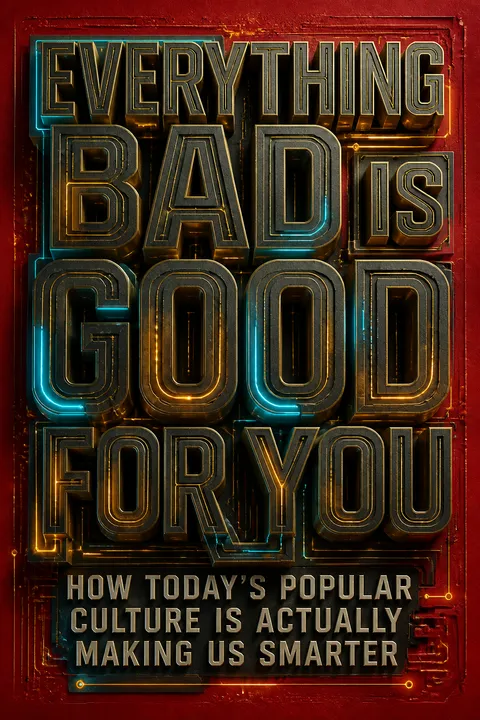
What's Everything Bad Is Good for You about?
- Main Premise: The book argues that popular culture, including television, video games, and the Internet, has become more complex and intellectually engaging over the past thirty years.
- Sleeper Curve: Steven Johnson introduces the concept of the "Sleeper Curve," suggesting that these forms of entertainment are enhancing our cognitive abilities rather than diminishing them.
- Cultural Analysis: The book examines various media forms, comparing them to past cultural artifacts, and highlights how they challenge our minds in new ways.
Why should I read Everything Bad Is Good for You?
- Challenging Conventional Wisdom: The book provides a counter-narrative to the common belief that popular culture is harmful and intellectually lazy.
- Insightful Analysis: Johnson combines cultural criticism with insights from neuroscience, making a compelling case for the cognitive benefits of engaging with modern media.
- Engaging Writing Style: Johnson's accessible prose and engaging examples make complex ideas easy to understand, appealing to both casual readers and those interested in media studies.
What are the key takeaways of Everything Bad Is Good for You?
- Sleeper Curve Concept: The main takeaway is the idea that popular culture is becoming more complex and intellectually demanding.
- Cognitive Skills Development: Engaging with modern media can enhance various cognitive skills, including attention, memory, and problem-solving.
- Cultural Evolution: The book illustrates how media has evolved over time, becoming more sophisticated and requiring greater engagement from audiences.
What are the best quotes from Everything Bad Is Good for You and what do they mean?
- "The sky is not falling.": This quote encapsulates Johnson's argument that despite negative perceptions, popular culture is improving and becoming more intellectually engaging.
- "The culture is getting more intellectually demanding, not less.": This statement reinforces the idea that modern media challenges audiences to think critically and engage deeply.
- "Television is growing increasingly rigorous.": Johnson emphasizes that contemporary television demands more from viewers, requiring them to follow complex narratives.
How does Steven Johnson define the "Sleeper Curve" in Everything Bad Is Good for You?
- Definition of Sleeper Curve: Johnson defines the Sleeper Curve as the upward trend in the complexity and cognitive demands of popular culture over the past few decades.
- Cognitive Work: The Sleeper Curve posits that engaging with complex narratives in television and video games exercises the brain.
- Cultural Implications: The concept implies that as media evolves, so do the cognitive skills of its consumers, leading to a more informed and capable society.
What examples does Johnson use to illustrate his points in Everything Bad Is Good for You?
- Television Shows: Johnson discusses shows like The Sopranos and The West Wing to demonstrate how modern television has become more complex.
- Video Games: He uses examples from popular video games like The Sims and Grand Theft Auto to show how these games require strategic thinking.
- Cultural Comparisons: Johnson compares contemporary media to past cultural artifacts, illustrating how the narrative structures have become more sophisticated.
How does Everything Bad Is Good for You relate to neuroscience?
- Neuroscientific Insights: Johnson incorporates findings from neuroscience to support his argument that engaging with modern media enhances cognitive abilities.
- Cognitive Development: The book suggests that the complexity of modern media requires active engagement, which can lead to improved cognitive skills.
- Reward Systems: Johnson explores how media taps into the brain's reward systems, making engagement with these forms of entertainment both enjoyable and beneficial.
What cognitive skills does Johnson argue are enhanced by engaging with modern media in Everything Bad Is Good for You?
- Critical Thinking: Johnson asserts that modern media encourages viewers to analyze and interpret complex narratives.
- Problem-Solving: Engaging with video games and intricate television plots fosters problem-solving abilities.
- Social Intelligence: The book highlights that modern media often involves social interactions, which can improve social intelligence.
How does Everything Bad Is Good for You address the criticism of popular culture?
- Countering Negative Perceptions: Johnson addresses the common criticism that popular culture is harmful and promotes negative behaviors.
- Cultural Evolution: The book suggests that popular culture has evolved to become more sophisticated, challenging the notion that it is in decline.
- Positive Outcomes: Johnson presents evidence that engaging with modern media can lead to positive cognitive outcomes.
What role does technology play in the arguments presented in Everything Bad Is Good for You?
- Technological Advancements: Johnson discusses how advancements in technology have enabled more complex forms of media.
- Changing Consumption Patterns: The book highlights how technology has changed the way people consume media, leading to increased interactivity.
- Future Implications: Johnson suggests that as technology continues to evolve, so too will the complexity of popular culture.
How does Everything Bad Is Good for You relate to the Flynn Effect?
- Rising IQ Scores: Johnson connects the Sleeper Curve to the Flynn Effect, which describes the observed increase in IQ scores over the past century.
- Cognitive Skills Development: The book posits that engaging with complex narratives and interactive media fosters skills such as problem-solving.
- Cultural Context: Johnson emphasizes that the Flynn Effect is influenced by the increasing complexity of the cultural environment.
What criticisms have been made about the arguments in Everything Bad Is Good for You?
- Oversimplification of Media Effects: Some critics argue that Johnson's focus on the positive aspects of popular culture overlooks potential negative impacts.
- Narrow Definition of Intelligence: Critics have pointed out that Johnson's reliance on IQ as a measure of intelligence is limiting.
- Lack of Empirical Evidence: Some readers feel that the evidence supporting the Sleeper Curve and its cognitive benefits is still largely anecdotal.
About the Author
Other books by Steven Johnson









Download PDF
Download EPUB
.epub digital book format is ideal for reading ebooks on phones, tablets, and e-readers.








