

Key Takeaways
Treat urban waste as infrastructure, not somebody else's problem
A city’s hidden labor. In 1850s London, scavengers sorted and sold waste without any central authority: bone-pickers supplied bone-boilers, while collectors of dog dung sold it to leather workers. Their work was dirty, but it performed an essential civic service. Waste could also feed productive cycles: medieval towns spread organic refuse on fields, enriching soil and supporting more people. Across ecosystems, what one organism discards can become another’s resource.
Growth without a system. London’s population reached about 2.4 million, while its sewage arrangements remained inadequate. Water closets made daily life more comfortable but sent more water and waste into cesspools and sewers that could not handle the volume. The result was not simply an unpleasant city. It was a city whose growth was undermining the systems needed to sustain it.
The scavengers make a useful distinction between a service and the institution that eventually organizes it. London already had waste workers, but their dispersed efforts could not safely manage the city’s scale. This is a recurring problem in complex systems: informal adaptation can keep a system functioning while concealing the need for shared infrastructure. Still, the story resists a simple celebration of bottom-up ingenuity. The scavengers performed valuable work under punishing conditions, and their usefulness did not make their poverty acceptable.
Trace cholera through what people swallowed, not what they smelled
An invisible route. Cholera is caused by Vibrio cholerae, a bacterium that must be swallowed, usually in water contaminated by infected waste. In the small intestine, it releases a toxin that disrupts the body’s water balance. Victims can lose enormous amounts of fluid in a short time, and the water they expel carries more bacteria into the environment. A glass can look clear while containing a dangerous number of microbes.
A low-tech treatment. Cholera’s devastation comes largely from dehydration, so replacing lost water and salts can save the patient. Thomas Latta used saline injections in 1832, but his insight was buried among competing remedies. Later understanding made the practical lesson plain: rehydration works, while many popular treatments, including purges, could worsen fluid loss. The city’s contaminated water enabled transmission; the patient’s lost water revealed the immediate danger.
This account separates the cause of infection from the process that kills. That distinction is central to effective medicine: a pathogen can initiate illness, while a specific physiological failure produces the emergency that treatment must address. It also explains why visible cleanliness is an unreliable safety test. Modern systems still depend on measurements that detect hazards before human senses can. The limit is that a clear mechanism does not by itself provide clean water or treatment; those require organization, access, and delivery.
Distrust vivid sensory evidence when it outruns causal evidence
The smell seemed decisive. Most Victorian authorities believed cholera traveled through miasma, or polluted air. The theory fit what people experienced: London stank of sewage, decaying matter, and industrial waste. Edwin Chadwick, a leading sanitation reformer, treated offensive smells as evidence of disease. His campaign to eliminate cesspools helped push human waste into sewers that emptied into the Thames, which many Londoners used for drinking water.
The wrong target. The miasma theory directed attention toward air, even though cholera entered through the gut. Smell was a warning sign of decay, but not proof of the route by which this disease spread. The error had practical consequences: a well-intentioned sanitation campaign increased the contamination of water. London’s authorities often had evidence of filthy water before them, but the prevailing theory made polluted air seem like the more compelling explanation.
The episode shows how a strong intuitive signal can become a substitute for a causal account. Disgust is useful for avoiding spoiled food and fecal contamination, but it cannot identify whether a pathogen travels through air, water, or contact. The same distinction matters in risk communication: an odor, image, or alarming anecdote can draw attention without locating the mechanism. Yet the miasmatists were not wrong to demand sanitation. Their mistake was treating a real environmental danger as proof of the wrong transmission pathway.
Test causes by comparing neighbors who differ in one exposure
Snow looked for contrasts. John Snow argued that cholera was swallowed, not inhaled. In a Horsleydown outbreak, he compared two nearby groups living in similarly poor conditions. One shared a water source that could be contaminated by a leaking drain and suffered many deaths; the adjacent group used a different source and suffered far fewer. The comparison did not make the groups identical, but it made water a stronger explanation than air or class.
A larger natural experiment. Snow also compared London neighborhoods supplied by different water companies. In districts where customers of two companies lived side by side, the key difference was their water source. The cleaner supply had no recorded cholera deaths among 14,632 customers in the comparison described in the book. These investigations helped Snow move from a plausible theory toward evidence that could challenge the accepted explanation.
Snow’s method anticipates a core strategy in causal inference: compare groups that share many conditions but differ in the suspected cause. The approach is powerful because it makes alternative explanations harder to sustain, not because it eliminates every possible confounder. Water-company data could still reflect differences between customers or neighborhoods, so the strongest case comes from several comparisons pointing in the same direction. The broader lesson is methodological: a good explanation should predict where harm appears and where it does not.
Use exceptions to test a theory, not just confirm it
The pump’s pattern. During the 1854 Soho outbreak, Snow compared deaths with access to the Broad Street pump. Of 83 deaths on his early list, 73 were at addresses closer to that pump than to another public source; he learned that 61 of those people regularly drank its water. The pattern was persuasive, but Snow also needed to explain people who died beyond the apparent boundary and people nearby who survived.
Survival had clues. The workhouse near the pump had few deaths, but it received water from another source and had its own well. Workers at the nearby brewery were also largely spared; they had separate water and drank malt liquor. By investigating these apparent exceptions, Snow connected some distant deaths to Broad Street water and found reasons why exposed-looking groups had avoided it. Exceptions made the theory more demanding, and more convincing.
A theory that explains only its successes is often just a story fitted to the data. Snow’s attention to people who escaped, and to deaths outside the central cluster, gave his account a chance to fail. This is close to the logic of falsification: explanations gain credibility when they survive attempts to find cases they cannot explain. The danger is selective storytelling, since exceptions can always be rationalized after the fact. Their value depends on clear records and a willingness to revise the claim when a pattern breaks.
Pair scientific expertise with the knowledge only locals possess
The skeptic became an investigator. Henry Whitehead, a curate who knew Soho and its residents, initially doubted Snow’s claim that the pump caused the outbreak. He had seen people recover after drinking its water. Rather than dismiss the theory, he tracked down former residents and questioned survivors. His inquiry covered 497 people and revealed that children often fetched water without their parents noticing. Among drinkers, infection was far more common than among those who avoided the pump.
An infant supplied the missing link. Whitehead found that baby Lewis had become ill before the wider outbreak. Her mother had rinsed the infant’s soiled diapers and poured some of that water into a cesspool near the pump. An excavation found decayed brickwork and contaminated ground between the cesspool and the well. Whitehead’s local knowledge and Snow’s epidemiology worked together to explain how the contamination began.
Whitehead’s contribution illustrates why expertise and local knowledge are complements, not rivals. Snow could organize evidence around transmission and population patterns; Whitehead could locate people, interpret household routines, and pursue details that a visiting investigator might miss. The collaboration also benefits from genuine skepticism: Whitehead’s doubts prompted tests of the pump theory rather than automatic agreement. Local familiarity is not infallible, as his initial impressions show. Its greatest value comes when it is combined with systematic comparison and a willingness to change one’s mind.
A useful map removes detail to reveal the pattern
The map made a claim visible. Other investigators mapped the Soho outbreak with so much information that its central pattern became hard to see. Snow simplified his map, marking deaths and the neighborhood pumps. In a later version, he outlined the area whose residents could reach Broad Street more easily than competing pumps. The boundary followed walking routes through crooked streets, not straight-line distance. Deaths clustered within the area linked to the pump.
A map is an argument. The image did not discover the cause on its own, prompt the pump handle’s removal, or immediately persuade the Board of Health. Its force came from data gathered through observation and interviews. It helped readers see how deaths related to actual movement through the neighborhood. The map’s lasting importance was not simply that it recorded the dead, but that it made an otherwise invisible relationship between ordinary routines and disease legible.
A map is never a neutral container. Choices about what to include, omit, and connect shape the claim a viewer can perceive. Snow’s version gains clarity by discarding detail that does not answer his question, while retaining the street paths that matter to water access. That is a general principle of good visualization: simplify the display without erasing the structure of the evidence. Visual elegance can also overstate certainty, however. The map supports a causal case; it cannot replace the interviews, comparisons, and physical investigation that produced it.
Turn causal evidence into infrastructure before the next outbreak
A handle was not a sewer. Local officials removed the Broad Street pump handle after Snow presented his findings, but deaths were already declining, and the pump’s removal may have had limited immediate effect. It mattered that officials acted on a sound explanation, but the deeper fix was citywide: separate waste from drinking water. Joseph Bazalgette’s sewer system eventually moved London’s sewage away from central water supplies.
Acceptance took time. The national Board of Health dismissed the waterborne explanation, while a parish inquiry supported it. In 1866, a cholera outbreak in East London gave William Farr a new pattern to examine: 93 percent of the dead were customers of the East London Water Company. The unfinished sewer system and contaminated supply helped explain the disaster. This time, officials warned residents to boil water, and the case for waterborne transmission gained broad institutional support.
The story distinguishes an emergency intervention from a durable prevention system. Removing one pump can reduce exposure in one place; reliable water and sewage networks change the conditions that make repeated outbreaks possible. The delayed acceptance also shows that evidence does not automatically move institutions. The investigation must fit their methods, priorities, and authority structures. Infrastructure has its own limits: centralized systems can fail or leave communities unserved. Public health therefore depends both on engineering at scale and on monitoring where those systems break down.
Make city density an advantage by wiring local knowledge into public systems
Density brings risk and capacity. London’s crowded streets helped cholera spread, but they also created the conditions for Snow and Whitehead to detect its pattern. The book argues that dense cities can concentrate talent, services, and economic activity, and may use shared infrastructure more efficiently than dispersed settlement. Density is not automatically healthy or sustainable; its benefits depend on water, sanitation, transport, and institutions that can respond to residents’ needs.
Let the city learn from its residents. The book connects Snow’s neighborhood investigation to later tools such as digital disease maps and New York’s 311 service. Residents can report local problems, while public agencies aggregate those reports to identify patterns. The principle is a two-way information system: officials share services and guidance, and residents provide fine-grained knowledge of what is happening on their streets. Local experience becomes more useful when it can travel beyond the block where it began.
The book’s urban argument is strongest when treated as conditional rather than celebratory. Density magnifies both contagion and coordination: more contact can spread danger, while proximity can make information, services, and collective action easier to organize. Digital reporting extends the same logic, but the volume of reports is not the same as a representative picture of need. People with less access or trust may be undercounted. A responsive city must combine resident observations with independent measurement and ensure that reports lead to material improvements.
Analysis
The book’s central achievement is to make an epidemic legible across scales. It begins with the intimate routines of households and workers, moves through the physiology of a single patient, and expands to water companies, microbial evolution, and the city as a whole. This structure does more than add historical color. It demonstrates that the relevant unit of explanation changes with the question: a bacterium explains the mechanism, a household explains an exposure route, and infrastructure explains why the exposure could recur across a population.
The Broad Street investigation is also a case study in how evidence becomes actionable. Snow’s theory preceded the outbreak, but the outbreak supplied a dramatic test. Whitehead’s resistance sharpened that test, and his local investigation found the infant whose illness connected household waste to the well. The map then compressed a complicated body of evidence into a form that could travel. No single hero, instrument, or discovery explains the outcome. The result depended on a chain of observations, records, arguments, and institutional decisions.
The book is careful to complicate the familiar pump-handle legend. Removing the handle did not neatly end the epidemic, and the national Board of Health rejected Snow’s theory despite its evidence. That correction matters because it relocates the achievement from a cinematic gesture to the slower work of causal reasoning and infrastructure. The map was influential, but it was not a substitute for proving the contamination route or building sewers.
The broad urban thesis is more contestable than the epidemiological account. Dense cities can support efficient services and exchange, but those advantages do not erase unequal access, weak governance, or hazards created by concentrated settlement. The book’s most durable standard is therefore not that cities are inherently good, but that their risks are governable when scientific inquiry, public systems, and local knowledge are connected. The ghost map matters because it models that connection: lives become data, data becomes a public argument, and an argument can reshape the conditions of urban life.
Review Summary
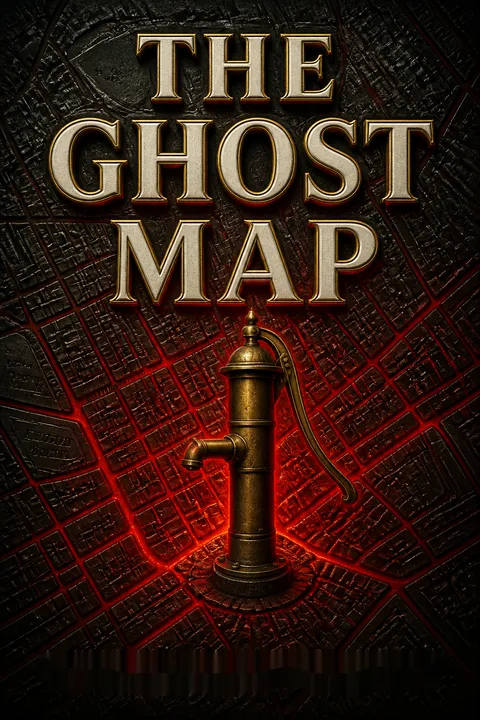
The Ghost Map recounts the 1854 cholera outbreak in London and Dr. John Snow's pioneering work in epidemiology. Readers found the historical details and scientific detective work fascinating, though some felt the book dragged in parts or included unnecessary tangents. Many appreciated Johnson's vivid depiction of Victorian London and the paradigm shift in understanding disease transmission. While most enjoyed the core story, opinions were mixed on the epilogue's speculations about modern urban life and global health threats.
People Also Read







Glossary
Miasma theory
Disease from polluted airA historical explanation that diseases such as cholera arose from, or spread through, foul air produced by decaying matter, sewage, and unsanitary places. Its intuitive fit with the odors of Victorian cities helped it retain authority. For cholera, it misidentified the transmission route: infection generally occurred when people swallowed water contaminated by infected waste.
Experimentum crucis
A decisive testA crucial experiment designed to distinguish between competing explanations by isolating the variable they disagree about. In Snow’s cholera investigation, the ideal test compared people living in similar conditions but drinking water from different sources. The term captures the demand for evidence that can separate waterborne transmission from explanations based on air, poverty, or neighborhood conditions.
Index case
First linked caseThe earliest identified case in an outbreak that can be connected to the chain of transmission under investigation. In the Broad Street inquiry, Whitehead identified baby Lewis as a likely starting point: she became ill before the wider outbreak, and water used to rinse her soiled diapers was poured into a cesspool close to the well.
Dot mapping
Cases plotted on mapsA way to display the locations of disease cases on a map, using dots, bars, or other marks to show where illness and death occur. In the Broad Street case, the map’s value came from comparing deaths with pumps and street access. The technique helped reveal spatial patterns, but the evidence behind the marks still had to be gathered and interpreted.
Voronoi diagram
Nearest-source regionsA diagram that divides an area into regions around specified points, assigning each location to the point nearest to it. Snow used this principle to outline which homes could reach the Broad Street pump more easily than other pumps. He based the boundary on routes through Soho’s streets, so it represented walking access rather than simple straight-line distance.
Consilience
Evidence across disciplinesA way of testing an explanation by seeing whether evidence from different fields or levels of analysis converges on the same conclusion. Snow connected clinical observations of cholera, the biology of the digestive system, household water habits, and citywide mortality patterns. The combined account was stronger than any isolated observation because its parts supported one another.
Transgenic shift
Genetic material exchangeA transfer of genetic material that can give a microorganism a new trait. The book uses the idea to explain how viruses or bacteria may acquire useful genetic instructions from other organisms, rather than relying only on random mutation. Such exchanges can alter how a pathogen behaves, including its ability to infect hosts or spread through a population.
FAQ
What's The Ghost Map about?
- Cholera Epidemic in London: The book chronicles the 1854 cholera outbreak in Soho, London, focusing on the deadly bacterium, the city's infrastructure, and the efforts of Dr. John Snow and Reverend Henry Whitehead.
- Scientific Investigation: It highlights how Snow used statistical analysis and mapping to trace the outbreak's patterns, leading to the understanding of cholera as a waterborne disease.
- Impact on Public Health: The narrative explores the broader implications of the outbreak on urban planning and public health policies, illustrating a pivotal moment in the understanding of disease transmission.
Why should I read The Ghost Map?
- Engaging Historical Narrative: Steven Johnson combines a gripping story with rich historical context, making it both informative and entertaining for readers interested in public health and urban history.
- Insight into Epidemiology: The book provides a fascinating look at the early days of epidemiology, showcasing how scientific inquiry can lead to significant societal change.
- Lessons for Today: The themes resonate with contemporary issues regarding public health and urban living, making it relevant for modern readers.
What are the key takeaways of The Ghost Map?
- Importance of Clean Water: The book emphasizes that access to clean drinking water is crucial for public health, as demonstrated by the cholera outbreak linked to contaminated water supplies.
- Role of Data and Observation: It illustrates how data collection and careful observation can reveal critical insights into public health crises, as exemplified by John Snow’s meticulous investigation.
- Interconnected Urban Systems: The narrative shows how urban systems, including sanitation and public health, are interconnected, and how failures in one area can lead to widespread consequences.
What methods did John Snow use in his investigation?
- Statistical Analysis: Snow employed statistical methods to analyze mortality data, identifying patterns in cholera cases relative to the Broad Street pump.
- Mapping Techniques: He created detailed maps that visually represented the locations of cholera cases, pinpointing the pump as the outbreak's source.
- Community Surveys: Snow conducted door-to-door interviews to gather firsthand accounts of residents' water consumption habits, complementing his statistical analysis.
How did the cholera outbreak change public health in London?
- Infrastructure Improvements: The outbreak led to significant investments in sanitation and sewage systems, resulting in the construction of a modern sewer system.
- Shift in Medical Understanding: It marked a turning point in the understanding of disease transmission, moving away from the miasma theory to a focus on waterborne pathogens.
- Public Health Policies: The epidemic prompted the establishment of more rigorous public health policies and the formation of health boards to monitor and manage urban health crises.
What is the miasma theory discussed in The Ghost Map?
- Historical Belief: The miasma theory posited that diseases like cholera were caused by "bad air" or noxious vapors emanating from decaying organic matter.
- Influence on Public Health: This theory influenced public health policies and responses to epidemics, leading to misguided interventions.
- Snow’s Challenge: John Snow’s investigation ultimately disproved the miasma theory, demonstrating that cholera was transmitted through contaminated water rather than the air.
What role did Henry Whitehead play in The Ghost Map?
- Community Connection: As a local curate, Whitehead had deep ties to the community, allowing him to gather firsthand accounts of the outbreak's impact on families.
- Support for Snow: He provided valuable insights and data that complemented Snow’s scientific approach, helping to humanize the statistics.
- Challenging Prejudices: Whitehead’s observations helped counteract the prevailing narratives that blamed the poor for their suffering, highlighting the need for systemic change.
What are the best quotes from The Ghost Map and what do they mean?
- "All smell is disease": This quote reflects the miasma theory's influence on public health thinking at the time, illustrating the misconceptions that led to ineffective responses.
- "The experiment…was on the grandest scale": This statement by Snow emphasizes the significance of his investigation into the cholera outbreak, framing it as a pivotal moment in public health history.
- “The pump handle was removed, and the plague was stayed.”: This encapsulates the pivotal moment when Snow's theory was acted upon, symbolizing the triumph of scientific reasoning over superstition.
How did John Snow prove his theory in The Ghost Map?
- Mapping Deaths: Snow meticulously mapped the locations of cholera deaths in relation to the Broad Street pump, revealing a clear correlation.
- Water Analysis: He conducted tests on water samples from various pumps, finding that the Broad Street water was contaminated.
- Community Engagement: Snow interviewed residents to gather anecdotal evidence about their water consumption habits, further solidifying his case.
What role did mapping play in The Ghost Map?
- Visualizing Data: Mapping allowed Snow to visualize the distribution of cholera cases, making it easier to identify patterns and correlations.
- Communicating Findings: The maps served as powerful tools for communicating Snow's findings to both the public and authorities.
- Historical Significance: Snow's maps are considered some of the earliest examples of disease mapping, influencing future epidemiological studies.
How did the public react to Snow's findings?
- Skepticism and Resistance: Initially, many members of the public and authorities were skeptical of Snow's waterborne theory, clinging to miasma beliefs.
- Gradual Acceptance: As the evidence mounted and the cholera outbreak subsided, more people began to accept Snow's findings.
- Legacy of Trust: The successful intervention based on Snow's research helped build trust in scientific inquiry and public health measures.
What are the broader implications of The Ghost Map?
- Urban Planning: The lessons learned from the cholera outbreak have had lasting effects on urban planning and public health infrastructure.
- Public Health Framework: The book underscores the importance of a robust public health framework that incorporates scientific research and community engagement.
- Crisis Response: The Ghost Map serves as a reminder of the need for timely and informed responses to health crises, exemplified by the collaboration between Snow and Whitehead.
About the Author
Other books by Steven Johnson





Download PDF
Download EPUB
.epub digital book format is ideal for reading ebooks on phones, tablets, and e-readers.








