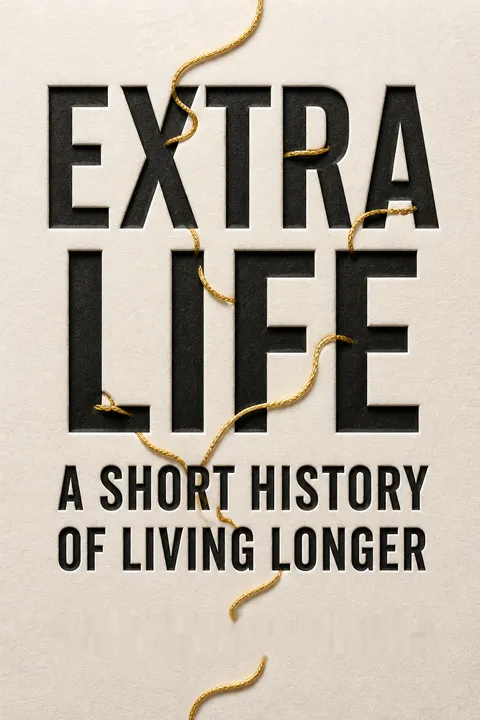


Key Takeaways
Humanity gained roughly 20,000 days by making childhood far less deadly.
The average hides the story. The book opens with the 1918 influenza pandemic, which drove US life expectancy down by about ten years in a single season. Yet the long arc turned sharply upward: compared with people several centuries ago, people today have gained roughly 20,000 days of life on average. That does not mean adults now routinely live twice as long. Much of the change comes from infants and children surviving illnesses that once killed huge portions of every generation. If three children out of ten die at age two while the rest live to seventy, the average is pulled down dramatically. Save those children, and the average rises even if adult lifespans do not change.
Read the distribution, too. Life expectancy at birth is a population average under current mortality conditions, not a personal prediction. The fall in childhood mortality, by more than a factor of ten globally, is a major part of what that average records.
The distinction between average lifespan and adult longevity is essential because averages can make demographic progress sound like a march toward immortality. In reality, preventing early deaths changes the arithmetic and the texture of ordinary life: more people reach adulthood, form families, and grow old. This is also a reminder that a good metric can reveal progress while concealing its source. Any public argument built around life expectancy is stronger when paired with age-specific mortality, especially childhood deaths.
Treat breakthroughs as networks, not lightning strikes by lone geniuses.
Ideas need carriers. Smallpox inoculation, later improved into vaccination, did not begin with a solitary European scientist. Variolation, the deliberate exposure to a milder smallpox infection to build protection, was practiced in parts of Asia and the Middle East. Lady Mary Wortley Montagu observed it in Constantinople and promoted it in Britain, including by having her children inoculated. In colonial New England, Onesimus, an enslaved man, described the practice to Cotton Mather, who helped spread it. Edward Jenner later improved the approach using cowpox. Each person supplied a different link: knowledge, access, evidence, advocacy, or technical refinement.
Adoption is part of invention. The book calls this a network narrative: a breakthrough depends not only on discovery but also on people and institutions that circulate, test, fund, and normalize it. A useful idea that never travels has little public effect.
This account expands the meaning of innovation beyond the moment an idea first appears. Diffusion research makes a similar point: adoption depends on trusted messengers, social ties, and institutions that reduce uncertainty. The network view also corrects a bias in historical storytelling, which tends to reward visible inventors and overlook translators, organizers, and practitioners. It should not erase individual insight, however. Networks do not make every participant equally important; they explain why a strong idea often needs several distinct contributions before it changes outcomes.
Count patterns, not just deaths, to make invisible causes actionable.
Numbers can change what is visible. In 1662, London haberdasher John Graunt analyzed weekly Bills of Mortality, turning scattered death records into patterns of risk. His tables suggested how deaths varied by cause and age, including the finding that 36 of every 100 London-born children died before age six. Centuries later, statistician William Farr compared life tables across Surrey, London, and Liverpool. His visualizations made the extreme mortality of industrial cities difficult to dismiss.
Maps can point toward causes. During the 1854 Soho cholera outbreak, doctor John Snow plotted deaths around a public water pump. The cluster suggested contaminated water, even though the cholera bacterium was not yet visible through a microscope. This kind of population-level investigation became epidemiology: studying how disease is distributed across people, places, and time so interventions can target its sources.
The power of these methods lies in converting dispersed experiences into a shared object of argument. A map or life table lets people question explanations that feel intuitively obvious, such as polluted air, by comparing them with the pattern of actual cases. This resembles modern causal inference, where researchers use variation across groups or time to test explanations. Still, a pattern alone does not prove a cause. The strongest epidemiology joins statistical signals with local knowledge, plausible mechanisms, and interventions whose results can be checked.
Use health data to expose unequal conditions, not blame vulnerable groups.
Measure the environment. In 1896, W. E. B. Du Bois spent hundreds of hours visiting more than 2,000 households in Philadelphia’s Seventh Ward. His study found that Black residents died at higher rates than white residents, and Black children were twice as likely to die before age fifteen. Rather than treating those differences as evidence of racial inferiority, he documented overcrowded housing, poor sanitation, restricted access to homes, and discriminatory rents. These conditions shaped exposure to disease and access to health.
Explain disparities, do not merely list them. Du Bois connected health outcomes to the social arrangements producing them. His work anticipated social epidemiology, the study of how social conditions and power affect patterns of illness. The practical implication is direct: exhortations to make healthier choices cannot substitute for changing environments that constrain those choices.
Du Bois’s method matters because measurement can either challenge prejudice or give it a scientific costume. The difference lies in whether researchers stop at group disparities or investigate the institutions that produce them. This approach aligns with contemporary social determinants of health research, which examines housing, income, work, and discrimination as causes rather than background details. Structural explanations should still be tested carefully, since communities are heterogeneous and mechanisms vary. But ignoring these conditions makes supposedly neutral medical analysis incomplete.
Prevention spreads when science gains advocates, law, and global delivery.
A vaccine needs a public. Variolation carried a real risk, yet smallpox killed children in enormous numbers. Its move from practice to broader protection depended on advocates and evidence, not only medical skill. In the twentieth century, international coordination made a still larger goal possible: eliminating smallpox. The World Health Organization coordinated work across 73 nations, with hundreds of thousands of health workers involved. In Liberia, epidemiologist William Foege developed ring vaccination: instead of vaccinating everyone in a region, teams protected the contacts surrounding each known case, creating a barrier to further spread.
Delivery completes prevention. A heat-stable vaccine, a simple bifurcated needle, surveillance, and local vaccination teams made the campaign workable. The last naturally occurring case was reported in 1975; global eradication was certified in 1980. The achievement depended on a global institution as much as on the vaccine itself.
Prevention is a collective-action problem: an individual may receive a benefit, while much of the value comes from reducing risk for others. That makes communication and legitimacy central to public health, not optional decoration. The smallpox campaign shows how a carefully chosen delivery strategy can conserve scarce resources while interrupting transmission. At the same time, coercive public policy can generate justified concerns about bodily autonomy. Durable prevention therefore requires clear evidence, accountable institutions, and attention to local trust, not simply a technically effective intervention.
Protect children upstream by fixing food, water, and sanitation systems.
Prevention often happens outside hospitals. Nineteenth-century New York milk could be dangerous: some urban dairies fed cows whiskey-distillery waste, and the resulting milk was linked to childhood deaths. Journalist Frank Leslie publicized the scandal, while department-store owner Nathan Straus later sold pasteurized milk at low cost. At an orphanage on Randall’s Island, introducing pasteurized milk was followed by a 14 percent fall in mortality. Meanwhile, sewer systems and water treatment separated drinking water from human waste. Chlorination helped make contaminated water safer at scale.
Simple treatments can travel. During a 1971 cholera crisis among refugees in Bangladesh, doctor Dilip Mahalanabis used oral rehydration therapy, a drink of water, salts, and sugar that replaces fluids lost through diarrhea. In the camps, mortality fell from about 30 percent to 3 percent. The shared lesson: safer environments and accessible treatments can save lives before advanced clinical care is available.
These examples shift the center of health from the clinic to the systems that shape daily exposure. Clean water, safe food, and simple rehydration are often less glamorous than medical technology, but their reach can be broad and their benefits preventive. The history also shows why technical plausibility is not enough: pasteurization and oral rehydration each faced delays in adoption. A useful intervention needs supply, affordability, public confidence, and an institution prepared to support it.
Demand controlled evidence, because hope and recovery can masquerade as cures.
A treatment needs a fair test. Before modern trials, many medicines relied on testimonials, while patients often recovered through their own immune systems or the placebo effect. In 1937, a sweet-tasting sulfa medicine dissolved in toxic diethylene glycol killed 105 people. The disaster helped prompt stronger drug-safety laws. Decades later, FDA reviewer Frances Kelsey delayed approval of thalidomide in the United States because the evidence was inadequate and safety signals remained unresolved. Her caution helped prevent widespread birth defects there.
Separate signal from expectation. A randomized, controlled double-blind trial assigns participants by chance to a treatment or comparison group, while concealing assignments from participants and researchers. This helps limit bias and distinguish a drug’s effect from natural recovery or expectation. Bradford Hill’s work helped establish this method. Hill and Richard Doll also used comparative studies to identify smoking as a cause of lung cancer, even though it was not the only cause.
The central contribution of controlled trials is not that they eliminate uncertainty, but that they discipline it. Randomization reduces the chance that treatment groups differ systematically, while blinding limits expectations from shaping reports or assessments. Yet trials answer bounded questions: results depend on who is included, what outcome is measured, and how long participants are followed. Good regulation therefore needs more than a single successful study. It needs transparent evidence, continued safety monitoring, and rules that can respond when new risks appear.
A discovery saves lives only after someone solves the scaling problem.
Penicillin needed a production system. Alexander Fleming noticed in 1928 that mold inhibited bacteria, but he did not establish that it could treat infection in a person. At Oxford, Howard Florey, Ernst Chain, and laboratory engineer Norman Heatley refined the substance and tested it. Their first human patient, Albert Alexander, improved dramatically, but the team ran out of penicillin and he died. The treatment worked; the supply did not.
Scale came from unlikely partners. US agricultural researchers found that penicillin mold grew well in corn steep liquor, and bacteriologist Mary Hunt identified a more productive strain on a moldy cantaloupe. Government, military, university, and pharmaceutical teams then developed mass production. By the 1944 Normandy landings, Allied forces carried penicillin. The path from observation to broad impact required experiments, engineering, manufacturing, funding, and distribution.
The distinction between efficacy and reach is a useful test for any proposed breakthrough. A treatment can work perfectly in a laboratory and still have negligible population impact if it cannot be manufactured, delivered, or afforded. This resembles the difference between invention and infrastructure in technology policy: the latter is often less visible but determines who benefits. The wartime setting accelerated coordination and investment, though it also raises a question about priorities. Essential health innovations should not have to wait for military urgency to receive serious support.
Redesign dangerous systems instead of treating their casualties as inevitable.
Accidents are design problems. Early industrial machines and railways killed workers at alarming rates. In 1888, US data showed railway workers faced roughly a 1 in 117 chance of dying in an industrial accident. Safety laws requiring automatic couplers and power brakes helped cut rail-worker deaths in half. Later, engineer Hugh DeHaven studied crash survivors and argued that vehicle design could protect occupants. He tested impact protection with eggs, then analyzed falls and collisions. John Stapp used rocket sleds to study how the human body tolerates sudden deceleration.
Evidence needed a champion. Volvo engineer Nils Bohlin developed the three-point seat belt and made the patent available to other manufacturers. But broad adoption in the United States required consumer advocate Ralph Nader, public pressure, and federal standards. Since the early era of driving, people have become more than ten times less likely to die per mile traveled.
Treating injury as preventable changes the engineering question from who caused the crash to how the system can limit harm. This is a core idea in safety engineering: build defenses that still work when people make mistakes or components fail. It also explains why markets may underprovide safety when consumers cannot easily judge risk or when safer products threaten an industry’s preferred image. Regulation can correct that gap, though standards need regular revision as technologies and hazards change.
Feed more people through innovation, but count the ecological bill.
Food security changed the health landscape. In 1908, chemists Fritz Haber and Carl Bosch developed a way to manufacture ammonia from atmospheric nitrogen at industrial scale. The process first helped supply explosives, then made artificial fertilizer widely available. Combined with later agricultural changes, it greatly increased crop yields. The book links this transformation to a sharp fall in famine deaths and chronic undernourishment, even as global population grew from about two billion to more than seven billion.
Success created new costs. Artificial fertilizer uses substantial natural gas, and runoff contributes to oxygen-depleted marine dead zones. Industrial poultry made animal protein cheaper and more abundant, but concentrated production also raises animal-welfare and disease risks. The adjacent possible is the set of new opportunities made thinkable by an innovation. In this case, wartime chemistry unexpectedly opened a path to feeding populations, while also creating environmental pressures that earlier generations did not face.
The history resists both easy celebration and easy condemnation. Fertilizer helped prevent hunger at a scale difficult to imagine, while its production and runoff impose costs on ecosystems. This is a classic rebound problem: efficiency can reduce resource use per unit while making much larger total consumption possible. Evaluation therefore needs more than a count of lives saved. It should include distribution, ecological effects, and the possibility of redesigning production so that nutritional gains do not depend on avoidable environmental damage.
Celebrate longer lives, then measure who still lacks the protections.
Progress remains uneven. The health gap between richer and poorer countries has narrowed dramatically in recent decades, but sharp differences persist within cities and nations. The book contrasts a life expectancy of about 82 in one Brooklyn area with about 73 in nearby Brownsville. Such differences show that averages can improve while whole communities remain exposed to preventable risks.
The upward line is not guaranteed. Future protection may depend on earlier outbreak detection, including surveillance in animals where some infections first emerge, as well as better data sharing and new treatments. The conclusion also warns that population growth and industrial life have intensified climate pressures. The extra years gained through public health are extraordinary, but they do not make progress automatic. The next task is to identify the remaining gaps and build institutions capable of closing them.
A progress narrative is most useful when it creates both confidence and accountability. Historical gains show that mortality is not fixed, but they do not prove that every society will keep improving or that benefits will be shared fairly. The Brooklyn comparison makes inequality concrete: proximity does not guarantee equal access to safety. Climate risk further complicates the story because gains in survival can increase pressure on shared resources. The right response is neither nostalgia nor triumphalism, but sustained measurement and collective action.
Analysis
The book’s central achievement is to make longevity a history of systems rather than a parade of inventions. Its organizing measure, life expectancy, connects intimate losses to population-wide change, while the stories reveal the mechanisms hidden behind the curve: counting, clean infrastructure, regulation, persuasion, manufacturing, and international coordination. That is a powerful corrective to histories that assign progress to a handful of celebrated scientists or to market innovation alone.
The metric also needs careful handling. Life expectancy at birth is highly sensitive to early death, so its dramatic rise can be mistaken for a comparable transformation in adult aging. The book repeatedly corrects this error by directing attention to childhood mortality and age-specific distributions. A second caution concerns causal attribution. Lives saved are counterfactual: no one can directly observe the deaths that would have occurred without a sewer, vaccine, or safety law. The book acknowledges this uncertainty and argues in practical terms, through converging historical evidence and comparisons, rather than claiming exact rankings as settled fact.
Its most compelling recurring principle is complementarity. A vaccine requires delivery and public trust. A treatment requires testing and reliable production. A map becomes useful when decision-makers act on it. This implies that societies should assess innovations not only by whether they work, but by whether the surrounding institutions can make them work for broad populations. Public health is therefore both science and governance.
The final tension is consequential: interventions that save lives can create second-order pressures, from population growth to ecological damage. That does not weaken the case for saving lives. It shows that successful solutions alter the problems societies face next. The book’s most durable lesson is consequently double-sided: progress is real, measurable, and reversible, and its benefits must be continually extended while its new costs are managed.
Review Summary
Extra Life explores how human life expectancy doubled in the past century, examining innovations like vaccines, antibiotics, and public health measures. Johnson emphasizes the collaborative nature of progress, highlighting lesser-known contributors alongside famous figures. The book challenges the "lone genius" narrative, instead portraying advancements as products of complex networks. Reviewers praise Johnson's engaging writing style and ability to make scientific history fascinating, though some criticize his emphasis on government intervention. Overall, the book offers an informative look at the factors behind increased longevity.
People Also Read




Glossary
life expectancy at birth
Average lifespan under current mortalityA demographic estimate of how long a newborn would live if the age-specific death rates observed in a particular year remained constant throughout that child’s life. It describes a population’s mortality conditions, not a prediction for any individual. Because infant and child deaths strongly affect the average, changes in this measure can reflect fewer early deaths even when adult longevity changes little.
vital statistics
Population health recordsSystematic information about births, deaths, causes of death, age, occupation, and other population characteristics. In the book, vital statistics describe the emerging practice of arranging public records so that patterns can be detected and acted upon. The method turns individual events into evidence about the health of communities and helps authorities identify risks, inequalities, and possible causes.
network narrative
Innovation through connected contributorsAn account of progress that traces how an idea moves among people and institutions, rather than crediting a single inventor. It highlights distinct roles such as connecting knowledge across cultures, testing a proposal, persuading the public, supplying money, building production, and establishing rules. The approach explains why discovery alone often has little effect until a network makes an idea usable at scale.
ring vaccination
Vaccinating contacts around casesAn outbreak-control method that vaccinates people who have been in contact with an infected person, along with nearby contacts, to form a protective barrier around the outbreak. William Foege developed the approach during a smallpox response in Liberia when vaccine supplies were limited. Instead of attempting to vaccinate every person in a broad region, teams focused on interrupting the disease’s likely path of transmission.
oral rehydration therapy
Replacing fluids by mouthA treatment for severe diarrhea and cholera that gives the patient water combined with sugar and salts. The mixture helps replace lost fluids and electrolytes without requiring an intravenous line or hospital equipment. Because it can be prepared and administered by nonspecialists, it is especially useful where clinics and trained staff are scarce. Its adoption expanded through field demonstrations, education, and public health programs.
randomized, controlled double-blind trials
A method for testing treatmentsA study design that assigns participants by chance to a treatment group or a comparison group, often given a placebo. In a double-blind trial, neither participants nor the people administering the treatment know who received which option during the study. Randomization and blinding help limit bias, while comparison allows researchers to distinguish a treatment’s effects from natural recovery, expectation, or chance.
McKeown thesis
Mortality fell before effective medicineHistorian and physician Thomas McKeown’s argument that much of the historical decline in mortality occurred before effective medical treatments for major infectious diseases were available. He emphasized rising living standards and improved nutrition as important explanations. Later scholarship challenged parts of his account, especially its weighting of nutrition, while broadly supporting his view that medicine had limited effects on population mortality before the mid-twentieth century.
adjacent possible
New options unlocked by changeThe set of further ideas or developments that become possible after an earlier innovation changes what people can do or imagine. A breakthrough can have effects beyond its original purpose, opening paths in seemingly distant fields. The book uses the concept to explain connections such as industrial nitrogen chemistry becoming a basis for fertilizer, and experimental methods enabling stronger drug regulation.
technophysio evolution
Health and productivity reinforcing each otherA feedback process in which technological and social changes improve nutrition and health, allowing people to contribute more energy and labor, which can support further economic and technological development. The concept is used to describe how better food supplies can improve physical capacity and living standards in mutually reinforcing ways. It connects biological well-being with economic and social change.
FAQ
What is Extra Life: A Short History of Living Longer by Steven Johnson about?
- Dramatic rise in longevity: The book explores how human life expectancy has doubled over the past century, tracing the scientific, social, and institutional breakthroughs that made this possible.
- Focus on networks and systems: Johnson emphasizes that progress is the result of collaborative networks—scientists, activists, regulators, and institutions—rather than lone geniuses.
- Comprehensive historical narrative: The story covers innovations from early epidemiology and vaccines to modern drug regulation, public health, and data-driven approaches.
- Persistent health inequalities: The book also addresses ongoing disparities in life expectancy across different populations and the challenges that remain.
Why should I read Extra Life: A Short History of Living Longer by Steven Johnson?
- Understanding human progress: The book reveals how humanity achieved one of its greatest feats—doubling life expectancy—and explains the interplay of science, public health, and social change.
- Insight into public health: Readers gain appreciation for the often-invisible roles of data, regulation, and advocacy in health improvements, not just medical discoveries.
- Relevance to current issues: Johnson connects historical lessons to modern challenges like pandemics, climate change, and aging, offering a framework for thinking about future health crises.
- Balanced perspective: The book inspires optimism about progress while cautioning against complacency, highlighting both achievements and ongoing vulnerabilities.
What are the key takeaways from Extra Life: A Short History of Living Longer by Steven Johnson?
- Life expectancy doubled: Over the last century, global life expectancy has roughly doubled, mainly due to reductions in childhood mortality and infectious diseases.
- Progress is multifaceted: No single invention explains this leap; it’s the result of multiple breakthroughs—vaccines, antibiotics, sanitation, epidemiology, and safety regulations.
- Networks drive innovation: Advances depended on collaborative networks and institutions, not just individual geniuses, with social movements and public policy playing crucial roles.
- History informs the future: Understanding this history helps us value public health infrastructure and recognize vulnerabilities, such as health disparities and the resurgence of infectious diseases.
What are the most important innovations and concepts explained in Extra Life by Steven Johnson?
- Randomized Controlled Trials (RCTs): RCTs transformed medicine by enabling rigorous testing of drug efficacy, separating effective treatments from quack cures.
- Vital statistics and epidemiology: Pioneers like William Farr and John Snow used data and mapping to understand disease patterns and improve public health infrastructure.
- Antibiotics revolution: The discovery and mass production of penicillin drastically reduced deaths from bacterial infections and enabled new medical procedures.
- Automobile safety and regulation: Innovations like seat belts and crash testing, driven by engineers, activists, and regulation, dramatically reduced traffic fatalities.
- Agricultural and nutritional advances: Innovations in soil science, artificial fertilizer, and factory farming helped feed a growing global population and reduce famine.
How does Steven Johnson explain the role of vaccines in extending life expectancy in Extra Life?
- Origins of immunization: The practice of variolation, and later vaccination, began centuries ago and was brought to Europe by figures like Lady Mary Wortley Montagu.
- Jenner’s breakthrough: Edward Jenner’s use of cowpox to prevent smallpox marked a major advance, but built on existing knowledge and practices.
- Global eradication efforts: The World Health Organization’s campaign led to the eradication of smallpox by 1979, showcasing international collaboration and technological innovation.
- Social and legal movements: Vaccination required advocacy, public acceptance, and legal frameworks to become widespread and effective.
What is the significance of life expectancy measurement in Extra Life by Steven Johnson?
- Statistical innovation: Life expectancy is a statistical prediction of average lifespan, first systematically calculated by John Graunt in the 1660s.
- Challenges in early measurement: High childhood mortality and lack of accurate age data complicated early calculations, as seen in studies of preindustrial societies.
- Revealing health disparities: Life expectancy trends expose inequalities, such as gaps between social classes or racial groups, and remain central to tracking public health progress.
- Impact on public health: Measuring life expectancy at different ages helps understand the effects of childhood mortality and guides health interventions.
How did data and epidemiology transform public health, according to Extra Life by Steven Johnson?
- Vital statistics revolution: William Farr’s systematic collection and analysis of mortality data revealed health inequalities and laid the foundation for modern epidemiology.
- Epidemiological detective work: John Snow’s mapping of cholera deaths identified contaminated water as the source, debunking the miasma theory and leading to effective interventions.
- Social determinants of health: W. E. B. Du Bois used epidemiological methods to link racial health disparities to environmental and systemic factors, anticipating modern social epidemiology.
- Data-driven insights: These pioneers showed how data visualization and analysis can save lives and inform public health policy.
How did pasteurization and chlorination reduce childhood mortality in Extra Life by Steven Johnson?
- Swill milk crisis: Contaminated milk in 19th-century New York caused high infant mortality, leading to reforms and the adoption of pasteurization.
- Pasteur’s discovery: Louis Pasteur developed pasteurization in the 1860s, but widespread adoption required public education and advocacy.
- Chlorination of water: Adding chlorine to drinking water in the early 20th century killed bacteria and dramatically reduced infant mortality from waterborne diseases.
- Combined impact: Pasteurization and chlorination, supported by social movements and public pressure, saved millions of lives by making basic foods and water safe.
What challenges in drug regulation and testing does Steven Johnson highlight in Extra Life?
- Early unregulated medicine: Before the 1930s, the pharmaceutical industry sold dangerous or ineffective remedies with little oversight.
- Regulatory turning points: Tragedies like the Elixir Sulfanilamide disaster led to laws requiring safety testing, empowering the FDA to regulate drugs.
- Placebo and RCTs: The development of randomized controlled trials and the use of placebos transformed drug testing from anecdote to science.
- Ongoing vigilance: The book underscores the need for continued regulatory vigilance to ensure drug safety and efficacy.
How did Frances Oldham Kelsey and the FDA shape drug safety, according to Extra Life by Steven Johnson?
- Heroic regulatory action: Kelsey’s refusal to approve thalidomide in the U.S. prevented thousands of birth defects, highlighting the importance of careful drug review.
- Strengthening regulations: The thalidomide scandal led to the Kefauver-Harris Drug Amendments, requiring proof of efficacy as well as safety for new drugs.
- Empirical evidence focus: Kelsey’s insistence on rigorous data over testimonials set a new standard for scientific rigor in drug approval.
- Legacy for clinical trials: Her work exemplifies the critical role of regulatory agencies and the need for robust clinical evidence.
What is the importance of randomized controlled trials (RCTs) in Extra Life by Steven Johnson?
- Gold standard for testing: RCTs involve randomly assigning subjects to experimental and control groups, using placebos and double-blinding to eliminate bias.
- Historical development: The method evolved from James Lind’s scurvy experiment to R. A. Fisher’s statistical innovations and Austin Bradford Hill’s landmark trials.
- Transforming medicine: RCTs enabled regulators to demand proof of efficacy, separating effective treatments from quack cures and underpinning advances in drug approval.
- Impact on public health: RCTs are now central to vaccine development, drug approval, and evaluating public health interventions.
How did the discovery and mass production of penicillin revolutionize medicine in Extra Life by Steven Johnson?
- Serendipitous discovery: Alexander Fleming discovered penicillin’s antibacterial properties in 1928, but its potential was initially overlooked.
- Collaborative development: The Oxford team refined penicillin’s efficacy and, with American support, enabled mass production during World War II.
- Antibiotics revolution: Penicillin drastically reduced deaths from bacterial infections and enabled complex surgeries, marking a turning point in medicine.
- Global impact: The success of penicillin launched the antibiotics era, saving millions of lives and changing the course of medical history.
What are the best quotes from Extra Life: A Short History of Living Longer by Steven Johnson and what do they mean?
- “The story of human progress is, in many ways, the story of life expectancy.” This quote encapsulates the book’s central thesis that the doubling of life expectancy is one of humanity’s greatest achievements.
- “Progress is not the work of a single genius, but of networks and systems.” Johnson emphasizes the collaborative nature of innovation, challenging the myth of the lone inventor.
- “The invisible shield of public health protects us every day.” This highlights the often-unseen infrastructure and policies that safeguard modern life.
- “History is a map of the future.” Johnson argues that understanding past health breakthroughs is essential for preparing for future challenges.
- “We are the beneficiaries of a thousand small interventions.” This quote underscores that progress is cumulative, built on many incremental advances rather than a few dramatic breakthroughs.
About the Author
Other books by Steven Johnson








Download PDF
Download EPUB
.epub digital book format is ideal for reading ebooks on phones, tablets, and e-readers.








