

Key Takeaways
Trace how ordinary tools quietly reshape lives far beyond their original purpose.
Follow the unexpected links. This history begins with everyday objects, then follows their effects across science, culture, and politics. Johnson calls one recurring pattern the “hummingbird effect ”: a change in one field creates conditions that enable an unforeseen change in another. Printing made books more accessible, which revealed widespread farsightedness and created demand for spectacles. The resulting expertise in lenses helped produce microscopes and telescopes. The chain is not a mysterious butterfly effect. Its links can be traced and understood, even when the final result was not part of anyone’s plan.
Tools enable, not dictate. The book’s central claim is that inventions often make social changes possible without causing them alone. Glass mirrors supported new forms of self-portraiture and introspection, but they did not single-handedly create the Renaissance. Progress also brings costs, from air-conditioning’s environmental demands to technologies used for harm.
What's valuable here is a distinction between a trigger and a complete explanation. A technology can alter what is feasible, visible, or profitable, while institutions and choices determine what people do with that opening. This resembles the idea of affordances in design: a tool makes certain actions easier to imagine and perform without compelling anyone to take them. The approach is strongest when links are concrete, as with print, spectacles, and lenses. More diffuse claims, such as mirrors helping create modern individualism, are suggestive rather than provable. Treating those claims as enabling conditions, not single-cause explanations, keeps the historical lens sharp.
A market for spectacles helped turn glass into a technology for seeing the unseen.
From ornament to optics. Glass was prized for vessels and decoration long before it transformed vision. After glassmakers settled on Murano near Venice, dense competition and shared expertise helped produce cristallo, a particularly clear glass. A later market shock mattered just as much: Gutenberg’s printing press brought more people into reading, making many newly aware of farsightedness. Demand for spectacles created a larger community of lens makers and experimenters.
Vision kept expanding. By arranging lenses in new ways, makers developed microscopes and telescopes. Robert Hooke’s microscope revealed the small compartments he named cells; Galileo’s telescope showed moons orbiting Jupiter, challenging the idea that everything circled Earth. Glass fibers eventually carried laser pulses as information, forming the backbone of global communications. Mirrors also gave people and artists new ways to see themselves, though their cultural influence is harder to measure than the practical effects of lenses.
The spectacles story shows how a new medium can expose a limitation people did not previously recognize as a problem. That pattern appears in many technologies: measurement tools make hidden variation legible, and markets then fund better instruments. The lens chain is particularly persuasive because each step has a direct technical connection. The argument about mirrors and individual selfhood is more interpretive. A mirror may have supported new habits of introspection, but literacy, commerce, and artistic patronage also mattered. Distinguishing strong material links from plausible cultural influences makes this a useful model of technological history, not technological determinism.
Cold became infrastructure, changing what people ate, where they lived, and when they had children.
A failed cargo taught Tudor. Frederic Tudor shipped New England ice to Martinique, expecting demand; residents had little idea what to do with it. He eventually solved the practical problems with better storage, sawdust insulation, and cheap space in ships that otherwise sailed empty. Ice became a trade, then a platform for artificial refrigeration. Doctor John Gorrie built a machine to make ice for fever patients, while Clarence Birdseye developed flash freezing, which preserved food better by forming smaller ice crystals.
Cooling moved populations. Refrigerated railcars helped Chicago meat reach distant markets, reshaping food production and the Great Plains. Home air-conditioning made hot regions more attractive. As Americans moved south and west, the Sun Belt gained population and political influence. Cold technologies also support fertility treatments that preserve reproductive cells and embryos. A device for comfort became part of food systems, migration, and family life.
Cold is a striking example of infrastructure changing demand rather than merely serving it. Refrigeration does not just preserve existing food habits; it makes distant supply chains, year-round availability, and new settlement patterns viable. The same systems can widen access to nutrition and support reproductive choices, while also encouraging energy use, industrial meat production, and development in water-stressed regions. These are not contradictions to be resolved by calling refrigeration good or bad. They are reminders that a technology’s benefits and costs often travel through the same network, and that policy determines who receives each.
Sound tools repeatedly escaped their inventors’ plans, from jazz broadcasts to prenatal imaging.
Recording began with a blind spot. Édouard-Léon Scott de Martinville built a device that traced sound waves onto a surface, but did not imagine playing them back. More than a century later, researchers used computers to turn one of his drawings into audible sound. A later leap came when wartime researchers converted speech into digital samples, making sound easier to encrypt and helping open the path to digital media.
New uses changed culture. Radio brought jazz into homes across the United States, giving Black musicians national audiences. Vacuum-tube amplification made mass rallies and stadium concerts possible, and its distortions became part of rock music. Reginald Fessenden’s underwater sound device helped inspire sonar; related sound imaging became prenatal ultrasound. That medical use can support care, but sex identification has also enabled sex-selective abortions in societies with strong preferences for sons.
The chapter makes a strong case that the uses of a communication technology are not contained in its engineering brief. Media studies often describe this as a shift in the relationship between producers, audiences, and cultural authority: radio amplified local music while also building mass audiences. The ultrasound example adds a harder point. More information does not automatically produce better outcomes; its effects depend on social norms and access to choices. The ethical task therefore begins before deployment, with attention to foreseeable incentives and unequal power, while accepting that no design process can anticipate every use.
Clean water cut city deaths sharply, but billions still lack basic sanitation.
Waste could poison the cure. Chicago’s early sewer system carried filth away from streets but emptied it into the river that supplied drinking water. The city even raised buildings and streets to create the slope its flat landscape lacked. John Snow’s mapping of cholera deaths helped show that contaminated water, not foul air, spread disease. Microscopes and germ theory made the threat clearer; John Leal then secretly tested chlorine in Jersey City’s water supply.
Measurement made safety testable. Researchers could assess bacterial contamination instead of waiting to see whether fewer people died. A study of American cities attributed a 43 percent reduction in total mortality and a 74 percent reduction in infant mortality to clean-water improvements. Yet billions still lack safe water and sanitation. The book points to toilets that treat waste locally as one possible alternative where massive sewer networks are impractical.
Public health infrastructure illustrates why quiet engineering can matter more than spectacular invention: it changes the baseline risks of daily life for whole populations. The book also links scientific knowledge to administrative capacity. Germ theory identified a threat, measurement made it observable, and municipal systems made prevention routine. The mortality figures summarize a historical analysis, not a promise that chlorine alone explains every improvement. The continuing sanitation gap is a crucial qualification: successful infrastructure in wealthy cities does not guarantee universal access. The next challenge is adapting solutions to local conditions rather than assuming every place can copy the same costly network.
Every more accurate clock redraws geography and reorganizes work.
Time became a tool of navigation. Galileo studied the regular swing of a pendulum, an observation that helped inspire more accurate clocks. Reliable time mattered to sailors trying to calculate longitude: comparing a ship’s time with the time at its home port revealed how far east or west it had traveled. Later, railroads forced towns to coordinate their clocks, replacing thousands of local times with standardized zones.
Precision changed daily life. Factory owners used clock time to coordinate workers and pay by the hour, replacing work rhythms organized around tasks. Quartz and then atomic clocks brought far greater precision. Atomic timing helps GPS receivers locate a phone by comparing signals from satellites. Meanwhile, radioactive decay provides clocks for dating ancient remains and rocks. The same human project measures fractions of seconds, deep history, and the location of a traveler.
Timekeeping is not merely a record of nature; it is also a technology of coordination and authority. Standard time helps trains run safely and networks function, but factory time also made workers’ hours measurable and subject to employer control. That dual role connects the history of clocks to modern debates about digital tracking and workplace metrics. Precision is useful when tasks genuinely require synchronization. It becomes less benign when measurement substitutes for judgment or treats every minute as interchangeable. The book’s history invites a practical question: whose coordination problem does a new standard solve, and who must adapt to it?
Cheap light stretched the night, exposed hidden poverty, and rewrote the economics of energy.
Brightness had a brutal supply chain. Before electric lighting, prized spermaceti candles depended on killing whales and extracting oil from their heads. Petroleum lamps offered brighter light and helped ease pressure on whale populations. Historian William Nordhaus compared the cost of producing equal amounts of light: around 1800, an hour’s wages bought about ten minutes of light; in the modern comparison, an hour’s wages bought roughly three hundred days.
Light changed what society could see. Electric lighting enabled more evening work and entertainment, while historical research suggests people once commonly slept in two nightly periods. Flash photography let journalist Jacob Riis document dark New York tenements, helping build support for housing reform. Lasers later scanned retail barcodes, supporting larger inventories and big-box stores. Each gain depended on networks of materials, power, engineering, and public response, not a bulb alone.
Light offers an unusually vivid measure of technological progress because the useful output, illumination, stays comparable while the cost collapses. Yet cheapness can hide external costs, from energy demand to the labor and materials behind electrical systems. The Riis example shows that visibility is political: images can make neglected conditions harder to ignore, but documentation alone does not guarantee reform. The chapter also complicates the idea that technology simply liberates people from nature. Artificial light extends activity into night while reshaping sleep and work. Its gains are real, but so are the new dependencies it creates.
Cross disciplines to spot possibilities that experts inside one field may miss.
Ideas need ingredients. The “adjacent possible” is the set of innovations that become imaginable once the necessary ideas and tools exist. Artificial refrigeration, for example, depended on knowledge of gases, heat, and measurement. Often several people independently reach similar solutions once those ingredients are available; Johnson calls this “multiple invention.” But some thinkers reach further by combining distant fields.
Ada Lovelace saw beyond calculation. Working with Charles Babbage’s proposed Analytical Engine, she recognized that a programmable machine might manipulate symbols and even produce music, not merely calculate numbers. Her mathematical training and imaginative interests helped her see that possibility. Other examples include Birdseye combining experience in Labrador with food science and factory production. The book’s practical lesson is not to wait for a miraculous flash: keep interests diverse, test hunches, and seek unfamiliar settings where separate kinds of knowledge can meet.
Innovation research often finds that recombination matters: novel work can emerge when existing ideas meet across social or disciplinary boundaries. The examples here make that claim tangible, especially Lovelace’s ability to imagine computation as symbolic expression. Still, cross-disciplinary contact is not automatically productive. Shared language, time to experiment, and institutions that tolerate failed attempts are often necessary for a useful combination to take shape. Celebrating the boundary-crossing thinker should not obscure collective labor or the enabling infrastructure. The most fruitful question is not simply how to be more eclectic, but how to build settings where different kinds of expertise can work together.
Analysis
The book’s organizing achievement is to make infrastructure narratively visible. Glass, cold, sound, sanitation, clocks, and light are familiar precisely because successful systems disappear into daily routine. By following each material or measurement across scales, the book counters histories that privilege rulers, celebrated inventors, and deliberate political decisions. Its strongest explanations trace concrete enabling chains: print expands reading, reading creates demand for lenses, and lens expertise supports new instruments. This approach also gives readers a useful distinction between an invention’s intended function and its social afterlife.
The method has an important limit. A long chain can be illuminating, but the farther it reaches into cultural or political change, the harder it becomes to establish how much causal weight belongs to the technology. The book is most convincing when it treats inventions as conditions that make outcomes easier or more likely, not as solitary causes. Its accounts of glass and individualism, or air-conditioning and electoral change, are valuable partly because they invite questions about other forces, including wealth, institutions, migration, and law.
The book’s deeper argument is therefore not that technology rules history, but that historical agency is distributed. Material properties constrain what can be built; networks of expertise make some ideas imaginable; markets and governments shape adoption; communities decide how tools are used. The same system can create lifesaving clean water and commercial hygiene anxieties, or connect voices while enabling mass persuasion. Progress is neither a straight line nor a neutral force. It is an accumulation of capabilities whose benefits and harms depend on governance and access.
That perspective is especially useful in evaluating current technologies. Rather than asking only what a tool does, readers can ask what conditions enabled it, what adjacent domains it may affect, whose choices it expands, and which costs remain invisible. Such questions turn history into more than a catalogue of clever objects. They make it a method for anticipating consequences without pretending to predict them perfectly.
Review Summary
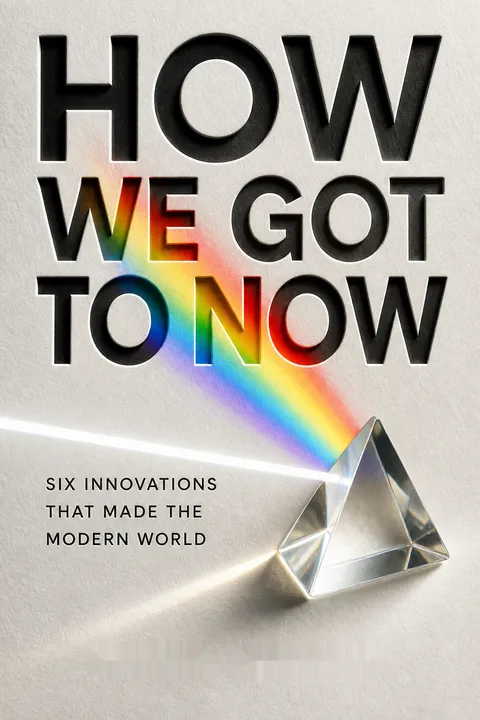
How We Got to Now receives mostly positive reviews for its fascinating exploration of six technological innovations that shaped the modern world. Readers appreciate Johnson's engaging writing style, interesting historical anecdotes, and ability to draw connections between seemingly unrelated developments. Some criticize the book for lacking depth or feeling rushed in later chapters. Many find it thought-provoking and enjoyable, praising Johnson's insights into the nature of innovation and its unexpected consequences. The book is often compared favorably to the TV series "Connections" and recommended for those interested in the history of technology.
People Also Read




Glossary
hummingbird effect
Cross-field ripple effectsA pattern in which an innovation in one area creates conditions for changes in a seemingly unrelated area. The connection is more than a remote butterfly-effect association: the chain can be traced through practical links. Printing increased demand for spectacles, for example, helping expand lens expertise that enabled microscopes and telescopes.
long-zoom history
History across multiple scalesAn approach to historical explanation that moves between scales, from physical materials and biological processes to institutions, cities, and political movements. It treats those levels as connected parts of the same history. The method helps reveal how a small technical change, such as a new way to cool air, can contribute to a large social transformation.
adjacent possible
What current knowledge enablesThe set of ideas and inventions that become feasible or imaginable given the tools, concepts, and knowledge available at a particular time. A brilliant inventor cannot build on components that do not yet exist. Artificial refrigeration became possible after developments in understanding gases, heat, measurement, and mechanical systems converged.
slow hunch
An idea developing over timeAn insight that takes shape gradually rather than arriving as a sudden flash of inspiration. It develops as observations, skills, and partial explanations accumulate. Clarence Birdseye’s frozen-food innovation grew from noticing how quickly fish froze in Labrador, studying food quality, and later encountering inefficiencies in commercial fishing and distribution.
multiple invention
Independent, near-simultaneous discoveriesThe phenomenon in which different people or groups independently arrive at similar inventions or discoveries around the same period. It suggests that the necessary knowledge and materials have made an idea newly attainable, rather than proving that one isolated genius alone caused it. Refrigeration and several other major technologies emerged through such clusters.
time discipline
Life organized by clock timeThe social practice of coordinating activity around standardized clock units rather than the natural rhythms or completion of particular tasks. As accurate clocks spread, factories could synchronize workers and pay by the hour, while railroads needed common schedules. This system improved coordination but also made workers’ time measurable and controllable.
FAQ
What's How We Got to Now about?
- Exploration of Innovations: The book examines six key innovations—glass, cold, sound, clean, time, and light—that have significantly shaped modern life. Each chapter delves into the history and impact of these innovations.
- Hummingbird Effect: Steven Johnson introduces the "hummingbird effect," where innovations in one area trigger unexpected changes in unrelated fields, encouraging readers to see the ripple effects of technological advancements.
- Historical Perspective: The narrative combines historical anecdotes, scientific discoveries, and cultural shifts, providing a comprehensive view of how these innovations have transformed human experience over centuries.
Why should I read How We Got to Now?
- Understanding Modern Life: The book offers insights into everyday objects and technologies, helping readers appreciate their origins and significance.
- Interconnectedness of Ideas: Johnson's exploration of the "hummingbird effect" illustrates how innovations are part of a larger web of influence, inspiring creative problem-solving.
- Engaging Storytelling: Johnson's narrative style makes complex ideas accessible and engaging, captivating readers with the stories behind the inventions that shape our lives.
What are the key takeaways of How We Got to Now?
- Innovations Shape Society: Technological innovations have profound and often unpredictable effects on society, influencing everything from health to culture.
- Co-evolution of Ideas: Different innovations influence each other, leading to unexpected developments, such as the printing press increasing demand for spectacles.
- Value of Measurement: Accurate measurement often leads to new innovations, illustrated by examples like the pendulum clock enabling the industrial revolution.
What are the best quotes from How We Got to Now and what do they mean?
- "We are indebted to those people...": Emphasizes the importance of everyday inventors in shaping history, suggesting their contributions are often overlooked.
- "Innovations usually begin life...": Highlights the unpredictable nature of innovation and its far-reaching consequences, encouraging consideration of broader implications.
- "The history of ideas and innovation...": Underscores the interconnectedness of ideas and innovations, suggesting advancements in one area can lead to breakthroughs in others.
How does How We Got to Now relate to the concept of co-evolution?
- Interconnected Innovations: Johnson shows how one innovation can lead to another, often in unexpected ways, like the printing press leading to advancements in optics.
- Cultural and Technological Shifts: Technological advancements are influenced by cultural changes, leading to significant transformations in human behavior and thought.
- Examples of Co-evolution: Historical examples, such as the invention of the microscope driven by demand for better lenses, illustrate the dynamic relationship between innovations.
What role does measurement play in the innovations discussed in How We Got to Now?
- Foundation for Innovation: Accurate measurement is crucial for developing new technologies and improving existing ones.
- Examples of Measurement Impact: The pendulum clock enabled precise timekeeping, essential for the industrial revolution and factory efficiency.
- Scientific Advancements: Measurement techniques, like those by Robert Koch in microbiology, have been pivotal in public health, establishing standards for safe drinking water.
How does How We Got to Now address the unintended consequences of innovation?
- Mixed Outcomes: Innovations can lead to significant benefits but often come with unintended negative consequences, like the internet's impact on journalism and privacy.
- Case Studies: Various case studies illustrate how innovations can have both positive and negative effects, such as air-conditioning's role in comfortable living and environmental challenges.
- Encouraging Critical Thinking: Johnson encourages readers to think critically about the technologies they use and their broader societal implications.
What is the significance of the "hummingbird effect" in How We Got to Now?
- Chain Reactions of Innovation: The "hummingbird effect" shows how innovations in one area can trigger unexpected changes in others, illustrating interconnected technological advancements.
- Examples of Hummingbird Effects: Examples like the printing press leading to advancements in optics showcase the ripple effects of innovation.
- Broader Implications: Understanding the "hummingbird effect" helps readers appreciate the complexity of technological progress and consider how their innovations might influence other fields.
How does How We Got to Now illustrate the importance of everyday inventors?
- Celebrating Unsung Heroes: Johnson emphasizes the contributions of everyday inventors who have shaped our world, often overshadowed by famous figures.
- Diverse Contributions: The book highlights inventors from various fields, illustrating how individual efforts can lead to significant societal changes.
- Inspiration for Future Innovators: By showcasing these inventors' stories, Johnson inspires readers to think creatively and pursue their ideas, reinforcing that anyone can contribute to innovation.
How does How We Got to Now connect historical innovations to modern technology?
- Historical Context: Johnson examines how past innovations laid the foundation for contemporary technologies, like glass lenses leading to microscopes and telescopes.
- Cumulative Knowledge: Modern technology is built upon layers of historical advancements, demonstrating the importance of understanding our technological heritage.
- Future Implications: Analyzing past innovations' trajectories encourages readers to consider how current technologies might evolve, fostering adaptability and foresight.
What role does public health play in How We Got to Now?
- Chlorination as a Case Study: The introduction of chlorination in drinking water is a significant public health innovation, dramatically improving community health and safety.
- Impact on Society: Public health innovations have far-reaching effects on societal structures and behaviors, transforming urban living conditions.
- Lessons for Today: The discussion of public health innovations serves as a reminder of ongoing challenges in ensuring safe living environments, encouraging advocacy for public health measures.
How does How We Got to Now address the concept of time?
- Evolution of Timekeeping: The book explores the development of timekeeping devices, from sundials to atomic clocks, and their influence on navigation, industry, and daily life.
- Cultural Shifts: Standardized time transformed societal structures, particularly in work and productivity, marking a significant change in life organization.
- Technological Interdependence: Advancements in timekeeping are interconnected with other innovations, like railroads and telegraphs, highlighting time's role in modern communication and transportation.
About the Author
Other books by Steven Johnson




Download PDF
Download EPUB
.epub digital book format is ideal for reading ebooks on phones, tablets, and e-readers.








