

Key Takeaways
Political specialists barely beat informed nonspecialists and often lost to algorithms
The scorecard was sobering. Tetlock began after watching hawks and doves argue over the Soviet Union, then explain away the outcome after it collapsed. He replaced retrospective victory claims with forecasts recorded before events unfolded. Between 1988 and 2003, 284 professionals made roughly 27,000 probability forecasts about political, economic, and security events. Taken together, experts narrowly beat an equal-probability guessing benchmark, but did not reliably outperform informed professionals predicting outside their specialties or simple trend extrapolations. Statistical models did better.
Expertise still matters. The result is not that experts know nothing. Specialized knowledge is essential for many tasks, and some expert fields have clear feedback that supports learning. The narrower finding is that political expertise alone offers little protection when forecasts concern complex futures with delayed, ambiguous feedback.
The striking move is from debating credentials to inspecting predictions made before the result was known. That changes the argument from a status contest into an empirical question. Yet a forecasting score measures only a bounded task, not the total value of expertise: experts may clarify mechanisms, identify relevant questions, or advise on choices without predicting exact outcomes. The book is strongest when it treats accuracy as evidence about judgment, not as a complete definition of professional competence.
Score forecasts with accuracy and belief-updating tests
Two standards matter. Tetlock separates correspondence, whether beliefs match observable outcomes, from coherence and process, whether beliefs follow logical rules and change appropriately with evidence. Across many forecasts, calibration asks whether events assigned a probability of 80 percent occur about 80 percent of the time. Discrimination asks whether forecasters assign higher probabilities to events that happen than to those that do not. A cautious forecaster can be calibrated yet fail to distinguish likely outcomes from unlikely ones, so both measures matter.
One event is not enough. No one can directly verify the true probability of a unique historical event. But thousands of forecasts reveal whether probability estimates track frequencies overall. Tetlock also tests whether forecasters revise their beliefs in line with the implications of their own stated odds. Scoring is imperfect, but explicit measures make disagreement inspectable.
This framework usefully separates being right once from being reliably informative. It also makes uncertainty legible: a 60 percent forecast can be reasonable even when the event fails, provided forecasts at that level succeed at roughly the expected rate across many cases. The limitation is equally important. A score can evaluate a forecast only after researchers define the event, time horizon, and resolution rule. Measurement improves debate, but it does not remove judgment from the design of the measurement.
Think like a fox when politics resists one grand theory
Style beat ideology. Tetlock found little consistent forecasting advantage for liberals or conservatives, optimists or pessimists, or one professional background over another. The stronger pattern came from the hedgehog-fox dimension, a continuum of thinking styles. Hedgehogs organize events around one powerful explanatory idea and apply it broadly. Foxes draw on several explanations, tolerate conflicting evidence, and adjust their view case by case.
The gap was measurable. Foxes had calibration scores around .015, compared with roughly .035 for hedgehogs, and stronger discrimination as well. The difference grew especially large when hedgehogs made long-range forecasts inside their specialties. Their knowledge often supplied more material for confident arguments, not better odds. Foxes were not clairvoyant: the best still only approached simple extrapolation models.
The distinction is useful as a check on intellectual temperament, not as a sorting hat. A person can reason flexibly on one issue and rigidly on another, and the continuum should not become a new credential or insult. Still, the result challenges a common assumption: deeper expertise and elegant theory do not automatically improve forecasts. In settings with interacting causes and delayed feedback, the ability to keep rival explanations active can prevent a compelling model from being mistaken for a reliable one.
Anchor dramatic political stories to base rates and the status quo
Plausible is not probable. Forecasters tended to overpredict change, both for better and worse, because vivid causal stories made departures from the status quo easy to imagine. In the aggregate data, change for the worse occurred about 23 percent of the time, while experts assigned it an average probability near .35. Change for the better occurred about 28 percent of the time, but experts assigned it about .34. The status quo occurred close to half the time and was often underestimated.
Use the outside view. A base rate is the frequency of comparable outcomes in a reference group. Before trusting a persuasive story about a coup, collapse, or war, ask how often such events occur among relevant cases. Choosing the right comparison group is difficult, but ignoring comparison cases altogether gives imagination too much authority.
The practical lesson is not to predict that nothing changes. It is to make a story earn its departure from the baseline. A useful forecast asks both what makes this case unusual and how common the proposed outcome is among reasonably similar cases. The danger is choosing a comparison class that quietly predetermines the answer. Base rates discipline intuition, but they are not self-selecting facts: the forecaster must explain why one set of past cases is relevant and another is not.
Make forecasts explicit, then update when their evidence turns against you
Write down the odds. Tetlock's reputational bets required experts to state how likely an outcome would be under their own explanation and under a competing one. When the outcome arrived, those conditional forecasts showed how much each expert had risked. Foxes revised their beliefs by about 59 percent of the amount Bayesian updating prescribed. Hedgehogs revised by about 19 percent, and sometimes became more confident in their view after an unexpected result.
Notice the escape routes. Experts often defended failed forecasts by saying the event nearly happened, would happen outside the forecast window, or was prevented by an unforeseeable shock. Such explanations can be valid, but they were used far more often to excuse one's own failures than an opponent's. Experts also tended to remember, after the fact, that they had expected the outcome that occurred.
A forecast record serves as external memory. Without it, hindsight can quietly rewrite yesterday's uncertainty into today's apparent foresight. The idea of updating is not to abandon a theory after every miss. A single result may be weak evidence, especially when the forecast was probabilistic. The more demanding test is consistency: did the forecaster apply the same standard to rival explanations, and did the size of the revision reflect how strongly the earlier forecast favored one side?
Test history lessons against counterfactuals that challenge your own side
Ask what else could have happened. Claims about why a policy succeeded or failed usually contain an unstated counterfactual: what would have happened under a different leader, strategy, or set of conditions? Tetlock found that experts often treated agreeable alternatives as plausible and dismissed alternatives that threatened their preferred account. In an experiment about newly discovered Soviet archival evidence, experts judged findings that supported their existing beliefs as more credible than opposing findings, even when the research process was described as careful.
Reverse the test. A turnabout thought experiment asks whether the same evidence would seem convincing if it supported the other side. This does not prove that every counterfactual is sound. It exposes whether a historical lesson depends on a standard of evidence that changes with the conclusion.
Counterfactuals are powerful because they reveal the hidden comparison behind causal claims. They are also easy to abuse: imagined histories cannot be checked as directly as recorded events, and elaborate alternatives can be tailored to almost any conclusion. The discipline is symmetry. Apply the same standards to the counterfactual that flatters a favored policy and the one that embarrasses it, then separate the plausibility of the altered starting condition from the claim about what would follow.
Scenario planning can correct hindsight while distorting future probabilities
Imagination cuts both ways. In experiments about Canada and Japan, participants first estimated future outcomes, then unpacked broad possibilities into vivid storylines. After imagining the branches, they assigned higher probabilities to many outcomes, especially dramatic departures from the status quo. For Canadian futures, the average probabilities assigned to continuation and breakup added to 1.58 among experts and 2.09 among foxes, although the outcomes were framed as alternatives. Vivid detail made scenarios feel more likely without making them more probable.
The past behaved differently. Asking experts to imagine alternative outcomes in China and North Korea reduced their hindsight bias: they better recalled how uncertain they had been before events unfolded. Scenario exercises can therefore help recover lost uncertainty about the past while making forecasts less calibrated if too many possibilities receive inflated odds.
The key distinction is between generating possibilities and estimating their likelihood. Imagination is useful for contingency planning because it helps decision makers notice paths they had ignored. But a scenario is a story, not evidence that its plot is likely. A sound process needs a second step that prunes branches, checks whether the probabilities sum coherently, and compares vivid possibilities with base rates. Otherwise, the exercise replaces narrow certainty with a crowded field of overconfident alternatives.
Match openness to the task before possibilities overwhelm probability
Neither style wins everywhere. Hedgehogs can resist distraction in noisy settings, negotiate firmly, and sustain a policy through temporary setbacks. Their weakness is letting one explanatory framework drive extreme forecasts, particularly over long horizons. Foxes are better at weighing clashing accounts and admitting uncertainty, but scenario exercises showed that they can give too much weight to too many possibilities. Their open-mindedness can become confusion when imagined branches are not reconciled with probability rules.
Monitor the thinking itself. Tetlock calls for a kind of metacognition: noticing whether analysis has become too closed or too diffuse. The useful question is not simply, “Am I open-minded?” It is, “Am I giving disconfirming evidence a fair hearing without treating every imaginable outcome as equally plausible?”
This is a more durable conclusion than simply declaring foxes superior. Forecasting rewards flexibility, while action sometimes requires commitment under uncertainty. The same analyst may need to explore alternatives during diagnosis and then choose a course without pretending uncertainty has vanished. A productive team can preserve both functions: one person presses the favored model, another searches for disconfirming evidence, and the final judgment records the residual uncertainty rather than hiding it.
Make pundits publish scored odds, not uncheckable warnings
Turn debate into a test. Political arguments often rely on words such as “could” or “likely,” which can mean very different things to different listeners and are easy to reinterpret after events unfold. Tetlock proposes translating claims into numerical probabilities tied to clear outcomes and deadlines, then scoring them with impartial rules. A Brier score rewards accurate probability estimates and penalizes unjustified certainty, so simply retreating to 50 percent is not a winning strategy.
Build relevance into the questions. A useful tournament should not be limited to easily scored trivia. Large policy claims can be broken into smaller, diagnostic indicators, then used to test whether rival camps update their views as evidence arrives. The goal is not to abolish disagreement, but to make its predictive claims visible and accountable.
Public scorekeeping could improve the information available to voters, officials, and journalists, especially when track records are displayed alongside credentials and arguments. Its design must guard against gaming: forecasters could specialize in easy questions, avoid consequential topics, or optimize scores rather than decisions. Forecast accuracy also cannot settle every policy choice, because societies differ in the costs they attach to false alarms and missed threats. Transparent odds help clarify those value judgments rather than making them disappear.
Analysis
Tetlock's central contribution is methodological as much as psychological: he turns political expertise from a reputation into a claim that can be tested over time. The finding that cognitive style predicts performance more consistently than ideology or credentials is important, but its force depends on keeping the outcome narrow. Forecast accuracy is not identical to explanation, wisdom, or decision quality. A forecaster can estimate an event's probability well and still recommend a poor response if the costs of error are misunderstood. Conversely, a sensible decision can produce a bad outcome when a low-probability event occurs.
The book's strongest practical insight is procedural. Record odds before outcomes, define the event clearly, compare forecasts across many cases, and preserve enough of the original record to make hindsight visible. This creates a learning loop that ordinary debate rarely supplies. The fox-hedgehog distinction describes useful tendencies within that loop, not fixed human categories. The most promising practice combines a fox's sensitivity to rival explanations with a hedgehog's willingness to commit when action is necessary.
The method also has limits. Political events are dependent, comparison classes are contestable, and rare catastrophic outcomes provide few opportunities for calibration. Scoring systems can create incentives to select safe, measurable questions while neglecting long-range risks that matter greatly. The book recognizes this tension in its call to make tournaments both rigorous and politically relevant. A mature system would display raw forecasts, scoring assumptions, value judgments about error costs, and revisions separately. That transparency would not deliver neutral truth by itself. It would make the disagreements harder to disguise as certainty, and make revision a visible part of expertise rather than an admission of incompetence.
Review Summary
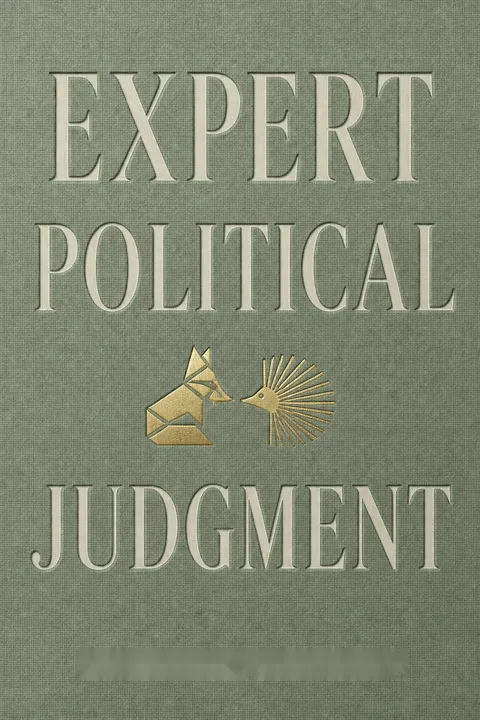
Expert Political Judgment explores the accuracy of political experts' predictions. Tetlock's research shows that generalist "foxes" outperform specialist "hedgehogs" in forecasting, though both are often surpassed by simple statistical models. The book is praised for its rigorous methodology and thought-provoking insights, but criticized for dense academic writing. Readers appreciate Tetlock's examination of cognitive biases and the limitations of expert knowledge. While some found it challenging, many consider it an essential work for understanding political forecasting and decision-making.
People Also Read




Glossary
Hedgehog-fox dimension
Reasoning-style continuumA continuum describing how people approach complex questions. Hedgehog-style thinkers rely on one central explanatory framework and apply it broadly. Fox-style thinkers draw on multiple explanations, tolerate contradiction, and adapt their judgments to particular cases. Tetlock treats this as a matter of degree, not a division into two fixed kinds of person.
Calibration
Confidence matching outcomesA measure of whether stated probabilities correspond to observed frequencies across many forecasts. A forecaster is well calibrated if events assigned a 70 percent chance occur about 70 percent of the time. Calibration does not show whether the forecaster can distinguish which individual events are more likely than others.
Discrimination
Ranking likely outcomesA measure of how well probability judgments separate events that occur from those that do not. A forecaster has stronger discrimination when higher probabilities tend to accompany events that happen and lower probabilities events that fail to happen. It complements calibration, which measures whether stated confidence matches observed frequency.
Reputational bets
Recorded conditional forecastsForecasts that specify how likely outcomes would be under competing explanations of the forces shaping events. By recording these conditional probabilities before the outcome is known, researchers can assess how much a result should change the forecaster's confidence in each explanation. The term makes abstract commitments concrete enough to evaluate afterward.
Belief system defenses
Excuses for failed predictionsArguments used to preserve confidence after a forecast fails. Examples include claiming the predicted outcome nearly occurred, will occur outside the stated time frame, or was prevented by an unforeseeable shock. These arguments can sometimes be reasonable, but Tetlock finds they are commonly invoked more to protect one's own views than to excuse rivals.
Close-call counterfactual
A near-miss alternative historyA claim that a forecast was almost correct because a small change in events would have produced the predicted outcome. It can help analyze historical contingency, but it can also insulate a failed prediction from evidence. Tetlock examines whether people apply the same standards to near-miss stories that support and challenge their preferred explanations.
Support theory
How descriptions shape likelihoodA theory of probability judgment associated with Amos Tversky and colleagues. It proposes that people judge likelihood partly by the arguments they can readily imagine for an outcome. Describing a broad possibility as several vivid sub-scenarios can increase the combined perceived likelihood of those parts, even when they form an exhaustive set and their probabilities should add to the probability of the whole.
Brier score
Probability forecast scoreA scoring rule that compares a stated probability with the eventual outcome. It penalizes forecasts more when confidence is high and the prediction is wrong, while rewarding justified confidence when it is right. Lower average scores indicate better forecasts. Tetlock uses probability scoring to make accuracy assessable across many events, rather than relying on remembered successes.
Fermi-izing
Decompose a large questionA forecasting technique described as breaking an expansive, difficult question into smaller, more answerable questions. For a long-range scenario, analysts identify nearer-term indicators that would be more or less likely if that scenario were developing. Combining the indicators can help update judgments while keeping the larger question connected to evidence that can be checked.
FAQ
What is Expert Political Judgment: How Good Is It? How Can We Know? by Philip E. Tetlock about?
- Investigating expert accuracy: The book examines how accurately experts predict political, economic, and security events, using decades of data and large-scale forecasting tournaments.
- Cognitive styles and judgment: Tetlock explores how different thinking styles—especially the contrast between “foxes” and “hedgehogs”—affect the quality of expert judgment.
- Scientific measurement: The author develops rigorous, empirical methods to assess forecasting skill, including probability scoring and belief-updating metrics.
- Accountability and improvement: The book argues for holding experts accountable to standards of accuracy and logical consistency, with implications for public debate and policy-making.
Why should I read Expert Political Judgment by Philip E. Tetlock?
- Challenging assumptions about expertise: The book reveals that experts are often only marginally better than chance at forecasting, challenging the trust we place in expert opinion.
- Learning to improve judgment: Readers gain practical insights into cognitive habits and thinking styles that lead to better decision-making under uncertainty.
- Relevance to democracy and policy: Tetlock’s findings have direct implications for improving political discourse, reducing polarization, and fostering evidence-based policy debates.
- Tools for critical thinking: The book equips readers to be more discerning consumers of expert advice in media, government, and business.
What are the key takeaways from Expert Political Judgment by Philip E. Tetlock?
- Marginal expert advantage: Experts, on average, outperform random guessing and simple algorithms only slightly, often suffering from overconfidence and poor calibration.
- Foxes outperform hedgehogs: Foxes—those who draw from multiple perspectives and tolerate ambiguity—consistently make more accurate and better-calibrated forecasts than hedgehogs, who rely on one big theory.
- Belief updating is crucial: Good judgment requires not just accurate forecasts but also the willingness to revise beliefs in light of new evidence, a trait more common among foxes.
- Forecasting tournaments matter: Structured competitions with transparent scoring can identify “superforecasters” and improve collective accuracy, offering hope for better policy and public debate.
How does Philip E. Tetlock define “foxes” and “hedgehogs” in Expert Political Judgment?
- Isaiah Berlin’s metaphor: Hedgehogs “know one big thing” and interpret events through a single overarching theory, while foxes “know many little things” and draw from diverse, sometimes contradictory, perspectives.
- Hedgehogs’ characteristics: Hedgehogs are confident, theory-driven, and often dogmatic, making bold but overconfident predictions and resisting belief revision.
- Foxes’ characteristics: Foxes are eclectic, open-minded, and comfortable with complexity, making more nuanced, probabilistic forecasts and updating beliefs more readily.
- Impact on forecasting: Foxes’ cognitive flexibility leads to better calibration and accuracy, especially in complex, uncertain environments.
What methods does Philip E. Tetlock use to measure forecasting accuracy in Expert Political Judgment?
- Brier score as primary metric: Tetlock uses the Brier score, which measures the squared difference between predicted probabilities and actual outcomes, with lower scores indicating better accuracy.
- Calibration and discrimination: Forecasting skill is broken down into calibration (how well probabilities match observed frequencies) and discrimination (distinguishing likely from unlikely events).
- Value and difficulty adjustments: The scoring system accounts for trade-offs between false alarms and misses, as well as the inherent difficulty and controversy of different forecasting tasks.
- Belief updating tests: Tetlock also measures how well experts update their beliefs in response to new evidence, using Bayesian principles and reputational bets.
What are the main differences between hedgehogs and foxes in Expert Political Judgment by Philip E. Tetlock?
- Cognitive style contrast: Hedgehogs seek explanatory closure with one big theory, while foxes integrate diverse, sometimes conflicting, information and tolerate ambiguity.
- Forecasting performance: Foxes consistently outperform hedgehogs in accuracy and calibration, partly because they hedge their bets and update beliefs more flexibly.
- Ideological extremism: Hedgehogs are more likely to be ideologically extreme and less open to revising mistaken beliefs, leading to overconfidence and poor performance.
- Error patterns: Hedgehogs make more extreme predictions and are slower to acknowledge mistakes, while foxes are more self-critical and adaptive.
How does Expert Political Judgment explain the cognitive biases and errors in expert forecasting?
- Overconfidence: Experts, especially hedgehogs, tend to assign overly extreme probabilities, leading to poor calibration and frequent forecasting errors.
- Belief perseverance: Many experts are slow to update their beliefs when confronted with disconfirming evidence, often defending failed forecasts with counterfactuals or timing excuses.
- Confirmation bias: Hedgehogs apply double standards, accepting evidence that supports their views and dismissing evidence that challenges them.
- Foxes’ advantage: Foxes’ cognitive flexibility and willingness to entertain multiple scenarios protect them from some biases and improve their forecasting accuracy.
What role do scenario exercises and counterfactual thinking play in Expert Political Judgment by Philip E. Tetlock?
- Scenario exercises: These involve unpacking possible futures into detailed branches to stimulate imagination and counteract theory-driven biases like overconfidence.
- Mixed results: Scenario planning can inflate subjective probabilities and sometimes reduce logical coherence, especially among open-minded foxes.
- Counterfactual reasoning: Experts use “what-if” thinking to imagine alternative pasts, which can reduce hindsight bias and challenge deterministic narratives.
- Ideological influence: Hedgehogs are more likely to reject counterfactuals that challenge their preferred theories, while foxes are more open to alternative scenarios.
How does Expert Political Judgment address belief updating and Bayesian reasoning?
- Bayesian updating test: Tetlock assesses whether experts revise their beliefs proportionally to new evidence, as prescribed by Bayesian probability theory.
- Hedgehogs’ resistance: Hedgehogs are less likely to update their beliefs after being wrong, often doubling down or invoking external excuses.
- Reputational bets: Experts are asked to make conditional predictions and are expected to revise confidence after outcomes, revealing differences in belief updating.
- Foxes’ flexibility: Foxes are more likely to adjust their beliefs appropriately, reflecting better judgment under uncertainty.
What are the philosophical debates about objectivity and relativism in Expert Political Judgment by Philip E. Tetlock?
- Relativist critiques: Some argue that good judgment is inherently perspectival and socially constructed, making objective measurement impossible.
- Neopositivist defense: Tetlock and others defend the use of flexible, transparent methods to approximate objectivity, incorporating principled objections as technical adjustments.
- Hybrid position: The book advocates a middle ground, recognizing pluralism but insisting on accountability to empirical accuracy and logical consistency.
- Implications for disagreement: These debates inform how we interpret expert disagreement and design systems for improving judgment and accountability.
What are the policy and practical implications of Expert Political Judgment for public debate and expert accountability?
- Marketplace of ideas flaws: The book identifies consumer ignorance, motivated reasoning, and cognitive limitations as reasons why poor expert judgment persists in public discourse.
- Forecasting tournaments: Tetlock proposes institutionalizing forecasting competitions with transparent scoring to improve accountability and reduce polarization.
- Reputational bets and transparency: Systematic monitoring of expert predictions and performance would allow consumers to judge epistemic quality and incentivize better forecasting.
- Challenges to adoption: Resistance from entrenched experts and cultural barriers to probabilistic thinking are obstacles, but technological advances and demand for credible expertise offer hope.
What are the best quotes from Expert Political Judgment by Philip E. Tetlock and what do they mean?
- On cognitive styles: Isaiah Berlin: “There exists a great chasm between those... who relate everything to a single central vision... and those who pursue many ends, often unrelated and even contradictory...” This highlights the fundamental difference between hedgehogs and foxes.
- On belief updating: John Maynard Keynes: “When the facts change, I change my mind. What do you do, sir?” This underscores the ideal of intellectual flexibility and Bayesian updating.
- On judgment limits: Daniel Kahneman: “The impossible sometimes happens and the inevitable sometimes does not.” This quote reminds us of the inherent uncertainty in forecasting and the need for humility.
- On language and meaning: Humpty Dumpty: “When I use a word, it means just what I choose it to mean—neither more nor less.” This reflects the challenges of defining and measuring concepts in political judgment.
About the Author
Other books by Philip E. Tetlock

Download PDF
Download EPUB
.epub digital book format is ideal for reading ebooks on phones, tablets, and e-readers.








