

Key Takeaways
Treat seeing as an active craft, not a passive gift of the eyes.
Delft, 1674. The book opens by placing two acts of looking near each other. Antoni van Leeuwenhoek examines lake water through a tiny lens and sees moving life invisible to the naked eyes. Johannes Vermeer, in a scene Snyder reconstructs rather than documents, studies a projected image through a camera obscura, a dark chamber or box that uses a lens to cast a scene onto a surface. The men lived close by and were born days apart, but their friendship is unproven.
A changed idea of sight. Their stories express the book’s central claim: seeing is not simply receiving an image. It requires tools, attention, and interpretation. Leeuwenhoek and Vermeer explored different worlds, one microscopic and one domestic, but both tested how vision works.
The pairing is powerful because it joins a discovery about what exists with an artistic inquiry into how appearances are made. It also avoids needing a tidy story of personal collaboration: shared place and period can shape parallel experiments without proving that the two men exchanged ideas. That distinction matters in intellectual history, where a compelling narrative can tempt readers to turn proximity into causation. The book’s deeper link is methodological, not biographical.
Use instruments to reveal hidden worlds, while questioning what they distort.
New evidence, new doubts. Telescopes and microscopes extended sight beyond its ordinary range, but their images were not automatically trusted. Galileo’s telescope revealed mountains on the moon and bodies orbiting Jupiter, findings that clashed with established ideas about a perfect, Earth-centered cosmos. Skeptics could blame the instrument for producing false images. Leeuwenhoek faced a similar response when he reported minute living creatures in water, so strange that observers wondered whether he imagined them.
Glass is imperfect. Seventeenth-century lenses could blur edges, distort shapes, and add colored fringes. The observer had to decide whether a feature belonged to the specimen, the lens, or the mind interpreting the image. An instrument therefore does not simply extend perception. It creates new evidence and new reasons to test that evidence.
This is an early version of a problem that remains central to measurement: instruments expand access while introducing their own signatures. In modern imaging, software may sharpen, filter, or color data, making interpretation inseparable from the way results are displayed. The book usefully resists the idea that a tool is a neutral window. Its caution also has limits: defects do not make instrument-based knowledge unreliable by default. Comparison, calibration, and independent checks can distinguish a tool’s distortions from features of the world.
Learn to see with a tool before claiming what it reveals.
Vision takes practice. A microscope’s image was unfamiliar and technically difficult to interpret. The book connects this challenge to Molyneux’s problem, a question about whether someone blind from birth could identify a sphere and a cube by sight alone after gaining vision. In 1728, surgeon William Cheselden reported that a thirteen-year-old patient who had been blind struggled to recognize shapes and understand that paintings represented three-dimensional objects.
Experience teaches perception. The point extends to instruments: a viewer must learn how to focus, illuminate, prepare, and interpret a specimen. A microscope image is not self-explanatory. Leeuwenhoek’s repeated practice helped him distinguish living movement from artifacts and structures from visual confusion. The act of looking becomes skilled work, not a reflex.
The argument aligns with perceptual learning: repeated exposure can improve the ability to detect meaningful patterns, whether in a medical scan, a bird’s call, or a microscope image. It also clarifies why expertise is not merely a storehouse of facts. Experts acquire ways of attending. Yet training can cut both ways. It helps observers notice subtle signals, but habits can also narrow attention toward familiar patterns. Skillful seeing therefore needs both practice and the willingness to question what practice has taught.
Let optical tools sharpen judgment, not dictate the finished image.
Vermeer’s optical experiments. The book argues that Vermeer probably used a camera obscura to study perspective, light, color, and focus. Its image could help explain the soft contours and bright highlights in paintings such as The Milkmaid and A View of Delft. Vermeer’s pointillés, small dabs of thick paint, suggest glints of light, even on surfaces that would not literally reflect them.
A tool, not a template. Snyder rejects the claim that Vermeer simply traced projected images. X-ray studies show changes to compositions, while his choices sometimes depart from the optics of a camera. His paintings create houding, a convincing illusion of spatial presence, through deliberate decisions about what to sharpen, blur, intensify, or omit. The camera may have taught him what vision could do. It did not make the painting for him.
The distinction between assistance and authorship is especially useful in debates about technology in art. A camera can supply an image, but artistic judgment still governs selection, emphasis, and meaning. Contemporary digital tools pose the same question in a new form. The book also handles a contested claim responsibly: evidence supports Vermeer’s interest in optical devices more strongly than it proves exactly how he used them. That uncertainty enriches the story by showing how art history makes arguments from traces, not complete records.
Repeat observations until both the object and the instrument make sense.
Return to the specimen. Leeuwenhoek revisited the same kinds of material many times, changing specimens, lighting, and microscopes. He examined optic nerves from different animals across years, and returned repeatedly to blood, semen, and water samples. Repetition helped him learn both about the material and about how his instruments behaved.
Return to the motif. Vermeer also revisited subjects: solitary women, maps, letters, musical instruments, and familiar rooms. The same map appears in several paintings, altered by light, color, and placement. These repetitions let him explore how one object could look different under new visual conditions. Neither practice was a modern controlled experiment, but each made comparison possible. The familiar became a test case, and variation became evidence.
Repeated looking can expose variation that a single dramatic observation hides. In science, this resembles replication; in visual analysis, it resembles studying the same subject under different conditions. Both approaches reduce dependence on a memorable first impression. Still, repetition alone does not guarantee accuracy. If every trial repeats the same bias or setup, errors can become more convincing rather than less. Strong inquiry combines return with variation: change the lighting, specimen, observer, or method enough to reveal what remains stable.
Separate a startling observation from the theory used to explain it.
Seeing can mislead. Leeuwenhoek correctly observed red blood cells and sperm, but interpreted some microscopic structures through the expectations of his age. He initially saw globules in many materials. He also believed sperm contained the essential beginnings of a human, while the egg mainly nourished it. That sperm-centered account was wrong, even though his observation of sperm itself was sound.
The homunculus question. Leeuwenhoek spent time looking for a tiny human inside sperm, but he did not claim certainty when he could not see one clearly. His case shows how observation and explanation can travel at different speeds. A new fact may be reliable while the theory attached to it remains mistaken. The discipline is to report what the evidence shows without treating an attractive explanation as part of the observation.
This distinction is a foundation of scientific reasoning. Data rarely arrive without interpretation, but separating the two makes revision possible. Leeuwenhoek’s sperm theory illustrates how a skilled observer can make accurate discoveries and still inherit assumptions that steer explanation. The same pattern appears in fields where researchers measure a real association but disagree about its cause. Caution should not become cynicism: theory is necessary to organize findings. The safeguard is to keep explanations provisional and test whether they predict observations beyond the original case.
Make discoveries inspectable if you want others to believe them.
A claim needs witnesses. Leeuwenhoek’s reports of tiny organisms initially met skepticism at the Royal Society. He described his findings but guarded the methods and construction of his microscopes, treating them like valuable craft secrets. The society wanted others to repeat his observations. In 1677, Robert Hooke prepared pepper water, saw tiny moving creatures, and demonstrated them to fellow members. Other witnesses then confirmed what Leeuwenhoek had reported.
From report to shared evidence. The society’s motto, Nullius in verba, means accept no claim solely on someone’s authority. Its members expected experiments to be checked, not merely admired. Leeuwenhoek’s experience exposes a tension: secrecy can protect an inventor’s advantage, but it makes a discovery harder to verify. Personal certainty becomes public knowledge only when other observers can examine the evidence.
The episode shows that credibility is partly social. A result gains force when independent observers can inspect it, and institutions create procedures for deciding whose testimony counts. That is not the same as truth being determined by a vote: Hooke’s replication mattered because it engaged the material phenomenon, not because he held status. The tension over Leeuwenhoek’s secrecy also remains relevant in research involving proprietary tools. Openness enables scrutiny, while some technical knowledge has legitimate commercial or personal value.
Reject inherited authority, but do not mistake novelty for truth.
Look beyond old texts. The Royal Society and other natural philosophers promoted observation and experiment over accepting ancient authorities without inspection. This empirical outlook helped challenge inherited accounts of the heavens, the body, and the smallest forms of life. Leeuwenhoek’s microscope made the invisible world difficult to ignore; Hooke’s Micrographia helped readers see what the instrument disclosed.
Not a simple war on religion. Many Dutch investigators understood nature as a second book through which divine creation could be studied. Their new methods challenged the authority of received explanations, not necessarily religious belief itself. The shift was also gradual: observers could replace one error with another, as Leeuwenhoek’s theory of generation shows. Seeing something new opens inquiry. It does not, by itself, settle what the discovery means.
The book complicates the familiar story that modern science emerged by simply defeating religion. In Delft, empirical study and religious meaning could coexist, even as observation displaced unquestioned reliance on old texts. This is a more useful model of intellectual change than a clean victory narrative. It also invites scrutiny of the word progress: new instruments can overturn established claims, but they do not remove human commitments from interpretation. The standard is not novelty alone, but explanations that survive continued examination.
Give slow observation time, tools, and a stable place to work.
Discovery has material conditions. Vermeer painted slowly, producing perhaps forty-five works across his career. He had a growing family, depended partly on art dealing and patronage, and struggled when the market collapsed after the Dutch Republic’s 1672 crisis. Leeuwenhoek, by contrast, held a salaried civic post that gave him time to pursue microscopy. Their different circumstances shaped what each could sustain.
Curiosity needs infrastructure. Delft’s wealth, trade, craft expertise, artists’ guild, and scientific networks helped make experimentation possible. Vermeer had access to patrons and costly pigments; Leeuwenhoek had a workshop, specimens from local butchers, and contacts who could assess his claims. Genius matters, but so do time, money, tools, and an audience. The city’s culture made unusual investigations possible, while political and economic shocks could narrow that freedom.
This historical contrast resists the myth of discovery as solitary inspiration. Creative and scientific work rely on resources that are often invisible in the final painting or published observation. Modern research has the same dependence on funding, laboratory access, skilled technicians, and time for replication. The comparison should not be overstated: a secure salary did not guarantee Leeuwenhoek’s success, and financial hardship did not erase Vermeer’s artistry. But it does show that societies influence which kinds of attention can be sustained.
Analysis
The book’s strongest move is to treat Vermeer and Leeuwenhoek as parallel investigators rather than force them into a tidy partnership. The surviving evidence does not establish that they were friends, and the executor role Leeuwenhoek held after Vermeer’s death is suggestive, not conclusive. Their connection is firmer at the level of practice: both used optical devices to interrupt ordinary seeing, then worked to interpret what appeared. That shift makes the book more than a paired biography. It becomes a history of how seeing acquired new authority.
The central epistemic insight is that instruments do not simply reveal reality. They create conditions under which aspects of reality become observable, while introducing distortion and demanding new skills. Leeuwenhoek’s microscopic creatures required patient manipulation and comparison; Vermeer’s painterly effects translated optical phenomena into intentional compositions. Neither observer passively copied an image. Each selected, tested, and interpreted it. The distinction between observation and explanation is especially important: Leeuwenhoek’s reports of cells, sperm, and microorganisms could be perceptive even when his theories of generation were mistaken.
The book also unsettles two convenient myths. Science did not advance through reason alone, nor did empiricism require abandoning religion. In the Dutch Republic, craft knowledge, commercial networks, Protestant ideas about nature, civic institutions, and image-making all contributed to inquiry. At the same time, evidence became more persuasive when others could inspect it, as Hooke’s replication of Leeuwenhoek’s observations shows. Openness was an evolving norm, not an automatic feature of discovery.
One productive tension is the difference between the strength of the book’s conceptual pairing and the uncertainty of its specific claims about Vermeer’s camera obscura. The instrument plausibly shaped his attention to focus, color, and light, but the precise practice remains debated. That ambiguity does not weaken the broader argument. It clarifies its scope: the most defensible claim is not that Vermeer mechanically copied projections, but that optical technologies helped artists investigate how the world appears. The book’s lasting lesson is therefore methodological. Vision is trained, mediated, and revisable, whether the object is a bacterium in water or a woman absorbed in a letter.
Review Summary
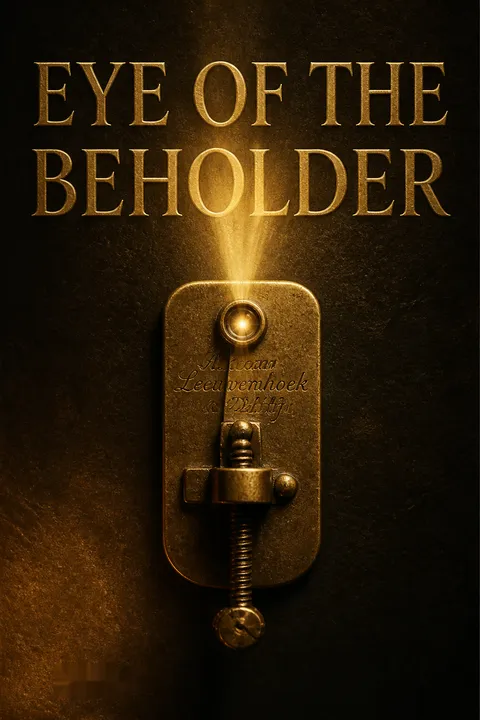
Eye of the Beholder receives mostly positive reviews for its exploration of how Vermeer and Leeuwenhoek revolutionized seeing through optics in 17th century Delft. Readers praise Snyder's detailed historical context and insights into art and science. Some find the writing engaging, while others critique the speculation about the men's relationship and desire more illustrations. The book is lauded for its thorough research but criticized by some for being overly detailed and meandering at times. Overall, it's considered an intriguing look at a pivotal period in art and scientific history.
People Also Read


Glossary
camera obscura
projected optical imageA dark chamber or box with a small opening or lens. Light from the outside scene passes through the opening and forms an image on an interior surface. The image can reveal perspective, focus, color, and differences in light that are difficult to notice unaided. Vermeer may have used one to investigate visual effects, though the exact method is uncertain.
animalcules
microscopic living creaturesA historical term Leeuwenhoek used for tiny organisms visible through his microscopes. He reported finding them in lake, rain, and well water, and in other samples. His observations included several kinds of microscopic life, including bacteria and single-celled organisms, though the term did not distinguish among them using modern biological classification.
Molyneux’s problem
vision after blindnessA philosophical question posed by William Molyneux: if a person blind from birth learns by touch to distinguish a sphere from a cube, could that person identify the shapes by sight alone after gaining vision? The problem asks whether visual recognition is innate or must be learned through experience and connected to other senses.
houding
convincing pictorial presenceA Dutch art-theory term for the combined effects that make a painted scene feel spatially coherent and lifelike. It includes techniques of light, color, perspective, and composition. Vermeer’s paintings create this sense of presence through choices that shape how viewers perceive a scene, rather than by simply copying an optical projection.
pointillés
painted light highlightsSmall, often thick dabs of paint that Vermeer used to suggest bright reflections or glints. They appear on surfaces such as bread, water, and threads. Their effect can evoke the way highlights look through an imperfect lens, but Vermeer also placed them where literal reflections would not occur, using them to strengthen the painting’s visual effect.
Nullius in verba
verify claims by experimentThe Royal Society of London’s motto, commonly understood as a rejection of accepting claims solely on another person’s authority. Fellows aimed to test reports through observation and experiment. The principle supported scrutiny and replication, although the society’s response to Leeuwenhoek shows that putting it into practice required time, access to methods, and trusted witnesses.
Download PDF
Download EPUB
.epub digital book format is ideal for reading ebooks on phones, tablets, and e-readers.








