

Key Takeaways
Treat archetypes as inherited patterns, not inherited stories
A pattern, not a script. Jung distinguishes personal memories and conflicts from the collective unconscious, a deeper layer of the psyche he proposes is shared across humanity. Its contents, called archetypes, are not fully formed ideas or stories passed down intact. They are predispositions that shape how people imagine and respond to recurring situations, such as care, danger, or renewal.
Experience gives them detail. Jung compares an archetype to the organizing structure of a crystal: it shapes what can form, but does not determine the finished crystal. A mother image, for example, takes its specific character from a person’s relationships, culture, and imagination. Myths and dreams offer recognizable expressions of these patterns, but their images are not identical to the archetypes themselves.
This distinction keeps Jung’s model from collapsing into the claim that everyone inherits the same ready-made myths. It also makes the theory more useful as a way to ask why certain images recur and feel powerful. The difficult question is evidential: a recurring symbol might reflect inherited psychological structure, shared human experience, or cultural borrowing. Treating archetypes as interpretive hypotheses, rather than established biological facts, preserves their value without pretending that recurrence alone proves inheritance.
Distinguish your actual mother from the psychic symbol placed on her
One person, many meanings. Jung’s mother archetype includes the personal mother, but also grandmothers, caregivers, goddesses, and symbolic sources of shelter or nurture. A cave, garden, sea, church, or homeland can carry maternal meaning. The image is ambivalent: it can signify care, fertility, and protection, or engulfment, fear, and death.
Projection complicates the relationship. Jung argues that a child may experience a parent through both the parent’s actual behavior and the child’s own archetypal expectations. A frightening dream figure may therefore express a real difficulty, an inner fear, or both. The task is not to dismiss harm as fantasy, nor to load one fallible person with every meaning attached to motherhood. It is to distinguish what belongs to the relationship from what the psyche adds to it.
The separation between a real caregiver and a symbolic image can prevent both idealization and blame from becoming total explanations. It gives a person room to honor meaningful care without turning a parent into a deity, and to name actual harm without assuming that one relationship explains an entire life. The limit is that symbolic interpretation can become an excuse to discount concrete conditions. The distinction works best when it deepens attention to lived relationships rather than replacing it.
Read a mother-complex as a pattern, not a verdict on character
A complex can constrain or equip. Jung uses mother-complex for a cluster of feelings and behaviors organized around the mother image. He describes different patterns in sons and daughters, including excessive dependence, resistance, identification, and overinvestment in relationships. He also argues that traits associated with a complex can have constructive forms: care can become generosity, sensitivity can support teaching, and resistance can fuel intellectual independence.
These are sketches, not diagnoses. Jung’s accounts draw on clinical experience, but he acknowledges that the types are broad pictures rather than templates for every person. He also suggests that a child’s difficulties may involve both a parent’s actual behavior and the child’s symbolic expectations. His descriptions are historically shaped by assumptions about gender, so they are better read as prompts for examining patterns than as fixed rules about men and women.
The useful move is to ask what a repeated pattern does, not to label someone as damaged. A protective instinct, for instance, can nurture others while making it difficult to recognize their independence. Jung’s positive and negative readings help keep a trait from being reduced to a symptom. His gendered categories, however, risk turning cultural expectations into psychological laws. Modern readers can retain the attention to relational patterns while testing each claim against the person’s own experience.
Rebirth names inner transformation, not only another life after death
One word, several claims. Jung separates beliefs about life after death from changes people experience within life. He identifies five broad meanings:
1. Metempsychosis: life continues through successive bodily lives.
2. Reincarnation: a continuing personality returns and may remember earlier lives.
3. Resurrection: existence is restored after death, sometimes in a changed form.
4. Renewal: a person or part of the personality is healed or transformed during life.
5. Participation: a person shares in a ritual transformation performed outside them.
Change can be symbolic. Jung also describes growth through enlarged personality, altered inner structure, group identification, and individuation, a natural process of psychological development. His examples range from religious rites to experiences that reshape a person’s sense of self. The focus is psychological: the reported experience matters as an experience, without requiring the psychologist to settle its metaphysical truth.
This taxonomy usefully separates phenomena that are often bundled under spiritual language. A ritual can alter a person’s sense of belonging without implying that the person has undergone a literal rebirth; a life crisis can change identity without invoking an afterlife. The distinction supports careful listening across religious and secular settings. It also marks a boundary: describing an experience psychologically does not verify or refute the metaphysical beliefs attached to it.
A crowd can lend courage while quietly borrowing your judgment
Belonging changes experience. Jung calls identification with a group a transformation that takes place at a lower level of individual consciousness. Shared emotion can give people courage, dignity, and solidarity, but it can also make them feel less responsible for their actions. He describes how a crowd’s suggestive force can carry individuals toward proposals they might reject alone.
Ritual can focus the group. In Jung’s account, a ceremony can direct attention toward shared symbols and help participants remain more conscious than an unstructured crowd. Yet the benefit is not automatic. Group emotion can be sustaining, but repeated reliance on it may leave a person unable to reproduce the same conviction in solitude. The practical test is whether belonging strengthens individual responsibility or substitutes for it.
The distinction is not between bad crowds and virtuous individuals. Shared action can help people do difficult, generous things, while anonymity and emotional contagion can weaken restraint. Jung’s emphasis on responsibility makes the account especially relevant to institutions, where a person can feel both carried by a group and insulated from consequences. A group’s size alone does not determine its ethics; its norms, leadership, and accountability matter too.
When thought stalls, notice the wise stranger your psyche supplies
A helper appears at the impasse. In dreams and folktales, Jung finds the spirit archetype represented by a wise old person, a child, a talking animal, or a voice that gives direction. Such figures often appear when the central character cannot find a way forward. In one Estonian tale, an orphan boy runs away after losing a cow. Exhausted and unsure what to do, he meets an old man who helps him gather himself and continue his journey.
Guidance is not infallibility. Jung reads the old man as a personification of insight or reflection that conscious thought cannot readily produce in the moment. But spirit figures can be ambiguous, even dangerous. In practical terms, a sudden image or inner voice can be taken seriously as material for reflection without being treated as an unquestionable command.
The story makes an abstract idea legible: in a crisis, a person may find a new perspective through an image, memory, or unexpected line of thought. Jung’s language gives this experience symbolic weight rather than dismissing it as noise. That need not make every inner voice wise. Reflection is strongest when it asks what an image reveals, checks it against circumstances, and preserves responsibility for the choice that follows.
Approach inner figures with curiosity, but keep the ego accountable
Transformation requires a relationship. Jung uses individuation for the process of becoming more psychologically whole through engagement with conscious and unconscious parts of the self. He illustrates it with the Koranic story of Moses and a mysterious guide, Khidr. Moses follows the guide but repeatedly objects when he cannot understand his actions. The story presents a gap between ordinary judgment and a larger process whose meaning is not immediately visible.
Do not confuse symbolism with permission. Jung interprets the guide as an image of a higher organizing principle in the psyche, not merely as a character in a tale. He warns that identifying the ego with such an image can produce inflation, a grandiose sense of personal importance. The point is to enter a dialogue with inner material, not to surrender judgment or claim moral exemption.
The enduring insight is the tension between openness and accountability. A person can acknowledge that conscious plans do not exhaust the mind’s activity without treating every impulse as revelation. Jung’s warning about inflation is crucial because symbolic language can make ordinary certainty feel cosmic. A grounded reading keeps the image meaningful while asking what evidence, consequences, and obligations remain visible in everyday life.
Own the trickster in yourself before projecting him onto a group
The fool carries disowned traits. Jung describes the trickster as a mythic figure of mischief, foolishness, appetite, and contradictory power. He sees it as a collective shadow, a symbolic gathering of traits that individuals would rather not recognize in themselves. Medieval church festivals briefly gave such disorder public form: participants mocked hierarchy, adopted comic roles, and turned solemn ritual upside down.
What is denied can return as blame. Jung argues that when people neglect their own disruptive tendencies, they may experience them as hostile forces in other people or groups. In a crowd, these projections can intensify. The trickster is not simply evil; he exposes an immature, impulsive side of human nature that may still carry creative energy. Recognizing it does not excuse harmful behavior, but makes it harder to pretend that disorder belongs only to outsiders.
The trickster’s comic form matters because humor can reveal what official self-images suppress. A society that cannot acknowledge aggression, foolishness, or appetite may be especially tempted to locate every such quality in an enemy. Jung’s account offers a useful question for group conflict: which traits are being assigned exclusively to the other side? Projection is not the only cause of political hostility, however. Material interests and real abuses also require direct analysis.
Analysis
This collection is best understood as a set of linked essays about symbolic patterns, not as a single step-by-step program. Its argument moves from the proposed shared structures of the psyche, through the mother image and experiences of transformation, to spirit figures in tales and the trickster’s comic shadow. Across the essays, the recurring problem is how consciousness relates to what it does not control. Jung’s proposed answer is neither to repress such material nor to obey it blindly, but to interpret it and enter a sustained relationship with it.
The approach remains valuable as a vocabulary for describing images that feel larger than personal biography. It can connect a private dream, a folktale, and a public ritual without reducing them to identical events. That interpretive reach is also its central risk. Similar symbols across cultures do not by themselves demonstrate an inherited collective psyche. Shared bodily experience, recurring social problems, and the movement of stories across communities can also produce resemblance. Jung’s archetypes are therefore most persuasive as a comparative psychological model, not as a settled account of biological inheritance.
The mother-complex essays need especially careful reading. Their observations about projection and mixed parental influence can prompt useful questions, but their typologies lean on historically specific expectations about women’s and men’s roles. Those descriptions should not be mistaken for universal clinical findings. Likewise, the claim that group life lowers consciousness captures a real danger of conformity but can understate the ways collective organization supports courage, knowledge, and accountability.
The strongest contemporary use of the book is consequently methodological. Treat symbols as evidence of meaning-making, not proof of metaphysics; distinguish actual relationships from projections; and ask what a compelling image invites a person or group to notice. Jung’s framework becomes more credible when it stays curious about its own limits.
Review Summary
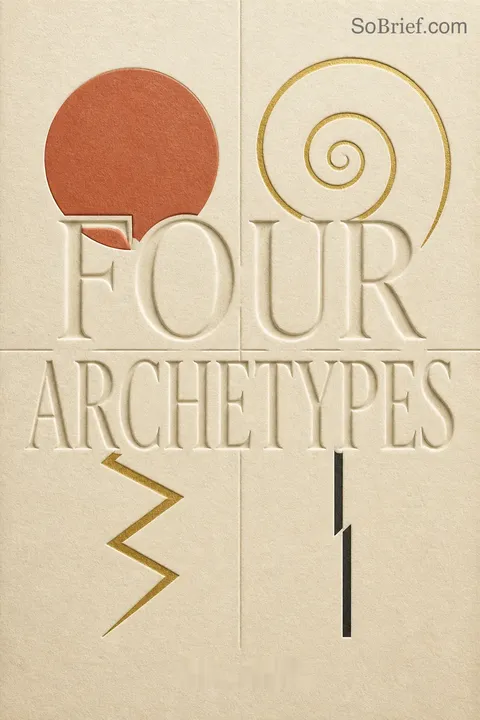
Four Archetypes receives mixed reviews, with many praising Jung's insights into human psychology and mythology. Readers appreciate the exploration of archetypes and their significance in understanding the human psyche. Some find the book challenging, requiring background knowledge in psychology and mythology. Critics note outdated views on gender and sexuality. Overall, the book is considered valuable for those interested in Jungian psychology, offering deep analysis of the Mother, Rebirth, Spirit, and Trickster archetypes. Many readers find it thought-provoking and applicable to personal growth and literary analysis.
People Also Read


Glossary
Archetype
Inherited pattern of experienceIn Jung’s theory, an archetype is an inborn, largely unconscious form that shapes how people imagine and respond to recurring situations. It does not contain a fully formed story or image. Specific symbols, such as a nurturing mother or a wise guide, take their content from personal experience and culture.
Collective unconscious
Shared layer of the psycheJung’s name for a proposed deep layer of the unconscious that is not acquired through an individual’s personal memories. He argues that it contains archetypes, or inherited patterns of psychic functioning, which recur across people and cultures. The concept is central to his theory, though its status as an inherited structure remains contested.
Mother archetype
Pattern of maternal meaningA recurring psychic pattern associated with motherhood, nurture, fertility, protection, and the possibility of engulfment or danger. It may be expressed through a personal mother or through symbolic figures and places, such as a goddess, cave, garden, or sea. Its appearance is shaped by individual experience rather than fixed in one image.
Mother-complex
Emotional pattern around motherA cluster of feelings, expectations, and behaviors organized around a person’s relationship to the mother image. Jung describes both limiting and potentially constructive forms, and distinguishes patterns he associates with sons and daughters. His categories are broad interpretations, not universal diagnoses, and reflect the gender assumptions of his period.
Individuation
Process of becoming more wholeJung’s term for psychological development through which a person becomes more integrated by engaging conscious and unconscious aspects of the psyche. It does not mean becoming socially isolated or simply asserting individuality. The process involves recognizing tensions and symbols that the conscious ego may not fully understand or control.
Anima
Inner feminine image in menIn Jung’s model, the anima is an unconscious feminine figure in a man’s psyche, often expressed through dreams, projections, or symbolic stories. Jung treats it as a mediator between conscious life and the unconscious. The concept belongs to his historically gendered theory of psychic opposites and should not be treated as a literal account of gender.
Shadow
Disowned side of personalityThe shadow is the part of personality a person does not recognize or accept as their own, often because it conflicts with their conscious self-image. Jung also describes collective shadow figures, such as the trickster, which dramatize disowned traits shared by a group. Recognizing the shadow does not excuse harmful actions.
Participation mystique
Unconscious merging with othersJung uses this term for a state in which a person experiences little psychological separation from a group or shared situation. In a crowd, mutual attention and emotion can create a powerful sense of unity. The experience may be pleasurable or energizing, but can also weaken individual judgment and responsibility.
FAQ
1. What is "Four Archetypes" by C.G. Jung about?
- Exploration of Archetypes: The book delves into four fundamental archetypes—Mother, Rebirth, Spirit, and Trickster—exploring their psychological significance and manifestations in myths, dreams, and fairytales.
- Collective Unconscious: Jung introduces and elaborates on the concept of the collective unconscious, a universal psychic substrate shared by all humans, populated by archetypes.
- Psychological Development: The essays examine how these archetypes influence individual psychological development, personal complexes, and cultural phenomena.
- Integration and Individuation: Jung discusses the importance of recognizing and integrating these archetypes for achieving individuation, or psychological wholeness.
2. Why should I read "Four Archetypes" by C.G. Jung?
- Foundational Jungian Concepts: The book provides a clear introduction to some of Jung’s most influential ideas, making it essential for anyone interested in psychology, mythology, or personal development.
- Practical Relevance: Understanding archetypes can help readers recognize patterns in their own lives, relationships, and dreams, offering tools for self-awareness and growth.
- Cultural Insight: Jung’s analysis connects individual psychology to universal myths and symbols, enriching the reader’s appreciation of literature, art, and religion.
- Accessible Essays: The book is structured as a series of essays, making complex ideas approachable and allowing readers to engage with topics of particular interest.
3. What are the key takeaways from "Four Archetypes" by C.G. Jung?
- Archetypes Shape Experience: Archetypes are universal, inherited patterns that shape human experience, behavior, and imagination.
- Mother Archetype’s Dual Nature: The mother archetype embodies both nurturing and destructive aspects, influencing personal complexes and cultural symbols.
- Rebirth as Transformation: Rebirth is a multifaceted concept, representing psychological renewal, transformation, and the process of individuation.
- Spirit and Trickster: The spirit archetype appears as wise guidance or inspiration, while the trickster represents the shadow, chaos, and the potential for transformation through disruption.
4. What is Jung’s definition of an archetype in "Four Archetypes"?
- Universal Psychic Patterns: Archetypes are innate, universal prototypes or forms that structure human experience and behavior.
- Not Fixed Content: They are not inherited ideas or images, but rather predispositions to perceive and respond in certain ways; their content is shaped by individual and cultural experience.
- Manifest in Symbols: Archetypes manifest in myths, dreams, fairytales, and religious imagery, often as recurring motifs or characters.
- Form, Not Substance: Jung likens archetypes to the axial system of a crystal—an invisible pattern that shapes the visible form.
5. How does Jung describe the Mother Archetype in "Four Archetypes"?
- Wide Range of Forms: The mother archetype appears as personal mothers, grandmothers, goddesses, the earth, the church, and even objects like vessels or caves.
- Positive and Negative Aspects: It encompasses both nurturing, protective qualities and destructive, devouring, or suffocating traits.
- Mother Complex: The archetype underlies the mother complex, influencing both sons and daughters in different ways, with potential for both psychological growth and pathology.
- Cultural and Personal Impact: The mother archetype shapes individual development and is reflected in cultural myths, religious figures, and collective symbols.
6. What does Jung mean by "Rebirth" in "Four Archetypes"?
- Multiple Forms: Jung identifies five forms of rebirth, including metempsychosis (transmigration), reincarnation, resurrection, psychological renewal, and participation in transformation.
- Psychological Renewal: Rebirth often refers to a transformation or renewal within a person’s lifetime, not just literal or religious interpretations.
- Individuation Process: Rebirth is closely linked to individuation, the process of becoming one’s true self by integrating unconscious contents.
- Symbolic Representation: Myths, rituals, and dreams about rebirth symbolize the psyche’s drive toward wholeness and self-realization.
7. How does Jung explain the Spirit Archetype in "Four Archetypes"?
- Wise Old Man Motif: The spirit archetype often appears as a wise old man, magician, teacher, or guide in dreams and fairytales.
- Dual Nature: It can be both benevolent (offering guidance, wisdom, and insight) and ambiguous or even dangerous, reflecting the complexity of the unconscious.
- Source of Inspiration: The spirit archetype is associated with inspiration, creativity, and the drive toward meaning and order.
- Compensatory Function: It often emerges when conscious resources are exhausted, providing solutions or new perspectives from the unconscious.
8. What is the Trickster Archetype according to Jung in "Four Archetypes"?
- Embodiment of the Shadow: The trickster represents the unconscious, chaotic, and irrational aspects of the psyche, often manifesting as a mischievous or foolish figure.
- Cultural Universality: Trickster figures appear in myths and folklore worldwide, from Native American stories to medieval carnivals and alchemical symbolism.
- Agent of Transformation: While disruptive and amoral, the trickster can catalyze change, self-awareness, and even healing by exposing hidden truths or breaking taboos.
- Integration and Growth: Recognizing the trickster within oneself is essential for psychological integration and avoiding projection of one’s shadow onto others.
9. How does Jung’s concept of the collective unconscious relate to the four archetypes in "Four Archetypes"?
- Foundation of Archetypes: The collective unconscious is the deep, universal layer of the psyche where archetypes reside, shared by all humans regardless of culture.
- Not Personal Experience: Unlike the personal unconscious, the collective unconscious is not shaped by individual experience but is inherited and universal.
- Archetypes as Contents: The four archetypes—Mother, Rebirth, Spirit, Trickster—are among the primary contents of the collective unconscious.
- Manifestation in Culture: These archetypes surface in myths, dreams, and cultural symbols, influencing both individual psychology and collective behavior.
10. What practical advice or methods does Jung offer in "Four Archetypes" for working with archetypes?
- Awareness and Integration: Jung emphasizes the importance of recognizing archetypal patterns in one’s own psyche, especially as they appear in dreams, fantasies, and projections.
- Dissolving Projections: He advises dissolving projections (e.g., seeing the mother archetype only in one’s personal mother) to reclaim psychological energy and foster individuation.
- Dialogue with the Unconscious: Jung suggests engaging in inner dialogue (active imagination) with archetypal figures, such as the wise old man or inner friend, to gain insight and balance.
- Balancing Opposites: He encourages maintaining awareness of the tension between opposites (e.g., rational and irrational, light and dark) as a path to psychological wholeness.
11. What are some of the best quotes from "Four Archetypes" by C.G. Jung, and what do they mean?
- “Archetypes are among the highest values of the human psyche; they have peopled the heavens of all races from time immemorial.”
This highlights the universal and enduring significance of archetypes in shaping human imagination and spirituality. - “There is no consciousness without discrimination of opposites.”
Jung stresses that awareness and growth arise from confronting and integrating opposing forces within the psyche. - “The mother is the first world of the child and the last world of the adult.”
This underscores the lifelong psychological impact of the mother archetype. - “The trickster is a primitive ‘cosmic’ being of divine-animal nature, on the one hand superior to man because of his superhuman qualities, and on the other hand inferior to him because of his unreason and unconsciousness.”
Jung captures the paradoxical, transformative role of the trickster in both individual and collective psychology.
12. How does "Four Archetypes" by C.G. Jung connect to broader themes in Jungian psychology and its relevance today?
- Foundation for Jungian Analysis: The book’s exploration of archetypes underpins much of Jungian analytical psychology, including dream interpretation, therapy, and cultural analysis.
- Relevance to Modern Life: Archetypal patterns continue to shape personal identity, relationships, and societal trends, making Jung’s insights valuable for contemporary self-understanding.
- Integration of Science and Myth: Jung bridges psychology, mythology, and spirituality, offering a holistic approach to understanding the human mind.
- Path to Wholeness: The recognition and integration of archetypes are presented as essential steps toward individuation, healing, and living a more conscious, meaningful life.
About the Author
Other books by C.G. Jung




Download PDF
Download EPUB
.epub digital book format is ideal for reading ebooks on phones, tablets, and e-readers.








