


Key Takeaways
Trace a life by its inner transformations, not its public milestones

The inward plot. Jung organizes his life around dreams, visions, and changes in belief, not a complete record of jobs, travels, or public achievements. Childhood memories of a frightening dream and a secret ritual with a carved figure became, decades later, material for his theories about the psyche. In his telling, the inner experience is the thread that makes outer events matter.
A personal myth. Jung calls this kind of life story a personal myth: an account of what experience means to the person living it, rather than a detached chronology. The book itself reflects that priority. Aniela Jaffé interviewed and edited his recollections, and Jung approved the manuscript, but the result remains selective and interpretive, not a conventional biography.
What's compelling is the shift from asking, “What happened?” to asking, “What stayed alive in the person?” That resembles narrative identity research, which examines how people organize remembered episodes into a sense of self. Such stories can reveal values that a résumé cannot. They are not neutral records, though. Memory selects, rearranges, and assigns meaning in the present. Jung's account is most useful when read as an interpretation of his life, not as proof that every remembered image had one fixed meaning.
Treat dreams as clues to a life, not puzzles with universal answers
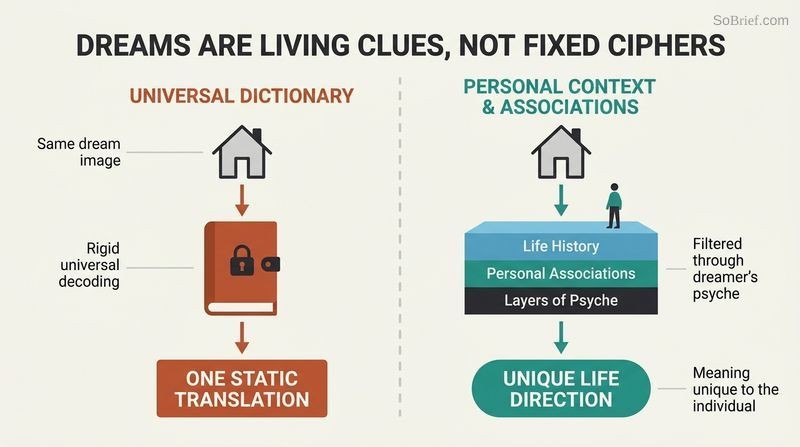
Dreams as material. Jung treats dreams as spontaneous expressions of psychic life, not as deliberate disguises with a single hidden translation. At university, two dreams helped settle his indecision about a career: one involved excavating ancient bones, another a strange living organism in water. He took them as signs of his interest in the natural world and chose medicine, a field that could eventually bring biology and psychology together.
Interpretation needs context. Jung later argued that dream images should be explored through the dreamer's associations, personal history, and relevant cultural symbols. A house in one dream, for example, seemed to him to represent layers of his own psyche. The same image could mean something different for another dreamer.
The practical strength here is curiosity instead of a symbol dictionary. Contemporary cognitive approaches also treat dreams as shaped by memory, emotion, and waking concerns, though they do not establish Jung's universal symbolic structures. A dream can prompt useful questions without delivering a prophecy or diagnosis. Its interpretation is strongest when it opens inquiry and weakest when the interpreter treats an evocative resemblance as decisive evidence.
Look for the life story that a symptom cannot tell by itself

Meaning behind labels. Early psychiatry often classified patients by symptoms while neglecting their personal histories. Jung tried to reverse that order. He describes an older woman who had been institutionalized for decades and repeatedly made the motions of sewing shoes. A nurse recalled that she had once worked as a cobbler; her brother said she had been rejected by a shoemaker she loved. The gesture, Jung concluded, carried a fragment of the life she had lost.
Listening can change the case. In another account, Jung questioned a woman labeled with a severe mental illness and connected her depression to a painful history involving her child. He believed that understanding the story altered treatment. His clinical examples argue that symptoms deserve interpretation, not merely classification.
This emphasis anticipates person-centered care: the diagnosis can guide treatment, but it cannot substitute for knowing the person. Modern trauma-informed practice similarly asks how symptoms function in a life shaped by relationships and events. There is a necessary caution. Jung's account of confronting the mother with suspected responsibility for her child's death raises serious ethical questions, and his interpretation cannot be independently checked here. Meaningful listening is not permission to impose a story.
Make therapy a dialogue between two people, not a technician and a case
The therapist is involved. Jung came to see psychotherapy as a meeting between two psyches, not the mechanical use of a method. He recounts a dream in which he had to look up at a patient seated high on a tower. He took this as a warning that he had been treating her as beneath him. After he shared the interpretation, their work improved.
Know your own instrument. Because a therapist's assumptions and emotions affect the encounter, Jung argued that therapists must examine themselves and seek supervision. He resisted one-size-fits-all rules, saying the patient's circumstances should shape the approach. Even a sound theory can become harmful when it blinds the clinician to the person in front of them.
The emphasis on the relationship is well aligned with psychotherapy research, where the quality of the working alliance is associated with outcomes across different treatment models. Jung adds a useful demand: the clinician should notice not only what the patient says, but what the encounter evokes in the clinician. Mutual influence does not mean equal power, however. Professional responsibility, informed consent, and supervision remain essential precisely because the relationship is not symmetrical.
Keep explanations plural when one theory starts explaining everything
A principled break. Jung respected Freud's work on repression and dreams, and his association experiments supported some of Freud's ideas. He objected when Freud treated sexuality as the central cause of neurosis. Jung's patients also struggled with social pressures, grief, status, and other conflicts. He came to view psychic energy, which he called libido, as something that could appear in several forms rather than as sexuality alone.
Truth over succession. Their disagreement became personal as well as scientific. Freud hoped Jung would carry his approach forward, while Jung wanted room to test different explanations. Jung describes refusing to build a career on ideas he did not believe. Their split cost him colleagues and friendships, but it pushed him toward a psychology that gave more weight to myth, culture, and religious experience.
Jung's resistance to a single-cause explanation remains valuable: human distress can reflect interacting biological, relational, and social pressures. Yet pluralism is not automatically accuracy. Jung sometimes substituted his own symbolic readings for Freud's, and his memoir gives only his side of the conflict. A strong theory should risk being corrected by evidence, rather than expanding until every possible outcome confirms it.
Give inner images form, then stay accountable to ordinary life
Make the images visible. After separating from Freud, Jung felt disoriented and began recording his fantasies. He also returned to a childhood activity, building small structures from stones. The work stirred further images and helped him reflect on them. He later wrote and illustrated this material in notebooks, including the manuscript known as the Red Book.
Keep one foot on earth. Jung did not treat imaginative immersion as an escape from daily obligations. He kept his medical practice, cared for his family, and used scientific study to examine what the experiences might mean. He feared that unexamined fantasies could overwhelm him; putting them into words and images made them easier to consider. The process was personally consequential, but it was not a controlled experiment that proved every interpretation.
Turning a vague feeling into a drawing, story, or written account can create reflective distance. That principle appears in expressive therapies and in ordinary journaling: representation gives experience a shape that can be examined. Jung's insistence on keeping work and family in view is an important safeguard. Still, intense inner exploration is not suitable for everyone, and images should not be mistaken for literal messages or treated as a replacement for clinical care.
Aim for a more whole self, not a flawless public identity
Beyond the ego. Jung uses individuation for the development of a person toward greater psychological wholeness. It does not mean making the conscious ego more powerful or perfect. It means bringing neglected or conflicting parts of life into a more honest relationship with awareness. Jung's mandala drawings, circular images organized around a centre, seemed to him to express this movement toward psychic order.
A house made of meaning. He built the Tower at Bollingen in stages over decades, adding rooms as his needs changed. Only afterward did he see the building as an image of his development. Its private room offered solitude, while its courtyard and other spaces connected him with the world. For Jung, wholeness was not a polished final state but an ongoing negotiation among different parts of a life.
This model challenges the modern habit of treating self-development as personal branding. Psychological integration can mean recognizing traits that do not fit a preferred identity, rather than suppressing them. The image of a centre also offers a useful metaphor for coherence without uniformity. Its limits matter: Jung's claim that mandalas express a universal psychic process is much broader than the evidence in this memoir can establish.
Use cultural distance to notice what your own worldview hides
An outside view. Jung traveled partly to see Europe from beyond its own assumptions. In New Mexico, a Pueblo leader challenged the white visitor's image of rational superiority and spoke of a community whose ceremonies gave human life a place in the cosmos. Jung connected that encounter to Europe's history of conquest and forced conversion, recognizing that the language of civilization could conceal violence.
The mirror has limits. Jung also described African and Asian societies in sweeping terms, often ranking them as less developed than Europe. His own account therefore shows the danger of the method: another culture can expose blind spots, but it can also be reduced to a mirror for the visitor's self-understanding.
Cross-cultural comparison can unsettle assumptions that feel natural only because they are familiar. That is valuable, especially when it reveals the power hidden in supposedly neutral descriptions. But one person's conversation cannot stand in for a whole society, and colonial settings shape who gets to observe, interpret, and publish. Jung's self-critique of European conquest sits beside language that reproduces cultural hierarchies. Reading both together is more instructive than treating him as either impartial witness or simple villain.
Take evil seriously without letting certainty excuse your choices
A difficult religious inheritance. Jung's childhood faith fractured when he could not reconcile a benevolent God with suffering, death, and his own disturbing dreams. He came to regard religious images as psychologically real and to argue that evil could not simply be explained away. In his view, a person must face the capacity for harm within the self rather than assign it entirely to an outside enemy.
Judgment still matters. Jung believed that moral decisions cannot always be made by applying a rule mechanically. He also insisted that uncertainty does not erase responsibility. In his account, inner experience may challenge conventional belief, but it does not automatically prove that an action is right. The person must reckon with the consequences of the choice.
This is a strong antidote to moral self-exemption: people who see themselves as purely good can become less alert to the harm they cause. Social psychology likewise documents how group loyalty and moral certainty can license cruelty. Jung's appeal to private inner authority needs care, since it can be used to rationalize almost anything. Self-scrutiny is valuable when it increases accountability, not when it places one person's conviction beyond challenge.
Let death enlarge your questions without turning visions into proof
A vision near death. After a heart attack, Jung described seeing Earth from space and approaching a dark stone temple. He felt that his life formed a meaningful whole, then returned to ordinary life with reluctance. The experience deepened his interest in death and the possibility of existence beyond it, but he acknowledged that he could not prove what, if anything, survives bodily death.
Myth without certainty. Jung considered dreams and religious traditions possible sources for imagining the afterlife. He argued that such images can help people confront mortality, even when their literal truth remains unknown. His method here is to permit reflection without claiming final knowledge. A sustaining myth, in this account, is a way to live with a question, not a scientific answer to it.
Near-death visions can be psychologically real and life-changing without establishing what happens after death. Modern medicine can study the conditions that accompany such experiences, while leaving their ultimate metaphysical meaning unsettled. Jung's distinction between personal conviction and proof is therefore crucial. His further suggestion that consciousness gives the world meaning is an arresting philosophical idea, but it should remain an interpretation rather than a demonstrated fact.
Analysis
This memoir is less a record of events than a case study in how one person turns experience into a theory of mind. Its narrative arc runs from a solitary child troubled by religious images, through a psychiatrist seeking meaning in patients' symptoms, to an older thinker trying to place private visions within history, myth, and religion. The recurring question is whether inner life is merely an echo of conscious experience or an active source of images and demands.
Jung's strongest contribution here is methodological rather than supernatural. He asks clinicians to attend to a patient's individual story, warns that theory can flatten human difference, and recognizes that the observer's own assumptions shape interpretation. His accounts of patients, Freud, his father, and his travels repeatedly show how people inherit frameworks that both illuminate and restrict what they can see.
The book also asks readers to hold two standards at once. A dream or vision may be psychologically important without proving a claim about God, archetypes, or life after death. Jung sometimes maintains this distinction, especially when he calls his beliefs hypotheses, but elsewhere he treats symbolic interpretations with considerable confidence. His cross-cultural observations similarly mix genuine self-questioning with the assumptions of a European of his era. Those tensions are not incidental; they show the risks of turning interpretive insight into universal law.
The memoir's form reinforces the point. Aniela Jaffé elicited, arranged, and edited much of the material, while Jung contributed chapters and approved the manuscript. The result is a shaped conversation, not transparent access to an unfiltered self. Its value lies less in settling whether Jung's metaphysics are true than in demonstrating how dreams, memory, relationships, and historical symbols can become material for sustained self-examination. Readers can borrow that practice while remaining more cautious than Jung about the certainty of its conclusions.
Review Summary
Memories, Dreams, Reflections is highly praised for its deeply personal insights into Jung's life and theories. Readers appreciate Jung's honesty, intellectual curiosity, and unique approach to psychology. Many find the book fascinating and life-changing, particularly the sections on childhood, dreams, and unconscious exploration. Some struggle with Jung's mystical experiences and unconventional ideas. The book is seen as an excellent introduction to Jung's work, offering a window into his mind and the development of his psychological concepts.
People Also Read





Glossary
collective unconscious
Shared inherited psychic patternsJung's term for a deep layer of the psyche that is not made up solely of an individual's remembered experiences. He proposed that it contains inherited forms and tendencies, including archetypes, which can shape images in dreams, fantasies, and myths. In this book, it helps explain why similar symbolic patterns may appear across people and cultures, though Jung's claim is theoretical rather than established fact.
archetype
Inherited pattern of experienceA basic, inherited form or tendency that Jung believed shapes how people experience and imagine recurring situations. An archetype is not, in his account, a fully formed idea passed down unchanged. It is more like a pattern that takes on particular content through a person's life and culture. Jung associated recurring figures and motifs in dreams and myths with archetypal patterns.
individuation
Development toward psychological wholenessJung's name for the process through which a person becomes more fully and distinctly themselves by relating conscious awareness to unconscious contents. It is not simply ego-strengthening or independence from other people. In the memoir, Jung presents it as a gradual engagement with conflicting parts of the psyche, expressed through dreams, work, relationships, and symbols such as the mandala.
Self
Totality of the psycheJung's term for the whole personality, including both conscious awareness and the unconscious. The Self is distinct from the ego, which is the centre of conscious experience. Jung treats the Self as a guiding centre of psychic development and associates it with images of wholeness, including circles, balanced forms, and mandalas.
mandala
Image of psychic wholenessA circular or centrally organized image that Jung interpreted as a symbol of psychic order and wholeness. He drew mandalas during a period of inner uncertainty and saw changes in them as reflecting changes in his psychological state. He later understood them as representing the Self and the movement of individuation. The interpretation describes Jung's psychological theory, not a universal meaning proven for every circular image.
synchronicity
Meaningful, noncausal coincidenceJung's term for the apparent correspondence between events that are meaningful to an observer but have no demonstrable causal connection. He applied it to experiences such as a dream or inner image that seemed to coincide with an external event. The concept proposes a way to think about such coincidences; it does not itself establish that they are caused by forces outside ordinary causality.
anima and animus
Contrasting inner figuresIn Jung's vocabulary, the anima is a feminine figure or pattern in a man's unconscious, while the animus is a masculine figure or pattern in a woman's unconscious. Jung saw these as mediators between conscious awareness and the unconscious, appearing in dreams, fantasies, and projections onto other people. These gendered categories reflect Jung's theory and era, and should not be mistaken for a complete account of gender or personality.
shadow
Disowned parts of personalityThe shadow is Jung's name for traits, impulses, and capacities that a person does not accept as part of their conscious identity. It can include qualities judged negatively, but Jung also allowed that it may contain useful instincts or creative potential. Bringing the shadow into awareness means recognizing one's own disowned tendencies rather than locating all wrongdoing in other people.
numinosum
Overwhelming sacred experienceA term Jung uses for an experience felt as mysterious, powerful, and charged with religious significance. It may inspire fear, awe, attraction, or a sense of being confronted by something beyond ordinary control. Jung treats numinous experiences as psychologically consequential, while their intensity alone does not prove that their source is supernatural.
libido
Psychic energyJung uses libido for psychic energy in a broad sense, not only sexual desire. He proposed that this energy could appear through different drives and interests, including sexuality, ambition, curiosity, and religious or creative activity. This broadened usage was one point of disagreement with Freud, who gave sexuality a more central role in explaining neurosis.
FAQ
What's Memories, Dreams, Reflections about?
- Autobiographical Account: The book is an autobiographical exploration of C.G. Jung's life, thoughts, and experiences, recorded and edited by Aniela Jaffé. It covers his early years, education, and development as a psychologist.
- Inner Experiences: Jung emphasizes the importance of inner experiences, dreams, and visions over external events, highlighting moments when the "imperishable world erupted into this transitory one."
- Psychological Theories: The narrative delves into Jung's theories on the psyche, the unconscious, and the interplay between personal and collective experiences, offering a profound exploration of human consciousness.
Why should I read Memories, Dreams, Reflections?
- Understanding Jung's Legacy: The book provides insight into the foundational ideas of analytical psychology and Jung's contributions to psychology and spirituality, highlighting their relevance today.
- Personal Growth: Jung's reflections on his life and struggles offer perspectives on self-discovery and the importance of understanding one's inner world.
- Cultural and Symbolic Richness: It is rich in symbolism and mythological references, deepening the reader's understanding of the human experience and the collective unconscious.
What are the key takeaways of Memories, Dreams, Reflections?
- Unconscious Importance: Jung emphasizes the unconscious's crucial role in shaping our lives, describing his life as a story of the self-realization of the unconscious.
- Integration of Opposites: The book discusses the necessity of integrating different aspects of the self, including the conscious and unconscious, to achieve wholeness.
- Spiritual Insights: Jung explores his relationship with religion and spirituality, offering a unique perspective that challenges traditional views.
What are the best quotes from Memories, Dreams, Reflections and what do they mean?
- "A book of mine is always a matter of fate.": This reflects Jung's belief that his writings are deeply connected to his personal journey and the collective human experience.
- "We are a psychic process which we do not control.": Jung highlights the complexity of the psyche and the extent to which it influences our thoughts and actions.
- "The only question is whether what I tell is my fable, my truth.": Jung emphasizes the subjective nature of autobiography and the importance of personal truth.
What is Jung's view on dreams in Memories, Dreams, Reflections?
- Inner Guidance: Jung views dreams as vital messages from the unconscious that can guide personal development, revealing hidden aspects of the self.
- Symbolic Language: Dreams communicate through symbols, requiring interpretation to uncover their meanings, described as "a little hidden door in the innermost and most secret recesses of the soul."
- Therapeutic Value: Analyzing dreams can lead to greater self-awareness and healing, a practice Jung often used in therapy.
How does Jung describe his childhood experiences in Memories, Dreams, Reflections?
- Vivid Memories: Jung recounts various memories from his early years, highlighting their emotional significance and impact on his psyche.
- Parental Influence: He reflects on family dynamics, particularly his relationship with his parents, which influenced his views on love and trust.
- Connection to Nature: Jung expresses a deep connection to nature, seeing it as a source of inspiration and insight.
What role does religion play in Memories, Dreams, Reflections?
- Spiritual Journey: Jung discusses his evolving relationship with religion, particularly Christianity, and how it shaped his understanding of the psyche.
- God and the Unconscious: He explores the concept of God as a psychological reality, suggesting that the divine is intertwined with the unconscious.
- Critique of Traditional Views: Jung critiques conventional religious beliefs, emphasizing the importance of personal experience in understanding the divine.
How does Jung's relationship with Freud influence Memories, Dreams, Reflections?
- Intellectual Partnership: Jung describes his initial admiration for Freud and their collaborative work in developing psychoanalysis.
- Theoretical Divergence: Over time, Jung's views diverged from Freud's, particularly regarding the nature of the unconscious and the role of spirituality.
- Impact on Career: The split with Freud marked a significant turning point in Jung's career, leading him to develop his own theories.
What is Jung's concept of the "Self" in Memories, Dreams, Reflections?
- Wholeness and Integration: Jung defines the "Self" as the totality of the psyche, encompassing both conscious and unconscious elements.
- Archetypal Symbol: The "Self" is often represented by symbols such as the mandala, signifying unity and harmony.
- Path to Individuation: The journey towards realizing the "Self" is called individuation, crucial for achieving psychological health and fulfillment.
What is the concept of the collective unconscious in Memories, Dreams, Reflections?
- Universal Structure: Jung defines the collective unconscious as a part of the unconscious mind shared among all humans, containing archetypes and universal symbols.
- Archetypes' Role: These archetypes shape human experiences and manifest in myths, dreams, and cultural narratives.
- Cultural Significance: Understanding the collective unconscious helps individuals connect with their cultural heritage and shared human experiences.
How does Jung contrast Eastern and Western spirituality in Memories, Dreams, Reflections?
- Different Approaches: Jung notes that Western morality often views good and evil as separate, while Eastern traditions see them as interconnected.
- Meditation vs. Action: Eastern spirituality emphasizes meditation and inner peace, while Western traditions focus more on moral action.
- Nirdvandva Concept: Jung discusses the Indian concept of nirdvandva, or liberation from opposites, contrasting it with Western moral perfection.
How does Jung's personal journey influence his theories in Memories, Dreams, Reflections?
- Life Experiences: Jung's travels and cultural encounters shape his understanding of psychology and spirituality.
- Dream Analysis: His own dreams play a crucial role in his psychological development and theories.
- Cultural Integration: Jung's commitment to integrating Eastern and Western philosophies enriches his psychological framework.
About the Author
Other books by C.G. Jung







Download PDF
Download EPUB
.epub digital book format is ideal for reading ebooks on phones, tablets, and e-readers.








