

Key Takeaways
Read Black farming as a history of resistance, not only forced labor
A fuller record. Slavery, sharecropping, and land loss made farming a site of profound exploitation. White’s account preserves that pain while recovering another part of the story: Black people used agricultural knowledge, land, and cooperation to survive and resist. Enslaved Africans grew food in provision gardens, cultivated crops they knew, and sometimes exchanged produce beyond the plantation’s rations. After emancipation, Black communities built farms, towns, and organizations around shared resources.
Farmers meant broadly. The book includes landowners, tenants, sharecroppers, laborers, and women who gardened around domestic work. It traces this tradition through the Colored Farmers Alliance and the cooperatives of the 1960s, arguing that working the land could support community life and political struggle, not just the crops that enriched others.
What's important here is the refusal of a false choice: either agriculture was oppressive or it was liberating. The same land and labor relations could produce exploitation and, through gardens and shared markets, some room for agency. This resembles a broader historical principle: people living inside coercive systems often use the skills those systems demand to create limited alternatives. The corrective should not romanticize farming or imply that food production undid slavery's violence. Its value lies in restoring farmers as organizers and political actors, rather than leaving them as scenery in a story told mainly through urban protest.
Treat agricultural knowledge as community infrastructure, not merely technical expertise
Knowledge made practical. Booker T. Washington built institutions around the needs of Black farmers, including Tuskegee's training and outreach programs. Its farmers' conferences gave growers a place to compare experience and discuss land, crops, and schooling. George Washington Carver made scientific agriculture useful to people with limited tools and money. His bulletins explained soil restoration, crop rotation, composting, and food crops; the movable school took demonstrations to rural communities.
A collective vision. W. E. B. Du Bois argued that cooperatives could connect Black producers and consumers, allowing communities to retain more value and govern economic life together. Their approaches differed, and Washington's accommodationist politics remain contested. Yet each treated education, agricultural skill, and institution-building as resources that could expand Black communities' choices.
The distinctive lesson is that useful expertise travels in both directions. Carver translated scientific findings into forms farmers could apply, while Washington's fieldwork began with observing what rural families actually needed. That resembles participatory research, where people affected by a problem help shape the questions and test possible solutions. The institutional setting matters: knowledge alone does not repair depleted soil or change unfair markets. Nor does Washington's practical contribution erase the limits of his political accommodation. The strongest model here joins accessible technical learning to community-defined priorities and the power to act on them.
Build democratic alternatives alongside protest, so people can practice freedom together
From complaint to construction. White develops the framework of collective agency and community resilience, or CACR, to describe how people organize, make choices together, and build capacity in the face of extreme adversity. It extends the study of resistance beyond marches and boycotts to include institutions that meet community needs and challenge unequal relationships.
Freedom in daily practice. Three connected ideas clarify how this worked. Shared land, labor, and resources put collective well-being ahead of individual accumulation. Democratic spaces let people discuss problems, set priorities, and govern together when public institutions excluded them. Economic alternatives reduced dependence on exploitative merchants and employers. Cooperatives could combine all three: they fed people, created a place to make decisions, and gave members more control over production and exchange.
This framework makes resistance visible in the work of building, not only in the act of refusing. It also offers a useful connection to Elinor Ostrom's research on shared resources: cooperation is more durable when participants have a voice in rules and can see how benefits and responsibilities are distributed. Still, a well-run cooperative does not make surrounding institutions fair. The book's cases show that community organization can create room to maneuver, but land access, public policy, credit, and protection from retaliation remain consequential. Collective capacity is a source of leverage, not a substitute for structural change.
Make food security a source of political leverage, not charity
Hamer's response. Fannie Lou Hamer had worked as a sharecropper and was evicted after registering to vote. In 1967, she founded Freedom Farm Cooperative in Mississippi's Sunflower County to address hunger, unemployment, housing, and education. She understood that people threatened with losing their jobs and food faced barriers to political participation. A garden and livestock could not end repression, but they could reduce a family's dependence on those using deprivation to enforce it.
A cooperative with reach. Members grew vegetables and cash crops, built housing, and developed employment and education programs. A donated group of pigs became a breeding bank: families received animals and returned piglets to replenish the shared stock. By 1973, more than 865 families had benefited. Freedom Farm made food production part of a wider effort to secure the conditions for community life and political action.
Hamer's achievement was to connect a material need to the political conditions that shaped it. That insight fits the social determinants of health: nutrition, housing, work, and safety are not isolated personal choices when access to them is structured by power. The pig bank also shows why a shared asset can matter beyond its market price: it can feed families while creating mutual obligations and confidence. Yet food production cannot by itself guarantee voting rights, income, or health care. Hamer's model is strongest as a means of strengthening political agency, not as an argument that oppressed communities should have to provide every public good themselves.
Own more of the food chain to keep farmers from subsidizing middlemen
Bolivar's cooperative. The North Bolivar County Farmers Cooperative began in 1967, when residents facing unemployment and hunger organized to grow food for their community. Its membership reached 953 families during its first year, and it raised and distributed more than one million pounds of produce. Members pooled land, tools, labor, and knowledge; local representatives helped govern the work.
Value beyond the harvest. Farmers noticed that produce bought cheaply from them could be resold at far higher prices, or transformed into packaged goods that captured still more profit. The cooperative explored processing and marketing its own food rather than surrendering every step after harvest to outside firms. Members also considered selling familiar Southern foods to Black migrants in the North. Their experiment showed that producing food matters, but so does controlling how it is processed, priced, and delivered.
The cooperative's attention to processing and distribution anticipates a central question in supply-chain analysis: who captures the value between production and the final sale? A farmer can increase output and still remain poor if buyers control prices and access to markets. Collective selling can improve bargaining power, while processing can keep more of the product's value near the people who grew it. Those strategies also bring new costs, skills, and risks. Scale does not automatically create fairness; governance and transparent accounting determine whether added value reaches members or merely creates another layer of management.
Connect local cooperatives through networks that share expertise and bargaining power
Regional capacity. The Federation of Southern Cooperatives formed in 1967 as an umbrella organization for rural cooperatives. By 1974, it included 134 cooperatives across fourteen states. It offered training in farm management, purchasing, marketing, and record keeping, and helped members obtain supplies and reach buyers. Pooling purchases and coordinating crops gave small farmers more leverage than they had negotiating alone.
Beyond one crop. The Federation supported more than farms. Its projects included housing, health care, literacy, energy conservation, and small businesses. It also helped cooperatives share resources, such as fuel and fertilizer, when shortages or high prices threatened production. This regional structure connected local initiatives without replacing them: communities identified needs, while the larger organization supplied skills, coordination, and access to resources that a single small cooperative might struggle to secure.
The Federation illustrates the value of a federated structure: local groups retain knowledge of their circumstances, while a larger network can provide specialized services and bargaining scale. In organizational design, this can reduce duplication and help small units survive shocks. It also creates a hard governance problem. A support body must remain accountable to its members rather than becoming a distant authority that defines their priorities. The Federation's combination of local decision-making and shared services is therefore more instructive than scale alone. Its reach mattered because it was designed to strengthen member cooperatives, not simply consolidate them.
Design self-reliance for durability, because a strong model can still be starved
Vulnerability was structural. Freedom Farm's work expanded, but the organization depended on grants and donations as it tried to build a self-supporting farm. Drought and flooding damaged crops, funding declined, and the organization could not keep up with its expenses. It ultimately sold its land. Meanwhile, cooperatives associated with the Federation faced evictions, hostile market practices, and political investigations. Their difficulties were not simply evidence of poor planning; they operated amid deliberate opposition and unequal access to capital.
Support is part of the system. The cases show that community initiative needs durable financing, technical skills, reliable markets, and protection from retaliation. Regional organizations could help smaller groups acquire expertise and coordinate sales, but they could not remove every obstacle. Self-reliance was a direction of travel, not complete independence from public institutions or outside resources.
The word resilience can imply that communities should absorb repeated harm and recover without asking who caused it. White's cases invite a sharper reading: resilience includes collective organization, but the conditions of recovery are political. Freedom Farm's collapse after weather damage and donor losses shows how a socially valuable project can remain financially fragile. This is a useful distinction between a good idea and a durable institution. Long-term plans need reserves, diversified income, and partners, while public policy must address unequal access to land and credit. Otherwise, celebrating self-reliance can unintentionally shift responsibility from powerful institutions onto communities with the fewest resources.
Let urban farms build civic power, not just harvest vegetables
Detroit's renewed practice. In a city battered by industrial decline and grocery-store closures, the Detroit Black Community Food Security Network organized around food access, community control, and political education. It helped create a city food policy and council, and established D-Town Farm as a place to grow produce, teach, and gather. The farm used vacant land for crops, composting, beekeeping, and community events, while connecting food choices to race, economics, health, and land stewardship.
A wider system. The network's Ujamaa buying club pooled purchases to lower costs. It also planned the Detroit Food Commons, including a cooperatively owned grocery store, as a way to expand community control over distribution. These efforts echo earlier Southern cooperatives, though the book does not claim a direct organizational lineage. They show how urban agriculture can support community and civic capacity as well as food production.
D-Town Farm is significant as social infrastructure: it combines growing, learning, gathering, and public discussion in one place. That makes the farm more than a food source, especially where residents have experienced disinvestment. Its influence also depends on recognizing limits. A community farm cannot supply an entire city's food needs, and local control does not eliminate affordability problems or unequal land ownership. The strongest interpretation is complementary: urban agriculture can build knowledge, relationships, and political voice while food policy, public investment, and larger distribution systems address needs that a few acres cannot meet.
Analysis
White's central contribution is not simply to add Black farmers to a history of food activism. It is to change what counts as activism. Gardens, cooperative purchasing, livestock banks, technical training, and shared marketing become political practices when they reduce dependence on institutions that exploit or exclude a community. This is a consequential shift from a protest-centered account of social movements toward one that also examines the durable alternatives people attempt to build.
The book's historical arc links enslaved people's agricultural knowledge and provision gardens with Black intellectual traditions, civil rights-era cooperatives, and urban food organizing in Detroit. These are not identical projects, and the narrative is careful to show difference in scale and circumstance. Tuskegee's extension work developed expertise; Hamer's Freedom Farm addressed acute deprivation; the Federation supplied regional coordination; DBCFSN joined food production to policy advocacy and community education. Their common thread is collective control over resources, not a single organizational blueprint.
The CACR framework is useful because it makes constructive institution-building legible as resistance. It also clarifies why food alone is not the whole story: land, labor, distribution, education, and democratic decision-making shape whether food can support autonomy. The cases expose the tension in the word self-reliance. Communities can pool knowledge and build alternatives, yet they remain vulnerable to weather, financing gaps, market power, and state action. Celebrating resilience without confronting those forces would risk treating imposed hardship as a test of community character.
The book's archival research and interviews also recover working-class and women's contributions too often obscured by accounts centered on prominent leaders or dramatic public events. Its strongest lesson is therefore both historical and institutional: community survival can be a political achievement, but communities should not bear the burden alone. Cooperative capacity matters most when it expands people's choices and strengthens their leverage in the systems around them.
Review Summary
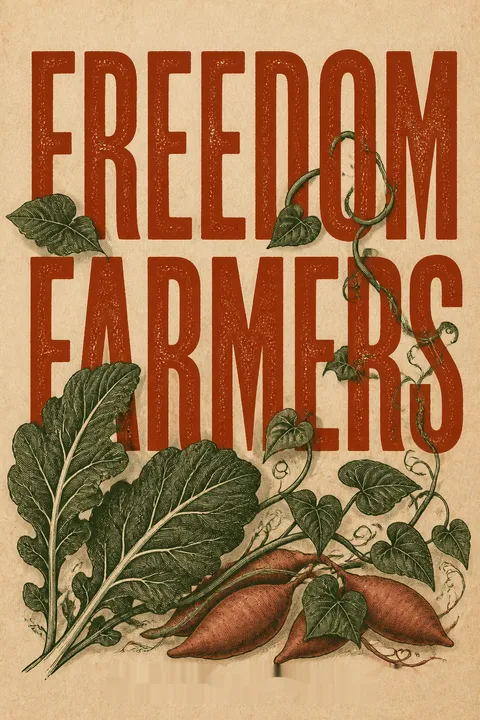
Freedom Farmers explores Black agricultural resistance and cooperatives as tools for empowerment and liberation. Readers praise White's thorough research, highlighting figures like Booker T. Washington and Fannie Lou Hamer. The book reframes agriculture as a site of resistance rather than just oppression. Many found it inspiring and enlightening, particularly in connecting historical movements to contemporary urban farming. Some readers noted the academic tone and density of the material, but most appreciated the book's importance in filling gaps in Black agricultural history.
People Also Read







Glossary
Collective agency and community resilience (CACR)
Organized community capacityWhite's framework for understanding how people facing adversity act together to shape their political future and sustain community life. It includes both collective agency, the ability to create and pursue shared options, and community resilience, the capacity to adapt and reorganize under stress. It directs attention to constructive institution-building as well as protest.
commons as praxis
Shared resources in practiceA strategy in which a community pools and governs resources such as land, water, seeds, labor, and knowledge for shared well-being. In White's account, this practice challenges individualism and unequal ownership by making cooperation part of everyday life. It is not merely a belief in sharing; it is the organized use of common resources.
prefigurative politics
Practicing desired democracyThe creation of democratic spaces and institutions that embody the political relationships a group seeks, even while members remain excluded from power elsewhere. In the cooperatives, people could deliberate, learn, and govern together. These practices made political participation tangible while helping communities imagine alternatives to oppressive arrangements.
economic autonomy
Greater control over exchangeA community's effort to reduce dependence on exploitative economic relationships by creating alternatives for producing, purchasing, selling, and sharing resources. White treats autonomy as a process, not total independence: communities remain connected to wider markets and institutions, but collective action can increase their bargaining power and control over resources.
organic intellectual
Community-rooted political thinkerA term associated with Antonio Gramsci that White uses to describe a thinker emerging from a social group who articulates its needs and helps organize its response. Fannie Lou Hamer's knowledge came from lived experience as a sharecropper and activist. She identified how hunger and eviction constrained political participation and organized practical responses.
food sovereignty
Community control of foodThe capacity of a community to shape its food system, including how food is grown, distributed, and accessed. In the book's cases, sovereignty means more than obtaining enough food. It includes participation in decisions, control over productive resources, and the ability to develop food practices that serve community priorities rather than outside interests.
FAQ
What is Freedom Farmers: Agricultural Resistance and the Black Freedom Movement by Monica M. White about?
- Explores Black agricultural resistance: The book examines how Black farmers in the United States used agriculture and cooperatives as tools for resistance, self-determination, and community building.
- Links to Black Freedom Movement: It situates Black agricultural efforts within the broader context of the Black freedom struggle, highlighting farming and land ownership as strategies for economic and political empowerment.
- Historical and contemporary scope: The narrative spans from the post-slavery era through the civil rights movement to modern urban food justice initiatives, connecting past and present struggles for food sovereignty.
Why should I read Freedom Farmers by Monica M. White?
- Uncovers overlooked history: The book reveals the vital but often ignored role of Black farmers and cooperatives in the Black freedom struggle and American history.
- Connects past to present: It draws direct lines between historical agricultural resistance and today’s urban food justice movements, offering lessons for contemporary activism.
- Provides a new framework: Monica M. White introduces the concept of collective agency and community resilience (CACR), offering a fresh lens for understanding how marginalized communities build sustainable alternatives.
What are the key takeaways from Freedom Farmers by Monica M. White?
- Black farmers as agents of change: The book challenges stereotypes, showing Black farmers as active leaders in building economic autonomy and resisting oppression.
- Cooperatives as resistance: Agricultural cooperatives provided spaces for self-sufficiency, democratic governance, and economic independence, bypassing exploitative systems.
- Enduring legacy: The strategies and philosophies of historical Black agricultural movements continue to inspire and inform modern food justice and land reclamation efforts.
How does Monica M. White define “collective agency and community resilience” (CACR) in Freedom Farmers?
- Collective agency: Refers to a group’s ability to act together to shape their political and economic futures, emphasizing shared identity and mutual success.
- Community resilience: Describes how communities adapt, withstand, and reorganize in the face of adversity, such as political violence or economic oppression.
- Three key strategies: CACR is enacted through commons as praxis (shared resources), prefigurative politics (democratic, alternative systems), and economic autonomy (independent economic structures).
What is “commons as praxis” and how is it used in Freedom Farmers by Monica M. White?
- Cooperative sharing of resources: Commons as praxis involves pooling land, tools, labor, and knowledge to build community-based institutions that circumvent oppressive systems.
- Sustaining community: This practice allowed Black farmers to support each other, share risks, and ensure survival in hostile environments.
- Foundation for resistance: By creating shared economic and social spaces, Black communities built resilience and autonomy outside mainstream exploitative structures.
How does Freedom Farmers by Monica M. White connect historical Black agricultural cooperatives to modern food justice movements?
- Legacy of resistance: The book traces how enslaved Africans and their descendants used farming knowledge and cooperative strategies to resist oppression and build community.
- Continuity of strategies: Concepts like commons as praxis, prefigurative politics, and economic autonomy are shown as enduring frameworks, adapted from rural cooperatives to urban food networks.
- Inspiration for today: Historical examples provide lessons and models for contemporary activists working to reclaim land, food systems, and economic power.
What role did Fannie Lou Hamer’s Freedom Farm Cooperative play according to Freedom Farmers by Monica M. White?
- Community-based antipoverty strategy: Founded in 1967, the cooperative aimed to provide food, housing, education, and employment to displaced Black farmworkers in Mississippi.
- Manifestation of CACR: Freedom Farm embodied commons as praxis, prefigurative politics, and economic autonomy through shared gardens, democratic governance, and collective production.
- Enduring legacy: Despite its eventual closure, the cooperative remains a powerful example of agricultural resistance and community resilience in the Black freedom movement.
How did the North Bolivar County Farmers Cooperative (NBCFC) contribute to Black agricultural resistance in Freedom Farmers?
- Regional cooperative model: NBCFC organized nearly a thousand families to grow and distribute produce, addressing hunger and economic displacement in Mississippi.
- Community governance: The cooperative maintained democratic control through elected representatives and community listening sessions, ensuring collective decision-making.
- Economic innovation: NBCFC bypassed exploitative middlemen, partnered with health institutions, and diversified into other cooperative businesses, strengthening economic autonomy.
What is the significance of the Federation of Southern Cooperatives (FSC) in Freedom Farmers by Monica M. White?
- Umbrella organization: FSC provided technical assistance, training, and financial services to over a hundred cooperatives across the South, helping Black farmers maintain land ownership.
- Promoting sustainable agriculture: The federation encouraged crop diversification, soil conservation, and youth training, blending the legacies of Booker T. Washington and George Washington Carver with cooperative principles.
- Political advocacy: FSC defended Black farmers against eviction and economic retaliation, supporting political participation and community resilience.
How does Freedom Farmers by Monica M. White redefine the narrative about Black farmers and land ownership?
- Challenges stereotypes: The book disputes the notion that Black people abandoned farming due to lack of interest, highlighting the impact of systemic racism and violence.
- Highlights agency and activism: Black farmers are portrayed as active agents who fought for land, built cooperatives, and supported civil rights activism.
- Recovers lost histories: By documenting these contributions, the book restores pride and offers a foundation for contemporary food justice and land reclamation movements.
What is the role of Detroit Black Community Food Security Network (DBCFSN) in Freedom Farmers by Monica M. White?
- Urban agricultural resurgence: DBCFSN represents the modern continuation of Black agricultural resistance, addressing food insecurity and economic decline in Detroit.
- Food sovereignty and empowerment: The network emphasizes pan-African solidarity, anti-racism, and cooperative economics, using farming as a form of political and community empowerment.
- Community wellness: Through projects like D-Town Farm, DBCFSN provides fresh produce, health education, and cultural events, fostering economic autonomy and collective agency.
What are the best quotes from Freedom Farmers by Monica M. White and what do they mean?
- Fannie Lou Hamer: “Down where we are, food is used as a political weapon. But if you have a pig in your backyard... you can feed yourself and your family, and nobody can push you around.” This highlights food as a tool of empowerment and resistance.
- bell hooks: “Collective black self-recovery takes place when we begin to renew our relationship to the earth, when we remember the way of our ancestors...” This underscores the importance of reconnecting with agricultural roots for healing and empowerment.
- W. E. B. Du Bois: “If leading the way as intelligent cooperating consumers, we rid ourselves of the ideas of a price system and become pioneer servants of the common good...” This expresses the vision of cooperatives as a path to economic and political freedom.
- Malik Yakini: “Our approach to farming and our approach to land stewardship is related to our interconnectedness to nature...” This reflects a holistic, pan-African philosophy guiding sustainable agriculture and community resilience.
Download PDF
Download EPUB
.epub digital book format is ideal for reading ebooks on phones, tablets, and e-readers.








