


Plot Summary
Prologue
At nine, River watches fighter planes cross the summer sky above Cape Cod. The noise gives way to an impossible silence, then news reports show a nuclear explosion in Kansas and announce a world war.
River’s mother offers her one rare moment of comfort, but the tenderness does not last. As the neighborhood panics, River holds her baby brother Gage and promises to keep him safe. She cannot yet understand that the bombs are only the first rupture in a much larger disaster.
The catastrophe begins through a child’s partial understanding: River sees the planes, the silence, and the adults’ terror before she can grasp their causes. Her mother’s brief touch makes the collapse intimate, not merely geopolitical, and its finality anticipates the emotional deprivation River will endure at home. Most important, River’s promise to Gage becomes the governing structure of her adult life. In a world where institutions fail, care begins as a child’s private vow, then grows into the labor that keeps her family alive.
Three Fish, One Flyer
At twenty-two, River Dawson feeds her family by fishing the Cape Cod canal, bartering her catch, and stretching scarce supplies for her younger brothers, Gage and Bailey. Their mother remains bitter and neglectful, so River has become both provider and protector.
The coastal community survives behind guarded bridges, cut off from the devastated interior, and its annual Volunteer Day sends teenagers to serve at the distant Wall. River has never volunteered because her brothers need her.
At the celebration, a government handbill asks residents to report anyone with unusual abilities, including visions. River recognizes herself in its description. Her friend Lisa and Gage urge caution, but the search has already turned River’s private strangeness into a danger that can reach her home.
River’s ordinary life is already a form of crisis management. Fishing, repairing gear, and caring for children are not background details; they show how she converts competence into protection when adults and public systems cannot be relied upon. The flyer changes the meaning of her hidden visions. What she once treated as a private peculiarity becomes state property, and the celebration’s promise of collective rebuilding acquires a coercive edge. Her reluctance to volunteer is not fear of adventure. It is loyalty to people whose survival depends on her staying.
A Mother’s Bargain
When River returns from Volunteer Day, Colonel MacIntyre and soldiers are waiting inside her home. Her mother has identified her as the person with visions, hoping the government’s reward will secure her own future. River refuses to be treated as a volunteer, but the officers insist she must go.
She bargains instead: her brothers must be removed from their mother’s care and protected by Lisa and Asante, a Guard and Lisa’s partner. River agrees to leave peacefully once the colonel promises it. Gage and little Bailey cling to her as she is taken away, and Lisa runs after the departing truck. River has protected her brothers again, but this time the price is her own home and freedom.
The betrayal hurts because it reverses River’s understanding of family obligation. She has spent years compensating for her mother’s failures, yet her mother treats River as an obstacle to be exchanged for material security. River’s response is characteristically practical: she cannot stop the abduction, so she negotiates the conditions of her absence. The scene makes care both her strength and her vulnerability. Her brothers’ safety is the only leverage she has, and the government knows it. Her departure therefore begins not as a chosen quest but as a coerced sacrifice made on behalf of dependents.
Beyond the Wall
The trucks carry River through the immense Wall and into a military camp where demons live and train beside human recruits. Kobal, a towering demon commander, studies River while Colonel Mac explains that the war never ended. Kobal later tells her what official broadcasts concealed: governments experimenting with other dimensions tore open a gateway into Hell, and the nuclear strikes were their attempt to contain the demons released.
Lucifer’s followers, the Craetons, now threaten humans and demons alike. River is furious that Kobal’s search caused her capture, but he will not yet explain what he wants from her. When she refuses the recruits’ first run, a soldier threatens her brothers’ safety, forcing River to begin training.
The revelation shifts responsibility away from a distant foreign enemy and toward human institutions that tried to master forces they did not understand. The Wall, which River once knew only as a guarded boundary, becomes both shelter and evidence of concealment. Kobal’s refusal to answer her questions echoes the secrecy that has governed her life, while the threat to her brothers converts training into another coerced act of care. River’s resistance remains morally intelligible: she is not rejecting survival skills, but the demand that she trust people who have already taken control of her future.
The First Impossible Strike
River’s training pits her against Kobal, who repeatedly knocks her down while teaching her how to fight demons. She gradually accepts the lessons because she refuses to become helpless beyond the Wall. Carrie, a fellow recruit from River’s town, offers a cushion for River’s bruised tailbone and becomes a rare companion who understands what home meant.
During a sparring match, River’s vision shows Kobal’s movements just before he makes them. She blocks his attacks and lands a blow on his chest, her first successful strike against him. The effort leaves her with a broken rib and punctured lung. Kobal carries her to the infirmary and stays beside her, reading aloud as she recovers.
The fight marks a change from endurance to agency. River’s ability does not erase the imbalance between her and Kobal; it lets her anticipate it, briefly turning vulnerability into tactical knowledge. Her injury is the cost of discovering that capacity without yet knowing its limits. Carrie’s kindness offers a different kind of support from Kobal’s intense attention: she restores a link to River’s former community without demanding anything from her. In the infirmary, Kobal’s reading complicates River’s judgment of him. He remains responsible for her capture, yet his attentive behavior resists a simple division between captor and enemy.
Fire Against Madagans
After River returns to training, a vision briefly removes Kobal and her from the crowded field and shows boar-like madagans charging over a hill. She warns him, and the creatures soon attack the camp. Soldiers fire from the Wall while demons meet the beasts at close range. When a madagan leaps at River, fire erupts from her palms and burns it to bone.
Kobal shields her from the remaining attackers and takes her to his tent, where he presses her to explain what else she can do. River admits only to a childhood fire that she once thought accidental. The attack convinces Kobal that she is more than a recruit, though he still withholds the reason he has been searching for her.
The vision becomes consequential rather than merely uncanny: River’s perception gives the camp warning, and her fire turns an exposed recruit into a combatant. The transformation is empowering but frightening, because it confirms that her body can act before her understanding catches up. Kobal responds by intensifying his control, which is protective and possessive at once. River’s continued secrecy reflects a learned survival strategy: information has often been used against her, so revelation must feel earned. The madagans make the larger conflict tangible, but River’s first victory also makes her difference impossible to dismiss.
Lucifer’s Living Heir
Kobal finally explains why the search brought River to the Wall. He believes she descends from Lucifer, whose child remained on Earth before Lucifer entered Hell, and that her mixed human, angelic, and demonic inheritance may let her close the unnatural gateway. The revelation gives new meaning to River’s violet eyes, visions, fire, and unusual sensitivity to life around her.
It also makes her a possible target for Lucifer. River resists being reduced to an asset, especially when Kobal says she may have to confront the fallen angel himself. She moves into Kobal’s tent for protection, but their growing attraction complicates the arrangement. River longs for home; Kobal promises to see if she can someday visit her brothers.
The revelation recasts River’s identity without resolving her fear of what it means. Her abilities are no longer isolated oddities but evidence of a lineage that may determine the fate of several worlds. Yet the language of usefulness threatens to reproduce the same instrumental treatment she has already faced from her mother and the government. Kobal offers safety and a possible family visit, but his protection also narrows her independence. River’s attraction to him grows alongside suspicion, revealing the central emotional tension: intimacy offers refuge, while dependence risks making her another person whose choices are made by someone more powerful.
Sparks Between Them
River’s sense of the life in trees and soil, which she has always assumed everyone shares, proves to be another ability. After she sees soldiers and demons at a nightly gathering, her attraction to Kobal sharpens into a kiss charged with energy. Golden-white sparks appear between their hands, and Kobal recognizes the power as an angelic capacity to draw on life around her.
River feels exposed and angry that he expects her to understand a self she has only just discovered. With the journey toward the gateway approaching, she practices in secret, learning to form a ball of living energy and drive it into the ground hard enough to scorch it. She hides how far she has progressed, determined to keep some knowledge for herself.
The sparks link desire, knowledge, and power without making any one of them simple. River’s connection to life is intimate and sensory, rooted in the same attentiveness that once made nature a refuge from household cruelty. Kobal interprets it as a weapon; River experiences it as a part of herself that precedes the war. Her secret practice is an important assertion of autonomy. She is still preparing to serve a mission she did not choose, but she now controls at least some of the knowledge shaping her role. The scene’s emotional charge comes from the contrast between being seen by Kobal and being defined by him.
The Dead Break Through
During a fight with Kobal, River receives a vision of revenirs emerging from the ruins of a nearby town. These skeletal, half-mummified creatures soon attack the soldiers and demons there, shrieking to weaken their victims before draining life through a kiss. River fights one with her own hands and uses fire when it tries to seize her.
Kobal finally reveals that he, too, can wield fire, turning the battle with a sweeping blast that saves the survivors and exposes a power he had kept secret. The demons recognize the attack as proof that Lucifer has broken the first seal in Hell. The revenirs are only the beginning: more imprisoned horrors may now reach the human world.
The attack makes the Wall’s protection feel temporary. The revenirs convert the dead into a source of further danger, so the destruction left by the old war becomes raw material for the new one. River’s response matters because she survives through a mix of training, instinct, and a power she cannot yet fully control. Kobal’s hidden fire saves lives, but the revelation also exposes how carefully the demons ration trust. Their alliance with humans is practical, not transparent. River sees that the threat cannot be contained by keeping knowledge or abilities private, even as secrecy remains one of the few protections available to her.
Marked as His Chosen
After the revenirs’ attack, River and Kobal stop holding back their attraction and become lovers. Kobal bites and marks her, then recognizes the bond as the demon pairing known as a Chosen. River marks him in return, and their connection makes Kobal stronger while giving each a claim on the other. She accepts the bond but insists they avoid pregnancy while Lucifer remains a threat.
For River, intimacy brings a startling sense of belonging after weeks of displacement; for Kobal, it turns desire into a lifelong commitment. He promises there will be no other partners. Their closeness does not remove the mission or River’s fear of her mortality, but it gives her a person she now has reason to protect as fiercely as her brothers.
The Chosen bond gives supernatural form to a relationship that has been shaped by unequal power from the start. River’s consent matters, but the bond also carries consequences she did not fully understand before accepting it. The marks signify mutual attachment, yet they do not erase the difference between an immortal demon commander and a mortal woman pulled into his world. River’s insistence on postponing pregnancy demonstrates that love has not dissolved her judgment. Her desire for belonging is genuine, but she continues to think concretely about danger, bodies, and the people who could be harmed by their choices.
A Father in the Dream
River’s connection to dreams draws Lucifer into a cavernous vision, where he recognizes Kobal’s marks and calls River his daughter. He claims her growing powers will corrupt her, turn her against Kobal, and make her the instrument of Kobal’s defeat. He promises a gift and disappears before she can learn more. River wakes shaken and tells Kobal what happened.
Kobal insists Lucifer is manipulating her to prevent her from developing her abilities, but River cannot dismiss the warning because it echoes her lifelong fear that she is inherently bad. The mission now carries a private terror alongside its public danger: River must become powerful enough to face Lucifer without becoming the person he predicts.
Lucifer attacks through interpretation rather than force. He finds River’s oldest wound, the belief that her mother’s cruelty might have been justified, and recasts it as destiny. Kobal offers certainty, but certainty cannot simply undo a fear that has been reinforced since childhood. The dream therefore shifts the conflict inward without making it merely psychological: River’s powers may genuinely change what she can do, while her ethical identity depends on how she chooses to use them. The promised gift keeps the threat open, and the bond that comforts River also becomes something Lucifer can threaten to exploit.
Blood on the Parade Ground
As Mac announces the fifty soldiers chosen for the journey, River foresees Eileen, a jealous soldier, attacking her with a knife. River dodges the blade and knocks Eileen down, but Kobal reaches them and kills her by tearing off her head, despite River’s attempt to stop him. Covered in Eileen’s blood, River tells Kobal that protecting her does not justify treating a human life as worthless.
She ends their relationship and orders him out, unwilling to risk losing her compassion or becoming like Lucifer. Kobal leaves, and River continues training with the expedition only days away. She remains committed to saving her brothers and proving that her inheritance will not dictate her choices, though her bond with Kobal is left unresolved.
The final rupture tests whether River’s compassion survives contact with the violence that protects her. Eileen’s attack is real and lethal, but Kobal’s response turns protection into absolute vengeance. River refuses the easy equation between love and permission: she can understand why Kobal acted and still reject what he did. Her decision also recalls the fear awakened by Lucifer’s dream. She cannot control her ancestry, but she can refuse to let power or attachment excuse cruelty. The ending offers resolve rather than closure. River is prepared to leave, yet the mission, the threat, and her separation from Kobal remain ahead.
Analysis
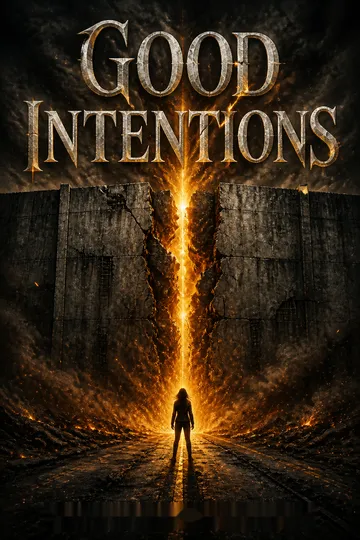
Good Intentions builds its fantasy conflict from a recognizably human failure: authorities seeking to improve the world cross a boundary they cannot control, then hide responsibility behind a false story of foreign attack. The Wall gives that denial architecture. It protects communities, but it also limits knowledge, turning survival into dependence on military explanations that are incomplete by design.
River’s character offers a counterforce to this institutional secrecy. Before she learns what her abilities mean, she already knows how to read the weather, feed a family, repair tools, and notice what others miss. Her power develops from habits of attention rather than from a sudden transformation into someone unrelated to her past. That continuity matters. She does not become valuable because she abandons care; her capacity to care is what distinguishes her from the forces trying to use her.
The romance with Kobal tests the boundary between protection and possession. Kobal’s devotion gives River tenderness she has rarely known, but his instinct to defend her through violence conflicts with her belief that every life matters. Their bond cannot settle that disagreement. Indeed, its supernatural permanence raises the stakes: affection may create obligations without guaranteeing ethical agreement. River’s break from Kobal at the end is therefore not a rejection of love so much as a refusal to let love excuse brutality.
The book’s central question is whether inheritance determines character. River’s feared resemblance to Lucifer echoes her mother’s lifelong condemnation, making the antagonist’s prophecy psychologically potent even when it may be manipulation. River cannot choose her ancestry or the powers it gives her. She can choose what those powers serve. The ending leaves that choice unresolved in action but firm in principle: she is ready to face the journey without accepting that either her bloodline or her beloved has the authority to decide who she becomes.
Review Summary
Good Intentions receives mixed reviews, with an average rating of 4.18 out of 5. Readers praise the unique post-apocalyptic demon romance concept, strong world-building, and chemistry between the main characters, River and Kobal. However, some criticize the slow pacing, information dumps, and underdeveloped characters. The book is described as a slow-burn romance with intriguing fantasy elements, though opinions vary on the execution. Many readers express interest in continuing the series despite its flaws, while others find it disappointing or not to their taste.
People Also Read

Characters
River Dawson
Reluctant wall recruitRiver is a resourceful young woman whose adult life has been shaped by caring for her younger brothers and compensating for an unreliable mother. Fishing, repairing equipment, and reading people are practical skills, but her unusual intuitions make her wary of being noticed. She meets danger with stubbornness and humor rather than easy trust. Her central psychological conflict is not simply whether she can survive, but whether power and inherited identity can alter her moral choices. She wants connection, yet resists being owned, managed, or reduced to a useful role. Her fierce attachment to family gives her courage and can also make her vulnerable to anyone who threatens the people she loves.
Kobal
Hell’s guarded commanderKobal is an immense, formidable demon commander tasked with opposing Lucifer and protecting the fragile human settlements along the Wall. He is disciplined, blunt, and accustomed to treating violence as a tool rather than a moral dilemma. River’s defiance and unusual abilities unsettle that certainty, while his attraction to her awakens forms of tenderness and possessiveness he has not had to manage before. He prefers direct action to explanation, which makes him an effective leader and a difficult partner. His struggle is between the strategic duty he has carried for centuries and the personal attachment that makes River’s safety feel more important than his own.
Lucifer
Fallen angel warlordLucifer is a fallen angel whose faction seeks to expand its power across the human world. Beautiful and cold, he uses knowledge of other people’s fears as deftly as force. He believes the existing order is corrupt and presents his ambitions as liberation, but his methods involve domination and destruction. His ability to manipulate perception makes him dangerous even when he is not physically present. He is the central antagonist of the conflict between the Palitons and the Craetons, and a figure whose history reaches across the boundaries separating Heaven, Hell, and Earth.
Gage
Protective younger brotherGage is River’s fourteen-year-old brother, responsible and emotionally perceptive beyond his years. He shares the practical work of keeping the household running and understands how much River shields him and Bailey from their mother. His loyalty does not make him passive: he challenges the people who take River away and grieves openly when she leaves. He represents the family life River has built through effort rather than through dependable parental care.
Bailey
Beloved youngest brotherBailey is River’s two-and-a-half-year-old brother, affectionate, playful, and dependent on River and Gage for daily care. His laughter and physical closeness give River a source of warmth in a household dominated by neglect. Because he is too young to understand the larger conflict, his distress when River is taken makes the cost of her separation immediate and bodily.
Lisa
River’s steadfast friendLisa is River’s longtime friend, energetic and warm, with a practical loyalty beneath her teasing manner. She knows enough about River’s strange experiences to take the government’s search seriously and urges her not to expose herself. When River is taken, Lisa helps secure a safe home for Gage and Bailey. Her bond with River offers continuity with the life River had before the Wall.
Asante
Guard and trusted caretakerAsante is a Guard from River’s neighborhood and Lisa’s partner. His military role places him on the side of the authorities who come for River, but his concern for her family is genuine. He offers to take Gage and Bailey into his home, turning a frightening separation into a more survivable one. His character bridges community loyalty and institutional duty.
Colonel MacIntyre
Human military liaisonMacIntyre, usually called Mac, is a senior officer who recruits and trains people near the Wall. He understands the cost of taking River from her family and is more candid than many officials, though he still participates in the system that compels her to go. His relationship with Kobal rests on years of cooperation and mutual caution. Mac’s concern for recruits gives him a human perspective inside a militarized world.
Bale
Kobal’s perceptive lieutenantBale is a powerful red-haired demon and one of Kobal’s oldest, most trusted commanders. Her visions help guide the search, though they arrive irregularly and never provide every answer. She is direct, observant, and willing to challenge Kobal when his judgment becomes clouded. Her mix of strategic competence and mischievous humor makes her a counterweight to his severity.
Corson
Playful demon confidantCorson is an ancient adhene demon, recognizable by his pointed ears, easy humor, and fondness for decorative earrings. He serves as one of Kobal’s trusted allies but is more approachable than his commander. His lightness does not mean weakness; he knows the brutality of the conflict and can speak frankly about its emotional costs. He becomes a rare source of perspective for River.
Carrie
Fellow recruit from homeCarrie is a teenager from River’s town who volunteers for the Wall despite her family’s needs. She and River share memories of Cape Cod and the ocean, which makes their connection valuable among unfamiliar recruits. Carrie’s quiet generosity, shown when she finds a cushion for River’s injured body, offers friendship without demanding trust or explanation.
River’s mother
Abusive, dependent parentRiver’s unnamed mother is bitter, withdrawn, and emotionally abusive. She depends on River’s labor while offering her little affection, and she has made River feel responsible for the household since childhood. Her hostility is rooted in disappointment and resentment, but it does not excuse the harm she causes. She embodies the family obligation River cannot easily escape.
Eileen
Resentful soldier rivalEileen is a soldier who resents River’s closeness to Kobal and expresses that resentment through insults and hostility. Her jealousy exposes the uneasy social world around the demons, where human relationships and supernatural attraction overlap without shared expectations. She is disciplined enough to belong among the soldiers, but her fixation on Kobal clouds her judgment.
Shax
Pragmatic demon allyShax is a strong, human-looking demon with striking yellow eyes. He often serves as a pragmatic voice among Kobal’s allies, emphasizing the consequences their choices will have for human cooperation and the mission.
Morax
Horned demon fighterMorax is a towering, green-skinned demon with horns, a tail, and a fighter’s strength. He is bonded to Verin, and their partnership offers River a visible example of demon attachment and mutual loyalty.
Verin
Demon warrior and mateVerin is a striking demon warrior with golden hair and eyes. She fights alongside Kobal’s group and shares a close, openly affectionate bond with Morax. Her confidence contrasts with River’s uncertainty about desire and belonging.
Mr. Anderson
River’s fishing mentorMr. Anderson is a neighbor who teaches River to fish after she returns home hungry and injured from an early attempt. He shares his tools, knowledge, and food, giving her practical skills that later sustain her family. His kindness becomes one of River’s few memories of reliable adult care.
Mr. Wix
Older coastal fishermanMr. Wix is an older fisherman who recognizes River’s skill and exchanges brief encouragement with her at the canal. He represents the community of people who survive through shared labor and limited resources.
Mrs. Loud
Neighborhood barter keeperMrs. Loud runs a local exchange counter where River trades fish for household necessities. Her transactions show how the postwar community has replaced ordinary money with food and useful goods.
Cherry
Gage’s shy admirerCherry is a young girl who kisses Gage after he wins a game at Volunteer Day. Her brief appearance lets River tease her brother and glimpse the ordinary adolescent life she hopes he may still have.
Josie
Neighborhood craftswomanJosie is a young widow who makes shell necklaces. Her craft turns the coast’s small natural treasures into gifts and trade goods, a modest sign of creativity continuing amid scarcity.
Plot Devices
The Wall
A border against HellThe immense fortified Wall separates the surviving communities from territories devastated by nuclear attacks and demonic incursions. It is both a military defense and an information barrier: people on the protected side know little about what lies beyond it. Volunteers are sent to guard and maintain it, while guards control the bridges and passage between communities. As the story advances, the Wall’s security proves incomplete, making it a temporary boundary rather than a final solution. Its physical scale gives shape to the human desire to contain a catastrophe caused by crossing boundaries in the first place.
The dimensional gateway
The breach driving the warHuman experiments tear open an unnatural passage into Hell, releasing demons and other imprisoned creatures into the human world. Governments conceal the cause, blame foreign enemies, and use nuclear weapons in a failed attempt to contain the breach. The gateway links the catastrophe of the opening prologue to the present conflict, explaining why the Wall exists and why demons and humans must cooperate. Kobal can control natural gateways but cannot fully close the unnatural one. River’s potential connection to Lucifer’s line may offer a way to repair it.
River’s threefold abilities
Power joined to perceptionRiver’s abilities emerge in fragments: visions show her events before they happen, her hands produce fire, and her sensitivity to living things can become a force she gathers and directs. These gifts initially appear disconnected, and River herself assumes some are ordinary experiences or accidents. Their combination gradually reveals a broader inheritance and makes her valuable to both sides of the war. The abilities are not effortless solutions: they can overwhelm her, require training, and intensify her fear that power might change her character. They give her agency while making her a target.
The Chosen bond
A claim with consequencesDemons have fated partners called their Chosen. Their bond is marked physically through biting, deepens attachment, and increases a demon’s strength. River and Kobal’s relationship becomes bound to this supernatural system, but River does not experience its implications in quite the same way Kobal does. The bond makes their intimacy feel like belonging and makes separation emotionally dangerous, while also giving Lucifer a possible means of threatening them. It complicates consent and choice because an instinctive connection develops within a relationship that began with River’s forced removal from home.
The Road to Hell Series

About the Author
Other books by Brenda K. Davies

Download PDF
Download EPUB
.epub digital book format is ideal for reading ebooks on phones, tablets, and e-readers.








