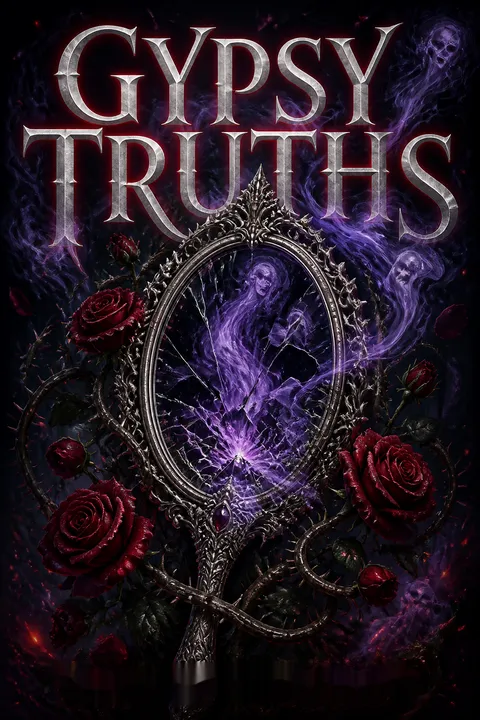


Plot Summary
Prologue
Violet corners Marta, the mother who raised her, and demands an account of the old feud between the Portocales, the Simpletons, and Idun. Marta admits that her family helped drive the gentle Bobo toward killing, then punished him and helped turn the resulting fear into generations of bloodshed.
She still refuses to explain what Violet is, insisting she kept her daughter ignorant to protect her from Idun. Their argument turns personal when Marta warns that Violet’s four ancient suitors may not know how to treat a woman who needs more than protection. A ghost named Edward urges Violet to build trust slowly, but she is already learning that her past has been kept from her by nearly everyone.
The opening makes secrecy both an act of love and a source of harm. Marta’s silence has protected Violet from immediate danger, but it has also left her unable to judge the risks surrounding her or understand her own identity. Her mother’s warning about the four men is not simply romantic skepticism: it identifies a mismatch between Violet’s modern need for emotional recognition and the alphas’ ancient reflex to equate care with control. Edward’s advice offers a method rather than an answer, encouraging Violet to build trust through repeated actions. The prologue therefore frames the central conflict as a struggle over who gets to define Violet, before the plot reveals how many forces are already trying.
Dorian Breaks Sanctuary
While the four alphas attend Idun’s meeting about restoring combat trials, Dorian Gray slips into Violet’s office using apple shampoo to hide his scent. He seals the room against sound and exploits old Neopry law, claiming an alpha may loan Violet’s services to him so she can break his curse.
His request is a threat disguised as procedure. Dorian traps her against the wall, then attacks her senses with phantom knives, choking blood, and visions of sexual submission.
Violet cannot slow her heartbeat without intensifying the imagined pain, and her monster does not come to protect her. When Dorian forces her to witness his childhood abuse by their father, she understands that his hunger for Damien’s place grew from a lifetime of humiliation, but she remains trapped inside his illusions.
Dorian’s attack turns legal language into a weapon: he uses the rules of the monster world not to settle a dispute, but to make violence appear authorized. His illusions target Violet’s ability to distinguish consent, sensation, and memory, which is why her usual instinct to panic and unleash her monster fails. The inserted childhood scenes complicate him without excusing him. Dorian has been brutalized and denied recognition, yet he chooses to reproduce that powerlessness by imposing it on Violet. Her inability to defend herself also exposes the limits of the identity she has built around resilience. She is not simply afraid of pain; she is terrified that her own mind and body no longer belong to her.
Anna Opens the Maze
Anna, the outspoken ghost Violet befriended, crashes into the office and gives Violet the seconds she needs to summon her threads. Rather than fight Dorian directly, Violet wraps herself in a cocoon and retreats into her own mind.
Dorian follows, impersonating Damien to lure her through an endless hall of mirrors, but a mysterious prompt helps her build a carnival maze of spinning patterns and warped reflections. The spectacle disorients Dorian, who staggers and bleeds as his control falters.
Damien arrives and enters the maze, where Violet mistakes him for another illusion until his familiar reactions convince her he is real. She wakes exhausted, bruised, and frightened, but Dorian has failed to violate her. Her first instinct afterward is to insist that she beat him herself.
Violet survives by changing the terms of the encounter. Dorian expects her to resist within a contest of dominance, so she turns her mind into an environment he cannot reliably interpret. The carnival is not merely a clever counterattack: it is a concrete expression of her improvisational intelligence, assembled from the odd materials she has gathered throughout life. Yet rescue does not erase the injury. Violet needs Damien to prove himself through small, ordinary reactions because Dorian has made familiar faces unsafe. Her insistence that she won preserves her agency, but it also conceals how close she came to being overwhelmed. Anna’s timely arrival suggests that Violet’s apparent isolation has never been as complete as she believed.
Damien Ends the Challenge
Damien reaches Violet’s ruined office, finds Dorian’s bruises on her throat, and nearly rushes after his brother before she stops him. Knowing he is too weak to fight, Violet offers him a powerful feeding, and Damien accepts enough of her strength to face Dorian.
Dorian has already challenged him and slaughtered succubae to provoke a response, so Damien enters the Van Helsing arena despite warnings that his brother has fed far more regularly. He defeats Dorian by attacking his mind, revealing that Damien’s greatest inherited strength is mental power.
Instead of killing him, Damien traps Dorian in a loop of his own memories. The punishment strips Dorian of his freedom and warns the Morpheous family to stay out of Sanctuary without Damien’s consent.
The duel changes the balance between the brothers, but its emotional force lies in the cost of the victory. Damien has spent centuries restraining himself around Dorian, partly from guilt over their shared childhood and partly to preserve his brother’s hope. Violet’s assault makes that restraint impossible. Her decision to feed Damien is an act of trust, but also a refusal to let his protectiveness become another form of exclusion. Damien’s punishment is devastating precisely because it reproduces the torment of memory that Dorian used against Violet. He wins the confrontation by using the power his family groomed him to possess, while accepting that compassion without accountability has allowed Dorian’s cruelty to continue.
A Flame and a Ring
After the arena, Violet sees how deeply Damien is shaken by what he did to Dorian, then chooses to support him rather than let him hide behind anger. Damien’s monster claims her as his Flame, leaving a vivid mark on her wrist, and his intimacy with her becomes both comfort and a frightening reminder of how little she understands their old customs.
Arion struggles with jealousy, while Vance tries to repair their strained relationship. He tells Violet that watching Idun had helped her build Sanctuary without obstruction, then offers her a family heirloom ring and asks her to consider marriage.
Before she can process the proposal, Vance falls under the Portocale curse. His body becomes helpless, and Violet must decide whether to trust Damien to enter his unconscious mind.
The men’s claims and Vance’s proposal make permanence feel less like a romantic destination than a pressure exerted on Violet before she has learned the vocabulary of her new world. Damien’s Flame mark expresses desire and protection, but its size and intensity unsettle her because she cannot tell what it obliges her to do. Vance’s ring is more deliberate: he offers a future while acknowledging that trust must be built rather than demanded. The curse interrupts that fragile negotiation, forcing Violet to make a consequential choice before she has resolved the relationship questions beneath it. Her response begins to shift the story from being protected by ancient alphas to participating in the risks they face.
The Curse’s Long Memory
Damien links Violet’s consciousness to Vance’s cursed mind, intending only to project her image into his memories. Violet crosses the boundary instead and spends what feels like days moving through Vance’s past.
She witnesses the four alphas’ wars, the massacre of the Portocales, their bargain with Pandora, and the betrayals and staged conflicts that kept monster populations under control. She also sees Vance’s repeated efforts to protect Caroline from Idun, despite the public role he played. When intimacy briefly makes Vance recognize Violet, the memory begins to break apart.
A man called Jack attacks her in the shifting scene, and she finishes a gypsy song in panic. Violet wakes beside Vance; the curse is broken, though Vance remembers none of her journey. The encounter leaves her carrying knowledge the others have avoided sharing.
The curse makes history experiential rather than explanatory. Violet cannot receive the alphas’ past as a tidy confession; she must move through its violence and witness how public loyalty concealed private acts of protection. This perspective disrupts the simple categories of hero and villain that have organized the men’s memories of themselves. Vance’s role as a hunter has not prevented him from being compromised by Idun’s games, nor has his apparent emotional restraint meant indifference. Violet’s success comes through contact and improvisation, not mastery of the rules. The cost is asymmetrical: she emerges with a deeper understanding of Vance, while he wakes without remembering what she risked to reach him.
A Small Monster Misjudged
Vance, Damien, Arion, and Emit finally persuade Violet to show them her monster. She grows stronger, breaks trees, and charges at the men, but they easily evade her. The spectacle looks unimpressive beside the four alphas’ power, and they conclude that Violet cannot challenge Idun in a direct fight.
Their judgment deepens her embarrassment and anger, especially because she has believed her monster was terrifying. Soon afterward, Idun’s loyalists attack a convoy carrying Talbot’s sister.
Violet confronts Idun at the Neopry House with Talbot and Avery beside her, accusing her of using rogues as deniable attackers and demanding limits on how she can use Sanctuary’s people. Idun welcomes the challenge. Violet leaves believing she has defended her community, while the alphas fear she has mistaken legal protection for safety.
The failed demonstration creates a dangerous gap between power and appearance. Violet’s modest physical strength is real, but the alphas mistake one visible capacity for the whole of her potential, repeating the same error they have made whenever her intelligence arrives in an unfamiliar form. Their disappointment also reveals their own wish for a simple solution: they want Violet to be powerful enough to end Idun’s rule, but not powerful enough to become another Idun. Violet’s confrontation is politically sharper than the men credit, since she identifies the use of proxies and challenges the conditions under which Idun can act. Yet the scene shows that law cannot protect someone who does not understand how ruthlessly her opponent will exploit it.
Fay Was Never Fay
During Emit’s rare moonlit gathering, Violet visits the cemetery where his wolves seek the spirits of their dead. She tries to open a death window at Fay’s grave but finds no body beneath the coffin. Leiza and Tiara lead her to the place where Fay supposedly died, and Violet sees a memory of a beta named Ian killing the wolf pack.
After the attackers leave, one returns and reveals herself as Idun, who had been impersonating Fay. Violet learns that Idun took the omega’s identity four years earlier and used the disguise to spy within Emit’s people. Emit overhears enough to understand that he failed to recognize the substitution. He runs into the woods, wounded by the realization that his friend was an enemy wearing a familiar face.
The empty grave turns Violet’s talent for investigating death into a tool for exposing a living deception. Idun’s disguise has endured not because it was flawless, but because the pack trusted its habits and remembered Fay through routine rather than sustained attention. That betrayal is especially painful for Emit, whose leadership depends on protecting vulnerable members of his pack. Violet’s discovery also revises the timeline of Idun’s return: the danger has been present for years, hidden inside daily intimacy. The revelation strips away the comforting belief that the alphas can recognize an enemy by scent, status, or behavior. Knowledge becomes less a matter of gathering facts than learning to distrust appearances without becoming incapable of trusting anyone.
Pandora’s Dragon Trap
Arion organizes the Monster Olympics as a playful courtship, hoping to win Violet’s affection through absurd contests. During the first events, Vance receives a message from Pandora and leaves to meet her at the dragon’s cemetery.
Pandora uses power drawn from the ancient dragon remains to bind him in black chains, then encases him in his own silver. She reveals that Idun has been active longer than the alphas believe and that fear has fed her strength for generations. Meanwhile, Violet tries to enjoy Arion’s celebration and keeps her growing doubts to herself.
When Vance fails to return, Damien and Emit warn Violet that Idun may use his disappearance to force a choice. The tournament’s staged merriment collapses into a real crisis, with Vance imprisoned and Violet caught between protecting him and refusing Idun’s terms.
Arion’s tournament stages a temporary world in which the alphas can treat power as play and courtship as a public celebration. Pandora’s invitation punctures that fantasy by making Vance’s hope for a useful ally the mechanism of his capture. Her dragon-derived magic literalizes the old danger of taking power from forces no one fully understands. The revelation about Idun’s longer presence also reframes the men’s confidence: they have been responding to an enemy whose preparation predates their awareness. Violet’s emotional dilemma is not simply whether she will submit. It is whether she can preserve the people she loves without accepting a system that treats them as bargaining pieces.
The Stadium Turns Battlefield
At the Olympics, Violet confronts Idun over the attack on Talbot’s sister and refuses to retreat when Idun threatens her. Pandora’s silver spell keeps Vance helpless, while the alphas struggle to reach him. Idun then strikes Violet before the gathered monsters, breaking her bones and forcing her back to her feet.
Violet’s body heals, but the assault drives her buried anger toward the surface. Her ghosts interfere with the spectacle, and she begins resisting Idun in ways the audience cannot explain.
At the same time, Emit, Damien, and Arion prepare to fight rather than let Idun use Violet’s suffering to dictate their loyalties. The attack turns the Olympics into a public test of power, and the watching Houses must decide whether to support Idun or risk standing against her.
Idun chooses a public venue because humiliation is part of her strategy: she wants the monsters watching to believe Violet’s resistance is futile and the old hierarchy inevitable. Violet’s ability to heal prevents a straightforward defeat, but it does not protect her from pain or from the emotional cost of being used as a spectacle. Her response is fueled by anger that has accumulated under years of restraint, not by a sudden appetite for rule. The scene also changes the meaning of the crowd. Spectators are no longer merely an audience for Arion’s games; their fear and allegiance help determine Idun’s power. The violence therefore becomes political theatre, with Violet’s body serving as the contested ground.
The Silver Prison Breaks
Emit, Talbot, and Zuela locate Vance beneath the dragon’s cemetery, where Pandora’s silver has sealed him into a rigid statue. They free him after Talbot counters the spell, while Violet continues drawing Idun’s attacks and Arion and Damien battle the Neoprys.
Talbot finally explains that the apparent ghosts surrounding Violet are manifestations of Hyde, a powerful spirit he created through a failed immortality ritual. Violet has carried Hyde since childhood, and its many personalities have disguised its presence even from her.
Bobo then confesses that the Simpletons’ exhausted hope helped bring Violet and Hyde together as a possible answer to Idun. The revelation transforms the danger: Violet is not merely a young monster facing an alpha, but the host of a force none of them can reliably predict.
The rescue and revelation expose the cost of treating mystery as someone else’s problem. Talbot’s account connects the ghosts, Violet’s unusual powers, and the Simpletons’ wish for a deliverer, but it does not offer the comfort of a controllable explanation. Hyde was created through ambition and mishap, then shaped by repeated attempts to contain it. Bobo’s confession makes the community’s hope morally complicated: the Simpletons wanted relief from Idun, yet they helped place that burden on a girl who never consented to become their answer. The alphas must now confront not only a powerful force inside Violet, but their own habit of interpreting her as either fragile beloved or convenient weapon.
Hyde Dethrones Idun
As battles spread through town, Demetria reveals herself as the force defending Sanctuary, while the Van Helsing knights and Emit’s wolves hold off Idun’s allies. Idun continues tearing Violet apart, convinced that pain will restore her control.
Instead, Hyde emerges through the personalities Violet has mistaken for ghosts. It turns the fight into a grotesque spectacle, using illusions, lightning, and physical force to dismember and humiliate Idun. Damien, Emit, Arion, and Vance can only watch until Hyde’s power recedes enough for them to move.
Violet regains control and confines Idun and Clyde Neopry in plain display cases beneath Sanctuary. She plans to let Caroline determine when Idun has suffered enough, while broadcasting the captive queen on Idun TV so the monster world can witness her loss of authority.
Hyde’s victory reverses Idun’s governing method. Idun has maintained authority by converting fear into obedience and making every challenge a public lesson in helplessness. Hyde answers with spectacle of its own, forcing the audience to watch the former ruler become an object rather than an author of violence. Violet’s choice of confinement matters as much as the defeat: she does not claim Idun’s throne or reproduce her system of rule. The display cases and continuous broadcast transform punishment into visible accountability, though they also risk turning suffering into entertainment. Violet’s plan tries to weaken Idun’s myth by making her ordinary enough to be watched, yet the power behind that plan belongs to a monster Violet is still learning to govern.
The Sanctuary Keeps Its Door
Once Hyde releases the struggle, Violet explains that she wants to remain Sanctuary’s keeper, not become a Neopry Head Alpha. She admits she feared both Idun’s power and her own, and asks the four men to see her rather than reduce her to either a helpless girl or a weapon.
Caroline will oversee Idun’s punishment, while Idun TV keeps the monster world informed. Violet also accepts that her ties to the men are real: Emit’s mate mark, Damien’s Flame marks, Arion’s claim, and the bond she unknowingly formed with Vance all require honest decisions rather than denial.
She gives Arion her promise of marriage, though she asks for time to understand what such commitments mean. The group begins to rebuild trust without pretending that their histories or power differences have disappeared.
Violet’s refusal of the throne distinguishes power from political ambition. She can defeat the ruler who terrorized the monster world, yet she does not assume that victory entitles her to reproduce the office or its hierarchy. Her preferred role, maintaining a sanctuary, is not apolitical: it offers safety and practical care without requiring universal obedience. In her relationships, she likewise seeks recognition without ownership. The men’s claims have often preceded her understanding, so her request for time is an attempt to restore agency to choices made under pressure. The resolution is deliberately incomplete. Trust is not magically repaired by a victory, and Violet’s promise of marriage is meaningful precisely because she treats it as a decision still requiring thought.
Four Men, One Future
In the days after Idun’s defeat, Violet and Arion marry in an intensely private, improvised ceremony, then make room for her other relationships rather than forcing them into a single traditional pattern.
She agrees to a later shared wedding celebration and continues negotiating boundaries with the four men, whose protective instincts often become possessive games. Vance accepts the bond and the ring Violet wears, though he needs time to process what she and her monster did. Emit remains her mate, Damien remains her Flame, and Arion becomes her husband.
The group also begins shifting responsibilities: Talbot serves Damien, Avery moves toward Emit’s pack, and Shera prepares to leave Arion for Emily’s new House. Violet keeps Sanctuary at the center of her life instead of letting romance or power replace the work she chose.
The relationship resolution resists the idea that intimacy must erase difference or produce a single conventional arrangement. Violet’s bonds are already entangled with supernatural marks and old customs, but she insists on naming her own expectations and retaining a life beyond the men. Their willingness to negotiate is meaningful, though not effortless: they repeatedly fall back on competition, protection, and sexual power as familiar languages. The changes among the betas extend that negotiation into governance. Shera’s departure and Avery’s prospective transfer show that loyalty need not mean permanent possession. Violet’s future remains anchored in Sanctuary, a place whose purpose is not to make her sovereign, but to give vulnerable people a choice about where and how they live.
Epilogue
Three weeks later, Violet holds a small wedding ceremony with her four partners, though Damien’s expansive vows and the guests’ arrival make it less private than planned. Shera formally leaves Arion’s service for Emily’s House, while the others accept that the combat trials may give restless betas a place to compete.
Thirty years later, Violet still runs Sanctuary and tries to keep Anna’s mischief within bounds. Idun remains confined, with Caroline continuing to confront her, while new monsters arrive seeking refuge. Violet welcomes them under her full name, still insisting that she only makes shampoo, even as the world continues to reorganize around the power she never wanted.
The two epilogue scenes measure change through ordinary arrangements rather than a declaration that conflict has ended. The wedding gives Violet a public place within the relationships she has chosen, while Shera’s departure shows that even trusted bonds can change without becoming betrayals. The later glimpse of Anna sewing Idun together for another bout of torment reveals that containment is not the same as rehabilitation, and that Violet’s internal life remains difficult to govern. Still, Sanctuary continues to receive people who have nowhere else to go. The ending is hopeful because Violet has preserved a practice of welcome, not because the monsters have become harmless or history has stopped repeating.
Analysis
The novel’s central conflict is not simply whether Violet can defeat Idun. It is whether power can be used without reproducing the very system it was meant to end. Idun rules through fear, proxy violence, and spectacles that teach monsters to anticipate punishment. Violet answers with Sanctuary, a home whose authority depends on protection rather than submission. Her victory is therefore political as well as physical, though the story keeps its costs visible: Hyde’s immense strength operates partly beyond Violet’s control, and the people she saves have helped place that burden on her without consent.
The romances echo this conflict at a more intimate scale. The four alphas often mistake possession for care, while Violet needs to be loved without being reduced to a protected object or a strategic weapon. Marks, proposals, and supernatural claims make commitment materially real before the characters have learned how to discuss it. Their relationship work is not a retreat from politics; it is a smaller test of whether power can coexist with another person’s agency.
Memory complicates any simple judgment of good and evil. Dorian’s abuse explains the roots of his resentment but does not excuse his violence. The alphas’ past choices were shaped by war and fear, yet their motives do not erase the harm they caused. Caroline’s demand for a role in Idun’s punishment insists that victims cannot be bypassed in the name of a neat resolution. The story’s most useful distinction is between understanding a person and absolving them.
Violet’s refusal to become queen is not passivity. She chooses the scale of responsibility she can live with: maintaining a refuge, honoring chosen bonds, and refusing to let inherited hierarchy dictate every decision. The ending remains uneasy because Idun is contained rather than transformed, and Hyde remains a force Violet must learn to manage. Hope comes not from the promise that danger is over, but from the possibility that care, accountability, and shared authority can interrupt its repetition.
Review Summary
Gypsy Truths received mixed reviews as the final book in the All the Pretty Monsters series. Many readers praised the creativity, plot twists, and character development, particularly Violet's growth. However, some found it too long and convoluted. The book resolves major storylines, including the confrontation with Idun and the mystery of Violet's monster. While some readers were satisfied with the ending, others felt it dragged on. The series as a whole was generally well-received for its unique premise and engaging characters, despite some pacing issues.
People Also Read




Characters
Violet Carmine
Sanctuary-building outlierViolet is a young woman raised among humans who enters the monster world with curiosity, stubborn compassion, and little patience for explanations that bury the point. She makes shampoo, gathers strange objects, and builds Sanctuary to protect people whom powerful Houses treat as disposable. Her instinct is to act before she understands every consequence, which makes her brave and vulnerable in equal measure. She wants to be treated as a person rather than a fragile possession, but she also struggles to recognize how much her choices can alter other people’s lives. Her humor and practical kindness are not signs of weakness; they are the standards she tries to preserve while learning what kind of monster she is.
Damien Morpheous
The guarded mind-readerDamien is a powerful Morpheous alpha whose illusions and ability to enter minds are matched by a habit of retreating into isolation. His disarming humor often disguises grief, exhaustion, and a deep fear of being forgotten. He has spent centuries avoiding the responsibilities of leadership, yet his loyalty to Violet repeatedly pulls him back into danger. Damien understands how cruelty can be inherited and repeated, but that insight does not always make him gentle. He is drawn to Violet because she unsettles his practiced detachment and asks him to be emotionally present, not merely useful. His relationship with her challenges his belief that remaining uninvolved is safer than caring.
Emit Morrigan
The protective wolf alphaEmit is a werewolf alpha who measures leadership by whether his pack’s most vulnerable members are safe. His physicality and blunt instincts can make him seem like a simple brute, but he is more emotionally attentive than he lets on. He has a complicated relationship with violence: his wolf’s anger is real, yet he works to keep it from becoming the only language his people know. His bond with Violet grows through trust, touch, and the willingness to protect without treating her as helpless. Emit’s loyalty can become fierce and possessive, but his deepest concern is that those he loves should not have to face danger alone.
Vancetto Van Helsing
The disciplined monster hunterVance is the Van Helsing alpha, a hunter shaped by law, duty, and an almost compulsive need to anticipate danger. He values competence and control, often expressing care through protection, planning, and correction rather than tenderness. His restraint is not emotional emptiness; it is a discipline built over centuries of painful choices. Violet frustrates him because she refuses to fit the categories that make his world manageable. He is attracted to her independence, even as he repeatedly tries to shield her from consequences she wants to face herself. Beneath his polished confidence lies a man who fears being deceived and who must learn that trust cannot be secured by supervision.
Arion Vampyre
The possessive romantic vampireArion is a vampire alpha whose elegance, speed, and theatrical confidence hide a history of devotion and humiliation. He enjoys spectacle and conflict, but beneath the swagger is a man who has long wanted a home and a relationship built on shared belonging. His loyalty can look reckless because once he chooses someone, he does not know how to love halfway. Violet attracts him through her unpredictability and her refusal to perform the polished role he expects. He often treats courtship as a game, testing boundaries to hide how much he risks emotionally. His challenge is to make room for Violet’s autonomy without mistaking surrender for proof of love.
Idun Neopry
The feared Neopry rulerIdun is an ancient alpha who understands that fear can be converted into obedience and political power. She is patient, strategic, and skilled at using other people as proxies, often presenting her ambitions as the enforcement of old laws. Her confidence comes from having shaped the monster world’s expectations for generations. She dislikes being ignored or challenged, but she rarely reacts without considering what a response will teach the watching community. Idun’s intelligence makes her more than a straightforward brute, while her appetite for control leaves little room for genuine reciprocity. She is particularly attentive to threats that unsettle the hierarchy she has worked so hard to maintain.
Marta Portocale
Violet’s secretive motherMarta is an ancient Portocale who has survived by guarding information and keeping old grievances close. She loves Violet fiercely, but her instinct to protect through concealment has shaped their relationship as much as affection has. Marta carries the emotional weight of centuries of conflict, and she often treats the past as something too dangerous to share rather than a history Violet has a right to understand. Her sharp humor and hardened judgment mask the vulnerability of someone who has repeatedly watched loved ones become targets. She wants Violet safe, though she does not always recognize that ignorance can leave her daughter less prepared.
Anna
The irreverent ghost friendAnna appears as a bold, teasing ghost who follows Violet closely and comments on the men and monsters around her. She uses jokes, flirtation, and startling interruptions to break tension, though her teasing can cross boundaries Violet has clearly set. Anna is curious about bodies, relationships, and power, and she tends to treat serious situations as opportunities for mischief. Her apparent confidence contrasts with Violet’s uncertainty, making her both a source of comic relief and an unsettling presence. She seems to know more than she explains, which keeps Violet and the reader unsure whether her loyalty should be trusted.
Talbot Lane
The persistent rogue betaTalbot is a knowledgeable rogue beta who seeks a place within an alpha House and refuses to disappear when Damien rejects him. He has spent a long time serving his people without the recognition he believes his work deserves. His sharp answers and confidence can sound insolent, but they arise from a beta’s awareness that alphas often overlook the labor keeping their Houses intact. Talbot is strategic, observant, and difficult to read; he knows details about the monster world that the leaders have stopped asking about. His ambition is not simply status. He wants an alpha who will value what he can contribute.
Dorian Gray
The resentful Morpheous brotherDorian is Damien’s older brother by blood and a Morpheous alpha shaped by a childhood of rejection and abuse. He is intelligent, manipulative, and skilled at invading other people’s senses, but he often uses those gifts to provoke rather than connect. His resentment toward Damien is rooted in the family’s unequal treatment of them, yet he has had centuries in which to choose what to do with that resentment. Dorian wants recognition, authority, and proof that he was never the weaker brother. His history makes his hostility comprehensible without making it harmless, especially when he directs the pain of his past at people with less power.
Bobo
The gentle SimpletonBobo is a gentle Simpleton whose care for his community is expressed through patient work and a deep dislike of violence. The old monster world has repeatedly misunderstood his softness as uselessness, even though his influence among the Simpletons is immense. He carries his mistakes heavily and finds it difficult to reconcile kindness with the terrible choices made around him. Bobo’s craft and quiet presence give Sanctuary an emotional center distinct from the alphas’ contests of strength. He wants the people he loves to live without fear, though he is painfully aware that good intentions can place the cost of that wish on someone else.
Pandora
The elusive blood witchPandora is an ancient blood witch associated with the creation of monsters and the bargains that altered their world. She is difficult to locate and harder to understand, speaking as though she has already judged the outcome of every conflict. Her knowledge of magic gives her leverage over beings who rely on strength or law, but her loyalties are shaped by old promises and personal attachments rather than a stable moral code. Pandora can present herself as a messenger, a victim, or an adversary, depending on what keeps others from seeing her intentions. She understands the cost of immortality and still participates in its consequences.
Shera
Arion’s blunt vampire betaShera is Arion’s vampire beta, a capable survivor who prefers clear duties to sentimental declarations. She speaks bluntly, holds her own among powerful alphas, and is more reliable than her sharp manner initially suggests. Her loyalty is practical: she protects the people she serves while insisting they respect the work that loyalty requires. Shera has little patience for being treated as decorative or expendable, and she is willing to reconsider where she belongs when a role no longer fits. Her presence also gives Violet an example of a woman who can be formidable without adopting an alpha’s style of authority.
Fay
The reserved wolf omegaFay is remembered by Emit’s pack as a brooding, reserved omega who keeps her thoughts close and does not seek attention. Her quiet manner makes her difficult to know, but it also gives her a distinct place among the wolves who trust one another through shared routines. She is connected to the pack’s memories of loyalty and loss, and her absence unsettles the people who believed they understood her. Fay’s importance comes less from public authority than from the small habits her friends notice once something has changed.
Caroline
A survivor of Idun’s crueltyCaroline is a Portocale woman whose past is inseparable from the damage Idun has inflicted on those she considers beneath her. She survives by holding tightly to memory, and she does not confuse forgiveness with justice. Her grief can harden into a formidable capacity for resentment, but it also preserves the truth of harms that powerful people would prefer to bury. Caroline’s presence reminds Violet that compassion for a powerful enemy cannot be demanded from the people that enemy has hurt. She seeks acknowledgment and agency after a long period in which others made decisions about her life.
Demetria
The formidable beta championDemetria is renowned as one of the strongest betas in the monster world and a disciplined figure within Idun’s House. She is a soldier more than a politician, accustomed to carrying out orders and measuring her worth through competence. Her physical skill gives her influence in a system that often makes betas fight for the interests of their Houses. Demetria’s reserve makes her difficult to read, while her reputation encourages others to assume she has no private loyalties. She represents the force and discipline that keep alpha power operational, even when the beta’s own motives remain obscured.
Zuela Van Helsing
The severe Van Helsing elderZuela is an older Van Helsing alpha who values discipline, authority, and competence. He can be abrasive, particularly toward people he sees as careless with power, but he recognizes the burden of leadership because he has carried it himself. His relationship with Vance is shaped by family history and by the difficult standards their House treats as necessary for survival. Zuela tends to approach conflict as something to be managed rather than emotionally processed. His guarded respect is hard won, and his presence makes clear that even the most powerful families are governed by inherited rules and strained loyalties.
Avery
Vance’s loyal knightAvery is a disciplined Van Helsing knight known for loyalty, restraint, and dependable service. He has spent years carrying out Vance’s orders and takes the safety of his fellow knights seriously. His cautious manner can make him appear conventional, but he is capable of making personal decisions that challenge the role others expect him to keep. Avery values commitment and wants a relationship built on exclusivity, even when that means reconsidering his place among the Van Helsings. He is one of the few characters whose steadiness comes from deliberate choice rather than simple obedience.
Jasper
The unusual young childJasper begins as an infant who quickly becomes the focus of care among Sanctuary’s older monsters. His presence draws out tenderness and protectiveness in characters more accustomed to war, duty, and rivalry. As he grows, he shows signs of unusual abilities and a stubborn personality. Jasper represents a future that the ancient alphas did not plan for, one involving responsibility beyond their romantic attachments or House politics. The adults’ instinct to protect him also reveals that family can form through care and commitment, not only through blood or established monster customs.
Edmond Portocale
A bitter Portocale elderEdmond is a Portocale elder whose long history with Idun and Caroline has left him angry, proud, and difficult to placate. He believes the alphas have repeatedly failed to understand the cost of their choices, and he is willing to provoke them when he thinks they are avoiding responsibility. His bitterness is sharpened by old grief, but he also carries an intense sense of loyalty to people harmed by the powerful. Edmond’s judgment is not always fair, yet his presence forces the other characters to confront histories they would rather reduce to distant mistakes.
Plot Devices
Sanctuary
A shelter outside hierarchyViolet creates Sanctuary as a protected home for omegas, Simpletons, and others who are vulnerable to the demands of alpha Houses. Its laws limit who may enter and how residents can be treated, giving Violet a practical alternative to the world’s reliance on fear and force. Sanctuary also changes the balance of power: it draws people away from Idun’s influence and gives them a place to organize, work, and seek safety. It is not a neutral refuge, because every rule challenges the established order. Violet’s greatest political act is building an institution that lets people survive without requiring her to become a ruler.
The Portocale curse
A doorway into buried memoryThe Portocale curse traps an alpha in a cycle of painful memories and leaves the body physically incapacitated. Violet can enter an unconscious mind through Damien’s power, encountering the past as a lived landscape rather than a recollection someone has chosen to explain. Her effort to reach Vance brings her into the alphas’ wars, bargains, and betrayals, and she discovers that memory is both evidence and danger. The curse also exposes how the characters’ histories have shaped their present instincts. In the story, its breaking is not simply a magical cure; it forces Violet to understand the people she is choosing to love.
Mate and Flame marks
Bonds with unequal meaningsThe marks left by Emit’s mating and Damien’s Flame claim signal relationships that carry old supernatural customs and lasting consequences. Vance’s ring offers a contrasting form of commitment, one that asks Violet to consider a future rather than assuming her consent. Arion’s bid for marriage adds another model of permanence, while Violet struggles to understand the different expectations each bond creates. These marks and promises make intimacy visible to the monster world, but they do not resolve the emotional questions beneath them. Violet has to negotiate what she wants within traditions that often move faster than her understanding.
Hyde and the apparitions
A hidden mind made visibleThe apparent ghosts surrounding Violet function as comic companions, informants, and interruptions, but their presence also conceals the nature of the force inside her. Their different voices give her buried impulses distinct personalities, allowing the story to externalize conflicts she cannot yet name. Hyde’s history is tied to Talbot’s failed magical ritual and the Simpletons’ desperate hope for an answer to Idun. Once revealed, the apparitions become central to the conflict because they can mislead, fight, and act beyond Violet’s conscious intentions. The device complicates agency: Violet is powerful, but she is still learning where her choices end and her monster’s begin.
Idun TV and combat trials
Power performed before an audienceIdun’s proposed combat trials appeal to restless betas by promising them a voice in disputes between Houses. The rules turn violence into a formal competition and let Idun gather influence without appearing to command every attack herself. Idun TV serves a related purpose, making the alphas’ choices and confrontations public entertainment that can also spread fear. Violet eventually repurposes the same idea by keeping Idun’s captivity visible to the monster world. In both uses, the audience matters: reputation is a source of authority, and a public spectacle can either magnify a ruler’s power or expose the limits of it.
All the Pretty Monsters Series



About the Author
Other books by Kristy Cunning

Download PDF
Download EPUB
.epub digital book format is ideal for reading ebooks on phones, tablets, and e-readers.








