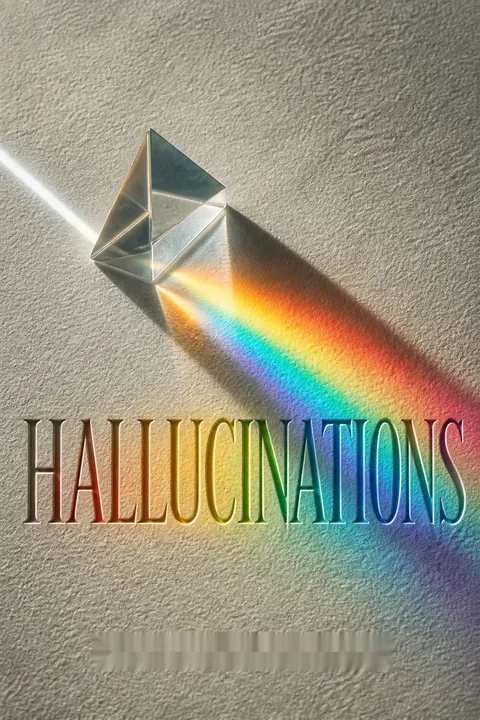


Key Takeaways
Treat hallucinations as brain events, not automatic evidence of madness.
A perception without an object. A hallucination is an involuntary sensory experience that seems perceptual, though no matching external stimulus is present. It differs from ordinary imagination, which is usually recognized as an inner image and can be deliberately changed. An illusion distorts something that is actually there, though the border between illusion and hallucination can blur. To the person experiencing it, a hallucination can feel entirely real, which helps explain why people may hide it or fear a psychiatric label.
Rosalie's visions had a cause. Blind for years, the nursing-home resident suddenly saw richly dressed people and animals. She was lucid, and her brain examination showed no sign of psychosis. The visions fit Charles Bonnet syndrome, a condition linked to impaired sight. A study of older adults with visual problems found complex hallucinations in almost 15 percent, suggesting the experience is often missed or left unreported.
The key distinction is between an experience's vividness and its source. A hallucination can be neurologically genuine as an experience without being evidence that its apparent object exists outside the person. That distinction supports humane care: clinicians can validate fear or wonder while investigating the cause. It also cautions against treating insight as all-or-nothing. Some people recognize a vision immediately, while illness, medication, exhaustion, or cognitive impairment can make reality testing less reliable.
When sensory input falls quiet, the brain may supply its own show.
The brain needs variation. Hallucinations can emerge when normal input is absent or monotonous, as in darkness, isolation, a featureless sea, or hours of watching an empty road. In an early McGill experiment, all 14 students held in sensory-poor cubicles reported visual imagery, ranging from colored lights and geometric shapes to miniature figures and scenes. The images often became more elaborate over time.
Blindfolding can be enough. In a later study, 10 of 13 sighted participants experienced hallucinations during 96 hours of blindfolding, despite being free to move and socialize. The experiences included flashes, patterns, faces, animals, and landscapes. They often faded during demanding activity in another sense, such as conversation or music. This suggests that deprived visual circuits can become unusually active, even without an eye disease.
The experiments make perception look less like a camera passively recording the world and more like a system that needs ongoing input to stay calibrated. That idea connects naturally to predictive models of perception, in which the brain constantly combines incoming signals with its own expectations. Still, sensory deprivation is not a single, universal recipe: people vary, and laboratory isolation differs from blindness, loneliness, or monotonous work. The studies establish possibility, not a complete explanation of every hallucination.
A damaged sense can generate vivid substitutes, not simply silence.
The missing signal can echo. Loss of smell may be followed by phantosmia, the perception of an odor without an external source, or by parosmia, a distortion of real smells. After surgery, Mary B. found ordinary foods and scents revolting in ways no one around her could detect. Such experiences can be confusing because smell is difficult to describe and can be hard to verify.
Hearing loss can bring music. Some people with impaired hearing experience persistent musical hallucinations, often built from familiar songs. One woman heard a Christmas carol so clearly that she initially searched for a radio. The music continued after she knew its source was internal. These sensory experiences resemble the visual hallucinations associated with blindness, but they are not always soothing or useful substitutes for the lost sense.
Calling these experiences compensation can be tempting, but it risks making a distressing symptom sound beneficial. A sensory system may become active without restoring the lost function, and the resulting experience can be intrusive or frightening. The clinical implication is practical: new phantom smells or music deserve careful questions about sensory loss, illness, medications, and timing, rather than an automatic assumption of psychiatric disease. Respectful description matters especially for smell, where patients may struggle to find words for something intensely real.
Hallucination content can reveal which neural systems are unusually active.
The brain has specialized pathways. Visual hallucinations are not random in every respect. Brain-imaging studies described in the book found that hallucinations of color, faces, textures, and written forms corresponded with activity in areas normally involved in processing those features. For example, face visions were associated with activity in face-related regions, while text hallucinations involved the brain's visual word area. The images could look convincing while remaining meaningless, like music notation too scrambled to play.
Similar visions can have different causes. In Parkinson's disease, hallucinations may relate to the disease process, sleep disruption, or medication effects. One patient developed frightening visions of intruders, which cleared after his medication was carefully reduced. A similar-looking vision in another person might arise from visual loss or a stroke. The appearance alone does not identify the mechanism.
This is a powerful use of symptoms as clues: what a person sees can reveal something about the brain systems involved, much as a selective deficit can. But a brain region is rarely a self-contained switch. The book itself points toward the importance of connections between regions, and modern network approaches reinforce that caution. Imaging correlations are informative, not a complete causal map. Individual experience, attention, medication, and sleep can all shape what an activated system produces.
Use timing and progression to distinguish migraine auras from seizures.
Migraine often unfolds slowly. A visual migraine aura may begin with a shimmering zigzag pattern and a blind patch, then spread across part of the visual field over roughly 15 to 20 minutes. Sacks experienced such patterns as a child and was reassured that they would pass. Migraine can also distort color, depth, movement, body size, smell, or speech.
Focal seizures can move faster. In epilepsy, abnormal electrical activity in one brain area may produce brief, repeated sensory events, often lasting seconds. Depending on the focus, an aura may involve lights, smells, déjà vu, multiplied objects, or a sudden feeling of joy or fear. Patients Jen and Valerie were initially diagnosed with migraine before further evaluation identified epilepsy. Timing is a useful clue, not a diagnosis; unusual or changing symptoms need medical assessment.
The contrast offers a memorable clinical lens: migraine's gradual spread and a seizure's rapid, stereotyped sequence can help organize a history. Yet real presentations overlap, and a normal initial scan or test does not always settle the question. The value lies in asking precise questions about onset, duration, recurrence, and what follows, rather than treating the word aura as an explanation. This is also a reminder that first-person descriptions can contribute diagnostic information that a brief examination may miss.
A powerful drug experience can feel revelatory without proving its message.
Chemistry can transform perception. Hallucinogenic drugs may intensify colors, alter size and time, generate geometric patterns, blend the senses, or make ordinary objects seem alive. Sacks describes one drug-induced episode in which he held an ordinary conversation with friends who were not present; he recognized the hallucination only when he entered an empty room. The experience had seemed mundane rather than strange.
Intensity is not evidence. Across cultures, psychoactive plants have been used in religious and ceremonial settings as well as for pleasure. The same altered state can be interpreted as spiritual revelation, neurological disturbance, or both. The book's cases show that hallucinations may feel meaningful and coherent, but their emotional force does not establish that their apparent content is objectively true. Drugs also differ in their effects and risks.
This distinction separates two questions that are often collapsed: what caused an experience, and what significance a person gives it. A neural explanation does not automatically erase personal or cultural meaning, but profound certainty is not a reliable test of factual accuracy. That balance is useful beyond drug experiences, including dreams and religious visions. The story of an ordinary conversation is especially instructive because hallucinations do not always announce themselves with surreal imagery; confidence can outlast the evidence.
Sleep's borders can turn temporary paralysis into a terrifying presence.
The transition can blur. Hypnagogic hallucinations appear while falling asleep; hypnopompic hallucinations appear while waking. They can include voices, faces, music, or fleeting patterns, often with extraordinary detail. Narcolepsy makes these border states more likely because the normal boundaries between wakefulness and REM sleep are disrupted.
Paralysis changes the experience. During sleep paralysis, a person becomes conscious while the temporary muscle paralysis of REM sleep persists. A sensed intruder, pressure on the chest, or vivid figure can feel physically present. One study cited in the book found that between a third and half of people may experience sleep paralysis at least once. Across cultures, people have explained similar episodes as attacks by spirits, witches, or, in modern accounts, aliens. The experience is bodily and frightening even when its cause is sleep-related.
A physiological explanation can reduce shame and fear, but it need not dismiss the meaning a person attaches to an episode. Culture supplies familiar characters for an experience whose raw features, paralysis and a threatening presence, are already alarming. That interaction helps explain why similar states produce different stories in different settings. At the same time, a single sleep-related hallucination is not enough to infer narcolepsy or another disorder; recurrence, daytime sleepiness, and functional impact matter.
Sudden confusion with hallucinations should prompt a search for medical causes.
Delirium is often systemic. Infections, fever, organ failure, metabolic disruption, medication effects, and drug withdrawal can disturb attention and awareness, sometimes producing vivid hallucinations. Delirium often improves when its physical cause is treated, so it should not be mistaken automatically for a primary psychiatric illness.
A small imbalance can matter. Michael F., a patient with severe liver damage, became confused and agitated after eating food his restricted diet could not safely accommodate. His brain-wave recording was markedly abnormal. Within a day of returning to his prescribed diet, both his mental state and the recording had normalized. Sacks also warns that older patients taking many medications may be vulnerable to interactions. A sudden change in perception or alertness is therefore a reason to assess health and medication, not merely to argue about what is real.
This is where the book's humane phenomenology becomes a safety principle. The person may be describing a vivid inner world, but the abrupt change can signal a treatable medical problem. Listening closely can reveal context, while a medical assessment looks for causes that the person cannot identify. The caution is against overgeneralization: not every hallucination in an older adult is delirium, and persistent sensory-loss hallucinations may have a different explanation. Timing and change from baseline are crucial.
Grief and trauma can make the emotionally charged past feel present.
Loss can produce a sensed return. In a study of nearly 300 recently bereaved people, almost half reported an illusion or hallucination of a dead spouse. Some heard a familiar voice or briefly saw the person; these experiences could comfort rather than alarm. Sacks also describes mistaking strangers for his dead mother, a form of perceptual searching shaped by loss.
Trauma can replay through the senses. A smell associated with an assault brought one correspondent back into the memory so completely that she lost her sense of time and place. Such flashbacks differ from ordinary autobiographical recollection because they can erupt automatically, with sensory detail and little feeling of distance. Grief, trauma, and neurologically generated visual patterns should not be treated as one phenomenon, even when all involve hallucination.
The contrast between a neutral visual pattern and a trauma-linked replay shows why content and context matter as much as sensory form. A bereavement vision may be a common part of mourning, while an involuntary traumatic flashback can be disabling. Neither should be interpreted from appearance alone. Cultural beliefs can shape whether a sensed dead relative is understood as a symptom, a memory, or a visitation; careful care can respect that interpretation while attending to distress, safety, and daily functioning.
Your sense of being in your body is assembled from multiple senses.
Ownership depends on coordination. A person's sense of bodily self draws on vision, touch, balance, and information about limb position. In a well-known rubber-hand experiment, synchronized stroking of a visible artificial hand and a hidden real hand could make participants feel that the rubber hand belonged to them. The illusion persisted even when they knew the hand was not theirs.
The self can shift location. During an out-of-body experience, someone may feel detached from the body and see it from elsewhere. Such experiences can occur during seizures, severe drops in blood flow, or altered states. Electrical stimulation of a region near the junction of temporal and parietal brain areas has also induced a sensed double. These findings suggest that bodily selfhood depends partly on the brain integrating signals, not on an unchanging inner observer.
The experiments give an unusually concrete account of embodiment: the self is stable in ordinary life because many sensory signals usually agree, not because the brain has an infallible ownership label. This connects neuroscience to philosophical questions about personal identity without resolving them. A constructed sense of bodily location does not prove that consciousness can leave the body; it shows that the feeling of location can be altered when integration fails. The distinction respects the force of the experience while keeping the inference proportionate.
Phantom limbs expose how the brain keeps a body map after amputation.
The missing limb can remain present. Most amputees experience a phantom limb, a vivid sense of the missing body part that may preserve its shape, position, and familiar features. Unlike many visual hallucinations, a phantom can often be moved voluntarily. It may also become painful, cramped, or seemingly paralyzed. People born without a limb can sometimes experience a phantom too, suggesting that body representation is not simply copied from current sensation.
Feedback can change the map. V. S. Ramachandran used a mirror box to let a patient see the reflection of a moving intact hand where the phantom hand seemed to be. The visual feedback created a convincing impression of movement and relieved painful spasms in that case. The technique illustrates how perception can reshape bodily experience, though one striking case does not guarantee the same result for everyone.
Phantom limbs make an abstract idea tangible: bodily identity depends on an active representation that can persist, adapt, or become painful after the body changes. The mirror-box case also links clinical rehabilitation to multisensory learning, where new feedback can revise an established prediction. Its promise should not be oversold as a universal cure. The broader lesson is to ask patients carefully about sensations that may sound impossible, because those reports can guide both explanation and treatment.
Analysis
Hallucinations is best read as a natural history of perception under strain, not as a single theory of why people see or hear things that are absent. Sacks moves among blindness, sensory isolation, migraine, epilepsy, drugs, delirium, trauma, sleep, and altered body image. The cases make one point repeatedly: the same broad experience, such as a face, voice, or sensed presence, can emerge through different routes. Conversely, one neurological disturbance can produce several forms of experience. This makes diagnostic humility central to the book's method.
Its strongest contribution is phenomenological. First-person accounts preserve details that a symptom checklist tends to flatten: whether a vision is silent, how it moves, whether it seems external, whether the person recognizes it, and what changes make it worse. Those details are not decorative. They can distinguish a pattern linked to impaired sight from a seizure, a sleep transition, or delirium. The book also resists a false choice between biological explanation and human significance. A brain mechanism can explain how a sensed presence occurs without deciding whether it comforts, terrifies, or changes the person's worldview.
The evidence is necessarily uneven. Case histories offer unusual depth but cannot establish how common a phenomenon is or predict who will experience it. Imaging studies can connect hallucinatory content with active neural systems, yet activation does not by itself explain the full experience. The book's most convincing claims are therefore modest: hallucinations are real experiences, their causes vary, and context matters. Its more speculative questions, such as whether internal patterns shaped sacred art or folklore, are illuminating hypotheses rather than settled conclusions.
For readers, the practical model is to ask three questions before interpreting an experience: what sensory or medical change might have triggered it, how much insight and distress accompany it, and what personal or cultural meaning has attached to it? That sequence reduces stigma without minimizing danger. It also prevents the opposite mistake, treating a vivid experience as either proof of madness or evidence of a supernatural world. Hallucination is a window into how the brain constructs perception, and a reminder that perception is less passive and more fragile than everyday life suggests.
Review Summary
Hallucinations by Oliver Sacks explores various types of hallucinatory experiences, from those caused by medical conditions to drug-induced states. Readers found the book informative and fascinating, praising Sacks' compassionate approach and personal anecdotes. Many appreciated learning about the commonality of hallucinations and their neurological basis. Some felt the book was repetitive or overly clinical at times. Overall, reviewers valued Sacks' ability to demystify hallucinations and provide insight into the complex workings of the human brain.
People Also Read



Glossary
Charles Bonnet syndrome
visual hallucinations with impaired sightA condition in which people with substantial visual impairment experience visual hallucinations, often of patterns, people, animals, or scenes. The hallucinations arise in the visual system and do not by themselves indicate psychiatric illness. Many people retain awareness that the visions are not externally real, although insight can vary with other medical or cognitive problems.
release hallucinations
activity released by reduced inputHallucinations thought to arise when damage or reduced sensory input weakens the normal control of neural activity. The less constrained system may generate its own perceptual material. The idea helps explain why visual loss, sensory deprivation, or certain brain lesions can produce hallucinations, though it does not account for every type or individual case.
phantosmia
smelling without an odor sourceThe perception of a smell when there is no corresponding odor in the environment. It may follow smell loss, infection, head injury, or occur with conditions such as migraine or epilepsy. The perceived smell can be familiar, unpleasant, or difficult to describe. It is distinct from a distortion of a real smell.
parosmia
distorted perception of real smellsA disorder in which actual odors are perceived in a changed or often unpleasant way. Foods and everyday scents may seem rotten, metallic, chemical, or otherwise wrong, even when other people smell them normally. It differs from phantosmia, in which the person perceives an odor without an external source.
scintillating scotoma
shimmering blind area in migraineA visual migraine aura consisting of a shimmering or zigzag border that gradually spreads, often around an area of lost or obscured vision. The pattern may move across part of the visual field over about 15 to 20 minutes. It reflects abnormal activity moving through visual areas of the brain and may occur with or without headache.
hypnagogic hallucinations
perceptions while falling asleepInvoluntary images, sounds, or other sensory experiences that arise as a person is falling asleep. They may include faces, patterns, voices, music, or fleeting scenes. They are often recognized as internal or dreamlike, though they can be unusually vivid. They differ from ordinary dreams, which tend to have greater continuity and narrative.
hypnopompic hallucinations
perceptions while wakingHallucinations that occur as a person is waking from sleep. They may seem to occupy the actual room and can feel solid, intentional, or threatening. Some are brief continuations of dream material. They are often more alarming than the imagery experienced while falling asleep, especially when accompanied by sleep paralysis.
narcolepsy
disrupted sleep-wake regulationA neurological sleep disorder marked by excessive daytime sleepiness and, in some people, sudden sleep episodes, sleep paralysis, vivid sleep-related hallucinations, or cataplexy. The book describes a connection with deficient orexin, a hormone associated with wakefulness. Narcolepsy can be mistaken for psychiatric illness when its hallucinations are not recognized as sleep-related.
cataplexy
emotion-triggered loss of muscle toneA sudden loss of muscle strength, often triggered by strong emotion, in which a person may collapse or become unable to hold a posture while remaining conscious. It commonly occurs as part of narcolepsy. Because the episode can be brought on by laughter or excitement, it may be confusing or embarrassing without a correct diagnosis.
sleep paralysis
wakefulness with REM muscle paralysisA state in which a person becomes aware of the surroundings while the temporary muscle paralysis associated with REM sleep continues. It may be accompanied by vivid visual, auditory, or tactile hallucinations, pressure on the chest, and a sensed presence. Episodes can occur with narcolepsy or independently, and are often interpreted through local cultural beliefs.
autoscopy
seeing a visual double of oneselfA visual hallucination in which a person sees a double of their own body, often from their ordinary viewpoint. In typical cases, the double is passive and mirrors the person's posture or movements, without independent intentions. Autoscopy can occur with neurological conditions, including seizures, and is distinct from the feeling of leaving one's body.
heautoscopy
interactive, shifting self-doubleA rare autoscopic experience in which a person sees a double that may act independently or interact with them. The sense of identity can shift between the person and the double, creating uncertainty about which is the original. Episodes have been associated with neurological conditions, including epilepsy, and can be frightening.
phantom limb
felt presence of a missing limbThe continuing sensation that an amputated limb is still present. A phantom may retain the former limb's shape, position, and familiar features, and may move voluntarily. It can also become painful, cramped, or immobile. Phantom limbs are common after amputation and reflect the persistence and plasticity of the brain's representation of the body.
mirror visual feedback
mirror-based movement feedbackA technique in which a mirror reflects an intact limb so that it appears to occupy the place of a missing or impaired limb. The apparent movement can provide visual feedback that changes the person's experience of the phantom. Ramachandran used a mirror box with one patient whose phantom hand felt mobile and whose painful spasms eased.
Geschwind syndrome
personality changes linked to temporal epilepsyA proposed pattern of personality changes sometimes associated with temporal lobe epilepsy, including intense religious preoccupation, unusually persistent writing, or strong artistic and musical interests. It is not universal or inevitable among people with temporal lobe epilepsy. The term reflects an effort to describe changes between seizures, not the brief hallucinations of an individual seizure.
FAQ
What's Hallucinations by Oliver Sacks about?
- Exploration of Hallucinations: The book delves into the nature of hallucinations, examining their origins, types, and the experiences of those who encounter them. It covers conditions like Charles Bonnet syndrome, Parkinson's disease, and epilepsy.
- Personal Accounts: Sacks includes numerous first-person accounts from patients, providing insight into how hallucinations affect their lives and humanizing the clinical aspects.
- Cultural Significance: The book discusses the cultural and historical context of hallucinations, suggesting their influence on art, religion, and folklore, and their role in human creativity and spirituality.
Why should I read Hallucinations by Oliver Sacks?
- Unique Perspective: Oliver Sacks blends neurology and storytelling, making complex medical concepts accessible and providing a compassionate view of patients' experiences.
- Insight into Human Experience: The book helps destigmatize hallucinations, offering empathy for those who experience them and appreciating the diversity of human perception.
- Engaging Narratives: Sacks' writing is engaging and thought-provoking, filled with rich descriptions and fascinating case studies, making it both informative and compelling.
What are the key takeaways of Hallucinations by Oliver Sacks?
- Understanding Hallucinations: Hallucinations are not solely a sign of mental illness; they can arise from various neurological conditions, and many people experience them without being psychotic.
- Types of Hallucinations: Sacks categorizes hallucinations based on sensory modalities, such as visual, auditory, and olfactory, discussing specific conditions like Charles Bonnet syndrome.
- Neuroscience Insights: The book provides insights into the brain mechanisms behind hallucinations, including the role of neurotransmitters and brain regions, and how imaging techniques have advanced our understanding.
How does Hallucinations by Oliver Sacks address the relationship between hallucinations and mental illness?
- Distinction from Psychosis: Sacks clarifies that not all hallucinations are linked to psychosis or severe mental illness; many occur due to neurological conditions without psychiatric disorders.
- Cultural Context: Different cultures interpret hallucinations as spiritual or mystical experiences rather than signs of madness, helping reduce stigma.
- Personal Narratives: Through personal accounts, Sacks shows how individuals navigate their hallucinations, often maintaining insight into their condition, challenging the notion of a loss of reality.
What is Charles Bonnet syndrome as described in Hallucinations by Oliver Sacks?
- Definition: Charles Bonnet syndrome (CBS) involves complex visual hallucinations in individuals who have lost their vision, not indicative of mental illness but a response to visual deprivation.
- Patient Experiences: Stories of patients like Rosalie, who sees vivid scenes despite being blind, illustrate the complexity of CBS, ranging from benign to frightening experiences.
- Neurological Basis: Sacks suggests the brain compensates for the lack of visual input by generating its own images, highlighting the brain's ability to create perception without external stimuli.
What types of hallucinations are discussed in Hallucinations by Oliver Sacks?
- Visual Hallucinations: Includes those experienced by patients with Charles Bonnet syndrome, where individuals with vision loss see vivid images, which can be both benign and distressing.
- Auditory Hallucinations: Often associated with conditions like schizophrenia or severe stress, these experiences can manifest in various ways and affect individuals' lives.
- Tactile and Other Sensory Hallucinations: Includes sensations like insects crawling on the skin, linked to conditions like drug withdrawal or neurological disorders, emphasizing sensory experience complexity.
How does Hallucinations by Oliver Sacks explore the connection between epilepsy and hallucinations?
- Types of Seizures: Epilepsy can lead to various seizures, some involving hallucinations, which can be visual, auditory, or olfactory, depending on the brain area affected.
- Experiential Seizures: Describes “experiential seizures,” where individuals relive vivid memories or experiences, evoking strong emotions and insights into memory and perception.
- Case Studies: Sacks shares stories of patients with epilepsy who experience hallucinations, detailing their symptoms and impact, highlighting epilepsy's complexity and effects on perception.
What role do drugs play in the experiences described in Hallucinations by Oliver Sacks?
- Psychoactive Substances: Sacks examines how drugs, including hallucinogens, can induce vivid hallucinations, discussing their historical and cultural contexts and use in spiritual practices.
- Neurochemical Effects: Explains how drugs alter brain chemistry, leading to changes in perception and consciousness, important in both clinical and recreational contexts.
- Personal Experiences: Sacks shares his own experiences with drugs, illustrating their profound effects on perception, contextualizing scientific discussions within personal narratives.
What are the visual hallucinations associated with migraines as described in Hallucinations by Oliver Sacks?
- Scintillating Scotoma: Describes a common visual aura in migraines, involving a zigzag pattern expanding across the visual field, often with temporary blindness.
- Complex Patterns: Some individuals experience more complex visual hallucinations during migraines, like geometric shapes or scenes, described in vivid detail by patients.
- Neurological Mechanisms: Discusses migraine aura's neurological mechanisms, suggesting waves of electrical activity in the brain, demystifying visual hallucinations in migraines.
What is the significance of ecstatic seizures in Hallucinations by Oliver Sacks?
- Ecstatic Experiences: Explores ecstatic seizures, producing profound joy and transcendence, as seen in Dostoevsky, leading to intense spiritual or mystical experiences.
- Neurological Basis: Discusses the neurological underpinnings of ecstatic seizures, associated with temporal lobe epilepsy, altering consciousness and perception uniquely.
- Cultural and Personal Impact: Notes that ecstatic seizures can influence beliefs and life choices, shaping identity and worldview, with significant cultural and personal implications.
What are some notable case studies in Hallucinations by Oliver Sacks?
- Dostoevsky's Seizures: Details Fyodor Dostoevsky's ecstatic seizures, influencing his writing and spirituality, described as revelations of ultimate truth and divine knowledge.
- Joan of Arc: Examines Joan of Arc's hallucinations, suggesting a link to temporal lobe epilepsy, shaping her mission and identity.
- Charles Bonnet Syndrome: Presents case studies of individuals with CBS, experiencing vivid visual hallucinations due to vision loss, illustrating perception, memory, and brain function intersection.
What are the best quotes from Hallucinations by Oliver Sacks and what do they mean?
- “Hallucinations are not solely a sign of madness.”: Emphasizes that hallucinations can occur in various contexts, challenging the stigma and encouraging broader understanding.
- “Ecstatic seizures may be felt as epiphanies or revelations of a deeper reality.”: Highlights the profound impact of ecstatic seizures, suggesting significant personal insights and transformations.
- “Hallucinations are not merely symptoms; they are experiences.”: Underscores the importance of understanding hallucinations in the context of individual lives, advocating for empathy in mental health.
About the Author


Download PDF
Download EPUB
.epub digital book format is ideal for reading ebooks on phones, tablets, and e-readers.








