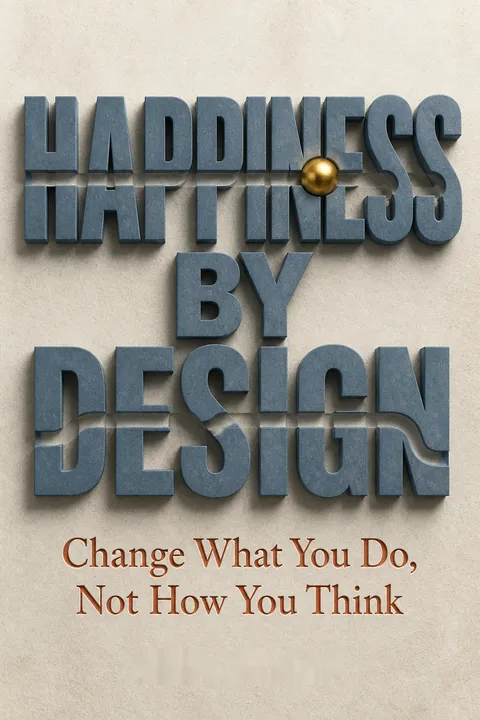


Key Takeaways
Define happiness by the pleasure and purpose you actually experience over time.
Two ingredients matter. Paul Dolan defines happiness as experiences of pleasure and purpose over time. Pleasure includes feelings such as enjoyment, calm, and excitement. Purpose includes the felt sense that an activity is worthwhile, useful, or meaningful. These are distinct: a night watching television may be pleasurable but feel pointless, while helping a friend move may be tiring yet purposeful. A life rich in only one ingredient can still feel out of balance.
Judge the whole experience. Raising children, for instance, may bring less pleasure than a night out with friends, but parenting can add substantial purpose. The useful question is not whether an activity is conventionally good, but how it affects the mix of pleasure and purpose across the time spent doing it, anticipating it, and remembering it.
This definition makes happiness more practical than a vague verdict on whether life is going well. It also avoids the familiar split between pleasure as shallow and purpose as virtuous: both count as parts of lived experience. The strength is its pluralism. Different people can value different combinations without being told that one is living incorrectly. The challenge is measurement: purpose can be difficult to distinguish from duty, identity, or social approval. Asking what an activity feels like while it is happening helps, but no single rating can settle what a life is worth.
Measure the daily film, not the flattering snapshot of your life.
Evaluation can mislead. A friend spends dinner describing a miserable job, then says she loves working there. There is no contradiction: her day-to-day experience is unpleasant, while her overall judgment of the job is positive. Dolan compares these perspectives to a film and a snapshot. A broad life-satisfaction answer captures the snapshot, which can be shaped by whatever comes to mind at the moment.
Activities reveal another picture. The Day Reconstruction Method asks people to recall yesterday as a sequence of activities and rate their feelings during each one. In a German study of 625 people, and in the much larger American Time Use Survey, television tended to bring more pleasure than purpose, while work and volunteering tended to bring more purpose than pleasure. Ranking only one dimension misses part of the story.
The distinction matters because people often make consequential choices from their overall story about themselves, not from the ordinary hours that make up that story. A diary of daily experience can expose a mismatch between the two. It also suggests why public measures should not treat one satisfaction score as a complete account of well-being. Yet retrospective diaries are not perfect recordings: memory edits, and being asked to rate an experience can change how it is considered. The best picture comes from combining repeated, specific reports with broader evaluations rather than treating either as the whole truth.
Attention is the machinery that turns circumstances into experienced happiness.
Circumstances need attention. Income, health, work, and relationships do not translate directly into happiness. Dolan’s central model treats attention as the process that converts these inputs into felt experience. The same circumstance can matter greatly or barely register, depending on how much attention it receives. His stammer once consumed enormous attention because speaking was unpredictable and he feared being judged. Therapy helped him notice that other people paid far less attention to it than he imagined.
Attention is limited. In the famous invisible-gorilla experiment, people counting basketball passes often failed to see a person in a gorilla suit walk through the scene. Focus on one thing can make another disappear from awareness. This is useful for happiness, but also risky: the attentional habits that make an irritating concern loom large can hide ordinary sources of pleasure and purpose.
The production model gives a memorable link between psychology and economics: attention is a scarce resource, so where it goes affects what life feels like. It also clarifies why changing circumstances alone may not change experience as expected. Attention can be redirected, but it is not fully under voluntary control; salient threats, uncertainty, and repeated cues can seize it. The practical implication is not to blame people for feeling unhappy, but to ask both what is happening and what keeps claiming their notice. Context, not just attitude, helps answer that question.
Choose goals by their daily costs, not their impressive labels.
Achievement has a price. A fisherman in a Brazilian village already enjoys time with his children, a nap with his wife, and evenings with friends. A visiting businessman urges him to build a company so he can retire and enjoy those same things. The story exposes a common trap: pursuing a distant image of success can postpone parts of a good life that are already available.
The process counts. A goal may bring a brief rush when achieved, but its pursuit occupies much more time. Students who strongly valued wealth were more satisfied when they later became rich, and disappointed when they did not. Dolan’s point is not to reject ambition, but to inspect its daily costs. A prestigious title or high salary is a poor bargain if the work reliably brings misery and the hoped-for payoff is uncertain.
This is a useful corrective to treating achievement as a proxy for well-being. Goals can organize effort and provide purpose, but their cultural prestige does not establish their value to the person pursuing them. The fisherman story works because it makes opportunity cost visible: the imagined destination contains familiar pleasures, while the journey may sacrifice them. Still, the parable cannot decide for everyone. Some people genuinely enjoy building, competing, or striving. The relevant test is whether the pursuit itself supplies enough pleasure or purpose to justify its costs, not whether ambition is inherently foolish.
Test your forecasts against ordinary days, not vivid imagined moments.
Imagination magnifies what is in view. The focusing effect occurs when a feature seems unusually important because attention is fixed on it. People asked to imagine how much pleasure they get from a car tended to link that answer to the car’s price, but the price did not predict enjoyment of their most recent drive. In the actual drive, attention had moved to traffic, conversation, and other details.
Memory edits experience. People often remember an event mainly through its strongest moment and its ending, while neglecting its duration. This is called the peak-end effect, and duration neglect describes how little remembered length can affect an overall judgment. Before changing jobs, buying a house, or planning a holiday, ask what ordinary days will feel like after novelty fades. Records of past experience, and advice from people with similar lives, can improve the forecast.
The lesson is not that people should stop imagining the future, but that vividness is a poor substitute for representativeness. A dramatic new house feature can dominate a comparison, while routine noise or commuting may matter more once the choice becomes daily life. Looking to comparable people and tracking one’s own experience are ways of correcting this bias. There is a limit, however: no diary can reveal the exact life not chosen. Forecasting is best treated as informed estimation, with room to revise when experience supplies better evidence.
Rebalance pleasure and purpose before repetition makes either feel empty.
More of one brings less. Dolan applies diminishing marginal returns to happiness: as an activity supplies more pleasure, the next increment may matter less than a first dose of purpose, and vice versa. In his German activity study, people’s ratings of work and television often differed across the two dimensions. About 60 percent received more purpose than pleasure from work and more pleasure than purpose from television; others leaned more heavily toward one side.
Needs change with time. Repetition can dull pleasure, while purposeful activities can lose their point and become boring. Some activities also gain purpose as people develop skills or commit to a project. A demanding workout may be uncomfortable yet purposeful in the moment. The practical test is whether the current balance suits the person now. If an activity brings neither pleasure nor purpose, continuing it merely because it once seemed worthwhile deserves scrutiny.
This model resists the idea that a single recipe can make everyone happy. It also makes room for worthwhile discomfort: unpleasant effort can still contribute to a good experience when it feels purposeful. The emphasis on changing balance is valuable because people can mistake a past preference for a permanent one. But pleasure and purpose are not always easy to compare on a common scale, and a temporary imbalance may be chosen for good reasons. The framework is most useful as a prompt to notice patterns, not as a formula that calculates the right life.
Shape your surroundings so helpful actions happen with less deliberation.
Context steers behavior. People are more likely to follow a path that is easy and already set up. A map showing where to get a tetanus vaccination worked better than general information about why vaccination mattered. At home, a different computer start page can shift the first minutes of the day; a recurring appointment with a friend can make social contact the default rather than a task to remember.
Small design choices compound. Dolan recommends using cues, preset options, commitments, and the influence of people nearby to make desired actions easier. In a UK energy experiment he describes, feedback comparing household energy use with neighbors’ use reduced consumption by about 6 percent. A change of job or home can be a useful moment to alter routines because familiar cues have been disrupted. Design reduces dependence on willpower, though it does not guarantee a desired result.
Environmental design is persuasive because it treats behavior as a response to circumstances, not simply as a test of character. A small change in friction can help people act on intentions they already endorse. The ethical question is who chooses the design and whose interests it serves. The same techniques that make helpful choices easier can also make commercial or institutional goals harder to resist. Used personally, the method is most defensible when the person affected understands the goal and can change the arrangement if it stops serving them.
Give experiences and people your attention, not your leftover attention.
Experiences keep their texture. Dolan argues that purchases made primarily for experiences, such as a trip, often retain their appeal longer than possessions, which can become ordinary and invite comparisons with what else could have been bought. The boundary is not absolute: a car can be valued for the experience of driving it, not merely as an object.
Presence matters. American time-use data associated being with another person with an average increase of about 0.4 points in pleasure and 0.6 points in purpose. Yet digital interruptions and task switching consume attention. In a study of students doing Sudoku and word-search tasks, those working through the tasks sequentially performed better than those forced to switch. A chosen break can refresh attention; constant interruptions are different. Put away devices during time that matters, and give one activity enough attention to experience it.
This takeaway joins two ideas that are often separated: what people spend money on and what they attend to while doing it. A meaningful outing can become little more than a backdrop if attention is repeatedly pulled elsewhere. The evidence also cautions against turning social contact into a universal prescription. Some activities, including homework in the survey, could feel less purposeful when done with someone else, and the effects vary by person and situation. The goal is not to maximize company or experiences indiscriminately, but to protect attention for the forms of activity that genuinely improve the day.
Make difficult work smaller, scheduled, and forgiving enough to begin.
Start with the next step. Procrastination often grows around tasks that feel important, effortful, or exposed to evaluation. Breaking a project into smaller actions and setting intermediate deadlines makes progress more visible. In an experiment with loan officers at Colombia’s Bancamía, weekly tasks paired with small rewards increased goal attainment by 30 percent and bonus payments by 25 percent compared with a group without the program.
Design beats self-reproach. A fixed work location, fewer online distractions, and deadlines set with another person can make starting easier. Self-forgiveness matters too: students who forgave themselves for earlier procrastination were less likely to procrastinate on the next task than those who remained self-critical. If a commitment repeatedly produces misery and no meaningful benefit, reconsidering it may be wiser than forcing completion simply because effort has already been spent.
The approach replaces moralizing with a diagnosis: is the task unclear, too large, too exposed, or competing with an easier cue? That makes procrastination more tractable and preserves self-respect, which supports another attempt. The Bancamía example combines structure with immediate rewards, but its result should not be mistaken for a guarantee that incentives solve every delay. Some tasks are postponed because they are genuinely low-value, not because the worker lacks discipline. Before designing a better system, it is worth asking whether the task deserves a place in the schedule at all.
Help others concretely, while protecting the capacity to keep helping.
Giving can benefit both sides. In a study cited by Dolan, people given $20 to spend on someone else reported greater happiness than people told to spend it on themselves. Specific information about what a donation accomplishes can make giving more rewarding. In a UK survey, 89 percent preferred a policy that provided reasonable well-being for everyone over one that generated more total well-being but left some people much worse off.
Care needs limits. Volunteering and helping can provide purpose, connection, and a sense of contribution. But sustained caring can also overwhelm people: young carers may struggle at school, and professionals in demanding care roles can experience compassion fatigue. Choose a concrete contribution that helps someone and remains sustainable. The aim is not self-erasure. It is to improve others’ lives in ways that also preserve the giver’s ability to remain present and engaged.
The section connects personal happiness with distribution: people care not only about their own experience, but also about whether others are left with very little. That broadens the book’s argument beyond private lifestyle optimization. At the same time, helping is not automatically beneficial simply because it is prosocial. The recipient’s needs, the helper’s capacity, and the actual impact all matter. Making a contribution specific and visible can strengthen its feedback, while boundaries prevent generosity from becoming an obligation that drains the very purpose it was meant to provide.
Analysis
The book’s central move is to redirect the question from what supposedly makes people happy to what they experience while doing ordinary things. Its pleasure-purpose principle gives that shift a usable vocabulary, while attention explains why the same job, income, or relationship can affect people differently. The strongest contribution is the combination: happiness is not only an outcome to pursue, but also feedback about how attention and behavior are working.
That framework is especially effective when it turns familiar advice into a question of evidence. Instead of prescribing positivity, Dolan asks readers to notice what their days contain, anticipate how routines will feel after novelty fades, and arrange environments to support chosen behavior. This makes the book more behavioral than motivational. It also recognizes that intention is often weaker than context, and that time spent in an activity matters as much as the abstract label attached to it.
The argument has limits. Pleasure and purpose are not cleanly separable in every experience, and self-reports can be affected by memory, expectations, and the questions used to collect them. The book acknowledges some of these problems, but its confident claim that happiness is the final standard remains a philosophical position, not a result established by the studies. People may also value commitments, rights, or relationships even when their immediate reported feelings are poor. The framework can include some of this through purpose and long-term experience, but it does not eliminate the debate.
Its practical value does not depend on accepting every philosophical claim. A reader can use the book as a disciplined audit: What is receiving attention? What does an ordinary day feel like? Which contexts make intended behavior easier? Those questions are specific enough to change choices without pretending that a single score can define a good life.
Review Summary
Happiness by Design receives mixed reviews. Many praise its scientific approach to happiness, focusing on balancing pleasure and purpose. Readers appreciate the practical advice and insights into behavioral economics. However, some find the book repetitive, overly academic, or lacking depth. Critics argue that Dolan's definition of happiness is too simplistic. Despite these criticisms, many readers find value in the book's unique perspective on designing a happier life through attention allocation and environmental changes. Overall, it's seen as a thought-provoking read, albeit with some flaws.
People Also Read






Glossary
pleasure-purpose principle
Pleasure and purpose over timeDolan’s account of happiness as the experiences of pleasure and purpose over time. Pleasure includes positive and negative feelings such as enjoyment, anxiety, or calm. Purpose concerns whether an activity feels worthwhile, meaningful, or pointless. The principle treats both dimensions as important, while allowing their relative importance to vary between people and across life.
production process of happiness
Attention converts inputs to feelingsDolan’s model for how life circumstances become experienced happiness. Inputs such as income, health, work, and relationships do not determine feelings directly. Attention is the process that shapes how those inputs are experienced. Since attention is limited and partly automatic, changing what receives it, or changing the surrounding context, can alter the happiness produced by the same circumstances.
day reconstruction method
Recall and rate daily episodesA survey technique that asks people to divide a recent day into episodes, such as commuting, working, or eating, and report what they did, who was present, and how they felt. Dolan adapted the method to include purpose as well as pleasure. It offers a structured account of daily experience without repeatedly interrupting people in real time.
focusing effect
Attention inflates what seems importantA bias in which a factor seems more influential when a person is actively thinking about it than it is during ordinary experience. Imagining how a car, a location, or a life change will affect happiness can make that feature loom large. In everyday life, attention moves among many concerns, so the feature may matter less than the forecast suggests.
distinction bias
Joint comparison exaggerates differencesThe tendency to judge two options as more different when they are compared side by side than when each is considered separately. A striking contrast, such as a larger house or a more attractive job offer, may dominate the choice even if the difference matters little in daily use. The concept encourages attention to lived consequences, not just comparative features.
projection bias
Current feelings distort future forecastsThe tendency to use current feelings as a guide to how an option will feel later. Hunger can lead someone to overbuy food, and excitement about a new opportunity can obscure the ordinary routine that follows. Because feelings change with context, a forecast based on the present state may misrepresent future experience.
peak-end effect
Memory favors peaks and endingsA pattern in which retrospective judgments of an experience are strongly influenced by its most intense moment and its ending. People may remember a holiday or performance through a high point and a final disruption rather than through the full sequence of moments. Dolan connects this with duration neglect, the limited role that remembered length can play in an overall evaluation.
AREA model
Attention, reaction, explanation, adaptationA model of adaptation described in the book: an event first attracts attention, prompts a reaction, and may lose its impact when a person can explain it. When uncertainty remains unresolved, the event can continue to command attention and feeling. The model helps explain why some changes fade from concern while unexplained or unpredictable problems remain salient.
MINDSPACE
Checklist of behavioral influencesA checklist for influences on behavior that often operate automatically. Its elements are messenger, incentives, norms, defaults, salience, priming, affect, commitments, and ego. Dolan presents it as a way to notice contextual forces that can be overlooked when behavior is explained only through deliberate reasoning, and applies several of its elements to personal behavior design.
behavioral spillovers
One behavior changes the nextEffects that occur when one action influences a later action linked by a shared motive. A workout might encourage continued healthy eating, or it might license a treat that offsets the exercise. Dolan distinguishes spillovers that promote the same aim, permit a counteracting action, or attempt to purge the consequences of an earlier behavior.
conspicuous caring
Visible prosocial behaviorDolan’s term for making acts of care visible in ways that can encourage other people to contribute. It draws on the idea that public signals influence behavior: people may be more generous when others know about their giving. The concept emphasizes outcomes over pure motives, while still requiring attention to whether the visible contribution genuinely helps.
FAQ
What's Happiness by Design about?
- Focus on Actions: Happiness by Design by Paul Dolan emphasizes that happiness is a result of our actions and decisions, not just a feeling.
- Pleasure-Purpose Principle: The book introduces the Pleasure-Purpose Principle (PPP), which suggests that balancing pleasurable and purposeful experiences leads to greater happiness.
- Behavioral Science Insights: Dolan combines insights from behavioral science and economics to offer practical advice on designing a happier life.
Why should I read Happiness by Design?
- Practical Strategies: The book provides actionable advice for improving happiness through changes in behavior and environment.
- Research-Based: Dolan's insights are backed by extensive research, making the advice credible and grounded in real-world findings.
- Encourages Reflection: It prompts readers to reflect on their own experiences and how they allocate their attention, leading to meaningful life changes.
What are the key takeaways of Happiness by Design?
- Attention Matters: The allocation of attention is crucial; what you focus on can significantly influence your happiness levels.
- Pleasure-Purpose Balance: Happiness requires a balance of pleasurable and purposeful experiences, as outlined by the Pleasure-Purpose Principle.
- Mistaken Beliefs: Recognizing and correcting flawed beliefs about happiness can lead to better life choices.
What is the Pleasure-Purpose Principle (PPP) in Happiness by Design?
- Definition of PPP: The PPP states that happiness consists of both pleasurable and purposeful experiences, and a balance of the two is essential for well-being.
- Importance of Balance: Too much focus on pleasure without purpose can lead to emptiness, while too much purpose without pleasure can lead to burnout.
- Personalization: Each individual may require different balances of pleasure and purpose at different times, making it a highly personal concept.
How does attention influence happiness according to Happiness by Design?
- Attention as a Resource: Attention is a scarce resource; what you pay attention to can either enhance or detract from your happiness.
- Focusing Effects: Focusing on certain aspects of life can lead to overestimating their importance, skewing happiness predictions.
- Reallocation of Attention: Consciously reallocating your attention to what truly brings joy and fulfillment can improve overall happiness.
How can I apply the concepts from Happiness by Design in my life?
- Assess Your Activities: Identify which activities bring you pleasure and which provide purpose to guide time and energy allocation.
- Design Your Environment: Make small changes to your surroundings that encourage happiness, such as decluttering or adding positive influences.
- Engage with Others: Prioritize spending time with friends and family who uplift you, enhancing both pleasure and purpose.
What are some practical strategies for increasing happiness mentioned in Happiness by Design?
- Daily Reflection: Keep a happiness diary or use the Day Reconstruction Method (DRM) to track daily activities and their associated pleasure and purpose.
- Social Connections: Engaging with others and spending time with loved ones can significantly enhance both pleasure and purpose in your life.
- Designing Your Environment: Create an environment that nudges you towards positive behaviors to maintain focus on activities that increase happiness.
What are mistaken desires, and how do they affect happiness in Happiness by Design?
- Definition of Mistaken Desires: Mistaken desires refer to goals and aspirations that do not align with what truly makes us happy.
- Impact on Choices: Pursuing achievement or external validation can lead to dissatisfaction if those pursuits do not provide genuine pleasure or purpose.
- Awareness and Adjustment: Recognizing these mistaken desires allows individuals to adjust their goals and focus on what genuinely contributes to their happiness.
How does Happiness by Design address the concept of mistaken projections?
- Understanding Projections: Mistaken projections occur when individuals inaccurately predict how future events will affect their happiness based on current feelings.
- Focusing Effects: We often overestimate the impact of certain events because we focus too much on them at the moment.
- Realistic Expectations: Understanding the limitations of our projections helps set more realistic expectations for future happiness and better decision-making.
What role do social connections play in happiness according to Happiness by Design?
- Happiness is Contagious: Happiness can spread through social networks, meaning that being around happy people can enhance your own happiness.
- Shared Experiences: Engaging in activities with others increases enjoyment and adds a sense of purpose, deepening relationships.
- Support Systems: Strong social connections provide emotional support during difficult times, crucial for maintaining mental health and happiness.
What are the best quotes from Happiness by Design and what do they mean?
- "Attention is the glue that holds your life together.": This underscores the importance of where we direct our attention, as it shapes our experiences and happiness.
- "You are what you attend to.": Our focus determines our reality; by choosing what to pay attention to, we can influence our emotional state.
- "Change what you do, not how you think.": This encapsulates the book's main message that actionable changes in behavior are more effective for improving happiness than merely changing one's mindset.
How does Happiness by Design suggest we deal with distractions?
- Recognizing Distractions: Multitasking and constant interruptions can diminish focus and well-being; awareness is the first step in managing them.
- Creating a Distraction-Free Zone: Design environments that minimize distractions, such as turning off notifications or setting specific times for checking emails.
- Taking Breaks: Instead of succumbing to distractions, take intentional breaks to recharge, enhancing creativity and focus when returning to tasks.
About the Author
Other books by Paul Dolan

Download PDF
Download EPUB
.epub digital book format is ideal for reading ebooks on phones, tablets, and e-readers.








