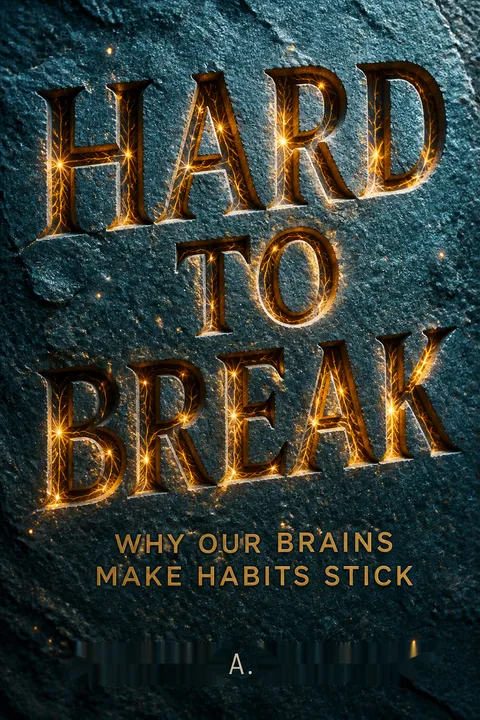


Key Takeaways
Treat habits as useful defaults that can outlast their original purpose
Habits conserve attention. A habit is behavior triggered automatically by a familiar cue, rather than freshly chosen to achieve a goal. This automaticity lets people handle routine actions without deliberating over every movement. William James saw the benefit in ordinary skills such as reading, which becomes so practiced that a written word can distract someone from naming its ink color. The same efficiency can misfire: a driver intending to stop at the dry cleaner may follow the familiar route straight home.
Learning can become detached. In Anthony Dickinson's experiments, rats initially stopped pressing a lever when they had eaten enough of its food reward. After extensive training, they kept pressing even when they no longer wanted the food. The brain's habit system automates what seems stable, while conscious memory helps track changing facts. Habit persistence is therefore not simply a personal flaw. It is the cost of a system designed to make repeated life manageable.
The useful distinction is not between good and bad people, but between actions that still serve a purpose and actions running on yesterday's learning. This resembles automation in engineering: reliable routines reduce cognitive load, but a system needs a way to detect when its assumptions no longer fit. The rat devaluation test is powerful because it separates repeating an action from pursuing its outcome. Human routines are more layered, though, and a behavior that looks automatic may still be shaped by social goals or constraints.
Dopamine teaches the brain what to repeat, not simply what feels good
Dopamine updates learning. This neurotransmitter modulates brain activity and helps change connections involved in learning. In the striatum, a brain region within the basal ganglia, dopamine can strengthen neural connections when an action and its outcome occur together. Research by Wolfram Schultz showed that dopamine neurons respond when a reward is unexpected, then shift their response to a cue that predicts it. When an expected reward fails to arrive, their activity drops. This difference between outcome and expectation is called a reward prediction error.
Wanting is not liking. Dopamine also helps make a reward worth pursuing. In experiments, rats with disrupted dopamine signaling could still climb a barrier for food when food was their only option, but were less willing to work for a larger reward when an easier, smaller one was available. Pleasure itself depends on other systems too. Dopamine is influential, but it is not a universal pleasure meter, and its signals respond to more than reward alone.
Separating motivation from pleasure clarifies why a person can pursue something intensely while finding it less satisfying than before. It also offers a useful caution against treating a brain chemical as a single-purpose explanation for complex behavior. Prediction error provides a bridge between neuroscience and learning theory: organisms adjust when experience differs from expectation. Yet dopamine activity is diverse, so the model is most useful as a simplifying account of some learning processes, not a complete reading of desire or choice.
Expect old habits to return when cues, stress, or settings change
Suppression is not deletion. In Mark Bouton's rat experiments, an animal first learned to press one lever for food, then learned a different response while the first went unrewarded. When the newer response stopped paying off, the original lever pressing returned. This return of an earlier behavior is called resurgence. The original learning remains available; new learning can inhibit it without erasing it.
Context changes the contest. In a study of spider phobia, students who practiced approaching a tarantula showed less fear a week later when tested in the same room than when tested elsewhere. The new, safer learning was especially tied to its setting. Habits also become sequences, or chunks: shoe tying no longer requires conscious attention to each lace movement. Familiar cues can trigger these sequences, and rewarding cues can capture attention before deliberate choice begins.
The return of an unwanted response is not proof that change has failed; it can reveal that the new behavior was learned under narrow conditions. This insight fits exposure-based therapies, where practicing in varied settings can make safer learning less dependent on one room, one therapist, or one emotional state. It also suggests a practical test: rehearse a replacement response where the old cue is likely to appear. Still, context cannot always be controlled, and stress may overwhelm even well-practiced alternatives.
Notice when distraction hands control from planning to learned responses
Two learning strategies compete. Model-free reinforcement learning records which actions have tended to bring rewards, without representing how the world works. Model-based learning uses a mental map of states and consequences to plan. In Nathaniel Daw's two-step task, a participant first chose a button that usually opened one of two rooms, then selected a door for a possible reward. A model-based learner uses knowledge of the transition probabilities; a model-free learner more directly repeats action sequences that paid off.
Attention changes the balance. Both systems can contribute to behavior, and their influence varies with circumstances. In experiments, distraction pushed participants toward model-free choices, while focused attention supported more planning. Goals themselves can also acquire habitual value: an unexpected bonus can bias future choices toward a goal even when the bonus was random. The systems are not separate little selves, but interacting ways the brain learns and selects actions.
This framework makes an everyday failure of judgment less mysterious. A person may know the consequences of a choice yet default to a response learned through repetition, especially when attention is occupied. The distinction also helps avoid a false binary between rational planning and mindless habit: the same decision can draw on both. Its limit is that laboratory tasks isolate simple choices, while real goals involve relationships, identity, and uncertainty that are harder to represent in a compact model.
Build self-control into routines instead of betting on momentary willpower
Control has a narrow operating range. The prefrontal cortex helps hold goals in mind, plan, and resist distraction. Its performance is sensitive to arousal: too little alertness or too much stress can impair working memory and planning. That makes a high-pressure moment a poor time to depend on elaborate self-control.
Waiting depends on circumstances. In Walter Mischel's famous studies, children waited much longer for a preferred treat when the food was out of sight or they had something else to think about. Later work complicated the popular lesson that waiting alone predicts success. A child's willingness to wait also depends on whether adults seem reliable and whether immediate resources feel scarce. Research on daily desires found that people reporting stronger self-control experienced fewer, weaker temptations and resisted them less often. Good habits may reduce the number of battles that need winning.
Self-control is better understood as a set of capacities operating within a person's environment than as a fixed store of moral strength. The marshmallow findings become more humane when trust and scarcity are included: taking an immediate reward can be sensible if future promises are unreliable. The same logic applies to adults facing stress or unstable conditions. Individual strategies still matter, but advice that ignores a person's options risks blaming them for constraints that shape what counts as a rational choice.
Treat addiction as interacting habit, motivation, stress, and vulnerability systems
Drugs intensify learning. Many addictive drugs affect dopamine signaling for longer than ordinary rewards do, helping reinforce drug-related behavior. Over time, the brain adapts, so the same drug can produce less response, while withdrawal can bring distress and anxiety. Drug cues may acquire strong motivational pull, or incentive salience: they prompt wanting and pursuit, even when the experience itself has become less pleasurable.
No single mechanism explains addiction. Some animal experiments show drug-seeking becoming habitual, but people may also make complex, goal-directed plans to obtain drugs. Stress can amplify cravings, weaken prefrontal control, and favor habitual responding. Only a minority of people who try most drugs become addicted; tobacco is an exception, with a much higher estimated rate. Biology, early adversity, experience, and chance all contribute, so addiction is not adequately explained as a simple lack of willpower or one broken habit.
This account replaces a moralized story with a systems view, without implying that biology determines every outcome. It also explains why a treatment aimed at only one mechanism may fall short: cravings, withdrawal, learned cues, and planning can reinforce one another. The distinction between wanting and liking is especially important for understanding persistent use. At the same time, animal models simplify human addiction, and overlapping brain activity does not make eating, phone use, and substance dependence equivalent disorders.
Change the surroundings and write specific plans before temptation arrives
Make the desired response easier. Choice architecture is the way a setting presents options and makes some more likely than others. Defaults can strongly shape behavior: European countries with presumed consent for organ donation reported rates above 85%, while opt-in countries reported rates below 30%. For personal change, removing a cue can be more effective than trying to resist it. Students who blocked distracting websites reported better progress on study goals than students told to rely on willpower. Smoke-free homes were associated with much higher odds of quitting.
Pre-decide the hard moments. Implementation intentions are specific if-then plans for responding to predictable situations. A person trying to stop smoking can identify likely offers or settings and decide in advance how to respond. Simple rules reduce repeated decisions; monitoring progress shows whether the plan is working. Commitment devices, such as putting money at risk if a goal is missed, can add accountability.
These strategies translate a theory of cue-driven behavior into design: change the path of least resistance, then rehearse what to do when the path is blocked. The distinction between removing a temptation and resisting it matters because attention and stress are limited resources. Defaults and rules can also help organizations, not just individuals. But choice architecture raises a question of power: the same tools can support a person's stated aims or steer people toward someone else's interests, so the objective should remain transparent.
Trust tested behavior change, not fashionable claims or laboratory wins
Evidence varies sharply. A large exercise study tested 53 approaches with about 63,000 gym members. Nudges and small payments increased attendance during the 28-day program, but the benefits largely disappeared afterward. Training people to resist alcohol-related images also failed to outperform a control condition in reducing drinking. These results caution against assuming that a short-term change in a laboratory or program will become durable behavior.
Some treatments are better supported. Comprehensive behavioral intervention for tics combines awareness of warning signs, a competing response, practice outside the clinic, monitoring, and relaxation. Trials found it more than five times as effective as standard treatment at reducing tics, though it did not work for everyone or eliminate all symptoms. Mindfulness may help individuals, but research quality and reporting problems do not justify sweeping promises. Strong interventions need sustained, real-world testing.
The contrast between the gym megastudy and tic treatment is instructive: a large sample can expose the limits of a popular intervention, while a coordinated package can help with a specific, difficult condition. No single evidence standard answers every practical question, but durable outcomes matter more than a temporary boost. Readers should also distinguish an intervention's failure from a failed experiment. A reliable null result saves time and helps narrow the search for strategies that actually fit the problem.
Treat behavior change like medicine: test mechanisms, not just outcomes
Find the lever, then test it. The Science of Behavioral Change program promotes an experimental-medicine approach: identify a psychological or biological target, test whether an intervention changes it, and see whether that change predicts lasting behavior change. This asks not only whether a program worked, but how. Possible future tools include disrupting or updating memories during reconsolidation, using brain stimulation, and tailoring treatment to individual response. These approaches remain preliminary; some require invasive procedures, and promising findings still need independent replication.
Scale beyond the individual. The book's closing examples show how settings can rapidly reshape routine, as during pandemic restrictions, and how entrenched habits complicate responses to climate change. Lasting progress depends on reliable evidence as well as environments and institutions that support new behavior. Preregistration, larger studies, and sharing data can make the evidence more trustworthy. The prospect is not a universal habit-erasing trick, but a more precise science of when and for whom change is possible.
The experimental-medicine analogy is valuable because behavior programs often report outcomes without establishing why they worked or who benefits. Target engagement can make a treatment more informative, even when its first version disappoints. Personalization could improve fit, but biological measurement should not become a substitute for understanding social conditions or a license to label people as risky. The strongest future science will connect individual mechanisms to environments, and will make its uncertainty as visible as its successes.
Analysis
The book's central achievement is to make persistence intelligible without treating it as either virtue or defect. Habits are an adaptive solution to a stable world: they reduce the computational burden of routine life. Their cost appears when the world changes, because learning systems preserve old responses while conscious control is vulnerable to distraction and stress. This is a more useful account than the familiar advice to simply try harder.
The neuroscience gives the argument explanatory depth, but its strongest use is as a map of interacting processes, not a claim that a specific brain region dictates a person's choices. Rodent experiments can isolate mechanisms such as reward devaluation, cue-triggered responding, and habit formation. Human behavior, however, includes language, institutions, social trust, and deliberate long-range goals. The book is careful to distinguish these evidence levels, especially when it questions claims about food addiction, digital addiction, and simple brain-based explanations of willpower.
Its most practical conclusion is architectural. Behavior changes more reliably when cues, defaults, rules, and plans change than when a person merely promises to exert more control in the moment. That conclusion does not absolve individuals of agency. It locates agency in advance preparation, including choosing settings and commitments that make desired action easier. It also highlights an ethical tension: environments can be designed to support a person's goals, but the same techniques can manipulate attention and choice for commercial or institutional ends.
The book's research agenda is as important as its advice. Many popular interventions produce short-lived effects or rest on weak evidence. Mechanism-based testing, replication, and transparent methods offer a better path than collecting attractive success stories. A limitation is that the science of changing behavior remains less mature than the neuroscience explaining why behavior sticks. The book does not resolve that gap, and its honesty about uncertainty is part of its value. It offers neither effortless transformation nor fatalism, but a clearer account of where the leverage lies and why durable change remains difficult.
Review Summary
Hard to Break offers a scientific perspective on habits and behavior change, drawing on neuroscience and psychology research. Readers appreciate its rigorous approach and skepticism towards bold claims. However, some find it too dense and technical for a general audience, lacking practical advice. The book is praised for its comprehensive overview of current knowledge but criticized for being overly academic. While informative, it may not provide concrete solutions for habit change, leaving some readers wanting more actionable insights.
People Also Read









Glossary
stability-plasticity dilemma
Balancing learning and retentionThe problem of learning what has changed without discarding what remains reliable. A brain that updated too quickly would lose useful knowledge; one that changed too slowly would fail to adapt. Poldrack presents multiple learning and memory systems, including habit and declarative memory systems, as part of the brain's solution.
reward prediction error
Outcome minus expectationThe difference between an expected outcome and what actually occurs. In reinforcement-learning accounts, this difference updates the estimated value of an action or situation. Dopamine neurons can signal such discrepancies: an unexpected reward produces activity, a learned predictive cue can take over that response, and an expected reward that fails to arrive can reduce activity.
Pavlovian-instrumental transfer
Cues energize learned actionsA process in which a cue previously associated with an outcome increases an action learned separately to obtain that outcome. For example, a sound associated with food can increase a rat's lever pressing even when no food is present. The effect is relevant to habits because cues associated with rewards can trigger seeking without a fresh evaluation of the reward's value.
model-free reinforcement learning
Learning actions from outcomesA learning strategy that updates the value of actions from their experienced outcomes without building an explicit representation of how the world works. It can efficiently repeat actions that have paid off, but it may adapt poorly when transitions or consequences change. Poldrack connects this style of learning with habitual control, while noting that it interacts with other systems.
model-based reinforcement learning
Planning with a world modelA learning strategy that uses knowledge of states, transitions, and outcomes to evaluate possible actions. Rather than simply repeating a rewarded sequence, a model-based learner can use a representation of how choices lead to later consequences. This supports flexible planning but requires attention and cognitive resources, making it more vulnerable to distraction than habitual responding.
incentive salience
Motivational pull of cuesThe motivational significance a cue gains through learning, making it compelling to pursue. The term distinguishes wanting a reward from liking its pleasurable effects. In addiction, drug-related cues can acquire strong incentive salience and prompt craving or attention even when the drug has become less pleasurable or has harmful consequences.
choice architecture
Design of available choicesThe way options are arranged and presented in a decision environment, which can make some choices more likely without removing alternatives. Defaults are a prominent example: people often accept a preselected option, especially when they have no strong preference. Choice architecture can support behavior change, although its effects are not reliably durable in every setting.
implementation intentions
Specific if-then action plansPlans that link a recognizable situation to a predetermined response. Instead of relying on a general intention, a person specifies what they will do when a particular obstacle or temptation appears. Research summarized in the book finds benefits for goals such as physical activity and healthy eating, with more specific plans tending to be more effective.
resurgence
Return of an earlier responseThe reappearance of an earlier learned behavior after a newer behavior stops producing a reward. In animal experiments, a rat trained to press one lever may learn to press another when the first no longer pays off, then return to the original lever when the newer response is also unrewarded. The original behavior was inhibited, not erased.
reconsolidation
Restabilizing a reactivated memoryThe process by which a consolidated memory can become temporarily unstable when reactivated and then require biological activity to become stable again. Experiments suggest that interfering with this process can weaken or modify some memories. Attempts to apply reconsolidation methods to addiction or trauma are promising but preliminary, with uncertain reliability and clinical usefulness.
Science of Behavioral Change
Mechanism-focused change researchA research program supported by the US National Institutes of Health to investigate the mechanisms underlying behavior change. Its experimental-medicine approach asks whether an intervention engages a defined psychological or biological target, and whether target engagement relates to meaningful change. The goal is to build interventions from mechanisms rather than relying only on broad stages or outcome measures.
FAQ
What is Hard to Break: Why Our Brains Make Habits Stick by Russell A. Poldrack about?
- Explores habit formation: The book investigates why habits form in our brains, why they are so persistent, and how they shape our behavior, often outside conscious awareness.
- Neuroscience and psychology focus: It delves into the brain mechanisms—especially the roles of the basal ganglia and dopamine—that underlie habit formation and maintenance.
- Covers addiction and change: The book also examines addiction as an extreme form of habit and discusses the science behind behavior change and self-control.
- Interdisciplinary approach: Poldrack combines insights from neuroscience, psychology, and computational modeling to provide a comprehensive understanding of habits.
Why should I read Hard to Break by Russell A. Poldrack?
- Deep scientific insight: The book offers a nuanced, research-based explanation of habits, moving beyond simplistic advice and common misconceptions.
- Practical relevance: Understanding the brain’s habit mechanisms can help readers develop more effective strategies for personal and societal behavior change.
- Broad applicability: Topics range from everyday routines to addiction and digital habits, making it relevant for anyone interested in psychology, neuroscience, or self-improvement.
- Actionable knowledge: Readers gain practical advice on behavior change, including the limitations of willpower and the importance of environment and planning.
What are the key takeaways from Hard to Break by Russell A. Poldrack?
- Habits are brain-based: Habits are deeply rooted in specific brain circuits, making them persistent and difficult to change.
- Self-control is not enough: Willpower alone is often insufficient for lasting behavior change; environmental design and habit management are crucial.
- Addiction as maladaptive habit: Addiction is explained as a hijacking of the brain’s habit systems, with unique challenges for change.
- Future of behavior change: Emerging neuroscience tools and personalized interventions may offer new hope for breaking stubborn habits.
How does Hard to Break by Russell A. Poldrack define a habit?
- Automaticity is central: A habit is an action or thought triggered automatically by a specific cue, performed without conscious intention.
- Detached from goals: Habits persist even when the original reward or motivation is gone, operating independently of current goals.
- Spans actions and thoughts: Habits include not just physical routines but also mental patterns and emotional responses.
- Chunked behavior: Habits often become sequences of actions that run to completion once triggered, making them hard to interrupt.
What are the main brain mechanisms behind habit formation in Hard to Break by Russell A. Poldrack?
- Basal ganglia’s central role: The basal ganglia encode and maintain habits, processing both motor and cognitive routines.
- Dopamine’s modulatory effect: Dopamine signals reward prediction errors, reinforcing actions that lead to rewards and driving habit formation.
- Transition from conscious to automatic: Behaviors start as goal-directed and shift to automatic control by the basal ganglia with repetition.
- Cue-driven activation: Environmental cues become powerful triggers for habitual actions through learned associations.
Why are habits so persistent and hard to break according to Hard to Break by Russell A. Poldrack?
- Original learning persists: Old habits are inhibited, not erased, making them prone to resurface when new behaviors aren’t reinforced.
- Chunking and automaticity: Habits become chunked sequences, making them difficult to interrupt once started.
- Powerful environmental triggers: Cues associated with habits gain increased salience, capturing attention and triggering responses even without current rewards.
- Brain mechanisms protect habits: Multiple neural systems reinforce and maintain habits, making simple solutions ineffective.
How does Hard to Break by Russell A. Poldrack explain the relationship between habits and goals?
- Goal-directed vs. habitual: Early learning is goal-directed, but with repetition, actions become habitual and less sensitive to current goals.
- Competing brain systems: The brain’s goal-directed (prefrontal cortex, hippocampus) and habit (basal ganglia) systems compete for behavioral control.
- Model-based vs. model-free: Habits reflect model-free learning (cached values), while goal-directed actions use model-based planning and cognitive maps.
- Persistence despite changing goals: Habits can persist even when the desired outcome is no longer relevant.
What does Hard to Break by Russell A. Poldrack say about self-control and willpower in behavior change?
- Prefrontal cortex’s role: Self-control depends on the prefrontal cortex, which supports planning, working memory, and impulse inhibition.
- Willpower is limited: The book challenges the idea that willpower alone drives change, showing that self-control is not strongly linked to basic inhibitory control.
- Avoiding temptation: People with better self-control tend to avoid situations requiring effortful inhibition, reducing reliance on willpower.
- Habits support self-control: Good self-control is linked to forming beneficial habits, automating desired behaviors and making change more sustainable.
How does Hard to Break by Russell A. Poldrack describe the role of dopamine in habits and motivation?
- Signals prediction errors: Dopamine neurons fire in response to unexpected rewards or cues, encoding reward prediction errors that drive learning.
- Motivation over pleasure: Dopamine is more about “wanting” (motivation) than “liking” (pleasure), which involves other neurotransmitters.
- Pathway-specific effects: Dopamine acts differently on direct and indirect pathways in the basal ganglia, influencing action facilitation or inhibition.
- Central to addiction: Drugs hijack dopamine systems, reinforcing maladaptive habits and compulsive behaviors.
What is the connection between habits and addiction in Hard to Break by Russell A. Poldrack?
- Addiction as maladaptive habit: Addiction is framed as the hijacking of the brain’s habit machinery by drugs that cause excessive dopamine release.
- From impulse to compulsion: Drug use often shifts from impulsive, goal-directed behavior to habitual, compulsive seeking resistant to negative consequences.
- Brain and stress changes: Addiction involves changes in stress systems and brain plasticity, contributing to withdrawal and relapse.
- Individual vulnerability: Genetic and environmental factors influence susceptibility to addiction through differences in habit formation and self-control systems.
What strategies for changing habits and behavior does Hard to Break by Russell A. Poldrack recommend?
- Environmental design: Altering cues and contexts can reduce habit triggers and support new behaviors.
- Implementation intentions: Forming specific if-then plans helps bridge the gap between intention and action, preparing for tempting situations.
- Monitoring and commitment: Self-monitoring and using commitment devices (like monetary pledges) increase accountability and support sustained change.
- Limitations of nudges: While nudges and environmental tweaks help, they may not produce lasting effects without deeper habit change.
What does Hard to Break by Russell A. Poldrack say about the future of behavior change science and emerging neuroscience tools?
- Brain stimulation potential: Techniques like transcranial magnetic stimulation (TMS) and optogenetics show promise for modulating self-control and habit circuits, though more research is needed.
- Memory erasure research: Experimental approaches targeting memory reconsolidation or molecular mechanisms may one day weaken or erase maladaptive habits.
- Precision interventions: Combining brain imaging, genetics, and behavioral data could enable personalized, mechanism-focused interventions for behavior change.
- Open science emphasis: The book advocates for transparency, large sample sizes, and preregistration to improve the reliability of behavior change research.
About the Author
Other books by Russell A. Poldrack
Download PDF
Download EPUB
.epub digital book format is ideal for reading ebooks on phones, tablets, and e-readers.








