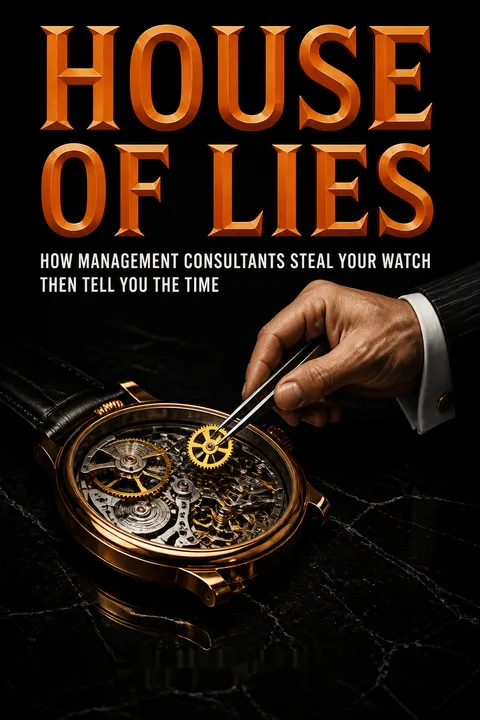


Key Takeaways
Consultants sell packaged judgment, not privileged knowledge.
The service is speed. Kihn argues that consultants are rarely hired because they know a client’s industry better than its employees. They are paid to gather facts quickly, organize them into an analysis, and present the result with authority. Recommendations may accompany the work, but clients often ignore them. The consultant’s value is partly the temporary labor and clear presentation, not a secret answer unavailable inside the company.
Expertise has a boundary. At a troubled tire company, a consultant struggles to understand the business while employees already know its products, systems, and problems. His best help comes from asking an employee who is burning the data CDs what the files contain. The book’s central joke is also its warning: clients may pay handsomely to hear their own information returned in polished form.
What's striking is that this account identifies a genuine service even while mocking its packaging. An outsider can supply focus, analytic labor, and a neutral forum when internal teams are overloaded or politically divided. That is different from possessing superior industry knowledge. The distinction matters because clients can evaluate consultants more intelligently by asking what is being purchased: capacity, independent scrutiny, or expertise. The book sometimes treats weak recommendations as typical, but that does not establish that all outside analysis is empty. The strongest version of its critique is narrower: presentation can create an illusion of insight unless the work changes what decision-makers understand or do.
After promotion, selling can matter more than analysis.
The ladder changes rules. Kihn describes a firm where early promotions depend on analytical work and clear presentations. At principal level, advancement and reward depend chiefly on winning business. The Rainmaker, a celebrated media consultant, had a weak reputation for analysis and nearly failed to advance. Once promoted, he landed a small client project, sold an extension, and brought in roughly $3 million within six months. His commercial success quickly outweighed doubts about his technical skills.
Sales reshape power. The Rainmaker’s story helps explain why someone with limited analytical ability could command a large practice, and why colleagues who do the analysis may remain less influential. The institutional message is blunt: the person who brings in revenue can define what the firm values, even when others must deliver the work.
This is a sharp illustration of changing performance criteria inside a career ladder. Early-stage work rewards craft, while senior roles reward client acquisition and revenue. Such transitions are common in professional services, but they can create a dangerous mismatch: a strong seller may gain authority over work whose quality depends on other people. The pattern is not automatically corrupt. Selling can be a real form of value creation when it connects clients to capable teams. The risk arises when revenue becomes a substitute for competence, accountability, or care for the people expected to execute the promises.
Check the facts behind a prestigious firm's polished biography.
Prestige invites loose claims. Kihn audits the Rainmaker’s promotional biography, which describes a worldwide media practice with more than two hundred consultants. In the author’s accounting, only about three people worked directly for him at the practice’s peak. Of eighteen factual claims in the short description, he judges 28 percent probably true, 11 percent partly true, and 61 percent false. He also says the Rainmaker’s named book was written by a younger colleague.
Verify the impressive nouns. The discrepancies are not just about wording. A group is renamed to sound more specialized, offices are attributed to a practice that barely had them, and other partners’ staff are presented as one leader’s team. The episode shows how a polished professional identity can turn loose association into apparent ownership.
The biography audit is more than a joke about one ambitious executive. It demonstrates how authority is assembled through small claims that are difficult for outsiders to check. In organizational life, titles, headcounts, client lists, and geographic reach act as signals of competence. Yet signals can become detached from the underlying work. A useful response is not blanket cynicism, but verification: distinguish direct responsibility from broad affiliation, and a real result from a flattering description. Kihn’s own figures are his reconstruction, so the audit should be read as an insider’s argument, not an independent industry-wide measurement.
Translate consultant jargon before mistaking it for insight.
Language can obscure work. Kihn’s mock dictionary translates consulting expressions into plain English. A “data dump” means information delivered by the client; “farmer’s math” means a quick rough estimate; and “client education” can mean pressuring a client to accept the consultant’s view. The jargon creates belonging among consultants and can make vague or improvised work sound systematic.
Ask what the words do. Kihn also observes that consultants often say “we” when they mean the client, blurring the line between adviser and employee. Terms such as “off-line” can politely end discussion, while “robust” may mean little more than complicated-looking. The practical test is simple: request the action, evidence, owner, and decision hidden inside a fashionable phrase.
Specialized language is not inherently dishonest. Shared vocabulary can shorten coordination and help teams distinguish recurring tasks. The problem begins when jargon stops clarifying and starts insulating speakers from scrutiny. Plain-language translation functions like an audit: it reveals whether a phrase names a measurable process or merely lends it prestige. The same discipline applies beyond consulting, from technology teams to public policy. Still, a glossary alone cannot expose every ambiguity. A crisp sentence can also mislead, so the decisive question is whether the claim can be tested against evidence and consequences.
Ask client insiders where the useful data actually lives.
Local knowledge beats guessing. On a tire-industry engagement, the team receives piles of unlabeled files and does not know what its own data request has produced. Kihn notices Geraldo, a client employee, operating the computer that burns the CDs. Geraldo explains what he is extracting and suggests how to regroup the inventory figures. His practical knowledge helps the consultants make progress that their confident instructions had not produced.
Treat employees as sources. Another client executive tells the team that consultants repeatedly repackage company data and make recommendations that do not fit the business. The book’s alternative is not to pretend the outsider knows more. It is to find the people who understand the records, workarounds, and constraints, then use analysis to help them make a decision.
This episode points toward a powerful idea from the study of organizations: useful knowledge is often distributed among people closest to particular tasks. Senior leaders may know strategy, while system operators know why the numbers are incomplete or what a process actually does. Consultants can connect these fragments, but only if they approach employees as collaborators rather than raw material. The narrative also warns against romanticizing insiders. Local knowledge can be partial or self-protective. Its value comes from combining it with evidence, comparison, and questions that make assumptions visible.
A feedback system is only fair if dissent has protection.
A process can imitate fairness. Kihn describes a 360-degree appraisal in which coworkers give feedback that is collected by an appraiser and discussed by more senior staff. Employees are absent from the decision meetings, and the person being evaluated helps choose whom the appraiser contacts. The structure looks comprehensive, but it can still reward alliances, silence, or convenient judgments.
Training does not guarantee trust. At Feedback Camp, colleagues are instructed to critique one another, yet the exercises feel artificial and the advice can contradict itself. Shelagh, a thoughtful participant, is later fired after receiving feedback that she does not listen well. For Kihn, the episode exposes the gap between a company’s language of development and a process that can determine someone’s livelihood.
Feedback is useful only when people can speak honestly, receive specific evidence, and see a fair path to improvement. Those conditions resemble psychological safety, the shared belief that interpersonal risk is tolerable. A workshop cannot manufacture that belief if career decisions remain opaque or retaliation feels possible. At the same time, anonymous input can protect people who lack power, so anonymity itself is not the flaw. The deeper design question is how to separate candid observation from political maneuvering, and how to give the person evaluated a meaningful chance to respond.
Treat consulting as a luxury service, not automatic salvation.
Cash attracts consultants. Kihn notes that information and communications, financial services, health care, government, and energy were major buyers of strategy consulting in 2001. He argues that their spending reflects their ability to pay, not proof that they are uniquely helpless or complicated. He calls consulting a luxury when wealthy organizations buy expensive outside help they could often do without.
Fees exceed paychecks. In his firm’s example, a first-year associate bills at $225 per hour, while the worker’s effective share is about $55. Clients are also charged expenses, commonly estimated in the book at 20 percent of fees. These figures show why a polished presentation can coexist with large costs and why clients should ask what measurable benefit justifies the bill.
The luxury framing usefully shifts attention from the consultant’s prestige to the buyer’s incentives. A company may purchase outside advice because it has surplus funds, wants an external endorsement, or needs temporary capacity. Those motives differ from needing an expert to solve a problem. The book’s broad claim that clients would generally do fine without consultants is harder to establish from its anecdotes alone. A more rigorous evaluation would compare the engagement’s total cost with outcomes, including avoided losses, faster decisions, and capabilities left behind.
Calculate what loyalty points cost before calling them rewards.
The prize can be expensive. Consultants discuss hotel, airline, and rental-car points as if they can convert exhausting travel into free vacations. Kihn calculates that earning one free round trip could require ten New York to Los Angeles round trips. At the fares he uses, that means spending roughly $6,000 to earn a nominally free flight. His Hertz example requires 28 weeks of four-day rentals for a free rental week, plus a membership fee.
Rewards steer behavior. The points are not literally worthless, but their restrictions, availability rules, and the travel required to earn them shrink their value. Kihn’s broader point is that a reward can make a costly routine feel like a personal benefit, even when the traveler pays with time, fatigue, and family life.
This is a practical lesson in evaluating incentives by opportunity cost rather than by the word “free.” Behavioral economics describes how rewards can redirect attention toward a visible payoff and away from the resources spent to obtain it. Loyalty schemes can still be worthwhile for travelers whose work already creates the required trips. The key is to compare the value of a redemption with the extra spending or inconvenience induced by the program. A reward that changes behavior is not merely a thank-you; it is part of the seller’s business model.
The road-warrior glamour is logistics disguised as prestige.
Travel consumes the week. Kihn’s consultant begins a Monday at 4:30 in the morning, flies, rents a red Ford Taurus, gets lost finding the client, and starts work after hours in transit. Hotels, delayed flights, early meetings, and repetitive dinners become the routine. The business traveler’s apparent status is often a sequence of small indignities managed through ritual and exhaustion.
Appearance is part of the job. At client sites, consultants monitor “optics,” or how their presence looks to employees who may wonder what the expensive outsiders are doing. They avoid appearing in large groups, leaving together, or displaying costly travel comforts. The work is not only analysis. It includes managing how the team’s cost and usefulness are perceived.
The travel chapters reveal how professional status can be built from conditions that are privately punishing. Routine travel also makes the worker’s life unusually legible to clients, colleagues, and reward systems, while private costs remain easy to overlook. Research on work-family conflict offers a useful lens: control over schedule and recovery time often matters as much as total hours. Kihn’s portrayal is deliberately comic and bleak, not a universal account of every firm. Its strongest point is that the lifestyle should be evaluated as part of compensation, not as glamorous scenery around the job.
A sound analysis can still threaten someone's power.
Facts enter political systems. On a car-parts assignment, Kihn assesses a software program called Casanova and reports that its promised benefits are unclear, its templates may be unusable, and it may create extra reporting work. He emails the document to Jerry, a client employee. Kelly, the program’s champion, later obtains it and escalates her concerns. The account never establishes exactly how the report reached her, but the firm removes Kihn from the project after the conflict reaches senior leaders.
Neutrality has limits. The software was tied to careers and internal influence, not just technical performance. At a later recruiting event, Kihn himself repeats the firm’s upbeat account of its layoffs. The ending shows how an institution can train even a critic to soften facts when his own standing depends on it.
The Casanova episode shows why organizational analysis cannot be separated from power. A report may be accurate and still be interpreted as an attack if it threatens a sponsor’s credibility or a project’s future. This does not mean analysts should avoid difficult findings. It means they must map stakeholders, control circulation, and agree on the purpose of the work before distributing sensitive conclusions. The ending adds an uncomfortable dimension: incentives shape not only what organizations hear, but what employees learn to say about them.
Use business frameworks as lenses, not substitutes for judgment.
Frameworks compress complexity. Kihn summarizes Michael Porter’s 1980 strategy book as a way to understand how industry pressures, including buyer power, substitutes, and barriers to entry, shape profitability. He notes that consultants are expected to know the framework, although he rarely sees it used directly in daily work. He also argues that popular management books often repackage familiar advice under memorable labels.
Useful ideas still need testing. Kihn sees overlap between the lessons in In Search of Excellence and Built to Last, while Reengineering the Corporation argues for redesigning work around customer-facing processes. His satire does not prove these ideas are useless. It asks readers to distinguish a helpful lens from a formula that sounds profound but does not guide a real decision.
Frameworks help by directing attention: a good model suggests which questions to ask and what evidence might matter. Their danger is reification, treating the map as if it were the terrain. Kihn’s skepticism is valuable because it asks whether a framework changes analysis or merely decorates a presentation. Yet ideas can become tacit practice without being named, so a consultant’s failure to invoke a model does not show that it has had no influence. The strongest test is operational: does the framework sharpen choices, expose assumptions, or improve decisions in the specific case?
Analysis
House of Lies is an insider memoir structured as a satire of professional status. Its plot follows Kihn from an unhappy television-writing job into business school and then into consulting, where the rituals he once imagined as glamorous become a system of travel, sales, jargon, layoffs, and impression management. The narrative’s comic detail matters: an unlabeled box of data, a procession of identical rental cars, or a meeting about a software tool makes organizational absurdity concrete rather than abstract.
The book’s strongest argument is not that consultants never help. It is that their authority often comes from packaging, access, and the client’s willingness to pay, while the people who understand the business may have less institutional power. Its recurring contrast is between what firms say they reward, analysis, teamwork, development, and client service, and what their incentives appear to reward, sales, status, billability, and self-protection. The Rainmaker’s rise and the author’s own recruiting performance make that contradiction personal.
The account is also historically situated. It describes consulting during the dot-com bust and the post-September 11 downturn, when firms expanded quickly, then shed staff and disguised layoffs in reassuring language. Its numbers and anecdotes should be read as the author’s evidence about a particular period and workplace, not as a comprehensive statistical portrait of every consulting firm. Satire sharpens patterns but can flatten differences among clients, firms, and engagements.
The most useful way to read the book is as a field guide to incentives. Ask who benefits from a recommendation, who owns the data, who can challenge a decision, and what a client is actually buying. That approach preserves the book’s skepticism without assuming that all expertise is fraudulent. Consulting can supply capacity and an outside perspective, but polished confidence is not proof of value. The work must earn trust through transparent evidence, clear accountability, and results that survive contact with the people who know the business.
Review Summary
House of Lies receives mixed reviews, with an average rating of 3.40 out of 5. Some readers find it hilarious and insightful, praising Kihn's wit and accurate portrayal of consulting life. Others criticize its lack of structure and failure to deliver on its premise. Many note the book's cynical tone and limited connection to the TV show. While some appreciate the behind-the-scenes look at consulting, others find it rambling and pointless. Overall, opinions vary widely on its entertainment value and usefulness as a business book.
People Also Read








Glossary
billability
Share of time billedBillability is the proportion of a consultant’s working time that can be charged to a client. Firms track it as a measure of utilization and economic contribution. Time spent preparing proposals, training, or waiting between engagements may be necessary, but it is not billable. In Kihn’s account, low billability can threaten a consultant’s standing or employment.
up or out
Advance or leaveUp or out is a career policy in which employees are expected to earn promotion within a set period or depart the firm. It creates a strong incentive to meet the criteria for advancement, but those criteria can vary by rank. Kihn contrasts early promotions based on analysis with senior rewards increasingly tied to selling work.
360 Degrees
Multi-source appraisalIn the book, 360 Degrees is a performance review process that gathers feedback from people around an employee, including peers, managers, and subordinates. An appraiser compiles the comments and senior staff discuss the employee’s standing. Kihn criticizes the process because the employee is absent from key decisions and feedback can conceal arbitrary or political judgments.
optics
How conduct appearsOptics means the way consultants’ behavior looks to clients, especially when clients are watching the team’s cost, presence, or apparent productivity. Consultants may avoid moving around or eating together in large groups because a visible crowd can make the engagement look expensive. The term captures the need to manage impressions as well as complete analytical work.
MECE
Distinct, complete categoriesMECE stands for mutually exclusive, collectively exhaustive. It describes a way of dividing a subject into categories that do not overlap and that together cover the full subject. Kihn uses the term while satirizing consultants’ love of tidy classification. The method can make analysis easier to inspect, but it cannot guarantee that the categories are meaningful or the conclusions correct.
farmer's math
Rough public estimateFarmer’s math is Kihn’s slang for a quick, approximate calculation used in place of more precise analysis. In his account, such an estimate may be accepted because a partner performs it publicly and confidently. The phrase highlights a tension in consulting: junior staff may be expected to verify numbers carefully, while senior people sometimes rely on fast estimates.
The Model
Engagement calculation systemThe Model is the central spreadsheet or group of linked spreadsheets used to combine assumptions and data during a consulting engagement. It can become a source of authority because its formulas are complicated and may be understood by very few people. In the New York recovery project, Kihn describes the model as demanding recurring inputs from several teams while its outputs remain difficult to challenge.
PIOUTA
Invented from thin airPIOUTA is a consulting acronym Kihn expands as an idea pulled from thin air. It refers to a claim, estimate, or presentation strategy that lacks a firm evidentiary foundation. The term belongs to his comic dictionary of workplace language, where a memorable acronym can make improvisation sound like an established method.
Download PDF
Download EPUB
.epub digital book format is ideal for reading ebooks on phones, tablets, and e-readers.








