

Key Takeaways
Treat 150 as the scale of real community, not a social-media score.
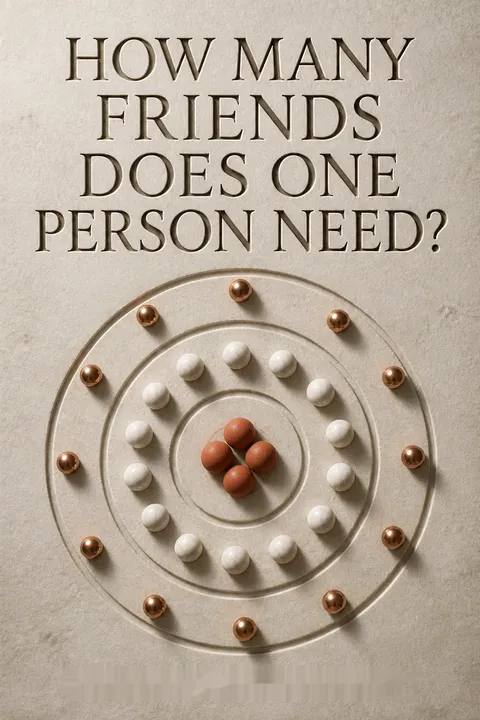
A limit on intimacy. Dunbar's Number is the estimated maximum number of people with whom a person can maintain stable, meaningful relationships. Dunbar derives it by comparing brain size with group size in other primates, then finds similar human group sizes in hunter-gatherer communities, villages, military units, and workplaces. Gore-Tex founder W. L. Gore, for instance, kept factory units near 150 people so that workers could coordinate through personal ties rather than added layers of management.
Circles, not a roster. Human networks form layers, roughly 5, 15, 50, and 150 people, with intimacy and contact frequency declining outwards. Online friend counts can exceed these numbers, but a large contact list does not mean each connection is a close relationship.
What's striking is how the proposed limit connects individual cognition with organizational design. A small workplace can often run on familiarity and mutual obligation; a larger one needs formal systems to carry information and resolve conflict. That is a useful way to think about institutions, not just friendships. The number itself should not be treated as a biological speed limit. Dunbar's evidence combines cross-species correlations with varied human examples, and people differ in social capacity, culture, and circumstances. The durable insight is that relationships require attention, and attention is finite.
Use talk, touch, laughter, and shared ritual to maintain bonds at scale.
Grooming by other means. Among primates, grooming is less about cleaning than about signaling commitment. Human touch can serve a similar role, while language lets people maintain relationships at a distance and exchange information about absent friends and rivals. In one university refectory study, social relationships and personal experiences occupied about 70 percent of conversation time, with much of it devoted to people who were not present.
Shared feeling matters. Laughter and music may help create bonds by triggering endorphin release, the brain's own pain-relieving system. In one experiment, people who laughed together at a comedy video shared money with a stranger as generously as they did with a friend. The book proposes that group singing and ritual can extend this bonding effect beyond one-to-one contact.
These examples make communication look less like a pipeline for facts and more like relationship maintenance. That distinction helps explain why apparently trivial conversation can keep a group socially informed and coordinated. Shared laughter and music also create a common experience without requiring people to agree on a complex argument. The endorphin account is a plausible biological mechanism, but it should not be mistaken for a complete explanation of social trust. People also bond through shared tasks, norms, and histories. The strongest point is that connection is repeatedly made, not merely declared.
Kinship turns a loose crowd into a dependable safety net.
Relationships carry obligations. Dunbar describes Scottish migrants who recruited trusted workers from home communities, including his grandfather, who found work in India through a relative. Kinship and shared community made cooperation more reliable across distance. The Donner Party story offers a stark contrast: during the 1846 trek to California, families were more likely to survive the winter trapped in the Sierra Nevada than people traveling alone.
Kinship can be signaled. Hamilton's Rule describes why relatives may be more willing to help one another: shared ancestry increases the chance that they carry the same genes. Names and accents can also suggest common origins, prompting people to treat strangers as potential kin. Studies described in the book found that shared, especially rare, names increased the likelihood of responding to a request for help.
The chapter's deeper point is that trust often rests on durable obligations rather than warm feelings alone. Kin networks can distribute care, information, and risk across people who expect to remain connected. In modern settings, institutions and chosen communities can provide some of the same reliability without blood ties. There is also a cost: kin-based trust can become nepotism, excluding outsiders regardless of their ability or character. The useful distinction is between valuing dependable ties and assuming that shared ancestry is a fair measure of who deserves opportunity.
Interpret bodily quirks as trade-offs shaped by old environments.
Evolution leaves compromises. Most people worldwide lose the ability to digest fresh milk after weaning. Lactase persistence, the continued production of the milk-digesting enzyme, became common in some populations with dairy-based cultures. In northern regions, lighter skin helps the body make vitamin D in weak sunlight, while darker pigmentation helps protect folate from intense ultraviolet exposure. Neither trait is universally best; each reflects different environmental pressures.
The body is not a perfect design. Upright walking shaped the human pelvis, while later increases in brain size made childbirth more difficult. Dunbar argues that earlier birth helped resolve this conflict, leaving human infants unusually dependent. He also presents morning sickness as a possible defense against foods or infections dangerous to a fetus. That explanation is a hypothesis, not a settled account of every pregnancy.
Evolutionary trade-offs are a powerful antidote to the idea that bodies are engineered for one ideal environment. A trait that helps under one set of conditions can become inconvenient when diet, climate, or social life changes. This perspective also discourages treating a biological explanation as a recommendation: explaining why a trait may have evolved does not make it beneficial in every modern context. The morning-sickness account is especially worth holding lightly. Evolutionary hypotheses can suggest useful questions, but an adaptive story needs evidence that distinguishes it from other explanations.
Treat monogamy as a strategy, not an unbreakable instinct.
Pair bonds are flexible. Long-lasting partnerships can be valuable because mates must coordinate care and share the risks of raising young. Yet monogamy is uncommon among mammals, and even birds that appear to mate for life may have offspring fathered by other males. DNA studies described in the book found that extra-pair fertilization occurs in some supposedly monogamous bird populations. Males may adjust their parental effort according to the chance that offspring are theirs.
Preferences reflect trade-offs. Studies of personal advertisements found broad average differences: men more often emphasized youth and appearance, while women more often sought signs of status or earning potential. Dunbar relates these patterns to unequal reproductive costs, while also describing how people adjust their expectations to their own prospects. Such population patterns do not dictate what any particular person wants.
This account usefully replaces a moralized contrast between faithful and unfaithful with a question about incentives, alternatives, and cooperation. It also clarifies that a pair bond can be emotionally real even when it is not genetically exclusive. The caution is that evolutionary explanations can turn flexible averages into rigid stereotypes if culture, individual preference, and changing economic conditions are ignored. The book's advertisement studies illuminate patterns in their samples, not universal rules for dating. Biology can help explain why certain preferences recur, but it cannot decide what a good relationship should look like.
Scale, not a magical human essence, may explain our social intelligence.
Minds model other minds. Theory of mind is the ability to recognize that another person can hold beliefs different from one's own. Dunbar uses intentionality to describe layers of mental reasoning: understanding what someone believes is simpler than reasoning about what one person believes another person wants someone else to think. He argues that larger frontal lobes support more layers of this social computation.
Stories test the limits. To follow Shakespeare's Othello, an audience must track what Iago wants Othello to believe about Desdemona and Cassio, while also remembering what each character knows. Dunbar suggests that great apes show some mind-reading ability, but do not display the same range as adult humans. On this account, human culture grows from expanding capacities rather than a single mysterious boundary.
The scale model offers an elegant bridge between brain anatomy, social life, and complex storytelling. It also invites a more gradual picture of human uniqueness: capacities may be shared in simpler forms and expanded in humans. The intentionality ladder is best read as a conceptual tool, not a definitive ranking of species or a complete measure of cognition. Animal experiments are difficult to interpret, and performance can depend on the task. Still, the framework directs attention to a crucial skill: representing what others know, believe, and intend.
See ritual as social technology that can unite and polarize.
Morality uses feeling. In the trolley problem, many people will divert a runaway trolley to kill one worker rather than five, but hesitate to push a person onto the tracks to stop it. The outcomes are similar, yet direct physical harm feels different. Dunbar uses this and brain-imaging research to argue that moral judgement draws on emotion and the interpretation of intentions, not only calculation.
Ritual makes belonging tangible. The book proposes that singing, dancing, chanting, and other shared religious practices can release endorphins and strengthen group bonds. Shared belief can reinforce those bonds by giving people common expectations. But the same forces that create solidarity can also intensify hostility toward outsiders, especially when religious identity is joined to political power.
The account connects private moral intuitions with the social value of belonging. Ritual can coordinate attention and emotion, giving a group a felt sense of unity that abstract rules alone may not create. That helps explain religion's social force without treating its beliefs as either foolish or automatically true. The proposed endorphin mechanism is one part of a larger picture: moral norms also depend on learning, institutions, and enforcement. Group cohesion is not inherently benevolent; the same boundary that supports mutual care can justify exclusion or aggression.
Respect evolution's lag before trying to engineer biology.
Intervention changes the contest. DDT and antibiotics once seemed to offer straightforward ways to control pests and infections. Their widespread use also created strong selection for resistant mosquitoes and bacteria. The underlying lesson is not to reject medicine, but to recognize that organisms adapt to the pressures humans impose.
Policies meet evolved preferences. Dunbar describes China's one-child policy as producing an unintended sex imbalance when families used prenatal testing to favor boys. The book reported that, at the time, the sex ratio in the largest cities had reached about 125 boys per 100 girls, well above the usual ratio at birth. This example shows how a policy can interact with cultural preferences and technology in ways its designers did not anticipate.
The chapter is strongest when it treats evolution as a process policy must account for, rather than a force that makes intervention futile. Antibiotic resistance is a clear example of feedback: treatment alters which organisms survive and reproduce. The demographic case likewise shows that rules do not act on blank slates. Yet evolutionary framing should not crowd out ethics, economic incentives, or unequal access to care. Nor should a historical forecast be mistaken for a current measurement. Good policy anticipates adaptation, monitors outcomes, and changes course when evidence shifts.
Protect ecological and cultural diversity before losses become irreversible.
Extinction is often cumulative. Mammoth numbers appear to have fallen as the climate warmed and suitable habitat shrank. A model discussed in the book suggests that when populations became small, even very occasional hunting could push them toward extinction. The same pressure can arise when natural resources are harvested faster than they regenerate. Frankincense trees, for example, produced fewer viable seeds when heavily tapped for sap.
Languages can disappear too. The book noted that hundreds of languages had fewer than one hundred speakers, putting them at risk of vanishing. A language carries history, practical knowledge, and cultural forms such as Gaelic work songs. Protecting a species or language therefore requires more than cataloguing it. Communities need realistic ways to sustain both their livelihoods and their inheritance.
The comparison between biological and linguistic loss is illuminating because both can erase options that cannot simply be rebuilt. The mammoth example also shows why a pressure that seems harmless at high population levels may become decisive after environmental decline. Conservation policy works best when it addresses the conditions that drive overuse, including immediate poverty and market demand, rather than blaming individuals for short-term survival choices. The analogy has limits: languages are maintained through people and institutions, while species depend on ecological processes. Each needs protection designed for its own kind of loss.
Analysis
The book's unifying claim is that human behavior remains constrained by evolutionary history even as culture transforms the world people inhabit. Dunbar makes that claim tangible through a recurring movement between scales: brain size shapes the reach of personal relationships; relationships produce institutions and customs; and those cultural systems meet biological processes that do not adjust on demand. The result is a connected account of friendship, kinship, mating, morality, religion, and ecological change, rather than a single narrow theory of human nature.
Its strength is explanatory range. The same social-bonding lens links grooming to conversation, laughter, music, and ritual, while the social-brain argument connects group size to cognitive limits. The book also resists a simple nature-versus-culture split: genes influence dispositions, but decisions and institutions remain part of the causal story. This makes its examples useful as prompts for asking what a behavior accomplishes, what it costs, and who benefits.
The main limitation follows from the book's form as a collection of popular science essays. Some claims are presented with the confidence of a settled mechanism when the evidence is correlational, contested, or drawn from a particular population. Evolutionary explanations can also become overly neat after the fact: a trait's current usefulness does not establish why it evolved. The book's numerical forecasts and some social-science claims belong to the period in which the essays were written, so they should not be treated as current data without checking newer evidence.
The most productive reading is neither biological fatalism nor the view that culture can erase biology at will. Evolution supplies constraints, tendencies, and trade-offs; history and institutions determine how people live with them. That framework encourages humility about interventions, caution about sweeping claims, and curiosity about how seemingly ordinary behaviors help people manage an intensely social life.
Review Summary
How Many Friends Does One Person Need? received mixed reviews. Many readers found the book's diverse topics on evolutionary psychology interesting, but criticized its lack of coherence and scientific rigor. Some appreciated Dunbar's accessible writing style and intriguing insights, while others felt the content was superficial and poorly supported. The book's title was deemed misleading, as it only briefly addresses Dunbar's Number. Readers noted the author's occasional humor but also pointed out potential biases. Overall, opinions varied widely on the book's value and readability.
People Also Read






Glossary
Dunbar's Number
stable relationship limitThe estimated number of people with whom an individual can maintain stable, meaningful social relationships, proposed by Robin Dunbar at about 150. It is derived partly from the relationship between neocortex size and group size in other primates, and is supported by examples from human communities and organizations. It describes a rough cognitive constraint, not a strict limit on contacts or acquaintances.
Social intelligence hypothesis
brains for social complexityThe hypothesis that primates evolved relatively large brains partly because managing complex social relationships requires substantial cognitive capacity. It is supported by correlations between neocortex size and group size across primate species. Dunbar emphasizes that social life involves tracking relationships and alliances, not merely recognizing individuals or solving practical problems in the physical environment.
Hamilton's Rule
kinship and helpingA principle in evolutionary biology associated with W. D. Hamilton. It predicts that helping behavior is more likely when the benefit to a relative, adjusted for how closely related the individuals are, outweighs the cost to the helper. Dunbar uses the principle to explain why shared ancestry can make relatives more likely to assist one another, while noting that kinship cues can also be inferred from names or community markers.
Genomic imprinting
parent-specific gene silencingA process in which the activity of certain genes depends on whether they were inherited from the mother or the father. One parental copy may be switched off, or silenced, while the other remains active. Dunbar discusses research in rats that associated maternal and paternal chromosomes with different aspects of brain development, while noting that the mechanisms and implications were not fully understood.
Theory of mind
understanding others' beliefsThe capacity to recognize that another individual has beliefs, knowledge, or intentions that may differ from one's own. In the book's account, children acquire this ability around four or five years of age, enabling more sophisticated deception, interpretation, and social interaction. Evidence for comparable abilities in other primates is presented as suggestive but not conclusive.
Intentionality
layers of mental reasoningDunbar's term for the levels of reasoning involved in representing mental states. First-order intentionality concerns one's own thoughts, while higher orders involve thoughts about what another person believes, wants, or intends. He uses these levels to compare social cognition across species and to explain the complexity required for fiction, religion, and other forms of human culture.
Major histocompatibility complex
immune-system gene groupA cluster of genes involved in the immune system's ability to recognize foreign substances. Dunbar describes these genes as variable among individuals and links them to natural body odor. He presents research suggesting that people may prefer partners with complementary immune-related gene variants, potentially giving their offspring a broader range of immune responses.
Endorphins
the brain's pain relieversA family of chemicals produced within the body that act on the nervous system to reduce pain. Dunbar describes their release during activities such as grooming, laughter, exercise, music, and religious ritual. He proposes that the resulting feeling of wellbeing may help reinforce social bonds, while treating this as a biological mechanism rather than a complete explanation of attachment or cooperation.
About the Author



Download PDF
Download EPUB
.epub digital book format is ideal for reading ebooks on phones, tablets, and e-readers.








