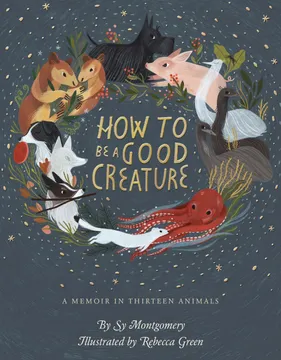


Key Takeaways
Become a good creature by letting other species revise your idea of life
Molly was the first teacher. As a child, Sy Montgomery watched her Scottish terrier chase rabbits, hear things people could not, and follow her own instincts. Montgomery wanted to be like Molly: not merely to own a dog, but to learn how a dog experienced the world. Animals perceive things humans cannot: a spider senses through its feet, and a dog hears sounds beyond our range. Those differences are not defects or curiosities. They reveal that human experience is only one way of being alive.
A wider view of life. The memoir’s central idea is that attention to animals can unsettle human assumptions about intelligence, independence, courage, and affection. Molly teaches Montgomery that another species can be a guide, not a lesser version of a person. Being a good creature means approaching the living world with humility and a willingness to learn.
The book’s opening move is more than a plea for animal affection. It treats perception as a source of knowledge: a dog’s hearing or a spider’s sensory world can expose how much human understanding leaves out. This aligns with embodied cognition, the idea that minds are shaped by the bodies and environments that make perception possible. The useful caution is that difference does not automatically mean wisdom, and an animal’s behavior can be misread. Respect begins not with pretending to know what another species feels, but with accepting that human senses and interpretations have limits.
Stay present long enough for observation to become relationship
The emus changed the question. At twenty-six, Montgomery left journalism for fieldwork in Australia. She first studied whether emus spread seeds by examining their droppings, which she nicknamed emu pies. Then she began recording the daily behavior of three young birds: Black Head, Bald Throat, and Knackered Leg. No one had published a behavioral study of a wild emu group, so their ordinary activities became new information.
Trust took time. At first, the emus ran when Montgomery tried to approach unseen. Inspired by Jane Goodall’s openness with chimpanzees, she stopped hiding and wore the same clothes, so the birds could recognize her. Eventually she could watch from a few feet away. She learned that doing the research mattered, but being with the birds mattered more. Her science depended on patience, repetition, and care.
This episode makes field observation feel both rigorous and relational. A behavioral checklist and repeated measurements keep attention from becoming pure projection, while a familiar, nonthreatening presence allows the observed animals to act less defensively. That tension appears across field sciences: the observer must reduce disturbance without imagining they have become invisible. The emus’ growing tolerance does not prove they felt friendship in a human sense. It does show why sustained observation can reveal far more than a hurried encounter, and why emotional investment need not cancel careful method.
Let a creature’s own nature turn strangers into family
A runt became a center. Christopher Hogwood arrived as a sickly piglet, small enough to fit in a shoebox. Montgomery and her husband, Howard, had never raised a pig, but warmth, food, and attention helped him thrive. Chris communicated through distinct grunts, loved company, and repeatedly escaped his pen to visit neighbors. His personality gave people an easy reason to meet.
Affection spread outward. Neighbors brought food, stayed to watch Chris eat, and became friends. Two girls next door began visiting daily, and their household gradually joined Montgomery and Howard’s. Their hens started crossing the property line too, as if the animals recognized the new social unit. Chris did not make the family by resembling a human child or fitting a plan. His piggish appetites, friendliness, and delight in company drew people together.
Chris’s story gives family a practical, observable form: repeated visits, shared food, care, and reliable pleasure in one another’s company. This resembles the social infrastructure studied in community psychology, where small, recurring interactions build trust more effectively than abstract declarations of belonging. The animal is not simply a symbol for human connection; his own preferences help create it. Still, the memoir’s unusually welcoming neighborhood is not a universal template. Shared care requires time, resources, and willing participants, conditions that are unevenly available.
Meet feared creatures at their scale before deciding what they are
A spider became an individual. In French Guiana, Montgomery met Clarabelle, a pinktoe tarantula. She had grown up hearing frightening stories about spiders, but when Clarabelle stepped onto her hand, Montgomery noticed a small animal moving carefully across her skin. The encounter did not make the spider harmless: tarantulas can defend themselves, and some of their hairs irritate human skin. It did make her more than a frightening category.
Fear softened in company. Clarabelle’s calm handling encouraged the expedition team to introduce her to local children. Even a girl who said she feared spiders eventually held her. The children could look closely and respond to the particular creature before them. Montgomery also learned about the tarantula’s silk, grooming, and ability to shed its outer skeleton as it grows. Attention replaced a stock image with curiosity.
The scene shows how direct contact can correct an exaggerated category, but it should not be mistaken for a general prescription to handle wildlife. Safe, informed encounters matter, and fear can be protective when an animal is genuinely dangerous or the setting is uncontrolled. The deeper lesson is cognitive: familiarity can make a feared being legible without erasing risk. In psychology, this resembles exposure, where gradual contact can reduce an outsized fear response. The ethical version adds an important condition: the animal’s welfare, not only the human’s discovery, must guide the encounter.
A predator’s violence can reveal life without making it evil
A hen’s death brought a weasel close. On Christmas morning, Montgomery found a beloved hen killed in the coop. The small white ermine responsible appeared from the hole where it had seized its prey. Rather than feeling rage, she was struck by the animal’s boldness and the force of its hunger. An ermine needs frequent meals to survive, especially in winter. Its killing was not cruelty aimed at her; it was the work of a predator meeting its needs.
The sight changed a family memory. The ermine’s fierce presence reminded Montgomery of her mother, a determined woman who had overcome poverty and limited expectations to build an accomplished life. Her mother’s ferocity, once difficult to understand, now looked like a form of survival. The encounter did not make the loss of the hen painless. It widened Montgomery’s view enough to hold grief, admiration, and awe together.
This is a useful distinction between moral judgment and ecological understanding. Recognizing that a predator is not evil does not require dismissing the loss of a beloved animal; both the hen’s value and the ermine’s need can be real. The comparison to Montgomery’s mother is emotionally powerful because it reframes fierceness as an adaptation to difficult conditions. It also carries a limit: animal behavior and human choices are not interchangeable, and an ecological explanation cannot excuse human harm. The scene works best as an exercise in holding competing truths, not flattening them.
Care becomes reciprocal when age takes away old abilities
Tess once led the way. A border collie adopted after years of hardship, Tess was athletic, alert, and exceptionally attuned to Montgomery and Howard. On dark nights she could find a thrown Frisbee Montgomery could not see, then place it in her hands. She also anticipated which trail to take and checked that her human companions were keeping up.
The roles reversed. In old age Tess lost her hearing, her sight, and eventually much of her mobility. Montgomery first grieved the lost hikes and games, then realized that Tess herself still enjoyed company, food, and life. The dog who had once guided her through darkness came to rely on her human’s touch and scent. Care shifted from receiving Tess’s abilities to helping her navigate without them. Their bond endured, but its daily shape changed.
Tess’s aging offers a vivid account of care as a relationship that changes direction without becoming less intimate. Disability studies often distinguish impairment from the loss imposed by an environment that no longer accommodates someone. Montgomery cannot restore Tess’s senses, but she can change how they move together. The story also resists a common projection: a human may mourn an animal’s lost abilities more than the animal appears to. That does not make the grief false; it does remind caregivers to attend to the dependent being’s present comfort, rather than treating the past as the only worthwhile life.
Treat grief as an emergency, not a test of gratitude
Loss became dangerous. After Christopher and Tess died, Montgomery entered a severe depression. The work and relationships that once sustained her felt inaccessible, and she made a private plan to end her life. She kept going through obligations, including a research trip to Papua New Guinea. The memoir describes this despair without presenting it as a failure of love or gratitude.
The forest gave her a next step. The demanding expedition followed researchers tracking endangered Matschie’s tree kangaroos. Montgomery carried some of Tess’s ashes, and when two captured kangaroos were named Christopher and Tess, the names became a way to remember her lost companions while encountering new, living animals. Releasing the kangaroos back into the forest gave the trip emotional meaning. It did not erase the deaths; it helped her move through the day in front of her.
The memoir captures how grief can narrow a person’s sense of the future until ordinary blessings no longer feel available. A meaningful task and the company of others can provide structure, but neither should be treated as a substitute for mental health care. Suicidal thinking is a crisis, not a private character test; professional support and immediate help can be lifesaving. The expedition’s role is therefore best understood as one source of connection and purpose within a dangerous period, not as a cure or a model that every grieving person should be expected to reproduce.
Play can build trust across an evolutionary gulf, without proving sameness
Octavia made contact on her terms. At the New England Aquarium, the giant Pacific octopus first ignored Montgomery, then grabbed her arms as she offered food. Octavia later reached for visitors, explored a bucket, and seemed to enjoy handling objects and interacting with people. Octopuses have many neurons in their arms, and their suckers can both grip and taste. Their intelligence is striking partly because their bodies and evolutionary history are so unlike ours.
Connection still has limits. When Octavia laid eggs, she stopped playing and devoted herself to tending them. Montgomery watched her clean, fluff, and protect the eggs, including eggs that could not hatch. Near death, Octavia still came to the people she knew and touched them briefly. Montgomery could not know exactly what Octavia understood or felt. She could, however, recognize that the animal’s behavior warranted attention and respect.
Octavia’s story makes a strong case against assuming that unfamiliar nervous systems are empty of experience. Comparative cognition asks what an animal can do and what its body makes possible, rather than measuring every mind against human abilities. At the same time, interpreting a color change or a touch as happiness remains an inference, not direct access to the animal’s inner life. The book’s most defensible position is both generous and cautious: take signs of agency seriously, while acknowledging uncertainty. That balance is more rigorous than either automatic anthropomorphism or automatic dismissal.
Let new love be itself, not a substitute for the dead
Sally was not Tess. After Tess’s death, Montgomery dreamed that Tess led her toward a new border collie. The dog, Sally, had been neglected and had lost most of her puppies in a cold basement. She was affectionate, exuberant, messy, and far less focused than Tess. At first her habits caused chaos: she stole food, rolled in unpleasant things, and seemed to know no commands. Training helped, but her personality remained her own.
Love did not require resemblance. Sally became a beloved companion, not a replacement for Tess or Christopher. Montgomery suggests that earlier attachments had enlarged her ability to love another animal. The relationship also gave Sally a safer home after a difficult beginning. Their bond was not made meaningful by erasing the past. Remembering Tess could coexist with enjoying Sally’s very different company.
The story avoids the idea that loyalty to someone who died requires emotional exclusivity. Grief research describes continuing bonds: people may preserve a relationship through memory while forming new attachments. That framework fits Montgomery’s experience without requiring the dream to be taken as supernatural evidence. Sally’s own history also matters. Her difficulties are not merely comic quirks; they reflect a dog who had been poorly cared for and needed patience. New love can open space in a life, but it does not retroactively make loss smaller or guarantee that every adoption will unfold this way.
Make room for the imperfect pup your plans would have ruled out
Thurber arrived unexpectedly. After Sally died, Montgomery again felt profound despair. Her veterinarian mentioned a puppy from a breeder whose working dogs were not usually sold as pets. One male had a blind eye, making him a poor candidate for herding work. Montgomery and Howard had not planned to get a puppy, and imagined a different dog. They went to see him anyway.
A limitation was not a verdict. They named him Thurber, after the writer James Thurber, who also had one functioning eye. The puppy proved energetic, sociable, playful, and able to enjoy a full life. His arrival did not undo the loss of Sally. It gave Montgomery something new to care for, at a moment when her work calendar left room to raise him. The memoir closes on a modest truth: a future that looks settled can still surprise.
Thurber’s story challenges the reflex to treat a difference as a complete account of what an animal can do. A blind eye excluded him from one demanding job, but it did not define his capacity for play, companionship, or learning in a home. This resembles a broader principle in disability thinking: ability depends partly on the task and environment, not on a single measure of normality. Still, the story’s happy outcome is not proof that every unexpected adoption is right. Openness works best when paired with honest assessment of the animal’s needs and the caregiver’s capacity.
Analysis
How to Be a Good Creature is a memoir organized by encounters, not by a single self-help formula. Each animal brings Montgomery into a different kind of learning: Molly draws her toward animal perception; the emus teach sustained observation; Christopher builds a human and animal community; Clarabelle and Octavia test how far curiosity can reach across species difference; and Tess, Sally, and Thurber shape her understanding of care, grief, and renewal. The changing scale, from a hand-sized spider to a many-hundred-pound pig to a wild tree kangaroo, keeps the argument embodied rather than abstract.
The book’s strongest claim is also its most delicate one: emotional attention can sharpen understanding, but it cannot grant transparent access to another mind. Montgomery’s fieldwork offers a useful counterweight to sentiment. She records behavior, distinguishes individual animals, and acknowledges when she cannot know what an animal experiences. At times, however, interpretations such as reading an octopus’s coloration as happiness move from observation toward inference. That uncertainty does not invalidate the bond; it clarifies what responsible affection requires. An animal can deserve moral consideration even when its inner life remains partly unknowable.
The memoir’s family stories further complicate its portrait of love. Animals do not simply compensate for painful human relationships. They make distinct relationships possible, sometimes drawing neighbors and children into shared routines. The book is careful to show that animals are not interchangeable: Sally is not Tess, and a new attachment does not cancel bereavement. That distinction gives the closing hope credibility. Thurber does not repair the past; he joins a life already shaped by it.
The book is not a universal guide to animal behavior or a clinical account of depression. Its insights emerge from one writer’s unusually close companionship, scientific work, faith, and willingness to travel. Its broader invitation is nevertheless clear: meet other forms of life with curiosity, pay attention to the individual before the category, and remain honest about what cannot be known. In that sense, becoming a good creature is less about mastering a lesson than practicing a better kind of attention.
People Also Read

Glossary
emu pies
Emu droppingsMontgomery’s playful name for the droppings she collected while studying wild emus in Australia. The droppings contained seeds, which she identified and tested to investigate whether seeds passed through an emu’s digestive system germinated more quickly. The nickname makes a field sample memorable, while the work behind it was a practical ecological study.
Strong Eye
A herding stareA term used in the book for the intense gaze border collies use to influence the movement of animals they herd. The stare is part of a working dog’s skill, not simply an expression of attention. The passage about Thurber notes that a dog with impaired sight may be poorly suited to herding, a job that relies heavily on visual control.
Matschie’s tree kangaroo
An endangered New Guinea marsupialA tree-dwelling kangaroo native to the cloud forests of Papua New Guinea’s Huon Peninsula. In the memoir, researchers locate, capture, radio-collar, release, and track these animals to learn about their range and needs. That information can guide efforts to protect the forest habitat on which the species depends.
Pig Spa
A warm-water pig bathThe name the neighborhood children gave to bathing Christopher Hogwood, Montgomery’s pet pig. They washed him with warm water and grooming products, and Christopher appeared to enjoy the attention when the water was comfortable. The activity became a shared neighborhood ritual, showing how caring for one animal created play and connection among children and adults.
Download PDF
Download EPUB
.epub digital book format is ideal for reading ebooks on phones, tablets, and e-readers.








