

Key Takeaways
Move toward the feared situation before confidence shows up
Ellis tested his own advice. As a teenager, he avoided public speaking and approaching women because he feared failure and rejection. At nineteen, he began arranging a speech every week for ten weeks, giving each one despite intense discomfort. His physical symptoms eased as he learned that a poor talk would be unpleasant, not ruinous.
Rejection became practice. That summer he approached 130 women in a park. Thirty left immediately; he spoke with the remaining hundred and got one date, which never happened. Yet the repeated approaches stripped rejection of its imagined power. Ellis’s point is not that exposure guarantees success. It is that repeated contact can teach the mind and body that discomfort and rejection are survivable.
The story’s force comes from separating success at the task from success at getting the desired outcome. Ellis did not win a date, but he did reduce avoidance and learn that rejection was tolerable. That resembles exposure-based learning: a feared prediction is tested against experience, rather than merely argued with in the abstract. The method is demanding, and not every person should reproduce the same exercise or pace. The useful principle is to choose a safe, relevant step that tests the fear, then repeat it long enough to learn from what actually happens.
Protective concern helps; panic can make danger harder to handle
Anxiety has a useful job. Concern alerts a person to possible loss or danger and can prompt preparation: watch traffic, seek help, or look for another job. Ellis distinguishes this useful caution from unhealthy anxiety, which he describes as an exaggerated alarm that disrupts action.
Intensity can reverse the benefit. Someone crossing a street may watch carefully when concerned, but panic can lead to freezing, rushing blindly, or refusing to cross at all. A worker who fears losing a job might plan, speak with a supervisor, or seek alternatives. In a panic, that same worker might quit impulsively or become too distracted to act effectively. The aim is not to eliminate every negative feeling. It is to reduce panic while retaining concern.
This distinction avoids treating calmness as the only healthy state. Emotion can carry information and mobilize action, while excessive arousal can narrow attention and impair judgment. That is consistent with broader work on stress and performance, where effects depend on intensity, context, and the demands of the task. The practical question is not simply whether anxiety is present, but whether it is helping someone respond to a real risk. A key limitation is that the line between useful alarm and disabling panic is personal and situation-dependent, not a universal threshold.
An event starts the story; your belief shapes the emotional ending
REBT looks for the middle link. Rational Emotive Behavior Therapy, or REBT, is Ellis’s approach to changing distress by examining beliefs and behavior as well as circumstances. Its ABC model distinguishes an adversity, the beliefs about it, and the emotional or behavioral consequences. Ellis adds disputing those beliefs and developing more effective ones.
The job interview example shows why. A rejected applicant might conclude that the interview went badly because stronger candidates were chosen, then feel disappointed and apply elsewhere. Another might decide that rejection proves personal worthlessness and predicts permanent failure, then become anxious and stop applying. The event matters, but it does not dictate a single emotional response. The beliefs that interpret it help shape both feelings and next actions.
This model gives people a usable point of intervention without pretending they control every event. It also resembles cognitive appraisal theories, which examine how a person interprets a situation before responding emotionally. The framework is especially useful when the same setback repeatedly triggers the same reaction. Still, beliefs are not the only influence: physiology, past learning, trauma, and material circumstances can all affect emotion and behavior. The model is strongest as a way to find one changeable influence, not as a claim that people simply choose every feeling.
Turn absolute demands into strong preferences before they become panic
A wish becomes a trap when it becomes a law. Ellis argues that people often turn desires for achievement, approval, or comfortable conditions into unconditional demands. He calls this pattern musturbation. The demands can target oneself, other people, or the world: one must succeed, others must behave fairly, and circumstances must go one’s way.
Demands breed further distortions. A person who believes failure must never happen may treat it as proof of personal inadequacy, an unbearable catastrophe, or evidence that failure will continue forever. Ellis recommends keeping the desire while removing the supposed necessity. Wanting approval can motivate effort; believing approval is essential to personal worth can make every uncertain response feel threatening.
The distinction between preference and necessity is a compact way to expose perfectionistic thinking. It preserves motivation while loosening the link between an outcome and a person’s entire identity. In practical terms, a preference leaves room for planning, disappointment, and adaptation; an absolute demand can make alternatives feel impossible. The approach should not be confused with passive acceptance of injustice or with lowering every ambition. A person can insist on fair treatment in action and still recognize that demanding fairness as a guaranteed fact of life may intensify distress.
Test anxious beliefs against evidence, logic, and their real-world payoff
Dispute the belief from three angles. Ellis recommends checking whether a fear fits the facts, whether its conclusion follows logically, and whether holding it helps in practice. For example, if a loved person seems indifferent, ask what evidence shows they must return affection. Then ask whether wanting love logically obliges another person to provide it. Finally, ask what insisting on that rule does to one’s daily life.
Use the same test on self-judgments. A poor presentation may be regrettable, but it does not prove that the speaker is worthless or will always fail. A realistic alternative acknowledges the setback, allows disappointment, and leaves room to learn and try again. Repeating this inquiry matters because familiar beliefs can remain emotionally persuasive even after they have been challenged once.
The three tests combine empirical checking, logical analysis, and pragmatic evaluation. Together they are more robust than forced optimism: the goal is not to claim that everything will go well, but to ask whether a rigid conclusion is warranted and useful. This method also resembles scientific reasoning, where hypotheses are examined rather than treated as facts. A caution: anxious thinking is not always a neat verbal argument that can be disproved in a moment. Repeated practice, behavioral experiments, or professional support may be needed, especially when distress is intense.
Avoidance shrinks life and teaches fear to keep its authority
Relief today can cost freedom tomorrow. Ellis describes avoidance as a short-term escape that can reinforce the belief that the feared situation is dangerous. In vivo desensitization means gradually facing a feared situation in real life so that experience can challenge the fear. A person afraid of elevators might ride them repeatedly and discover that the predicted catastrophe does not occur.
Mal rebuilt his commute one stop at a time. He had avoided the subway for years after a train once stopped between stations and he panicked. With support, he began riding one stop, then increased the distance over time. After months of practice, he could commute by subway and Path train. Ellis also describes Frances, who completed her own term papers when her boyfriend stopped finishing them for her.
These cases show how action can provide evidence that reasoning alone cannot supply. Contemporary exposure approaches similarly emphasize approaching feared situations and learning that distress can be tolerated, rather than waiting to feel fearless first. The book allows both gradual and faster exposure, but pace should fit the person, the feared situation, and the level of risk. Exposure is not a command to enter genuinely dangerous situations or endure abuse. For severe symptoms, trauma-related fear, or uncertainty about safety, a qualified clinician can help plan it responsibly.
Rate actions, not entire people, including yourself
A mistake is not a total identity. Unconditional self-acceptance, or USA, means accepting oneself as a fallible person while still evaluating and improving specific behavior. Ellis argues that tying personal worth to achievement or approval creates fragile self-esteem: success may feel temporary, and rejection can seem like a verdict on the whole self.
Apply the same distinction to others. Unconditional other-acceptance, or UOA, means judging conduct without reducing a whole person to that conduct. Ellis illustrates this through Martin, a physically confident bodyguard who condemned a rival for intimidation. When Martin stopped treating the rival as wholly rotten and objected instead to the harmful behavior, he was able to speak with him more calmly. The point is not to excuse wrongdoing, but to criticize it without global condemnation.
Separating a person from a behavior supports accountability without making shame the engine of change. It also has a practical interpersonal benefit: specific criticism gives someone something to address, while total condemnation often invites defensiveness or retaliation. This is close to approaches that distinguish self-compassion from self-excuse. The distinction can be difficult in cases of serious harm, and acceptance does not require trust, reconciliation, or abandoning boundaries. It means resisting the claim that one act, or even many acts, captures the entirety of a human being.
Rehearse healthier feelings with tools that engage thought, emotion, and action
Insight alone may not change a habit. Ellis combines cognitive, emotional, and behavioral practice. Rational emotive imagery asks a person to imagine a feared setback, notice the unhealthy feeling it triggers, and then practice changing that response into a healthier feeling such as regret or concern. Ellis describes a physician who rehearsed responding to a mistaken diagnosis with disappointment and corrective action rather than panic and self-condemnation.
Different tools fit different moments. Rational coping statements can reinforce a more balanced belief; visualization can rehearse a difficult presentation; humor can puncture exaggerated fears; and relaxation or distraction can offer temporary relief. Modeling, role-play, teaching the ideas to someone else, rewards, and penalties can support action. Ellis cautions that distraction alone does not usually change the beliefs driving recurring anxiety.
The variety reflects a useful principle from behavior change: understanding, emotional practice, and real-world action can reinforce one another. Imagery can make a feared situation feel more immediate than abstract reasoning, while role-play allows rehearsal before a consequential encounter. Humor may create distance without denying genuine stakes. These techniques are not interchangeable, and none is guaranteed to work for every person. Relaxation can reduce arousal, but using it only to escape every uncomfortable feeling may preserve avoidance. The most suitable tool is the one that helps a person approach life more effectively.
Work the solvable problem without demanding a flawless answer
Separate practical obstacles from emotional demands. Anxiety can make a problem feel unsolvable, especially when someone insists on a quick, complete, or perfect answer. Ellis recommends defining the problem, generating alternatives, comparing their likely advantages and disadvantages, testing a promising option, and revising it in light of results. Manny, a successful business owner, learned to apply his practical decision-making habits to personal choices he had treated as tests of his worth.
Check the cost of avoidance. A cost-benefit analysis can compare the short discomfort of confronting a fear with the continuing restrictions of avoiding it. Reframing can also correct exaggeration: Ellis contrasts fear of flying with the book’s reported annual figures of fewer than 300 deaths in plane crashes and 40,000 in car accidents. The aim is perspective, not denial of risk.
This pairing is valuable because emotional regulation should not replace practical problem-solving. A person facing a real job, financial, or relationship difficulty may need both a less catastrophic interpretation and a concrete plan. Iterative problem-solving also fits uncertain environments better than searching for one perfect decision. The statistics in the book are period-specific and should not be used as current safety comparisons without updated data. More broadly, reappraisal can correct inflated risk, but it should never override credible evidence of danger or substitute for protective action.
Treat anxiety as psychological and biological, not a personal failure
The body is part of the picture. Ellis recognizes that anxiety can involve inherited vulnerability, brain and nervous system activity, physical health, and life events. He argues that beliefs and learned responses can still be worth addressing, even when biology contributes. If self-help efforts make little difference, he recommends consulting a physician or mental health professional and considering medication under medical supervision.
Do not make treatment a test of character. Medication may help some people, but Ellis warns against self-medicating, particularly with tranquilizers or substances such as alcohol. He also advises against relying on medication as the only source of help. Severe anxiety, persistent impairment, or possible physical causes warrant professional assessment; therapy and medically guided treatment may be used together.
This qualification matters because an agency-focused model can otherwise sound like blame: if beliefs shape emotion, a reader may conclude that continued anxiety reflects weak effort. A more accurate reading is that beliefs are one potential leverage point, not the whole causal story. Biology, trauma, health, and stressful environments can change what self-help can accomplish. The book’s recommendation to seek medical or therapeutic care helps guard against simplistic self-reliance. Self-management is useful, but appropriate treatment is not evidence of failure or a substitute for careful assessment.
Analysis
The book’s most durable contribution is its attempt to preserve agency without requiring positive thinking. Ellis does not ask readers to believe that setbacks are harmless, that other people will behave well, or that life will eventually reward them. He asks them to distinguish a painful preference from an absolute demand, then test the demand through evidence, logic, and its consequences. That move is psychologically practical: it protects ambition while loosening the belief that success, approval, or comfort must arrive for life to remain worthwhile.
The book also treats change as practice, not merely insight. Ellis’s own public-speaking and social experiments supply the narrative proof of concept, while his clients illustrate different routes: exposure, rehearsed imagery, problem-solving, humor, and acceptance. The broad toolkit is a strength because anxiety is not one uniform experience. Yet the sheer number of methods can obscure a priority order. A reader may do better to identify one recurring fear, one rigid belief, and one safe behavioral test than to attempt every technique at once.
A careful modern reading must also resist turning responsibility into blame. The claim that beliefs shape emotional responses can be empowering, but feelings are influenced by bodily vulnerability, trauma, and circumstances beyond individual control. Ellis acknowledges these factors and supports professional care, though his forceful language sometimes gives personal choice the spotlight. His model is best understood as an invitation to work on what may be changeable, not a claim that anxiety is freely chosen. The enduring lesson is both demanding and humane: keep realistic caution, question catastrophic certainty, and take action while uncomfortable, without making either success or failure a verdict on human worth.
Review Summary
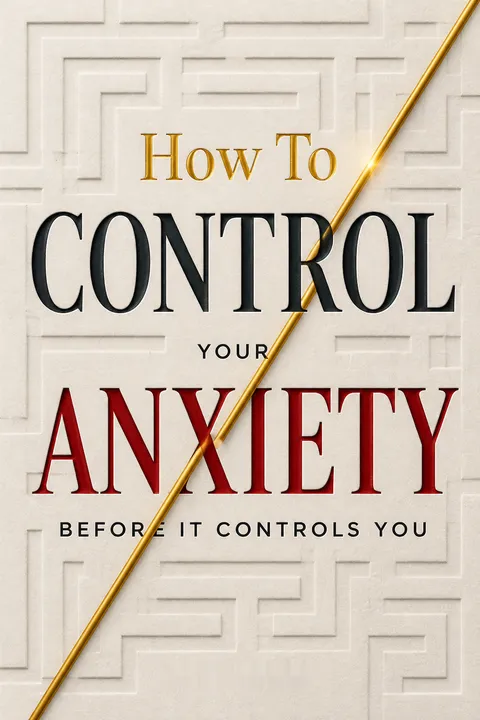
How To Control Your Anxiety Before It Controls You receives mixed reviews. Many find it helpful for understanding REBT and anxiety management, praising its practical advice and humor. However, some criticize its repetitiveness and dry writing style. Readers appreciate Ellis's pragmatic approach but note it may not suit everyone. The book is seen as more theoretical than a typical self-help guide. Some readers find it life-changing, while others feel it lacks depth or fails to address limitations. Overall, it's considered a good introduction to REBT and anxiety management techniques.
People Also Read





Glossary
Rational Emotive Behavior Therapy (REBT)
Belief-focused behavior therapyA psychotherapy developed by Albert Ellis that examines how beliefs about adversity influence emotional and behavioral responses. REBT aims to identify rigid, self-defeating beliefs, challenge them, and replace them with more flexible beliefs. It combines cognitive, emotional, and behavioral methods, including practicing new responses in situations that provoke anxiety.
ABCs of REBT
Adversity, belief, consequenceA model for examining emotional reactions. An activating event or adversity is followed by beliefs about what happened, which contribute to emotional and behavioral consequences. REBT extends the model by disputing irrational beliefs and developing more effective beliefs and responses. The model emphasizes that an event matters, but does not by itself determine one uniform emotional outcome.
musturbation
Rigid demands that fuel distressEllis’s term for turning preferences into absolute demands. These demands may be directed at oneself, other people, or the world, such as insisting that one must succeed, others must treat one fairly, or circumstances must be comfortable. REBT links such rigid expectations to anxiety and other forms of emotional disturbance, and recommends replacing them with strong but flexible preferences.
Unconditional self-acceptance (USA)
Accepting oneself beyond performanceThe REBT principle of accepting oneself as a fallible human being without assigning one global value based on achievements, mistakes, or other people’s approval. It does not mean approving of every behavior. A person can evaluate conduct against chosen goals, take responsibility for harmful actions, and work to change them without treating a failure as proof of being worthless.
Unconditional other-acceptance (UOA)
Accepting people, evaluating behaviorThe practice of judging another person’s actions without reducing that person’s entire identity to those actions. UOA does not require approving of misconduct or tolerating harm. It allows criticism, boundaries, and efforts to change a situation while avoiding the conclusion that a person’s errors make them wholly bad or beyond understanding.
Rational emotive imagery
Imagery rehearsal for emotional changeAn REBT exercise in which a person imagines a feared or distressing event, notices the unhealthy emotion it evokes, and practices shifting toward a healthier negative emotion, such as disappointment or regret. The exercise uses revised beliefs during the imagined situation, with repetition intended to make the healthier emotional response more accessible.
in vivo desensitization
Real-life practice with feared situationsA behavioral method of confronting a feared situation in real life rather than only imagining it. The person approaches the situation, sometimes in gradual steps, and remains in contact with it long enough to learn from the experience. In Ellis’s account, this practice can challenge exaggerated predictions and reduce avoidance, though it should be adapted to actual safety and individual needs.
FAQ
1. What is "How To Control Your Anxiety Before It Controls You" by Albert Ellis about?
- Comprehensive anxiety guide: The book introduces Rational Emotive Behavior Therapy (REBT) as a practical, evidence-based approach to understanding and managing anxiety.
- Self-created anxiety focus: Ellis emphasizes that most anxiety is self-generated through irrational beliefs and can be reduced by changing these beliefs and behaviors.
- Practical tools and examples: The book combines theory, real-life case studies, and actionable exercises to help readers become their own therapists and control anxiety before it controls them.
2. Why should I read "How To Control Your Anxiety Before It Controls You" by Albert Ellis?
- Evidence-based methods: The book is grounded in REBT, a clinically tested and widely respected form of cognitive-behavioral therapy proven effective for anxiety.
- Empowering self-help strategies: Readers learn to identify, dispute, and replace irrational beliefs, fostering independence from anxiety and reducing reliance on medication or therapists.
- Broad applicability: Ellis addresses various types of anxiety, from social and performance anxiety to panic and phobias, making the book relevant for a wide audience.
3. What are the key takeaways from "How To Control Your Anxiety Before It Controls You" by Albert Ellis?
- Irrational beliefs drive anxiety: Most unhealthy anxiety stems from rigid, absolutistic demands and catastrophic thinking, not external events.
- REBT techniques are effective: Disputing irrational beliefs, using rational coping statements, and practicing unconditional self-acceptance are central to anxiety reduction.
- Behavioral and emotive methods: Techniques like shame-attacking exercises, exposure therapy, and humor are practical tools for confronting and diminishing anxiety.
4. What are the main concepts of Rational Emotive Behavior Therapy (REBT) as presented in "How To Control Your Anxiety Before It Controls You"?
- ABC Model: Ellis explains that Adversity (A) leads to Beliefs (B), which then cause emotional Consequences (C); changing beliefs changes emotional outcomes.
- Irrational vs. rational beliefs: REBT focuses on identifying and disputing irrational "musts," "shoulds," and "oughts," replacing them with rational preferences.
- Unconditional acceptance: The method emphasizes unconditional self-acceptance (USA) and unconditional other-acceptance (UOA) as foundations for emotional health.
5. How does Albert Ellis explain the creation of anxiety in "How To Control Your Anxiety Before It Controls You"?
- Self-created anxiety: Most anxiety is not caused by external events but by the irrational beliefs individuals hold about those events.
- Musturbation: Ellis identifies "musts" or absolutistic demands (e.g., "I must not fail") as the core irrational beliefs fueling anxiety.
- Belief consequences: Depending on whether beliefs are rational or irrational, individuals experience healthy concern or unhealthy panic and depression.
6. What are the main irrational beliefs that cause anxiety according to Albert Ellis?
- Three major musts: (1) Musts about oneself ("I must be perfect"), (2) musts about others ("Others must treat me fairly"), and (3) musts about the world ("The world must be easy and fair").
- Corollary beliefs: These include self-downing, awfulizing, and intolerance of discomfort, which intensify anxiety.
- Cognitive distortions: Overgeneralization and black-and-white thinking further contribute to irrational fears and heightened anxiety.
7. How can I use Albert Ellis’s REBT methods to dispute and change anxiety-creating irrational beliefs?
- Disputing techniques: Question the evidence, logic, and usefulness of absolutistic demands to weaken their influence.
- Three disputing methods: Use realistic (fact-checking), logical (reasoning), and pragmatic (practical consequences) approaches to transform beliefs.
- Structured exercises: REBT Self-Help Forms guide individuals through identifying events, beliefs, consequences, and developing new rational philosophies.
8. What are rational coping self-statements in "How To Control Your Anxiety Before It Controls You" and how do they help?
- Definition and purpose: Rational coping self-statements are positive, realistic affirmations that counter irrational beliefs and promote healthy thinking.
- Examples: Replace "I must do perfectly or I’m worthless" with "I prefer to do well, but I can accept imperfection and still be okay."
- Practice and effect: Repeating these statements helps internalize rational beliefs, reducing anxiety and improving performance.
9. How does Albert Ellis recommend using shame-attacking exercises and exposure therapy to reduce anxiety?
- Shame-attacking exercises: Deliberately perform socially awkward acts to reduce fear of embarrassment and shame, lowering social anxiety.
- Exposure therapy: Gradually or rapidly face feared situations to learn that outcomes are manageable, reducing avoidance and panic.
- Combined with disputing: These behavioral methods are most effective when paired with disputing irrational beliefs and increasing frustration tolerance.
10. What role does unconditional self-acceptance (USA) play in controlling anxiety in "How To Control Your Anxiety Before It Controls You"?
- Separating self-worth from performance: USA means accepting oneself regardless of successes, failures, or others’ approval, reducing ego-anxiety.
- Avoiding global self-rating: Ellis advises against labeling oneself as "good" or "bad" based on behavior, promoting self-improvement without self-condemnation.
- Foundation for resilience: USA helps individuals face setbacks with emotional strength, reducing anxiety, depression, and self-pity.
11. How does unconditional acceptance of others (UOA) help manage anxiety and anger according to Albert Ellis?
- Condemn behavior, not people: UOA involves criticizing harmful actions without globally condemning the person, reducing interpersonal anger and anxiety.
- Reduces overgeneralization: Avoiding global judgments of others helps maintain calmness and improve problem-solving in conflicts.
- Mutual reinforcement: Practicing UOA supports self-acceptance, lowering anxiety related to social rejection, criticism, and conflict.
12. How does "How To Control Your Anxiety Before It Controls You" by Albert Ellis address the biological aspects of anxiety and the use of medication?
- Acknowledging biological factors: Ellis recognizes that anxiety has physiological components involving brain chemistry and biology.
- Medication as adjunct: Psychotropic medications can help reduce symptoms, especially when combined with REBT and cognitive-behavioral methods.
- Caution and supervision: The book warns against self-medication, advocating for medical supervision and a combined approach for best results.
About the Author
Other books by Albert Ellis

Download PDF
Download EPUB
.epub digital book format is ideal for reading ebooks on phones, tablets, and e-readers.








