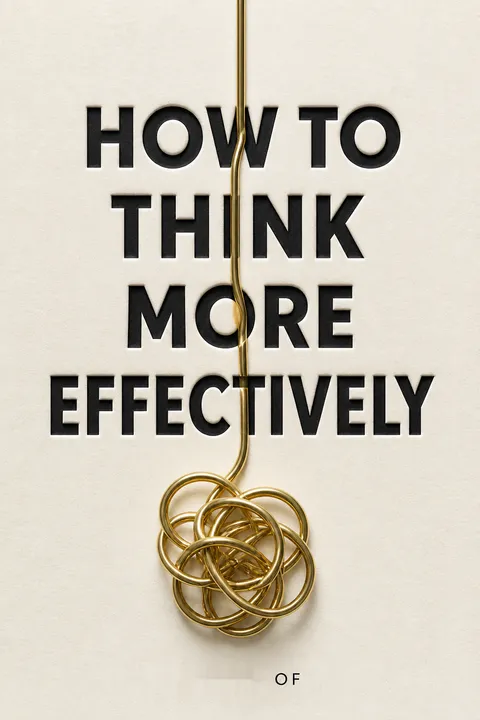


Key Takeaways
Spend time choosing the destination before optimizing the route
Question the goal first. The book argues that people are better at executing plans than deciding whether those plans serve a worthwhile purpose. We work hard to earn money without asking how it should support a good life, and chase career success without examining what success is for. The suggested correction is to make deliberate room for questions about meaning and value, not only procedures and deadlines. The book proposes shifting a substantial share of effort from execution to reflection, even if that feels uncomfortably unproductive.
Remember the deadline. A skull in a study once served as a reminder that life is finite. Bringing mortality into view can expose the cost of postponing a needed conversation, career change, or more satisfying relationship. It can also make failure less terrifying: with limited time, trying matters more than perfect certainty.
The distinction between ends and means is a powerful antidote to productivity culture, where visible activity can masquerade as progress. In decision theory, optimizing an objective is useless if the objective itself is poorly chosen. Mortality makes that abstract problem personal by forcing attention onto opportunity cost: every commitment displaces another. The caution is that reflection can become its own form of avoidance. Strategic thought earns its keep when it changes a choice, a calendar, or a commitment, rather than merely producing elegant questions.
Treat important ideas as drafts assembled across days, not instant verdicts
Thought accumulates slowly. Cumulative Thinking is the practice of building an idea through repeated sessions, revisions, and changes of perspective. A finished book can look effortless, but Marcel Proust’s notebooks show layers of additions, deletions, rearrangements, and abandoned passages. The polished result disguises a long process of assembly.
Give memory an external home. A notebook lets an idea from one day meet a related thought that appears weeks later. It also allows a writer to revisit an idea without the original excitement, and notice where the meaning is unclear. The practical lesson is to record fragments before they are complete, then return to them. Early confusion is not proof of incapacity; it is often the normal raw material of coherent thought.
This view resembles distributed cognition: thinking does not happen only inside the head, but through interaction with notes, drafts, and the changing conditions of daily life. Writing also reduces the burden on working memory, leaving more capacity to compare and revise ideas. The manuscript example is especially useful because it corrects survivorship bias: readers see finished work, not the abandoned attempts behind it. Still, accumulation needs periodic editing. A notebook can preserve insight, but it can also become a warehouse unless its contents are revisited.
Give anxious thoughts a low-pressure place to land
Important ideas can flee. Butterfly Thinking names the effort to notice delicate thoughts before they disappear. The book compares ideas to birds or butterflies that are difficult to catch directly. Often, the thoughts most worth examining are also the ones that threaten familiar choices, so anxiety pushes attention away from them.
Distract the guard. Rather than ordering the mind to think harder, give it a gentle, repetitive task. Walking, showering, travelling alone, or watching scenery can occupy the restless surface of attention while a deeper concern becomes easier to hear. A shower, for instance, may offer enough ordinary activity to ease self-consciousness without demanding much thought. When a realization appears, capture it quickly; its first appearance may be brief.
The idea that insight can emerge during low-demand activity fits a broader account of cognition in which attention alternates between focused work and looser association. The practical distinction is not between effort and idleness, but between useful mental conditions: some problems need concentrated analysis, while others need enough quiet for hidden concerns to surface. This is not a guarantee that every shower thought is profound. A fleeting impression still needs later scrutiny before it becomes a reliable guide to action.
Read other minds to awaken your own, not outsource it
Experience is intellectual material. Independent Thinking is the discipline of taking one’s own perceptions seriously instead of assuming that valuable ideas must come from famous authorities. The French essayist Michel de Montaigne objected to scholars who relied on citations rather than saying what they themselves thought. His point was not to reject learning, but to recognize that ordinary experiences contain evidence worth examining.
Use books as prompts. Reading Thinking treats a book as more than a container of answers. A passage can sharpen an idea already forming, and disagreement can reveal what a reader believes. The philosopher Immanuel Kant credited David Hume’s work with prompting his own thinking, in part because he objected to it. Read for what a text helps clarify in the reader, not only for what it asks the reader to remember.
This is a useful corrective to credential worship, but it is not an argument for replacing expertise with intuition. Personal experience supplies questions and observations; comparison, evidence, and criticism help determine whether an interpretation holds up. Reading becomes especially productive when it alternates between receptivity and resistance. Montaigne’s confidence in lived experience is liberating, while Kant’s response to Hume illustrates that intellectual independence can be sparked by disagreement rather than isolation.
Replace vague labels with the specific experience underneath
General words conceal detail. Focused Thinking means questioning broad descriptions until they reveal what a person actually feels, wants, or values. Calling work “creative,” a relationship “fun,” or a meal “brilliant” may be sincere, but such labels do little to guide a decision. Ask what kind of creativity is satisfying, which moments feel fun, or what precisely made the meal memorable.
Socrates kept asking. In the book’s account, he questioned confident claims about justice, courage, and beauty until speakers had to explain what they meant. Proust similarly criticized familiar descriptions that substituted clichés for precise observation. The practical move is to examine a vague word, compare it with its opposites, and search memory for specific instances. The aim is not precision for its own sake, but a clearer basis for action.
This method resembles operationalization in research: an abstract construct becomes useful when its observable features are specified. It also improves decisions by replacing borrowed labels with personally meaningful criteria. “A more creative job” may mean making things, choosing one’s schedule, or solving open-ended problems, which point toward different choices. Precision has limits, however. Not every feeling can be reduced to a neat definition, and some ambiguity is real. The goal is enough specificity to guide a next step, not a perfect taxonomy of experience.
Turn worry, hurt, and excitement into a map of your mind
Inspect the inner traffic. Philosophical Meditation is a structured practice of examining thoughts and feelings instead of trying to empty the mind of them. It asks three questions: What am I anxious about? What has upset me? What am I excited or ambitious about? The book recommends writing down even small worries and slights, since unacknowledged concerns can combine into a confusing background burden.
Unpack rather than suppress. A worry can be separated into practical steps and emotional meaning. A hurt can be described in detail, then considered as if it belonged to a friend. Excitement can be treated as a clue to an unmet wish. The point is not to solve every problem in one sitting, but to replace a jumble of mental noise with named concerns and clearer possibilities.
The practice joins emotional labeling with problem decomposition. Naming an emotion can create distance from it, while listing concrete next actions can turn diffuse threat into a manageable task. The three prompts also avoid a common bias: people often inspect distress while ignoring desire, or pursue ambition without asking what emotional need it serves. Reflection is not a substitute for treatment when distress is severe or persistent, but as a regular self-inquiry it can help distinguish a solvable problem from a feeling that first needs recognition.
Let impossible questions reveal what you actually want
Suspend feasibility briefly. The book’s term “Mad” Thinking describes temporarily setting aside ordinary limits, such as money, failure, or fear of ridicule, to discover which possibilities genuinely attract us. Asking what one would do if failure were impossible is not a plan or a prediction. It is a way to identify ambitions that practical objections may have silenced too early.
Jules Verne imagined first. His fiction described submarines and journeys to the Moon before the technology to achieve them existed. The imaginative picture did not solve engineering problems, but it helped make a new possibility thinkable. Apply the same sequence to a personal or social problem: picture the bold version, notice what matters within it, then decide which element can be pursued in reality.
The distinction between generating possibilities and evaluating them is central to creative problem-solving. Premature feasibility checks can shrink the space of ideas before anyone knows what problem deserves solving. Verne’s example makes imagination look less like escape and more like a prototype for desire. The discipline lies in returning from the thought experiment: fantasy can reveal a value, but it cannot establish that a plan is affordable, ethical, or workable. Inspiration becomes useful when translated into a modest experiment or specific goal.
Listen until another person can hear their own thought clearly
Conversation can clarify. Friend Thinking treats a good listener as a partner in thought, not merely an audience. People often arrive with a problem in vague or tangled form. A listener can help by showing attention, asking what a phrase means, inviting more detail, and gently returning to a point the speaker has drifted away from.
Resist the rescue reflex. Immediate advice can shut down exploration, especially when the speaker has not yet understood what hurts or matters. Questions such as “How did that feel?” or “What do you think was underneath that?” can help make the issue more precise. The listener should not moralize or treat every difficulty as a puzzle with a quick solution. Sometimes the valuable contribution is making it safe for someone to think aloud.
This account is close to reflective listening in counseling, where paraphrase and open questions help a speaker organize experience without having an answer imposed. The listener’s restraint is active rather than passive: attention, timing, and a well-chosen follow-up all shape what can be said. Yet listening should remain responsive, not mechanical. A sequence of questions can feel like an interview, and serious danger or urgent practical needs may call for direct help rather than extended exploration.
Translate envy into a smaller, usable desire
Envy carries information. Envious Thinking treats jealousy as a clue to an unmet wish, rather than a feeling to hide or obey. The person envied may appear to possess an entire desirable life, but the real attraction may be one element: creative freedom, welcoming social spaces, or control over time.
Separate the life from the ingredient. The book suggests listing people one envies, what they are known for, which appealing features one does not actually want, and which positive qualities genuinely appeal. This separates a usable desire from a misleading fantasy of becoming someone else. The result might be a smaller change that fits one’s own life, rather than an attempt to copy another person’s whole path.
Envy can function as a rough signal of comparison-based desire, but it is noisy: status, visibility, and selective presentation can distort what appears enviable. Breaking the imagined life into specific features is a form of signal separation. It converts “I want their life” into a question about the value underneath the comparison. The method also guards against moralizing an emotion that can contain useful information, while keeping a necessary distinction: learning from another person’s success does not mean their circumstances are fully knowable.
Borrow patterns from other fields when your problem stays blurry
Analogy transfers clarity. Analogical Thinking uses a familiar pattern from one area to illuminate a difficult idea in another. Calling a cosmetic fix “papering over the cracks,” for example, makes it easier to see why a pleasant holiday may not repair daily conflict in a relationship.
Search beyond the silo. Proust compared a person’s many impulses to separate jets of water that appear, from a distance, to form one fountain. The image gave him a way to express psychological complexity. The book also compares money in a relationship to an ingredient in a dish: important in combination, inadequate by itself. When an issue resists direct explanation, look for a pattern in nature, art, cooking, or politics that makes its structure visible.
Analogy is a compact tool for model-building: it lets a thinker import a structure, not just a colorful phrase. In science, useful models work this way, making an unfamiliar process easier to reason about through a more familiar one. The risk is that analogies can smuggle in assumptions along with insight. A relationship is not literally a building or a recipe. The comparison should generate questions and hypotheses, then be checked against the details of the situation it is meant to illuminate.
Use your own hidden flaws to understand others without excusing harm
Empathy starts close to home. The book argues that understanding another person does not require erasing the self. Instead, knowledge of one’s own fears, shame, selfishness, and vulnerability can help imagine what may be happening in someone else. People who seem alien may share ordinary human needs beneath differences in status or background.
Interpret behavior as a story. Love Thinking resists reducing a person to a single bad act. Anger may conceal fear; cruelty may have roots in humiliation or pain. Remembering that adults carry childhood wounds can widen the search for explanation. This is not the same as approving misconduct: understanding possible causes can coexist with boundaries and accountability. The aim is to see a person more fully than a moral headline allows.
This approach humanizes without requiring moral blindness. Social psychology often finds that people explain their own failures through circumstances but explain others’ failures through character; deliberately imagining context can correct that asymmetry. The book’s use of self-knowledge is especially practical because it gives empathy a starting point rather than making it a mysterious gift. Still, a sympathetic explanation is not evidence that a particular motive is true. Compassion should widen interpretation, while behavior and consequences remain relevant.
Treat your first certainty as a draft, not a verdict
The mind can mislead. Sceptical Thinking is the habit of questioning one’s own judgment, especially when a conclusion feels immediate and obvious. The ancient Greek sceptics pointed to unreliable perceptions of distance, time, desire, and even the effects of basic physical conditions. The book adds that fatigue, hunger, and emotion can shape judgment without announcing themselves.
Build in a margin of error. Before making a major decision, sleep on it, check whether basic needs are met, and try to state the strongest case for the opposite view. This does not mean refusing to decide or treating every claim as equally plausible. It means recognizing that confidence is not proof. A cautious person may speak tentatively because the situation is complex, not because they lack conviction.
The principle resembles calibrated reasoning: confidence should track the quality of evidence, not merely the intensity of a feeling. Delaying an irreversible decision can reduce the influence of transient states, while considering an opposing argument can expose missing information. Scepticism is most useful when it is directed inward as well as outward. Taken too far, though, it becomes paralysis or reflexive contrarianism. Good doubt is a tool for better judgment, not a permanent refusal to act.
Analysis
How to Think More Effectively is a practical philosophy of attention. Its central claim is that good thinking is not a mysterious burst of brilliance but a set of conditions and habits that make insight more likely: choosing worthy ends, allowing ideas to mature, noticing anxiety, testing vague words, and using other people and books as mirrors. The book’s fifteen short essays move across solitary reflection, social conversation, imagination, and moral judgment. Their common thread is not a single formal system, but a repeated invitation to slow down and examine what usually passes unexamined.
Its most distinctive contribution is to treat emotional life as part of intellectual work. Worry can hide a practical problem; envy can signal an unrealized preference; an uncomfortable thought may threaten a familiar identity. This makes the book more psychologically rich than a standard productivity manual. The memorable examples, from Proust’s altered manuscripts to Verne’s speculative machines, show how ideas are made and sustained rather than merely celebrated after completion.
The approach also has limits. Literary anecdotes illustrate possibilities but do not establish how often a technique works or for whom. The claim that people can draw profound wisdom from personal experience is encouraging, yet experience can reinforce bias as readily as it can reveal insight. The book’s methods therefore work best when paired with external evidence, feedback, and willingness to revise. Its counsel to interpret others generously also needs the boundary it partly acknowledges: understanding a cause does not erase the effects of harmful behavior.
The lasting value is a shift in what counts as thinking. Reflection, note-taking, listening, and revising are not preliminaries to the real work. They are the work. The reader is left with a practical challenge: create conditions in which ideas can appear, then question them carefully enough to decide which deserve a life beyond the page.
Review Summary
Readers praise How to Think More Effectively for its concise, insightful exploration of various thinking styles. Many find it practical, well-organized, and applicable to daily life. The book's brevity is seen as a strength, packing valuable content into a quick read. Some appreciate its philosophical depth and empathetic approach. While a few critics found it lacking depth or originality, most reviewers recommend it as a thought-provoking guide to improving one's thinking processes and decision-making skills.
People Also Read






Glossary
Strategic Thinking
Choosing worthwhile endsThe practice of deciding what outcomes are genuinely worth pursuing before concentrating on the practical steps to achieve them. The book contrasts this reflection on purpose and value with execution, or the work of carrying out a chosen plan. Strategic Thinking asks whether a goal serves a fulfilling life, rather than merely whether it can be reached efficiently.
Cumulative Thinking
Ideas built over timeThe process of developing ideas through scattered moments of thought, written notes, revision, and return. It assumes that complex thinking rarely arrives complete in a single sitting. Drafts and notebooks preserve partial insights so they can be reconsidered from different moods and perspectives, then assembled into a clearer whole.
Butterfly Thinking
Catching fleeting insightsA way of understanding how important thoughts can be difficult to grasp because they are delicate, fleeting, or unsettling. Instead of forcing insight through intense concentration, the practice creates conditions in which anxiety eases and a thought can surface, such as during a walk, a journey, or another low-demand activity.
Philosophical Meditation
Examining inner experienceA structured form of reflection that turns toward, rather than away from, the contents of the mind. It asks a person to examine current anxiety, upset, and excitement or ambition. By writing these experiences down and unpacking their practical and emotional dimensions, the practice aims to make them clearer, more manageable, and more informative.
‘Mad’ Thinking
Imagining beyond constraintsA deliberate thought experiment in which ordinary limits, such as money, fear of failure, or concern about ridicule, are temporarily set aside. The purpose is not to assume that an ideal scenario is feasible, but to reveal ambitions and values that practical objections may suppress. Those insights can then inform realistic choices.
Friend Thinking
Thinking through listeningA form of collaborative reflection in which a careful listener helps another person clarify their own thoughts. The listener shows interest, asks for examples and emotional detail, and may gently return the speaker to a central concern. The aim is not to dominate the conversation with advice, but to make clearer thinking possible through attentive company.
Reading Thinking
Reading as self-discoveryAn approach to reading that treats a book as a prompt for one’s own ideas, not merely a source of information to absorb. Agreement, disagreement, or even an imperfect argument can reveal what the reader believes. The text supplies a question or contrast that helps bring hesitant thoughts into focus.
Envious Thinking
Finding desire inside envyThe practice of examining envy as a possible clue to a genuine ambition. Rather than wanting another person’s whole life, the reader identifies which particular quality or experience seems appealing, and which attractive features are not actually wanted. This separates a usable personal desire from an unhelpful urge to copy someone else.
Analogical Thinking
Clarifying through comparisonA method of understanding a confusing subject by comparing it with a more familiar one that shares a relevant pattern. A vivid analogy can make an abstract problem easier to see and discuss. The comparison is a thinking aid, not proof that the two situations are identical, so its assumptions should be checked.
Love Thinking
Interpreting others humanelyA way of interpreting other people that looks beyond a harmful or irritating act to consider possible fear, pain, history, and vulnerability. It resists treating a person as wholly defined by their worst behavior and searches for a fuller story. It does not require approving the behavior or abandoning accountability.
Sceptical Thinking
Questioning one’s judgmentThe habit of recognizing that perception, emotion, physical state, and prior assumptions can distort judgment. It encourages a person to pause, consider opposing interpretations, and allow for the possibility of error. The purpose is not endless doubt, but more careful decisions and less overconfidence in first impressions.
FAQ
What’s "How to Think More Effectively" by The School of Life about?
- Explores the variability of our thinking: The book examines why our minds sometimes produce great insights and, at other times, only clichés or confusion.
- Offers practical mental manoeuvres: It provides a set of exercises and strategies to help readers improve the quality and originality of their thoughts.
- Focuses on the genesis of good thinking: Rather than just valuing results, the book investigates how to systematically cultivate better thinking habits.
- Covers 15 distinct thinking styles: Each chapter introduces a different approach to thinking, such as strategic, cumulative, butterfly, and independent thinking.
Why should I read "How to Think More Effectively" by The School of Life?
- To improve mental productivity: The book teaches readers how to harness their minds for greater insight, creativity, and clarity.
- To overcome common thinking pitfalls: It addresses issues like vagueness, distraction, and over-reliance on external authorities.
- To develop self-understanding: The exercises encourage deeper reflection on personal goals, anxieties, and ambitions.
- To gain practical tools: Readers receive actionable advice for integrating more effective thinking into daily life and work.
What are the key takeaways of "How to Think More Effectively" by The School of Life?
- Thinking is a skill to be cultivated: Good thinking is not just a gift but can be developed through conscious effort and practice.
- Strategic reflection is undervalued: Most people focus on execution rather than questioning their goals and purposes.
- Embrace multiple thinking styles: The book highlights the importance of using different approaches—like cumulative, butterfly, and sceptical thinking—to tackle various challenges.
- Self-trust and self-examination are crucial: Readers are encouraged to value their own experiences and insights, not just those of experts or tradition.
What are the main types of thinking described in "How to Think More Effectively" by The School of Life?
- Strategic Thinking: Focusing on the "why" behind actions and goals, not just the "how."
- Cumulative Thinking: Building ideas gradually over time, using notebooks and revision.
- Butterfly Thinking: Allowing the mind to wander and catch fleeting, important thoughts.
- Independent Thinking: Trusting one’s own experiences and insights rather than deferring to external authorities.
- Focused Thinking: Moving from vague impressions to precise, actionable understanding.
- Additional types: Philosophical meditation, ‘mad’ thinking, friend thinking, reading thinking, envious thinking, analogical thinking, empathetic thinking, death thinking, love thinking, and sceptical thinking.
How does "How to Think More Effectively" by The School of Life define and encourage Strategic Thinking?
- Distinguishes strategy from execution: Strategic thinking is about determining what you want to achieve, not just how to achieve it.
- Highlights societal bias: The book argues that society and education overemphasize execution, neglecting the importance of questioning goals.
- Suggests practical steps: Readers are encouraged to devote more time to strategic reflection, question their motivations, and create environments that support deep thought.
- Uses historical examples: The book references monastic traditions as models for creating focus and minimizing distraction.
What is Cumulative Thinking in "How to Think More Effectively" by The School of Life, and how can it be practiced?
- Recognizes the slow nature of thought: Good ideas rarely come all at once; they develop over time through repeated effort.
- Advocates for notebooks: Writing down thoughts allows for gradual refinement and the combination of ideas from different times and moods.
- Emphasizes revision: The process of returning to and revising ideas is essential for clarity and depth.
- Normalizes struggle: The book reassures readers that even great thinkers like Proust produced messy drafts before arriving at polished insights.
What is Butterfly Thinking according to "How to Think More Effectively" by The School of Life, and why is it important?
- Captures fleeting thoughts: Butterfly thinking is about noticing and catching delicate, important ideas that often escape conscious attention.
- Addresses anxiety’s role: The book explains that anxiety can cause us to avoid or lose track of significant thoughts.
- Recommends gentle distraction: Activities like walking, showering, or traveling can help the mind relax and allow deeper thoughts to surface.
- Encourages patience: Recognizing that profound ideas may come when we’re not actively trying to think can lead to more authentic insights.
How does "How to Think More Effectively" by The School of Life promote Independent Thinking?
- Challenges deference to authority: The book critiques the tendency to value only the ideas of established experts or historical figures.
- Encourages self-trust: Readers are urged to take their own experiences and intuitions seriously as sources of wisdom.
- Uses Montaigne and Emerson: These thinkers are cited as advocates for mining one’s own mind for valuable insights.
- Suggests practical exercises: The book provides steps for setting aside external opinions and focusing on personal judgments and feelings.
What is Focused Thinking in "How to Think More Effectively" by The School of Life, and how can it be developed?
- Moves from vague to precise: Focused thinking involves breaking down general feelings or ideas into specific, actionable details.
- Uses Socratic questioning: The book recommends asking follow-up questions to clarify what is truly meant by terms like "fun," "creative," or "success."
- Warns against clichés: It highlights the danger of relying on overused phrases that obscure real understanding.
- Provides step-by-step guidance: Readers are taught to chip away at vagueness through targeted self-questioning and reflection.
What is Philosophical Meditation in "How to Think More Effectively" by The School of Life, and how does it differ from traditional meditation?
- Focuses on examining thoughts: Unlike traditional meditation, which aims to clear the mind, philosophical meditation encourages confronting and unpacking anxieties, upsets, and ambitions.
- Uses structured questions: The practice involves systematically asking what you are anxious, upset, or excited about.
- Aims for clarity, not serenity: The goal is to understand and order the mind’s contents, not just to achieve calm.
- Offers practical exercises: The book provides detailed steps for listing and exploring worries, grievances, and hopes.
How does "How to Think More Effectively" by The School of Life address the role of ‘Mad’ Thinking?
- Validates unconventional ideas: The book argues that some of the best insights come from thoughts initially dismissed as "mad" or unrealistic.
- Encourages imaginative freedom: Readers are prompted to temporarily set aside practical constraints and explore their wildest ambitions.
- Uses historical examples: Figures like Jules Verne are highlighted for envisioning possibilities that seemed impossible in their time.
- Suggests practical exercises: The book offers prompts for imagining ideal scenarios and identifying which "mad" ideas might be worth pursuing.
What are the best quotes from "How to Think More Effectively" by The School of Life and what do they mean?
- "We can learn systematically to harvest rather than sporadically to forage our most satisfying and necessary thoughts."
- This emphasizes the importance of intentional, regular reflection rather than waiting for inspiration to strike by chance.
- "The difference between vagueness and focus is what separates great from mediocre art."
- Precision and specificity in thought (and art) lead to greater impact and understanding.
- "In the minds of geniuses, we find – once more – our own neglected thoughts."
- Geniuses often articulate ideas that many people have had in a vague form but never fully developed or expressed.
- "We should dare to move the emphasis of our thinking away from execution and towards strategy."
- Prioritizing the "why" behind actions leads to more meaningful and effective outcomes.
- "The good listener is loyal not so much to entertainment or anecdote, reminiscence or gossip; they are, above all, a friend to our still not fully developed ideas."
- True listening helps others clarify and develop their own thoughts, rather than just exchanging stories or advice.
About the Author
Other books by The School of Life







Download PDF
Download EPUB
.epub digital book format is ideal for reading ebooks on phones, tablets, and e-readers.








