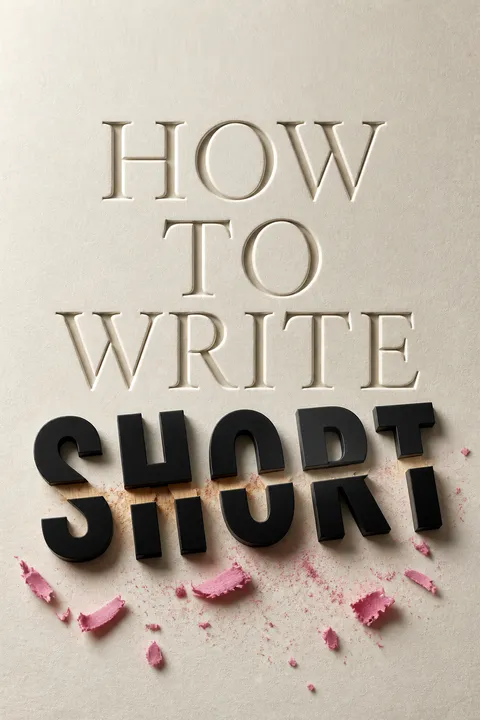


Key Takeaways
Treat short writing as concentrated craft, not a lesser version of long writing.
Small can carry weight. The book argues that a short text is not merely a long one with words removed. A sonnet can summarize a play, a headline can announce a historic event, and a few lines can hold an idea people remember for generations. The author counts 996 words across seven influential religious, literary, and civic texts, showing how much cultural force can fit in a small space.
Craft beats compression. Good short writing depends on focus, wit, and polish: a governing idea, an intelligent way of seeing it, and careful choices that make the language memorable. Digital limits may make brevity unavoidable, but they do not excuse dull or careless writing.
The distinction between shortness and compression is crucial. Compression preserves the same information in fewer words; craft asks which information deserves to survive, and what form gives it force. That resembles good interface design, where the goal is not simply to shrink a screen but to make the important action easy to find. Still, a compact text can conceal complexity as easily as it can clarify it. Its apparent completeness may depend on readers supplying context the writer has left unstated.
Collect small language everywhere, then study how it earns attention.
Build a writer’s archive. Clark recommends keeping a daybook, or commonplace notebook, for memorable short passages and experiments of one’s own. Useful material turns up well beyond literature: on cereal boxes, baseball cards, signs, fortune cookies, and even ransom notes. A baseball card’s few lines about a player can teach narrative detail, while a hotel towel notice can make a practical request feel like a small moral choice.
Notice the grace note. Clark uses this term for a single vivid word or detail that gives a plain sentence extra color. In a brief commentary on a political summit, the word chimera changes the reader’s picture of the event. Collecting examples makes such choices visible, so a writer can learn from them rather than rely on instinct alone.
A daybook functions like a field notebook: it trains attention to notice how language behaves in everyday settings, not just in celebrated books. That habit also widens a writer’s sense of audience, since a sign, a joke, and a baseball card solve different communication problems. Collection alone, however, can become hoarding. The useful step is comparison: what does each text make easy to understand, feel, or remember, and which exact choice produces that effect?
Find the real point before trimming the sentence.
Focus organizes the evidence. Clark asks writers to identify what a piece is really about before cutting it down. In Frank Deford’s 207-word paragraph on five-cent prices in 1898, the central claim is that the nickel once ruled everyday American life. The paragraph makes its case through a string of familiar expressions and purchases, repeating the key idea until the examples feel like proof rather than a loose inventory.
Narrow the lens. A broad subject such as vandalism becomes easier to write about when anchored in a particular place or incident. A detour, an unrelated fact, or an attempt to impress the wrong audience can blur the point. Clark contrasts a bloated description of a man too busy to flush with a nine-word version that preserves its comic focus.
Focus is a practical form of selection: it tells the writer which facts belong together and gives the reader a reason to keep them together. The cognitive benefit is substantial because working memory handles a coherent pattern more easily than a pile of details. Yet focus should not become tunnel vision. In reporting or argument, the most vivid example may not represent the larger pattern, so the writer must distinguish a powerful illustration from adequate evidence.
Use two ideas to create tension, and three to suggest wholeness.
Make ideas interact. Clark calls the basic pairing of contrasting or complementary elements a one-two punch. It works in a phrase, sentence, or larger piece: old against new, problem against solution, or one person’s account against another’s. Parallel grammar can make the comparison feel balanced, while a dependent clause can give one idea more weight than its partner.
Add a third dimension. Two elements often divide a subject into opposites; three can suggest a fuller picture. The Serenity Prayer, for instance, separates acceptance, action, and judgment into three related needs. This is not a mechanical rule. The writer chooses two when contrast is the point, and three when a sequence or set of details should feel more complete.
These patterns work because readers are good at detecting relationships. A pair creates a question of difference or conflict; a third element can resolve the binary or make the set feel representative. The structures are useful in teaching, presentations, and argument because they make organization audible as well as visible. Their familiarity is also a risk: repeated threes can sound artificially complete, and a neat opposition can flatten realities that do not divide cleanly.
Control rhythm so the final short phrase carries the weight.
Let the sentence decelerate. Clark’s change-of-pace move sets longer sentences beside a much shorter one, using the shift in length to make the ending land. A story about an older dog, for example, builds through the animal’s failed romantic adventure and later confusion before closing on a compact nickname that reframes the tale.
Aim at the ending. The target move builds a passage toward one final word or phrase that gives the preceding material its meaning. In a 108-word paragraph about ancient Greek philosophy, historian Stephen Greenblatt saves the name of the central idea for the end. Comedy uses a related principle: delaying the odd or funny word gives the listener time to form an expectation, then overturn it.
Sentence length is not just a visual property. Read aloud, it becomes timing, and timing shapes suspense, emphasis, and humor. This is why a short ending can feel louder than a long explanation: the reader arrives at it with momentum. The technique is powerful but easy to overuse. If every paragraph ends with a dramatic fragment, the surprise becomes a predictable beat, and the prose begins to sound like a trailer rather than an argument.
Cut whole branches before pruning individual words.
Revise in large strokes. Clark questions the idea that concision means removing isolated words first. He recommends deciding what the piece is about, then cutting material that does not serve that purpose before polishing individual sentences. When he compresses a 65-word paragraph about concise writing toward a 140-character limit, each revision saves space but also risks losing nuance and voice.
Keep the load-bearing parts. Concrete nouns and active verbs help readers see who did what. Weaker elements often include redundant phrases, intensifiers, vague qualifiers, jargon, and strings of prepositional phrases. Clark also distinguishes writers who draft expansively and cut from those who draft sparely and add. Either process can work; the obligation is to scrutinize what remains, including language that is useful but not necessary for this version.
The branch-and-leaf approach reflects a general principle of editing: structure matters more than surface economy. Removing an entire tangent can improve both clarity and pacing, while shaving a word from every sentence may leave the real problem untouched. The harder judgment is deciding what counts as necessary. Detail that looks expendable to one reader may carry voice, qualification, or emotional truth for another. Strong editing therefore needs a clear audience and a willingness to test whether the cut changes meaning.
Make each format serve its purpose, reader, and screen.
Design for the glance. A short text can often be seen all at once, allowing readers to judge its length, organization, and relevance before reading closely. Headlines, blurbs, lists, and labels benefit from clear visual structure and useful white space. Online, links can help readers explore, but too many competing exits can scatter attention.
Choose the right voice. Contractions and slang may suit a friendly message, while a formal notice may need spelled-out words and a more solemn tone. A dating profile is a small persuasive essay: it needs an opening that distinguishes its author, concrete evidence of personality, and an ending that invites a response. Captions, slogans, and social posts each have different jobs, so brevity alone cannot determine their style.
This is an argument for genre awareness, the ability to recognize the unspoken rules of a form and then use them deliberately. A headline must orient quickly; a profile must make a person seem specific; a caption should add something the image cannot provide by itself. Digital media make these choices more consequential because layout, links, and scrolling influence attention before prose is read. Yet optimizing for the glance can reward superficial appeal, so a compelling entrance must lead to substance.
Report vividly without letting speed outrun accuracy.
Bring the scene close. Clark describes Peter King, a radio correspondent who turns technical material into short news reports. King seeks expert help, identifies the most important fact, translates jargon, and decides what can be omitted. He estimates approximate reading time, or ART, as a practical guide: about 100 spoken words take 30 seconds to deliver.
Make reporting feel present. After Haiti’s earthquake, Toronto Star reporter Joanna Smith sent short dispatches describing specific people, actions, and sights. Together, the posts formed a developing account rather than a single finished article. This works because real-time reporting can give readers the sense of witnessing events as they unfold. But speed is not the same as accuracy: Clark warns that getting a report right matters more than being first.
Real-time reporting turns sequence into a narrative resource. Each dispatch can add a new observation, and readers assemble the event as it develops, much as they might follow evidence in an investigation. The format also exposes a tension between immediacy and verification. A vivid eyewitness detail can be true and still mislead if it lacks context or is unrepresentative. Responsible short reporting therefore needs both sensory precision and the slower discipline of checking what a fast-moving scene appears to mean.
Keep excerpts short without severing their original meaning.
Context can hinge on one word. A memorial inscription shortened a sermon by Martin Luther King Jr. into a declaration that sounded more self-promoting than the original. In the sermon, King framed the drum-major role conditionally and tied it to service. Removing that condition changed how readers could interpret his meaning. The dispute led to a revision of the inscription.
Edit responsibly. Clark argues that quotation requires more than accurate transcription. Writers should check the surrounding argument, preserve a speaker’s intent, and use punctuation to show where material has been omitted. The shorter the excerpt, the more powerful each remaining word becomes, but that concentration can make a distortion seem especially definitive.
This example shows that quotation is an act of interpretation, not a neutral transfer of words. Removing a condition can reverse the force of a statement, while a public inscription gives that reversal unusual permanence and authority. The lesson applies to headlines, social posts, and clipped video as well as monuments. Concision is responsible only when the missing context does not materially alter the claim. When the source is complex, a few extra words may be the most economical way to protect its meaning.
Use concise language to persuade without disguising what it does.
Short forms can serve many ends. A few words can honor the dead, deliver advice, make a joke, sell a product, or tell a story. Clark presents a moving exchange of text messages between a Norwegian teenager hiding from a gunman and her mother. In a handful of messages, they share urgent information, reassurance, fear, and love. The form works because it carries both action and relationship.
Notice the danger. Slogans and political sound bites can replace evidence with emotional shorthand. Clark uses George Orwell’s critique of political euphemism and examples of strategic word choice to show how language can conceal an argument’s real stakes. His standard is not brevity for its own sake, but craft attached to a useful or honorable purpose.
The same features that make short messages memorable make them effective instruments of persuasion. A vivid phrase can focus attention, but it can also smuggle in assumptions or make a contested policy sound harmless. Media literacy therefore requires asking not only whether a message is catchy, but who benefits from its framing and which facts have been left outside it. The Norwegian text exchange offers a counterexample to cynical views of digital communication: informality can carry genuine care, not just distraction or manipulation.
Analysis
How to Write Short is a craft manual presented as a guided tour through the places short language lives. Its first half teaches writers to notice, collect, analyze, shape, and revise concise texts. Its second half explores what those texts do: commemorate, amuse, persuade, explain, report, and connect. The book’s central achievement is to make short writing feel like a demanding literary form rather than a concession to phones, deadlines, or impatient readers.
The method is inductive. Clark moves between canonical works and everyday artifacts, from Lincoln’s address to a cereal box, from poetry to a social post. This range makes craft visible in unexpected settings and keeps the teaching grounded in examples. It also creates a challenge for summary: the book is less a single linear argument than a large collection of demonstrations. The adaptation must therefore preserve the recurring principles while allowing the variety of forms to remain apparent.
The strongest principles are highly practical: identify the real subject, select rather than merely compress, use contrast and rhythm to guide attention, and revise even informal writing. The examples also reveal that form is inseparable from purpose. A memorial, a caption, a headline, and an emergency text cannot be judged by the same standards, even if each is brief.
The book’s optimism about short forms deserves one qualification. Concise writing can increase clarity, but it can also intensify ambiguity, strip away context, or make persuasion feel like fact. Clark addresses this ethical risk directly, especially in his discussion of political language and quotation. Taken together, the craft and ethical arguments form the book’s most durable lesson: brevity is not an automatic virtue. It is a choice that becomes valuable when the writer knows what to preserve, what the reader needs, and what the words are being used to do.
Review Summary
How to Write Short receives mixed reviews, with an average rating of 3.78/5. Many praise Clark's insights on concise writing for the digital age, finding it helpful for various forms of short-form content. Readers appreciate the practical examples and exercises provided. However, some criticize the book's length and repetitiveness, finding irony in a book about brevity. Critics also note gender bias in examples and a focus on American culture. Overall, most find value in Clark's advice, though experiences vary based on writing background and expectations.
People Also Read


Glossary
Grace note
A vivid linguistic accentClark uses grace note for a small, distinctive word or detail that gives an otherwise plain passage extra energy. It should enrich the sentence without pulling attention away from its main purpose. The term comes from music, where a brief ornamental note adds character to a melody.
One-two punch
Two elements in productive tensionA one-two punch joins two ideas or details so their contrast, similarity, or interaction creates an effect. It can operate within a phrase, a sentence, a paragraph, or a whole piece. Clark emphasizes that the pairing should do more than list two items: the elements should generate friction, clarity, or surprise.
Change-of-pace move
Long passage, short landingA change-of-pace move places a brief sentence or fragment after one or more longer sentences. The shift in length slows the reader and gives the final thought special emphasis. Clark uses the technique to sharpen humor, complete a story, or make a closing phrase feel like a decisive stop.
Target move
Build toward a final wordThe target move directs a paragraph or sentence toward an emphatic final word or phrase. Earlier material prepares the reader for that landing, so the ending can deliver the central idea, a joke, or a revealing detail. The name describes the effect of aiming the passage and striking its point at the end.
Approximate reading time (ART)
Estimated spoken delivery timeART is Clark’s shorthand for estimating how long a written report will take to read aloud. His example uses roughly 100 words per 30 seconds of radio delivery. The estimate helps writers fit information to a broadcast slot, although actual timing varies with a speaker’s pace and the material’s complexity.
Six-word discipline
Practice writing in six wordsThe six-word discipline is an exercise in creating a complete effect under a strict six-word limit. Writers can use the constraint to practice a punch line, a contrast, a three-part pattern, or a miniature narrative. The purpose is not simply to reduce word count, but to develop judgment about which words carry the most meaning.
FAQ
What's "How to Write Short: Word Craft for Fast Times" about?
- Focus on brevity: The book emphasizes the importance of writing concisely in the digital age, where short writing is prevalent and often more effective.
- Practical guide: It provides strategies and techniques for crafting impactful short texts, from tweets to headlines and everything in between.
- Historical context: The author, Roy Peter Clark, explores the history and evolution of short writing, demonstrating its enduring significance.
- Wide range of examples: The book includes examples from various sources, such as literature, journalism, and social media, to illustrate effective short writing.
Why should I read "How to Write Short"?
- Improve writing skills: The book offers practical advice for enhancing your ability to write concisely and effectively, which is valuable in both personal and professional contexts.
- Adapt to digital communication: In an era dominated by short-form content, mastering the art of brevity can help you communicate more effectively online.
- Learn from a writing expert: Roy Peter Clark is a renowned writing coach, and his insights can help writers of all levels improve their craft.
- Diverse applications: The techniques discussed are applicable to various forms of writing, from social media posts to professional emails and beyond.
What are the key takeaways of "How to Write Short"?
- Brevity is powerful: Short writing can convey messages effectively and memorably, often with greater impact than longer texts.
- Strategic techniques: The book provides specific strategies for crafting concise writing, such as using parallelism, varying sentence length, and focusing on key words.
- Purposeful writing: Every piece of short writing should have a clear purpose, whether it's to inform, persuade, entertain, or inspire.
- Practice and revision: Writing short requires practice and careful revision to ensure clarity and impact.
How does Roy Peter Clark suggest improving short writing skills?
- Read short writing: Study examples of effective short writing from various sources to understand what works.
- Practice regularly: Write short pieces frequently to develop your skills and become more comfortable with brevity.
- Focus on key elements: Pay attention to word choice, sentence structure, and the overall message to ensure clarity and impact.
- Revise diligently: Edit your work to remove unnecessary words and refine your message for maximum effectiveness.
What are some specific methods or advice from "How to Write Short"?
- Use parallelism: Employ parallel structures to create rhythm and emphasis in your writing.
- Vary sentence length: Mix short and long sentences to maintain reader interest and highlight key points.
- Hit the target: End sentences or paragraphs with a strong, impactful word or phrase to leave a lasting impression.
- Embrace the power of two: Use dualities to create tension and interest, such as comparing and contrasting ideas.
What are the best quotes from "How to Write Short" and what do they mean?
- "Brevity is the soul of wit." This quote emphasizes the importance of being concise to convey wit and intelligence effectively.
- "Omit needless words." A reminder to remove unnecessary words to enhance clarity and impact.
- "Every short passage should contain one gold coin." Each piece of short writing should offer a valuable insight or memorable element.
- "Brevity comes from selection and not compression." Effective short writing involves choosing the right words, not just cutting down text.
How does "How to Write Short" address the challenges of digital communication?
- Adapting to new platforms: The book discusses how to write effectively for digital platforms like social media, where brevity is essential.
- Maintaining clarity: It emphasizes the importance of clear and concise communication in a fast-paced digital world.
- Engaging audiences: The book provides strategies for capturing and maintaining reader attention in short-form content.
- Balancing formality and informality: It offers guidance on choosing the appropriate tone and style for different digital contexts.
What role does historical context play in "How to Write Short"?
- Evolution of short writing: The book explores how short writing has evolved over time, from ancient texts to modern digital communication.
- Enduring significance: It highlights the continued importance of brevity in conveying powerful messages throughout history.
- Learning from the past: By examining historical examples, the book provides insights into effective short writing techniques.
- Cultural impact: It discusses how short writing has influenced and been influenced by cultural and technological changes.
How can "How to Write Short" help with professional writing?
- Effective communication: The book offers strategies for writing clear and concise professional emails, reports, and presentations.
- Persuasive writing: It provides techniques for crafting compelling arguments and proposals in a limited space.
- Branding and marketing: The book discusses how to create impactful slogans and taglines that capture attention.
- Time management: By focusing on brevity, professionals can communicate more efficiently and save time.
What are some examples of short writing forms discussed in "How to Write Short"?
- Tweets and social media posts: The book covers how to write engaging and effective content for platforms like Twitter.
- Headlines and captions: It provides tips for crafting attention-grabbing headlines and informative captions.
- Slogans and taglines: The book explores the art of creating memorable and persuasive slogans for branding and marketing.
- Microfiction and poetry: It discusses the challenges and techniques of writing short stories and poems.
How does "How to Write Short" address the misuse of short writing?
- Avoiding misinformation: The book warns against using brevity to oversimplify complex issues or spread misinformation.
- Ethical considerations: It emphasizes the importance of maintaining accuracy and integrity in short writing.
- Critical thinking: The book encourages readers to question and analyze short messages to avoid being misled.
- Responsible communication: It advocates for using short writing to inform and enlighten, rather than manipulate or deceive.
How can "How to Write Short" benefit creative writers?
- Enhancing storytelling: The book offers techniques for creating vivid and engaging narratives in a limited space.
- Experimenting with form: It encourages writers to explore different short writing forms, such as microfiction and haiku.
- Developing voice: The book provides guidance on crafting a unique and authentic writing voice in short pieces.
- Inspiring creativity: By focusing on brevity, writers can experiment with new ideas and push the boundaries of their creativity.
About the Author
Other books by Roy Peter Clark

Download PDF
Download EPUB
.epub digital book format is ideal for reading ebooks on phones, tablets, and e-readers.








