

Key Takeaways
Understand trauma as a bodily injury that can heal, not a life sentence.
The event is not enough. Levine argues that trauma is not simply the terrible thing that happened, or the pain it caused. It is the body and nervous system remaining caught in survival responses that could not resolve. His term for trauma as an injury, rather than a disorder, shifts the focus from a fixed identity to a wound that may heal. He describes this as posttraumatic stress injury, or PTSI, a label proposed by a veteran he met.
Recovery needs more than explanation. In Levine's approach, people learn to notice bodily sensations and impulses, with support, rather than relying only on talking about the event. This reframing may reduce shame, but it does not mean everyone recovers quickly, or that one method works for every survivor.
The injury framing offers a valuable counterweight to the idea that a diagnosis defines a person. It can preserve hope while recognizing that symptoms are real and deserve care. Yet diagnoses can also help people access treatment, services, and community; replacing them wholesale could remove useful protections. The strongest version of Levine's point is not that trauma is never a disorder, but that labels should not obscure the possibility of change or the person's agency in recovery.
Recognize freezing as survival biology, not evidence of weakness.
Stillness can be defense. Tonic immobility is the term Levine uses for an involuntary shutdown response when escape or fighting seem impossible. A threatened animal may become motionless; a person may feel paralyzed, numb, or detached. Levine uses this model to explain why survivors sometimes cannot act during danger, and why blaming themselves afterward can deepen distress.
The body may not fight back. In studies cited by Levine, 88% of childhood sexual assault survivors and 75% of adult sexual assault survivors reported moderate to high paralysis during the assault. He also cites a study in which 52% of orthopedic trauma patients developed PTSD. These findings underscore that helplessness can follow many kinds of threat, not just combat.
This reframing has an important ethical consequence: outward stillness cannot be treated as evidence of consent, indifference, or cowardice. Animal comparisons can make a stigmatized response easier to understand, but they are analogies, not proof that human trauma follows identical biological rules. The survivor's experience deserves belief and care without requiring a particular theory of why the body reacted as it did.
Let a regulated body complete its survival response with safe support.
A witness can steady the system. Levine opens with his own accident: he was struck by a car and lay confused, frightened, and unable to move. An off-duty paramedic's sharp commands made him feel more trapped. A pediatrician then sat beside him, held his hand, and offered a calm presence. With that support, he noticed trembling and small protective movements in his arms rather than suppressing them.
His body settled. Levine reports that his heart rate, initially measured at about 170, had fallen to 74 in the ambulance. He interpreted the shaking, attention to sensation, and protective movements as helping his nervous system settle. The story illustrates his method, but one person's experience cannot establish that these responses prevent PTSD.
The scene makes a compelling case for first aid that includes humane contact, not only equipment and instructions. Research across caregiving contexts also supports the broader idea that social support can buffer stress. The clinical inference requires more caution: a falling heart rate is not by itself proof of trauma prevention, and trembling is not a universal sign of recovery. Support should create choice and safety, not prescribe a particular bodily reaction.
Approach distress in small doses, alternating it with felt safety.
Pace matters. Levine calls gradual contact with intense sensation titration. Pendulation is the body's movement between contraction and expansion, or distress and relative ease. Rather than flooding someone with painful memories, a therapist helps them touch a difficult sensation briefly, then return attention to a safer or more comfortable one. The aim is to make distress tolerable enough to notice without becoming overwhelmed.
A rhythm replaces a trap. Levine compares the process to adding a reactive chemical one drop at a time instead of pouring two caustic substances together at once. He also describes grief and a child's recovery after a fall as naturally ebbing and flowing. The person learns through experience that a sensation can change, rather than assuming it will last forever.
The emphasis on dose and pacing connects with a basic principle in exposure-based therapies: learning can occur when feared material is approached without overwhelming the person. Levine's distinctive emphasis is on tracking bodily states and movement, rather than primarily recounting a narrative. Neither approach should be treated as a do-it-yourself rule. For some people, sustained focus on internal sensation increases distress, so pacing and clinical judgment matter.
Rehearse blocked protective actions to rebuild a sense of agency.
Movement can correct helplessness. Levine's early client Nancy had panic attacks and other troubling symptoms after a childhood tonsillectomy. In a session, he imagined a tiger pursuing her and invited her to notice the sensation of running. Her legs began to move, and she trembled. She later connected the experience to being held down for surgery. Levine reports that her panic attacks stopped and several other symptoms improved.
The focus is the present body. In this approach, a client slowly senses an incomplete defensive movement, such as raising an arm to protect the head or moving the legs to escape. This is not meant to be dramatic role-play or forced reliving. Bodily sensations may suggest possibilities about past experience, but they do not independently verify that a memory is historically accurate.
The approach draws on a useful insight from motor learning: experiences of effective action can differ meaningfully from passive recollection. That may help a person feel capable rather than trapped. But an evocative image or bodily response is not a reliable historical recording. Therapists need to avoid leading questions or treating emerging impressions as established facts, especially when a client is vulnerable to suggestion.
Listen across bodily channels before trusting the mind's first explanation.
The body tells in parts. Levine's SIBAM model tracks five elements of experience: internal sensation, sensory images, behavior, affect, and meaning. It helps therapist and client notice which parts are present, which are missing, and how they connect. Instead of immediately interpreting a symptom, the client attends to physical experience and observable movement, allowing new meanings to emerge rather than imposing them too soon.
A frozen shoulder had a story. Firefighter Vince developed severe pain and restricted movement after witnessing a child killed in a car crash. In session, he slowly moved his arm and noticed competing impulses to reach toward the car and pull away. As he sensed these movements, his range of motion returned. He later connected the shoulder tension to that scene, an account from one clinical case rather than a general diagnosis.
SIBAM is useful as an observation map because it discourages premature certainty and includes nonverbal experience that ordinary conversation can miss. Its limits matter too: bodily signals are meaningful data, not self-interpreting evidence. Pain, tension, or an image may have medical, psychological, or situational causes. Somatic exploration should complement appropriate medical assessment, not substitute for it.
Use connection to support regulation, then strengthen independent capacity.
Safety is also social. Levine draws on Stephen Porges's polyvagal theory, a model describing three broad defensive patterns: social engagement, active mobilization such as fight or flight, and shutdown or immobility. He proposes that overwhelming threat can make connection difficult, even when another person is offering care. A steady face, voice, or appropriate touch may help a person feel safer enough to notice internal sensations.
Support should build agency. Levine's accident story illustrates how a calm presence helped him remain oriented, while he also set a boundary with the first responder. In therapy, the aim is not simply to make the client dependent on a soothing practitioner. The practitioner helps the client gradually develop self-regulation and a renewed ability to engage with other people and the present environment.
The model usefully emphasizes that regulation is not only an individual achievement: people often calm in relationship, and compassionate contact can make difficult work possible. Polyvagal theory, however, is a framework for interpreting physiology, not a complete or uncontested account of it. The practical lesson survives that debate: observe the person's actual response, ask what feels safe, and avoid assuming that eye contact or touch is welcome.
Let children set the pace when play revisits a frightening event.
Play can restore choice. After toddler Sammy was restrained for stitches, he became unusually controlling and irritable. Levine and the family used a stuffed bear in a simple rescue game. When the bear fell, Sammy fled; the adults paused and reassured him. Over repeated rounds, he moved from avoidance to helping rescue the bear, then took a turn escaping from under a blanket himself.
Watch the child's signals. Sammy's excitement and growing participation suggested that the play felt more manageable. The adults did not force him to continue when he ran away or said he was scared. Levine's guidance is to slow down, allow breaks, and stop if play increases distress or becomes compulsively repetitive. The goal is not to reenact horror, but to let the child experience an active, supported outcome.
The episode shows how play can give a young child control and a language for fear that is not primarily verbal. It also highlights the importance of reading behavior rather than treating participation as automatic consent. The case is a vivid illustration, not a universal treatment protocol. Complex trauma, unsafe caregiving, or persistent symptoms call for qualified professional support rather than improvised reenactment at home.
Contain emotional impulses long enough to choose their direction.
Feeling is not the same as venting. Levine draws on Nina Bull's research into how emotions relate to bodily posture and blocked action. He argues that anger can involve both an impulse to strike and a counter-effort to restrain it. Simply acting out the impulse may repeat the familiar response without changing the underlying state. Containment means staying aware of intense sensation without either suppressing it or being swept into action.
A pause can create options. Levine tells of a samurai who raises his sword in rage, then lowers it after a Zen teacher names the danger of the moment. The point is not that anger should be denied, but that a brief pause can make its energy available for protection, boundary-setting, or another deliberate response. Emotional expression can help, but it is not automatically healing.
This distinction offers a more precise alternative to the simplistic advice to either let it all out or keep it in. Contemporary emotion-regulation approaches likewise distinguish noticing an impulse from acting on it. Yet expression is not inherently harmful: naming anger, grieving, or speaking up can be essential. The useful question is whether an action increases understanding and choice, or merely repeats a reaction.
Build body awareness to reconnect instinct, thought, and choice.
Awareness is not analysis. Levine distinguishes noticing present sensations from introspection that evaluates, explains, or judges them. A simple exercise in the book asks readers to close a hand while watching, then repeat with their eyes closed and attend to the movement from within. The point is to experience the difference between an image of the body and the body's felt sensations.
Sensation can inform action. The book argues that physical cues help people recognize boundaries, needs, and changes in emotion. Trauma may narrow those cues into numbness or alarm, making it harder to tell what is happening now. Gradual, nonjudgmental attention can help restore nuance. Levine cautions against forcing internal focus; it should be paced, and professional support may be needed when it becomes overwhelming.
Interoception, the perception of internal bodily states, is increasingly studied as part of emotion and decision-making. Levine's exercises make that abstract idea tangible by asking readers to notice sensations before explaining them. Still, bodily signals are not infallible intuitions: hunger, illness, anxiety, and context can shape them. Awareness is most useful when it informs reflection and choice, rather than replacing evidence or careful judgment.
Treat spiritual intensity as a possible byproduct, never a promised cure.
Aliveness can return. Levine reports that some clients experience warmth, joy, clarity, compassion, or a sense of connection as trauma symptoms shift. He links these experiences to the same bodily systems involved in survival and self-regulation, and compares them with states described in meditation and spiritual traditions. In this view, intense survival energy can be redirected into a fuller sense of presence rather than remaining tied to fear.
Meaning is personal. These experiences are described as possible outcomes, not a standard stage of recovery. Levine's account suggests that healing can restore pleasure and belonging, not merely reduce symptoms. It does not establish that suffering is spiritually beneficial, or that survivors must find meaning in what happened to them.
The connection between bodily change and spiritual experience can help readers take reports of awe or wholeness seriously without treating them as supernatural proof. It also calls for cultural humility: people interpret unusual sensations through different religious and personal frameworks. A crucial boundary is that trauma is not a gift or a required route to growth. Spiritual language should support a survivor's meaning-making, never pressure them to celebrate harm.
Analysis
The book's organizing claim is that trauma persists when survival responses remain unresolved, and that recovery can involve bodily awareness, gradual regulation, and restored agency. Levine makes this argument through an unusual blend of personal narrative, animal behavior, neuroscience, clinical cases, and spiritual reflection. The opening accident gives the thesis a human-scale demonstration: an injured person receives calm company, attends to sensations, and experiences trembling and protective movements. The rest of the book expands that scene into a therapeutic model.
Its most practical contribution is the discipline of pacing. Rather than demand a complete story or dramatic emotional release, the approach attends to small changes in posture, breath, sensation, and movement. The cases of Nancy, Sharon, Vince, Adam, and Sammy illustrate how bodily cues can become part of a careful therapeutic conversation. The SIBAM map and the ideas of titration and pendulation give practitioners language for tracking that process.
The scientific claims require more discrimination than the narrative sometimes provides. Tonic immobility in animals can illuminate human freezing, but analogy does not establish identical mechanisms. Polyvagal theory offers a memorable account of defensive states and social connection, yet its evolutionary interpretation should not be mistaken for settled explanation of every trauma response. Individual case reports show what Levine observed, not what will reliably happen for every client. The book's strongest claims are therefore clinical hypotheses and principles of attention, not universal laws.
A careful reader can retain the humane core without accepting every physiological interpretation: survivors may react in ways they did not choose; shame is a poor guide to understanding those reactions; supportive relationships matter; and recovery should not require a person to relive overwhelming events. Body awareness can complement other forms of care, while memories and sensations should not be treated as automatic proof of historical detail. The result is a compelling invitation to regard the body as part of the story and part of the route toward choice, without making it the only authority.
Review Summary
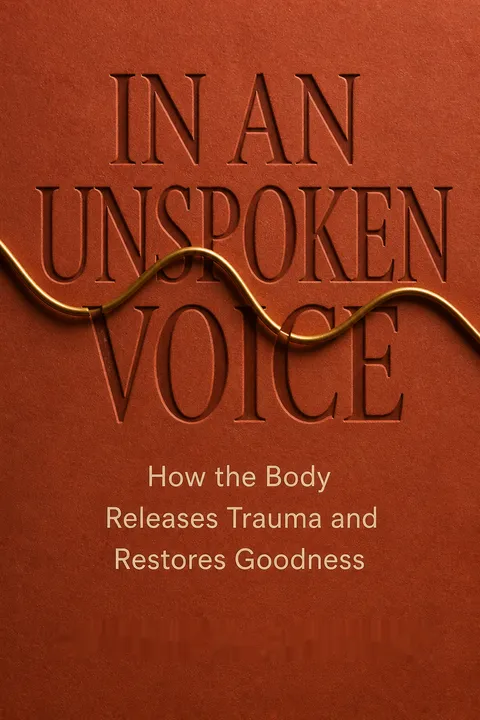
In an Unspoken Voice is widely praised for its groundbreaking approach to trauma healing through somatic experiencing. Readers appreciate Levine's insights on the body's role in trauma and recovery, though some find the writing dense or repetitive. Many report life-changing effects from applying the book's concepts. Critics note a lack of scientific rigor in some sections. The book is seen as essential reading for therapists and trauma survivors, offering hope for healing through body awareness and gentle, incremental release of blocked energy.
People Also Read





Glossary
Somatic Experiencing®
Body-based trauma approachThe therapeutic approach Peter Levine developed for addressing trauma through attention to physical sensations, emotions, and instinctive defensive responses. The practitioner supports gradual exploration rather than requiring a client to relive the traumatic event in full. Levine presents it as a way to increase self-regulation and restore a sense of agency.
tonic immobility
Involuntary shutdown under threatA defensive response in which an animal or person becomes temporarily immobile when danger is overwhelming and active escape or resistance seems unavailable. Levine uses the concept to interpret experiences of freezing, numbness, or dissociation during threat. In his model, immobility alone is not necessarily traumatic; its lasting association with fear and helplessness is central.
fear-potentiated immobility
Fear prolongs the freeze responseLevine's term for a feedback pattern in which fear intensifies or prolongs immobility. He proposes that a person who remains afraid of bodily sensations associated with freezing may experience those sensations as further evidence of danger, reinforcing shutdown. Therapy aims to make the sensations tolerable and separate them from overwhelming fear.
titration
Gradual contact with distressA stepwise way of approaching intense sensations or emotions in small amounts, with pauses for stabilization. Levine compares it to controlling a chemical reaction drop by drop rather than combining reactive substances all at once. In trauma work, titration is intended to reduce the risk of overwhelm and allow a person to remain aware while difficult experience shifts.
pendulation
Rhythm between distress and easeLevine's term for a felt movement between states of contraction and expansion, or between distress and relative comfort. In his approach, a client attends briefly to a difficult sensation, then notices an area or experience that feels safer. This rhythm is meant to show that distress can change rather than remain fixed.
SIBAM
Map of five experience channelsLevine's framework for tracking five aspects of experience: Sensation, Image, Behavior, Affect, and Meaning. A therapist and client may notice bodily sensations, sensory impressions, observable movement, emotional feeling, and the interpretation attached to them. The model encourages attention to how these elements interact, instead of assuming that verbal explanation captures the whole experience.
neuroception
Unconscious assessment of safetyA term associated with Stephen Porges's polyvagal theory that Levine uses for the nervous system's automatic assessment of cues of safety or danger. The assessment is described as occurring without deliberate conscious reasoning and as influencing whether a person engages socially, mobilizes for action, or shifts toward shutdown.
premature cognition
Meaning imposed before sensation unfoldsLevine's term for arriving too quickly at an explanation or judgment before a person has attended to the sensations, movements, and feelings of an experience. He argues that immediate interpretation can interrupt exploration and reinforce familiar conclusions. In his method, new meaning is encouraged to emerge after the person has stayed with bodily experience.
dynamic equilibrium
Flexible return to balanceLevine's term for the nervous system's active, shifting process of returning toward balance after arousal. Unlike a static state, it involves movement between activation and settling while maintaining an overall capacity for relaxed alertness. He connects this flexibility with self-regulation, resilience, and renewed engagement with the present.
FAQ
What's In an Unspoken Voice about?
- Focus on Trauma Healing: In an Unspoken Voice by Peter A. Levine explores how trauma affects the body and mind, emphasizing that trauma is not a disease but an injury that can be healed by understanding and addressing bodily sensations.
- Somatic Experiencing Method: The book introduces Levine's method, Somatic Experiencing®, which helps individuals reconnect with their bodies to release trauma and restore resilience.
- Integration of Science and Experience: Levine combines insights from biology, neuroscience, and personal therapeutic experiences to provide a comprehensive understanding of trauma and healing.
Why should I read In an Unspoken Voice?
- Innovative Approach to Trauma: This book offers a fresh perspective on trauma treatment, moving beyond traditional talk therapies to emphasize the importance of bodily awareness and sensations.
- Accessible and Engaging: Levine writes in an engaging style that makes complex scientific concepts accessible to both professionals and laypeople, making it a valuable resource for anyone interested in healing.
- Practical Tools for Healing: Readers will find practical exercises and insights that can be applied in their own lives or therapeutic practices, enhancing their understanding of trauma and recovery.
What are the key takeaways of In an Unspoken Voice?
- Trauma as an Injury: Levine posits that trauma should be viewed as an injury rather than a disorder, which shifts the focus of treatment towards healing rather than managing symptoms.
- Importance of the Body: The book emphasizes that the body holds the key to understanding and releasing trauma, advocating for a somatic approach to therapy.
- Role of Connection: The significance of social engagement and connection in healing from trauma is highlighted, underscoring the need for supportive relationships during recovery.
What is Somatic Experiencing® as described in In an Unspoken Voice?
- Body-Centered Approach: Somatic Experiencing® is a therapeutic approach developed by Levine that focuses on bodily sensations to help individuals process and release trauma.
- Awareness of Physical Sensations: The method encourages clients to become aware of their physical sensations and feelings, allowing them to reconnect with their bodies and facilitate healing.
- Gradual Process: It involves a gradual process of titration and pendulation, where clients learn to navigate their sensations without becoming overwhelmed, ultimately restoring their sense of agency and resilience.
How does Levine define trauma in In an Unspoken Voice?
- Trauma as an Injury: Levine defines trauma as an injury caused by fright, helplessness, and loss, rather than a mental disorder, which reframes the understanding of trauma in a more biological context.
- Impact on the Body: He explains that trauma manifests in the body and can lead to a range of physical and emotional symptoms if not properly addressed.
- Healing Through the Body: The healing process involves attending to the body's wisdom and allowing the natural responses to trauma to unfold, leading to recovery and restoration.
What is the significance of the Polyvagal Theory in In an Unspoken Voice?
- Understanding Nervous System Responses: Levine incorporates Polyvagal Theory to explain how different branches of the autonomic nervous system respond to threats, influencing behaviors and emotional states.
- Social Engagement System: The theory highlights the role of the social engagement system in regulating emotions and fostering connections, which are crucial for healing from trauma.
- Hierarchy of Responses: It describes a hierarchy of responses to danger, where immobilization is the last resort when fight or flight are not viable options, emphasizing the importance of understanding these responses in therapy.
How does trauma affect the body according to In an Unspoken Voice?
- Physical Manifestations of Trauma: Levine explains that trauma can lead to various physical symptoms, including chronic pain, tension, and disconnection from bodily sensations.
- Nervous System Dysregulation: Trauma can dysregulate the autonomic nervous system, leading to either hyperarousal (anxiety, panic) or hypoarousal (numbness, dissociation).
- Embodiment and Healing: The book emphasizes that reconnecting with the body and its sensations is essential for healing trauma, allowing individuals to process their experiences and restore balance.
What role does awareness play in healing trauma in In an Unspoken Voice?
- Foundation for Healing: Awareness is presented as a crucial component of the healing process, allowing individuals to recognize and understand their bodily sensations and emotions.
- Mind-Body Connection: Levine highlights that awareness fosters a deeper connection between the mind and body, enabling individuals to process trauma more effectively.
- Empowerment Through Self-Discovery: By cultivating awareness, individuals empower themselves to take control of their healing journey, building resilience and a sense of agency.
How does In an Unspoken Voice address the mind-body connection?
- Interconnectedness of Body and Mind: Levine argues that trauma affects both the body and mind, and healing requires addressing both aspects simultaneously.
- Somatic Awareness: The book emphasizes the need for somatic awareness, where individuals learn to listen to their bodies and understand the messages they convey about their emotional states.
- Therapeutic Integration: By integrating body-oriented practices into therapy, clients can achieve a more holistic understanding of their experiences, leading to deeper healing and transformation.
How does In an Unspoken Voice address the relationship between trauma and spirituality?
- Spiritual Awakening Through Trauma: Levine discusses how trauma can serve as a catalyst for spiritual growth and transformation, leading to profound insights and a deeper connection to oneself and the universe.
- Integration of Experiences: The book emphasizes that integrating traumatic experiences can lead to a greater sense of purpose and meaning in life, often accompanied by feelings of compassion, peace, and wholeness.
- Embodiment of Spirituality: Levine argues that true spirituality is rooted in the body and its sensations, allowing individuals to access deeper spiritual experiences and a sense of oneness with the world.
What are some practical exercises suggested in In an Unspoken Voice?
- “Voo” Sound Exercise: Levine suggests making a prolonged “voo” sound to stimulate the vagus nerve and promote relaxation, helping to reconnect with bodily sensations.
- Pendulation and Titration: He emphasizes the importance of pendulation (moving between discomfort and comfort) and titration (gradually approaching difficult sensations) to help clients process trauma safely.
- Body Awareness Practices: Exercises that involve gentle movements, such as running in place or using resistance against a therapist's hand, are recommended to help clients reconnect with their bodies and restore a sense of agency.
How can therapists apply the concepts from In an Unspoken Voice in their practice?
- Focus on Bodily Sensations: Therapists are encouraged to help clients become aware of their bodily sensations and to use these as a gateway to process trauma.
- Utilize Somatic Experiencing® Techniques: Incorporating techniques from Somatic Experiencing®, such as titration and pendulation, can help clients navigate their experiences without becoming overwhelmed.
- Create a Safe Environment: Establishing a safe and supportive therapeutic environment is crucial for clients to feel secure enough to explore their sensations and emotions, facilitating the healing process.
About the Author


Download PDF
Download EPUB
.epub digital book format is ideal for reading ebooks on phones, tablets, and e-readers.








