

Key Takeaways
Let anomalies widen psychology without forcing a supernatural verdict.
Experience came first. Jung grew up hearing accounts of uncanny events, then witnessed a family table split and a bread knife shatter inside a closed cupboard. These incidents unsettled his scientific assumptions and helped draw him toward psychiatry. As a student, he studied trance states in a seance circle led by his cousin. He later caught her attempting to fake some effects, yet considered her shifting personalities valuable evidence about the psyche.
Stay with the uncertainty. Jung’s work began with a practical question: could apparently paranormal events reveal something about mental life, even if their physical cause remained unknown? His account moves between what he experienced, what he inferred, and what he could not explain. That distinction is essential: an event can be psychologically consequential without proving a supernatural cause.
What's compelling is Jung's willingness to let unsettling experiences complicate a theory instead of dismissing them to protect it. That resembles good clinical practice: first describe what happened and how it affected someone, then separate observation from interpretation. The same discipline matters in research on unusual experiences, where ridicule can suppress useful reports and credulity can turn weak evidence into certainty. Jung's own stories are retrospective accounts, however, not controlled demonstrations. Their value is strongest as records of how anomalous experiences shaped a psychologist's questions.
Separate the experience of spirits from claims about spirits' independent existence.
Two kinds of complexes. Jung proposed that the personal unconscious contains forgotten, repressed, or unnoticed material from an individual’s life. He called the deeper, shared layer the collective unconscious, whose inherited patterns are not acquired through personal experience. In this model, a spirit encounter might express an autonomous complex: a mental pattern experienced as separate from the conscious self. A personal complex can feel like part of oneself returning; a collective one can feel strange, powerful, and alien.
His certainty shifted. Jung initially treated mediumistic phenomena chiefly as psychological material and said he lacked proof that spirits existed independently. After decades of reports and experiences, he became less confident that psychology alone could explain them. Yet he still distinguished a compelling experience from reliable evidence for its literal interpretation.
This distinction remains useful well beyond paranormal claims. People can experience voices, presences, or vivid dream figures as independent agents, while explanations range from ordinary memory and dissociation to religious belief. Taking the experience seriously does not require prematurely deciding what caused it. Jung's model offers a vocabulary for studying the mind's apparent multiplicity, though its collective unconscious is a theoretical interpretation, not a directly observed storehouse. The careful question is what the experience means to the person and what evidence could distinguish competing accounts.
Use synchronicity for meaningful parallels that ordinary cause-and-effect cannot yet explain.
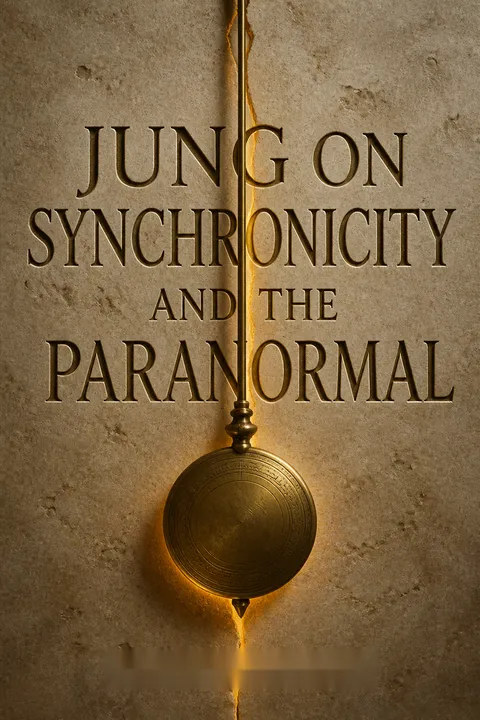
A coincidence with meaning. Jung used the term synchronicity for a meaningful coincidence between events that appear to have no ordinary causal connection. His best-known example comes from therapy: a patient described a dream about receiving a golden scarab. At that moment, a beetle struck the window. Jung opened it, caught the insect, and connected it to the dream. The startling parallel disrupted the patient’s rigid rationalism and helped the therapy move forward.
Not just simultaneity. Jung also included distant events verified afterward and dreams that seemed to anticipate future events. Across these cases, he emphasized the experiencer’s sense that the events belonged together. The term names that puzzling relationship; it does not identify a mechanism or, by itself, establish that a paranormal force produced it.
The scarab episode shows why coincidences can matter even when their cause is unclear: a well-timed event can change what someone is able to consider. In psychology, an unexpected image or event can function as a powerful prompt for reinterpretation, much like a metaphor that loosens a fixed belief. But significance to a person is not the same as evidence of an external connection. The most useful reading preserves both facts: the encounter affected the patient, and its apparent improbability does not alone prove acausality.
Look for archetypal meaning where coincidence meets emotional crisis.
A shared pattern, not a picture. Jung called archetypes inherited forms or tendencies that shape recurring human experiences and images. They are not fixed pictures stored in the mind; they are patterns that can take different forms across dreams, myths, and events. Jung thought they became especially active when someone reached a psychological impasse or faced danger, loss, or major change. Their emotional force, which he called numinosity, could make a coincidence feel more than ordinary chance.
A possible function. In therapy, a surprising parallel might challenge a one-sided conscious attitude and open a new response. Jung linked this to individuation, his term for the development of a more integrated personality. He also connected emotional intensity to Rhine’s finding that extrasensory-perception scores tended to weaken as experiments continued and participants lost interest.
Jung's account gives emotion a central role: people notice and remember coincidences not just because they are rare, but because they arrive when a question is already pressing. This connects with contemporary work on salience and memory, where emotionally charged events receive extra attention and are more readily woven into personal narratives. That makes such moments psychologically informative, but also vulnerable to selective recall. An archetypal interpretation can illuminate a person's concerns; it should not be treated as the only possible explanation for the event.
Jung's 483 marriages produced astrological-looking maxima, not proof astrology works.
A curious statistical pattern. Jung and a collaborator examined 483 pairs of marriage horoscopes in three batches. They compared 50 combinations of planetary positions and other horoscope points. In each batch, the most frequent result matched a traditional astrological expectation involving the moon: once with the sun, once with another moon, and once with the ascendant. Jung found the pattern striking because the figures fell within what chance could produce individually, yet together resembled the traditional rule.
Not a validation. Jung interpreted this as a synchronistic arrangement, not proof that astrology predicts marriage. The findings depended on how material arrived, how it was divided into batches, and which patterns were highlighted. The editor’s introduction notes that the statistical treatment and its conclusions are open to criticism. The experiment is most revealing as an example of Jung’s attempt to study meaningful chance.
This experiment is valuable partly because it exposes the difficulty of testing a claim when many possible patterns can be selected after seeing the data. Modern statistical practice treats that flexibility as a serious source of false positives: an unusual result is less persuasive if the analyst had many chances to find one. Jung's interest in chance patterns is intellectually fertile, but the study cannot establish that astrology works or that acausal meaning arranged the results. The distinction between an intriguing anomaly and a robust, independently replicated effect is crucial.
Use oracles as reflective instruments, not reliable forecasts.
The moment as a picture. Jung used the Chinese I Ching, or Book of Changes, by casting coins or dividing stalks to produce a hexagram, a figure made of six lines. He then read its traditional text in relation to a question. He thought the random result could reflect the character of the moment and the questioner’s situation, rather than provide a causal prediction. One reason the method interested him was that its interpretation invited attention to the whole situation, including details Western analysis might dismiss as irrelevant.
Interpretation remains central. Jung found answers that seemed personally apt and valued Richard Wilhelm’s translation and commentary. He also acknowledged that judgments of an oracle’s accuracy depend heavily on the observer’s interpretation and on what happens afterward. The method can prompt reflection, but the source does not provide a basis for treating it as a dependable forecasting technology.
An oracle can work as a structured pause: it interrupts habitual reasoning and gives a person an unfamiliar image to think with. In that sense, the I Ching resembles projective methods used in therapy, where an ambiguous prompt helps surface concerns the person already carries. The benefit is reflective rather than predictive. Because interpretations are flexible, apparent hits can be easier to remember than misses. Keeping a record of predictions before outcomes are known would make any claim of forecasting more testable.
Use physics as analogy, not borrowed proof for paranormal claims.
A bridge Jung hoped for. Jung drew on J. B. Rhine’s card-guessing and dice experiments, which were presented as evidence for extrasensory perception and psychokinesis. He also discussed Einstein’s relativity and quantum physics with physicists including Wolfgang Pauli. These ideas suggested to him that space, time, and cause might not apply to every psychological event in the familiar way. He treated synchronicity as a possible complement to causal explanation, not simply a replacement for it.
The inference is disputed. Statistical unpredictability in physics does not by itself prove acausality, and findings at the subatomic scale do not automatically establish paranormal effects in everyday life. The introduction stresses these gaps in Jung’s reasoning. His comparisons are best read as attempts to ask whether psychology and physics share conceptual problems, not as scientific confirmation that they do.
Cross-disciplinary work is most productive when it transfers questions, not prestige. Physics can challenge overly simple assumptions about observation and prediction, but technical terms such as uncertainty or complementarity do not validate unrelated claims merely by resemblance. Jung and Pauli explored a genuine philosophical puzzle: how the observer belongs in a description of nature. The caution is that a useful analogy is not a demonstrated mechanism. Keeping that line visible lets the dialogue between fields remain ambitious without making physics carry evidence it has not supplied.
Let near-death visions inform questions, not settle what follows death.
A vivid boundary experience. During a severe illness and heart attack in 1944, Jung reported visions of seeing Earth from space and approaching a temple-like structure. He described later nights of mystical union and a sense that ordinary time had fallen away. The experience changed his outlook and strengthened his willingness to explore questions he had previously treated more cautiously. He also recounted dreams and impressions that seemed to anticipate deaths or events, while admitting that such experiences could be misread.
Experience is not proof. Jung argued that reports of precognition and perceptions during apparent unconsciousness challenge easy assumptions about the psyche’s limits. He did not claim that they conclusively establish survival after death. His position was that such experiences invite serious attention while leaving the ultimate question unresolved.
Near-death experiences can transform a person’s beliefs and priorities regardless of whether they reveal an afterlife. That distinction allows respect for the experience without confusing its intensity with independent verification. Neuroscience and clinical research can investigate memory, perception, and altered states, while philosophy can ask what counts as evidence of personal continuity. Jung’s restraint is strongest when he treats visions as clues and weakest when he moves from unusual reports toward claims about a reality beyond space and time. The unanswered question deserves neither mockery nor premature certainty.
Read UFO reports as uncertain events carrying unmistakable cultural meaning.
Two questions at once. Jung could not determine whether UFOs were physical objects, psychological projections, or some combination. Reports of sightings and radar echoes raised a physical question; the flood of speculation and vivid imagery raised a psychological one. He proposed that an unexplained phenomenon could provide a surface onto which people project powerful shared images. In his view, UFO stories gained force amid political conflict and weakening religious certainty, when people might be especially receptive to images of rescue, unity, or a mediator from beyond Earth.
Meaning is not identification. Jung treated the cultural response as worthy of study even while the objects’ physical nature remained uncertain. A mythic interpretation can help explain why reports grip the imagination, but it cannot decide whether a particular sighting involved an actual craft.
This is a durable way to study extraordinary public stories: separate whether an event occurred from why a society finds it compelling. Cultural analysis can explain the appeal of a savior image without proving that the reported object is imaginary. Conversely, testimony and radar reports do not automatically establish the grand interpretations attached to them. Jung's approach invites researchers to hold both inquiries open. Its limitation is that mythic symbolism can become too elastic if every detail is made to fit a preferred cultural diagnosis.
Analysis
This collection is not a single argument unfolding in a straight line. It is a curated path through Jung’s experiences, clinical observations, letters, and speculative essays, with synchronicity as its organizing question. The narrative begins with childhood stories and startling household incidents, moves through mediumship and therapeutic practice, then expands toward divination, physics, death, and UFOs. That breadth gives the reader a sense of why the problem mattered to Jung: it was not a decorative interest, but a challenge to his picture of the psyche and its relation to the world.
The most useful contribution is methodological rather than evidentiary. Jung asks readers to notice the psychological importance of unusual events without immediately reducing them to fraud, illness, or supernatural fact. His distinction between experience and explanation remains valuable, as does his attention to the role of emotion, personal crisis, and cultural imagery. The scarab encounter captures the strength of this stance: its therapeutic effect is intelligible even if its alleged acausal connection remains unproven.
The central weakness is the leap from meaningful experience to a general principle of acausality. Jung’s appeal to physics and parapsychological experiments offers suggestive parallels, but the parallels do not establish that psychic meanings organize external events. His astrological experiment makes the methodological problem especially visible: an unusual pattern can be compelling while still being compatible with chance, flexible analysis, and retrospective interpretation. The collection is strongest when it presents synchronicity as a lens for asking questions and weakest when the lens is treated as an explanation.
Read this work as a map of an intellectual boundary, not a scientific verdict. It shows how a psychologist tried to make room for experiences that his era’s dominant models struggled to describe. Its lasting invitation is disciplined openness: investigate anomalies carefully, take their human meaning seriously, and keep the difference between possibility, interpretation, and proof unmistakable.
Review Summary
Jung on Synchronicity and the Paranormal receives mostly positive reviews, with readers praising Jung's exploration of paranormal experiences and synchronicity. Many find the book fascinating, offering insights into Jung's thoughts on spirituality, quantum mechanics, and the limitations of rationalistic science. Readers appreciate Jung's personal anecdotes and informal writing style in letters. Some find parts of the book challenging to read, particularly the academic sections. Overall, reviewers value the book for its unique perspective on unexplained phenomena and Jung's contributions to psychology and parapsychology.
People Also Read





Glossary
Synchronicity
Meaningful coincidence without known causeJung’s term for a meaningful correspondence between events that appear causally unrelated. The correspondence may link a person’s inner experience, such as a dream, with an external event, or include distant and apparently precognitive events. Synchronicity describes the perceived relationship; it does not identify a verified mechanism or prove that paranormal forces caused it.
Archetype
Inborn pattern shaping experienceA recurring, inherited pattern that Jung believed structures human experience and imagery. An archetype is not a fixed picture or learned idea. It can appear through different symbols in dreams, myths, emotions, and situations. Jung proposed that archetypes belong to the collective unconscious and can become especially active during emotionally charged periods or psychological crises.
Collective unconscious
Shared inherited psychic patternsJung’s name for a layer of the unconscious whose contents are not acquired through an individual’s personal experiences. He associated it with inherited forms and instincts that shape recurring patterns of thought and imagery across people and cultures. He distinguished it from the personal unconscious, which contains forgotten, repressed, or unnoticed material from an individual life.
Personal unconscious
Unnoticed material from one lifeThe part of the unconscious that Jung associated with an individual’s own history. It includes forgotten memories, subliminal impressions, weak or unformed thoughts, and material incompatible with the person’s conscious outlook. Jung contrasted it with the collective unconscious, whose archetypal patterns are not formed from personal experience.
Numinosity
Powerful sense of sacred forceThe compelling emotional charge Jung associated with certain experiences, images, or archetypes. A numinous event may feel fascinating, frightening, sacred, or unusually authoritative. Jung treated this intensity as psychologically important and often connected it with an activated archetype. Strong numinosity describes the force of an experience, not proof that its supernatural interpretation is true.
Individuation
Development toward psychic integrationJung’s term for the process through which a person develops a more integrated relationship among conscious and unconscious parts of the psyche. It is not simply social adjustment or steady, linear self-improvement. Jung understood dreams, symbols, and compensating unconscious material as possible contributors to this development, especially when a person’s conscious attitude has become one-sided.
Psychoid
Archetypal aspect beyond psycheJung used this term for a hypothetical aspect of archetypes that cannot be described as purely mental. He proposed it to express the possibility that archetypal patterns might be related to both psychic and physical processes while belonging fully to neither. The psychoid is a speculative concept, not an experimentally established substance or mechanism.
unus mundus
Hypothesized unity beneath realityA Latin phrase meaning one world, used by Jung for a proposed underlying unity from which psychic and physical events might emerge. He connected the idea with synchronistic correspondences, which appear to link mind and matter without ordinary causation. The unus mundus is a metaphysical hypothesis intended to imagine a common ground, not a demonstrated description of nature.
Decline effect
Results weaken with repetitionIn Jung’s discussion of J. B. Rhine’s parapsychology experiments, the decline effect refers to the reported tendency for successful results to be stronger early in an experimental session and to diminish as participants’ interest, optimism, or emotional engagement faded. Jung interpreted this as evidence that affective conditions might matter. The pattern alone does not establish a paranormal cause.
FAQ
What is "Jung on Synchronicity and the Paranormal" by C.G. Jung about?
- Exploration of the Paranormal: The book delves into Jung’s lifelong investigation of paranormal phenomena—events that defy conventional rational explanation—and their impact on his psychological theories.
- Central Theory of Synchronicity: It introduces and elaborates on Jung’s theory of synchronicity, which describes meaningful coincidences that lack a causal relationship.
- Integration of Diverse Disciplines: Drawing from Jung’s letters, essays, and collaborations, the book weaves together insights from psychology, parapsychology, physics, alchemy, and esoteric traditions.
- Personal and Historical Context: The narrative is enriched by Jung’s personal experiences and the scientific developments of his era, providing a comprehensive view of his evolving ideas.
Why should I read "Jung on Synchronicity and the Paranormal" by C.G. Jung?
- Unique Psychological Perspective: The book offers a rare, rigorous attempt to make sense of paranormal phenomena within a psychological framework, blending scientific inquiry with openness to mystery.
- Broad Relevance: Jung’s writings have influenced psychotherapists, parapsychologists, spiritual seekers, and general readers, making this a foundational text for anyone interested in the intersection of psychology and the paranormal.
- Historical and Scientific Depth: It situates Jung’s ideas within the context of quantum physics, parapsychological experiments, and his collaborations with figures like Wolfgang Pauli, adding credibility and depth.
- Insight into Archetypes and the Unconscious: Readers gain a deeper understanding of Jungian concepts such as archetypes, the collective unconscious, and the mind-body relationship.
What are the key takeaways from "Jung on Synchronicity and the Paranormal" by C.G. Jung?
- Synchronicity as Acausal Principle: Jung’s theory of synchronicity challenges the dominance of causality by proposing that meaningful coincidences can occur without causal links.
- Paranormal Phenomena as Meaningful: Events like telepathy, precognition, and hauntings are explored as manifestations of the collective unconscious and synchronistic principles.
- Bridging Science and Spirituality: The book argues for a unified reality (unus mundus) underlying both psyche and matter, drawing parallels between psychology and modern physics.
- Therapeutic and Spiritual Implications: Synchronicity is shown to have practical significance in psychotherapy and spiritual experience, offering new ways to understand transformation and individuation.
How does C.G. Jung define synchronicity in "Jung on Synchronicity and the Paranormal"?
- Meaningful Coincidence: Synchronicity is defined as the occurrence of meaningful coincidences in time that lack a causal relationship but are connected by meaning.
- Acausal Connecting Principle: It is presented as an acausal principle that complements causality, accounting for connections based on shared meaning rather than cause and effect.
- Three Forms of Synchronicity: Jung identifies three types: simultaneous psychic and objective events, psychic states reflecting distant events, and present psychic states corresponding to future events.
- Empirical and Philosophical Basis: The concept is supported by personal experiences, parapsychological research, and philosophical influences from quantum physics and Chinese philosophy.
What role do archetypes play in Jung’s theory of synchronicity in "Jung on Synchronicity and the Paranormal"?
- Source of Shared Meaning: Archetypes are collective unconscious patterns that provide the shared meaning necessary for events to be considered synchronistic.
- Emotional and Numinous Charge: The activation of archetypes during synchronistic events is accompanied by a powerful emotional intensity, making these experiences especially significant.
- Facilitation of Individuation: Synchronicities involving archetypes help individuals overcome psychological impasses and support the process of individuation by bringing unconscious material to consciousness.
- Manifestation in Both Psyche and Matter: Archetypes can appear in both psychic experiences and physical events, reinforcing the unity of psyche and matter.
How does "Jung on Synchronicity and the Paranormal" relate astrology and the I Ching to synchronicity?
- Astrology as Qualitative Time: Jung interprets astrology as reflecting the quality of moments in time, not as a causal science, but as a system of meaningful correspondences.
- I Ching as Experimental Tool: He uses the I Ching as a practical method for generating synchronistic experiences, finding that its oracular answers often align meaningfully with the questioner’s state.
- Divinatory Rather Than Scientific: Both astrology and the I Ching are seen as divinatory systems that illustrate the dynamics of synchronicity rather than operating through causal mechanisms.
- Psychic Participation: Jung’s experiments suggest that the psychic involvement of the practitioner plays a crucial role in the effectiveness of these systems.
What evidence from parapsychology does Jung use to support synchronicity in "Jung on Synchronicity and the Paranormal"?
- J.B. Rhine’s ESP Experiments: Jung references Rhine’s card-guessing and psychokinesis studies, which produced statistically significant results that challenge conventional causality.
- Transcending Space and Time: These experiments suggest that psychic phenomena can operate independently of normal spatial and temporal constraints.
- Emotional State Influence: Jung notes that the success of such phenomena often depends on the subject’s emotional state, such as faith or optimism.
- Empirical Support for Acausality: The findings provide empirical grounding for the existence of acausal connections in nature.
How does C.G. Jung’s personal experience influence his views in "Jung on Synchronicity and the Paranormal"?
- Early Exposure to the Paranormal: Jung’s family background included stories of ghosts and clairvoyance, and his own childhood experiences fostered openness to the paranormal.
- Mediumship and Seances: His doctoral research on mediumistic trance phenomena, particularly involving his cousin, shaped his understanding of the unconscious and psychic dissociation.
- Critical Life Events: Paranormal events marked significant moments in Jung’s life, such as his break with Freud and his near-death experience, reinforcing his belief in the meaningfulness of such phenomena.
- Motivation for Theoretical Work: These personal experiences motivated Jung to develop his theory of synchronicity and explore its implications for psychology.
How does "Jung on Synchronicity and the Paranormal" address the relationship between psyche, matter, and physics?
- Psychophysical Unity: Jung proposes that psyche and matter are not fundamentally separate but share a common underlying reality, which he calls the unus mundus.
- Influence of Modern Physics: He draws on quantum mechanics and relativity to argue that space, time, and causality are relative, allowing for phenomena that transcend these categories.
- Energy Analogy: Jung uses the concept of energy metaphorically to describe psychic activity, suggesting that psychic and physical energies may be different manifestations of a single source.
- Bridging Science and Psychology: The book attempts to bridge the gap between scientific and psychological explanations of reality.
What is the significance of paranormal phenomena like ghosts, mediumship, and UFOs in "Jung on Synchronicity and the Paranormal"?
- Manifestations of the Unconscious: Jung sees ghosts and apparitions as archetypal figures from the unconscious that can sometimes have physical effects.
- Mediumship as Psychological Phenomenon: He emphasizes the role of trance states and lowered conscious control in facilitating the emergence of archetypal content during mediumship.
- UFOs as Modern Myths: Jung interprets UFO phenomena as synchronistic events with both psychic and possible physical components, reflecting collective unconscious processes and mythic symbolism.
- Scientific Challenges: He acknowledges the difficulty of scientifically verifying such phenomena but considers them crucial for understanding the psyche’s relation to matter.
How does "Jung on Synchronicity and the Paranormal" address visions, altered states, and the possibility of life after death?
- Visions as Archetypal Encounters: Jung describes his own visionary experiences as encounters with archetypal images, often involving symbolic death and rebirth.
- Transcendence of Space and Time: He suggests that parts of the psyche can operate beyond normal space-time constraints, as seen in near-death experiences and precognitive dreams.
- Continuity of Psyche: While empirical proof is lacking, Jung entertains the possibility that the psyche continues after physical death, supported by parapsychological evidence and symbolic dreams.
- Spiritual and Psychological Implications: These experiences highlight the depth and complexity of the unconscious and its potential for transformation.
What are the main criticisms and philosophical implications of Jung’s theory of synchronicity in "Jung on Synchronicity and the Paranormal"?
- Empirical and Metaphysical Tensions: Critics argue that some aspects of Jung’s theory, such as the psychoid archetype, cross into metaphysics and are difficult to empirically verify.
- Challenge to Causality: Synchronicity questions the absolute validity of causality, suggesting the need for a broader scientific and philosophical framework.
- Simultaneity and Psychic States: Jung’s insistence on simultaneity in synchronicity is problematic, especially for precognitive events, complicating the concept’s application.
- Unity of Psyche and Matter: The theory supports a monistic view of reality, emphasizing the importance of meaning and archetypes as organizing principles for both psychic and physical phenomena.
About the Author
Other books by C.G. Jung





Download PDF
Download EPUB
.epub digital book format is ideal for reading ebooks on phones, tablets, and e-readers.








