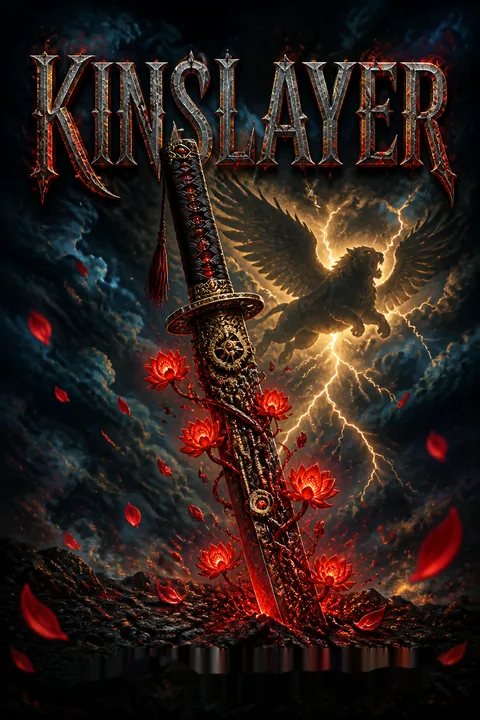


Plot Summary
Prologue
Fifty-five days after Yukiko killed Shōgun Yoritomo, Shima is caught between rebellion and civil war. The Kagé reveal that the blood lotus fertilizer sustaining the Imperium is made from the remains of murdered gaijin prisoners. Riots erupt, then Iron Samurai suppress them.
Yukiko returns on Buruu to urge the people of every capital to resist. Meanwhile, Kin abandons the Lotus Guild and treks through the wilderness to find her, haunted by the future shown to him during his Awakening and by the metal identity he has cast off.
The opening makes revolution both moral awakening and political danger. The revelation about inochi contaminates the empire’s ordinary comforts with the violence used to sustain them, while the sudden suppression of the riots shows that public outrage alone cannot dislodge entrenched power. Yukiko becomes a symbol before she has learned how to carry that burden. Kin’s journey supplies the counterpoint: he has already crossed the boundary between obedience and resistance, but still grieves the certainty and belonging his old life offered. The frame promises a story about what rebellion costs its chosen symbols and its less visible converts.
Three Ironclads Fall
A Guild fleet hunts Kin through the Iishi Mountains, driving him toward the Kagé refuge with incendiary bombs and shuriken fire. Yukiko and Buruu attack from the sky, using lightning, claws, and a flare to destroy three ironclads. They spare the surviving young Guildsman, though Yukiko nearly kills him while warning the Guild to stay away from her father’s memory.
Kin is badly wounded, but he has finally reached the people he crossed Shima to find. His return exposes the immediate cost of his defection: the Guild considers him valuable enough to pursue, while Yukiko’s retaliation shows how grief has sharpened her into a feared weapon.
The aerial ambush reverses the Guild’s usual relation to technology: its weapons cannot protect it from a creature that refuses the empire’s categories of machine and beast. Yet Yukiko’s mercy is precarious. She leaves the survivor alive, but her threat makes clear that restraint now coexists with a capacity for violence she barely recognizes. Kin’s rescue also complicates the victory. He has escaped the Guild’s command, not its reach, and the destroyed ships will make his refuge a more dangerous place. The scene establishes that rebellion’s first victories can enlarge the enemy’s attention rather than secure safety.
A Mark Burned Away
At the Kagé refuge, Yukiko asks Daichi to burn Yoritomo’s tattoo from her shoulder, rejecting the mark that made her the Shōgun’s servant. The ritual forces her to confront memories of Hiro and her father’s death, but grief remains locked behind rage. Then Kaori reports that Hiro survived their arena fight, now seeks the Tiger leadership with Guild support, and will marry Yoritomo’s sister, Aisha, to claim the throne.
The news overwhelms Yukiko’s already painful Kenning. Birds smash themselves against her room as her uncontrolled thoughts flood their minds. She emerges shaken, newly aware that her gift is changing, while Hiro’s survival turns the struggle into a race against a royal wedding.
The removal of the tattoo is an attempt to reclaim the body from political ownership, but it cannot erase what the body remembers. Yukiko treats pain as preferable to carrying Yoritomo’s mark, a choice that reveals both agency and self-punishment. The birds’ deaths make the Kenning’s expansion materially dangerous: her inner distress no longer stops at the boundary of her own mind. Hiro’s survival then binds private trauma to public succession. Yukiko’s unfinished grief is not a separate emotional subplot; it affects her ability to act safely at precisely the moment the Guild is rebuilding the order she helped shatter.
A New Guild Refugee
Kin and Yukiko renew their bond at Masaru’s grave, where Kin admits how much he missed her and Yukiko returns his kiss, though she cannot yet trust what she feels. Their moment ends when scouts find a trapped Guild creation. The creature is Ayane, a female False-Lifer who has fled a life of engineered service and traveled from Yama to join Kin.
Yukiko fears the newcomer may be a spy, and the Kagé council argues over whether to kill her. Daichi permits Ayane to live, but keeps her confined. As Yukiko’s Kenning begins reaching beyond animals toward human minds, Daichi points her toward a remote monastery said to preserve its mysteries.
Ayane’s arrival tests the distinction between a person’s origin and allegiance. The Kagé oppose the Guild’s dehumanizing system, yet their first impulse is to judge its escaped victim as an extension of that system. Kin recognizes in Ayane a version of his own rupture, but Yukiko’s suspicion is understandable after her betrayal by Hiro. Their brief intimacy cannot settle the question of trust because Yukiko is still using alcohol and anger to mute her changing power. Daichi’s decision to spare Ayane marks a small ethical correction, while the monastery offers Yukiko a way to seek knowledge rather than simply endure symptoms.
No One Enters Court
In Kigen, Hana works as a despised palace servant and uses the name No One inside the Kagé network. Her invisibility gives her access to Aisha’s imprisoned attendants, whom she contacts through notes slipped beneath a door. She learns that Hiro’s wedding is approaching and that Aisha cannot leave her guarded rooms.
After a raid destroys the Kuro Street safe house, Hana helps the wounded Akihito escape and hides him with her brother Yoshi and Yoshi’s lover, Jurou. Akihito recognizes her courage and tells her about Yukiko, while Hana’s own memories show why she distrusts the empire. Her double life now carries information the scattered rebels urgently need.
Hana’s low status functions as camouflage, but the disguise is built from an actual social injury: people ignore her because they believe she is beneath notice. She turns contempt into access without mistaking access for power. Her secret work also exposes the gap between heroic rebellion and the ordinary people asked to risk themselves for it. Akihito’s presence gives her a human connection to the older Kagé struggle, while her family’s precarious shelter makes every political choice immediate. The palace is not merely a seat of government; it is an institution whose servants can move freely only because authority has already decided they do not matter.
The Library of Skin
Yukiko and Buruu reach Shabishii, where a silent monastery seems to offer the Kenning’s history. Inside its library, Yukiko discovers that the scrolls are human skin bearing the preserved knowledge of dead monks. The caretaker, Shun, and his brethren are not living scholars but nearly indestructible beings who demand part of her body as payment.
Yukiko fights them with the sword Daichi gave her, but ordinary wounds do not stop them. Buruu smashes through the roof to rescue her, and she escapes with a scroll about earlier Stormdancers. It contains legends, not instructions for controlling her power, leaving her injured and no closer to understanding its cause.
The monastery literalizes the cost of preserving knowledge: bodies become archives, and the people who seek wisdom are treated as material to be harvested. Yukiko enters expecting instruction, but finds a system that reproduces the violence she opposes under the language of tradition and payment. Her swordsmanship and Buruu’s rescue secure survival, not mastery. The scroll’s disappointing contents matter because they deny her an easy inheritance from past heroes. She must develop her own discipline rather than treat legend as a manual. The episode also teaches her that apparent sanctuaries can conceal predatory institutions as effectively as palaces or chapterhouses.
Caught by Lightning
Following a Guild craft north, Yukiko and Buruu are drawn toward the Razor Isles, where Buruu’s instincts seize control in pursuit of a female arashitora. Another male attacks, and Yukiko is thrown into the sea. Gaijin soldiers from a remote lightning farm pull her from the water and imprison her, mistaking her for a spy.
There she meets Ilyitch, the young man who saved her, and Piotr, a scarred former prisoner who speaks some Shiman. Through the dog Red, Yukiko discovers the farm captures lightning in glass vessels and maps its offshore pylons. She realizes Buruu is somewhere beyond the network, injured and alone, and begins planning her escape.
The storm pursuit turns Buruu’s animal nature from a source of strength into a rupture in the partnership. Yukiko discovers that intimacy does not mean complete knowledge or control, and the separation leaves her without the companion who has anchored her through every previous crisis. The lightning farm extends the book’s technological critique beyond Shima: the gaijin also convert natural forces into military power. Yukiko’s communication with Red offers a narrow route through captivity, but her dependence on the dog also foreshadows the ethical danger of forcing the Kenning. Survival now requires her to act without the support she has mistaken for certainty.
The Kinslayer Returns
Yukiko escapes her cell with Ilyitch’s help and crosses the storm-battered cables to reach Buruu. On the islands, she finds him fighting the nomad Skraai, while sea dragons circle beneath them. Yukiko and Ilyitch help pull the wounded Buruu from the water, and her newly forceful Kenning stills the dragons long enough for them to survive.
But Ilyitch has used her to locate the thunder tigers. He shocks both beasts with a lightning weapon, then cuts Skraai’s throat to claim his hide. Piotr turns on the soldiers to protect Yukiko, while she tries to stop Ilyitch from reaching Buruu. The rescue becomes a slaughter, and Yukiko’s trust costs her dearly.
Ilyitch’s betrayal turns the apparent rescue into a calculated act of capture. The reversal is painful because Yukiko has treated his earlier courage as proof of character, just as she once trusted Hiro’s tenderness. The scene refuses the comfort of reading kindness as permanent innocence. At the same time, Yukiko’s command over the sea dragons shows how far the Kenning has expanded, though its power cannot prevent betrayal or restore Skraai. Buruu’s old title, Kinslayer, signals that his history contains violence Yukiko does not understand. The past he buried is now active in the present, even as she fights to keep him alive.
Twins in the Storm
The female arashitora, Kaiah, initially refuses to help Buruu, whom she calls Kinslayer and blames for losses among her kind. When the gaijin threaten to kill Buruu, Yukiko attacks them through the Kenning; Kaiah descends in fury, killing the soldiers, and Piotr kills Ilyitch before he can finish her.
Piotr explains that he promised a dead Guildsman to help the rebels, and gives Yukiko the man’s letter describing a hidden anti-Guild faction. After Buruu wakes, Kaiah recognizes that Yukiko is carrying his unborn children. She agrees to travel with them for the sake of the twins, though her grief and Buruu’s past remain unresolved. Yukiko recovers her father’s dagger and begins the flight home.
This turning point makes survival depend on obligations that cross old enmities. Piotr acts from a promise to a man who once saved him, while Kaiah’s decision is directed not toward reconciliation with Buruu but toward protecting vulnerable young. Yukiko’s pregnancy reframes the Kenning’s growth as more than an individual crisis: she has been carrying new life while struggling to contain a power that can damage others. The revelation does not soften the war; it raises its stakes. Yukiko now has reason to imagine a future beyond revenge, but she must return to a country whose institutions are preparing another cycle of violence.
The Shuriken Line Breaks
While Yukiko is away, Kin converts wrecked Guild shuriken-throwers into hand-powered defenses for the Kagé refuge. The machines initially work against a force of oni, killing many before their seals fail together. The Kagé win the battle, but Daichi is crushed by the oni leader and suffers a collapsed lung.
Kin suspects sabotage, especially after seeing grease on Isao’s hands, but the villagers blame his Guild origins. Ayane uses her mechanical limbs to repair Daichi’s breathing and save his life. Instead of gratitude, she and Kin face further hostility; Isao and his allies assault Kin and threaten Ayane. The attack deepens Kin’s isolation and gives his decision about where he belongs a sharper, more dangerous edge.
The failed defense is both a practical disaster and a social verdict. Kin’s engineering saves the Kagé from an overwhelming force, yet a single failure allows the community to interpret him through inherited suspicion. His skill cannot purchase belonging because the group has not agreed on what evidence would count as trust. Ayane’s intervention complicates the same prejudice: the person most visibly associated with Guild machinery is the one who saves Daichi. The sabotage suggests that danger is not only external. The rebellion’s internal fractures threaten to reproduce the Guild’s habit of assigning guilt by category rather than judging actions.
A Robbery Becomes War
In Kigen, Yoshi uses Hana’s iron-thrower to rob Scorpion Children couriers, hoping to buy his family a way out of Downside. Jurou helps him, but Yoshi hides the scheme from Hana, who is already risking her life as No One in the palace. The gang tracks the thieves to their home and attacks. Yoshi and Hana fight back, yet the Scorpion Children seize them and torture Yoshi for information.
Their leader, the Gentleman, removes Hana’s eye in front of her brother, then orders Yoshi’s suffering prolonged. Hana’s memories reveal the wound’s earlier history: their father killed their mother and tried to gouge out Hana’s eye before Yoshi stopped him. The siblings’ shared violence becomes the measure of their loyalty and their danger.
Yoshi’s robbery is a protective act distorted by secrecy. He wants to rescue his family from poverty, but by deciding alone what risks they can bear, he recreates the controlling model he opposes in his father. The Gentleman makes that private contradiction public, using Hana’s body to punish Yoshi and force him to witness his failure. Hana’s recovered memory links the gang’s violence to the violence inside her childhood home, showing how the same act of protection can become both love and trauma. Her hidden eye also makes identity a material vulnerability in a society that polices ancestry and belonging.
The Eye Revealed
Hana turns the Scorpion Children’s tools against Seimi, stabbing him in the neck with pliers when he prepares to torture Yoshi. Her exposed eye shines rose-colored, revealing the gaijin ancestry she has spent years concealing. The fight leaves both siblings badly hurt, and the gang’s retaliation has already killed Jurou.
Akihito reaches them during the Kagé assault on Kigen and helps them escape the warehouse. Hana grieves Daken, who dies protecting her, while Yoshi must face the consequences of the secret robbery that brought the gang to them. Akihito takes the siblings with him toward the rebellion, and Hana leaves the life she tried to protect behind.
Hana’s eye becomes visible only when concealment can no longer keep her safe. The revelation does not make her powerful by itself; what matters is the choice she makes while the gang has her brother in its grasp. Her defense of Yoshi echoes his defense of her in childhood, but now she acts with deliberate force rather than helpless terror. The losses of Jurou and Daken make escape morally and emotionally costly, not a clean liberation. Akihito offers a path out, yet Hana’s decision to follow him is not simply romantic or political. It is a refusal to let the gang define the limits of her life.
The Stain’s Iron Giant
Kin learns that the Guild is building the Earthcrusher, a colossal war machine intended to flatten the forests where the Kagé hide. Ryusaki and two scouts cross the poisoned deadlands of Jukai to confirm the threat. The fumes kill one scout, and Ryusaki’s radio fails, but he carries the warning north until he too dies.
Back at the refuge, Kin recognizes the machine from plans once developed inside the Guild. Meanwhile, the threat from Hiro’s wedding and the Earthcrusher forces the Kagé to plan an attack on Kigen. Kin gives Daichi the refinery maps and technical guidance, while his growing connection to Ayane and his mistreatment by the Kagé make his allegiance increasingly unstable.
The Earthcrusher makes environmental ruin an instrument of military strategy. The Guild does not merely poison the land through extraction; it intends to deploy that poisoned industrial power against the forest that shelters resistance. Ryusaki’s fatal reconnaissance shows the human cost of acquiring knowledge when the enemy controls the routes, air, and fuel. Kin’s expertise is therefore indispensable and compromised at once: the plans he can use against the Guild were created by the institution that trained him. His position is not a simple choice between good and evil, but a struggle over whether technical knowledge can ever be separated from the purposes that produced it.
A Key Made of Wax
Michi uses her affair with Magistrate Ichizo to gather information and obtain a wax impression of his key, hoping to free Aisha before the wedding. Ichizo genuinely loves her and offers to flee with her, but Michi kills him rather than abandon the mission or expose the Kagé. She disguises herself in court dress, kills the guards outside Aisha’s rooms, and reaches the First Daughter.
There Michi discovers that Yoritomo’s beating left Aisha paralyzed and dependent on Guild life-support machines. Aisha refuses to be displayed as the dynastic bride and asks Michi to end her suffering. Michi cuts her wrists. With Kazumitsu’s last daughter dead, Hiro’s marriage can no longer secure the dynasty.
Michi’s intimacy with Ichizo is never safely separated from espionage, but the relationship becomes emotionally real even as its political function remains. Her decision to kill him is a refusal of the private escape he offers, though it also destroys the possibility of a life she wanted. Aisha’s condition turns the rescue plot inside out: freeing her physically would mean carrying the machines that sustain her, while leaving her alive would preserve a political object rather than restore a person. Michi’s final act is both mercy and irreversible political intervention. She honors Aisha’s autonomy while triggering consequences neither woman can control.
The Wedding Turns to Fire
The Kagé launch their uprising during the wedding celebrations, setting fires across Docktown and striking the Guild chapterhouse, bridges, and military patrols. Akihito helps assault the chapterhouse, while Kaori leads fighters through the refinery’s sewage outlet. Michi escapes the palace after killing its guards, but Aisha’s death leaves her with no clean victory to report.
The Phoenix Daimyo turn against Hiro and bombard the city; the Dragon clan withdraws. Hiro mobilizes the ash-painted Shikabane and joins the defense, calling himself Shōgun. Kigen becomes a battlefield of rival fleets, burning buildings, and fleeing civilians. The Kagé have disrupted the succession, but their attack has unleashed a wider conflict.
The uprising wins its immediate political objective by preventing a wedding that would have legitimated Hiro, but the city’s devastation exposes the inadequacy of treating symbolic victory as liberation. The Phoenix clan’s attack is driven by its own power calculations, not by solidarity with the Kagé. Hiro’s display of mourning ashes converts shame into a governing performance, making vengeance appear like service to the dead. Civilians bear the cost of every faction’s strategy. The scene therefore resists a clean moral map: the Guild’s violence is systematic, but opposition can also turn streets and homes into weapons.
Yukiko Spares Hiro
Yukiko and Buruu return to Kigen with Kaiah as the city burns. They see the Phoenix Floating Palace preparing to bombard the refinery, which would ignite its enormous chi reserves and destroy much of the capital. The thunder tigers attack the flagship, tearing open its hydrogen compartments.
Yukiko has a flare in hand and could finish the ship by igniting it, but she sees the civilians and crew who would die. She drops the flare into the bay instead, allowing the Palace to crash into the river rather than explode. Hiro challenges her from his ship, but Yukiko reads his grief over Aisha and turns away. She refuses another private killing and leaves the city’s fate unresolved.
Yukiko’s restraint is not forgiveness, nor does it erase the deaths she has caused. It is a decision to stop treating every available target as an opportunity for revenge. By sparing the Floating Palace’s crew and refusing Hiro’s challenge, she distinguishes justice from the satisfaction of making an enemy suffer. The choice costs her the certainty of a personal ending. It also marks a shift in how she uses power: the Kenning lets her perceive other lives within a conflict, and that perception interrupts the logic of indiscriminate retaliation. Her restraint cannot end the civil war, but it prevents one more deliberate mass death.
Kin Returns to Brass
As the Kagé operation unfolds, Kin and Ayane reconnect her mechabacus to the Guild network. Kin has supplied misleading refinery directions and uses the renewed connection to pass information that helps the Guild capture Daichi. He kills Isao when the young rebel discovers what Ayane is transmitting, then remains beside her as Lotusmen seize the wounded Kagé leader.
In the final frame, Kin is imprisoned in the Guild chapterhouse, where an Inquisitor welcomes him back. The epilogue confirms that Kin has delivered the rebellion’s leader and helped turn the uprising against itself. Yukiko and the surviving Kagé escape Kigen with Kaiah, but the Guild has regained Kin and the rebellion has suffered a grave defeat.
Kin’s betrayal makes the novel’s central question of belonging brutally concrete. The Kagé offer him a cause but never overcome their suspicion of the person he used to be; Ayane, who shares his Guild origins, is the one person he can protect from that rejection. His return to the Guild may be a chosen allegiance, a coerced bargain, or both, but the outcome is plain: Daichi is captured and the rebellion is compromised. The ending refuses to equate escape with victory. Yukiko has chosen restraint, yet the institution she fights still possesses the machinery, information, and human loyalties to survive.
Epilogue
Kin sits imprisoned in the Lotus Guild’s chapterhouse, waiting for the Inquisitor who once showed him his future. He has delivered Daichi, leader of the Kagé, to the Guild and is welcomed back as a member of the brotherhood he abandoned.
Yet the old attraction of metal skin and mechanical certainty now carries the weight of betrayal. Kin remembers the life he expected to lead and the love he briefly knew, but cannot recover the boy who entered the Chamber of Smoke believing he understood himself. His name remains Kin, even as the Guild claims him again.
The ending circles back to the opening image of Kin’s Awakening, but the circle is not a return to innocence. The Guild’s welcome offers him structure and recognition at the exact moment he has surrendered the people who might have given him another home. The novel leaves his motives morally unsettled without obscuring the consequence of his act: the Kagé have lost their leader. His memory of Yukiko and his old longing for the mechabacus exist together, showing how belonging can persist as desire even after its terms have become intolerable. The frame turns prophecy into a question of whether knowing a future makes it inevitable.
Analysis
Kinslayer treats revolution as a struggle over who gets to count as a person. The Lotus Guild makes that question brutally literal: prisoners become fertilizer, women become engineered servants, and political heirs become bodies whose value lies in the blood they carry. The Kagé oppose this order, yet repeatedly risk copying its logic when they dismiss Kin and Ayane as irredeemable because of their origins. The novel’s most consequential conflicts therefore occur inside the rebellion as well as between rebels and rulers.
Yukiko’s expanding Kenning gives the ethical problem a sensory form. She can hear the lives around her, but greater access does not automatically produce wisdom. When she first uses that access to force or injure others, power becomes another kind of domination. Her later choice to spare the Floating Palace’s crew does not absolve earlier violence; it marks the beginning of a harder discipline, in which seeing another being’s life imposes responsibility rather than entitlement.
The environmental catastrophe mirrors the political one. Blood lotus keeps the machines running while exhausting the land, and the Guild answers the resulting crisis by demanding more prisoners and more territory. The Earthcrusher extends that cycle into open war, turning extraction’s damage into an engine of conquest. Kin’s engineering skill is morally ambiguous for the same reason: machines can sustain empire or defend a refuge, but neither purpose is guaranteed by their design.
Finally, the story refuses to equate survival with victory. Aisha’s death interrupts Hiro’s dynastic plan, but factional ambition sets Kigen ablaze. Yukiko and the Kagé escape, while Kin’s return to the Guild leaves the rebellion compromised and Daichi captured. Love, grief, and loyalty remain real, but none can shield characters from the institutions they inhabit. The book’s closing question is not whether revolution is necessary. It is whether its participants can build a different order without turning their own wounded loyalties into new instruments of control.
Review Summary
People Also Read



Characters
Yukiko
Stormdancer in crisisYukiko is a young Kitsune woman whose Kenning lets her communicate with animals and, increasingly, intrude upon human minds. After killing Yoritomo, she becomes a public emblem of rebellion, though she experiences herself as a grieving daughter rather than a savior. Her father’s death and Hiro’s betrayal intensify her anger, while the uncontrollable growth of her gift makes her fear what she can do to those around her. She is fiercely loyal to Buruu and drawn toward Kin, but intimacy competes with the habits of self-protection that war has taught her. Yukiko’s defining tension is between the power to punish and the discipline required to choose whom not to destroy.
Buruu
Yukiko’s thunder tigerBuruu is the last known arashitora in Shima, a powerful winged predator whose clipped feathers have been replaced by mechanical wings built by Kin. His bond with Yukiko is affectionate, argumentative, and so intimate that each can feel the other’s strongest emotions. Buruu is protective of her, but his own instincts and buried history remain beyond her full understanding. He values freedom, loyalty, and the wild home he left behind, even as he chooses to remain beside Yukiko. His mixture of animal force and reflective judgment makes him more than a mount: he is her companion, counterweight, and reminder that love does not erase another being’s independent nature.
Kin
Guild engineer turned rebelKin was raised inside the Lotus Guild, trained to see metal skin and mechanical discipline as the proper shape of adulthood. Helping Yukiko free Buruu broke that certainty, and he now brings rare technical skill to the Kagé. He is thoughtful, self-effacing, and more comfortable repairing a machine than interpreting a human relationship. His attachment to Yukiko gives his defection emotional force, while his compassion for Ayane reflects his recognition of what the Guild takes from its people. Kin wants to build useful things and belong to a community, but his need for acceptance leaves him vulnerable wherever others treat his origins as proof of guilt.
Hana
Palace spy from DownsideHana, known in the Kagé network as No One, is a lowborn young woman employed in the palace’s least respected work. She has learned to survive through observation, quick judgment, and a practiced ability to disappear in plain sight. Her loyalty to her brother Yoshi is fierce, but she also believes that remaining passive allows powerful people to decide whose suffering counts. Hana is resourceful without being invulnerable; her courage coexists with poverty, old family trauma, and a longing for safety. Her story is shaped by the difficult question of how to serve a larger cause without abandoning the people whose love has kept her alive.
Michi
Kagé blade in the palaceMichi is a Kagé operative trained in both swordplay and courtly behavior. Her childhood in Daiyakawa, where state violence shattered her family, gives her hatred of the Imperium a personal history. In the palace she must conceal that anger, reading rooms, managing appearances, and waiting for a moment when action can matter. She is disciplined, observant, and capable of genuine tenderness, qualities that make her affection for Ichizo complicated rather than strategic alone. Michi’s central psychological challenge is learning to endure injustice without confusing patience with surrender, then to act without pretending that the cost will leave her untouched.
Aisha
Last Kazumitsu daughterAisha is Yoritomo’s sister and the surviving dynastic link through which the Lotus Guild hopes to legitimize a new Shōgun. Her courtly position gives her influence, but it also makes her body and future objects of political negotiation. She secretly sympathizes with the Kagé and understands that public resistance can cost more than private courage. Aisha is perceptive and politically patient, able to conceal conviction beneath the manners expected of a royal woman. She cares deeply for the people around her, especially Michi, and sees leadership not as entitlement but as a responsibility toward lives beyond the palace walls.
Hiro
The Guild-backed heirHiro is a young Iron Samurai who served in Yoritomo’s elite guard and once loved Yukiko. He is disciplined, proud, and shaped by a warrior code that makes loyalty to a dead lord feel more binding than the judgments of the living. His damaged arm and the Guild’s mechanical replacement embody the alliance he enters to regain power and pursue vengeance. Hiro is capable of tenderness, but grief and wounded honor harden those capacities into possessiveness. He seeks legitimacy through dynastic marriage and sees Yukiko as both the person who ruined his former life and the enemy he must defeat.
Daichi
Kagé leader and mentorDaichi leads the Kagé from the Iishi Mountains, carrying the authority of a former samurai and the guilt of choices made in service to the Shōgunate. He is strategic and unsentimental, yet capable of revising his judgments when experience challenges them. His bond with Yukiko is marked by shared loss and by his effort to help her become more than a symbol of revenge. Daichi understands that resistance requires sacrifice, but he also knows that victory can demand decisions no one can make cleanly. His failing health gives urgency to the rebellion and exposes how much of its stability rests on one aging leader.
Ayane
Escaped False-LiferAyane is a female Guild creation engineered to serve as a living machine, with mechanical limbs rooted into her body and a mechabacus that links her to Guild systems. After escaping, she reaches Kin because his defection has made another life seem possible. She is observant and gentle, but her unfamiliarity with ordinary sensation leaves her vulnerable to confusing curiosity with consent and freedom with immediate belonging. Ayane’s wish to choose for herself gives her a quiet courage. She also forces the Kagé to confront whether they can oppose dehumanization while treating a former Guild servant as fully human.
Akihito
Wounded Kagé hunterAkihito is an experienced hunter and Masaru’s loyal friend, carrying an injured leg and the grief of losing people he served beside. He is practical, protective, and slow to trust, but he recognizes courage in Hana and gives her room to prove herself. His affection is expressed through useful acts, including shelter, advice, and the craftwork he leaves at places of mourning. Akihito’s past connects the younger rebels to the previous generation’s losses, while his refusal to abandon people in danger repeatedly draws him into the fight.
Kaori
Daichi’s battle-tested daughterKaori is Daichi’s daughter and a Kagé lieutenant, marked by a facial scar inflicted by Yoritomo. She is disciplined, sharp-tongued, and instinctively suspicious of anyone whose history touches the Guild. Her hostility toward Kin and Ayane arises from real losses, though it can harden into the same collective judgment the rebellion claims to oppose. Kaori is also a capable organizer who understands palace politics and covert operations. Her loyalty to her father and to the Kagé makes her both a forceful leader and a person vulnerable to the costs of leadership.
Yoshi
Hana’s fiercely protective brotherYoshi is a clever young man from Downside who uses gambling, charm, and risk to keep himself and Hana alive. His love for his sister is genuine, but it is entangled with a belief that protecting her means making decisions without her. He fears the state and the criminal gangs for good reason, and resists the Kagé because he doubts that any powerful cause will value people like them. His relationship with Jurou gives him tenderness and companionship beyond his bond with Hana, though he hides much of his life behind jokes and bravado.
Ichizo
A conflicted palace magistrateIchizo is Hiro’s cousin and the magistrate overseeing Aisha’s attendants. He is cultivated, politically connected, and more humane toward servants than the court expects. His attraction to Michi begins amid interrogation and confinement, making affection difficult to separate from power. He wants to see himself as honorable, yet his duty to Hiro and his desire for Michi pull in opposing directions. Ichizo’s vulnerability lies in believing that personal decency can remain untouched by the political machinery he serves.
Kaiah
A wary nomad arashitoraKaiah is a female arashitora living far from Shima among the Razor Isles. She is swift, independent, and deeply wary of males and of the histories that bind them. Her grief has made her unwilling to join causes that are not her own, but she is not incapable of compassion. Kaiah’s presence reveals that Buruu has a life and past beyond his bond with Yukiko. She judges others by what they have done, not by the heroic stories humans tell about them.
Kensai
The Guild’s political architectKensai is the Second Bloom of the Lotus Guild in Kigen and Kin’s adoptive uncle. He combines political calculation with religious certainty, treating the Guild’s power as necessary to the survival of Shima. Kensai understands how to turn dynastic custom into leverage, and he backs Hiro because a royal marriage can restore the order the Guild prefers. His attachment to Kin complicates the institutional role he occupies, but he remains committed to the machinery and hierarchy that shaped them both.
Piotr
Scarred gaijin allyPiotr is a gaijin soldier held prisoner during Shima’s war of conquest. His damaged face and leg bear the consequences of captivity, leaving him bitter toward Shimanese people and especially wary of Yukiko. Despite that history, he honors a promise to a Guildsman who once saved his life. Piotr is blunt, limited in his command of Shimanese, and more compassionate than his manner suggests. He acts from debt and loyalty rather than from an abstract faith in rebellion.
Ilyitch
A young lightning-farm soldierIlyitch is a young gaijin worker at the lightning farm who rescues Yukiko from the sea and initially appears sympathetic. He is curious about her and fascinated by the thunder tigers. His place among the farm’s soldiers ties his choices to a culture that treats rare creatures as trophies and military assets.
Jurou
Yoshi’s beloved companionJurou is Yoshi’s lover and partner in small schemes, a quick-witted young man who has left lotus smoking behind but retains habits formed in Downside. He brings humor and affection to Yoshi’s crowded home, while his clan tattoo hints at a history different from the one he now lives. Jurou values closeness over respectability and helps Yoshi imagine a life beyond their poverty.
Daken
A battered, watchful tomcatDaken is a scarred, earless tomcat rescued by Hana and Yoshi. He moves through Kigen’s rooftops and alleys, serving as lookout through the Kenning and offering a blunt, feline perspective on human secrecy. His fierce attachment to the siblings is expressed through vigilance rather than obedience, and his presence links Hana’s survival to the animals she can hear.
Yoritomo
The dead Shōgun’s legacyYoritomo is the former Shōgun whose assassination leaves Shima without a settled ruler. His brutality toward Yukiko’s family, Aisha, and Buruu continues to shape the living long after his death. He represents a political order that depends on fear, engineered dependence, and the appearance of unquestionable authority.
Plot Devices
The Kenning
A mind across speciesThe Kenning lets Yukiko share thoughts and sensations with animals, especially Buruu, and it becomes increasingly difficult for her to control. As it expands toward human minds, it can transmit images, influence actions, and inflict physical harm. The power gives the story a way to make intimacy literal, but also makes emotional boundaries dangerous: grief, rage, and desire can spill outward and injure others. It is central to Yukiko’s survival and to her struggle to distinguish connection from control.
Blood lotus and chi
Empire’s fuel and poisonThe Guild processes blood lotus seeds into chi, the fuel that powers Shima’s machines. The plant degrades the soil, while its inochi fertilizer is revealed to be made from murdered gaijin prisoners. This system links environmental collapse to imperial expansion and hidden mass violence. The fuel shortage after Yoritomo’s death becomes political leverage, and the threat of stored chi turning explosive shapes the Kagé’s attack on Kigen.
Buruu’s mechanical wings
Freedom built from machineryKin constructs metal wings for Buruu after Yoritomo clips the thunder tiger’s feathers. The invention allows Yukiko and Buruu to escape captivity and gives Kin a way to reject the Guild’s values through his own engineering skill. The wings later fail under strain, making repair a practical obstacle during the Razor Isles sequence. They embody the book’s tension between technology as an instrument of control and technology redirected toward liberation.
False-Lifer mechabacii
The body wired to powerFalse-Lifers are female Guild creations fitted with mechanical limbs and connected to mechabacii, devices that process information and link them to Guild systems. Ayane’s escape makes visible the bodily cost of a society that treats people as components. Her connection can also receive and transmit information, giving the device a political role beyond its original function. The mechabacus becomes a contested boundary between imposed identity, practical knowledge, and the possibility of choosing whether to reconnect.
The Kazumitsu wedding
A marriage meant to restore ruleHiro plans to marry Aisha so he can claim the Kazumitsu dynasty through its last surviving daughter and secure the clanlords’ allegiance. The wedding gives the Guild a legal and symbolic route back to centralized power after Yoritomo’s assassination. It drives Michi’s palace mission, the Kagé’s timing, and the Phoenix and Dragon clans’ calculations. Aisha’s role as a dynastic bridge also exposes how political succession reduces women to bloodlines and reproduction.
The Lotus Wars Series
About the Author
Other books by Jay Kristoff





Download PDF
Download EPUB
.epub digital book format is ideal for reading ebooks on phones, tablets, and e-readers.








