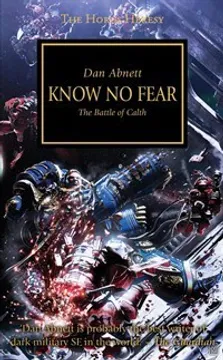


Plot Summary
The First Ship Is Lost
More than five days before the battle begins, Word Bearers seize the fleet tender Campanile and kill its 3,709 crew members. They use the vessel’s access codes to enter Calth’s orbital yards, then allow it to resume sending valid signals while system controllers overlook its earlier irregularities. The tender’s loss is not discovered until the attack is already underway.
When Roboute Guilliman learns what happened, he recognizes the operation as deliberate preparation, not a navigational accident. The murdered crew and stolen codes establish the assault’s essential advantage: Calth’s defenders are being made to trust the very systems that the enemy has already compromised.
The attack begins before anyone can name it. Routine procedures, valid codes, and delayed inspections become instruments of deception because the defenders trust the systems they built. The tender’s unseen dead also make the later slaughter more than a sudden military reversal: the Word Bearers have already chosen their victims and practiced treating fellow humans as expendable. Guilliman’s conclusion matters psychologically as well as strategically. Once he understands that his brother has planned the killing, the possibility of misunderstanding disappears.
Calth Gathers Its Armies
Calth fills with ships, soldiers, and two enormous Legions, officially assembled to crush an ork threat. Ultramarines captain Remus Ventanus handles the Erud Province muster, chafing at the administrative work even as he understands Guilliman’s hope that warriors might someday govern as well as fight. Sergeant Aeonid Thiel, censured for studying how to defeat Space Marines, is summoned to the flagship.
Guilliman tracks every delay but notices growing communication faults, strange singing on the vox, and unusually high scrapcode. On the surface, Army sergeant Bowe Hellock reassures his men that their deployment is an exercise. Retired soldier Oll Persson watches the troopships pass over his farm and feels his old military instincts stir.
The preparations show an empire convinced that order can absorb every danger. Guilliman’s attention to schedules, systems, and future civic life reflects a sincere belief that military power can be converted into peaceful stewardship. Thiel’s forbidden study quietly challenges that confidence: he has identified a weakness that the Legion’s own rules discourage him from examining. Meanwhile, Hellock’s false reassurance and Oll’s unease give the mobilization two human scales, the soldier who trusts his officers and the veteran who knows that a familiar sky can still carry war.
Friendship Becomes a Weapon
Honorius Luciel, an Ultramarines captain, and Sorot Tchure, a Word Bearers captain, have built a rare friendship through fighting side by side years earlier. Now they meet again aboard the Samothrace, hoping their rapport will help reconcile their Legions. Tchure explains that his Legion has changed its colours and is searching for a new purpose, then describes how betrayal can be treated as a sacrificial force.
Luciel understands the theory as a warning about enemy psychology, not a prediction. When Tchure admits he must prove his commitment to that new purpose, Luciel finally sees the danger. Tchure shoots him at close range, then his men massacre the Ultramarines gathered around them.
The betrayal works because Luciel’s trust is not naïve. He has evidence of Tchure’s courage and loyalty from a shared campaign, and he believes their friendship can model cooperation between rival Legions. Tchure turns that history into the weapon’s charge. His reasoning makes intimacy valuable precisely because it makes the coming violence harder to anticipate and more devastating to survive. The scene also gives the title’s central moral rupture a personal form: war is no longer merely brother against brother in theory, but one trusted friend using another friend’s faith as proof of devotion.
The Campanile Strikes
The Campanile passes Calth’s defenses on the access codes stolen with its original crew, then abruptly accelerates toward the planet. It tears through the crowded orbital anchorage and smashes into the vast Veridian shipyard.
Docked warships, factories, habitats, and data engines vanish in the collision and its spreading explosions. Thousands die in less than a second; burning wreckage begins falling toward the planet. The blast also destroys the main control hub for Calth’s defense grid and devastates the communications network.
On the ground, Ventanus shields local official Seneschal Arbute from the shockwave, while Oll’s farm is struck by a flood surge. What first looks like catastrophe leaves the assembled Ultramarines blind and helpless.
The strike converts infrastructure into a weapon against the people who depend on it. The shipyard is not just a military target: it is a workplace, a communications center, a transport system, and the visible promise of Calth’s future. Its destruction therefore attacks the defenders’ ability to understand events as much as their capacity to fight. By beginning with a flash and only later revealing its human consequences, the narrative makes the scale of the assault feel cognitively overwhelming. Characters must first grasp that the world has changed before they can decide what to do.
Mercy Meets Crimson Fire
With the orbital grid crippled, the fleet’s ships are cold at anchor and slow to raise shields. Word Bearers vessels, already powered and ready, begin destroying them. On the surface, their cult auxiliaries attack Army camps and Ultramarines staging areas while debris rains from orbit.
Guilliman initially refuses to return fire, reasoning that the Word Bearers may be responding to a terrible mistake and that retaliating could deepen the disaster. He sends a ceasefire appeal instead. The attack continues, and he realizes the enemy is not speaking on the broken channels because its ships are the ones firing. When Lorgar rejects the appeal, Guilliman finally orders the XIII Legion to defend itself.
Guilliman’s restraint is not weakness but a disciplined attempt to prevent a tragic error from becoming irreversible. The Word Bearers exploit that ethical discipline as a tactical delay, forcing the defenders to pay for the distinction between aggression and self-defense. Across the planet, soldiers encounter the same collapse of ordinary categories: allied uniforms conceal attackers, and familiar military protocols no longer predict behavior. Guilliman’s eventual order marks the point when moral certainty must be rebuilt through action. The Ultramarines are not choosing war; they are accepting that the other side has already chosen it for them.
The Flagship Goes Dark
A failing link allows Guilliman to confront Lorgar, who reveals that Horus has rebelled and claims that loyalist primarchs have already been killed at Isstvan. The revelation overturns the imagined campaign against orks: Calth is part of a civil war. Lorgar’s projection then changes into a warp-born horror, and the flagship’s bridge explodes, throwing Guilliman into the ship’s thin atmospheric envelope.
Chapter Master Marius Gage survives with grave injuries. With the command structure shattered and daemons loose aboard the Macragge’s Honour, Thiel organizes a mixed defense of Ultramarines, ship crew, and Army survivors. He argues that conventional Legion tactics cannot answer enemies that know those tactics already.
The catastrophe attacks the Ultramarines’ confidence in both their institutions and their understanding of reality. Lorgar’s disclosure places political betrayal beside supernatural violence, so neither military analysis nor the old secular worldview can explain the whole crisis. Thiel responds by doing what his censure had prepared him to do: treat the Legion itself as a possible opponent and improvise beyond its standard playbook. His leadership is practical rather than grand. He builds a working chain of command from whoever remains, demonstrating that discipline can survive even when the system that authorized it has failed.
Oll Sees Terra Burning
After the flood ruins his farm, Oll Persson is visited by John Grammaticus, who reminds him that he is an ancient, deathless human called a Perpetual. Grammaticus insists that Calth is only one front in a war that will decide humanity’s future.
He forces Oll to witness a vision of a dead angel, a victorious figure of darkness, and the burning world of Terra, then urges him to retrieve something important through a coming breach in reality. Oll rejects the summons, but the vision leaves him no longer able to pretend that his quiet life can keep the wider war out. He gathers injured labourers, including Hebet Zybes and the silent Katt, takes his old rifle, and sets out.
Oll’s refusal makes his return to danger emotionally distinct from the Legion’s duty. He has deliberately built a life that separates him from the repeated violence of his past, and Grammaticus’s intervention tears away the memories that helped sustain that retreat. The vision does not make Oll eager or heroic; it makes withdrawal impossible. His choice to take ordinary survivors with him preserves the small scale of his concern even as the threat expands to the fate of Terra. The novel places a human being with a long memory beside soldiers trained to think in campaigns.
Ventanus Holds the Palace
At the shattered starport, Ventanus and Sergeant Kiuz Selaton use an obsolete listening station to seek news, but Word Bearers attack the civilians and Ultramarines sheltering there. Ventanus escapes the collapsing station with Selaton and joins Skitarii commander Arook Serotid and Mechanicum magos Meer Edv Tawren.
They gather scattered survivors at the Leptius Numinus palace, where Tawren activates an isolated data engine and Ventanus arranges the defenses. Word Bearer commander Morpal Cxir offers surrender terms, then transforms into the daemon Samus after Captain Teus Sullus kills him in anger. The creature tears through the palace until Ventanus drives Cxir’s ritual blade into it, forcing it away. The defense buys time, not safety.
The palace becomes a provisional community assembled from people whose institutions have been broken: Legionaries, Army troops, Skitarii, and civic officials. Ventanus’s command depends on recognizing each group’s capacities rather than pretending the old hierarchy still functions. Sullus’s uncontrolled strike shows how grief can create new danger even among loyal defenders, while the transformation of Cxir makes the enemy’s beliefs physically consequential. Ventanus’s use of the ritual blade is a desperate adaptation, but he refuses to mistake a useful weapon for a safe one. Survival demands improvisation without surrendering judgment.
The Grid Turns Traitor
At the surviving Zetsun Verid Yard, Kor Phaeron’s corrupted Mechanicum allies rebuild the data systems and seize Calth’s planetary weapons grid. They first use it to destroy Veridia Forge, then turn its fire against ships and settlements across the system. Meanwhile, Guilliman’s fleet struggles to survive and the isolated surface forces try to reconnect.
Ventanus learns from Cxir that the Word Bearers fight for Horus and against the Emperor, confirming Lorgar’s account of rebellion. On the flagship, Thiel and Gage fight through daemons and boarders, while Gage restores command through the auxiliary bridge. Calth’s attack is now unmistakably both a planetary invasion and one front of a wider war.
The captured grid makes the defenders’ own sophistication dangerous to them. A system built to protect Calth becomes more destructive than any ordinary invading force because its power and reach were designed for planetary defense. The irony is sharpened by the Mechanicum’s dependence on interconnected machines: the enemy corrupts the shared language through which the system coordinates itself. At the same time, the scattered survivors gain a more accurate political picture. Knowing that Horus has rebelled does not make their situation easier, but it gives their losses a cause larger than the old rivalry between two Legions.
The Killcode Finds Its Target
Tawren discovers that the dying server Uhl Kehal Hesst hid a cleansing killcode inside an overlooked cargo guild data engine. The engine can process Calth’s weapons grid, but reaching it requires a fight through enemy-held port districts. Ventanus gathers surviving Ultramarines, Army troops, and Skitarii for that assault.
At the same time, Guilliman, Thiel, and a teleporting kill squad attack Zetsun Verid Yard, where Kor Phaeron controls the grid. Guilliman defeats Kor Phaeron before the Word Bearer can corrupt him with an athame, while Thiel wounds Tchure. Kor Phaeron’s control collapses. Tawren immediately launches Hesst’s killcode, clears the hostile scrapcode, and assumes control of the grid.
The counterstroke succeeds because the novel has made its essential tools and vulnerabilities visible well before their payoff: Hesst’s stubborn attention, Tawren’s technical skill, Thiel’s unorthodox thinking, and Guilliman’s willingness to risk himself. The two assaults are complementary rather than interchangeable. Ventanus’s force must reach a clean, powerful engine; Guilliman’s must remove the enemy’s control at its source. Kor Phaeron’s attempt to turn Guilliman repeats the Word Bearers’ broader strategy of converting intimate trust into submission, but Guilliman answers with physical refusal. The killcode turns one server’s final work into collective agency.
The Grid Answers Back
With Tawren in command, the planetary grid strikes Word Bearer formations near the port and destroys enemy ships in orbit. Ventanus’s assault is saved from imminent annihilation, though the fighting has already devastated Calth and cost enormous numbers of lives. The victory comes too late to stop Kor Phaeron’s earlier order: the grid has also been aimed at the Veridian star.
Its bombardment destabilizes the sun, which begins swelling toward a lethal flare. On the Satric Plateau, Erebus completes the ritual that opens the way for the Ruinstorm, a vast warp storm intended to divide loyalist forces and isolate Terra. The Ultramarines have regained a weapon, but not control over the consequences already set in motion.
The reversal is real, but deliberately incomplete. Restoring the grid changes who can inflict damage; it cannot undo the shipyard’s destruction, resurrect the dead, or halt the star’s destabilization. This distinction prevents tactical recovery from being mistaken for moral or planetary repair. Erebus’s ritual also reveals the campaign’s deeper scale: Calth is both a battlefield and an offering in a plan to sever communication across the Imperium. The survivors win local agency while discovering that the enemy’s aim was never limited to conquering one world.
Calth Opens Beneath Them
As the sun’s radiation makes the surface unlivable, Ventanus broadcasts a warning for civilians and soldiers to flee into the arcologies. Guilliman leaves the system with the survivors he can evacuate, while Ventanus remains on Calth with Tawren and the forces still fighting below. Oll reaches the Satric coast with Rane, Krank, Zybes, Katt, and Graft.
When cult leader Criol Fowst comes after the ritual blade Oll took, Oll kills him and uses the blade to cut open a passage through reality. He leads the survivors through it as daemons close in. The world is not rescued: one group seeks refuge underground, while Oll’s small company steps into an unknown elsewhere.
The ending refuses a single image of salvation. Guilliman’s departure preserves a military remnant, Ventanus’s retreat offers civilians a chance to outlast the solar disaster, and Oll chooses a passage whose destination he cannot guarantee. Each response measures responsibility differently: command protects what can still be organized, while Oll protects the few people within reach. His ancient knowledge finally becomes useful, but it does not make him omnipotent. The world’s fate remains unresolved at ground level even as the larger ritual succeeds, leaving endurance rather than triumph as the immediate form of hope.
Epilogue
Many years later, the count of Calth’s battle still runs as Ventanus stands on the ruined world of Colchis. He has become a veteran marked by losses stretching far beyond the first day of treachery. A force waits behind him, and a fleet barge in orbit carries cyclonic weapons.
Ventanus takes the battered standard that has accompanied him through the war and plants it in Colchis’s burning ground. When his sergeant signals the old march for Macragge, Ventanus redirects the company’s purpose: this time, they march for Calth. The retaliation cannot restore the dead or reverse the betrayal, but the running count gives remembrance a military form.
The epilogue turns the book’s system of elapsed marks into an ethical burden. The count continues long after the battle because the destruction cannot be contained by a single day or a single generation. Ventanus’s standard carries the physical record of that history, while his choice of destination distinguishes vengeance from forgetfulness: the Legion acts against Colchis, but its loyalty remains fixed on Calth and its dead. The conclusion offers no claim that punishment repairs what was lost. Instead, ritual and remembrance keep the survivors answerable to the people whose absence defines their campaign.
Analysis
Know No Fear makes betrayal frightening by showing how much ordinary competence it takes to exploit it. Calth is not caught unprepared in any simple sense: Guilliman has assembled one of the Imperium’s largest Legions, the Mechanicum has built layered defenses, and the Army has mobilized on a vast scale. Those strengths become liabilities because the attackers understand the systems, relationships, and assumptions that hold them together. A stolen ship uses trusted codes; a friendly Legion attacks from within the formation; a defense grid becomes an execution mechanism. The catastrophe is therefore not a failure of order alone. It is order manipulated by people who know its moral and technical logic.
The book’s competing models of knowledge sharpen this conflict. Guilliman treats information as the basis of victory and believes that careful analysis can make violence finite, useful, and eventually unnecessary. Thiel tests the blind spots in that belief by studying how to fight his own kind. Tawren works through damaged systems without pretending certainty. Oll brings a different intelligence: historical depth, religious attention, and experience that predates the institutions now collapsing. None of these ways of knowing can prevent the attack. Together, they allow some people to act after the old explanations have failed.
The Ultramarines’ emotional movement is from confidence in fraternal cooperation, through bewilderment and moral restraint, into an anger they must learn to discipline. Guilliman’s order to return fire ends the hope that a misunderstanding can be negotiated away. Ventanus and Thiel then make survival communal, joining forces with civilians, Army troops, and Mechanicum survivors. The recovered grid provides a genuine reversal but cannot restore the world or stop the Ruinstorm. That imbalance is the novel’s final measure of victory: resistance matters even when it cannot cancel the damage, and remembrance becomes part of continuing the fight.
Review Summary
Know No Fear is highly praised as one of the best Horus Heresy novels, with many considering it Abnett's finest work. Readers appreciate the intense action, compelling characters, and unique narrative style. The book portrays the Ultramarines in a more sympathetic light, surprising even those who dislike the chapter. The Battle of Calth is vividly depicted, with the Word Bearers' betrayal and subsequent carnage leaving a lasting impact. While some criticize the lack of character development, most reviewers find the fast-paced, large-scale conflict engrossing and emotionally powerful.
People Also Read

Characters
Roboute Guilliman
The calculating primarchPrimarch of the Ultramarines, Guilliman is a commander who treats information, logistics, and governance as parts of the same responsibility. He tracks thousands of details while imagining a future in which Space Marines help build peaceful societies rather than remain instruments of war. His rational habits are not coldness so much as a method for containing enormous responsibility. He values loyalty, but his confidence in orderly systems can leave him vulnerable to enemies who turn those systems against him. Under pressure, he must decide when restraint protects others and when it only gives an aggressor more time.
Remus Ventanus
The field-born commanderCaptain of the Ultramarines’ 4th Company, Ventanus begins the crisis doing the administrative work his primarch expects of a future ruler. He prefers direct military problems, yet he is capable of persuading civilians, Army units, and Mechanicum forces to work together. His command style is observant and pragmatic: he asks what can still be done, then acts without pretending the situation is fair. The battered standard he carries becomes an extension of that approach, useful as a weapon and as a visible rallying point. Ventanus’s loyalty is disciplined, but never merely ceremonial.
Aeonid Thiel
The censured tacticianAn Ultramarines sergeant marked for censure, Thiel has been punished for studying how one might defeat Space Marines. His willingness to examine forbidden possibilities makes him unusually prepared when the Legion’s own methods are turned against it. He does not mistake rule-breaking for cleverness; he tests ideas against immediate needs and accepts responsibility for their consequences. Thiel’s calm under pressure comes from analysis, not emotional distance. He asks direct questions, organizes whoever is available, and adapts familiar training to a conflict that has no accepted precedent.
Oll Persson
The reluctant veteranA retired Army soldier who has built a quiet farming life on Calth, Oll keeps his military past private and his faith close. His reluctance to return to conflict comes from experience rather than cowardice; he knows what war asks of ordinary bodies and ordinary lives. He has also lived far longer than his neighbours realize, carrying memories and knowledge from eras beyond their imagining. Oll’s attention is practical and local. Even when a crisis expands to the fate of humanity, he remains alert to the people beside him and the immediate work of keeping them alive.
John Grammaticus
The impossible messengerA Perpetual with unusual psychic abilities, Grammaticus reaches Oll when the crisis on Calth is already underway. He is urgent, persuasive, and conscious that his warning may sound like madness. His connection to Oll rests on shared history and an understanding of threats that ordinary people cannot easily accept. Grammaticus asks for action rather than offering comfort, and his method is invasive even when his purpose is protective. He represents the unseen networks and long memories operating beneath the Legion’s visible war.
Lorgar Aurelian
The wounded preacherPrimarch of the Word Bearers, Lorgar is a searching, intensely religious figure whose need for meaning shapes his Legion. He is also deeply sensitive to perceived humiliation, particularly the rebuke that once placed the Ultramarines over his warriors as an example. That wound affects how he interprets cooperation, criticism, and respect. Lorgar’s gift for persuasion is bound to an appetite for certainty: he wants his beliefs to explain not only his own purpose but the structure of the universe. His relationship with Guilliman is strained by opposing temperaments as well as old history.
Kor Phaeron
The faith’s ruthless architectLorgar’s foster father and senior religious authority among the Word Bearers, Kor Phaeron combines political calculation with an unwavering appetite for spiritual power. He treats people, technology, and military operations as elements of a larger design. His confidence is most visible in how patiently he prepares and how readily he spends lives to advance his purpose. The contrast between his physical frailty and his influence gives him a particular menace: he expects others to mistake appearance for weakness.
Erebus
The ritual’s dark apostleA senior Word Bearers religious leader, Erebus is skilled at turning belief into action. He plans ceremonies with the same care a commander gives an assault, selecting sites, objects, and human sacrifices for their practical and symbolic value. His patience distinguishes him from more impulsive fighters: he can wait for a larger design to mature while other people mistake the ritual for battlefield excess. Erebus’s faith has become inseparable from his political ambition and his willingness to manipulate the Legion’s followers.
Sorot Tchure
The converted captainA Word Bearers captain and former comrade of Honorius Luciel, Tchure is intelligent, self-questioning, and hungry for a clear purpose. He once learned from the Ultramarines captain’s discipline, just as Luciel learned from his sense of cosmic scale. Tchure’s relationship with the Word Bearers’ changing identity draws him toward commitments that demand proof through action. His thoughtful manner makes him more dangerous than a simple zealot: he understands what trust means and how its violation can wound a person or a Legion.
Honorius Luciel
The loyal bridge-builderAn Ultramarines captain, Luciel is one of the rare officers to form a genuine bond with a Word Bearer. His friendship with Tchure grows from shared combat and reciprocal respect, not from pretending the Legions are alike. Luciel believes their differences can be a source of learning rather than permanent hostility. His ability to see value in another Legion’s perspective makes him a natural representative of reconciliation, but also places him at the fragile meeting point between personal trust and political rivalry.
Marius Gage
Guilliman’s first captainChapter Master of the Ultramarines’ 1st Chapter, Gage is an experienced officer who balances Guilliman’s strategic authority with the practical needs of the Legion. He knows the primarch well enough to question him without confusing disagreement with disloyalty. Gage’s confidence rests on preparation and familiarity with command structures, which makes him especially effective when those structures collapse. He is a steady presence for younger officers and a demanding judge of plans, including his own.
Meer Edv Tawren
The surviving serverA Mechanicum magos responsible for analytical systems, Tawren is both technically gifted and emotionally attentive in ways her institution does not always encourage. Her working bond with server Uhl Kehal Hesst gives her insight into his choices and a personal stake in preserving his work. Tawren’s competence depends on patience, careful isolation of corrupted data, and a willingness to acknowledge limits. Rather than claiming certainty she does not possess, she tells Ventanus what her systems can and cannot do, making honesty part of her leadership.
Kiuz Selaton
Ventanus’s practical sergeantA sergeant in Ventanus’s company, Selaton is an alert observer who notices details his more experienced officers may overlook. He understands military procedure but is willing to question assumptions when reality contradicts them. His loyalty to Ventanus includes candid disagreement, and he often helps turn a broad plan into an immediate, workable action. Selaton’s perspective also keeps human consequences in view, especially when the scale of battle threatens to reduce individuals to numbers.
Teus Sullus
The bruised captainA veteran Ultramarines captain, Sullus is courageous, combative, and deeply shaken by the destruction of the world he serves. His instinct is to answer violence with direct action, which can make him an asset in battle and a risk when grief narrows his judgment. Ventanus recognizes that Sullus’s anger is tied to fear that the order he trusts is disappearing. Their relationship is built on frank challenge rather than easy reassurance.
Eikos Lamiad
The wounded tetrarchA ruler of one of Ultramar’s major worlds and one of Guilliman’s champions, Lamiad is a statesman as well as a warrior. He values cultural memory and sees the unfinished Holophusikon as a promise about what Calth might become. His own reconstructed body reflects a life spent serving his people through repeated hardship. Lamiad’s authority is formal, but his manner with officers such as Ventanus is warm and reflective, grounded in a shared commitment to Ultramar’s future.
Gabril Telemach
The new DreadnoughtKnown in his armored form as Telemechrus, Gabril Telemach is a young Ultramarines warrior rebuilt as a Dreadnought after catastrophic injury. He is still adjusting to a life of intermittent waking, constant pain, and a body that no longer resembles his own. His training has taught him discipline, but the transformation exposes him to unfamiliar anxiety and isolation. Telemechrus’s formal, halting speech reflects the gulf between the person he remembers and the machine that now carries him.
Bale Rane
The raw young soldierA newly mustered soldier in the Numinus 61st, Rane is inexperienced and emotionally exposed amid a force assembled for a campaign he does not understand. He has married Neve shortly before deployment and is preoccupied with whether he will see her again. His feelings are shaped by the rushed intensity of a young life suddenly narrowed by military orders. Rane’s ordeal forces him to confront the distance between romantic expectations and the unpredictable demands of survival.
Dogent Krank
The veteran beside RaneAn older soldier serving alongside Rane, Krank uses blunt humour and practical care to protect the young trooper. He has seen enough combat to distrust reassuring assumptions, but his experience does not make him indifferent. Instead, it makes him attentive to small dangers, fatigue, and the moment when a companion needs to be pulled away from harm. His bond with Rane grows through shared danger rather than speeches.
Criol Fowst
The searching cult lieutenantA well-educated follower of the Word Bearers, Fowst is drawn to forbidden knowledge and the possibility that the visible universe conceals a greater power. He approaches occult belief as an ambitious student, first seeking access to secrets and then seeking influence through service. His intelligence distinguishes him from the rank-and-file cultists, but it does not protect him from the appetite for power that the cult encourages. Fowst’s polished background makes his descent into ritual violence especially stark.
Uhl Kehal Hesst
The stubborn serverA Mechanicum server responsible for Calth’s planetary defense grid, Hesst takes pride in maintaining human oversight rather than surrendering decisions entirely to automated systems. His demanding work reflects a belief that machinery should extend human responsibility, not erase it. Tawren is his close colleague and understands both his technical discipline and his emotional reserve.
Bowe Hellock
The Army’s false reassurerA sergeant in the Numinus 61st, Hellock tries to keep his soldiers’ spirits up by presenting their deployment as routine. Privately, he knows the danger is real and resents the euphemisms used to describe it. His concern for his inexperienced troops appears in small acts of discipline and care, even as the wider command keeps them in the dark.
Neve Rane
Rane’s new brideNeve is Bale Rane’s wife, separated from him by the mobilization of the Numinus 61st. Her absence gives shape to his fears and his hopes of returning home. She represents the ordinary future the soldiers imagine they might still reach, rather than a military cause or a strategic objective.
Plot Devices
Calth’s elapsed marks
A clock made of battleThe Ultramarines measure the operation in marks, elapsed hours counted from Guilliman’s order to return fire. The record distinguishes the secret preparation from the moment open combat officially begins, which is itself a moral judgment: Guilliman refuses to call the preceding treachery a battle. Marks also let the narrative jump between the flagship, the planetary surface, and individual survivors while keeping their events synchronized. The count’s continuation in the epilogue turns a military timing system into a memorial that outlives the people who began it.
The planetary weapons grid
Calth’s defense turned inwardCalth’s interconnected surface and orbital weapons can defend the system against a fleet, but the Campanile strike destroys the main data hub and malicious scrapcode corrupts the network. The Word Bearers seize an alternate engine and use the grid against ships, installations, and eventually the Veridian star. Tawren later finds Hesst’s hidden killcode in an isolated cargo guild engine. Once Guilliman’s assault breaks the enemy’s control, she purges the corrupted code and redirects the weapons. Its shifting ownership gives the battle a concrete measure of power, while showing how security systems can become instruments of mass destruction.
The Octed scrapcode
A ritual hidden in dataThe Word Bearers’ followers transmit eight names through ordinary communications channels, where Mechanicum systems read and absorb them as corrupted meanings rather than harmless text. This scrapcode does not behave like a conventional virus. It merges technological sabotage with ritual action, first degrading Calth’s information systems and then helping the traitors exploit the defense network. Its importance lies in the collision of two kinds of expertise: the Mechanicum’s technical protocols and the Word Bearers’ occult beliefs. The defenders initially search for a familiar machine fault, while the attack is already operating by rules they do not know.
The ritual athame
A blade that cuts realityThe black ritual knives carried by the Word Bearers’ cult auxiliaries signal that their violence is more than ordinary military practice. Ventanus uses one against the daemon Samus, discovering that the enemy’s own ritual tools can injure warp-born creatures. The blade is also dangerous to trust: Ventanus refuses to let his troops treat it as a dependable weapon, because the Word Bearers’ corruption began through the acceptance of powers that seemed useful. Oll later keeps a more significant athame and uses it to open a passage through reality, linking the local fighting to his separate task.
Download PDF
Download EPUB
.epub digital book format is ideal for reading ebooks on phones, tablets, and e-readers.








