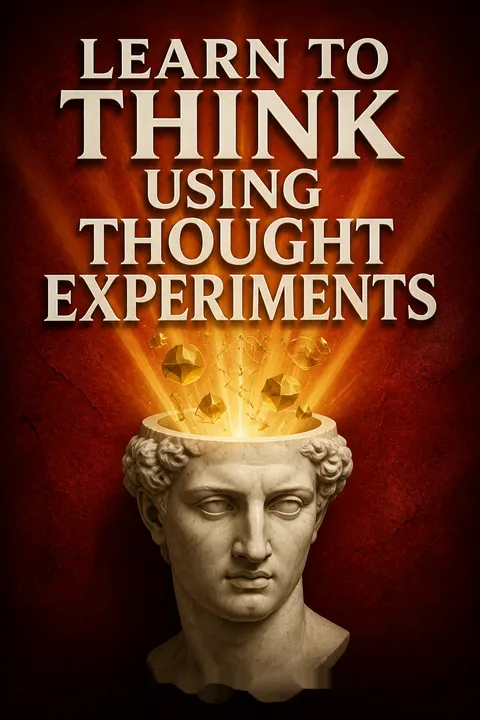


Key Takeaways
Use thought experiments to expose the assumptions driving your reasoning
A rehearsal for thought. A thought experiment is an imagined scenario used to examine what follows from a premise or choice without carrying it out. In the runaway trolley problem, a train is heading toward five people, and pulling a lever would divert it toward one. The numbers invite a quick calculation, but variations change the moral dilemma: What if the one person is a relative? What if stopping the train means pushing someone onto the tracks? Each version brings different values into view, such as minimizing deaths or refusing to use one person as a means to save others.
Inspect the answer. The aim is not to settle every moral case. It is to notice why an answer feels right, and whether the reasoning holds when the circumstances shift.
What's useful about the trolley case is its controlled simplicity: changing one detail makes a hidden moral rule easier to spot. This resembles how researchers isolate variables, though moral judgment is not a laboratory measurement. The setup strips away uncertainty, relationships, and real-world consequences, so it can clarify principles without dictating what anyone should do in an actual emergency. Its best use is diagnostic: identify the value behind a judgment, then ask whether that value deserves to guide action outside the hypothetical.
Follow a theory to its consequences before defending its premise
Test the implications. Schrodinger's cat imagines a cat in a sealed box whose fate depends on a radioactive event. Under the Copenhagen Interpretation, a quantum system can be described as a range of possibilities until measured. Schrodinger used the cat to make the interpretation's implications for a large, familiar object seem troubling. The scenario does not establish that cats are literally alive and dead; it presses a theory to an unsettling conclusion.
Imagine to discover. Einstein mentally chased a beam of light and found that ordinary assumptions about time could not comfortably accommodate the scenario, helping shape his thinking about relativity. Newton's cannon imagines a projectile fired with enough speed to keep falling around Earth, illustrating an orbit. In each case, imagining consequences helps reveal what a theory requires.
Thought experiments can function as stress tests for theories: they reveal implications that may be difficult to see in equations or ordinary language. Their scientific value depends on what follows. A hypothetical can expose a contradiction or suggest a prediction, but it cannot by itself confirm that the prediction describes nature. The strongest chain joins imagination to evidence, as in cases where a conceptual puzzle points toward a testable account. That distinction prevents an evocative scenario from being mistaken for proof.
Treat perception as a model that may omit the decisive fact
Shadows are not sources. In Plato's cave allegory, prisoners see only shadows cast on a wall and mistake them for the whole world. The story asks whether people can recognize the limits of what they perceive when they have no view of what produces it. The book connects this to mental models: useful representations of reality that leave things out.
Keep the model revisable. Someone who has only seen white swans might generalize that all swans are white, until encountering a black one. The error is not using a model; it is treating a limited model as complete. This matters when people interpret a few observations as proof of a broad claim, or make confident forecasts from incomplete information. Ask what your picture leaves out, and what evidence could force you to revise it.
The cave is powerful because it turns a subtle epistemic problem into a scene: a person can be mistaken without feeling mistaken. In science, models are similarly valuable precisely because they simplify, and their limits become visible when observations do not fit. The practical challenge is not to abandon representation, which is impossible, but to keep it corrigible. Skepticism also needs a stopping rule: evidence can improve a model without granting a view from nowhere, entirely free of perspective.
Suspend certainty long enough to separate evidence from assumption
Begin with doubt. The brain-in-a-vat scenario asks whether a person could be receiving artificial experiences while believing they inhabit an ordinary world. Descartes' demon pushes the doubt further: what if even reasoning is being systematically misled? These puzzles do not show that daily life is unreal. They expose how little absolute certainty ordinary perception can provide. Descartes' limited foothold is that doubting itself requires a thinker to be doing the doubting.
Check the story you tell. The book applies this skeptical habit to everyday judgments. If someone fails to greet you, the conclusion that they dislike you is an interpretation, not an observation. Other explanations remain possible. Pausing to distinguish what happened from what it might mean can loosen the grip of anxiety and premature certainty.
This kind of doubt has a practical cousin in cognitive behavioral therapy, where people examine the evidence for automatic interpretations rather than treating thoughts as facts. The analogy is useful, but philosophical skepticism is not a treatment plan, and endless doubt can become its own trap. Ordinary decisions require provisional trust in perception, testimony, and shared evidence. The productive lesson is calibrated uncertainty: hold conclusions lightly enough to update them, while still acting on the best available account.
Question whether a boundary belongs to reality or your question
Try the edge. Lucretius' Spear asks what would happen if someone stood at the edge of a supposedly finite universe and threw a javelin beyond it. If the javelin travels onward, the proposed edge was not the end. If something stops it, that stopping point seems to require an explanation of what lies beyond. The thought experiment makes the idea of a simple outer boundary difficult to picture.
Inspect the terms. The puzzle does not prove that the universe is infinite. A universe could be finite yet have no edge, much as a person can travel around a closed surface without reaching a boundary. The deeper exercise is to notice how a question may smuggle in assumptions, such as imagining that every finite thing must have an outside edge. Sometimes the first task is to revise the question.
The javelin argument is most valuable as a prompt to distinguish different meanings of finite, bounded, and edge. Those terms sound interchangeable in everyday speech but need not describe the same structure. This is a general feature of difficult questions: an image can quietly determine which answers seem possible. The thought experiment opens conceptual space, though it does not settle cosmology. That limit is instructive. A powerful argument can reveal that a picture is inadequate without supplying the final picture.
Do not confuse mathematical possibility with practical likelihood
Infinite input, every output. The infinite monkey theorem imagines random typists working for unlimited time. Given truly infinite attempts, any finite sequence of characters, including a Shakespeare play, would appear. The claim concerns mathematical probability under impossible conditions, not a realistic forecast. In a real-world trial described in the book, monkeys with typewriters produced pages dominated by the letter S, a much more ordinary result.
Scale changes meaning. A tiny probability is not automatically a useful possibility for planning. The book also warns against using the monkey analogy as a simple explanation of evolution: biological change involves inheritance and selection, not every organism being assembled from scratch by random chance. The distinction between theoretical possibility and practical feasibility helps prevent enormous numbers from disguising how unlikely or resource-intensive an event would be.
The theorem is a memorable lesson in conditional probability: its conclusion depends on infinite time and truly random attempts. Those conditions matter as much as the headline result. The evolution comparison shows why analogies need their mechanisms checked, not just their surface resemblance. Natural selection preserves and builds on inherited variation, while the monkey image starts each attempt over. Abstract probability can discipline intuition, but only when its assumptions resemble the process being discussed.
Use paradoxes to inspect where abstraction parts company with experience
Divide the distance. Zeno's arrow puzzle says that before an arrow reaches its target, it must cross half the distance, then half the remainder, and so on without end. His Achilles and tortoise puzzle similarly gives the slower tortoise a head start, then divides the remaining gap into ever-smaller intervals. The reasoning seems to make arrival impossible, even though arrows move and faster runners overtake slower ones.
Notice the model. These puzzles expose the tension between describing motion as an endless sequence of subdivisions and experiencing motion as continuous travel. They invite scrutiny of the concepts being used, including infinity, time, and distance. The lesson is not that mathematics is useless or that movement is an illusion. It is that an abstract description can produce counterintuitive results, so its assumptions and fit with physical reality deserve examination.
Zeno's puzzles are not simply defeated by pointing to a moving arrow. Modern calculus shows how infinitely many shrinking intervals can add up to a finite distance, which helps resolve the apparent contradiction. That resolution sharpens rather than erases the philosophical lesson: intuitions about infinity can mislead, and formal tools can correct them. At the same time, mathematical models are not automatically descriptions of physical reality. The useful question is what the model explains, and what assumptions connect it to the world.
Define identity by continuity, not by unchanged material
Replace the pieces. In Theseus' ship, parts are gradually removed and replaced. If every piece changes, is it still the original ship? A second version reassembles the discarded pieces elsewhere, leaving two candidates for the original. Applied to a person, the puzzle asks whether identity rests on the body, its organization, memories, or an ongoing history.
Add a life story. Davidson's swamp man is an exact physical duplicate of a person, produced by a bizarre lightning strike, but with no past experiences. The transporter imagined in Star Trek raises a different problem: a person is dismantled and reconstructed with memories intact. These cases separate physical resemblance, memory, and continuity. They do not yield one agreed answer, but they make clear that calling someone the same person depends on which features count.
Identity puzzles matter because personal identity is not only a metaphysical label. Families, institutions, and laws rely on judgments about who persists through change, yet different settings may prioritize different criteria. Memory, bodily continuity, and social recognition can point in different directions. A duplicate with the same memories also raises a hard question: if two copies exist, both cannot be numerically the one original. The scenarios do not settle identity, but they expose the criteria hidden inside confident claims about sameness.
Choose a self-conception that permits revision and growth
Self-beliefs set limits. The book argues that a person's working idea of identity shapes how they interpret the past, respond to adversity, and imagine the future. If identity is treated as fixed, a difficult experience may seem like a permanent definition. If identity is understood as capable of change, the same person may see room to develop beyond it. Theseus' ship provides the prompt: how much can change while something remains recognizably itself?
Make the belief deliberate. The point is not that a person can simply choose any identity or erase painful experience by deciding to move on. It is to examine whether inherited assumptions about the self are useful and accurate. A self-conception that allows learning can make it easier to admit error, adapt behavior, and imagine new possibilities without denying the history that shaped the person.
This connects with growth-mindset ideas, which distinguish abilities treated as developable from abilities treated as fixed. Such beliefs can influence persistence, but they do not remove structural barriers, illness, or the effects of trauma. Flexibility is not a demand to minimize suffering or reinvent oneself on command. Its value is narrower and more humane: a person's past can matter deeply without having exclusive authority over every future interpretation of who that person is.
Clarify shared language without pretending to share private experience
Symbols can mimic understanding. In the Chinese room thought experiment, an English speaker follows instructions to match Chinese symbols with appropriate responses. To observers, the replies may look fluent, although the person does not understand Chinese. The example asks whether correct behavior alone proves comprehension, and where meaning enters the process.
Minds remain partly private. Wittgenstein's beetle in a box imagines that everyone has a private object, unseen by others, but all use the same word for it. The image suggests that people can share words without knowing whether their inner experiences match. Zhuangzi's debate about fish makes a related point: seeing fish behave does not grant direct access to what their happiness feels like. Clarifying terms can prevent avoidable misunderstandings, even if private experience remains inaccessible.
The distinction between observable performance and inner understanding is central to debates about minds and machines, but the Chinese room does not settle whether a system as a whole could understand. The beetle image adds a social insight: language works through public practices, even when sensations cannot be compared directly. In relationships, asking what someone means by a word can improve coordination without claiming perfect access to their feelings. Humility about another mind need not become silence; it can make listening more careful.
Analysis
The book's central method is a sequence of intellectual moves rather than a system for producing final answers. It gives the reader a scenario, makes an assumption vivid, alters a condition, then asks what the changed case reveals about the original judgment. The collection travels from moral choice to scientific models, uncertainty, infinity, identity, and private experience. That progression shifts the focus from what people believe to how they form beliefs, and finally to how limited their access is to other minds.
Its strongest contribution is practical metacognition. The trolley problem helps identify moral commitments; the cave asks whether familiar perceptions are incomplete; the identity puzzles reveal that ordinary labels such as same person conceal competing criteria. These examples make abstract philosophy approachable without requiring a technical background. They also teach a transferable habit: when a conclusion feels obvious, vary the premise and inspect what changes.
The method has limits. A thought experiment can expose an assumption, but a compelling story is not evidence that its conclusion is true. Some examples are designed to provoke, not resolve, and readers may mistake uncertainty for proof that all views are equally plausible. Scientific cases especially require care: an imagined consequence can guide inquiry, but empirical evidence must do the work of testing claims about nature. Zeno's puzzles, for instance, become more illuminating when paired with mathematical accounts of convergent infinite series rather than treated as evidence that motion is unreal.
The most balanced reading treats thought experiments as tools for clarification, not substitutes for observation or action. Their value lies in making hidden premises discussable. They widen the space of possible explanations, while leaving the responsibility to judge among them with evidence, argument, and attention to consequences.
Review Summary
Learn To Think Using Thought Experiments receives mixed reviews (3.84/5) with readers appreciating its accessible introduction to philosophical concepts like Theseus's ship and the trolley problem. Many praise it as thought-provoking and excellent for beginners, noting its short, lucid chapters. However, critics find it repetitive and surface-level, better suited for younger readers or newcomers to philosophy. The content covers classic thought experiments in abbreviated form, with some readers wanting deeper analysis and cultural context. Most agree it's worthwhile for those seeking an introduction to critical thinking.
People Also Read




Glossary
Thought experiment
Reasoning through a hypotheticalAn imagined scenario used to examine a question by specifying conditions and reasoning through their consequences. Unlike a physical experiment, it is conducted mentally. It can reveal assumptions, test a theory's implications, or clarify a moral judgment, but its conclusions do not automatically establish facts about the real world.
Trolley Problem
A forced moral choiceA moral thought experiment in which a runaway train threatens five people, while an observer can divert it onto a track where one person will be killed. Variations change details such as whether intervention involves direct physical force. The cases probe judgments about consequences, responsibility, and the moral status of individuals.
Schrodinger's cat
Quantum uncertainty made visibleA thought experiment devised by physicist Erwin Schrodinger. A cat is placed in a sealed box with a device whose operation depends on a radioactive event. The scenario highlights the apparent difficulty of applying quantum descriptions of uncertain outcomes to a large, familiar object. It is not a claim that an observed cat is literally both alive and dead.
Allegory of the cave
A story about limited knowledgePlato's story of prisoners who can see only shadows cast on a wall and mistake those shadows for reality. It explores how perception and education shape what people accept as knowledge, and whether someone can recognize the limits of their own view. The book uses it to encourage scrutiny of mental models.
Brain in a vat
A challenge to certaintyA skeptical scenario in which a brain is kept alive and connected to a system that supplies experiences indistinguishable from ordinary perception. It asks how a person could know that the perceived world is not artificially produced. The thought experiment tests claims about knowledge and perception rather than proving that the scenario is actual.
Lucretius' Spear
A puzzle about cosmic boundariesA thought experiment that asks what would happen if a person standing at the supposed edge of a finite universe threw a spear outward. If it continues, the edge seems not to be final; if it is stopped, the stopping boundary needs explanation. The argument challenges a simple idea of cosmic edges but does not establish that the universe is infinite.
Infinite monkey theorem
Randomness under infinite conditionsA mathematical thought experiment in which infinitely many random typists work for an infinite amount of time. Under those conditions, any finite sequence of characters would eventually be produced, including a Shakespeare play. The result depends on infinite resources and time, so it illustrates mathematical possibility rather than practical likelihood.
Zeno's paradoxes
Puzzles about motion and infinityA family of arguments associated with the Greek philosopher Zeno. In one, an arrow must cross infinitely many progressively smaller portions of its path, apparently making arrival impossible. The puzzles expose tensions between intuitive accounts of motion and abstract reasoning about infinite divisions. Mathematical analysis can show that infinitely many shrinking intervals may have a finite total.
Theseus' ship
A puzzle about persistenceA thought experiment asks whether a ship remains the same ship as its parts are gradually replaced. A further version reassembles the removed parts into another ship, creating competing candidates for the original. Applied to people and objects, it probes whether identity depends on material parts, structure, memory, history, or continuity.
Swamp man
A duplicate without a pastDonald Davidson's scenario imagines a lightning strike producing a physical duplicate of a person from material in a swamp. The duplicate resembles the person but has no prior experiences or history. The case asks whether physical similarity alone is enough for personal identity, and what role memory and causal continuity play.
Parfit's transporter
A puzzle about reconstructed identityA speculative transporter disassembles a person and reconstructs a being elsewhere with the original's memories and apparent personality. The scenario asks whether the reconstructed being is the same person, despite the interruption or destruction of the original body. It focuses attention on continuity and the criteria used to identify a person.
Chinese room
A test of apparent understandingJohn Searle's thought experiment places an English speaker in a room with rules for matching Chinese symbols and producing appropriate responses. The person can appear fluent to outsiders without understanding the language. Searle uses the case to distinguish symbol manipulation from comprehension, though whether it settles questions about artificial intelligence remains contested.
Beetle in a box
A metaphor for private experienceWittgenstein's analogy imagines each person with a box containing something called a beetle, while nobody can inspect anyone else's box. The shared word can still function even though no one can verify that the private contents match. The example probes the relation between language, shared meaning, and inner experience.
About the Author
Other books by Patrick King

Download PDF
Download EPUB
.epub digital book format is ideal for reading ebooks on phones, tablets, and e-readers.








