

Plot Summary
Black Mamba Gets a Tart
Nine months after Pippa died, her seven-year-old twins, Sylvie and Cassia, had begun waking their father, Alfie, with reports of a man in their room. The visits stopped, and Alfie dismissed them as nightmares. Then, on the monthly anniversary of Pippa’s death, the girls asked for a jam tart for Black Mamba, a friend Alfie could not see.
Their grandmother Marian had brought the tarts, but the strange request unsettled him enough to summon Julia, Pippa’s twin sister and a family therapist. Julia was already wary of Hart House, where she and Pippa grew up. When she learned about the earlier nighttime visitor, she fled, recognizing a pattern she feared had returned.
The story begins by placing grief inside an ordinary domestic act: a father handing out pastry. Alfie’s choice to indulge the girls is loving, but it also lets their private world acquire a place at the family table. Julia’s flight suggests that she recognizes more than a familiar childhood fear. The alternating perspectives make neither response definitive. Alfie treats the girls’ claims as play because he needs a manageable explanation; Julia’s alarm points toward a past she has not shared. The first disturbance is therefore not simply a ghost story, but a family’s unequal knowledge of its own history.
The Snake Has a Face
The next morning, Alfie tries to join the girls’ game, but Cassia rebukes him for pretending he can see Black Mamba. The twins draw him separately, yet each produces the same black snake, with golden eyes and a raised tail. That night, Alfie dreams of Pippa drowning at Collier Beach, then wakes to find a light on in the bathroom.
The girls deny going there, and Cassia explains that Black Mamba is not really a snake. He is a man who can change shape, the same visitor who had frightened them months earlier. The revelation ties their new friend to the old nightmares and leaves Alfie unable to dismiss him as an ordinary imaginary companion.
The drawings make the girls’ shared imagination materially visible, while their insistence that Alfie cannot see the creature preserves a boundary between adult explanation and child experience. Their exact agreement could signal twin attunement, imitation, or something harder to account for. The bathroom light quietly shifts the issue from what they say to what may have happened in the house. Alfie’s dream also binds his private bereavement to the girls’ story. He is not yet convinced of the supernatural, but the children’s account now has consequences he cannot entirely explain away.
Julia Crosses the Threshold
After leaving Hart House, Julia tries to drown her unease in work and memories. She recalls her mother’s belief that twins could share thoughts, and the strange religious household in which she and Pippa were raised. Marian later warns her that Alfie is deteriorating and that the girls are losing ground, while Alfie leaves a message linking Black Mamba to the earlier nightmares.
A recurring dream of the girls trapped under ice finally forces Julia to answer his call. She returns to Hart House and agrees to counsel her nieces, though she has avoided them since Pippa’s death. There, she sees an unfinished painting Pippa began before dying and learns that no one ever identified what bit or stung her.
Julia’s professional competence does not protect her from the family patterns she learned as a child. She can interpret other people’s distress, yet struggles to name her own attachment to Hart House and her fear of what it contains. Her return is an ethical compromise as well as an act of love: she will help the twins, but she also enters a family system she had deliberately kept at a distance. Pippa’s unfinished painting and unexplained death give Julia’s choice a second pressure. The past is not merely remembered here; it begins to shape the terms of care in the present.
A Bird Over London
During Julia’s first session, the twins describe Black Mamba turning into a huge bird, carrying them through London, and flying them to the moon. They say they were safe because he would catch them if they fell. Alfie listens from the corner, feeling displaced from the closeness between Julia and the girls.
Later, he shows Julia four fresh scratches across his stomach, which appeared after a nightmare. He also describes Pippa’s recurring dream of returning to the cellar, where she encountered someone who looked like her father but was not. Julia hides how much this resembles her own memories and agrees to keep seeing the girls, while explaining Black Mamba as a possible comfort created by grief.
The flight fantasy gives the twins a controlled version of danger: they can leave the house, approach the moon, and rely on a protector who guarantees their return. Their confidence exposes what Alfie cannot provide emotionally at this point, even as he remains physically present. Julia’s clinical reading offers a plausible account, but her concealment of Pippa’s similar dreams compromises that certainty. The scratched body complicates the distinction between imagined fear and physical evidence. Each character reaches for a different form of control: the girls through fantasy, Alfie through observation, and Julia through professional language.
The House Takes Its Shape
The girls soon describe Black Mamba as a fish that led them through the pipes and out to sea. Alfie finds them in the bathtub, wrapped in soaked bedsheets, after they have dragged their bedding into the water. He suspects they wet the bed and invented an adventure to hide their embarrassment, but their enthusiasm troubles him.
At dinner, they demand an empty place setting for their friend. During a storm, they interpret thunder as people moving upstairs, while Alfie drinks alone and fails to check on them. The next morning, the twins say Black Mamba lay between them, his heartbeat quieting the storm. Their imagined protector is becoming more intimate as Alfie withdraws.
The wet sheets may have a practical explanation, but the girls’ elaborate account transforms shame into adventure and makes their private companion indispensable. The empty place setting extends that invention into family ritual. Meanwhile, Alfie’s grief turns domestic care into a burden he can barely sustain, and alcohol deepens the distance between his intentions and his actions. The storm scene reverses the family’s usual roles: the children worry about their absent father, while Black Mamba supplies the comfort he cannot. The haunting gains power not only from uncertainty about its reality, but from the real neglect and loneliness it can explain.
A Wolf Eats the Cereal
As Black Mamba takes animal forms, Julia asks the girls about food missing from the kitchen. They admit that he eats cereal at night, after Alfie has gone to sleep. Their description of him changes again: when not an animal, he resembles Alfie, though with stranger eyes and a brighter smile.
Julia suspects the twins are feeding themselves while their father drinks, but she does not confront him directly. Instead, she urges him to keep routines and play along with their stories. Alfie resists the advice, then tries to follow it. The revelation that Black Mamba looks like him turns the girls’ fantasy into a rival image of fatherhood, one that offers attention without his exhaustion.
The missing cereal punctures the comfort of treating Black Mamba as harmless play. Whatever the creature’s status, the girls’ account points to a concrete caregiving failure: they may be hungry while Alfie sleeps through the night. Julia’s response protects him from shame, but that tact also delays a direct confrontation. The resemblance between Black Mamba and Alfie makes the fantasy psychologically precise. The girls retain their father’s recognizable shape while replacing his depleted presence with an idealized protector. The imagined rival is therefore not arbitrary; he is built from the very relationship the family is struggling to repair.
The Vase Hits the Floor
At the supermarket, Sylvie insists on buying a cake for Black Mamba. Embarrassed by the attention of other shoppers, Alfie removes it from the trolley and drags her home as she screams. Cassia follows, but tells him she had tried to stop her sister. Later, a treasured vase made by Pippa lies shattered, and Sylvie is terrified while Cassia blames Black Mamba.
Alfie and Julia decide the imaginary friend must leave. That night, Alfie wakes to a furious man beside his bed; when he switches on the light, the figure vanishes. In the twins’ room, he finds Cassia awake and silently watching him. His attempt to end the game has not ended the fear.
The supermarket scene exposes how grief has eroded Alfie’s patience in public, where he feels judged as well as overwhelmed. The broken vase then makes the cost of the girls’ fantasy visible, but the twins respond differently: Sylvie shows fear and remorse, while Cassia offers an explanation that protects Black Mamba. Their divergence undermines the comforting idea that they function as one mind. Alfie’s vision at bedtime also destabilizes the assumption that the creature belongs only to the girls. The expulsion is meant to restore adult authority, yet it leaves each family member more alone with an experience the others cannot verify.
The Birthday Staircase
On Pippa’s birthday, Alfie plans to take irises to her grave. Cassia refuses to move because Black Mamba says she must stay. When Alfie insists that the creature is not real, Sylvie doubles over with severe stomach pain and vomits. Cassia says Black Mamba is punishing her father for denying him.
The pain stops after Alfie promises not to deny the creature again, leaving him shaken by the girls’ apparent conviction. Later, a teacher and social worker visit after noticing bruises on Sylvie and Cassia. Alfie admits that he once gripped Sylvie’s wrist during the supermarket meltdown, but the more extensive bruising on Cassia appeared at school, increasing suspicion about what is happening between the twins.
Pippa’s birthday converts a private fantasy into a test of loyalty: the girls’ refusal prevents Alfie from performing a ritual of remembrance, and his denial seems to trigger Sylvie’s bodily distress. Whether the pain is psychological or supernatural, it is real enough to change his behavior. The bruises then move the story into an institutional register, where family explanations must answer to evidence. Alfie’s wrist-grip is a concrete failure, not merely an accusation, while Cassia’s more severe injuries resist easy attribution. Care, belief, and accountability are now entangled, and no adult can solve the problem by choosing one explanation alone.
Two Stories in Schoolbooks
The social worker, Mr. Lewer, and the twins’ teacher, Bella, return to investigate. Julia recognizes Lewer as the official who questioned her and Pippa after their father died, though he does not recognize her. Bella privately shows Julia the girls’ school assignments about best friends.
Sylvie describes Black Mamba as loving but frightening, and fears that he may one day take the twins away from Hart House. Cassia writes that he has protected them since before birth and makes them feel safe when Alfie gets angry. The pages suggest that the girls’ stories are not identical: one fears being taken, while the other uses the imagined man to explain her safety and her father’s anger.
The schoolbooks provide a rare view of the twins apart from their synchronized speech. Sylvie’s account contains attachment and fear at once; Cassia’s account frames Black Mamba as an answer to instability in the home. The difference matters more than the supernatural claims, because it reveals distinct emotional strategies hidden beneath the twins’ shared performance. Julia’s recognition of Mr. Lewer also links the present investigation to the family’s earlier bereavement, suggesting that adults have repeatedly approached this household with questions it cannot bear to answer. The girls’ writing turns a private mythology into evidence of competing needs.
The Cellar's Old Evidence
After Julia begins staying at Hart House, Alfie searches the cellar when he hears a rattle and notices the attic hatch disturbed. He finds an old box containing newspaper clippings about a nineteenth-century murder trial at Hart House, an account of its previous owner’s attempt to burn the building, and the antique rattle once used by Julia and Pippa’s father.
A torn reference-book page describes the house as an occult site tied to an alleged demon and a religious sect. Julia later sees the twins sleepwalking into the cellar, where the rattle lies exposed. She remembers Pippa’s recurring dream of following their dead father into a red-lit darkroom and meeting an impostor.
The cellar evidence converts atmosphere into history without settling whether the supernatural is real. Hart House has accumulated stories of violence, religious conflict, and attempted destruction, making it a plausible container for inherited fear. The rattle connects the old house’s occupants to Julia and Pippa’s childhood, while sleepwalking turns the twins’ nighttime narratives into observable behavior. Julia’s recollection of Pippa’s dream supplies a parallel that she had withheld from Alfie. The revelations do not offer a clean diagnosis; they instead show how family stories, physical objects, and the architecture of the house can reinforce one another across generations.
Pippa's Last Fight
As Julia stays to help, she asks Alfie about the marriage he had portrayed as nearly effortless. He admits that he and Pippa had been struggling for about a year after losing the baby they named Peter. Pippa wanted another child, while Alfie felt unready and feared that their family left no room for him.
On the night Pippa hit her head in the bathroom, they had argued about trying to conceive; the fight became physical, and Alfie pushed her away. Their three-year-old Cassia saw part of it. Julia understands that Cassia’s rejection may be rooted in that memory, while Alfie confronts how his grief and earlier resentment have shaped the daughters’ fear of him.
Alfie’s confession breaks the idealized portrait he built around Pippa, but it does not reduce their relationship to a single act of harm. Their conflict grew from unequal readiness for parenthood, competing needs for intimacy, and the loss of Peter. Cassia’s possible memory gives her attachment to Black Mamba a painful logic: the substitute father may be both a protector and an accusation. Julia’s response is compassionate, though her own history of loving Pippa complicates her neutrality. The scene reframes the haunting as part of a family’s effort to manage facts that have been softened, hidden, or made unspeakable.
Julia's Door Opens
When Julia and Alfie watch Sylvie kick Cassia in the courtyard, Cassia blames Black Mamba, and Sylvie is injured during the ensuing struggle. Julia separates the twins, taking Sylvie into Peter’s Park. There, Sylvie confesses that she believes she caused Pippa’s death by inventing the bug-hunting game in which Pippa was stung.
She says Cassia first saw Black Mamba, then she began seeing him too. Returning home, Julia learns that Black Mamba has started telling Sylvie to call him Daddy. She speaks with Cassia and discovers that the original image came from Julia herself: years earlier, she told a frightened Cassia to imagine a strong man guarding a red door. Cassia says the creature is not real, but Julia created him.
The violence between the twins reveals the cost of their alliance: closeness has become a mechanism for control, and one child’s fear can be enforced through the other’s body. In the park, Sylvie’s guilt about the sting shows how children turn coincidence into responsibility when adults leave a death unexplained. Julia’s own childhood reassurance supplies the missing origin of Black Mamba, but it does not fully explain why both girls now experience him. Her discovery also unsettles her professional position: she is not an observer of the family’s fantasy but one of its authors.
A Father Called Alfie
At dinner, Cassia directs the girls to treat Black Mamba as their father, and Alfie overturns the meal in a burst of anger before fleeing into the park. When he returns, he admits to Julia that his fight with Pippa became physical and that Cassia may remember it. Julia tells him about her mother’s occult beliefs and her own childhood effort to make a protective man appear behind a locked door.
Afterward, Cassia confirms that she has never seen Black Mamba and that Julia first imagined him. Julia later sees the figure herself, however, and follows it to Alfie’s room. In the darkness, she and Alfie sleep together, an intimacy that binds the surviving family while sharpening Julia’s guilt toward Pippa.
The dinner scene makes the family’s competing claims to parenthood physically disruptive: Alfie destroys the setting rather than accept the role of outsider at his own table. His flight gives way to a more difficult form of intimacy, as he finally names his past violence and Julia admits her role in creating a protector. Yet Cassia’s confession cannot close the supernatural question, because Julia then sees the figure herself. Her sexual encounter with Alfie is neither a simple betrayal nor a clean new beginning; it joins desire to bereavement and leaves both adults vulnerable to mistaking replacement for repair.
The Red Door Takes Alfie
After sleeping with Julia, Alfie sees a red glow beneath the cellar door and descends, believing Pippa is waiting. A double of himself appears, with Black Mamba’s golden eyes, and the cellar floor becomes dark water that pulls him under. Julia finds him again outside, but the house loses power and the twins disappear.
Marian arrives with candles and leads them through the house, urging the girls to command the demon. In the cellar, she explains that their father died after trying to reach the dead, and Julia recalls claiming to see her cousin Michael during a childhood ritual. The twins finally say Black Mamba is gone and identify Alfie as their father. Julia and Alfie leave the cellar with them.
The red door gathers the novel’s overlapping meanings: a childhood image meant to contain grief, a route into family history, and a possible threshold to something beyond explanation. Alfie’s descent is driven by longing for Pippa, but the mirror figure offers not reunion so much as an encounter with his own vulnerable identity. Marian’s ritual repeats the family’s old attempt to control death through belief. The twins’ final recognition of Alfie does not prove what happened in the cellar; it does establish a choice to resume relationship with him. The emotional resolution is firmer than the supernatural one.
Epilogue
Six months later, Julia has moved back into Hart House and is pregnant with Alfie’s child. Her mother died after another stroke, and Aunt Sue now lives in care, unable to recognize the family she once held together. The twins have improved and no longer speak of Black Mamba, though they sometimes hear movement beneath the cellar.
When Julia asks who is there, they say it is Alfie. Their laughter makes the claim sound like a game, but Julia cannot be certain. Alfie enters as the girls pelt each other with pillows and feathers drift through the room. The family is rebuilding, yet the house keeps one last uncertainty beneath its floor.
The ending offers domestic repair without granting certainty. Julia’s pregnancy gives the family a future, while the deaths and institutional decline around Marian and Sue close much of the older generation’s influence. The twins’ joke about Alfie beneath the cellar can be read as ordinary play, a return of Black Mamba’s logic, or evidence that Hart House remains active in ways the adults cannot govern. The final burst of feathers turns menace into laughter, but it does not erase the history beneath it. The novel lets recovery and unease share the same room, refusing to make one cancel the other.
Analysis
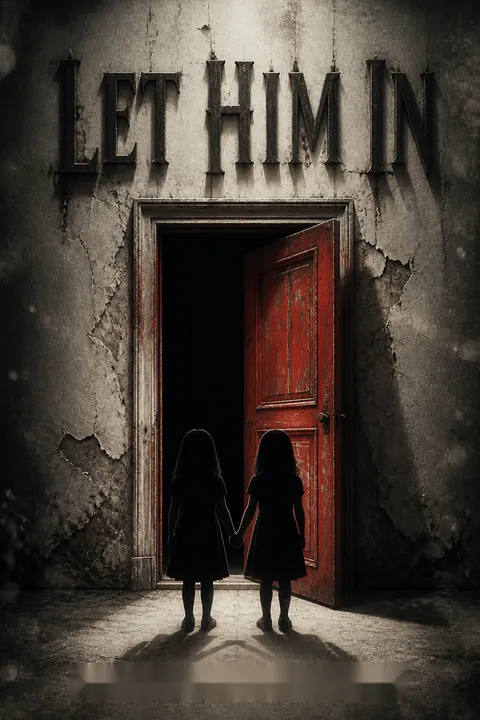
Let Him In makes grief a force that reorganizes ordinary family life. A tart, an empty place setting, a wet bed, or a late-night light becomes evidence because the adults and children no longer share a stable account of what has happened. Black Mamba is effective precisely because he can be read in several ways at once: as imaginative play, as a shared coping structure, as a rival father, and as a supernatural being tied to Hart House. The novel never allows a clinical explanation to erase the material risks around the children, nor does the haunting make those risks disappear.
The twins’ bond is both refuge and pressure. Their synchronized speech and drawings initially suggest a single childlike imagination, but bruises, schoolwork, and competing attachments disclose separate inner lives. Cassia’s and Sylvie’s different responses show why treating twins as one unit can hide distress. Alfie, meanwhile, is not a simple monster or a blameless widower. His grief, drinking, and past violence matter, but so do his efforts to repair trust. Julia’s clinical skill helps only when she accepts that she is implicated in the family’s history rather than standing outside it.
The house gives inherited belief an architecture. Its cellar, darkroom, red door, and hidden objects make the past feel physically reachable, while the competing religious and psychological accounts leave the source of the haunting unsettled. The novel’s most durable insight is not that one explanation wins, but that stories can protect people and endanger them at the same time. Recovery begins when the family tells harder truths, accepts uncertainty, and chooses relationship without pretending that love can undo loss.
People Also Read


Characters
Alfie Marvell
Grieving fatherAlfie is Pippa’s partner and the father of Sylvie and Cassia. Big-hearted and attentive when life is stable, he becomes withdrawn after Pippa’s death, relying on wine and routine to move through ordinary days. His grief is complicated by guilt, unresolved conflict with Pippa, and the fear that the twins’ closeness leaves him outside their family bond. He wants to protect his daughters, but his exhaustion and anger sometimes undermine that aim. Alfie’s struggle is not simply to accept or reject the supernatural. He must learn to remain present with the children while acknowledging the parts of family life he had hidden from himself.
Julia Harris
Reluctant family therapistJulia is Pippa’s twin sister, the girls’ aunt, and a psychotherapist who has kept Hart House at emotional distance since Pippa’s death. She is observant, self-controlled, and skilled at interpreting other families, but her own history makes her vulnerable to guilt and avoidance. Julia’s bond with Pippa was shaped by love, rivalry, and the pain of feeling less favored by their father. Her professional explanations offer the family structure, while her private memories complicate her certainty. Julia is driven by a wish to help the twins without taking her sister’s place, a distinction that becomes increasingly difficult to maintain.
Sylvie
The volatile twinSylvie is one of Alfie and Pippa’s seven-year-old daughters and Cassia’s twin. More outwardly emotional than her sister, she can be playful, demanding, and quick to anger, especially when she feels threatened or overlooked. Her close attachment to Alfie shapes how she responds to loss, discipline, and the twins’ shared friend. Sylvie’s vivid imagination gives her a way to express fears she cannot yet manage in direct conversation. She is not merely the impulsive twin: her behavior carries grief, guilt, and a strong need for reassurance from the adults who remain.
Cassia
The watchful twinCassia is Sylvie’s twin and the quieter, more controlled daughter of Alfie and Pippa. As a young child she was often described as calm and dependable, but restraint does not mean she feels less intensely. She watches other people closely, chooses her words carefully, and can use silence as a form of protection. Her bond with Sylvie is unusually strong, sometimes making it difficult for adults to understand where one girl’s feelings end and the other’s begin. Cassia’s stories and drawings reveal a keen mind working to make sense of family change, fear, and the question of whom she can trust.
Pippa Harris
Artist and absent motherPippa is Julia’s twin, Alfie’s partner, and the mother of Sylvie and Cassia. A professional painter with a gift for imaginative play, she brought energy and creative attention to family life. She was passionate and loving, but could also be restless, superstitious, and difficult to read. Her relationship with Alfie held genuine affection alongside disagreements about marriage, children, and their future. Pippa’s paintings, memories, and the circumstances surrounding her death shape how the living characters understand themselves. She remains a distinct person in their minds, not simply an idealized symbol of what they have lost.
Marian
The grieving grandmotherMarian is the mother of Julia and Pippa and the twins’ grandmother. She has lived with the effects of a stroke and is often in pain, but her faith and emotional intensity remain powerful forces in the family. Marian loves her daughters and granddaughters, yet she can intrude on boundaries and use religious beliefs to shape how others interpret loss. Her relationship with Alfie is strained, partly because she sees Hart House as her family home. Her convictions offer the children a language for death and spirits, though that language can deepen their fears.
Eric Harris
The searching fatherEric is Julia and Pippa’s father, remembered as a religious man who photographed the rooms of Hart House and used its cellar as a darkroom. He believed in the possibility of reaching beyond ordinary perception, a conviction that shaped his daughters’ childhood. His death left Marian and the girls with grief they struggled to explain, while his objects and habits continued to influence the family. Eric’s role in the story is inseparable from the questions he pursued and the danger of trying to force certainty from experiences that resist it.
Aunt Sue
The faithful auntSue is Eric’s sister and Marian’s sister-in-law, a longtime presence in Julia and Pippa’s childhood church. Practical, warm, and deeply religious, she helped create a sense of community around the family. Her son Michael died before Julia was born, a loss that shaped Sue’s faith and her understanding of death. As she grows more forgetful, her words blur past and present, but her affection for Julia remains evident. Sue’s memories connect private family grief to the beliefs and rituals that once governed the household.
Bella Addison
The observant teacherBella teaches Sylvie and Cassia and notices changes in their behavior at school. She takes her safeguarding responsibilities seriously, reporting bruises while also seeking to understand the girls’ circumstances before judging their father. Her private decision to show Julia the twins’ writing gives the family therapist a clearer view of how differently the sisters experience Black Mamba. Bella functions as a careful outsider: close enough to spot warning signs, but not so close that family loyalties dictate what she reports.
Mr. Lewer
The investigating social workerMr. Lewer is the social worker who visits Hart House after school staff report concerns about the twins. His questions about injuries and behavior force the adults to confront the difference between private explanations and public responsibility. Julia also recognizes him as resembling the official who questioned her family after Eric’s death, linking the present investigation to an earlier crisis.
Michael
The lost cousinMichael was Sue’s son and Eric’s nephew. He died as a child in an accident before Julia was born. Julia knows him chiefly through a drawing and family stories, while his death shaped Sue and Eric’s religious search for meaning.
Plot Devices
Black Mamba
A shared protective figureBlack Mamba is the twins’ companion, described as a man who can become a snake, bird, fish, bear, wolf, or other creature. He begins as a nighttime visitor and gradually enters the girls’ drawings, meals, schoolwork, and family conflicts. His shifting forms allow the children to give shape to different needs: comfort, adventure, protection, and control. The adults disagree about whether he is an imaginary friend, a shared delusion, or a supernatural presence. The device keeps those interpretations in tension while revealing how the twins understand grief and their relationships with Alfie.
The red door
A boundary around the deadJulia teaches Cassia to imagine a strong man guarding a red door, an image meant to help a frightened child feel safe. The motif later connects to the red-cross box that stores family photographs, the cellar’s former darkroom, and the possibility of reaching the dead. Because the door functions both as a protective barrier and a possible threshold, its meaning changes with the characters’ beliefs. It expresses the human wish to make grief containable, while leaving open the danger of treating a metaphor as an actual route.
Pippa’s paintings
Grief made visiblePippa’s paintings give the family images for experiences they cannot explain directly. Her unfinished final canvas depicts two shadowy figures beneath a red ring, an image Alfie initially cannot interpret. Her other works appear at the funeral and throughout Hart House, preserving both her artistic presence and the family’s memories of her. The paintings are not simply clues to a supernatural mystery. They show how art can record emotional material before its maker or audience fully understands it, and how the bereaved may search an image for certainty after a death.
The rattle and photographs
Objects linking generationsEric’s antique rattle, the family’s locked box of photographs, and the old darkroom connect the present crisis to the girls’ childhood and Hart House’s history. Eric used the rattle at night and photographed empty rooms, while the family treated photographs as objects with unusual power. Alfie’s discovery of the rattle and old records gives the house a documented past of occult claims and violence. These objects let the novel link memory to physical evidence without proving that the family’s supernatural interpretations are correct.
Recurring dreams
Memory returning in disguiseAlfie dreams of Pippa at Collier Beach, while Julia recalls childhood visions and Pippa’s nightmares of a false version of their father. The recurring images of drowning, red light, an impostor, and a locked threshold bring buried family conflicts into the present. Dreams expose feelings the characters cannot easily state, including guilt, fear of abandonment, and longing for the dead. Their ambiguity also prevents a simple distinction between psychological distress and paranormal warning. What the dreams do reveal clearly is that each character carries a private version of the family’s past.
Download PDF
Download EPUB
.epub digital book format is ideal for reading ebooks on phones, tablets, and e-readers.








