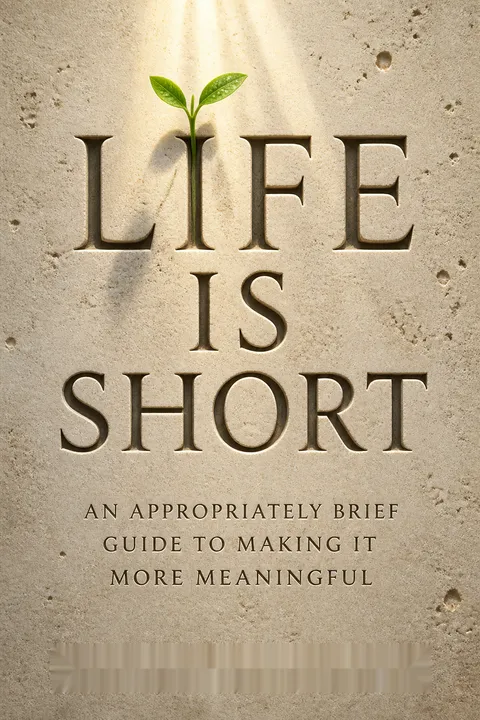


Key Takeaways
Let mortality narrow your options, or your choices never become real.
Limits make choices matter. Dean Rickles builds on Seneca’s argument that a long life can still be mostly unused. Death does more than take time away: it makes choosing necessary. Each decision makes one possible future actual and leaves others unrealized. Without a limit, every possibility could remain open indefinitely, weakening the force of any choice. The book’s central claim is that finitude is not merely an obstacle to meaning. It helps create meaning by making decisions consequential.
Freedom has a boundary. Rickles compares life to a game: rules and consequences are what make play possible. This does not mean that every limit is good, or that death is painless. It means that the need to choose among finite possibilities gives action weight. The task is to shape those limits consciously rather than let distraction or circumstance make every choice by default.
What's striking is the reversal: limits do not simply reduce freedom, they give freedom something to act on. This resembles the way a design brief can make creativity more focused than an unlimited blank page. The argument is persuasive as an account of why choices matter, though it does not establish that every finite life is meaningful. Scarcity can also generate panic, coercion, or regret. The book's sharper point is that limits create the conditions for meaningful action, not that limits automatically produce it.
Stop confusing years passed with a life actually lived.
Elapsed time is not enough. Seneca distinguishes mere existence from living with attention and direction. A person may accumulate years without feeling that they have made a journey. Rickles updates the warning with modern distractions, including long stretches spent managing appearances and scrolling through social media instead of thinking or acting with purpose.
Notice where time goes. Seneca’s image is of a traveler driven repeatedly around the same route by bad weather: movement happens, but little progress is made. The point is not that rest or entertainment is wasteful. Rather, time becomes unlived when a person stays in waiting mode, postponing meaningful activity while claiming to be too busy to begin. A useful question is not only how much time remains, but how much of the time already spent felt chosen and inhabited.
This distinction helps separate busyness from engagement. It also challenges the habit of measuring a life by visible output: a quiet afternoon with a friend may be more fully lived than a packed day of tasks. The book's criticism of social media is most useful when aimed at automatic use, not at a particular platform or generation. Attention is finite, but so is the energy required to make every hour purposeful. A life cannot be reduced to a productivity score without recreating the very waste the argument opposes.
More years cannot guarantee one continuous self or meaningful life.
Immortality raises an identity problem. In the play The Makropulos Case, Elina Makropulos has lived for 342 years through a life-extending potion, yet chooses to stop renewing it. The story asks whether limitless time would preserve a meaningful life or drain it of urgency. Rickles questions the familiar answer that immortality must simply become boring. The deeper puzzle is whether an immortal being would remain the same person in a sense that matters.
Memory connects a life. Philosopher Thomas Reid imagines an old general who remembers being a middle-aged officer, and that officer remembering his boyhood, while the old general can no longer recall the boy. The example complicates the idea of a single self persisting unchanged. Rickles does not prove that longer lives would fail, but argues that extra years alone cannot solve the problem of meaning or personal continuity.
The chapter shifts the debate from whether endless life would be tedious to what makes a life belong to one person at all. Memory, plans, and relationships provide practical continuity, but none guarantees an unchanged inner self. This is a useful corrective to treating longevity as an uncomplicated good. It also leaves room for a fair objection: human capacities and ways of remembering might change along with lifespan. The thought experiment exposes an unresolved question rather than settling the ethics of life extension.
Treat tomorrow's consequences as yours, not someone else's problem.
Time creates a bias. Rickles calls harmful patterns tied to how people relate to past and future selves diseases of time. People often favor a reward now while discounting a cost years away, whether that means overspending, avoiding exercise, or delaying important work. The distant person who bears the consequences can feel almost like a stranger, even though that person is oneself.
Make the future easier to picture. Rickles draws on research about future-self continuity, including brain-imaging work associated with psychologist Hal Hershfield. He also discusses mental time travel, the ability to imagine oneself in possible future situations. Vividly picturing a future can strengthen the felt connection to it. The Marshmallow Test adds an important qualification: children who take an immediate reward may be responding rationally to unstable circumstances, not simply lacking self-control.
The practical insight is not to shame people for preferring what feels immediate, but to make distant consequences emotionally legible. This connects to commitment devices, arrangements that help a person follow an intention when temptation arrives, such as automatic saving. Yet the Marshmallow Test example cautions against treating delay as a universal virtue. Trust in the future depends partly on whether the world has been reliable. Good advice therefore pairs future planning with attention to the real conditions people face.
Choose deliberately, then investigate the hidden motives choosing through you.
Action shapes the future. Rickles calls this project of shaping a life Project Me, while warning that it is not permission for self-absorption. Choices alter what becomes possible, much as a sculptor shapes a form by removing material. At twelve, Rickles became intensely focused on piano and practiced a demanding piece until his fingertips split. The drive helped him progress, but also showed how effort can become punishing when its motives go unexamined.
Know what is steering. Jung’s term individuation means bringing unconscious influences into awareness so a person can act more deliberately and become more psychologically whole. Dreams, patterns of behavior, and persistent emotional reactions can offer clues. Rickles argues that conscious intention alone is not enough: people can know what they are doing and still act against their own interests. The challenge is to examine both the future being built and the motives behind the building.
The sculptor image makes agency tangible, while individuation adds an important check against turning self-improvement into obedience to an ideal image. The two ideas work best together: action tests a person's aims, and reflection tests the forces behind action. Agency, however, is not omnipotence. Money, health, discrimination, family duties, and chance constrain which futures are realistically available. The model is strongest when responsibility means taking available action, not blaming people for conditions they did not choose.
Commit to the imperfect life in front of you.
Waiting can become a lifestyle. Rickles uses provisional life for an existence treated as a temporary holding pattern. A person waits for the right partner, career, or feeling before fully committing, but the ideal may remain vague and perpetually out of reach. Jungian writer Marie-Louise von Franz describes this pattern as fear of being bound to a particular life. Rickles connects it to his own difficulty committing to a long-term relationship.
Balance freedom with structure. Jungian psychology describes the Puer aeternus as an eternal-youth pattern: present-focused, restless, and resistant to limits. Its complement, the Senex, represents planning, responsibility, and acceptance of finitude. Either extreme can become destructive. Rickles recounts Jung advising a hesitant person to do the available work thoroughly rather than wait for a perfect calling. Commitment gives a life shape, but it need not mean surrendering curiosity or spontaneity.
The distinction between a real aspiration and a fantasy that postpones action is valuable well beyond relationships. Treating Puer and Senex as flexible patterns, rather than fixed personality types, makes the framework more useful: one can ask whether a situation needs more play or more follow-through. The language of the original Jungian tradition can carry dated assumptions about gender and adulthood, so it should not be used as a diagnosis. Its practical core is simpler: stop requiring perfect certainty before participating in life.
Build resilience without burying the parts that make you human.
Protection has a price. Rickles calls the pursuit of near-total invulnerability bulletproofing. A person may try to perfect the body, personality, or public image so thoroughly that ordinary flaws feel intolerable. The defensive self can become what psychoanalyst Jean Arundale calls a fortress of I: a protected identity that keeps vulnerability out, but also makes connection difficult.
Buried traits still exert influence. In Jungian psychology, the shadow consists of qualities a person rejects or hides. Pushing them out of view does not necessarily make them disappear; they may shape behavior without being recognized. Perfectionism can therefore create a false self that is difficult to maintain and disconnected from actual needs. Rickles is not arguing against health or effort. He is warning against treating weakness, dependence, and imperfection as evidence that the real self must be concealed.
This argument usefully distinguishes care from control. Training, medical treatment, and ambition can enlarge a life, while the demand to eliminate every vulnerability can shrink it. The shadow concept offers a memorable way to ask what a polished self excludes. Still, not every private trait needs public expression, and protective boundaries can be necessary rather than neurotic. The relevant test is whether protection serves participation in life or becomes a substitute for it.
Let future people matter without outsourcing your meaning to legacy.
Humanity's continuation matters. Philosopher Samuel Scheffler asks readers to imagine knowing that humanity will end soon after their own natural death. In one version, a meteor destroys humanity a month later. Many people expect this certainty to change how they work and what seems worthwhile. Scheffler calls the continued existence of other people after one's death a collective afterlife, distinct from personal survival.
The concern is complicated. The prospect of extinction may trouble people because future generations will no longer read books, make art, or continue shared projects. It may also reflect a desire for civilization's achievements to be preserved. Rickles questions whether concern for humanity proves that people are less egoistic than they think. He notes that the universe itself will not preserve human traces forever, yet distant cosmic endings feel less urgent than near ones, perhaps because people are biased toward the immediate future.
This thought experiment reveals that personal meaning is partly social: a project often matters because other people can receive, extend, or contest it. That need not reduce meaning to fame or legacy. A meal, a lesson, or a kindness can matter to its participants even if nothing lasts forever. The argument also exposes a scale problem: if a near extinction would destroy meaning, it is not obvious why a remote one should not. The book treats that tension seriously rather than offering a simple answer.
Practice noticing: attention turns an existing world into a lived one.
Awareness changes experience. Rickles argues that people often move through ordinary life absorbed by regrets, plans, imagined judgment, and worries about appearance. They may perform actions without noticing what is guiding them. Drawing on psychologist and philosopher William James's idea of the specious present, he describes immediate awareness as a narrow window through which the world is experienced.
Meaning needs a subject. Rickles connects conscious attention to the claim that human beings do more than observe a meaningful universe: they help make the world meaningful by noticing and interpreting it. He contrasts this with the view that science's account of physical processes makes human life pointless. His counterclaim is that explanations of how things behave do not settle why anything exists or what it means. Attention, in this account, is not escape from the world but a way of encountering it.
The emphasis on attention gives the book's metaphysical argument a daily practice: meaning is not only an abstract answer but also a quality of contact with experience. This connects naturally to reflective practices that help people notice automatic reactions. The stronger claim, that human consciousness is necessary for the universe to have objective existence or meaning, remains philosophical rather than established science. The modest claim is more secure: a world can be physically present without being experienced as significant by any particular person.
Make an irreversible choice before time makes it for you.
Avoidance is still consequential. Rickles treats major decisions as both creative and destructive: choosing one path can close others. That loss helps explain why commitment can feel frightening. But refusing to choose does not preserve every possibility. Time, aging, and changing circumstances continue to alter what remains available, often without the person directing the change.
Crisis means decision. Rickles notes that the Greek root of crisis refers to deciding. A turning point makes the narrowing of possibilities especially visible, but the same process runs through ordinary life. A person choosing between two demanding musical paths, for instance, may have to commit to one if mastery is the goal. The choice does not make every outcome controllable. It does make the person's agency part of what happens, rather than leaving the future entirely to drift.
This is a potent account of why freedom can feel less like comfort than responsibility. The financial-portfolio metaphor for keeping options open has limits: some choices are reversible, and experimentation can reveal preferences that reflection alone cannot. But postponement is not neutral when opportunities decay or other people bear the consequences. The useful question is not whether a decision eliminates alternatives, since most meaningful decisions do, but whether the person has examined enough to stand behind the path selected.
Analysis
The book's argument is both existential and practical. Its central move is to treat death not as a mere endpoint but as the condition that makes choosing urgent and makes a lived future distinct from an unlimited field of possibilities. That gives its advice about attention, commitment, and self-knowledge a common rationale. Seneca's complaint about wasted time becomes more than a productivity lesson: the problem is not simply that hours disappear, but that people can avoid becoming authors of what those hours contain.
The argument is strongest when it describes recognizable behavior. People discount distant consequences, postpone commitments while waiting for certainty, and mistake a protected self-image for a secure self. Rickles connects these patterns to philosophical debates about personal identity and time, then offers individuation as a method of examining hidden motives. The result is a rich synthesis, though the Jungian vocabulary can make ordinary conflicts sound like fixed psychological types. Puer and Senex work best as lenses for competing tendencies, not as clinical classifications.
The most debatable step is the move from mortality's usefulness to its necessity for meaning. A deadline can concentrate attention, but it can also produce fear, injustice, or truncated plans. Conversely, longer life would not automatically erase commitment: people with more time could still encounter scarcity, risk, and consequences. The book's argument is therefore more compelling as a claim about finite conditions making choices salient than as a proof that immortality would be meaningless.
A further strength is the refusal to reduce meaning to private satisfaction. The collective afterlife thought experiment shows that people care about future human activity, while the final account makes attention and conscious action part of how the world becomes significant. These claims do not resolve the cosmic question of why anything exists. They offer a more local answer: a person can shape a small part of reality, and that agency matters precisely because neither time nor possibilities are unlimited.
Review Summary
Life Is Short receives mixed reviews, with an average rating of 3.17 out of 5. Readers appreciate its philosophical approach to life's brevity and meaning, but some find it dense and difficult to understand. The book explores concepts like mindfulness, authenticity, and the importance of death in giving life purpose. While some readers find it thought-provoking and insightful, others criticize its complexity and lack of practical advice. The book's brevity is both praised and seen as a limitation in fully exploring its themes.
People Also Read



Glossary
Diseases of time
harmful patterns across timeRickles's term for behaviors shaped by a person's relationship to past and future selves that lead to damaging outcomes. The central example is temporal myopia: treating a distant future self as less important than the present self. The concept includes both neglecting the future and sacrificing too much of the present for it.
Provisional life
life postponed for laterA way of living in which current circumstances are treated as placeholders while a person waits for a better relationship, job, identity, or time to begin. The desired future often remains vague, and the person neither commits to the present nor takes sustained steps toward change. Rickles connects this avoidance to fear of limits and irreversible choices.
Puer aeternus
eternal-youth patternA Jungian term for a pattern associated with youthfulness, present-focused desire, resistance to responsibility, and difficulty accepting limits. Rickles uses it to describe one pole of a psychological tension, not simply a lively or creative personality. When dominant, it can encourage fantasy, indecision, and repeated escape from commitments.
Senex
responsible, future-focused patternThe Jungian counterpart to the Puer aeternus, associated in Rickles's account with planning, responsibility, analysis, and awareness of mortality. The Senex can support sustained work and commitment, but an excess may produce anxiety, overcontrol, and neglect of present experience. A healthy life requires flexibility between these complementary tendencies.
Individuation
becoming psychologically wholeIn Jungian psychology, individuation is the process of bringing unconscious influences into awareness and developing a more integrated personality. Rickles presents it as necessary to deliberate action: people need to examine the motives, fears, and patterns shaping their choices, rather than assuming every strong conscious desire expresses their considered values.
Bulletproofing
pursuit of invulnerabilityRickles's label for efforts to become protected from weakness, criticism, pain, or imperfection. Physical health and resilience are not the problem. The danger comes when protection hardens into a flawless public identity that hides disowned parts of the person, limits intimacy, and turns ordinary vulnerability into something to defeat.
Collective afterlife
human life after one's deathThe continued existence of other people and human activity after a person dies, rather than an individual's religious or personal survival. In the thought experiment Rickles discusses, people consider how they would live if humanity were certain to end soon after their own natural deaths. The scenario tests how much meaning depends on future generations.
Mental time travel
imagining one's possible futureThe capacity to picture oneself in future situations and rehearse possible outcomes. Rickles connects this capacity to how strongly a person identifies with a future self. Making a future more vivid can help distant consequences feel personally relevant, although circumstances and uncertainty also affect whether people trust that future.
Possibility structure
available paths through lifeRickles's image for the branching futures available to a person, given their circumstances and the actions they might take. Decisions can make some paths actual while weakening or closing others. The structure differs across people because opportunities, constraints, and luck differ, and it changes as time passes.
Specious present
the felt window of nowA term associated with William James for the brief span of experience that a person experiences as the present moment. Rickles uses it to stress that immediate awareness captures only a small portion of reality, while the past and future must be remembered, imagined, or inferred. Attention shapes what enters this lived present.
FAQ
What's "Life Is Short: An Appropriately Brief Guide to Making It More Meaningful" about?
- Exploration of Life's Meaning: The book by Dean Rickles explores how the shortness of life can be leveraged to make it more meaningful. It draws inspiration from Seneca's classic work, "On the Shortness of Life."
- Philosophical Insights: It delves into philosophical discussions about time, mortality, and the human condition, questioning how these elements contribute to a meaningful existence.
- Practical Guidance: The book offers practical advice on how to live a more conscious and purposeful life, emphasizing the importance of making deliberate choices.
- Contemporary Context: Written during the COVID-19 pandemic, it reflects on how global events can prompt a reassessment of personal priorities and life goals.
Why should I read "Life Is Short: An Appropriately Brief Guide to Making It More Meaningful"?
- Timely Reflection: The book provides a timely reflection on life’s brevity, especially relevant in the context of the global pandemic.
- Philosophical Depth: It offers deep philosophical insights into the nature of time and existence, appealing to readers interested in self-help and philosophy.
- Practical Advice: Readers can gain practical strategies for living a more meaningful life by understanding and embracing life's limitations.
- Inspirational Content: The book is designed to inspire readers to think deeply about their lives and make conscious choices that align with their true selves.
What are the key takeaways of "Life Is Short: An Appropriately Brief Guide to Making It More Meaningful"?
- Embrace Limitations: The book argues that limitations, including mortality, are essential for a meaningful life as they provide structure and focus.
- Conscious Living: It emphasizes the importance of living consciously and making deliberate choices to align actions with personal values and goals.
- Balance and Integration: The book discusses the need to balance different aspects of life, such as the Puer (youthful spirit) and Senex (wise old man), for a well-rounded existence.
- Role of Death: Death is presented not as an end but as a crucial element that gives life its meaning by enforcing choices and actions.
How does Dean Rickles suggest we make life more meaningful?
- Active Engagement: Rickles suggests actively engaging with life by making conscious choices and taking responsibility for one's actions.
- Individuation Process: He advocates for individuation, a process of self-discovery and understanding one's unconscious drivers to live authentically.
- Embrace Mortality: Accepting and understanding mortality is crucial, as it provides the urgency and focus needed to live a meaningful life.
- Balance and Integration: Finding a balance between different life aspects, such as work and play, and integrating them into a cohesive whole is essential.
What is the role of death in "Life Is Short: An Appropriately Brief Guide to Making It More Meaningful"?
- Source of Meaning: Death is portrayed as a source of meaning, as it imposes limits that necessitate choices and actions.
- Focus and Urgency: The awareness of mortality provides focus and urgency, encouraging individuals to live purposefully and make the most of their time.
- Philosophical Perspective: The book challenges the Epicurean view that death is nothing to fear, suggesting instead that it is a gift that breathes life into existence.
- Life's Bookends: Death, along with birth, serves as a bookend to life, framing it in a way that makes each moment precious and unique.
How does Dean Rickles incorporate Seneca's ideas in his book?
- Modern Reassessment: Rickles provides a modern reassessment of Seneca's ideas, applying them to contemporary life and challenges.
- Time as a Resource: Like Seneca, Rickles emphasizes the value of time as a precious resource that should not be wasted on trivial pursuits.
- Philosophical Dialogue: The book engages in a philosophical dialogue with Seneca, exploring themes of mortality, time management, and the pursuit of a meaningful life.
- Practical Application: Rickles translates Seneca's philosophical insights into practical advice for modern readers, encouraging them to live deliberately and authentically.
What are the diseases of time mentioned in the book?
- Temporal Myopia: The book discusses temporal myopia, where individuals prioritize immediate gratification over long-term benefits, leading to poor decision-making.
- Procrastination: Procrastination is highlighted as a common issue, where people delay important tasks, wasting valuable time and opportunities.
- Disconnectedness: A lack of connectedness to one's future self is identified as a problem, leading to actions that harm future well-being.
- Balancing Act: The book suggests that balancing present-focused and future-focused attitudes is crucial to overcoming these time-related challenges.
What is the concept of "Project Me" in the book?
- Self-Creation: "Project Me" involves treating one's life as a creative endeavor, actively shaping the future through conscious choices and actions.
- Authenticity and Responsibility: It emphasizes authenticity and taking responsibility for one's life, understanding the unconscious drivers behind actions.
- Sculpting the Future: The concept likens life to a sculpture, where individuals prune possibilities and make deliberate choices to create a meaningful existence.
- Avoiding False Self: The book warns against projecting a false self and encourages aligning actions with one's true character and values.
How does the book address the concept of immortality?
- Immortality Fantasies: The book explores the human fascination with immortality and the implications it would have on life's meaning.
- Finite Boundaries: It argues that finite boundaries, including death, are essential for a meaningful life, as they enforce choices and focus.
- Philosophical Inquiry: The book engages in philosophical inquiry about the nature of immortality and its coherence with human identity and memory.
- Practical Implications: It suggests that the pursuit of immortality might lead to a loss of meaning, as unlimited possibilities could result in a stagnant existence.
What are the best quotes from "Life Is Short: An Appropriately Brief Guide to Making It More Meaningful" and what do they mean?
- "Limit gives birth to freedom." This quote encapsulates the book's central theme that limitations, including mortality, are essential for true freedom and meaning.
- "To be a free agent is precisely to be a being who faces consequences." It highlights the importance of making choices and accepting the consequences as a path to a meaningful life.
- "Death is the most necessary limit of all, and without it, all projects are devalued." This quote emphasizes the role of death in providing urgency and value to life's endeavors.
- "The game of life must contain boundaries." It suggests that life's rules and limitations are what make it engaging and meaningful, much like a game.
How does the book suggest balancing the Puer and Senex archetypes?
- Integration of Opposites: The book advocates for integrating the youthful spirit (Puer) and the wise old man (Senex) to achieve a balanced and meaningful life.
- Avoiding Extremes: It warns against living too much under either archetype, as both have their virtues and vices that need to be balanced.
- Conscious Living: By living consciously and making deliberate choices, individuals can navigate the tension between these archetypes effectively.
- Personal Growth: The integration of Puer and Senex is seen as a path to personal growth and individuation, leading to a more authentic existence.
What is the significance of the "provisional life" concept in the book?
- Inauthentic Living: The provisional life refers to living in a state of inauthenticity, where individuals are stuck in a holding pattern, waiting for life to happen.
- Fear of Commitment: It highlights the fear of commitment and decision-making, leading to a life of unfulfilled potential and missed opportunities.
- Breaking Free: The book encourages breaking free from the provisional life by embracing reality, making choices, and committing to a path.
- Living Fully: By addressing the provisional life, individuals can move towards living fully and authentically, making the most of their limited time.
Download PDF
Download EPUB
.epub digital book format is ideal for reading ebooks on phones, tablets, and e-readers.








