

Key Takeaways
Use fallacy names to diagnose reasoning, not to declare victory
A reasoning error. A logical fallacy is a defect in how an argument supports its conclusion, not simply a false claim. Bennett’s test asks whether the problem is an error in reasoning rather than fact, commonly arises in an argument, and can mislead an ordinary audience. A mistaken statistic may make an argument factually wrong without making its reasoning fallacious. By contrast, saying a belief must be true because many people hold it substitutes popularity for evidence.
Name the role. A fallacy may describe an argument’s structure, an audience’s mistaken inference, or a deliberate persuasive tactic. Those are different things: a charity may use an emotional image deliberately, while a viewer may wrongly treat that image as proof. A label helps identify the move, but it does not settle the issue.
The three-part test gives a sprawling catalog a practical purpose: it asks whether a label clarifies a real reasoning problem. That caution matters because informal fallacies often overlap, and reasonable people can dispute where one category ends and another begins. The most useful habit is therefore not memorizing hundreds of names, but explaining exactly what premise fails to support which conclusion. A fallacy label without that explanation can become a conversational shortcut, a way to sound rigorous while avoiding the argument itself.
Reconstruct the claim and its support before judging its logic
Find the argument. An argument is a conclusion offered with premises, meaning the reasons or evidence meant to support it. A bare opinion may be mistaken, but it is not yet an argument to evaluate. In casual speech, the reasons may be implied, so the listener has to identify what is being claimed and what supposedly follows from it.
Check the kind of support. A formal fallacy is a flaw in logical structure. An informal fallacy depends on content, context, or how the claim is presented. Deductive reasoning aims for a conclusion that must follow if the premises are true; inductive reasoning supports a conclusion as likely, not guaranteed. For instance, having more money to spend does not establish that a tax cut caused it. Other explanations could fit the same result.
This reconstruction step resembles careful reading in law and science: the claim, evidence, and inference must be separated before anyone can test them. It also reduces needless conflict, since people often respond to an implication that was never intended. The challenge is that real conversation is messy. A speaker may not have a settled conclusion, or may be thinking aloud. Asking what is meant is often more accurate than forcing an unfinished remark into a formal argument.
A bad argument does not prove its conclusion false
Separate truth from support. An argument can reach a true conclusion by a poor route. If someone claims smoking is harmless because one heavy smoker lived to 69, the anecdote does not establish the health effects of smoking. But its weakness does not, by itself, settle the issue either. The evidence for the conclusion must be assessed separately.
Avoid the fallacy fallacy. The argument from fallacy is the mistake of deciding that a claim is false simply because one argument for it contains a fallacy. Likewise, a valid argument can begin with a false premise, so validity alone does not guarantee a true conclusion. The key question is what the argument establishes, given its premises, and whether those premises are reliable.
This distinction protects critical thinking from turning into mere debate scoring. A flawed argument may still point toward a conclusion supported by other, stronger evidence. The same principle applies to credibility: catching one mistake should lower confidence in that argument, not automatically reverse the claim. There is a practical limit, however. Repeatedly poor reasoning can be evidence that a speaker is not a reliable guide, even though it is not proof that every claim the speaker makes is false.
Treat possibility as a prompt for testing, not as evidence
Possibility is cheap. The appeal to possibility treats “it could be true” as support for “it is true” or “it is likely.” But many incompatible explanations are possible at once. The argument from ignorance makes a related mistake: it concludes that a claim is true because it has not been disproved, or false because it has not been proved.
Keep uncertainty honest. Not knowing how life began does not, by itself, establish a supernatural explanation. Nor does the current absence of an explanation prove that none can be found. The book distinguishes an unexplained event from one shown to be unexplainable, while warning against pretending that either conclusion has been established. State what is known, what remains open, and what evidence could change the assessment.
This is a useful discipline wherever uncertainty is emotionally charged. People often mistake an imaginable scenario for a likely one, especially when fear or hope makes the scenario vivid. Yet skepticism cuts both ways: rejecting a claim merely because it feels astonishing can also be poor reasoning. The strongest position is neither automatic belief nor reflexive dismissal. It is calibrated confidence, proportioned to the evidence and open to revision.
Restore the missing denominator before generalizing from vivid cases
Ask what is missing. The base rate fallacy occurs when a judgment ignores the overall frequency of an event and relies instead on a striking case or detail. The survivorship fallacy is a related error: drawing conclusions from visible winners while overlooking those who failed or did not survive to tell their story.
Follow the selection. Bennett describes a stock-picking scheme that sends different predictions to millions of people, then stops contacting those who received losing picks. After several rounds, a remaining group has received a string of apparently successful predictions. Those recipients may mistake selective reporting for extraordinary skill. The same problem appears when one dramatic news story is treated as typical. Ask how often the event happens, how the cases were selected, and what evidence is absent.
The denominator is often where a persuasive story loses its spell. A vivid example can establish that something happened, but not how common it is or what usually happens. Repeated exposure can make rare cases feel routine, while success stories hide the people who quietly dropped out. This does not make anecdotes worthless: they can reveal a possibility or suggest a question worth investigating. They become misleading when they are made to stand in for a representative sample.
Do not confuse sequence or correlation with causation
Time order is not enough. Post hoc reasoning assumes that because one event happened before another, it caused it. Questionable cause reasoning treats a regular association as proof of causation. Someone whose headache improves after a doctor visit may credit a wristband or treatment, even when headaches can naturally subside over time.
Test the causal claim. Bennett offers three checks: Did the proposed cause come before the effect? Is the association stronger than chance would explain? Could another factor account for it? Complex outcomes often have several contributing causes, so naming one factor as the whole explanation can mislead. Use measured language such as “may contribute” when the evidence does not justify “causes” or “solves.”
Causal claims are especially tempting because they turn uncertainty into a usable story: do this, and that will happen. A helpful further question is counterfactual: would the outcome probably have occurred without the supposed cause? That comparison is difficult in everyday life, which is why a single personal experience rarely settles a causal question. Still, caution should not become paralysis. Evidence can support strong causal conclusions when patterns, mechanisms, and comparisons converge.
Weigh claims, not credentials, crowds, or verbal fireworks
Check relevance and evidence. An appeal to authority treats an expert’s statement as sufficient proof; an appeal to false authority relies on someone whose expertise does not fit the subject. But rejecting a claim solely because its source is biased can also be fallacious. Expertise is useful as a guide to provisional trust, especially when it is relevant, but the claim and supporting evidence still matter.
Watch the performance. Popularity, celebrity, emotional language, and confidence can make a claim feel true without adding support. The Gish Gallop overwhelms an audience with many claims too quickly to examine. A practical response is to identify the strongest claim, ask for its evidence, and address it before moving on. Volume and polish are not substitutes for a sound case.
Argument quality is not the same as speaker quality, but speakers and institutions still matter when evidence is hard to inspect directly. The balanced approach is neither blind deference nor blanket distrust: consider relevant expertise, incentives, transparency, and independent support. A flood of claims creates an attention problem as much as a logic problem. Requiring one claim at a time is therefore not merely efficient; it gives each side a fair chance to understand and answer the argument.
Clarify what someone means before announcing their fallacy
Interpret charitably. The principle of charity means choosing the strongest reasonable interpretation of another person’s argument before criticizing it. This helps prevent strawman arguments, which attack a distorted version of someone’s position. It also helps with ambiguity: a phrase may have several meanings, and a conclusion may depend on quietly switching between them.
Ask before accusing. In one practice exchange, a person expresses disgust about killings involving guns, and the reply assumes that person claimed nobody was killed before guns existed. The book cautions that the first remark may have been an emotion, not a fully stated argument. Ask what conclusion is intended and what reasons support it. Fallacy labels can help, but wielding them too quickly often derails the conversation.
Charitable interpretation is not indulgence. It is a way to make disagreement more exact: the critic must answer the claim the other person actually holds, not the easiest version to defeat. This also exposes a useful limit of fallacy detection. Some statements are incomplete, emotional, or exploratory rather than arguments at all. Treating every sentence as a courtroom proposition can make conversation brittle. Clarification preserves rigor while leaving room for people to explain themselves.
Stress-test your rules with their least comfortable implications
Follow the rule through. Reductio ad absurdum tests a premise by showing that it leads to a contradiction. Reductio ad consequentia tests a proposed rule by examining what follows if it is applied consistently. For example, a claim that unconsciousness alone makes ending a life acceptable invites scrutiny of how that rule would apply in other cases.
Distinguish discomfort from contradiction. An implication that feels disturbing does not automatically refute a rule. The important work is to show that the rule produces a contradiction, conflicts with another principle its supporter accepts, or has consequences that reveal a hidden assumption. If the rule needs exceptions, state and justify them rather than quietly changing the standard when a difficult case appears.
These tests turn argument into a search for consistency rather than a hunt for a humiliating example. They are especially useful for revealing principles that sound plausible in isolation but become unstable across cases. The caution is essential: an unwanted consequence may be a reason to reconsider a policy, but it is not always a logical disproof. A strong test makes the inference explicit, gives the other person room to refine the rule, and distinguishes a genuine contradiction from a value disagreement.
Analysis
This book is best understood as a field guide to argumentative failure, not as a unified theory of logic. Its alphabetical catalog is deliberately broad, ranging from formal mistakes in syllogisms to social tactics, statistical misreadings, and habits of thought. That breadth makes the work useful as a reference, but it also creates its central difficulty: many labels overlap, and informal fallacies depend on context, intent, and the exact inference being made. The author’s own criteria help manage that sprawl by separating reasoning errors from factual mistakes and asking whether a pattern commonly misleads people.
The most durable contribution is the book’s insistence on preserving distinctions. A weak argument does not settle the truth of its conclusion. A cognitive bias is not automatically a fallacy, because fallacy analysis concerns argumentation. A legitimate expert opinion is not equivalent to treating authority as proof, and a source’s bias is not by itself a refutation. These distinctions make critical thinking less like a list of forbidden moves and more like a discipline of tracing support from premises to conclusions.
The book also recognizes that reasoning happens in social settings. A person may use an emotional appeal strategically, while an audience member mistakes emotion for evidence. A label can illuminate that process, but it can also become a weapon that changes the subject from the claim to the alleged error. The advice to clarify, interpret charitably, and test one’s own standards is therefore not a soft alternative to rigor. It is part of rigor.
A limitation follows from the catalog format. Naming a fallacy can make a complex dispute seem resolved when the actual work remains: identifying the implicit premise, assessing the evidence, and deciding whether the inference is strong enough. The best use of this book is not to memorize a taxonomy, but to develop a repeatable question: what exactly supports this conclusion, and what would count against it?
Review Summary
Logically Fallacious receives mixed reviews, with an average rating of 3.85/5. Readers appreciate its comprehensive coverage of logical fallacies and the author's attempts to make the material engaging through humor. Many find it informative and useful for improving critical thinking skills. However, some critics note that the book's extensive list of fallacies can become tedious and dry. The organization and indexing of fallacies are also points of contention. Despite these issues, many readers recommend it as a valuable resource for those interested in logic and argumentation.
People Also Read









Glossary
Logical fallacy
Deceptive reasoning errorAn error in reasoning that commonly occurs in an argument and can mislead people. It is not simply a factual mistake. A claim may be factually wrong without using fallacious reasoning, while a conclusion may be true even when the argument offered for it is weak or invalid.
Dr. Bo’s Three Criteria for a Logical Fallacy
Three-part fallacy testThe book’s test for deciding whether a reasoning pattern merits the label of logical fallacy. The pattern must be an error in reasoning rather than a factual error, commonly apply to an argument or its interpretation, and be deceptive enough to fool an average adult. The criteria are intended to distinguish useful categories from arbitrary labels.
Formal fallacy
Flaw in argument structureA defect in the logical form of an argument. A formal fallacy occurs when the conclusion does not follow necessarily from the premises, even if the premises and conclusion happen to be true. For example, affirming the consequent infers the condition from a result that the condition could produce, though other causes may produce it too.
Informal fallacy
Flaw in argument contentA problem in reasoning that depends on an argument’s content, wording, or context rather than only its logical structure. Appeals to popularity, misleading comparisons, and attacks on an irrelevant personal trait are examples. Their assessment often requires judgment about what the speaker means and what evidence the audience is being asked to accept.
Cognitive bias
Systematic thinking tendencyA recurring pattern in thought or judgment that can distort how people interpret information. Unlike a logical fallacy, a cognitive bias does not require an argument. A bias may contribute to a fallacious argument, as when people treat popularity as evidence of truth, but biased thinking and fallacious argumentation are not identical.
Principle of charity
Strongest fair interpretationThe practice of interpreting another person’s argument in the most reasonable and constructive way available before criticizing it. It helps prevent attacks on distorted versions of a claim and encourages clarification when meaning is uncertain. Charity does not require agreement; it makes disagreement address the position actually being expressed.
Base Rate Fallacy
Ignoring overall frequencyA statistical reasoning error in which someone neglects the general frequency of an event and gives too much weight to a vivid or seemingly relevant detail. A person may focus on one striking case while ignoring how common the outcome is across the larger population, leading to an exaggerated estimate of its likelihood.
Gish Gallop
Overwhelming with claimsA debate tactic that presents a rapid succession of arguments, often without regard to their accuracy or strength. The other person may lack time to address each point, leading observers to mistake an incomplete response for defeat or to treat the sheer number of claims as strong evidence.
Reductio ad absurdum
Expose a contradictionA form of reasoning that tests a proposition by assuming it is true and deriving a contradiction from it. If the proposition entails both a claim and its negation, the original proposition must be rejected. The method depends on demonstrating a genuine contradiction, not merely an outcome someone dislikes.
Reductio ad consequentia
Test a rule’s implicationsA technique for examining a proposed principle by applying it consistently and tracing its implications. It can reveal that a rule supports outcomes its advocate rejects or needs important qualifications. An unwelcome consequence alone does not prove the rule false; the reasoning must show why the consequence creates a real inconsistency or undermines the rule.
FAQ
What's Logically Fallacious about?
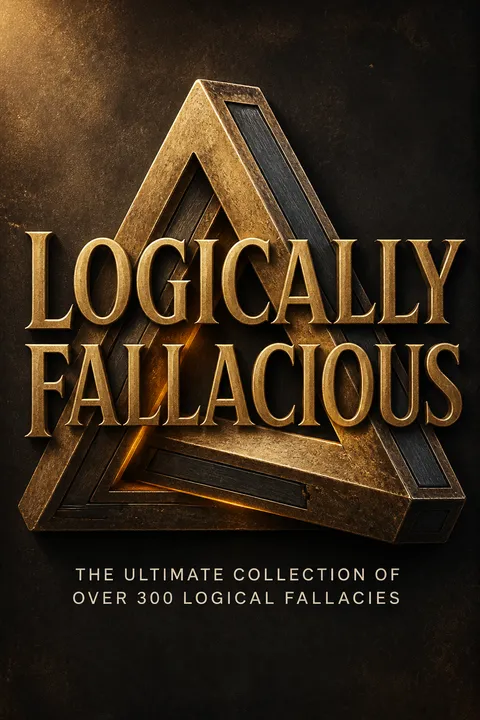
- Comprehensive Guide: Logically Fallacious by Bo Bennett is an extensive exploration of over 300 logical fallacies, providing definitions, examples, and explanations.
- Focus on Critical Thinking: The book emphasizes the importance of identifying fallacies to improve reasoning and rational discourse in everyday conversations and debates.
- Accessible to All: Written for both laypersons and those with an academic interest in logic, it aims to educate readers on critical thinking and reasoning skills.
Why should I read Logically Fallacious?
- Enhance Argumentation Skills: The book helps you recognize and avoid common logical fallacies, making your arguments stronger and more persuasive.
- Improve Critical Thinking: It encourages readers to think critically about the information they encounter, especially in a world filled with misinformation.
- Engaging Content: Dr. Bennett uses humor and relatable examples to make the content enjoyable, ensuring that readers learn while having fun.
What are the key takeaways of Logically Fallacious?
- Understanding Fallacies: The book categorizes fallacies into formal and informal types, helping readers understand flawed arguments.
- Practical Application: It includes practice situations and questions to help readers apply their knowledge of fallacies in real-life scenarios.
- Awareness of Cognitive Biases: The book discusses cognitive biases and their impact on reasoning, providing a broader understanding of human thought processes.
What is a logical fallacy, exactly?
- Definition of Fallacy: A logical fallacy is an error in reasoning that can mislead arguments and conclusions.
- Types of Fallacies: Fallacies are categorized into formal (based on structure) and informal (based on content), each with specific examples.
- Importance of Identification: Identifying logical fallacies is crucial for effective argumentation and critical thinking.
How does Logically Fallacious differentiate between logical fallacies and cognitive biases?
- Logical Fallacies vs. Cognitive Biases: Fallacies require an argument, while biases are patterns of thinking that can lead to errors in judgment.
- Crossover Between Concepts: Cognitive biases can lead to fallacies, but not all biases result in fallacies; they often operate unconsciously.
- Examples Provided: The book illustrates how biases like the bandwagon effect can manifest in arguments, impacting reasoning.
What are some common logical fallacies discussed in Logically Fallacious?
- Ad Hominem Fallacy: This occurs when an argument attacks the person rather than addressing the argument itself.
- Strawman Fallacy: Involves misrepresenting an opponent's argument to make it easier to attack.
- Appeal to Authority: Asserts that a claim is true simply because an authority figure endorses it, without supporting evidence.
How can I defend against an ad hominem attack according to Logically Fallacious?
- Stay Focused on the Argument: Maintain focus on the argument rather than the personal attack.
- Address the Fallacy: Politely point out that the attack does not address the validity of your argument.
- Use Evidence: Support your position with evidence and logical reasoning to counter the personal attack effectively.
What is the difference between formal and informal fallacies in Logically Fallacious?
- Formal Fallacies: Errors in the logical structure of an argument, often identifiable through syllogistic forms.
- Informal Fallacies: Based on the content of the argument, including emotional appeals or irrelevant information.
- Examples in the Book: Numerous examples help readers recognize and differentiate them in practice.
Can you explain the concept of "begging the question" as described in Logically Fallacious?
- Definition: Begging the question is a fallacy where the conclusion is assumed in one of the premises, creating circular reasoning.
- Example: "Paranormal activity is real because I have experienced what can only be described as paranormal activity."
- Importance of Avoidance: Recognizing this fallacy is essential for constructing valid arguments and avoiding flawed reasoning.
What is the "Gambler’s Fallacy" as described in Logically Fallacious?
- Definition: The Gambler’s Fallacy is the mistaken belief that past random events can influence future random events.
- Example: Believing that after flipping heads five times, the next flip must be tails, which is incorrect.
- Implications: Understanding this fallacy helps in making better decisions in gambling and other probabilistic situations.
What techniques does Logically Fallacious suggest for identifying fallacies?
- Become a Human Fallacy Detector: Actively look for logical fallacies in everyday conversations and media.
- Ask Clarifying Questions: Questions can help reveal any underlying fallacies in an argument.
- Practice with Examples: Engaging with examples in the book allows readers to practice identifying fallacies.
What are the best quotes from Logically Fallacious and what do they mean?
- "Expose an irrational belief...": Emphasizes challenging irrational beliefs to promote rational thinking.
- "A succession of uncontroversial true claims...": Warns against accepting conclusions based solely on preceding statements.
- "Become a human fallacy detector.": Encourages readers to actively engage in identifying fallacies in arguments.
Download PDF
Download EPUB
.epub digital book format is ideal for reading ebooks on phones, tablets, and e-readers.








