

Key Takeaways
Restart with the next useful step, not a perfect life plan.
A creative restart can be small. James Martin describes a childhood that included sexual abuse by a teacher, a long period of silence, drug use, expulsion, and leaving home as a teenager. He does not present design as a cure for trauma or excuse for his choices. Instead, he shows how a later decision to enroll in a yearlong art foundation course gave him a focus and a route back into learning. That course led toward graphic design, further study, and eventually agency work.
Progress came by stages. Martin had no single master plan, and his route included wrong turns, teaching, and a tattoo apprenticeship. His story makes a practical case for beginning with what is available now: a class, a project, or a first attempt. A life need not be fixed before a person can take a useful step.
The strength of this story is its refusal to turn hardship into a tidy origin myth. A person can build a meaningful career after serious harm, but the book does not establish that trauma causes creativity or that persistence alone resolves it. That distinction matters: readers should not feel obliged to extract a gift from suffering. The more transferable insight is about agency at manageable scale. In behavioral terms, a modest next action can restore a sense of control without demanding certainty about the whole future. Professional success is one possible outcome, not the measure of recovery.
Let your style emerge from experiments, not borrowed templates.
Style grows through practice. Martin argues that a recognizable visual voice is not found by copying what performs well online. It develops as personal interests, ways of working, and repeated experiments begin to reinforce one another. His Four P's is a mnemonic for four ingredients: knowing oneself, pursuing what holds attention, developing a working method, and allowing time for all three to mature.
Try before you define yourself. Martin's own visual language grew from drawing, illustration, skateboard culture, and tattoo art. He advises creatives to keep testing directions rather than force an identity too early. Patience matters because experiments include work that misses the mark. A style should be cared for through continued practice, not treated as a fixed look that must be repeated forever.
This account treats style less like a signature filter and more like accumulated evidence about how a person sees. That aligns with the broader idea of tacit knowledge: repeated making builds judgments that are difficult to explain but visible in the work. It also offers a useful antidote to platform-driven imitation, where a format can spread faster than the thinking behind it. Still, personal style is not always the primary goal. Client constraints, accessibility, and collaboration may require visual range. A strong practice can have a recognizable sensibility without making every project look alike.
Sketch to think, then make your reasoning visible to clients.
Drawing is a thinking tool. Martin prefers beginning logo projects on paper because sketching lets him explore quickly, record how an idea develops, and stay focused before moving to software. A drawing does not need to be polished. Its job is to help formulate possibilities and make the designer's decisions easier to discuss.
Show the journey, not just the result. Martin says clients often connect with the process behind a logo as well as its final form. Sketches give them a view of how a choice relates to their brief, rather than asking them to judge an unexplained symbol. He recommends even a short sketching session at a project's beginning and keeping records of the process. For him, those records support both client communication and sharing knowledge with other designers.
A sketch functions as an external thinking surface: it makes an incomplete idea available for inspection, revision, and conversation. This is useful in design because clients cannot reliably infer the reasoning hidden inside a finished mark. Process visibility can also build trust by showing that choices respond to a brief rather than personal whim. The caveat is that process imagery is not proof of quality by itself. A persuasive sequence of sketches still needs a coherent final solution, and some clients may value concise explanations over a detailed behind-the-scenes display.
Turn client language into concepts before polishing the logo.
Start with associations. Word mapping is a technique Martin uses to connect brief details, such as a company's values or history, with related words and visual possibilities. Rather than jump straight to a familiar symbol, he writes down associations and looks for less literal ways to express them. For example, a leaf might suggest a bird feather, opening a less predictable route to an animal mark.
Test ideas loosely. Martin calls the next stage rapid prototyping: quickly sketching possible visual directions before investing in refinement. He often chooses only a few ideas to develop, then checks whether the chosen direction reflects the brief, tells the client's story, and works in use. In the Vexquisit identity, a leaf became part of a bird design, linking plant-based values with an animal image. The point is not to include every brief detail, but to make a few meaningful ones work together.
The method creates distance between a brief and the first cliché it suggests. Associative thinking is useful because it expands a designer's search space before visual commitment narrows it. Rapid sketches also make comparison cheaper: weak directions can be discarded before they consume hours of polish. The method works best when associations remain anchored in the client's actual story. A clever visual pun can impress a designer while distracting the audience, so concept quality depends on more than novelty. Legibility, cultural context, and the mark's real applications still determine whether the idea succeeds.
Give clients a process they can trust, not a pile of options.
Set expectations early. Martin recommends a discovery conversation, a clear brief, and a visible explanation of how the work will proceed. A Stylescape is a visual guide to a project's intended language, usually assembled by the designer; Martin prefers discussing client-supplied references and information so the conversation starts from the client's perspective. A Statement of Work, or S.O.W., records project scope, deliverables, timelines, and terms. He also requests a deposit. His own usual arrangement is 75 percent up front, with the balance paid before final files are delivered.
Present the work in context. A logo is only one component of a broader identity, which may include typography, color, packaging, signage, and digital uses. Martin's six-four-two scenario allocates presentation mockups across industry-specific uses, general materials, and outdoor applications, adjusted to the project. Context helps clients judge how the design works instead of having to imagine it.
A defined process does more than protect a designer's schedule. It reduces uncertainty for a client who may be commissioning creative work for the first time. Scope documents, deposits, and realistic timelines are familiar tools in project management because they make assumptions explicit before conflict appears. Contextual mockups similarly turn an abstract proposal into a decision that can be evaluated. The balance to watch is authority without inflexibility. A designer should lead the process, but a process is not a shield against useful client knowledge or a substitute for understanding what the business needs.
Price the project by its real work, not by guesswork.
Know what delivery costs. Martin's starting pricing formula multiplies an hourly rate by the time required, then adds a 20 percent profit margin. He presents this as a simple tool from his own experience, not a universal rate card. Estimating well means understanding the steps in a project and accounting for operating costs such as equipment, supplies, rent, and insurance. Tracking time helps reveal how long the work actually takes.
Charge for disruption. If an unusually urgent project requires him to rearrange other work or work longer hours, Martin may double his fee as a rush charge. He also argues that price should reflect the value and expertise a designer brings, not just the cost of a pencil or sketchbook. Early in a career, a carefully chosen lower-fee project can sometimes create portfolio value or a longer client relationship, but the choice should remain deliberate.
The useful shift is from treating price as a test of confidence to treating it as a model of labor, risk, and value. Time records can expose invisible work, including communication and revisions, that flat estimates often omit. A rush premium also prices the opportunity cost imposed on other commitments. Yet the 20 percent margin and doubled rush fee are personal examples, not economic laws. Rates vary by market, scope, experience, and bargaining power. A sustainable price should be tested against both the client's alternatives and the designer's actual costs, not copied from someone else's formula.
Treat rejected concepts as information, not a verdict on talent.
Revision is part of design. Martin recalls an early agency mistake: he failed to understand a framing instruction, nodded rather than asking for clarification, and caused costly rework. The lesson is not simply to avoid mistakes. It is to notice what went wrong and change the behavior that produced it, in this case, asking questions instead of pretending to understand.
Feedback can reveal the missing idea. For a workwear brand called Jackhammer, Martin's early concepts leaned too heavily on the letter H. He returned to the brief and realized the company had been started by four friends. The final mark used four interlocking J shapes to reflect that origin. The rejected directions helped identify what the design had overlooked. Martin calls this experience rather than failure: an attempt can be wrong for the client and still improve the next decision.
This is a strong model of error correction. In safety-critical fields, a mistake is most useful when it becomes a specific change in practice, not a vague promise to be more careful. The same applies to design: client rejection can expose a weak interpretation, a missing fact, or a mismatch in taste. Separating a person's worth from a draft's performance makes revision psychologically easier. But not every negative response contains useful information. Some feedback is contradictory or poorly informed, so designers need to distinguish evidence about the brief from noise about preference.
Say yes strategically, then build a network beyond your own skills.
Create opportunities early. When Baby Giant Design Co. was new, Martin and his partner took on varied work, sometimes learning a skill, finding a collaborator, or managing a project they could not execute alone. Martin advises new creatives to contact potential clients, make their work easy to find online, and tell people what they do. A free logo he made for one client led, in his account, to a decade of further work, though he emphasizes choosing such projects rather than giving labor away by default.
Let the practice evolve. The agency also learned that trying to provide every service diluted its strengths. Martin's long-term approach is to focus on work the team does well and collaborate or delegate on the rest. He shares his process publicly and emphasizes being consistent, honest, authentic, and open about difficulties. That visibility can build relationships and referrals, not merely followers.
The underlying business lesson is portfolio construction: each early project can create income, evidence of skill, relationships, or access to future work. Saying yes can be rational when the learning or network value is real, but it becomes costly when the scope is vague or the client treats unpaid effort as an entitlement. A collaborator network reduces that risk by letting a small practice offer broader solutions without claiming universal expertise. Public sharing can also build trust, although attention metrics are not the same as demand. The sound measure is whether visibility leads to durable relationships and better-fit work.
Plan for a forty-year craft, not a six-month breakthrough.
Protect the working rhythm. Martin argues that a creative career depends on habits and recovery as well as skill. His workweek routine includes early reading, a dog walk, set office hours, and a regular bedtime. He credits clear boundaries with helping him focus during work and switch off afterward. He also makes room for sleep and unstructured play, which give the mind space to recover and explore.
Keep learning without chasing every signal. Martin cautions against treating social-media growth as proof of professional progress. He suggests choosing a few skills to improve over a year, staying curious about subjects beyond design, and spending time with people who can teach, challenge, or learn from you. He calls persistent self-doubt The Jackal, a name for the inner voice that undermines confidence. Honest feedback, gradual public sharing, and study can help reduce its influence.
The long horizon changes how progress is judged. A slow year can still contain skill acquisition, stronger relationships, or a healthier practice, while a burst of online attention may not produce reliable work. Routine helps convert intention into repeatable effort, and recovery is part of performance rather than a prize for finishing. The book's suggested schedule is an example, not a prescription: caregiving, disability, financial pressure, and different work patterns alter what is feasible. The durable principle is to design a rhythm that supports sustained practice, rather than imitate someone else's timetable.
Analysis
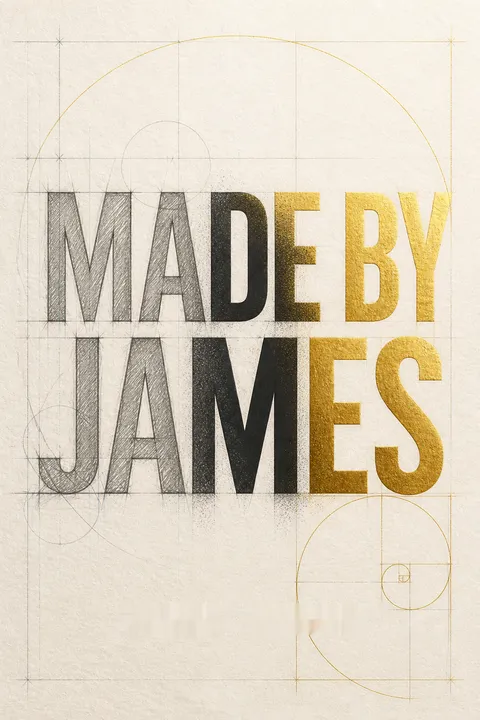
Made by James is part memoir, part practical guide, and part visual casebook. Its central argument is that creative work becomes a viable career when craft is joined to process, communication, relationships, and patience. The book's most useful organizing idea is the connection between visible making and client confidence. Sketching is not presented only as a route to better marks; it is also a way to expose decisions, invite understanding, and demonstrate that a design answers a particular brief. That link between creative method and commercial trust gives the book its distinctive value.
The personal narrative gives this advice emotional weight. Martin describes a childhood trauma and a damaging period in adolescence without claiming that either automatically produced artistic talent. His route back through art education and agency work supports a more grounded idea: identity and career can be rebuilt through successive choices, even when a neat plan is absent. Readers should distinguish this testimony from a general formula. His experience is illustrative, not proof that one pathway fits everyone.
The practical guidance is strongest when it makes invisible work concrete: discovery calls, written scope, deposits, contextual presentations, time estimates, and deliberate iteration. It is less universal when advice depends on a designer's market position, such as saying yes to nearly every request, offering free work, or using a particular pricing margin. These can be useful experiments, but they need boundaries and local judgment. Taken together, the book is most persuasive as a field guide rather than a rulebook. It encourages readers to borrow methods, test them against their circumstances, and keep revising both the work and the way they work.
Review Summary
Made by James is highly praised by readers for its honest, insightful approach to logo design and creativity. Reviewers appreciate James Martin's personal anecdotes, practical advice, and encouraging tone. The book is lauded for its beautiful design, comprehensive content, and relevance to both novice and experienced designers. Many readers found it inspiring and helpful for their creative processes, business practices, and personal growth. The book's accessibility and James' willingness to share his knowledge are frequently highlighted as standout features.
People Also Read




Glossary
Four P's
Ingredients of a developing styleMartin's mnemonic for the personal and practical conditions that shape a distinctive creative style: self-understanding, sustained interest, an individual way of working, and patience. The idea is that style is developed through repeated practice and reflection, rather than selected as a fashionable look or discovered fully formed.
word mapping
Brief-to-idea associationA visual brainstorming method Martin uses to expand a design brief into related words and possible concepts. The designer starts with information such as a company's values, name, or history, then records associations that might suggest less obvious visual directions. The method helps move from client facts toward design ideas without defaulting immediately to standard industry symbols.
rapid prototyping
Quick concept testingMartin's early sketching stage for turning word associations into loose visual possibilities. The goal is to test directions quickly before polishing them, so a designer can see which ideas deserve more attention. It favors open exploration and a small number of useful concepts over detailed execution at the outset.
Statement of Work (S.O.W.)
Written project scopeA document that records the requirements and expectations for a specific design project. In Martin's guidance, it sets out scope, deliverables, timelines, and working terms, and is signed by the client. It gives both parties a shared reference for what the project includes and how the work will proceed.
Stylescape
Visual guide to a project's languageA visual presentation assembled by a designer to communicate and guide the visual language of a project. It can help establish an aesthetic direction before detailed design work begins. Martin contrasts this with discussing references and information supplied by the client, which can reduce guesswork about the client's preferences and business.
six-four-two scenario
Mockup mix for presentationsMartin's suggested way to distribute logo mockups in a client presentation: six examples tied to the client's industry, four showing other relevant uses, and two illustrating outdoor applications. The proportions are adjustable to the project. The purpose is to show the identity in realistic settings so clients can evaluate its use beyond a logo shown by itself.
The Jackal
Voice of creative self-doubtA name used by a designer Martin spoke with for the lack of confidence she felt when presenting her work and prices. Martin uses the term for the undermining inner voice many creatives experience. His suggested responses include seeking candid feedback, sharing work in manageable ways, and learning more about areas of uncertainty.
Download PDF
Download EPUB
.epub digital book format is ideal for reading ebooks on phones, tablets, and e-readers.








