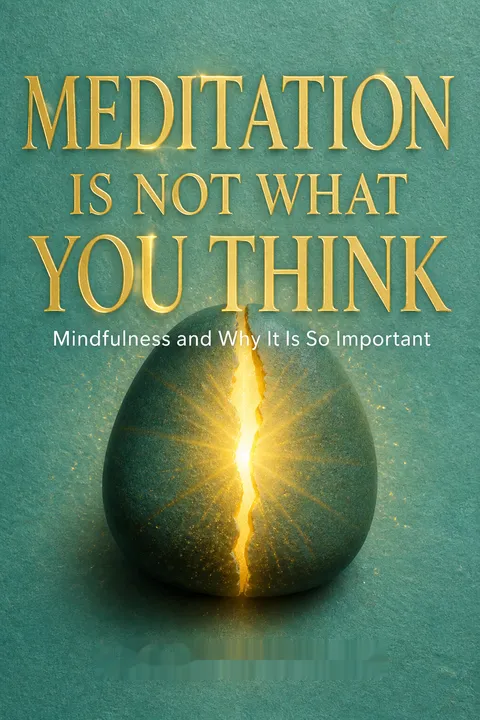


Key Takeaways
Treat meditation as a way of meeting life, not a route to a special state.
A different kind of practice. Meditation is not simply a technique for relaxing, silencing thought, or reaching an unusual mental state. It is a way of relating to whatever is happening, including restlessness, pain, anger, and boredom. Formal methods can help, but they are supports for being awake to experience, not prizes to collect. The book holds two views together: practice can develop attention over time, and awareness is already present, needing recognition rather than manufacture.
Start where you are. This makes meditation less like self-improvement and more like learning to inhabit a life already underway. The aim is not to approve of every circumstance or abandon the wish to change it. It is to see clearly before acting, instead of letting an imagined future or a preferred outcome dictate the whole response.
The distinction between practicing for a result and practicing to meet experience is useful well beyond meditation. In learning theory, deliberate practice builds capacity, while excessive fixation on performance can interfere with attention to the task itself. The book’s two-sided account accommodates both: repetition matters, but it should not become a promise of guaranteed calm or transcendence. That qualification is important because meditation is often marketed as an effortless cure. A practice can help someone respond differently without making difficult circumstances disappear, and those are not the same claim.
Train attention by returning gently, not by demanding an empty mind.
Returning is the workout. In breath meditation, attention is directed toward breathing, wanders, and is brought back. The return is not evidence of failure; it is the central repetition. Kabat-Zinn describes aiming and sustaining attention as basic elements of practice. In Buddhist vocabulary, the steadier concentration that develops is called samadhi. It does not require every thought to stop. Rather, attention becomes more stable while thoughts and feelings continue to arise.
Carry it into ordinary moments. Formal sitting is one way to train, but the book treats daily life as the real field of practice. A breath, a conversation, or a moment of tension can all become occasions to notice where attention has gone and return to what is happening. Consistent practice takes effort, but the instruction is to return without scolding yourself for having wandered.
This account resembles skill-building in music or sport: expertise includes noticing drift and recovering, not maintaining flawless focus. It also avoids a common trap in productivity culture, where attention is treated as a resource to squeeze harder rather than a capacity shaped by conditions. The book emphasizes personal practice, but attention is not purely a matter of individual discipline. Sleep, stress, disability, and the demands of a person’s environment all affect concentration. A compassionate return is therefore more realistic than treating distraction as a character defect.
Question the first story your senses tell you; context changes what appears.
Perception is not a photocopy. The book describes a Zen teacher who would hold up a stick, ask whether students saw it, then strike a surface and ask whether they heard the sound. The point was how quickly raw seeing and hearing become judgments, memories, and explanations. A drawing that some people see as a young woman and others as an old woman makes a similar point: what a person has just seen can shape what they notice next. Attention can reveal the interpretation as it forms.
Look for more than one reading. The aim is not to distrust every perception, but to recognize that perception is partial and influenced by expectation. Kabat-Zinn connects this to the story of Odysseus seeking advice from Tiresias, a blind seer: functioning eyes do not guarantee insight. Pausing before deciding what an event means can make room for nuance and wiser action.
The examples point toward a well-established feature of human cognition: perception combines incoming sensory information with expectation and prior learning. That makes interpretation efficient, but it also means confidence is not proof of completeness. The practical lesson is not radical skepticism, which would make ordinary decisions impossible. It is calibrated confidence: notice what is directly observed, what is inferred, and what remains uncertain. This distinction can improve interpersonal judgment, especially when disagreement tempts people to treat their own perspective as the entire event.
Meet discomfort at its first contact instead of trying to pave the whole world.
Protect the point of contact. An old story tells of a princess who stubs her toe and wants the kingdom covered in leather. A minister instead proposes protecting her feet with shoes. The story illustrates how an unpleasant event can trigger an outsized effort to control everything around it. In mindfulness, the “point of contact” is the first encounter with a sensation, thought, or event, before the familiar cascade of liking, disliking, fear, and resistance takes over.
Notice the cascade. A sore neck, for example, may call for practical care. But it can also provoke worry, self-criticism, or assumptions about what the pain means. Paying attention does not replace medical help or require passivity. It makes it easier to distinguish the sensation from the reactions that follow, so the response can address the actual problem rather than every fear attached to it.
The shoes story offers a compact model of proportionate intervention: respond at the relevant point rather than reorganizing the whole world around one discomfort. That principle is useful in emotional regulation and in problem-solving, where a clear distinction between an initial signal and the reaction to it can prevent escalation. Still, not every distressing response is excessive, and some environments genuinely need to change. Mindfulness is most useful when it helps identify whether a person needs to adjust their response, alter the situation, seek support, or do several of these at once.
Let awareness hold pain without pretending the pain has vanished.
Make room for what hurts. Kabat-Zinn invites readers to notice that awareness of pain is not itself the same thing as pain. The claim is not that awareness removes physical injury, grief, or fear. Rather, attending to an experience can change the relationship to it. A person may notice bodily sensations, thoughts about those sensations, and emotions arising around them, instead of being wholly swept into one undifferentiated crisis.
Turn toward, not away. Awareness here means acknowledging what is present without immediately suppressing it, denying it, or treating it as the whole self. The book applies this to both bodily and emotional distress, while recognizing that the practice does not grant immunity from suffering. In its example of a physician facing an MRI, attention to breathing helped him stay oriented in a frightening, confined situation. The distress remained real, but it was not the only thing available to notice.
This is a helpful distinction between changing a condition and changing one’s relationship to it. Psychological approaches that encourage observing thoughts and feelings similarly aim to reduce automatic entanglement, rather than insist that painful content disappear. The framing should be used carefully: it can support coping, but it must not imply that serious pain is merely a mindset problem or that people are responsible for failing to feel better. Medical treatment, social support, and attention to material causes remain essential. Awareness can widen the response; it cannot guarantee a cure.
Build meditation on ethical conduct, because attention cannot flourish in a life of harm.
Practice has a moral ground. The book argues that dishonesty, cruelty, exploitation, and harmful habits agitate the mind and damage relationships. Generosity, trustworthiness, kindness, and compassion support greater clarity and well-being. Ethics is not presented as a list of rules detached from meditation. It is the everyday consequence of paying attention to what actions do to oneself and others.
Intention shapes consequences. The Buddhist term karma refers here to how actions, influenced by their motivations, contribute to what unfolds later. Kabat-Zinn illustrates moral responsibility through Hugh Thompson Jr., a helicopter pilot who intervened to stop American soldiers from killing civilians at My Lai. Ethical action may be dramatic, but it can also be quiet: refusing to cause harm when no one is watching. Meditation is not an excuse to retreat from responsibility; it can sharpen the ability to recognize it.
The connection between attention and ethics is one of the book’s strongest claims. Choices become more responsible when people notice their motives, consequences, and effects on others, rather than acting on impulse alone. This also resists the idea that meditation is merely a private wellness tool. At the same time, ethical conduct cannot be reduced to individual calm or good intentions. Institutions distribute power and harm unevenly, so personal awareness needs to be paired with accountability and collective change. The book’s emphasis on non-harming is most compelling when it leads outward.
Use mindfulness to become an active partner in care, not a passive patient.
A clinic for people falling through gaps. In 1979, Kabat-Zinn started a Stress Reduction Clinic at the University of Massachusetts Medical Center. Its eight-week mindfulness-based stress reduction program, or MBSR, was designed for patients whose pain, stress, or chronic conditions were not being adequately addressed by usual care. It was intended as a self-education program and a complement to medical treatment, not a replacement for it.
Practice within a community. The program asked participants to practice for 45 minutes a day, six days a week, over eight weeks. The clinic aimed to help patients use their own capacities for attention and self-care alongside the work of physicians. The book recounts how surgeon H. Brownell Wheeler once gave up a reserved meeting room when he learned that patients were using it for meditation. His decision captured the humane principle the program sought to cultivate: patients deserve to be treated as people, not interruptions.
MBSR’s institutional setting matters. Offering meditation inside a medical center helped make contemplative practice available to people dealing with concrete health problems, while also framing patients as participants in care. That is a valuable corrective to models in which patients are expected only to comply. Yet self-management should not become a way to shift responsibility from health systems onto individuals. A program can complement good care, but it cannot compensate for inaccessible treatment, rushed clinicians, or inadequate social support. The book is clearest when mindfulness is presented as an addition to care, not a substitute.
Protect unclaimed attention from devices that keep life permanently on call.
Connectivity has a cost. The book describes a culture of continual partial attention, in which people divide focus among work, messages, family, and entertainment. It gives the example of a father checking email while his child rebuilds a toy airplane during their game. The arrangement may look efficient, but neither activity receives undivided attention. Kabat-Zinn argues that constant availability can leave people connected to others while losing contact with their own bodies and immediate surroundings.
Make ordinary moments count. Attention to an everyday action, such as getting on a train or washing one’s hands, can make that moment more vivid instead of treating it as dead time to fill. The book also suggests that noticing more of ordinary experience can make life feel less hurried and more fully lived. The point is not to reject technology. It is to notice when the tool is useful, when it is habitual, and what it is displacing.
The critique anticipates a central problem of digital life: tools that reduce the friction of communication can also increase the number of interruptions people must manage. Attention switching has cognitive costs, and the sense of being perpetually reachable can blur boundaries between work, rest, and relationships. But the book’s broad cultural diagnosis should not be mistaken for a claim that every device use is harmful. Technology can provide access, safety, and meaningful connection. The practical question is whether its use serves an intention or simply captures attention by default.
See yourself as a changing process within a shared world, then act accordingly.
A self is not sealed off. The book uses the image of a whirlpool in a river: it has a recognizable shape for a time, yet it is made from water continually moving through it. Kabat-Zinn uses this to explain Buddhist emptiness, the idea that people and things lack a fixed, independent existence. This does not mean that nothing matters. It means that lives and identities emerge through relationships and conditions that keep changing.
Interdependence raises the stakes. The body, a business, and a community are all presented as processes whose parts affect one another. Seeing this can loosen rigid self-stories and widen attention to consequences beyond personal advantage. The book links this perspective to the world’s shared challenges, including environmental damage and injustice. Awareness matters, in this account, because how people meet the present helps shape what happens next, both in private relationships and in public life.
The process view connects contemplative insight with systems thinking: a person, institution, or ecosystem cannot be understood by examining isolated parts alone. That perspective can make responsibility more realistic, since consequences travel through networks rather than stopping at the individual. It also cautions against treating identity as fixed, which can allow room for change. A potential misunderstanding is that interdependence dissolves personal accountability. It does not. Being shaped by conditions and influencing them are compatible. The challenge is to recognize structural causes without using them to excuse choices, and to recognize personal agency without pretending anyone acts alone.
Analysis
This book is less a meditation manual than a case for attention as a human and civic capacity. Its central move is to redefine meditation away from a special mental state and toward a more deliberate relationship with experience. That framing makes room for formal practice, everyday awareness, and difficult emotions without treating calm as the measure of success. The stories give this argument texture: the surgeon who yields a room to patients, the Zen teacher’s stick, and the princess who invents shoes each translate abstraction into a memorable choice.
The book’s most useful tension is between training and recognition. Attention requires repetition, patience, and support, yet awareness is described as already available. Held together, these views discourage both passivity and perfectionism: practice is work, but not a project of manufacturing a superior self. The ethical turn is equally important. Mindfulness is not merely an individual stress tool; its value is tested in how people treat patients, children, colleagues, strangers, and the shared world.
The argument also reaches beyond what its examples can establish. The book moves from personal practice to claims about social dysfunction and planetary health, but awareness alone cannot repair inequitable institutions, untreated illness, or environmental damage. Nor should mindfulness be used to train people to tolerate preventable harms. Its strongest interpretation is complementary: attention can improve judgment and resilience while practical care, political accountability, and material change remain necessary.
Readers should also distinguish the book’s account of MBSR from a guarantee of clinical benefit. The author describes a program developed within medicine and reports observed improvements, while emphasizing that it was not a replacement for treatment. The broader lesson is not that meditation solves every problem, but that training attention can help people perceive their circumstances more clearly, respond less automatically, and participate more fully in their own lives. That is a substantial promise, even without turning mindfulness into a cure-all.
Review Summary
Meditation Is Not What You Think receives mixed reviews. Some find it insightful and inspiring, praising its philosophical approach to mindfulness. Others criticize its dry, academic writing style and lack of practical meditation guidance. Readers note excessive repetition and verbosity. The book is seen as an introduction to mindfulness concepts rather than a how-to guide. Some appreciate the author's expertise, while others find the content too abstract or dense. Overall, opinions vary widely, with ratings ranging from 1 to 5 stars.
People Also Read








Glossary
Mindfulness
Present-moment awarenessKabat-Zinn defines mindfulness as awareness developed by paying attention deliberately, in the present, and as non-judgmentally as possible. Non-judgment does not mean having no preferences or judgments; it means noticing them without immediately treating them as facts or commands. The book presents mindfulness as both a trainable practice and an innate capacity for knowing experience.
MBSR
Mindfulness-based stress programMindfulness-based stress reduction is an eight-week educational program Kabat-Zinn established at the University of Massachusetts Medical Center in 1979. It was created for people dealing with stress, pain, and illness, particularly when standard medical care did not fully address their needs. Participants practiced meditation and related exercises as a complement to medical treatment, not as a replacement for it.
Dukkha
Human unsatisfactorinessA Pali term used in Buddhist teaching for the suffering or dis-ease that marks human life. It can refer to obvious anguish, but also to stress, dissatisfaction, and the unease produced by clinging to what people want or resisting what they fear. The book treats recognizing dukkha as a starting point for understanding its causes and practicing a different relationship to experience.
Dharma
Teachings and natural orderThe book uses dharma in two related senses: the teachings associated with the Buddha and the lawful character of reality, or the way things are. In this broader sense, dharma is not limited to religious identity. It refers to insights about experience and the mind that can be tested through attentive practice, including the possibility of greater freedom from habitual suffering.
Samadhi
Stable concentrationSamadhi is the concentrated, relatively steady quality of attention developed by repeatedly returning to an object such as the breath. The book describes it as a stabilizing capacity, not a guarantee that thoughts or difficult feelings disappear. As attention becomes steadier, experience may be perceived with greater clarity, making concentration a support for insight.
Scaffolding
Support for practiceKabat-Zinn uses scaffolding for the instructions, methods, traditions, and frameworks that help people learn meditation. These supports can orient practice and draw on the experience of teachers and communities. They are useful but not identical to the direct experience they point toward, so practitioners should avoid becoming attached to a method or mistaking the map for the territory.
Continual partial attention
Divided, ongoing focusA phrase used in the book to describe attention continually split among simultaneous activities and incoming demands. A person may answer messages while speaking with a child or move rapidly between work tasks, giving each only part of their focus. The term names a cultural pattern associated with persistent connectivity and difficulty sustaining attention on one experience.
Four Noble Truths
Diagnosis and path of sufferingA foundational Buddhist teaching presented as a practical sequence: suffering or dukkha is present; clinging and desire contribute to it; release from it is possible; and a path of practice supports that release. Kabat-Zinn compares the sequence to a medical approach involving diagnosis, causes, prognosis, and treatment. Mindfulness is central to the path described in the book.
Noble Eightfold Path
Eight elements of practiceA Buddhist path composed of wise view, thinking, speech, action, livelihood, effort, mindfulness, and concentration. The book presents these not as separate boxes but as mutually informing aspects of a whole way of living. Mindfulness both belongs to the path and helps connect its elements, including ethical conduct and the cultivation of attention.
Emptiness
Lack of fixed existenceIn the book’s Buddhist account, emptiness means that people and things do not exist as isolated, permanent entities independent of causes and relationships. It does not mean that life is meaningless or that nothing matters. Rather, phenomena arise through changing conditions and interdependence. Recognizing this can loosen rigid self-concepts while increasing awareness of how actions affect others.
About the Author


Download PDF
Download EPUB
.epub digital book format is ideal for reading ebooks on phones, tablets, and e-readers.








