Key Takeaways
1. Embracing Dual Identities: Beyond Binary Thinking
We all have multiple and sometimes diverging identities.
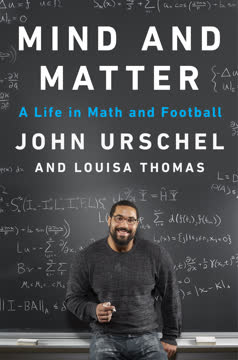
Challenging binaries. John Urschel's life defies the common perception that mind and body, or math and football, are mutually exclusive pursuits. He views his multiple identities not as contradictions but as integral parts of who he is, demonstrating that excellence can be achieved across diverse fields. This perspective allows him to see the world beyond simplistic "either/or" categorizations.
Personal normalcy. For Urschel, his unique blend of passions is simply his normal. He doesn't dwell on being an anomaly but rather accepts his diverging interests as natural extensions of himself. This self-acceptance is crucial for pursuing unconventional paths without being swayed by external expectations or societal norms.
Integrated self. His journey illustrates that individuals can integrate seemingly disparate aspects of their lives, finding personal meaning and fulfillment in each. Both mathematics, offering clarity and structure, and football, providing elemental challenge and confidence, were essential to his development and sense of self.
2. The Foundation of Early Learning: Nurturing Curiosity
Every kid has a little bit of a mathematician in them.
Mother's influence. Urschel's mathematical journey began in toddlerhood, nurtured by his mother, an African-American single mother who loved math but was discouraged from it. She artfully encouraged his curiosity through puzzle books, workbooks, and games, making learning an engaging and natural part of his daily life. This early, playful exposure fostered a deep-seated love for problem-solving.
Playful learning. His mother transformed math into a game, from sudoku races to calculating sales tax for pocket money. This approach taught him to seek shortcuts and develop intuitive numerical reasoning, turning everyday situations into opportunities for mental exercise. These early experiences cultivated a powerful problem-solving mindset, viewing challenges as puzzles to be deciphered.
Universal potential. Urschel believes every child possesses an innate mathematical inclination, understanding concepts like "more" and "less" and developing logic through questioning rules. His own "troublemaker" tendencies were reframed as problem-solving, highlighting how natural curiosity, when encouraged, can unlock significant intellectual development.
3. The Power of Challenging Expectations: A Drive to Excel
Nothing made me want to take that class more than being told that I couldn’t do it.
Defying limitations. Urschel consistently sought out and excelled in challenges others deemed too difficult or inappropriate for him. Whether it was auditing a college calculus class in eighth grade or taking advanced probability as a freshman, he was driven by a fierce desire to prove that perceived limitations were merely opportunities to demonstrate his capabilities.
Internal motivation. This drive wasn't just about external validation; it was a deep-seated need to test his own limits and understand his potential. Being told he "couldn't" do something ignited an internal fire, pushing him to master complex subjects and develop a profound understanding that went beyond rote memorization.
Unlocking potential. His experience in calculus, for instance, revealed that the subject was accessible if one wasn't conditioned to believe it was impossible. This early success in advanced topics, fueled by his competitive nature, solidified his belief in his intellectual gifts and his willingness to put in the necessary work to excel.
4. Discipline and Compartmentalization: Mastering Focus
Long before I was particularly good at anything, I was an elite compartmentalizer.
Strategic focus. Urschel's ability to manage dual demanding careers stemmed from his exceptional discipline and skill in compartmentalization. He could intensely focus on one task, whether a math problem or football practice, completely tuning out other concerns. This mental separation prevented distractions and allowed for deep engagement in each pursuit.
Prioritization. His college life revolved around two clear priorities: studying math and playing football, with everything else being secondary. This strict prioritization, combined with effective time management, allowed him to maximize his hours, often waking early to study math before rigorous football training.
Mental agility. This mental agility was akin to a bilingual person switching between languages, enabling him to transition seamlessly between the abstract world of mathematics and the physical demands of football. This unique temperament allowed him to thrive in both environments without feeling overwhelmed by their conflicting demands.
5. The Allure of Mathematical Proof: Unwavering Truth
We believe they are true because it is impossible for them not to be true.
Unwavering truth. For mathematicians, proof represents a standard of truth that is absolute and unyielding, independent of perspective, culture, or time. Unlike legal or scientific verification, mathematical proof establishes certainty, where a statement is true because its falsehood is impossible, tracing back to fundamental axioms and logic.
Ancient foundations. The enduring power of mathematical proofs is evident in ancient Greek theorems, like Euclid's geometry, which remain true millennia later. This timelessness appealed to Urschel, offering a stable reality amidst life's complexities and disagreements. He found solace in a system where disputes could be resolved definitively through calculation and reason.
Gödel's insights. While Hilbert sought to formalize all proofs, Kurt Gödel's incompleteness theorems revealed inherent limits to axiomatic systems, showing that some true statements are unprovable within a formal system. This didn't negate truth but highlighted the role of intuition, which Urschel embraced as a bridge between the ideal mathematical world and reality.
6. Intuition as a Guide: Bridging Theory and Reality
Intuition will not take you very far if you cannot support it with sound theory, but theory has its limits, if it is not constantly questioned and invigorated by intuition.
Balanced approach. Urschel recognized that intuition and rigorous reason are not opposing forces but complementary tools in mathematics. While reason provides the framework for proof, intuition guides the initial conjectures, identifies promising paths, and invigorates theoretical exploration. This balance allows mathematicians to ask the right questions and seek elegant solutions.
Poincaré's wisdom. Henri Poincaré, a celebrated mathematician, championed intuition as the link between the mathematical and real worlds. Urschel admired Poincaré's ability to re-conceptualize problems, making imaginative leaps that led to profound insights, such as in the three-body problem. This approach resonated with Urschel's own problem-solving style.
Aesthetic drive. The concept of "beauty" in mathematics, as described by G. H. Hardy, deeply influenced Urschel. He sought projects that possessed "a very high degree of unexpectedness, combined with inevitability and economy," allowing his intuition to lead him toward elegant and significant discoveries. This aesthetic pursuit became a core motivator in his research.
7. Navigating Uncertainty and Risk: A Probabilistic View
A zero probability event is not the same as an impossible one.
Mathematical perspective. Urschel's comfort with uncertainty, both in life and football, was deeply informed by his mathematical understanding of probability. He recognized that improbable events happen frequently and that randomness can be quantified, allowing for better decision-making rather than succumbing to fear or superstition.
Probability's lessons. Concepts like the law of large numbers taught him that while individual outcomes are unpredictable, patterns emerge over many trials. This helped him distinguish between valid worries and those beyond his control, enabling him to focus energy where it could make a difference and let go of what couldn't be changed.
Quantum mechanics. His exploration of quantum mechanics further deepened his understanding of fundamental uncertainty. Heisenberg's uncertainty principle, for instance, showed that certain pairs of properties cannot be known precisely simultaneously, a profound limit to knowledge that Urschel applied metaphorically to the dualities of life.
8. The Value of Mentorship and Collaboration: Shared Discovery
It is not enough just to love something, Yu told me. It is not enough just to pass the exams. You have to choose the right problems and find the right people to work with.
Guided discovery. Urschel's mathematical growth was significantly shaped by mentors like Vadim Kaloshin and Yu Qiao, who challenged him with advanced problems and guided his independent learning. Kaloshin's "period three implies chaos" challenge and subsequent reading assignments pushed Urschel to teach himself complex topics and develop a research-oriented mindset.
Collaborative synergy. His partnership with Ludmil Zikatanov exemplified the power of collaboration in mathematics. They shared ideas, debated approaches, and built on each other's insights, transforming solitary work into a shared quest for discovery. This collaborative environment, often extending to informal discussions over meals, fostered deeper understanding and new breakthroughs.
Communication as key. Urschel learned that effective communication is crucial for mathematicians. Sharing proofs and ideas with colleagues not only verifies work but also forms the basis for new problems and advancements. This collaborative spirit, where each solution becomes a stepping stone for others, underscores the communal aspect of mathematical progress.
9. The Drive for Discovery and Contribution: Becoming a Mathematician
I wanted to produce new results. I wanted to discover things that no one else had. I wanted to be a mathematician.
Pivotal realization. A turning point in Urschel's life was the realization that he wanted to be a mathematician, driven by the profound satisfaction of discovering something new and making an original contribution to the field. This desire to produce new results, rather than merely solving existing problems, became a powerful calling.
Competitive spirit. His competitive instincts, usually channeled on the football field, found a new outlet in mathematical research. The challenge of proving a theorem that no one else had, or refining existing methods, ignited a fierce determination to be the first to uncover a particular truth.
Making a mark. This ambition was not about fame but about intellectual impact. He aspired to illuminate aspects of mathematics or science, advancing knowledge and contributing to the collective understanding of the universe. The "Q.E.D." (quod erat demonstrandum) at the end of a proof symbolized this ultimate satisfaction of demonstrating what had to be proved.
10. The Physicality and Brutality of Football: An Elemental Release
It was a brutal, violent, pointless, painful game, and I loved it.
Elemental experience. Football offered Urschel a raw, elemental experience, a channel for aggression and a test of will that he found nowhere else. The physical impact, the grunts, the crashing pads, and the constant pain were part of a brutal game he deeply loved, providing a unique sense of power and release.
Toughness and sacrifice. The sport instilled in him a profound sense of toughness, discipline, and the willingness to sacrifice his body for teammates. He embraced the physical demands, viewing the constant soreness and injuries as inherent to the game and a testament to his commitment.
Controlled aggression. Football provided a defined space—the white lines of the field—where aggressive instincts could be unleashed and channeled toward a common purpose. This controlled environment allowed him to be calm off the field, knowing he had an outlet for the intensity that simmered within him.
11. The Evolution of Identity and Priorities: A Shifting Path
I was starting to question whether that was still the case.
Internal conflict. As Urschel's mathematical pursuits deepened, he began to question whether he could continue to prioritize football, especially with the prospect of an NFL career. The realization that he wasn't pushing his mathematical potential to its limits created an internal conflict, challenging his long-held identity as a football player first.
Time constraints. He recognized the finite window for both elite football and significant mathematical contributions, particularly with the Fields Medal's age limit. This awareness spurred him to consider how to integrate a PhD program with an NFL career, rather than deferring his academic ambitions entirely.
Shifting values. A shoulder injury and the cumulative physical toll of football further intensified his introspection. He started to confront his limitations as an NFL player, realizing that sheer effort might no longer be enough to bridge the gap between his desired performance and his body's capabilities, leading to a re-evaluation of his life's path.
12. Finding Stability Amidst Transformation: The Essence of Self
They were a way of finding what was stable in the midst of change.
Mathematical metaphor. Urschel found a powerful metaphor for navigating personal change in the mathematical concept of eigenspaces. These represent the stable, essential properties of a complex system that remain unchanged amidst transformations like rotation, stretching, or shrinking. This idea offered a framework for understanding his own evolving identity.
Orienting oneself. Eigenspaces, with their corresponding eigenvalues and eigenvectors, allowed him to break down complex systems and identify what was fundamental. He applied this concept to his life, seeking to understand his core identity and values as he transitioned between roles, careers, and environments.
Embracing change. His journey from a college football player to an NFL lineman and then to an MIT PhD candidate involved constant shifts in "coordinates." The concept of eigenspaces provided a mental tool to find stability and purpose, helping him to orient himself and maintain a sense of self amidst profound personal and professional transformations.
Last updated:
Similar Books