

Key Takeaways
Do not confuse changing measurements with the disappearance of moral standards

The eclipse was empirical. In 1919, photographs of a solar eclipse confirmed Einstein’s prediction that gravity bends light. Johnson treats the public excitement around relativity as a turning point: many people confused a new account of space and time with the claim that truth and morality were relative too. Einstein himself insisted that scientific theories must face tests that could prove them wrong.
Ideas traveled beyond science. Johnson groups relativity with Marxism and Freudianism as accounts of hidden forces beneath human choices. He argues that these ideas weakened faith in personal responsibility and helped create a climate receptive to political dogma. His claim is about their cultural reception, not what the theories themselves logically require.
What's striking is the gap between a scientific idea and its public metaphor. Relativity changes how motion and measurement are understood; it does not imply that right and wrong are matters of taste. The distinction resembles a basic rule in intellectual history: ideas acquire political force through interpretation, not merely through their original claims. Johnson’s account is vivid, but the causal link from modern science to moral disorder is suggestive rather than demonstrated. Readers should keep the cultural history while resisting the shortcut from changed physics to weakened ethics.
Constrain emergency powers before war makes state control permanent

War enlarged the state. Before 1914, government activity averaged about 5 to 10 percent of national output in advanced countries. The First World War brought controls over industry, transport, labour, food, and speech. Many wartime systems were later revived or made permanent, even in countries that never became dictatorships.
Capacity needs limits. Johnson argues that a larger state has greater power both to organize public life and to oppress its citizens. The United States, for example, created wartime boards that influenced later interventionist programs, while Britain expanded conscription and censorship. The lesson is not that every public service is dangerous. It is that emergency authority needs clear legal limits, oversight, and a defined end date.
The useful distinction is between state capacity and unchecked state power. Public institutions can coordinate disaster response, infrastructure, and basic services, but the same administrative reach can monitor, coerce, or silence citizens. Political science often treats accountability as a design problem: powers must be distributed, reviewable, and reversible. Johnson is persuasive about wartime expansion leaving institutional traces. His warning is strongest when applied to specific powers, rather than as a blanket argument against government activity.
Build peace on credible bargains, not promises that secrecy can undo

Versailles began with mistrust. The 1919 settlement was shaped by incompatible promises about self-determination, security, reparations, and territory. Wilson’s public principles were modified in private Allied discussions, but Germany was not told of the changes before agreeing to the armistice. At the conference, it received imposed terms rather than a negotiated settlement.
Economic recovery mattered. Keynes argued that reparations and inter-Allied debts could obstruct European trade and recovery. The book links the settlement’s punitive atmosphere and financial disorder to later instability, while acknowledging that Germany’s own leaders had concealed their war aims and responsibility. The practical lesson is to make agreements transparent, enforceable, and compatible with the economic life needed to sustain them.
Peace agreements work best when parties know what they are accepting and believe the rules will apply consistently. That is a problem of credible commitment, not merely goodwill. The Versailles episode shows how secret revisions can turn a public promise into a future grievance. Still, Johnson’s account sometimes assigns too much causal weight to the settlement itself. Nationalist ambition, domestic politics, and later choices also mattered. A flawed agreement can create danger without making another war inevitable.
Ask who actually chose a revolution before calling it the people’s will
A small cadre seized the opening. Lenin returned to Russia in 1917 with a disciplined party, not a mass mandate. In the Constituent Assembly election, the Social Revolutionaries won 410 seats to the Bolsheviks’ 175. Lenin dissolved the assembly after it rejected Bolshevik power, then used the soviets as a source of legitimacy while building control through the party, armed groups, and the secret police.
Repression was designed in. The Cheka, a secret political police force, began as a supposedly temporary body. Within three years, Johnson reports, it had 250,000 full-time agents. It could arrest, investigate, sentence, and punish outside ordinary courts. The key test for a revolutionary government is therefore not its slogans, but whether citizens can reject it without losing their rights.
A revolution can have genuine popular causes and still be captured by an organized minority. That distinction matters because political legitimacy depends on more than the ability to mobilize crowds or control institutions. Lenin’s use of soviets as a public face while concentrating real authority in the party is an especially clear case of institutional substitution. The account also invites a careful question: whose support is being measured, and through what process? Elections, local participation, and the right to dissent provide different evidence.
When whole classes become guilty, terror stops needing individual crimes
Collectivization made categories the target. Stalin’s campaign against the peasantry escalated from grain seizures to forced collectivization. Peasants who resisted were labelled kulaks, a political category that expanded to include many who owned little or nothing. The book cites estimates of millions deported, imprisoned, or killed, and describes the famine that followed as substantially created by government policy.
Hitler extended the logic. Stalin’s terror treated social class as guilt; Hitler’s regime made race the basis for extermination. Under cover of war, the Nazis murdered millions of Jews and other victims, using bureaucratic systems and forced labour. The shared danger is collective blame: once a group is treated as an obstacle to utopia, law and individual responsibility can be swept aside.
The central moral mechanism is the replacement of individual evidence with group identity. That shift makes violence easier to administer because officials no longer need to establish what a person did. It also shows why language matters: labels such as parasite, class enemy, or racial threat can prepare institutions for persecution. The historical cases are not interchangeable, and their aims and methods differed. Their common warning is narrower and more powerful: collective guilt is a license for abuse, not a substitute for justice.
Protect pluralism before political fear makes dictatorship look like rescue
Weimar’s weakness was institutional and social. Germany’s constitution gave the president emergency powers under Article 48, which were increasingly used when parliament deadlocked. The republic also faced street violence, anti-Semitism, a hostile bureaucracy, and parties that often treated opponents as enemies rather than rivals.
Hitler used spectacle and legality together. The Nazis won 37.2 percent of the vote in July 1932, not a majority. Hitler nevertheless became chancellor in January 1933, then used emergency decrees, police powers, and legislative votes to dismantle democracy within months. Johnson emphasizes Hitler’s skill at staging politics as a national spectacle. The warning is concrete: protect institutions and opposition rights before fear makes a strongman appear to be the only source of order.
Democracy depends on more than elections. It also requires losing parties to remain legitimate, courts to constrain executives, and public institutions to resist partisan capture. Weimar’s emergency provisions were not enough on their own to cause dictatorship, but they gave political actors tools to exploit crisis. The account’s attention to theatre and symbolism is valuable: leaders can make coercion look like unity. Yet personality alone is not an explanation. Institutional weakness and elite decisions made Hitler’s performance effective.
Do not treat a boom or crash as proof that one economic system works
The 1920s brought tangible gains. By 1929, the United States had about 26.5 million registered cars, and its prosperity spread radios, homes, savings, and new forms of leisure to millions. But credit expanded by about 62 percent between 1921 and 1929, while low rates and foreign lending helped fuel a speculative boom.
The crash exposed policy as well as markets. Johnson argues that tariffs, cheap credit, and official efforts to stabilize prices helped make the downturn worse. He also challenges the familiar story that Hoover simply refused to intervene: Hoover supported wage maintenance, public works, credit expansion, and federal lending. Roosevelt continued much of this intervention. The useful lesson is to examine policies and outcomes, not turn either markets or government into a moral hero.
The book is strongest when it separates the stock-market spectacle from the economy’s underlying mechanisms. A crash can reveal fragile credit and poor regulation, but it does not automatically prove that markets are inherently unstable or that government intervention is always effective. The same caution applies to recovery: correlation with a new administration does not establish causation. Johnson’s critique of both Hoover and Roosevelt challenges partisan mythology, though his defence of laissez-faire at other points makes his own preferred explanation worth testing.
Modern machinery cannot compensate for institutions that cannot restrain force
Japan modernized unevenly. Meiji leaders imported technology and administrative practices while leaving the social order largely intact. The military gained unusual independence from civilian control, while Shinto and bushido were reshaped into state doctrines. Assassinations and military disobedience became increasingly tolerated, and the civilian government lost authority.
China showed the cost of broken legitimacy. After the 1911 revolution ended the monarchy, warlords competed for power, and by 1928 China had eighty-four armies, eighteen independent divisions, and twenty-one brigades. Japan’s invasion and China’s civil conflict followed. The comparison shows why factories and railways are not enough: institutions must settle disputes without violence, or modern technology simply equips the next contender.
Modernization is not a single process. A country can acquire industrial capacity without developing reliable legal authority or civilian control of the military. Political science often distinguishes state capacity, the ability to implement decisions, from legitimacy, the accepted right to rule. Japan’s armed forces had capacity without effective civilian restraint; China had neither stable authority nor a monopoly on force. The contrast helps explain why material progress alone cannot secure political order.
Enforce credible limits before local aggression becomes a global war
The 1930s repeatedly rewarded risk. Japan occupied Manchuria in 1931 and left the League of Nations after its inquiry condemned the action. Italy’s invasion of Ethiopia brought sanctions but no decisive enforcement. Hitler then remilitarized the Rhineland and took Austria and the Sudetenland, while Britain and France struggled to agree on a response.
The result was wider war. The book presents appeasement as a signal that aggressive states could advance at limited cost. Hitler and Stalin’s 1939 pact divided Eastern Europe, then Germany invaded Poland and began the European war. The sequence does not prove that one tougher decision would have prevented war. It does show the danger of guarantees that are not backed by credible means or shared political resolve.
Deterrence depends on both capability and belief. A promise that allies doubt, or a treaty that its signatories cannot enforce, may invite the very test it is meant to prevent. The 1930s also show why overreaction is not a simple cure: military action can widen a crisis or strengthen extremists. Johnson’s narrative is most useful as a study of credibility and coordination, not as proof that a single decisive strike would have prevented the Second World War.
Test imperial power on the ground, not by the map
Maps exaggerated imperial strength. After the First World War, Britain’s empire covered more than a quarter of the earth’s surface, yet India had only 77,000 British troops in 1919, and unrest was spreading across the empire. In 1930s Africa, colonial rule combined uneven investment with forced labour and racial restrictions on land.
Colonialism had no single balance sheet. Some governments built transport, schools, or health services; others relied on coercion and underinvestment. The book argues that empires were varied, often improvised systems rather than coordinated capitalist conspiracies. Its strongest warning is about social engineering: policies that allocate land or labour by race can create durable grievances. Its account also leaves room to question whether colonial order should be compared with the violence that followed its end.
A map measures territory, not consent, administrative reach, or the cost of control. This is a useful corrective to imperial nostalgia, but it cuts both ways: colonial governments could provide infrastructure while denying political rights and using coercion. The economic effects also varied by place and period. Rather than asking whether colonialism was simply good or bad, the more revealing questions concern who controlled resources, who bore the costs, and whether institutions could survive withdrawal.
After Europe fell, superpower bargains reshaped freedom and risk
The wartime alliance was never a moral union. Britain and the United States relied on Soviet armies to defeat Hitler, while Stalin expanded his control in Eastern Europe. Yalta exposed the weakness of promises unsupported by enforcement, and Western governments forced many displaced people back into Soviet hands after the war.
Power shifted beyond Europe. The United States backed reconstruction in Western Europe and organized NATO, while nuclear weapons made direct conflict between superpowers potentially catastrophic. Korea showed that containment could become a costly proxy war. Johnson’s central point is that the post-war order was improvised by leaders balancing survival, security, and morality, often inconsistently. A stable peace required more than shared enemies: it needed durable limits on what even victorious allies could do.
The post-war settlement shows how alliances built around necessity can preserve freedom in one region while abandoning it in another. That contradiction is not merely hypocrisy; it is a recurring strategic tradeoff that deserves scrutiny. Institutions such as NATO and the UN can constrain powerful states, but only when members accept limits on their own discretion. The episode also illustrates how nuclear deterrence changes the meaning of victory: preventing direct war becomes a central achievement, even when proxy conflicts continue.
Analysis
Modern Times is a sweeping history organized around one moral and political question: what happens when societies lose confidence in limits that stand above the state? Johnson links the erosion of religious and moral authority to the rise of ideologies that promise to remake humanity. The result is a narrative of expanding state power, from wartime economic controls to Lenin’s party dictatorship, Stalin’s collectivization, Hitler’s racial empire, Japanese militarism, and postcolonial experiments in social engineering. Its strongest recurring insight is institutional: when leaders can redefine legality, assign collective guilt, and claim exclusive knowledge of history, violence becomes easier to organize and harder to stop.
The book is especially effective when it restores contingency to events often described as inevitable. Lenin’s seizure of power depended on a narrow opening; Hitler’s rise depended on elite miscalculation; the collapse of the European empires reflected both weakening will and local political conflict. Johnson also brings cultural life, economic policy, military strategy, and personal ambition into one account, making events feel connected rather than compartmentalized.
Its method has limits. The author’s moral framework is explicit, and at times it becomes a causal shortcut. The link between relativity and moral relativism is more metaphorical than historical proof; the contrast between free markets and state planning is often tilted toward the former; and the consequences of colonial rule are sometimes weighed against postcolonial disorder more sympathetically than colonial coercion warrants. The focus on individual rulers can also understate institutions, mass participation, and economic constraints. The book is therefore best read as a forceful argument about power and responsibility, not as a neutral survey. Its lasting value lies in making readers ask who controls the state, who can challenge it, and what protections remain when ideals become excuses for coercion.
Review Summary
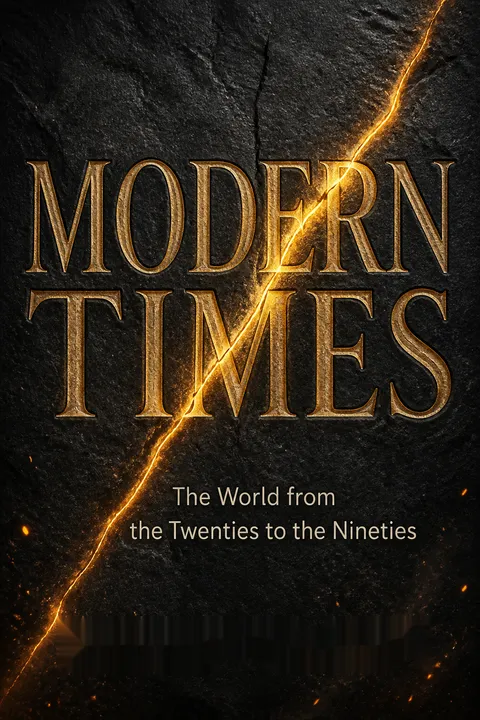
Modern Times is a comprehensive history of the 20th century, praised for its breadth and insight. Readers appreciate Johnson's conservative perspective and ability to connect events across disciplines. Many find it engaging and thought-provoking, though some criticize its bias. The book covers major events and figures from WWI to the 1990s, analyzing the impact of relativism, totalitarianism, and the decline of traditional values. While controversial, it's widely regarded as an important work that challenges conventional historical narratives.
People Also Read






Glossary
Moral relativism
Standards treated as contingentJohnson uses this term for the belief that moral standards are not fixed or binding across situations. In his account, political actors who reject an external moral code can justify coercion as necessary for a class, race, nation, or revolution. The term is central to his interpretation, though the book sometimes links it to intellectual movements more directly than the evidence establishes.
Will to Power
Drive to dominateA Nietzschean phrase Johnson uses to describe the pursuit of power as a central force in human and political behaviour. He argues that, as religious authority weakened, secular leaders could turn political ideology into a substitute source of purpose and legitimacy. The term helps frame the rise of rulers who sought not merely office but control over society.
vanguard fighters
Disciplined revolutionary cadreLenin’s term for a small, secretive, highly organized group of professional revolutionaries. Lenin believed such a cadre could push a revolution forward before the working class was politically prepared and could direct mass institutions once power was seized. Johnson presents this model as a key step toward party dictatorship, because the cadre claimed to represent people who had not chosen it.
democratic centralism
Party hierarchy over dissentA Leninist principle combining formal elections within the Communist Party with strict obedience to decisions made by higher party bodies. In practice, the party leadership could overrule lower organizations and discipline internal opposition. Johnson emphasizes the contradiction between the language of democratic participation and the concentration of actual authority in a small leadership group.
Cheka
Bolshevik political policeThe All-Russian Extraordinary Commission, created by the Bolshevik government in December 1917 to combat counter-revolution and sabotage. It developed into a secret police force with extensive powers of arrest and repression. Johnson stresses that it operated outside ordinary legal safeguards and became an early model for later Soviet security organizations.
NEP
Temporary return to marketsJohnson calls Lenin’s 1921 retreat the New Economic Planning, or NEP. It followed economic collapse, food shortages, peasant resistance, and the Kronstadt mutiny. The policy allowed some market exchange and small private enterprise so food and goods could reach the towns. It was a tactical retreat from coercive state control, not a permanent abandonment of Communist rule.
Shinto
State-backed Japanese religionAn indigenous Japanese religious tradition centered on ancestral and divine associations, which the Meiji state reshaped into a national creed. Johnson describes the state’s promotion of emperor worship and school instruction as a way of linking religious practice to nationalism and military loyalty. The term refers to this politicized state form, not to every expression of Japanese religious life.
bushido
Militarized warrior codeA code of conduct associated with the samurai and later recast as a national ethic of loyalty, discipline, and military honour. Johnson argues that twentieth-century authorities popularized and militarized the idea, using it to legitimize obedience, violence, and sacrifice for the state. Its historical status as a unified, long-standing code is disputed within the book itself.
Lebensraum
Territory for German expansionA Nazi term for the land and resources Hitler claimed Germany needed, especially in Eastern Europe. The policy linked territorial conquest to German settlement, the subjugation of Slavic populations, and the destruction of Soviet power. Johnson presents it as part of a larger expansionist programme, not merely a demand to unite German-speaking communities.
social engineering
State redesign of societyJohnson uses this term for attempts by governments to reorganize populations, economies, or social relations according to an ideological plan. Examples include Soviet collectivization, Nazi racial settlement schemes, and racial land allocation in parts of colonial Africa. In the book, the danger arises when planners treat people as material to be moved or sacrificed rather than as individuals with rights.
FAQ
What's Modern Times: The World from the Twenties to the Nineties about?
- Historical Overview: The book provides a comprehensive analysis of global events from the 1920s to the 1990s, focusing on political, social, and economic changes.
- Key Themes: It explores the rise of totalitarian regimes, the impact of the Great Depression, and the evolution of Western democracies.
- Cultural Context: Paul Johnson examines how cultural, social, and economic factors influenced political developments across different regions, including Europe, Asia, and the Americas.
Why should I read Modern Times: The World from the Twenties to the Nineties?
- In-depth Analysis: Paul Johnson offers a detailed examination of the 20th century, providing insights into how historical events are interconnected and their lasting impact on contemporary society.
- Engaging Writing Style: Johnson's narrative is both informative and engaging, making complex historical events accessible to a wide audience.
- Critical Perspective: The book challenges conventional narratives and encourages readers to think critically about history, politics, and the ideologies that have shaped our world.
What are the key takeaways of Modern Times: The World from the Twenties to the Nineties?
- Rise of Totalitarianism: The book highlights the emergence of despotic regimes in the 20th century, particularly in Russia and Germany, and their devastating effects on society.
- Cultural Shifts: Johnson examines the cultural revolutions that occurred alongside political changes, including the rise of modernism in art and literature, and the impact of these movements on public consciousness.
- Lessons from History: The author emphasizes the importance of learning from history to avoid repeating past mistakes, encouraging readers to critically evaluate the ideologies and movements that have shaped modern times.
What are the best quotes from Modern Times: The World from the Twenties to the Nineties and what do they mean?
- “The world is out of joint.”: This quote reflects the disorientation and uncertainty that characterized the early 20th century, particularly after the upheaval of World War I and the advent of new scientific theories.
- “Revolutions are the feast-days of the oppressed classes.”: This suggests that revolutions often arise from the suffering of the lower classes, who seize the opportunity to change their circumstances during times of crisis.
- “The totality of physical phenomena is of such a character that it gives no basis for the introduction of the concept of ‘absolute motion.’”: This encapsulates Einstein's theory of relativity, emphasizing the shift in understanding from absolute truths to relative perspectives in science and philosophy.
How does Paul Johnson describe the impact of Einstein's theories in Modern Times: The World from the Twenties to the Nineties?
- Scientific Revolution: Johnson explains that Einstein's theories, particularly the theory of relativity, fundamentally changed our understanding of space and time, leading to a scientific revolution.
- Cultural Confusion: The author argues that the public misinterpretation of relativity contributed to a broader cultural relativism, where traditional values and absolutes were questioned.
- Legacy of Ideas: Johnson notes that Einstein's work not only influenced physics but also had profound implications for philosophy, ethics, and the way people perceive reality.
What role does Freud play in Modern Times: The World from the Twenties to the Nineties?
- Psychoanalysis and Culture: Freud's theories on the unconscious mind and human behavior are presented as pivotal in shaping modern psychology and influencing cultural movements in the 20th century.
- Critique of Morality: Johnson discusses how Freud's ideas contributed to a shift away from traditional moral values, promoting a view of human behavior driven by instinct rather than ethics.
- Intellectual Influence: The author highlights Freud's impact on literature and art, as many writers and artists adopted his ideas to explore themes of identity, desire, and the human psyche.
How does Modern Times: The World from the Twenties to the Nineties address the rise of totalitarian regimes?
- Historical Context: Johnson provides a historical overview of the conditions that led to the rise of totalitarian regimes in the 20th century, particularly in Russia and Germany.
- Ideological Foundations: The book examines the ideological underpinnings of these regimes, including Marxism and fascism, and how they appealed to the masses during times of crisis.
- Consequences of Totalitarianism: Johnson discusses the devastating effects of totalitarian rule on individual freedoms, society, and culture, illustrating the human cost of such regimes.
What insights does Modern Times: The World from the Twenties to the Nineties provide about the Cold War?
- Global Tensions: Johnson discusses the ideological battle between capitalism and communism, highlighting key events that defined the Cold War era.
- Impact on Society: He examines how the Cold War influenced domestic policies in both the United States and the Soviet Union, shaping political discourse and public life.
- End of the Cold War: The book reflects on the eventual decline of Soviet power and the resurgence of democratic movements in Eastern Europe, marking a significant shift in global politics.
How does Modern Times: The World from the Twenties to the Nineties explore the theme of democracy?
- Enduring Ideals: Johnson emphasizes the resilience of democratic ideals, arguing that they have proven more effective than totalitarian regimes in promoting societal well-being.
- Historical Examples: The book provides examples of successful democratic movements, particularly in Eastern Europe during the late 20th century.
- Challenges to Democracy: Johnson also addresses the challenges faced by democracies, including economic crises and the rise of populism, suggesting that vigilance is necessary to maintain democratic values.
How does Paul Johnson view the Vietnam War in Modern Times: The World from the Twenties to the Nineties?
- Critical Mistakes: Johnson identifies key mistakes made by American leadership, such as the failure to occupy North Vietnam after becoming involved in the conflict.
- Ineffective Bombing Campaign: He argues that the limited bombing strategy employed by President Johnson was a sign of indecision and ultimately ineffective against the Vietcong.
- Public Perception: Johnson discusses how media portrayal of the war influenced public opinion and political decisions, often misrepresenting the realities on the ground.
What does Modern Times: The World from the Twenties to the Nineties say about the process of decolonization?
- Decolonization Challenges: Johnson argues that the process of decolonization was fraught with difficulties, often leading to violence and instability rather than the promised prosperity and democracy.
- Pace of Change: He notes that the pace of decolonization varied significantly, with some countries experiencing rushed independence that left them ill-prepared for self-governance.
- Constitutional Confusion: The author points out that many newly independent nations were burdened with complex constitutions that did not reflect their social realities, leading to governance issues.
How does Modern Times: The World from the Twenties to the Nineties address the concept of collectivism?
- Historical Context: Johnson traces the rise of collectivist ideologies in the 20th century, examining their appeal and eventual failures in various countries.
- Economic Consequences: He argues that collectivism often leads to economic inefficiency and social unrest, as seen in the Soviet Union and other socialist states.
- Comparison with Capitalism: The book contrasts collectivism with capitalism, suggesting that the latter provides a more effective framework for economic growth and individual freedom.
About the Author



Download PDF
Download EPUB
.epub digital book format is ideal for reading ebooks on phones, tablets, and e-readers.








