

Key Takeaways
Train awareness before trying to manufacture a virtuous character.
Awareness comes first. Osho reverses the familiar moral formula. Instead of obeying a list of virtues in hopes of becoming religious, he says to develop awareness: clear attention to oneself and the present situation. In his view, honesty or compassion imposed from outside can become a performance, while moral conduct that grows from awareness is spontaneous and integrated.
Meditation is the method. It is not meant to install a new rulebook, but to make a person less mechanical and more able to see what is happening. Osho compares morality to flowers that grow from a healthy plant: the task is to nourish the source, not glue blossoms onto a branch. His central shift is from judging actions by a fixed code to examining the consciousness that produces them.
What's compelling is the distinction between compliance and moral perception. A person can follow rules while remaining indifferent to the people affected, whereas attention can reveal consequences that a rulebook misses. Yet attention alone is not a complete ethical standard. A calm, observant person can still act selfishly or misread another person's needs. Awareness is strongest when paired with principles such as consent, fairness, and accountability, which help test whether an apparently spontaneous response is actually considerate.
Trade inherited scripts for responses fitted to the moment.
A script is not a response. Osho calls character a stored set of answers learned from parents, priests, or society. Such rules can smooth everyday behavior, but they may fail when circumstances change. By contrast, a conscious person takes in the situation and responds to what is actually happening, rather than replaying an old instruction.
Training through surprise. In one story, a prince is sent to a sword master to learn morality. The master secretly tries to strike him while he works, gradually requiring him to notice danger sooner and even while asleep. The lesson is not a commandment, but alertness. Osho concludes that a person who sees clearly is less likely to harm others. He calls this flexible, moment-by-moment quality a character that is not fixed in advance.
The prince's training illustrates a useful difference between habit and perception. Habits conserve effort, but unfamiliar situations require flexible attention. This resembles the distinction in skill learning between repeating a routine and adapting it to changing conditions. Still, the sword lesson mainly trains vigilance toward danger; it does not by itself teach fairness or compassion. Rules can also protect people when quick intuitions are biased, so flexibility and stable safeguards need not be enemies.
Question guilt that turns ordinary human errors into permanent stains.
A mistake is not a cosmic crime. Osho argues that religious authorities often turn ordinary errors into sins, then use guilt to make people dependent on priests, rituals, or promises of salvation. He distinguishes consciousness, which he treats as a person's own awareness, from conscience, which he describes as society's learned inner voice of approval and condemnation.
Conditioning can feel physical. Osho recalls growing up in a Jain household where eating after dark was forbidden. At sixteen, he ate at night during a school outing and became nauseated, which he understood as a bodily reaction to years of moral conditioning, not bad food. The episode shows how inherited beliefs can feel like personal truth even when their original context has disappeared.
The account captures how social rules can become embodied, shaping emotion as well as conscious belief. It also raises a useful question: guilt is not always imposed or manipulative. When it follows real harm, it can signal that a relationship or obligation needs attention. The practical distinction is between guilt that demands submission to an authority and remorse that helps a person understand consequences and repair them. Rejecting manufactured shame need not mean dismissing every uncomfortable moral feeling.
Repair harm directly; ritual confession cannot substitute for changed behavior.
Repentance should reach the injured person. Osho rejects the idea that a priest, sacred river, or religious ceremony can erase wrongdoing on someone else's behalf. If an action has harmed a person, he says, the meaningful response is to approach that person, ask forgiveness, and undo what can be undone.
Learning completes the apology. He distinguishes remorse from a ritual reset that lets someone repeat the same behavior without reflection. In the book, he describes a small Thai community whose members apologize for harmful acts they have dreamed about, treating the dreams as clues to unexamined impulses. The story is offered as an illustration, not proof that dreams equal deeds. Osho's practical point is simpler: recognize the mistake, make amends where possible, and pay attention so the same harm is less likely to recur.
This account anticipates the logic of restorative justice, which focuses on acknowledging harm, repairing relationships, and preventing recurrence rather than treating punishment as moral cleansing. The emphasis on the person harmed is valuable because private regret can otherwise become self-absorption. A limitation is that forgiveness cannot be demanded as part of repair. The injured person may decline contact or reconciliation, and responsible repentance must respect that boundary while still accepting consequences.
Trace corruption to competitive systems, not just crooked individuals.
Ambition changes the incentives. Osho argues that a society organized around wealth, power, and status teaches people to compete for scarce prizes. When everyone is urged to become exceptional but only a few can win, people face pressure to use dishonest means. Success can then conceal misconduct, while failure makes similar behavior visible and punishable.
Virtue can become another contest. The same competitive impulse, he says, can dress itself in religious clothing: people pursue superiority by trying to be more saintly, humble, or worthy than others. His proposed remedy is a less ambition-driven society, not simply more sermons about personal honesty. That does not remove individual responsibility, but it asks why a system repeatedly rewards behavior it publicly condemns.
This structural lens helps explain why exhortations to be good often have little effect when institutions reward the opposite. It connects personal ethics to incentive design: behavior responds not only to character, but also to what a workplace, school, or political system measures and rewards. The argument is less persuasive when ambition is treated as the sole source of corruption. Competition can also spur useful effort, and institutions can channel it with transparency, fair rules, and consequences for abuse.
Treat moral codes as local tools, not universal truths.
Rules arise in circumstances. Osho compares moral conventions to traffic rules: societies need shared directions, but a rule's usefulness does not make it an eternal truth. He points to customs that he says responded to particular historical conditions, including polygamy in an era with far fewer men and praise for celibacy when women were scarce. A practice can persist after the conditions that produced it have changed.
Three standards do different jobs. Osho distinguishes spiritual awareness, social morality, and law. Morality is society's higher expectation; law sets a lower, enforceable limit; spiritual action, in his framework, comes from awareness rather than either code. His argument warns against mistaking local convention for divine command, though it does not establish that every convention is harmless or disposable.
The traffic-rule analogy clarifies how a norm can be socially necessary without being metaphysically absolute. This is a strong case for examining a rule's history, purpose, and present effects. But cultural variation alone cannot decide whether a practice is just. A norm may be local and still protect people from coercion; another may be traditional and deeply unequal. Contextual ethics therefore needs a way to assess power, avoidable harm, and whose interests a rule serves.
Judge an act carefully without reducing a person to it.
One deed is not a whole biography. Osho challenges judgments that turn a single act into a permanent identity. In a story about Lao Tzu serving as a judge, a thief who steals to help his sick mother is treated as less culpable than a wealthy man whose accumulated fortune depends on exploitation. The story asks readers to examine circumstances and the larger pattern, not just the visible offense.
Clarity needs context. Osho argues that judgments often smuggle in social assumptions about what counts as respectable or shameful. His point is not that actions have no consequences, but that a label can hide the conditions that shaped an action and the harms caused by other people. To understand a person, he says, requires more than naming the most obvious thing they did.
The story usefully separates moral assessment from character assassination. Context can reveal coercion, unequal opportunity, and forms of exploitation that legal categories overlook. Yet explanation should not dissolve accountability: a desperate motive may mitigate blame without making the injured party whole. A sound judgment can hold both truths at once. It can condemn a harmful act, investigate the conditions around it, and still refuse to define someone's entire identity by a single episode.
Forgive from inner capacity, not a verdict on who deserves it.
Forgiveness begins with the forgiver. Osho argues that forgiving only people judged worthy is not much of a test of compassion. He applies this unsettling idea to Rudolf Hess, a senior Nazi who expressed no regret for his actions, and asks whether the capacity to forgive can extend even to someone profoundly culpable.
Compassion is not acquittal. A story about the murderer Angulimala, who abandons violence after encountering Buddha, illustrates Osho's belief that transformation remains possible even after terrible wrongdoing. The point is not that victims owe forgiveness or that a criminal should escape justice. Osho's emphasis is on the forgiver's freedom from hatred and moral superiority, while leaving open the separate question of what accountability and protection require.
The distinction between forgiveness and acquittal is crucial. Forgiveness can be an inward release from consuming resentment, while legal consequences, truthful remembrance, and protection of others remain necessary. In cases of mass atrocity, language about forgiveness can also pressure victims to comfort the perpetrator or move on before they are ready. The strongest version of Osho's claim is therefore an invitation to loosen hatred, not a demand that anyone reconcile, forget, or suspend justice.
See awakening as human potential to uncover, not a birth privilege.
The capacity is already present. Osho says Buddha or Christ is not a special type of person created at birth, but a possibility within everyone that must be uncovered. He compares this to a seed whose future flowering cannot be inferred just by inspecting its small, plain appearance. In his view, social conditioning obscures this potential by training people to serve useful roles rather than explore their inner lives.
Potential is not a title. Osho presents awakening as the result of discovery, not inherited status or imitation of a revered figure. The claim challenges the excuse that only a rare, specially born person can become conscious. It is a spiritual assertion, not evidence that everyone will reach the same state or that circumstance places no limits on what a person can develop.
The idea is empowering because it refuses to make insight the property of a priestly or genetic elite. It also resembles developmental views in which capacities emerge through practice, support, and experience rather than appearing fully formed. Potential, however, should not be confused with guaranteed achievement. People face unequal conditions, illness, and trauma; saying that everyone can awaken can inspire, but it should not become another way to blame those who struggle.
Make ordinary life whole instead of escaping it to appear holy.
Holiness is not withdrawal. Osho favors a life that accepts the full range of human experience over a purified identity built by rejecting the body, pleasure, or ordinary relationships. He describes innocence as something first received in childhood, then lost through experience, and potentially regained with understanding. The second innocence is not ignorance; it is a simplicity reached after seeing how rigid judgments divide life.
The closing vision is expansive. Osho's ideal joins freedom and individuality with love, meditation, playfulness, creativity, sensitivity, gratitude, and a sense of mystery. His reading of Adam's disobedience likewise treats departure from innocence as part of growth, not an inherited stain. The aim is not to label every impulse good, but to stop treating life itself as a contaminant that must be escaped.
This vision makes room for a spirituality that can include work, pleasure, and relationships rather than requiring retreat from them. Its appeal lies in integration: a person need not split into a public saint and a hidden self. Still, accepting life whole does not mean endorsing every impulse. Maturity includes restraint, care for others, and recognition of limits. The useful test is whether openness enlarges responsibility and vitality, rather than serving as a flattering excuse to avoid either.
Analysis
The book is a collection of responses to questions, but a single argument runs through it: moral conduct cannot be reliably produced by commands when the person obeying them remains inwardly divided. Osho repeatedly shifts attention from the visible act to the quality of awareness behind it. His strongest insight is psychological and political at once. Rules can become masks; guilt can bind people to authorities; and institutions that reward status competition can reproduce the very corruption they condemn. His anecdotes make these claims vivid, especially the prince learning alertness through surprise and the account of religious conditioning around eating after dark.
The argument also contains a consequential tension. Osho denies that moral distinctions are ultimate, yet claims awareness reliably yields compassion and makes severe harm impossible. That confidence is asserted more than demonstrated. Awareness can mean attention, self-knowledge, or ethical concern, and those are not interchangeable. A person may be attentive while pursuing a cruel goal. The book's rejection of fixed codes can free readers from inherited prejudice, but it risks removing standards that protect people when intuition fails or power is unequal.
A balanced reading treats awareness as necessary, not sufficient. It can interrupt automatic behavior and expose motives, while shared principles help evaluate consequences and law can restrain harm. Osho's critique of sin is most persuasive when it targets shame used to control people, and less persuasive if extended to every form of remorse. Likewise, forgiveness can be a personal release without becoming an obligation imposed on victims. The lasting value of the book is its invitation to examine where one's moral voice came from, and whether it reflects genuine attention or merely a rule repeated until it sounds like conscience.
Review Summary
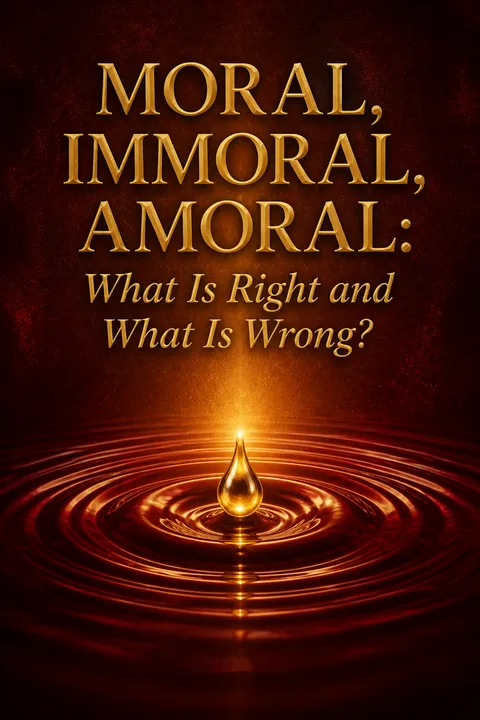
Moral, Immoral, Amoral receives mixed reviews, with an average rating of 4/5. Some praise Osho's candid insights on morality, consciousness, and human nature, finding his philosophy profound and liberating. They appreciate his emphasis on meditation and authenticity. Others criticize the book as extremist, confusing, or contradictory to their beliefs. Readers note Osho's unique perspective on religion, morality, and individual freedom. The book challenges conventional ideas about right and wrong, encouraging readers to develop their own moral compass through self-awareness and meditation.
People Also Read






Glossary
Consciousness
personal present awarenessOsho uses consciousness to mean direct awareness of oneself and the situation at hand, rather than mechanical behavior governed by habit or inherited rules. He treats it as a capacity that can deepen through meditation. In his framework, ethical action emerges from this clarity, rather than being produced by obedience to a prescribed code.
Conscience
socially installed moral voiceOsho distinguishes conscience from consciousness. Conscience is the internalized voice of social instruction, formed through family, religion, and culture, that labels actions acceptable or forbidden and can produce guilt. He argues that it may block a person's own awareness, especially when its rules were inherited without being examined.
Right-mindfulness
undivided present awarenessOsho's interpretation of a Buddhist term for a state of full presence without striving toward a goal or filtering experience through judgments. He describes it as mirrorlike awareness: experience is noticed without imposing a ready-made interpretation. It is not a behavior to practice mechanically, but an expression of understanding and attention.
sammasati
Buddhist term for presenceThe Buddhist term Osho discusses when explaining right-mindfulness. He notes that it can carry meanings beyond the English word mindfulness, including presence, recollection, tranquility, balance, and centeredness. He presents it as the seventh step in Buddha's eight-step path, near the threshold of samadhi, or deep meditative absorption.
Religiousness
lived awareness beyond creedOsho's term for a direct, meditative quality of life that is not defined by membership in an organized religion or obedience to scripture. Religiousness means living with heightened awareness and responding to experience from that clarity. In his account, ethical behavior follows from this state rather than serving as its prerequisite.
Characterless
free from fixed behavioral scriptsOsho uses this provocative term not to mean immoral or without integrity, but to describe a person who is not bound to a rigid character pattern learned in the past. Such a person responds flexibly to the present situation instead of applying the same rule regardless of context. The intended contrast is between spontaneity and mechanical conduct.
FAQ
What's "Moral, Immoral, Amoral: What Is Right and What Is Wrong?" about?
- Exploration of Morality: The book delves into the concepts of morality, immorality, and amorality, questioning traditional views and exploring the nature of right and wrong.
- Awareness and Consciousness: Osho emphasizes the importance of awareness and consciousness as the guiding principles for actions, rather than rigid moral codes.
- Critique of Society: It critiques societal norms and the imposition of morality by religious and political institutions, advocating for individual freedom and self-discovery.
- Spiritual Insight: The book offers spiritual insights into living a life of awareness, suggesting that true morality arises naturally from a conscious state.
Why should I read "Moral, Immoral, Amoral: What Is Right and What Is Wrong?" by Osho?
- Challenging Norms: It challenges conventional beliefs about morality, encouraging readers to think critically about societal norms.
- Personal Growth: The book provides guidance on personal growth through increased awareness and consciousness, leading to a more authentic life.
- Spiritual Perspective: Osho offers a unique spiritual perspective that integrates Eastern philosophies with modern existential questions.
- Practical Wisdom: Readers can gain practical wisdom on living a life free from societal constraints and embracing individual freedom.
What are the key takeaways of "Moral, Immoral, Amoral: What Is Right and What Is Wrong?" by Osho?
- Awareness Over Morality: True morality is a by-product of awareness, not adherence to societal rules.
- Critique of Religion: Organized religions often exploit the concept of sin to control individuals, rather than fostering true spiritual growth.
- Individual Freedom: Emphasizes the importance of living according to one's own light and inner voice, rather than external dictates.
- Beyond Duality: Encourages moving beyond dualistic thinking of right and wrong to embrace a more holistic understanding of existence.
What is Osho's view on morality in "Moral, Immoral, Amoral: What Is Right and What Is Wrong?"?
- Morality as a By-product: Osho views morality as a natural outcome of awareness, not something to be cultivated through effort.
- Critique of Cultivation: He argues that cultivating morality leads to hypocrisy and repression, rather than genuine goodness.
- Awareness as Key: Awareness and consciousness are the true guides for moral actions, transcending societal norms.
- Freedom from Codes: Osho advocates for freedom from rigid moral codes, suggesting that true morality arises from inner consciousness.
How does Osho define sin in "Moral, Immoral, Amoral: What Is Right and What Is Wrong?"?
- Sin as Unawareness: Osho defines sin as a state of unawareness, rather than a specific action or behavior.
- Forgetfulness: The original meaning of sin is forgetfulness, indicating a lack of consciousness in one's actions.
- Beyond Guilt: He argues against the concept of sin as a tool for inducing guilt, which is often used by religious institutions for control.
- Path to Awareness: True repentance involves becoming more aware and conscious, rather than feeling guilty for past actions.
What is the role of awareness in "Moral, Immoral, Amoral: What Is Right and What Is Wrong?"?
- Central Theme: Awareness is the central theme of the book, seen as the key to living a moral and fulfilling life.
- Guiding Actions: It is presented as the guiding principle for actions, replacing rigid moral codes and societal norms.
- Transformation: Awareness leads to personal transformation, allowing individuals to act in harmony with existence.
- Freedom from Duality: Through awareness, one transcends the duality of right and wrong, embracing a more holistic understanding of life.
What does Osho say about organized religion in "Moral, Immoral, Amoral: What Is Right and What Is Wrong?"?
- Critique of Control: Osho criticizes organized religions for using the concept of sin to control and manipulate individuals.
- Beyond Dogma: He encourages moving beyond religious dogma to discover one's own spiritual path through awareness.
- Religious Hypocrisy: Organized religions are seen as promoting hypocrisy by imposing external moral codes rather than fostering true spiritual growth.
- Individual Spirituality: Osho advocates for individual spirituality, where each person discovers their own truth and morality through consciousness.
How does Osho view the concept of God in "Moral, Immoral, Amoral: What Is Right and What Is Wrong?"?
- God as Existence: Osho views God not as a person or entity, but as existence itself, the totality of being.
- Beyond Personification: He argues against personifying God, which leads to misconceptions and false responsibilities.
- Impersonal Reality: God is seen as an impersonal reality, beyond human concepts of good and evil.
- Spiritual Experience: Understanding God is a spiritual experience of oneness with existence, achieved through awareness.
What is the significance of the title "Moral, Immoral, Amoral: What Is Right and What Is Wrong?"?
- Exploration of Concepts: The title reflects the exploration of the concepts of morality, immorality, and amorality.
- Questioning Norms: It suggests a questioning of traditional norms and the nature of right and wrong.
- Beyond Duality: The title indicates a movement beyond dualistic thinking to embrace a more holistic understanding of existence.
- Invitation to Awareness: It invites readers to explore these concepts through the lens of awareness and consciousness.
What are the best quotes from "Moral, Immoral, Amoral: What Is Right and What Is Wrong?" and what do they mean?
- "Awareness is the master key." This quote emphasizes the importance of awareness as the guiding principle for actions and moral decisions.
- "Sin is a state of unawareness." It redefines sin as a lack of consciousness, rather than a specific action or behavior.
- "True morality is a by-product of awareness." This highlights the idea that genuine morality arises naturally from a state of awareness, not through cultivation.
- "Freedom from rigid moral codes." Osho advocates for individual freedom and self-discovery, moving beyond societal constraints.
How does Osho address the concept of repentance in "Moral, Immoral, Amoral: What Is Right and What Is Wrong?"?
- Repentance as Awareness: True repentance involves becoming more aware and conscious, rather than feeling guilty for past actions.
- Beyond Guilt: Osho argues against the traditional concept of repentance as a tool for inducing guilt and control.
- Understanding Mistakes: Repentance is about understanding mistakes and learning from them, rather than seeking forgiveness from external authorities.
- Path to Growth: It is seen as a path to personal growth and transformation through increased awareness.
What is Osho's vision of religiousness in "Moral, Immoral, Amoral: What Is Right and What Is Wrong?"?
- Individual Spirituality: Osho's vision of religiousness is centered on individual spirituality and self-discovery through awareness.
- Beyond Organized Religion: He advocates for moving beyond organized religion and dogma to find one's own spiritual path.
- Awareness as Key: Awareness and consciousness are the keys to true religiousness, leading to a life of authenticity and fulfillment.
- Holistic Understanding: Religiousness involves a holistic understanding of existence, transcending dualistic concepts of right and wrong.
About the Author
Other books by Osho






Download PDF
Download EPUB
.epub digital book format is ideal for reading ebooks on phones, tablets, and e-readers.








