

Key Takeaways
Prices are neon signs that silently coordinate a billion daily transactions
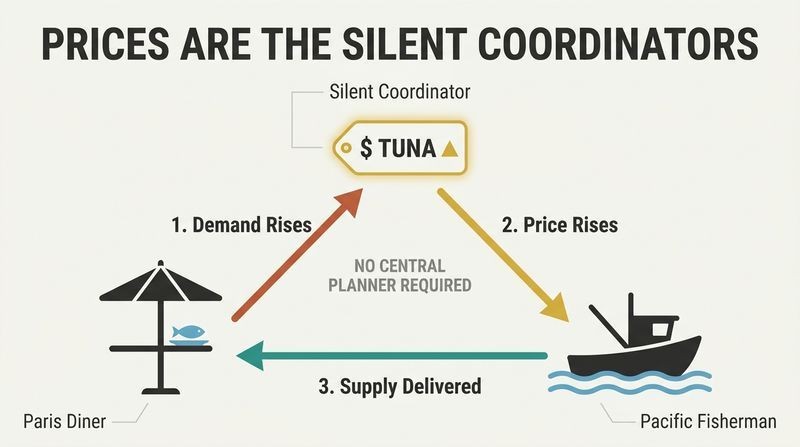
Nobody plans Paris, yet Paris eats. Wheelan opens by asking who ensures a Rue de Rivoli restaurant gets exactly enough fresh tuna each night. No central authority does. Prices carry information: when diners order more sashimi, the wholesale price rises, and Pacific fishermen switch from salmon to tuna without knowing or caring about upscale Parisians. This is Adam Smith's invisible hand, illustrated by Coca-Cola literally passing bottles through the crumbling Berlin Wall in 1989 to chase profit.
Markets align self-interest with social benefit. Individuals maximizing their own utility (a broader concept than happiness that includes paying taxes to avoid jail) collectively produce rising living standards. A color TV cost the average worker 174 hours of wages in 1971 and about 23 hours today. Central planning failed the Soviets because bureaucrats could never process what prices convey instantly.
The tuna example is a modern retelling of Leonard Read's 1958 essay "I, Pencil," which noted no single person knows how to make a pencil. Friedrich Hayek's 1945 paper "The Use of Knowledge in Society" formalized the deepest point: prices aggregate dispersed information no planner could ever gather. What's worth adding is that markets coordinate but do not deliberate. They answer "what" efficiently while remaining silent on "what should be," a tension behavioral economics and later chapters probe. The Coke-through-the-Wall image is vivid but slightly romanticized; the currency was worthless, so it was a bet on future markets, not pure invisible-hand magic.
The market is amoral: it rewards scarcity, not human need

Diamonds versus water. Wheelan insists the market is amoral, not immoral. It provides what people will pay for, not what they need. Diamonds fetch thousands per carat while tap water is nearly free, yet lose all water and you die; lose all diamonds and you are merely inconvenienced. This is why top surgeons perform face-lifts for celebrities while the poor struggle for basic insurance, and why kidnappers traffic girls into prostitution: it is profitable.
Criminals as innovators. Drug traffickers, losing cargo to Coast Guard radar, built radar-invisible submarines in Colombian jungles capable of carrying tons of cocaine. A Coast Guard admiral noted that like any business losing product, they find another way. The market rewards the swift, strong, and smart, but Wheelan warns that two of evolution's best-adapted species are the rat and the cockroach.
This is the book's most important ethical corrective to naive free-market cheerleading. The diamond-water paradox stumped Adam Smith himself and was only resolved by the 1870s marginal revolution: value depends on the utility of the last unit consumed, not total usefulness. Michael Sandel's "What Money Can't Buy" pushes further, arguing markets can corrode the goods they touch (paying children to read, selling kidneys). Wheelan's framing invites a sharper question: if scarcity and value diverge, when should society override market pricing entirely? The criminal-innovation point is a dark mirror of Schumpeter, reminding readers that ingenuity is morally neutral and follows incentives wherever they lead.
Get the incentives right and reform feels like rowing downstream

Save the rhino by making it valuable alive. With 4,000 black rhinos left (down from 65,000 in 1970), poaching persists because a single horn fetches $30,000 where annual income is $1,000. The animals are worth more dead than alive. The fix is aligning local incentives through eco-tourism, so villagers profit from living rhinos, as Costa Rica did by turning 25% of its land into revenue-generating national parks.
Perverse incentives sabotage good intentions. Mexico City banned cars one weekday each by license plate to cut pollution; families bought second (older, dirtier) cars, worsening air quality. Requiring child car seats on planes could kill more kids by pushing families onto dangerous highways. London succeeded instead by charging drivers a congestion fee, cutting traffic 15% and doubling average speeds. Good policy channels self-interest; bad policy ignores it.
This chapter is applied behavioral design decades before "nudge" became fashionable. The rhino and fishery examples map onto Garrett Hardin's "Tragedy of the Commons" (1968) and Elinor Ostrom's Nobel-winning rebuttal showing communities can self-govern shared resources with the right rules, exactly what Port Lincoln's lobster quotas achieve. The deeper insight is the "law of unintended consequences": rational agents route around constraints. One caution Wheelan underplays is that designing correct incentives requires knowing the full behavioral response function, which policymakers rarely do. Cobra farms in colonial Delhi (bounties spawned breeding for bounties) show incentive design can backfire as spectacularly as prohibition.
Good government builds the tracks capitalism runs on
Markets need an umpire. The cocktail-party claim that government should simply get out of the way is wrong. Government defines and enforces property rights, circulates sound currency, roots out fraud, and provides public goods. Without it, you get Nigeria's "bring your own infrastructure" problem or India's courts, where one property dispute ran 39 years until both litigants died.
Two market failures demand a role for the state. First, externalities: costs imposed on people not party to a transaction, like SUV emissions or a neighbor's bongo drums. Economists often prefer taxing the behavior (a gas tax) over banning it, so those who value it most still pay the true social cost. Second, public goods (missile defense, lighthouses, basic research) that benefit everyone but attract free riders. When Stephen King sold a novel online on the honor system, only 46% paid, and the project folded.
Wheelan threads a careful centrist needle that neither ideological camp likes. The externality-taxing preference traces to Arthur Pigou; the private-bargaining alternative to Ronald Coase, whose theorem holds that clear property rights let parties negotiate efficient outcomes regardless of who holds the right, provided transaction costs are low. Global warming is the textbook case where those costs (six billion affected parties) make private bargaining impossible, justifying state action. The public-goods framing rests on non-rivalry and non-excludability, the standard Samuelson definition. What's underexplored is government failure as a symmetric risk: the same institution that corrects markets can be captured, a tension the organized-interests chapter confronts head-on.
Missing information can quietly collapse an entire market
Adverse selection kills good deals. When one party knows more than the other, markets favor the informed and can break down entirely. George Akerlof's "market for lemons" shows why: sellers of good used cars keep them, so buyers assume hidden defects and demand discounts, driving quality cars out. The same logic doomed Clinton's income-based Hope Scholarships: future high earners would opt out, leaving only future low earners, so the program could never break even.
Information failures explain health care. Patients know less than doctors; insurers know less than patients about their own risks. Sick people most want coverage, so insurers screen aggressively, which is why the ambulance is the optimal time to buy insurance and why guaranteed coverage requires forcing everyone (healthy included) to buy in. Firms fight information gaps with brands: a McDonald's in unfamiliar Nebraska promises predictability, not a better burger.
This trio of ideas (adverse selection, signaling, screening) earned Akerlof, Spence, and Stiglitz the 2001 Nobel and reframed economics around asymmetric information. The insurance death-spiral logic is precisely why the Affordable Care Act paired guaranteed issue with an individual mandate; remove the mandate and the model wobbles, as later policy debates confirmed. Spence's signaling model has a provocative implication Wheelan raises via the Krueger-Dale study: elite college earnings premiums may reflect selection (smart students) rather than value added (teaching). The branding insight connects to reputation economics and trust, the invisible infrastructure that lets strangers transact, which David Hume identified as civilization's quiet foundation.
Bill Gates is rich because his skills are scarce, not because he stole your pie
Human capital is your economic passport. Human capital is the total of skills embodied in a person: education, intelligence, experience, even the ability to throw a fastball. Strip Gates of every asset and firms would still hire him; strip a meth-addicted dropout and little remains. Poverty is best understood as a dearth of human capital, which is why the poverty rate for dropouts is twelve times that of college graduates. Becker estimated skills and knowledge constitute roughly 75% of a modern economy's wealth, not oil or buildings.
Wealth is not zero-sum. Poor families are poor despite Gates, not because of him. The "lump of labor fallacy" (the belief that jobs are a fixed pie to be rationed) is false: America created tens of millions of new jobs, including the entire internet sector. Productivity, driven by human capital, is what lets us work less and produce more.
Becker's human-capital framework, radical when introduced in the 1960s, treats education as investment yielding roughly 10% annual returns, better than most Wall Street bets. The zero-sum debunking matters because it undercuts both anti-immigrant and anti-trade populism. Yet the chapter's optimism deserves a nuance Wheelan partly acknowledges: skill-biased technological change has widened inequality dramatically, with the top 1% moving from 9% to 16% of national income. Recent work by Raj Chetty shows human capital is inherited through neighborhoods and family, creating traps that individual effort cannot escape. Human capital explains who wins, but not why the starting line is so unequal, which is a distributional question economics alone cannot resolve.
Buy the whole market, hold forever, and ignore the hot tips
You cannot beat the crowd shopping the same shelves. Wheelan compares stock picking to finding a Lincoln Park brownstone at half price: if it were truly a bargain, someone smarter and faster would have grabbed it. This is the efficient markets theory: prices already reflect available information, so consistently beating the average is nearly impossible. Over 20 years, 55% of actively managed funds underperformed a simple S&P 500 index fund, the modern equivalent of a monkey throwing a towel at the stock pages.
Four rules survive the sniff test.
1. Save early and often; compound interest does the heavy lifting.
2. Risk earns reward, but on average, with occasional brutal years.
3. Diversify, so no single failure (Enron, Lehman) wipes you out.
4. Invest for the long run; day trading pays all the costs of ownership with none of the benefits.
Wheelan channels Burton Malkiel's "A Random Walk Down Wall Street," and the empirical case has only strengthened; SPIVA reports consistently show 80-90% of active funds trailing benchmarks over 15 years. The honest tension is that behavioral finance (Shiller, Thaler, Kahneman) has poked real holes in strict efficiency: bubbles exist, herding is real, and Thaler's own fund beat the market. The reconciliation is subtle and important: markets can be irrational yet still hard to exploit, because arbitrage that corrects mispricing erases the very anomaly. The diversification-via-coin-flips analogy is pedagogically brilliant but glosses over correlation risk, exactly what turned mortgage-backed securities "toxic" when housing defaults became nationally correlated.
Small, focused groups routinely beat the diffuse, distracted majority
Concentrated benefits, diffuse costs. Mohair farmers collected federal subsidies for 35 years after the military stopped using mohair, because each farmer cared intensely about their check while taxpayers paid mere pennies and never noticed. Becker's insight (building on Friedman) is that in politics it pays to be small: the costs of your favors get spread thinly across an unorganized public. This is why ethanol subsidies survive every Iowa caucus despite weak environmental evidence.
Everyone is a special interest. Teachers' unions back tougher certification rules that conveniently exempt current teachers, restricting supply. Wheelan, running for Congress, watched candidates condemn earmarks in one breath and defend the earmark for the children's hospital 300 yards away in the next. The democratic process structurally favors intense minorities over apathetic majorities, which is why 2% who care deeply outmuscle 98% who mildly disagree.
This is public-choice theory, the school associated with James Buchanan and Gordon Tullock, applied with unusual candor. Mancur Olson's "The Logic of Collective Action" (1965) is the foundational text: large groups struggle to organize because each member has an incentive to free-ride on others' activism, while small groups overcome this easily. The framework elegantly explains sugar tariffs, occupational licensing, and agricultural subsidies worldwide. The sobering implication, which Wheelan embodies by admitting his own townhouse-association NIMBYism, is that this is not corruption by bad actors but the predictable equilibrium of decent people responding to incentives. Campaign finance reform, he notes, barely dents it because money is only one lever among many.
GDP counts the paper, not the well-being, so read it skeptically
GDP measures output, not happiness. Gross domestic product is the total value of goods and services produced. It matters because consumption is constrained by production, but it counts prisons, disaster cleanup, and clear-cut forests as gains while ignoring unpaid housework, leisure, and environmental damage. China now calculates "Green GDP" subtracting pollution costs, which cut its 2004 growth from 10% to about 7%. Notably, rising US incomes from 1970 to 1999 coincided with a drop in those calling themselves "very happy."
Recessions spread through confidence. A shock (a burst housing bubble, an oil spike) makes people cautious, and collective thrift becomes collectively self-defeating: my spending cut costs you your job. Governments fight back with fiscal policy (spending and tax cuts) and monetary policy. The 2007 crisis showed the danger: overleveraged households, foreclosures feeding bank losses feeding layoffs feeding more foreclosures.
The GDP critique is now mainstream; Robert Kennedy's 1968 speech that GDP "measures everything except that which makes life worthwhile" prefigured the Stiglitz-Sen-Fitoussi commission Wheelan references. The Easterlin Paradox (income and happiness decoupling above a threshold) remains contested; Stevenson and Wolfers later found the link more durable than Easterlin claimed. The recession-as-coordination-failure framing is pure Keynes and the "paradox of thrift," a genuine collective-action problem where individually rational behavior produces collectively irrational outcomes. What deserves emphasis is that GDP's flaws are features of a deliberately narrow tool; the error is treating a production gauge as a welfare verdict, a category mistake politicians make constantly.
That dollar has value only because everyone agrees it does
Modern money is pure confidence. Since the US left the gold standard in 1971, dollars are backed by nothing; stranded on an island with $100 million, you would perish. Currency has value solely because others accept it, a faith so fragile that Indians refuse torn but legally valid rupee notes simply because they expect others to refuse them. Prison inmates spontaneously adopt mackerel cans as currency when cigarettes are banned.
The Fed's job is monetary brain surgery. The Federal Reserve controls the money supply, setting a "speed limit" of roughly 3% growth. Push credit too hard (easy money) and demand outstrips capacity, producing inflation, which erodes purchasing power and redistributes wealth arbitrarily from lenders to debtors. Volcker crushed 1970s inflation by driving rates above 16%, engineering a painful recession. Deflation is worse: falling prices freeze spending, as Japan learned across two lost decades.
The fiat-money confidence game is a profound point often lost on hard-money advocates: value is a social convention, not a physical property, a theme running from Georg Simmel's "Philosophy of Money" to modern papers on money as collective memory. The independence argument (that insulated central banks deliver lower inflation) is well-supported empirically by Alesina and Summers, though the 2008 crisis and quantitative easing blurred the line between monetary and fiscal policy in ways still debated. Wheelan's "speed limit" metaphor usefully conveys the difficulty of driving with lagged, unreliable controls. The deflation danger, underappreciated before Japan, is why central banks now target positive inflation rather than price stability at zero.
Sweatshops are a symptom of poverty, not its cause
Trade is a machine that turns what you have into what you need. Wheelan imagines an invention converting corn into stereos or software into wine; it already exists and is called trade. Comparative advantage means even a country good at nothing in absolute terms gains by specializing where it is relatively most productive. Seattle engineers import shirts from Bangladesh so they can build airplanes, and everyone is richer.
Cheap labor is the only card the poor hold. Nike pays Vietnamese workers about $600 a year, roughly double the average local income. Workers take these jobs voluntarily because the alternatives are worse. When Senator Harkin's 1993 bill pushed Bangladeshi factories to fire child workers, Oxfam found many ended up in prostitution. Trade barriers are a hidden tax (tariffs add about 30 cents to a gallon of orange juice) and self-imposed sanctions of the kind we inflict on enemies.
Comparative advantage, Ricardo's 1817 insight, remains the least intuitive powerful idea in economics, as Paul Samuelson famously observed. Wheelan's defense of sweatshops echoes Krugman and Jeffrey Sachs and has strong empirical backing: no country has developed while walled off from global trade. The honest counterweight, which the book grants, is that trade creates real, concentrated losers (the shuttered Newton Falls paper mill) even as it produces diffuse winners, and the winners rarely compensate the losers. Recent work by Autor, Dorn, and Hanson on the "China shock" shows adjustment costs to displaced American workers were far larger and more persistent than economists assumed, vindicating the book's plea to actually fund transition aid.
Rich countries share a recipe: institutions, human capital, and open trade
We know what makes nations rich, even if we cannot install it. No franchise formula exists (China is authoritarian, India democratic), but functional economies share features: honest government institutions, secure property rights, restrained regulation, human capital, and openness to trade. De Soto estimates the poor hold over $9 trillion in "dead capital," property they occupy but cannot legally title, mortgage, or sell.
Surprising findings reshape development thinking.
1. Natural resources often hurt; oil-rich Angola sees a third of children die before five, while resource-poor Israel and Switzerland thrive.
2. Amartya Sen showed famines stem from faulty politics, not crop failure; democracies with a free press never have them.
3. Educating women pays double: they spend windfalls on family nutrition while men spend more on alcohol and tobacco.
4. Tropical geography traps economies through disease and poor soil.
This chapter synthesizes the great development debate between Jeffrey Sachs (poverty traps need a big aid push) and William Easterly (top-down aid fails; favor small, measurable, market-friendly projects). The Acemoglu-Johnson-Robinson colonial-origins study Wheelan cites became the backbone of "Why Nations Fail" (2012), arguing inclusive versus extractive institutions determine destiny. Sen's famine work is genuinely paradigm-shifting: entitlement and information, not food supply, cause mass starvation. The resource-curse finding (Sachs and Warner) is robust though contested; Norway and Botswana show good institutions can tame it. The women's-empowerment evidence from Duflo's Ivory Coast experiment anticipated the randomized-controlled-trial revolution that won Banerjee, Duflo, and Kremer the 2019 Nobel.
Analysis
"Naked Economics" is a thesis-light, intuition-heavy tour of the discipline, structured to strip away the graphs and equations that alienate undergraduates and reveal the logic underneath. Wheelan, a former Economist correspondent, writes as a translator rather than an original theorist, and the book's value lies in its curatorial judgment: it distills a century of Nobel-caliber ideas (Becker on human capital, Akerlof on information, Coase on externalities, Sen on famine, Schumpeter on creative destruction) into digestible parables. The fully revised 2010 edition is notable for confronting the 2008 financial crisis head-on, which forces a productive humility onto what could have been a triumphalist free-market primer.
The book's intellectual spine is a balanced liberalism: markets are astonishingly good at allocating resources and terrible at distributing them fairly or accounting for what they cannot price. Wheelan repeatedly refuses the ideological satisfaction of either pole. Markets are "amoral, not immoral." Government is "a scalpel" that heals or harms depending on the hand. This centrism is the book's greatest strength and its subtle limitation. By presenting the economist's consensus as apolitical common sense, it sometimes underweights how contested the empirical foundations are (minimum wage effects, the true magnitude of trade's losers, the efficacy of stimulus).
Reading it in the 2020s, three things stand out. First, its treatment of behavioral economics feels prescient but preliminary; the Kahneman-Thaler revolution it flags has since reshaped the field's core assumptions about rationality. Second, its optimism about globalization has aged unevenly against the China-shock literature and populist backlash it half-predicted. Third, its central pedagogical bet, that economics is fundamentally intuitive once dressed down, remains vindicated. The book's enduring achievement is teaching readers to ask the economist's reflexive questions: What are the incentives? Who bears the cost? What is the opportunity cost? Compared to what? These habits of mind, more than any single fact, are what it successfully transmits.
Review Summary
Naked Economics receives generally positive reviews for making economics accessible and engaging. Readers praise Wheelan's clear explanations, humor, and real-world examples. Some criticize his pro-capitalist stance and oversimplification of complex issues. The book is recommended as an introduction to economics for beginners, though some argue it lacks depth on certain topics. Reviewers appreciate Wheelan's ability to make a traditionally dry subject entertaining and relatable, while still conveying important economic concepts.
People Also Read



Glossary
Utility
Broad measure of personal satisfactionAn economist's term for whatever makes an individual better off, broader than happiness. It includes unpleasant but beneficial acts like paying taxes or getting a vaccination. Economists assume people act to maximize their own utility however they define it, which is compatible with altruism and generosity, not just selfishness.
Externality
Cost or benefit hitting bystandersThe gap between the private cost of an action and its full social cost, borne by people not party to the transaction. Driving an SUV imposes pollution and congestion on others. Externalities cause markets to fail, justifying remedies like taxing the behavior (a gas tax) rather than banning it, so those who value it most still pay the true cost.
Adverse selection
Informed parties self-sort, breaking marketsWhen one side of a transaction has private information, participants sort themselves in ways that can collapse the market. In insurance, the sickest people most want coverage; in used cars, owners of good cars keep them. The result is that quality drives out, or premiums spiral, unless everyone is forced to participate or information asymmetry is reduced.
Human capital
The skills embodied in peopleThe total stock of skills, education, intelligence, experience, health, and entrepreneurial drive embodied within a person. Gary Becker estimated it constitutes roughly 75% of a modern economy's wealth. It is what remains if all your assets are stripped away, and it is the deepest explanation for both individual prosperity and national poverty.
Creative destruction
Progress destroys old economic structuresJoseph Schumpeter's term for capitalism's process of continually replacing old products, firms, and industries with new ones. The telephone doomed the telegraph operator; Walmart shutters Main Street shops. It is a powerful engine of long-run growth that necessarily produces short-run losers, which explains why competition is embraced in theory and resisted in practice.
Efficient markets theory
Prices already reflect all informationThe premise that asset prices incorporate all publicly available information, making it nearly impossible to consistently outperform the market average. It implies index funds beat most active managers over time. Wheelan compares beating the market to reliably picking the fastest grocery checkout line: possible occasionally, but not systematically, because everyone sees the same signals.
Lump of labor fallacy
False belief jobs are fixedThe mistaken idea that an economy contains a fixed number of jobs that must be rationed, so any new worker or immigrant displaces someone else. France once shortened its workweek on this logic. In reality, new workers create new demand and jobs are generated whenever someone provides a new or better good or service.
Purchasing power parity (PPP)
Exchange rate equalizing real pricesThe theory that exchange rates should adjust so a basket of goods costs the same across countries. The Economist's Big Mac Index applies it playfully. PPP is the most accurate way to compare living standards across nations, though official exchange rates deviate widely because most goods and services (haircuts, housing) cannot be traded internationally.
Comparative advantage
Specialize where relatively most productiveRicardo's insight that a country benefits from trade by specializing in what it produces relatively most efficiently, even if it is worse at everything in absolute terms. Seattle engineers import shirts from Bangladesh so they can build airplanes. Trade lets everyone specialize, making the most efficient use of the world's scarce resources.
Principal-agent problem
Agents' interests diverge from owners'Arises when a principal (an owner or employer) hires an agent whose incentives are similar but not identical to their own. A Burger King cashier may pocket cash; a CEO may pursue prestige-boosting mergers that hurt shareholders. Stock options were meant to align CEOs with owners but created incentives for short-term manipulation instead.
Statistical (rational) discrimination
Judging individuals by group averagesWhen a decision-maker makes an inference defensible on broad statistical patterns but likely wrong for the specific individual and discriminatory toward a group. A firm might avoid hiring young women fearing maternity costs. Better information (criminal background checks, refundable maternity benefits) can paradoxically reduce this kind of discrimination by replacing group averages with facts.
Federal Open Market Committee (FOMC)
Fed body setting interest ratesThe committee within the Federal Reserve that makes monetary policy decisions, chaired by the Fed chairman. It sets a target for the federal funds rate (the rate banks charge each other) and manipulates the money supply through open market operations, buying or selling government bonds with newly created money to hit that target.
FAQ
What's Naked Economics: Undressing the Dismal Science about?
- Accessible Economics: Charles Wheelan's Naked Economics simplifies complex economic concepts, making them understandable for a general audience without heavy jargon or equations.
- Real-World Applications: The book connects economic theories to everyday life, illustrating their relevance in personal finance, public policy, and global trade.
- Critical Perspective: Wheelan challenges traditional economic views, encouraging readers to think critically about market efficiency and the role of government.
Why should I read Naked Economics?
- Engaging and Humorous: Wheelan's writing style is both informative and entertaining, using anecdotes and humor to make economics enjoyable.
- Practical Insights: The book offers insights into how economic principles affect personal and global financial decisions, helping readers understand current events.
- Foundation for Further Study: It provides a solid foundation for those interested in pursuing more advanced studies in economics.
What are the key takeaways of Naked Economics?
- Power of Markets: The book emphasizes the efficiency of markets in resource allocation and wealth creation, highlighting competition and innovation.
- Role of Incentives: Incentives are crucial in shaping behavior and economic outcomes, affecting both individuals and organizations.
- Government's Dual Role: Wheelan discusses how government can either facilitate or hinder economic growth, depending on its policies and regulations.
What are the best quotes from Naked Economics and what do they mean?
- “It’s the economy, stupid!”: Highlights the importance of economic issues in political discourse and public policy.
- “Economics is the art of making the most of life.”: Emphasizes economics as a discipline focused on improving human welfare and quality of life.
- “The market is amoral.”: Reminds readers that markets operate without moral considerations, necessitating regulation to prevent negative social outcomes.
How does Naked Economics explain the concept of externalities?
- Definition of Externalities: Externalities are costs or benefits incurred by third parties not involved in a transaction, such as pollution affecting nearby residents.
- Market Failure: Externalities can lead to market failure, requiring government intervention to correct inefficiencies.
- Examples and Solutions: Wheelan provides examples like pollution from SUVs and suggests taxes or regulations to internalize these external costs.
What is the significance of human capital in Naked Economics?
- Definition of Human Capital: Refers to the skills, knowledge, and experience possessed by individuals, crucial for productivity and earning potential.
- Impact on Income Inequality: Disparities in human capital contribute to income inequality, with higher education leading to higher earnings.
- Economic Growth: Societies investing in education and skills development tend to experience higher economic growth rates.
How does Naked Economics address the role of government in the economy?
- Government as a Facilitator: Wheelan argues that government creates the legal framework necessary for markets to function, such as enforcing contracts.
- Correcting Market Failures: Government can intervene to correct market failures like externalities and public goods, enhancing economic productivity.
- Balancing Act: A balance between government intervention and market freedom is crucial to avoid stifling innovation and growth.
What does Naked Economics say about globalization and trade?
- Benefits of Trade: Globalization and free trade increase efficiency and lower prices, allowing countries to specialize in their strengths.
- Concerns about Inequality: Globalization can create winners and losers, particularly among low-skilled workers, exacerbating income inequality.
- Long-Term Growth: Despite disruptions, globalization contributes to long-term economic growth, requiring adaptation to maintain competitiveness.
What is the efficient markets theory discussed in Naked Economics?
- Asset Prices Reflect Information: The theory posits that stock prices incorporate all available information, making it hard to consistently outperform the market.
- Challenges in Stock Picking: Wheelan compares stock picking to finding the fastest checkout line, as everyone is trying to do the same.
- Index Funds as a Solution: Advocates for index funds as a practical investment strategy, often outperforming actively managed funds over time.
How does Naked Economics explain the concept of productivity?
- Definition of Productivity: Defined as the efficiency with which inputs are converted into outputs, crucial for wealth and living standards.
- Factors Influencing Productivity: Includes technology, human capital, and investment, with countries prioritizing these factors experiencing higher growth.
- Impact on Wages: Productivity growth is linked to wage growth, allowing more productive workers to command higher wages.
How does Naked Economics address the issue of income inequality?
- Causes of Income Inequality: Factors include differences in education, skills, and opportunities, with human capital playing a significant role.
- Economic Growth vs. Equality: Discusses the trade-off between growth and equality, where a growing economy can also lead to wealth disparities.
- Policy Implications: Suggests thoughtful policy interventions, such as investing in education, to address income inequality and create equitable opportunities.
What are the implications of inflation discussed in Naked Economics?
- Erosion of Purchasing Power: Inflation diminishes money's value, affecting consumers' ability to buy goods and services.
- Impact on Savings and Investments: Inflation can undermine savings, making wise investments crucial to preserve wealth.
- Central Bank's Role: Emphasizes responsible monetary policy in controlling inflation and maintaining economic stability.
About the Author
Other books by Charles Wheelan


Download PDF
Download EPUB
.epub digital book format is ideal for reading ebooks on phones, tablets, and e-readers.








