

Key Takeaways
Treat rationality as context-bound, not as a permanent human setting
People have limits. Behavioural economics starts from bounded rationality: people make decisions with limited time, information, memory, and mental processing power. Herbert Simon's idea helps explain why a person may choose a workable option rather than calculate the theoretical best one. Rationality can also depend on the setting. A quick rule may work well in a familiar situation, but mislead when circumstances change; people may also stick with an old choice because switching seems costly or simply takes effort.
Evidence has limits too. Researchers study decisions through experiments, surveys, brain measurements, and naturally occurring events. Each method has weaknesses: student experiments may not predict professional behaviour, while surveys can capture mistaken or self-serving answers. The field's central claim is not that people are irrational, but that decision-making varies with context and constraints.
What's striking is the shift from asking whether people are rational to asking what a decision-maker could reasonably manage in a particular setting. That question makes economic models more humane and more useful: the same shortcut can be sensible in a familiar choice and costly in a complex one. It also raises a measurement challenge. A decision that looks mistaken to an observer may reflect information or priorities the observer cannot see. Behavioural explanations are strongest when they distinguish predictable bias from a choice that is merely different.
Pay attention to what a reward says about the task
Money changes meaning. Intrinsic motivation comes from an activity's own appeal, such as enjoyment, duty, or craft pride. Extrinsic motivation comes from external rewards, including pay, prizes, and social approval. A reward can help, but it can also displace the meaning that made someone act willingly. In a puzzle experiment, unpaid students sometimes did better than paid students, apparently because a small payment shifted attention from the challenge to the inadequate reward.
A fine can become a price. An Israeli nursery introduced a penalty for parents who arrived late. Lateness increased: some parents treated the fine as a fee for extra childcare, rather than as a reason to arrive on time. Paying blood donors also reduced willingness to donate in some studies, perhaps weakening the sense of civic generosity. By contrast, public recognition can encourage charitable effort, because reputation itself is a reward.
The examples show that incentives are not just amounts added to a decision. They also signal how a relationship should be understood: as cooperation, service, duty, or a transaction. This connects to organizational psychology, where autonomy and a sense of purpose can support effort beyond what close monitoring achieves. The caution is not to romanticize intrinsic motives. Fair pay matters, and some tasks are unpleasant enough to require compensation. The design question is whether a reward supports the desired motive or accidentally replaces it with a less effective one.
Fairness and reciprocity make cooperation possible, even when free-riding pays
People punish unfairness. Inequity aversion is a preference against unequal outcomes, especially when a person is disadvantaged. In the Ultimatum Game, one player proposes how to divide a sum, and the other can accept or reject it. Rejection means neither receives anything. A purely self-interested responder should accept even a tiny offer, yet people often reject offers they regard as unfair, sacrificing money to object.
Cooperation has enforcement. In public goods games, participants contribute to a shared pot that is divided equally. Keeping one's contribution while benefiting from others' payments would be individually tempting, but groups often contribute anyway. Some participants also pay to punish those who contribute little. This altruistic punishment can reinforce cooperation by making free-riding costly. Trust and reciprocity work similarly in daily life: fair treatment from colleagues or employers can motivate people to return help and effort.
These findings make cooperation more than a pleasant exception to self-interest. Fairness can be a condition for trust, and trust can lower the need for surveillance and formal enforcement. The connection to institutions is important: rules are more likely to command support when people see them as fair, not merely efficient. Still, fairness judgments vary across settings and cultures, and punishment can be misdirected. A system that relies on moral outrage may sustain cooperation, but it can also reward conformity or punish people unfairly.
Use the crowd as evidence, not as a substitute for judgment
Other people provide clues. Social learning means using others' choices as information. A crowded restaurant may seem safer than an empty one because other diners may know something about the food. In Solomon Asch's line experiments, participants sometimes gave an obviously wrong answer after a group of others did so. That result captures both the pressure to fit in and the reasonable possibility that a group knows more.
Crowds can lose information. If people copy visible choices, private knowledge may disappear from view. Someone who follows the queue despite knowing a better option gives later observers no sign that the alternative had merit. Such cascades can amplify an early mistake. Group identity and reputation add further pressure: people may copy an in-group or avoid an unconventional choice because being wrong with the majority can feel safer than being right alone.
Social information is a remarkably efficient tool because it lets people learn without repeating everyone else's research. It also explains why reviews, recommendations, and shared norms can coordinate behaviour. But a crowd is most informative when its members bring independent evidence. If each person is copying the previous person, apparent consensus can be an echo rather than accumulated knowledge. A useful habit is to ask what the first informed choices were, and whether anyone in the group has access to evidence that the visible majority cannot see.
Simplify choices, but check which shortcut is making the choice
More options can paralyze. In one shopping experiment, people bought more jam when offered five varieties than when offered twenty-four. Students given six essay topics also performed better than those choosing from thirty. Simple rules called heuristics help people decide without examining everything, but can introduce systematic mistakes. The availability heuristic relies on information that comes readily to mind. The representativeness heuristic judges by resemblance: in the Linda problem, people often judged a bank teller who is also a feminist more likely than a bank teller, although the combined category cannot be more probable.
Starting points matter. Anchoring occurs when an initial number or status quo pulls later judgments toward it. Familiar suppliers may retain customers even when better deals exist, and default settings can exploit inertia. A practical check is to identify what is salient, what merely resembles the story, and what starting point is shaping the judgment.
The lesson is not to eliminate shortcuts. Careful analysis has costs, and many everyday decisions are too small to justify exhaustive research. The deeper skill is matching the decision process to the stakes. A familiar bread purchase may not deserve a spreadsheet; a pension choice may. This is close to the idea of cognitive offloading: tools, checklists, and comparison tables can reserve attention for consequential decisions. The Linda problem also warns that a vivid, coherent story can feel statistically persuasive even when basic probability says otherwise.
Judge risk from reference points, because equal losses hurt more than gains
Value is relative. Prospect theory describes how people evaluate outcomes against a reference point, often the status quo, rather than as absolute totals. It also captures loss aversion: losing a given amount tends to affect people more than gaining the same amount pleases them. In experiments, many participants preferred a guaranteed smaller gain over a gamble, yet accepted a gamble to avoid a sure loss. Their apparent appetite for risk changed with whether the choice was framed as gain or loss.
Ownership shifts the price. In a mug experiment, students who owned a mug asked a median $7.12 to sell it, while potential buyers offered a median $3.12. That gap is consistent with the endowment effect, the extra value attached to something already possessed. Loss aversion can also delay home sales when prices fall, potentially worsening losses if many owners wait and later sell at once.
Reference points help explain why the same outcome can feel like a gain to one person and a loss to another. This is useful in finance, consumer decisions, and public policy, where the framing of a change can alter its reception. Yet an observed price gap does not prove that loss aversion alone caused it; bargaining strategy and uncertainty can also matter. The practical implication is to inspect the baseline explicitly. A choice framed as preserving what exists may look different when evaluated against the alternatives and their likely consequences.
Pre-commit before temptation arrives; future intentions are cheap
Present bias shifts plans. People often prefer an immediate, smaller reward over a larger delayed one, even when they expect to prefer patience later. This time inconsistency helps explain procrastination and weak saving. In a gym study, members paid large annual fees but attended only a few times, despite cheaper pay-as-you-go options. The fee may have been an attempt to force future attendance, though it often failed.
Make the future easier. A pre-commitment strategy limits future choices to help a long-term goal survive a short-term temptation. In the Odyssey, Odysseus has himself restrained so he can hear the Sirens without steering toward danger. Modern versions include commitment contracts that charge users if they miss a stated goal. In Kenya, time-limited fertilizer discounts offered just after harvest helped farmers buy inputs before procrastination or lack of savings disrupted the plan.
Pre-commitment treats self-control as a design problem rather than a test of character. That approach fits evidence from behavioural science showing that immediate cues and rewards can dominate abstract future benefits. It also clarifies why commitment devices work best when the future temptation is predictable and the contract is credible. Not every costly choice is a failed attempt at discipline, however: gym fees may reflect changing schedules or mistaken expectations. A useful commitment should reduce a known obstacle, not simply add a penalty.
Treat emotion as information, not as either truth or interference
Feelings can guide choice. Emotions are not always the enemy of reason. Antonio Damasio's somatic marker hypothesis proposes that bodily signals associated with past experience can help people assess options quickly. Phineas Gage survived a severe brain injury, but changes to his personality and decision-making damaged his working life. A patient named Elliot, whose emotional responses were impaired after surgery, could reason in many ways yet struggled to choose between alternatives.
Fast and slow interact. Dual-system models describe automatic, rapid thought alongside slower, deliberate reasoning. A strong emotion may provide useful warning, or distort judgment when a vivid but unlikely danger dominates attention. Personality also shapes economic choices: conscientiousness is associated with outcomes such as academic and job performance, but no single personality profile suits every role. Emotional and personality measures are difficult to interpret because surveys and tests can reflect motivation and context as much as stable traits.
The most useful insight is that emotion can carry condensed experience, especially when a decision must be made quickly. It is neither a reliable oracle nor mere noise. This resembles expert intuition: an experienced clinician may notice a pattern before being able to articulate it, but intuition is more trustworthy in familiar domains with frequent feedback. In novel or high-stakes settings, deliberate review helps test the feeling. The distinction matters because people can confuse intensity with accuracy, particularly when fear, anger, or excitement is vivid.
Read market confidence as a force, not just a forecast
Mood moves economies. Keynes distinguished short-term speculators, who watch what others may pay next, from entrepreneurs making uncertain long-term investments. His beauty-contest analogy describes investors trying to predict not the best asset, but what others will judge best. When speculation overwhelms enterprise, volatility can discourage productive investment. Hyman Minsky likewise described credit booms fueled by optimism, followed by fear and contraction. During the 1636 to 1637 Dutch tulip mania, prices for rare bulbs soared, then many became difficult to sell.
Measure more than output. Confidence, patience, and shared mood can affect spending, saving, investment, and employment. Research cited in the book links sunshine and seasonal mood with stock-market patterns, though such correlations do not by themselves establish cause. GDP also misses parts of welfare. Happiness surveys offer a wider lens, but responses can shift with recent events and question order.
Macroeconomics becomes more realistic when expectations are treated as forces that can help create the outcomes people anticipate. Confidence can support investment, while panic can make otherwise viable projects seem impossible. The challenge is separating genuine shifts in fundamentals from feedback loops in belief. A stock-market correlation with weather, for example, is suggestive but vulnerable to confounding factors. Likewise, national well-being measures can enrich GDP, but a survey answer is not a complete account of a person's life or a society's welfare.
Use nudges to repair choice friction, not to excuse broken markets
Defaults steer behaviour. Choice architecture is the way options are arranged and presented. Because people often stay with the default, a pension plan that automatically directs part of future pay rises into savings can raise contributions while allowing workers to opt out. Social information can also reduce energy use: households told how their consumption compared with neighbours often moved toward the local average. But below-average users sometimes increased consumption, a boomerang effect.
Keep the larger system in view. Behavioural nudges can complement taxes, subsidies, and rules, but cannot repair every market failure. A charge for plastic bags may reduce one behaviour while encouraging purchases of other plastic bags. In the UK, many consumers did not recall switching energy suppliers, despite potential savings. Better information and easier switching can help, but policies need testing for unintended effects, durability, and who benefits.
Nudges are attractive because they can preserve choice while making a beneficial action easier. Their legitimacy depends on transparency, a real ability to opt out, and clear evidence that the default serves the people affected rather than the institution setting it. The energy example also shows why average effects can conceal opposite responses across groups. Policy evaluation should therefore track distributional consequences, not only the headline change. Most importantly, a better-designed choice cannot substitute for competition, consumer protections, or remedies for pollution and other costs markets leave unpriced.
Analysis
Baddeley's central contribution is a map of economic behaviour that replaces the frictionless optimizer with a person shaped by cognitive limits, relationships, emotion, time, and institutions. Its strongest move is not simply importing psychology into economics. It shows how the same mechanism can be adaptive in one context and damaging in another. Following a queue can save time, but imitation can erase private information. A default can help people save, but a business can use the same inertia to trap customers. A payment can encourage effort, or redefine generosity as a transaction.
That contextual account also sets a demanding standard for evidence. Lab experiments reveal mechanisms under controlled conditions, but their results do not automatically transfer to workplaces, financial markets, or public policy. Natural experiments improve realism but are uncommon, while surveys of happiness and personality can reflect current mood and question framing. The book consistently acknowledges these problems, an important restraint in a field whose vivid demonstrations can become more memorable than their limits.
The policy discussion is especially valuable because it rejects a false choice between behavioural design and conventional economics. Nudges can reduce friction and help people act on intentions, but they cannot by themselves correct monopoly power, pollution, or unequal access to information. Their ethical case also depends on who defines the beneficial outcome and whether people can understand and resist the intervention. Good policy therefore combines behavioural insight with transparent rules, material incentives, and rigorous evaluation.
The book's broad scope necessarily leaves some mechanisms less settled than others. Brain scans and physiological measures can be suggestive without establishing a simple causal story about a decision. Likewise, models of aggregate mood offer plausible explanations of economic cycles but face the challenge of distinguishing psychological causes from economic conditions that alter mood. The enduring lesson is methodological: treat behavioural claims as testable explanations, not as clever labels for every departure from textbook rationality.
Review Summary
Behavioural Economics receives mixed reviews. Readers appreciate its comprehensive introduction to the field, highlighting psychological factors influencing economic decisions. Many find it informative and well-researched, praising its coverage of key concepts and experiments. However, some criticize the writing style as dry or academic, and a few readers feel it lacks depth in certain areas. Despite these criticisms, most reviewers recommend it as a solid starting point for those interested in behavioral economics, particularly for readers with some background knowledge in related fields.
People Also Read



Glossary
Bounded rationality
Decision-making under constraintsHerbert Simon's term for decision-making limited by constraints such as time, information, memory, and processing ability. People therefore may not identify or calculate the theoretically best option. They often choose a workable course using the resources available, so their decisions depend partly on the circumstances in which they choose.
Ecological rationality
Reasoning fitted to contextA view associated with Vernon Smith that rationality depends on the environment and circumstances in which a decision is made. A strategy that works well in one setting may fail in another. The concept shifts attention from judging a rule in isolation to examining how it performs in the conditions where people use it.
Inequity aversion
Dislike of unequal outcomesA preference against unequal outcomes, whether the person is disadvantaged or advantaged. The book distinguishes disadvantageous inequity aversion, concern about being worse off than others, from advantageous inequity aversion, discomfort with being better off while others fare poorly. Experiments such as the Ultimatum Game show that fairness concerns can influence choices even when acting on them costs money.
Heuristics
Quick decision rulesSimple rules people use to make decisions without processing every available piece of information. Heuristics save time and mental effort, and can work well in familiar settings. They can also produce systematic errors, such as relying on easily recalled examples, judging probability by resemblance, or allowing an initial value to anchor a later estimate.
Prospect theory
A model of risky choiceDaniel Kahneman and Amos Tversky's account of how people evaluate risky options relative to a reference point. It incorporates findings that people often give certainty special weight, react more strongly to losses than equivalent gains, and can change their risk-taking depending on whether a choice is framed as a gain or a loss.
Present bias
Extra weight on immediate rewardsA tendency to prefer a smaller reward available now over a larger delayed reward, even when a person expects to value patience when planning for the future. It is one expression of time inconsistency: preferences shift as the moment of choice approaches. Present bias helps explain procrastination, inadequate saving, and difficulty resisting immediate temptations.
Pre-commitment strategy
Restricting future choicesA method of limiting one's future options in advance to help a long-term intention survive a predictable temptation. Examples in the book include Odysseus arranging to be restrained while passing the Sirens, and commitment contracts that impose a cost for missing a stated goal. Such strategies are most useful when future self-control problems are foreseeable.
Mental accounting
Separate psychological money accountsRichard Thaler's term for the cognitive operations people use to organize, assess, and track financial decisions. People often treat money differently according to how it was acquired or where it is assigned, rather than as fully interchangeable. A windfall may feel spendable, while earned income or savings may feel more protected, even when the amounts are equal.
Choice architecture
How options are arrangedThe structure and presentation of the options people encounter before making a decision. Defaults, prompts, and the amount or complexity of information all shape the choice process. Policy-makers and businesses can design this structure to make particular actions easier or more likely, while the available options may remain open to the decision-maker.
Somatic markers
Bodily signals linked to experienceAntonio Damasio's term for physiological cues associated with past experiences and communicated through emotion. These signals can help a person assess options quickly, often without conscious calculation. They may support useful intuition, such as recognizing a familiar danger, but the feeling they produce is not automatically accurate in unfamiliar or misleading situations.
FAQ
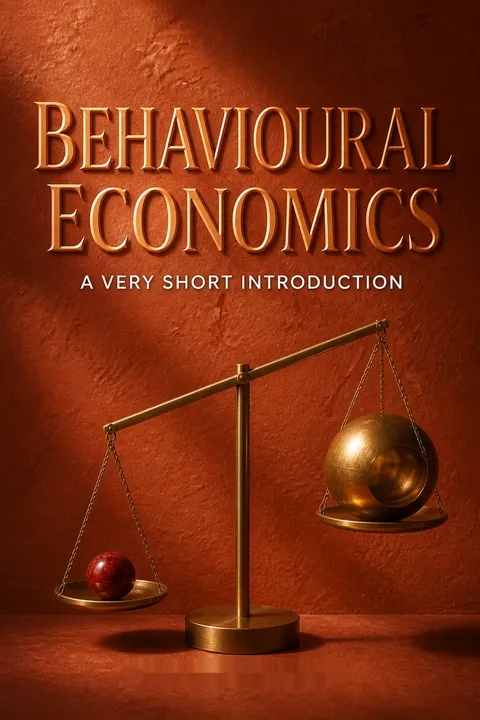
What's "Behavioural Economics: A Very Short Introduction" about?
- Overview of Behavioural Economics: The book provides a concise introduction to behavioural economics, a field that extends traditional economic principles by incorporating psychological and social influences on decision-making.
- Interdisciplinary Approach: It highlights how behavioural economics integrates insights from psychology, sociology, neuroscience, and evolutionary biology to enrich our understanding of economic behaviour.
- Focus on Real-World Applications: The book discusses how behavioural economics is applied in policy-making and everyday decision-making, making economics more accessible and relevant to a broader audience.
Why should I read "Behavioural Economics: A Very Short Introduction"?
- Understand Human Decision-Making: The book offers insights into how real people make decisions, which can differ significantly from traditional economic models.
- Practical Applications: It provides examples of how behavioural economics is used in public policy and business to improve outcomes and efficiency.
- Broadened Perspective: Reading this book can help you appreciate the complexity of economic behaviour and the factors that influence it beyond mere financial incentives.
What are the key takeaways of "Behavioural Economics: A Very Short Introduction"?
- Behavioural Biases: The book explains common biases like loss aversion, status quo bias, and the endowment effect, which affect decision-making.
- Motivation and Incentives: It discusses how intrinsic and extrinsic motivations influence behaviour and how these can be leveraged in policy and business.
- Social Influences: The book highlights the impact of social norms, trust, and reciprocity on economic decisions, emphasizing the importance of social context.
How does "Behavioural Economics: A Very Short Introduction" define rationality?
- Bounded Rationality: The book introduces the concept of bounded rationality, where decision-making is limited by cognitive constraints and available information.
- Ecological and Selective Rationality: It discusses how rationality can be context-dependent, with people choosing when to be rational based on circumstances.
- Practical Rationality: The book suggests that in real-world scenarios, people often make quick, frugal decisions rather than complex calculations.
What role do heuristics play in "Behavioural Economics: A Very Short Introduction"?
- Quick Decision-Making: Heuristics are mental shortcuts that help people make decisions quickly, often leading to systematic biases.
- Types of Heuristics: The book covers availability, representativeness, and anchoring/adjustment heuristics, explaining how they influence choices.
- Pros and Cons: While heuristics can simplify decision-making, they can also lead to errors and misjudgments, which behavioural economics aims to understand and mitigate.
How does "Behavioural Economics: A Very Short Introduction" address risk and uncertainty?
- Prospect Theory: The book introduces prospect theory, which describes how people perceive gains and losses differently, often overvaluing losses.
- Behavioural Paradoxes: It discusses paradoxes like the Allais and Ellsberg paradoxes, which challenge traditional economic models of risk.
- Loss Aversion: The book emphasizes that people are generally more sensitive to losses than gains, affecting their risk-taking behaviour.
What insights does "Behavioural Economics: A Very Short Introduction" offer on time inconsistency?
- Present Bias: The book explains how people often prefer immediate rewards over future benefits, leading to time-inconsistent decisions.
- Pre-Commitment Strategies: It discusses strategies like pre-commitment to help individuals align short-term actions with long-term goals.
- Behavioural Life Cycle Models: The book explores how time inconsistency affects saving and spending patterns over a lifetime.
How does "Behavioural Economics: A Very Short Introduction" explore social influences on behaviour?
- Trust and Reciprocity: The book highlights how trust and reciprocity are crucial in economic interactions, affecting cooperation and fairness.
- Social Norms and Herding: It discusses how social norms and the tendency to follow the crowd (herding) influence decision-making.
- Identity and Image Motivation: The book examines how identity and the desire to maintain a positive social image drive economic choices.
What are the practical applications of behavioural economics in public policy, according to "Behavioural Economics: A Very Short Introduction"?
- Nudging: The book explains how nudges can guide people towards better decisions without restricting freedom of choice.
- Default Options: It discusses the use of default options in policies, such as automatic enrolment in pension plans, to improve outcomes.
- Social Nudges: The book highlights how providing social information can influence behaviours, such as energy consumption and tax compliance.
What are the best quotes from "Behavioural Economics: A Very Short Introduction" and what do they mean?
- "Behavioural economics extends economic principles by allowing that our decisions are affected by social and psychological influences." This quote underscores the core idea of behavioural economics, which is to incorporate human psychology into economic models.
- "We are motivated by far more than just money." This highlights the book's emphasis on understanding the complex motivations behind human behaviour, beyond financial incentives.
- "Our choices are sticky." This refers to the concept of status quo bias, where people tend to stick with existing decisions or conditions, even when change might be beneficial.
How does "Behavioural Economics: A Very Short Introduction" address the measurement of happiness and well-being?
- Beyond GDP: The book discusses the limitations of traditional economic indicators like GDP in capturing true well-being.
- Subjective Well-Being Surveys: It highlights the use of surveys to measure happiness and life satisfaction, despite challenges in capturing accurate data.
- Broader Definitions: The book advocates for considering psychological and social factors in assessing national welfare and policy effectiveness.
What is the significance of "Behavioural Economics: A Very Short Introduction" in the field of economics?
- Bridging Disciplines: The book plays a crucial role in bridging economics with psychology and other social sciences, offering a more holistic view of human behaviour.
- Influence on Policy: It has influenced the design of public policies that aim to improve decision-making and societal outcomes through behavioural insights.
- Educational Value: The book serves as an accessible introduction to behavioural economics, making complex concepts understandable to a wider audience.
Very Short Introductions Series Series














Download PDF
Download EPUB
.epub digital book format is ideal for reading ebooks on phones, tablets, and e-readers.








