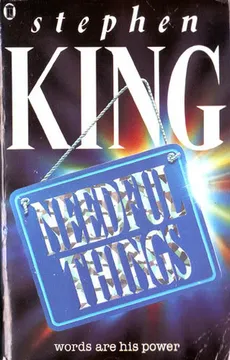


Plot Summary
Prologue
An unseen storyteller welcomes the reader back to Castle Rock, Maine, where October leaves old grudges close to the surface. The town is already divided over a church casino night, and its residents nurse private griefs, jealousies, and resentments.
Then a new shop opens beneath a dark green awning. The narrator senses that the store, called Needful Things, will turn ordinary irritation into something far worse. The first customer is Brian Rusk,4 an eleven-year-old boy walking home with his bicycle and a secret longing for a rare baseball card.
The opening frames Castle Rock as a community that mistakes familiarity for safety. Its quarrels are not new, and residents expect them to pass, which makes them slow to recognize when old grievances are being deliberately sharpened. The narrator’s intimate knowledge of the town invites the reader to treat its people as neighbors before the supernatural threat becomes clear. The store’s arrival is presented not as an invading force but as an answer to ordinary curiosity. That distinction matters: Gaunt does not need to invent anyone’s weakness. He needs only to notice it, price it, and make the customer feel that the bargain was freely chosen.
Brian Buys His Dream
Eleven-year-old Brian Rusk4 slips into Needful Things before its public opening and meets Leland Gaunt,3 the elegant proprietor whose eyes hold him unusually fast. Gaunt3 lets Brian4 handle a supposed fragment of Noah’s Ark, then produces the treasure Brian4 wants most: a 1956 Sandy Koufax card, signed to a boy also named Brian.
He sells it for eighty-five cents, almost all the money in Brian’s4 pocket, plus a deed to play a trick on neighbor Wilma Jerzyck.8 Gaunt3 leaves the deed vague, and Brian4 cannot remember their exact agreement. He rides home thrilled with the card, not yet understanding that he has traded more than money for a private dream.
Brian’s bargain is powerful because it meets a real emotional need without appearing to exploit him. The card represents recognition, adulthood, and a treasured bond with his father, while Gaunt makes the transaction feel like a lucky discovery rather than a trap. Brian’s age matters: his imagination is vivid, but his understanding of consent and consequences is still developing. Gaunt’s manipulation therefore depends less on force than on arranging the terms so Brian supplies his own desire and later his own rationalizations. The impossible inscription gives the object an intimacy that money cannot explain, making it easier for Brian to accept the deed attached to it.
The Shop Learns Its Customers
When Needful Things opens, townspeople discover that Gaunt’s3 stock seems uncannily suited to each visitor. Nettle Cobb,7 a timid housekeeper who loves carnival glass, buys a lampshade for a price she can afford and agrees to prank Head Selectman Danforth Keeton.6 Hugh Priest,9 a hard-drinking public-works employee, buys a fox-tail that recalls his happiest youthful day and accepts an errand involving Nettle.7
Cora Rusk10 pays for Elvis Presley sunglasses, while her friend Myra Evans11 secures an Elvis portrait by promising to target bartender Henry Beaufort.17 Gaunt’s3 prices are negotiated rather than displayed. Each customer leaves believing the object is a bargain, while the hidden deed quietly connects one neighbor’s resentment to another’s.
Gaunt’s store turns consumption into a social mechanism. A customer does not merely buy an object; the customer accepts a small obligation that can be disguised as harmless play. Because the promised tricks are individualized, the victims and perpetrators are linked through existing tensions rather than arbitrary coincidence. The lack of price tags intensifies this process: customers must reveal what they value before Gaunt decides what it costs. The result is a market in which private longing becomes public risk. Gaunt’s apparent generosity is not the opposite of exploitation; it is the method that makes exploitation feel like personal choice.
Polly Takes the Charm
Polly Chalmers,2 who runs a sewing shop and suffers worsening arthritis, is drawn to the new proprietor3 after he treats her pain and independence with unusual attention. She is also Alan Pangborn’s1 lover. The Castle Rock sheriff is still burdened by the deaths of his wife Annie and younger son Todd in a car crash, and Polly2 has helped him face the grief he once kept at bay.
Yet she has concealed the truth about her own son, Kelton, who died in a San Francisco fire. When her hands flare badly, Gaunt3 lends her an Egyptian amulet said to ward off pain. Her fingers soon move more freely, and relief makes the strange charm difficult to refuse.
Polly and Alan approach pain from opposite directions. Alan turns grief into investigation, repeatedly searching for evidence that might absolve or condemn him; Polly protects herself by controlling what others are allowed to know. Their intimacy depends on mutual care, but not yet on equal honesty. Gaunt finds the pressure point in Polly’s body and offers what Alan cannot: immediate relief without the emotional cost of disclosure. The charm therefore exploits a genuine medical vulnerability while deepening a preexisting secrecy. Its apparent success raises a difficult question for Polly: when suffering is chronic, how much skepticism can a person afford before hope itself begins to feel like a luxury?
Mud Begins the Feud
Brian’s4 forgotten deed returns as a dream in which Gaunt3 tells him he still owes for the Koufax card. Brian4 rides to Wilma Jerzyck’s8 home and flings garden mud across her clean sheets, then washes his hands and hides the act from his family. Gaunt3 has separately persuaded Nettle7 to enter Buster Keeton’s6 house and post traffic-warning notices.
Hugh,9 meanwhile, has been ordered to frighten Nettle. Wilma8 finds the muddy sheets and blames Nettle,7 whom she has long bullied over her dog, Raider. She telephones Nettle7 with threats, then makes repeated drive-bys to keep her frightened. Nettle7 retreats indoors, guarding her new lampshade and dog while both women mistake Gaunt’s3 interference for a personal attack.
The first prank works because it is small enough to deny and intimate enough to wound. Brian does not break a window or steal anything; he soils a domestic object that embodies Wilma’s control over her household. Wilma’s response reveals how much her identity depends on never appearing afraid or challenged. Nettle, already shaped by years of abuse and institutionalization, interprets intimidation through the logic of survival. Each woman reads the other’s action as proof of a longstanding judgment, while the actual author of the escalating pattern remains invisible. Gaunt’s most effective weapon is not the prank itself but the false certainty it gives its target.
Two Women Meet Armed
On Sunday, Hugh9 enters Nettle’s7 home with a corkscrew and kills Raider, leaving a note that blames her for his damaged tires and stolen fox-tail. Brian,4 meanwhile, returns to Wilma’s8 house with a cooler full of rocks and throws them through the windows, appliances, and flowerbeds, attaching warnings that frame Nettle.
Nettle7 comes home, finds Raider dead, and believes Wilma8 has struck first. Wilma8 returns to find her house smashed and assumes Nettle7 did it. Each woman takes a knife from her kitchen and walks toward the other. They meet at the corner of Willow and Ford, fight in the street, and die from their wounds as neighbors watch helplessly.
The deaths are the catastrophic conversion of interpretation into fact. Hugh’s note supplies Nettle with a false explanation, while Brian’s notes supply Wilma with another; both messages make the intended target seem unmistakable. Their histories then do the rest. Wilma’s habitual aggression and Nettle’s trauma converge in a confrontation neither woman can retreat from without feeling defeated. The violence is not an eruption from nowhere. It is the endpoint of carefully staged misrecognition, with each participant acting on evidence that has been planted to resemble the truth. Their deaths expose how a community’s familiar grudges can be turned into a lethal system when trust is deliberately removed.
The Evidence Points Elsewhere
Sheriff Alan Pangborn1 initially sees a straightforward feud, but the case refuses to fit. Polly2 remembers Nettle7 saying Wilma8 had stopped bothering her, and the timing leaves little room for Nettle7 to prepare the rocks after finding Raider dead. A veterinary examination places the dog’s death within a narrow window, while Wilma’s8 handwriting does not match the note left on the corkscrew.
Investigators also find large, blurred fingerprints on Nettle’s7 door, apparently from a man. A neighbor recalls a boy leaving Wilma’s8 yard with a picnic cooler after the rock-throwing. Alan1 asks for time to question him himself, sensing that someone used the women’s history to conceal a third person’s actions.
Alan’s police work begins where community gossip ends: he tests the story against time, handwriting, physical evidence, and ordinary behavior. His unease is not proof, but it prevents him from mistaking a socially plausible explanation for a true one. The boy with the cooler becomes a crucial contradiction because the scene has been arranged to make two women look responsible for acts they did not commit. At the same time, Alan’s willingness to trust intuition is complicated by his personal grief. He has spent years looking for certainty about Annie’s death, so he knows how easily a desired explanation can masquerade as evidence. Here, careful doubt becomes a form of protection.
Brian Cannot Confess
Alan1 finds Brian4 after school carrying the same cooler, now filled with baseball cards. The boy admits he went to Wilma’s8 house and heard crashes, but claims he rode away without seeing the person who threw the rocks. His exhausted face and strained answers suggest he knows more, yet Alan1 cannot make him speak.
Brian4 is suffering from the secret of what he did and from Gaunt’s3 continued claim on him. At home, his mother is absorbed by the Elvis sunglasses and cannot offer him comfort. As the final violence erupts, Brian4 goes into the family garage with his father’s rifle and kills himself, leaving his younger brother, Sean,20 to witness the act.
Brian’s silence is not simple guilt or simple coercion. He is a child caught between an adult’s manipulation and the knowledge that his own actions helped trigger a murder. Gaunt has made the card feel inseparable from Brian’s identity, then expanded the price until the boy can no longer imagine returning to ordinary life. Alan recognizes the child’s distress but arrives without the means to break Gaunt’s psychological hold. The tragedy reveals the asymmetry between adult power and a child’s imagination: Brian can understand that he has done harm, but he cannot yet see a future in which confession, punishment, and forgiveness might coexist.
The Winning Ticket Works
Danforth Keeton6 buys Gaunt’s3 antique mechanical game, Winning Ticket, after explaining his secret embezzlement and disastrous gambling habit. The toy appears to select winners when he assigns horses names from the racing form. Buster6 follows its predictions at Lewiston Raceway and returns with a small fortune, briefly restoring his marriage to Myrtle12 and his confidence in himself.
Then he finds fake traffic warnings posted throughout his house, including accusations of embezzlement. Gaunt3 tells him that Sheriff Pangborn1 and the town’s officials are persecuting him. Buster6 begins treating his real crimes as evidence of a conspiracy, hides the money and game, and becomes increasingly armed, isolated, and dangerous.
Buster’s downfall grows from a genuine secret. He has embezzled public money and accumulated debts, so his fear of exposure is rational; Gaunt redirects that fear into a delusion that makes accountability look like persecution. Winning Ticket supplies the emotional proof Buster needs: success at the track convinces him Gaunt understands him and can rescue him. The false warnings then transform his own guilt into an enemy’s accusation. This is more than supernatural mind control. Gaunt amplifies a psychological defense that Buster already uses, allowing him to preserve the image of himself as a capable public servant while preparing for violence against those who might expose him.
Jealousy Becomes a Weapon
Gaunt3 sells Sally Ratcliffe,13 Brian’s4 speech teacher, a supposed holy relic and directs her to plant an envelope in Principal Frank Jewett’s office. In Lester Pratt’s14 Mustang, Sally13 finds a staged photograph and intimate letter suggesting Lester has resumed an affair with Judy Libby, his former girlfriend.
The evidence fits Sally’s13 fear that her strict, faith-centered courtship has left her trusting a man she barely understands. She breaks with Lester14 and vandalizes his car. Separately, Cora10 and Myra11 compete for Elvis memorabilia, and Gaunt3 turns Myra’s11 purchase into an errand against Henry Beaufort. Small transactions become intimate betrayals, giving each victim a reason to strike back at someone they already resent.
Gaunt’s deceptions work because they exploit gaps between public virtue and private desire. Sally’s religious certainty has made her feel morally secure, but it has also left her with little experience testing intimacy through honest conversation. The fabricated evidence offers a sudden, vivid answer to her insecurity, so she accepts it before asking Lester. The Elvis rivalry operates on a different register: Cora and Myra’s shared obsession becomes competition, and Gaunt converts that competition into action. In both cases, an object promises private fulfillment while the accompanying deed corrodes trust. The shoppers are not merely deceived about what they see; they are steered toward becoming people they would not have recognized as themselves.
Ace Finds a False Fortune
Ace Merrill5 returns to Castle Rock under pressure from drug-dealing associates who demand repayment by November. At Needful Things, Gaunt3 offers him a map supposedly written by Ace’s dead uncle, Pop Merrill, marking buried treasure across the county. Ace5 accepts a job driving a rare Tucker car from Boston and transporting crates of automatic pistols, ammunition, and blasting caps.
Gaunt’s3 car seems to evade ordinary limits, and Ace5 reaches town ahead of schedule. He digs at several marked sites, finding worthless trading stamps and other scraps, but remains convinced the real fortune is near. Gaunt3 has supplied him with both transportation and weapons, directing Ace’s5 desperation toward Castle Rock.
Ace is not drawn in by nostalgia for home; he returns because his ordinary routes to money have closed. Gaunt recognizes that a person facing a deadline can mistake any possibility for rescue. The map is especially effective because it combines a family secret with material evidence, making greed seem like inheritance rather than fantasy. The Tucker and the drug supply further lower Ace’s resistance by rewarding obedience with sensations of power and speed. His role differs from Brian’s: Brian is trapped by a prized object, while Ace is recruited through the promise of escape from debt. Both, however, surrender judgment to a bargain that keeps changing its terms.
Polly Is Turned Against Alan
Alan’s1 efforts to investigate Polly’s2 past reach San Francisco’s Child Welfare Department, but Gaunt3 intercepts the information and delivers a false letter implying Alan1 has been prying into the death of Polly’s2 son, Kelton. Hurt and ashamed, Polly2 believes it and refuses to hear Alan’s1 explanation. Gaunt3 then exploits her dependence on the pain-relieving amulet, ordering her to bury a message for Ace5 at the abandoned Camber farm.
She digs up a can, removes incriminating material, and replaces it with Gaunt’s3 letter. Only after returning home does she understand that the accusation against Alan1 may have been fabricated. She finally destroys the amulet, freeing herself from Gaunt’s3 leverage while accepting that the pain will return.
Polly’s betrayal is produced by two vulnerabilities Gaunt has carefully joined: her fear that Alan will judge her past and her fear of living with uncontrolled pain. The forged letter does not create her shame; it gives the shame a target and turns it into a reason to reject the person who might have helped her. At the Camber farm, Polly participates in Gaunt’s scheme while telling herself she is merely defending what remains of her privacy. Her decision to destroy the charm marks a painful return of agency. She does not erase her past or cure her illness, but she refuses to let either be used to command her.
Castle Rock Turns Violent
On Tuesday, the planted grievances erupt across town. Buster6 murders Myrtle12 with a hammer after deciding she has joined the conspiracy against him. Lester14 attacks Deputy John LaPointe16 over the false belief that John16 has rekindled a romance with Sally;13 dispatcher Sheila Brigham kills Lester14 with a shotgun to save John.16
Hugh Priest9 shoots shopkeeper Henry Beaufort17 and employee Billy Tupper after blaming Henry17 for damaging his treasured fox-tail, while Henry17 returns fire and fatally wounds Hugh.9 Eddie Warburton18 enters Sonny Jackett’s19 station to avenge his burned car, kills the wrong employee, then is shot by Sonny.19 Cora10 storms Myra’s11 home, and the two women exchange gunfire over Elvis and the portrait they both believed they owned.
The violence arrives as a series of local reckonings, each legible on its own and horrifying in accumulation. The victims and attackers act from recognizable motives: jealousy, humiliation, ownership, racial resentment, and fear of losing a prized object. Gaunt’s design does not require his customers to become strangers to themselves; he gives their worst impulses a permission structure and a target. The town’s ordinary institutions, including the sheriff’s office and the church, are drawn into the same contagion. What began as private bargaining becomes public violence because each deed has been calibrated to make retaliation appear justified.
The Churches Smell War
Timed devices placed by Gaunt release unbearable chemical stench inside both the Baptist church and the Daughters of Isabella Hall during rival Casino Nite meetings. The congregations flee in panic, blaming one another before anyone can establish what happened. Reverend Rose’s21 followers march toward the Catholics, while Father Brigham’s22 parishioners converge from the opposite direction.
Their meeting becomes a street brawl, with church leaders and State Police swept into the fight. In the confusion, several people are injured and one police officer is shot. The explosive charge under the Tin Bridge then detonates, severing the main crossing and isolating the town as the storm intensifies.
The stink-bombs turn an ideological dispute into a sensory emergency. Each congregation experiences the attack before it can evaluate the evidence, so the first available explanation, that the rival church is responsible, feels certain. The feud has already trained both groups to interpret hostility as proof of the other side’s malice. Gaunt’s timed intervention exploits that conditioning, while the bridge explosion converts social division into physical isolation. The town’s competing authorities are no longer managing conflict; they are participants in it. The sequence shows how quickly shared fear can make a crowd abandon judgment in favor of a familiar enemy.
The Town Comes Apart
While the storm and street fighting absorb the police, Buster6 and Ace5 plant timed dynamite charges around Castle Rock, including the courthouse and businesses on Main Street. Buster6 believes they are striking back at the people who persecuted him; Ace5 is driven by revenge against Sheriff Pangborn1 and the stolen treasure.
At the same time, Brian,4 crushed by guilt and Gaunt’s3 threats, takes his father’s rifle into the garage and kills himself. His younger brother Sean20 witnesses the act and later tells Alan1 that Brian4 warned him away from Needful Things. The first charges explode, destroying the municipal center and nearby businesses, while the town’s residents remain scattered, injured, and unable to coordinate a response.
The climax gathers private damage into a civic catastrophe. Buster’s delusion and Ace’s greed converge on the same physical tools, but they imagine different enemies and different rewards. Their cooperation is therefore practical rather than loyal, which makes the alliance unstable. Brian’s suicide is the intimate cost of the same system: unlike the adults, he cannot externalize blame or transform guilt into a campaign against someone else. The explosion and the child’s death occur within the same widening crisis, linking civic destruction to personal collapse. Gaunt’s most devastating achievement is not merely violence; it is making each person’s choices seem isolated until their consequences arrive together.
Alan Sees the Real Crash
At the empty shop, Alan1 finds a VCR, television, and cassette left for him. The tape shows the day Annie and Todd died: Ace’s5 green Dodge Challenger deliberately bumps their Scout off the road and into a tree. Alan1 has spent years fearing Annie may have chosen to die and taken Todd with her; the footage reveals that both died because Ace5 caused the crash.
But the revelation is Gaunt’s3 final lure, meant to draw Alan1 toward vengeance. Alan1 leaves with the truth and a fake can of nuts in hand, approaching Ace5 as a hostage-taker holds Polly.2 Norris Ridgewick15 shoots Ace,5 while Alan turns the can’s paper snake into a brief supernatural weapon and faces Gaunt3 with the captured valise.
The tape gives Alan the answer he has wanted, but not the comfort he expected. It releases him from the false possibility that Annie deliberately killed herself and Todd, yet it also presents a new temptation: to let knowledge become revenge. Gaunt’s manipulation is especially cruel because the evidence is true. The trap lies not in falsifying the past but in choosing the moment and manner of its revelation. Alan’s restraint matters more than the discovery itself. He does not allow the truth about Ace to turn the rest of his life into an extension of that collision.
The Bargain Is Broken
Polly2 reaches Alan1 before Gaunt3 can carry him into the promised revenge. She has destroyed her pain charm and accepts the return of her arthritis rather than remain under Gaunt’s3 control. Alan1 realizes the tape is accurate but rejects the vengeance it was meant to purchase. He confronts Gaunt3 with the valise of stolen souls and a magician’s trick that becomes a flare of supernatural light.
Gaunt’s3 human shape fails; his horse-drawn wagon appears, rises above the ruined street, and disappears into the storm. Castle Rock is left burning, its bridge and civic center destroyed, and its survivors grieving. Alan1 and Polly2 leave together, unable to reclaim their old home but no longer deceived about what they have lost.
The resolution refuses an easy restoration. Alan receives the truth but cannot recover Annie or Todd; Polly regains her choice but not a cure. Their departure acknowledges that some places become inseparable from the harm done there, even after the immediate threat is gone. Gaunt’s defeat is not a victory of force so much as a refusal to keep bargaining on his terms. Alan declines to trade his remaining future for revenge, and Polly gives up a pain-free body rather than surrender judgment. The ending makes moral freedom costly, but it also makes clear that a painful life honestly chosen is preferable to comfort purchased through another person’s control.
Epilogue
The story closes in Junction City, Iowa, where a new shop is being prepared beneath a fresh awning. The sign calls it Answered Prayers and promises that customers will not believe what they see. Retired school principal Irma Skillins pauses outside, curious despite her aching joints and the ordinary caution of age.
The new store has no stock on display yet, but the name alone is enough to draw her closer. Castle Rock’s ruin has not ended the business. Somewhere else, another town is about to mistake its needs for an invitation.
The coda makes the ending deliberately incomplete. Castle Rock has escaped Gaunt’s immediate control, but the pattern he used is portable because it depends on ordinary human vulnerabilities rather than on one town’s peculiar history. The next shop does not need the same inventory; it needs only a new set of desires and resentments. Irma’s curiosity echoes Brian’s first approach to Needful Things, while the phrase Answered Prayers recasts predation as benevolence. The novel therefore ends by denying the comfort of a sealed victory. Alan and Polly may leave the wreckage behind, but the mechanism that exploited them remains active elsewhere.
Analysis
Needful Things treats evil less as an outside force that invades a town than as a skilled rearrangement of what its residents already want. Gaunt3 does not manufacture greed, shame, grief, or prejudice. He identifies them, gives them a tangible object, and adds a deed that directs one person’s private appetite toward another person’s weakness. The town’s downfall is therefore both supernatural and socially legible. A church dispute, a humiliating repair bill, a failed marriage, a child’s collection, and an official’s concealed embezzlement are not interchangeable motives. Each becomes dangerous in its own particular way because Gaunt3 understands the emotional logic attached to it.
The bargains also complicate responsibility. Gaunt3 exerts extraordinary influence, but his customers25 still choose, act, and sometimes recognize the harm too late. This creates a grim moral structure in which manipulation explains behavior without erasing consequence. Brian’s4 guilt is especially painful because he is both exploited and causally involved. Adults, by contrast, often protect themselves by converting guilt into accusation. Buster6 turns criminal exposure into a persecution fantasy; Wilma8 and Nettle7 interpret staged evidence through the histories they already know. Gaunt’s victims25 become most dangerous when they feel most certain that they are defending themselves.
Alan1 and Polly2 embody two competing responses to pain. Alan1 seeks evidence because he hopes certainty can settle grief; Polly2 withholds truth because she fears that exposure will cost her dignity and control. Gaunt3 exploits both strategies. He offers Alan1 a true answer designed to provoke vengeance, and Polly2 a real easing of pain designed to make obedience seem reasonable. Their recovery begins when each refuses the bargain’s final demand: Alan1 will not let knowledge dictate revenge, and Polly2 will not surrender judgment for relief. The ending does not restore their losses or their town. It offers a more modest freedom: the right to live with pain and uncertainty without allowing someone else to price them.
Review Summary
Needful Things receives mostly positive reviews, averaging 3.99/5 stars. Readers praise King's masterful small-town storytelling, memorable villain Leland Gaunt, and the compelling exploration of human greed and materialism. The novel's large cast of characters and slow-building chaos culminating in explosive mayhem are frequently highlighted. Some criticisms include repetitive scenes, an overly long runtime, an abrupt ending, and difficulty tracking the extensive cast. Despite mixed feelings about pacing, most readers find it an entertaining, often darkly humorous ride through Castle Rock's destruction.
People Also Read






Characters
Alan Pangborn
Grieving town sheriffAlan is Castle Rock’s sheriff, a widower raising his surviving son while carrying unresolved grief over Annie and Todd. He is observant, patient, and unusually skilled at reading the small physical clues other people dismiss. His magic tricks are not merely entertainment; they express a wish to make fear manageable and wonder available to others. In his relationship with Polly2, he offers tenderness but can also mistake vigilance for permission to investigate her private life. Alan’s central tension is between his professional need to know and his human need to accept uncertainty. His decency is real, but it does not make him immune to guilt, anger, or the desire for a final answer.
Polly Chalmers
Pain-worn shopkeeperPolly runs You Sew and Sew and has lived with progressive arthritis for years. Practical and self-reliant, she has learned to conceal both physical suffering and a painful past, especially the loss of her son, Kelton. She is Alan’s1 lover and was close to his late wife, which gives their relationship a foundation of affection and grief as well as tension. Polly’s pride protects her from other people’s judgment, but it can also keep her isolated. She values independence because she has fought hard to reclaim it. Her attraction to immediate relief is therefore understandable, not frivolous: pain narrows the world, and the promise of control can feel like a lifeline.
Leland Gaunt
Predatory shopkeeperGaunt is the proprietor of Needful Things, a polished, attentive businessman who seems to know exactly what each customer25 wants. He studies people closely and adapts his manner to their appetites, insecurities, and private histories. His calm courtesy makes him more dangerous, not less: he presents manipulation as fair negotiation and turns the customer’s own desire into the engine of the bargain. Gaunt treats relationships as networks he can wire together, then watches how pressure travels through them. He has no interest in ordinary community life except as material for his work. His charm is a performance of generosity that conceals a profound contempt for the people he entices.
Brian Rusk
Dreaming young collectorBrian is an eleven-year-old honor student who collects 1956 baseball cards and quietly admires his speech teacher, Sally Ratcliffe13. His corrected cleft palate and speech therapy have made him sensitive to embarrassment, but he is conscientious, imaginative, and eager to be seen as older than he is. The rare card he longs for represents both his connection to his father and a private achievement he can claim as his own. Brian’s strength is his capacity for wonder; his vulnerability is that he has not yet learned how easily adults can use wonder to shape obligation. He tries to be good, but his desire to keep a treasured object becomes a burden he cannot manage alone.
Ace Merrill
Cornered ex-conAce returns to Castle Rock after prison with debts, drug dependencies, and a long history of bullying and petty crime behind him. He is charismatic in a rough, intimidating way and expects strength to settle disputes. His uncle Pop’s reputation and unexplained wealth keep Ace’s imagination fixed on buried money and the possibility of a sudden escape from his debts. He is not sentimental about his hometown, but he is deeply invested in the humiliations he remembers there. Ace’s willingness to take risks makes him useful to Gaunt3, while his craving for control makes him vulnerable to the promise of a quick fortune and a chance to punish old enemies.
Danforth Keeton
Besieged town powerbrokerKnown as Buster, Danforth is Castle Rock’s head selectman and a practiced administrator with a concealed gambling problem and a family history of mental illness. He has built his public identity around competence and authority, while privately relying on evasions to keep financial failures hidden. The danger for Buster is not simply that he lies; it is that he cannot tolerate the possibility of being exposed as ordinary, flawed, or dependent. When fear rises, he reaches for control and interprets criticism as persecution. His marriage to Myrtle12 reflects this imbalance: he has often treated her as a prop in his orderly public life rather than as a person with her own fears and perceptions.
Nettle Cobb
Shy survivor and housekeeperNettle works for Polly2 and is slowly rebuilding an independent life after years of abuse and institutionalization. She is timid around authority, anxious about leaving home, and deeply attached to her dog and her modest collection of carnival glass. Beneath her fragility is a capacity for loyalty and care: she notices Polly’s2 pain and responds with practical tenderness. Nettle’s history has taught her that safety is temporary and that people with power may turn cruel without warning. Her gradual willingness to enter a new shop or travel alone matters because these small acts represent a return to ordinary life, not a sudden transformation into confidence.
Wilma Jerzyck
Combative neighborhood matriarchWilma is a tough, domineering woman who treats marriage and neighborhood life as contests of control. She keeps her husband, Pete, obedient through constant criticism and seeks out feuds when daily life feels dull. Her sharpness is not simply confidence; it is a defense against vulnerability and a source of stimulation when other parts of her life feel empty. Wilma has a keen sense for other people’s weaknesses, especially Nettle’s7, and uses that knowledge to intimidate. She believes the first move and the last word belong to whoever is strongest. That conviction makes her formidable in a quarrel, but leaves little room for retreat or repair.
Hugh Priest
Alcoholic public workerHugh works for Public Works and has spent years drinking through a life he regards as already ruined. Beneath his bluster and temper is a memory of a happier boyhood, tied to a convertible and a fox-tail on its antenna. The object awakens a brief possibility that he might stop drinking and start again, but shame and habit quickly smother that hope. Hugh’s aggression is partly a shield against the knowledge that he has wasted much of his life. He is dangerous when humiliated, yet his brief tenderness toward the past shows how much he still wants something better, even when he cannot sustain the effort to reach it.
Cora Rusk
Elvis-obsessed motherCora is Brian4 and Sean’s20 mother, an avid Elvis Presley admirer who spends long stretches absorbed in television and music. She is quick to judge other people’s purchases and appetites, even as she becomes emotionally dependent on the Elvis memorabilia she finds at Needful Things. Her attachment offers an escape from household routine and from the demands of her children. Cora’s taste is sincere, but her fantasy life can make present relationships seem like interruptions. She is not cruel by design; rather, she is easily drawn toward experiences that make her feel chosen and special.
Myra Evans
Cora’s competitive friendMyra is Cora Rusk’s10 best friend and shares her fascination with Elvis. Their friendship contains warmth, but also a quiet rivalry over who has the more valuable memorabilia and who has the stronger claim to The King. Myra is not naturally assertive, so Gaunt’s3 attention and the fantasy he offers feel like a sudden permission to want without restraint. Her actions show how easily longing can become competitive when a person believes affection is scarce. She is drawn to spectacle and private escape, and she has little practice recognizing when a fantasy is being used to direct her behavior.
Myrtle Keeton
Lonely selectman’s wifeMyrtle has spent years trying to make a marriage work with a husband who increasingly ignores or belittles her. She collects dolls and finds comfort in objects that do not criticize or withdraw affection. A rare kind morning with Danforth6 feels so precious that she clings to it without asking what has changed. Myrtle’s longing is not for luxury but for ordinary warmth, attention, and safety. She is observant enough to sense that something is wrong, yet accustomed to yielding before she can act on that knowledge. Her vulnerability comes from prolonged emotional isolation rather than lack of intelligence.
Sally Ratcliffe
Devout speech teacherSally teaches speech therapy at the middle school and is engaged to high-school coach Lester Pratt14. Her faith gives her a strong moral framework, and she tries to live by its rules with sincere conviction. She is also young and inexperienced in intimacy, relying heavily on the certainty of her beliefs and Lester’s14 assurances. The apparent proof of his betrayal shakes not only her trust in him but her confidence in her ability to judge people. Sally’s vulnerability lies in the distance between her idealized view of love and the unresolved questions she has never felt permitted to ask.
Lester Pratt
Muscular coach and fiancéLester is a high-school physical education teacher, a Baptist, and Sally Ratcliffe’s13 fiancé. He is physically powerful but generally amiable, proud of his athletic life, and earnest in his religious commitments. His courtship with Sally13 is constrained by their shared beliefs and by her limited willingness to cross the boundaries they have set. Lester assumes affection and trust are secure because he sees himself as devoted. That confidence leaves him unprepared for the jealousy and humiliation that can be stirred by carefully planted evidence.
Norris Ridgewick
Sensitive deputy sheriffNorris is a thin, self-conscious deputy whose awkwardness makes him an easy target for jokes, but he is conscientious and emotionally perceptive. He is devoted to his father’s memory and to the simple pleasure of fishing, which gives his life a quiet center. His sensitivity is often mistaken for weakness, including by people who have not noticed how much responsibility he accepts. Norris wants to be a competent officer and a decent man, yet he can be vulnerable to shame and to the longing for a treasured connection with his past.
John LaPointe
Steady sheriff’s deputyJohn is one of Alan’s1 deputies, a capable and generally cheerful officer who helps maintain the ordinary routines of law enforcement in Castle Rock. He has an old relationship with Sally Ratcliffe13 that ended before the story’s central events, though he remains emotionally attached to memories of their time together. John’s practical temperament and loyalty make him a dependable colleague, but his personal history can be manipulated when someone presents an image that appears to confirm his fears.
Henry Beaufort
Mellow Tiger proprietorHenry owns and tends the Mellow Tiger, a local bar where much of Castle Rock’s male social life passes through. He is direct, responsible about refusing service to dangerously drunk patrons, and willing to enforce boundaries even when doing so risks a confrontation. Henry’s sense of duty is practical rather than grand: he keeps the bar running and tries to prevent customers from harming themselves or others. His establishment gives him a front-row view of the town’s habits, grudges, and drinking culture.
Eddie Warburton
Municipal night custodianEddie is the night custodian at the Municipal Building and has a long-standing grievance against mechanic Sonny Jackett19. He believes Sonny19 cheated him over repairs and may have caused the fire that destroyed his new car. Eddie’s resentment is sharpened by the unequal power he feels in a predominantly white town, where he expects his complaints to be dismissed. He is quiet and observant at work, but private humiliation can make an old injury feel permanently unfinished.
Sonny Jackett
Sunoco mechanicSonny owns and runs the Sunoco station, where he repairs cars and cultivates a familiar small-town persona. He is suspicious, opinionated, and quick to judge political or racial subjects through the biases common in his circle. His dispute with Eddie Warburton18 began over a repair bill and grew into a lasting feud. Sonny’s self-image as a straightforward businessman leaves little room for considering how his conduct appears to someone with less power or fewer options.
Sean Rusk
Brian’s younger brotherSean is seven, energetic, and eager to share games and cartoons with Brian4. He looks up to his older brother4 even when Brian4 becomes withdrawn and irritable. Sean’s understanding of adult conflicts is limited, but he notices changes in the people around him and responds with direct affection. He wants reassurance and companionship more than explanations, making him a useful counterweight to Brian’s4 private burden.
Reverend William Rose
Militant Baptist ministerWilliam Rose leads Castle Rock’s Baptist congregation and treats the proposed casino night as a moral emergency. He is vain, rigid, and highly skilled at turning conviction into public performance. His contempt for Catholic practices is longstanding, but he believes his hostility is justified by religious duty. Rose’s authority depends on certainty: he finds it difficult to admit fear, error, or ambiguity. As tension rises, his pulpit becomes a platform for mobilizing people who trust his judgment.
Father John Brigham
Combative Catholic priestFather Brigham leads Our Lady of Serene Waters and supports the Daughters of Isabella’s casino night as a legitimate fundraiser. He is a blunt, quick-tempered Irish priest who has little patience for Reverend Rose’s21 attacks. Brigham’s instincts are protective of his parish, but his anger and pride make escalation easier. He believes that refusing to answer provocation would look like surrender, a belief that leaves him vulnerable when a dispute becomes a public test of loyalty.
Frank Jewett
Middle school principalFrank Jewett is the middle school principal, a meticulous administrator who keeps a secret life he fears would destroy his standing if exposed. He is accustomed to presenting a respectable public face and protecting his private habits through concealment. Gaunt3 recognizes the pressure points in that split and directs a prank at the gap between Jewett’s authority at school and his hidden appetites.
Henry Payton
State Police investigatorHenry Payton is a State Police lieutenant who takes over the murder investigation from Alan1. He is conscientious and experienced, but he does not know Castle Rock’s residents as intimately as its local officers do. His attention to procedure helps protect evidence, even as the town’s rapidly multiplying emergencies strain his ability to coordinate the response.
Leland Gaunt’s customers
Neighbors turned adversariesThe townspeople who visit Needful Things include shopkeepers, church members, public officials, teachers, and ordinary collectors. Each arrives with a specific want and leaves feeling unusually fortunate. Their varied desires make the store seem welcoming to everyone, but their existing rivalries, shame, grief, and envy give Gaunt’s bargains somewhere to take hold.
Plot Devices
Needful Things bargains
Desire at a priceGaunt3 sells objects without marked prices, first asking what the customer wants and then setting a cost that combines money with a deed. The objects seem almost miraculously suited to private longing: a baseball card, a carnival-glass lamp, a fishing rod, a doll, or a supposed cure for pain. The second payment is usually framed as a harmless prank, but it connects customers25 to other residents’ vulnerabilities. Because the buyer agrees to the terms, Gaunt3 can make coercion feel like choice. The shop’s central mechanism is psychological before it is supernatural: desire narrows attention until the buyer stops asking what the bargain will set in motion.
Customized curios
Objects awaken memoryGaunt’s3 wares do more than satisfy collecting habits. They provoke sensations, memories, or visions that make the purchaser feel an intimate connection to the object. Brian4 experiences the signed Koufax card as a direct brush with his hero; Hugh’s9 fox-tail revives a memory of happier youth; Polly’s Egyptian amulet appears to reduce her arthritis. These effects make skepticism feel like a refusal of lived experience. The object becomes evidence of its own value, even when its history is unverifiable. Each purchase therefore fuses possession with identity, making the customer more willing to protect the item and obey the terms attached to it.
The promised prank
Grudges cross-wire neighborsA prank is the hidden second price of many purchases. Gaunt3 assigns each customer a target connected to an existing grievance, then supplies a story or object that makes retaliation appear deserved. Mud, false warnings, planted photographs, stink-bombs, vandalism, and threats all circulate through the town. The victims attribute each event to the person they already distrust, so one staged act prompts another. The device allows Gaunt3 to create a chain of violence while keeping his own hand outside every immediate confrontation. It also exposes how quickly people accept hostile interpretations when those interpretations confirm what they already believe about a neighbor.
The altered keepsake
Comfort hides dependenceSome objects seem to offer more than memory or status. Polly’s2 azka appears to relieve her pain, while Buster’s6 Winning Ticket predicts race results and Ace’s5 map appears to identify buried treasure. Their benefits are persuasive because they answer urgent needs, but each object increases dependence on Gaunt3 and directs the buyer toward a further act. The promise is never simply that the item is valuable; it is that the owner can escape a life that has become unbearable. The device makes supernatural temptation concrete by attaching it to pain relief, money, or emotional repair. Its danger lies in making the first benefit feel more certain than the accumulating cost.
The magic performance
Wonder becomes resistanceAlan’s1 sleight-of-hand tricks, Brian’s4 fascination with baseball, and the paper snake in the joke can all establish a vocabulary of illusion and belief. Gaunt3 uses wonder to disarm customers25, but Alan1 eventually uses a magician’s misdirection against him. The distinction is not that one kind of magic is good and another evil; it is that Alan’s1 performance is offered freely, while Gaunt’s3 wonder is attached to a hidden demand. The fake snake becomes briefly real at the decisive moment, transforming a childhood novelty into a defense. The device connects the novel’s supernatural climax to the small acts of attention and play that Gaunt3 has repeatedly exploited.
Download PDF
Download EPUB
.epub digital book format is ideal for reading ebooks on phones, tablets, and e-readers.








