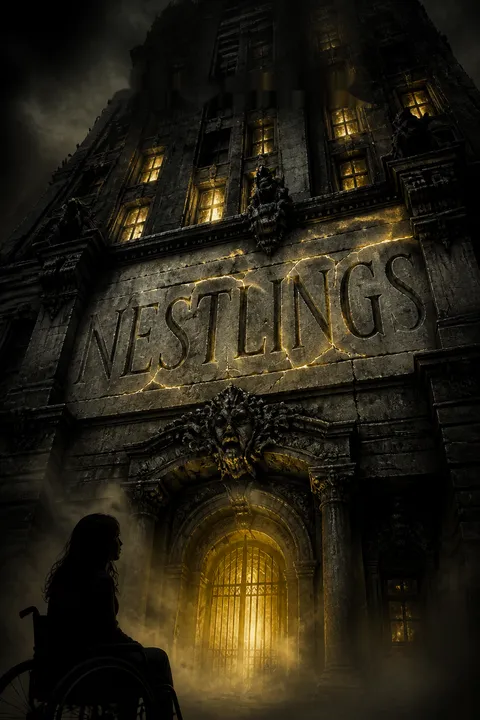


Plot Summary
The Deptford Lottery
Ana Greene, a former dancer who now uses a wheelchair, and her husband Reid inspect the luxury apartment they have unexpectedly won through a housing lottery. Its huge windows and accessible kitchen seem to offer the fresh start they need after a brutal year, but the top-floor location leaves Ana fearing a fire or broken elevator could trap her.
Reid agrees they should refuse, though Ana can see how much he wants the home. Then she looks out at the city and changes their answer: they will take it. Their broker, Vera, watches them leave with an insect hidden in her hands. Alone, she eats the roach and savors the couple’s arrival as the beginning of something the building has been waiting for.
The apartment is both an earned reprieve and an instrument of pressure. Ana’s choice resists the assumption that safety means retreating from risk, yet the building makes that risk literal: height, access, and dependence are built into the home itself. Reid’s eagerness and Ana’s hesitation also establish an intimate imbalance. He sees possibility first; she must calculate what the same possibility costs her body. Vera’s private appetite turns their hopeful decision into a transaction whose terms the couple cannot yet know.
Seven Days to Move
A voicemail gives Ana and Reid only a week to move in or lose the apartment, so Reid arranges movers before dawn and lies to their racist landlord, Frank, about where they are going. Ana travels with their nearly one-year-old daughter, Charlie, while Reid supervises the move. In the new home, Charlie cries through the night and Ana struggles to settle into a space she still distrusts.
Reid, however, finds a rare book about the Deptford in a used-book bin. Its stories of vanished residents and a mass rooftop death fascinate him, while a faint pull toward the building makes the home feel chosen. The apartment’s first welcome is not comfort but a collection of unexplained sounds, histories, and appetites.
The move compresses a family’s life into a deadline, making the supposedly fortunate apartment feel less like a choice than a summons. Reid answers uncertainty by collecting stories and interpreting coincidence as destiny; the book gives his optimism a narrative framework. Ana, whose body has already taught her how quickly a home can become inaccessible, registers the cost of that optimism more sharply. Their differing responses are not simple bravery and fear. They are competing survival strategies, each shaped by exhaustion and the need to believe that hardship can lead somewhere.
The Neighbor’s Key
As Charlie grows unusually distressed in the apartment, Ana keeps noticing details that refuse to settle: sticky residue on a windowsill, a view where she remembers gargoyles, and a strange quiet beyond her walls. A key Georgia, Ana’s physical therapist and friend, finds in the hallway opens the neighboring apartment.
Inside, a gaunt woman, Mrs. Jacobs, runs from her crying baby and nearly throws herself over the stair railing. Ana stops her and, for the first time, confesses the postpartum despair she has concealed, including the night she held a knife above Charlie’s crib. Mrs. Jacobs insists the baby is not hers anymore. The concierge arrives, closes her robe, and takes her back inside, dismissing the crisis as familiar.
Ana’s intervention begins as an attempt to rescue someone else, but it also breaks the isolation around her own most shameful memory. The parallel between the two mothers is deliberately unstable: Ana recognizes the exhaustion and fear, yet Mrs. Jacobs’s insistence that the child is no longer hers cannot be reduced to ordinary postpartum distress. The concierge’s calm management is more disturbing than open menace because it converts an emergency into routine procedure. In this building, care and control already look remarkably alike.
Georgia Takes the Stairs
Georgia tries to push Ana toward more intensive rehabilitation, bringing a walker and insisting that home exercises have become a refuge from the risk of trying again. Ana hears the challenge as another judgment on her body and sends Georgia away in anger. Georgia stays in the building to explore its grand staircase, carrying her equipment toward the exit.
The floors become strangely irregular, the hallways empty, and a corridor ends in darkness without a visible stair or elevator. When a distorted, animal-like figure emerges from an apartment, Georgia recognizes its resemblance to something she has seen outside. She prepares to fight, but another presence closes around her from behind. Her route out of the Deptford disappears with her.
Georgia’s confidence is grounded in practical skill, but the scene exposes the limits of competence when the environment itself stops obeying ordinary rules. Her argument with Ana also echoes the novel’s central conflict over effort: trying can open possibility, but it can also expose a person to pain and danger. Georgia’s disappearance makes the building’s architecture predatory rather than merely confusing. The staircase that once promised elegant circulation becomes a system for separating residents from help.
Reid Loses His Job
After years of absorbing extra tasks at a law firm, Reid confronts his boss about the work and his family’s needs. The firm refuses to fire him outright, instead threatening worse hours and pay unless he quits, so Reid leaves without telling Ana. The next morning, panic draws him back toward their old Brooklyn apartment.
He curses the place, then sees Frank emerge with a bandaged hand and runs before they can speak. Back at the Deptford, Ana finds red marks on Charlie that resemble the bedbug bites they once endured. The couple inspect the apartment, spread diatomaceous earth, and prepare for another infestation. Their new home has delivered a job crisis and revived the very fears they thought they had escaped.
Reid’s workplace confrontation is a genuine assertion of dignity, but the employer’s retaliation turns that victory into economic precarity. He hides the consequence from Ana because he wants to protect her, while also protecting himself from admitting how little control he has. His return to the old apartment shows that the body remembers routes even when the mind claims to have moved on. The suspected bedbugs make that return physical: past vulnerability appears to have crossed the threshold with them.
A Face at the Window
The bedbug search reveals no insects, but that night Ana sees a pale, distorted face pressed against Charlie’s bedroom window, impossibly far above the street. Reid wakes to find Ana on the floor and insists she was dreaming.
The next day, he explores the basement while removing boxes and finds looping corridors, a locked super’s door, and a growling sound in a dark passage. Later, delivery trouble brings him into contact with Camilla Varné, an elderly former film star whose apartment is filled with awards and memorabilia.
She listens closely when he admits he has lost his job, then offers him work as her personal assistant. Reid accepts, drawn by the money, the attention, and the sense that he has finally found a place inside the building.
The face at the window gives Ana evidence her husband can dismiss, leaving her alone with a perception that may be supernatural or psychological. The basement offers Reid a parallel warning, but he translates unease into curiosity and access. Camilla’s offer rewards precisely that appetite. Her glamour and attentive listening provide what his old job withheld: recognition. The temptation is not merely wealth or celebrity. It is the emotional relief of being treated as someone whose story matters.
The Courtyard Eats Space
Reid settles into Camilla’s apartment and meets the celebrated residents who gather there, while Ana tries to make a normal outing with Charlie in the courtyard. The dense trees swallow the path, and Ana loses her way in ground too rough for her wheelchair. When she falls, a split in the soil releases a flood of pale, spider-like creatures.
Ana crawls through the foliage toward Charlie’s chirp and finds her daughter sitting calmly in a clearing, chewing on something that may be one of the creatures. Ana escapes with Charlie, filthy and bleeding, then learns Reid has been away with Camilla. The garden has not simply disoriented them. It has given Charlie access to something the adults cannot safely approach.
The courtyard reverses the usual promise of a shared green space. It offers recreation in name, but its hidden terrain makes access unequal and turns Ana’s chair into a liability. Charlie, by contrast, moves through the space without apparent fear. That contrast sharpens Ana’s maternal anxiety: the child’s ease may signal resilience, but it may also mean the child is being welcomed by a world that excludes her. The scene makes accessibility a matter of survival, not convenience.
Charlie Bites Eliot
At Charlie’s first-birthday party, Ana tries to reconnect with other parents and admits more about the difficulties of childbirth and paralysis than she usually shares. Reid performs the song he has written for Charlie, and for a moment the family feels close again. Then the adults go to the roof, leaving Ana with the children.
She returns from the bathroom to find Charlie biting Eliot’s neck. The wound looks burned rather than bitten, and Ana has to pull Charlie away. At the doctor’s office, the pediatrician finds no clear cause for Charlie’s new behavior. On the ride home, Eliot develops a high fever, and his mother blames Charlie. She also tells Ana that Reid treated the guests badly on the roof.
The party stages belonging as a performance: Ana makes herself sociable, Reid offers a song, and their friends admire the apartment. The injury punctures that performance, turning a family celebration into a public test of parental competence. Ana’s prior fear that she is a bad mother becomes entangled with evidence that Charlie may be dangerous. The doctor’s inability to identify a cause deepens rather than relieves the anxiety. The ordinary explanations are still available, but they no longer account for everything the parents have witnessed.
Frank Finds the Deptford
After the party, Ana discovers Reid has concealed his firing and new work for Camilla. Their argument exposes the secret as a breach of trust, not just a financial risk. Camilla interrupts to send Reid for a repaired earring. Outside, Frank confronts him over apartment damage and turns the dispute into an antisemitic attack on Reid and Ana.
Reid punches him, and the concierge intervenes with a whisper that leaves Frank terrified and fleeing. Meanwhile, Ana records in her booth and isolates an eerie musical hum. A creature climbs through Charlie’s open window, so Ana hides the baby inside the soundproof booth before being forced toward the stairs. She falls, wakes in hospital, and tells Reid that monsters took Charlie.
The conflict between Ana and Reid is rooted in secrecy, but the external threat makes their private failures consequential. Reid’s new job gives him income and admiration while separating him from the family decisions that income is meant to support. Frank’s racism turns the couple’s old housing insecurity into a direct physical confrontation. The concierge’s intervention hints that the building can control outsiders as well as residents. Ana’s recording booth, initially a work tool and refuge, becomes the one place where a child can disappear from sound.
Camilla Throws Charlie
Reid finds Charlie hidden in Ana’s soundproof booth and, after police leave, falls asleep beside her. Camilla appears in the apartment and takes the baby upstairs. On the roof, she throws Charlie over the railing. Reid watches her fall, then discovers her clinging safely to the building wall with tiny hands.
Camilla reveals that the Deptford’s residents are not conventional vampires but an ancient family that makes new members through a process involving children near their first birthday. The residents have been preparing Charlie, whose apparent bites and strange behavior are signs of that change. Camilla offers Reid a place in their household and promises that they can restore Ana’s ability to walk.
The rooftop is where Reid’s yearning for belonging becomes impossible to separate from the price of admission. Camilla demonstrates the family’s power by making him experience the apparent death of his child, then reframes the horror as evidence of Charlie’s fitness. Her offer exploits the exact wounds that have shaped him: economic fear, exhaustion, and helplessness beside Ana’s disability. The transformation is sold as care and exceptional status, but it removes the parents’ right to decide what their child becomes.
Reid Chooses the Offer
Camilla explains that Charlie has been chosen for transformation and offers Reid a chance to join the Deptford’s hidden family. He pretends to record their conversation and demands one night with Charlie plus a cure for Ana, but the recording is a bluff. After returning home, he searches his mother’s belongings for protection and finds a heavy bronze Jewish chai.
The next morning he asks Isaac, a Chabad visitor, how Jewish tradition might resist vampires. Isaac responds with grief and fatalism after losing his own son. Charlie then speaks to Reid for the first time and asks to go home. He takes her words as proof that the Deptford is where she belongs, goes to Home Depot for a lock, and prepares to force Ana to accept his decision.
Reid’s choice is neither simple cowardice nor uncomplicated devotion. He truly wants safety for Charlie, but he has begun treating the building’s promises as facts because they answer his own need to be chosen. Isaac’s grief offers a counter-story, one in which survival does not erase suffering, yet Reid hears that account as despair. Charlie’s first words become the confirmation he wants, although a child’s attachment cannot carry the moral burden he places on it.
The Jacobses’ Living Nest
Ana leaves the hospital before staff can stop her and returns to an empty apartment. Isaac calls with information Reid had requested: old Jewish accounts describe vampires drawn to babies and vulnerable to earth forced into the mouth.
Ana then uses Georgia’s key to enter the Jacobses’ apartment. She finds Mrs. Jacobs and her husband encased in sticky secretion, alive but immobilized while their transformed baby feeds through a tube from its mouth. The creature attacks Ana, but she escapes into the hall and reaches her own apartment.
There, Reid has locked her inside the voice-over booth to make her hear his plan. The neighbors’ fate shows Ana what the Deptford’s offer means, and Reid’s attempt to make her comply turns their marriage into a trap.
The Jacobses’ apartment is a grotesque answer to Ana’s earlier effort to help a mother in crisis. Her instinct to recognize shared suffering had been morally serious, but it also left her unable to see that this neighbor’s danger was not only emotional. The feeding scene literalizes the cost of treating children as a family’s property or a building’s resource. Reid’s booth trap repeats that logic in miniature: he claims to protect Ana while removing her freedom to act.
The Staircase Betrayal
Reid tells Ana that the Deptford will cure her and give Charlie a privileged life, but he cannot persuade her that the offer is safe. She smashes the booth glass with her microphone stand and demands her wheelchair.
When Reid blocks her, Ana strikes his foot and shoulder with the stand and her mother-in-law’s bronze chai, then escapes toward the staircase. He catches her and tries to force her back into the apartment. Ana pulls him over the railing with her, and they crash down the stairs. Reid breaks his back and cannot move.
Ana hears him pleading for help, but keeps descending because Charlie is still in the building. She crawls flight by flight, dragging her folded chair and the chai, choosing rescue over the marriage she once believed could carry them both.
The physical violence marks a rupture that the couple can no longer soften with good intentions. Reid’s coercion grows from his belief that he alone can calculate the family’s future; Ana’s refusal answers that paternalism with force. Her fall with him is not a triumphant escape but a costly break from mutual dependence. The wheelchair remains both a practical tool and a symbol of agency: she does not abandon it, even when moving without it is the only way forward.
Frank Meets the Nest
As Ana crawls down the staircase, Frank enters the Deptford disguised as an electrical worker, intent on frightening the Greenes. He finds Ana in a dark transfer corridor and calls her by the cruel nickname he used before. Seeing monstrous residents in the shadows, he mistakes their presence for proof of his conspiracy theories and advances with his hammer.
Ana tells him to run, but Frank attacks the creatures instead. They swarm him, tear at his body, and trap him inside the dark stairwell. Ana escapes through the service stairs while Frank’s screams fade behind her. His intrusion creates the opening she needs, though it costs him his life and leaves Ana alone with the building’s pursuing residents.
Frank’s end is not a moral correction delivered by the supernatural so much as an exposure of his preferred way of understanding the world. He has spent his life turning other people into threats, and he interprets the monsters through the same racist story rather than recognizing danger in time to flee. Ana’s warning is the opposite of his worldview: she tries to help someone who has harmed her. The scene refuses to make his death redemptive, but it does show how hatred can blind a person to the actual peril in front of him.
Earth in the Queen’s Mouth
Ana reaches the basement and finds the Deptford’s hidden heart: a vast mass of living flesh that Vera identifies as the residents’ mother and the source of the building’s life. The transformed residents surround her with Charlie, claiming the child is already one of them and will die if taken away. When they return Charlie to Ana, the baby cries for the creatures and calms only when they sing the building’s strange music.
Ana recognizes that Charlie is happy, but refuses to let the residents keep the choice entirely on their terms. She cuts the queen’s sealed mouth with the chai and pours diatomaceous earth into it. The queen convulses, the residents collapse, and Ana pushes through them with Charlie before leaving the building in chaos.
The climax gives Ana no clean victory. She can recognize Charlie’s happiness and still reject the system that engineered it, but her act cannot restore their former relationship or guarantee an ordinary future. The earth and the chai join inherited identity to practical knowledge: neither belief nor ritual works by itself, yet both help her act. Most importantly, Ana stops accepting the building’s claim that love requires surrender. She makes a choice under grief rather than waiting for certainty.
The Gargoyles Fall
Ana reaches the street as the Deptford’s residents remain incapacitated. A neighboring doorman, Manny, steps between her and the concierge when he sees the man pursuing her. A stone gargoyle falls from the building and kills the concierge, while more of the ornamentation crashes onto the street.
The building suffers a public collapse, leaving bystanders injured and its secret exposed only as an unexplained infrastructure disaster. Ana gets away, but Charlie remains inside with the transformed family.
Five years later, Ana has built a life helping people with spinal cord injuries and tells others that Charlie lives with her own mother. She visits a modest new building, feels a pulse beneath its wall, and leaves after silently acknowledging her daughter.
The collapse turns the Deptford’s carefully guarded secrecy into public debris, but it does not undo the family’s loss. Ana survives without receiving a conventional rescue or a reunion, and the five-year leap refuses to make grief disappear simply because she has found work and a new routine. Her visit to the new building suggests that the hidden family has continued elsewhere, while her refusal to force entry respects Charlie’s separate life. Moving forward here means carrying the relationship without controlling it.
Epilogue
Five years after the Deptford’s collapse, Ana walks through Manhattan in her wheelchair, working at a foundation for people with spinal cord injuries and speaking more openly about what she needs. She visits a new apartment building that appears to house the living presence she once encountered beneath the Deptford.
A doorman there reminds her of Reid, now rigid and silent in the building’s service. Ana does not approach either of them. She rests her hand against the wall, senses a faint pulse, and leaves with a quiet expression of love for Charlie. Her daughter is alive somewhere inside the building’s hidden world, and Ana continues forward without pretending the loss is resolved.
The closing scene denies the consolations of a conventional reunion while giving Ana a form of contact that does not depend on possession. She recognizes signs of both Charlie and Reid, yet does not make either recognition a demand. Her work with spinal cord injuries also reframes the novel’s opening fear of not belonging: she has found a community by helping others navigate changed bodies, not by recovering her old life. The final gesture is deliberately small. A hand on a wall cannot undo what happened, but it allows love to coexist with distance, uncertainty, and continued movement.
Analysis
Nestlings makes its horror out of the overlap between genuine care and coercive control. The Deptford offers a family affordable housing, accessible alterations, employment, and a community, all needs the Greenes have struggled to meet. Its seduction works because those needs are real. Camilla’s promise to cure Ana and protect Charlie is frightening not because it sounds absurd, but because it answers the couple’s exhaustion with exactly the language they want to hear.
Ana and Reid respond to loss differently. Ana resists the demand to make disability inspirational or motherhood uncomplicated; she is allowed to be resentful, frightened, desirous of escape, and loving at once. Reid’s humor and caretaking help him endure, but his need to turn suffering into a story of destiny leaves him vulnerable to the Deptford’s offer. Their conflict shows how devotion can become domination when one person assumes that bearing the burden gives them sole authority to choose.
The novel also treats the body as a site where personal history and social structure meet. Ana’s injury follows an extraordinarily rare complication of childbirth, then meets an insurance system that denies sustained rehabilitation. Her wheelchair is not a symbol of failure: it is a means of movement, skill, and escape. The horror comes from the inaccessible staircase and the people who mistake assistance for permission to control her.
The Deptford’s hidden family twists vampire folklore through Jewish history and antisemitic stereotypes about outsiders, blood, and belonging. The story does not offer a simple religious weapon or a clean triumph over grief. Instead, inherited objects, community knowledge, and practical improvisation help Ana act. The ending’s deepest change is not that she recovers what was taken. It is that she can love Charlie without claiming ownership of her future, and can keep moving while grief remains part of her life.
Review Summary
Nestlings by Nat Cassidy is a chilling horror novel set in a mysterious New York City apartment building. Readers praise its atmospheric tension, compelling characters, and fresh take on vampire mythology. The story follows a couple struggling with disability and new parenthood as they encounter supernatural horrors. While some found the pacing slow at times, many appreciated the psychological depth and social commentary. Cassidy's writing style and character development received high marks, with comparisons to classic horror works like Rosemary's Baby and Salem's Lot.
People Also Read







Characters
Ana Greene
Paralyzed new motherAna is a former dancer and personal trainer whose rare spinal injury during childbirth leaves her using a wheelchair. She is intelligent, observant, blunt, and often angry, particularly when other people turn her into either an inspiration or a problem to solve. Her complicated feelings about motherhood are intensified by postpartum depression and the critical voice she inherited from her own mother. Ana values movement and independence, but distrusts promises that recovery will make her whole again. Her humor and stubbornness protect her, though they can also keep her from asking for support. She is defined not by a single attitude toward disability or motherhood, but by her effort to make room for contradictory feelings without letting them dictate every choice.
Reid Greene
Musician and caretakerReid is Ana’s husband, Charlie’s father, and a musician who supports his family through an office job he resents. Attentive and generous, he often uses humor to make fear manageable and takes pride in caring for the people he loves. His mother’s death, the pressure of work, and the demands of new parenthood have left him hungry for a place where he feels valued. He tends to convert uncertainty into stories about luck and destiny, a habit that can help him endure hardship but can also make him vulnerable to seductive explanations. Reid’s devotion is genuine, though he sometimes mistakes taking responsibility for having the right to decide for others.
Charlie Greene
The chirping babyCharlie is Ana and Reid’s daughter, approaching her first birthday as the family moves to the Deptford. Her bright birdlike chirp delights her parents, and she quickly learns how to use it to draw their attention. She is still too young to explain her needs, so her changing moods and reactions become a source of parental uncertainty. Charlie’s presence makes the adults confront the difference between loving a child and knowing what is best for her. She is not a symbol to her parents so much as a real, responsive person whose desires they can only partly interpret.
Camilla Varné
The magnetic movie starCamilla is an elderly, celebrated actress who lives in the Deptford and carries herself with the confidence of someone accustomed to being watched. She is witty, charming, and intensely curious about other people’s stories. Her attention makes Reid feel recognized, while her worldly ease disguises how completely she understands the building’s secrets. Camilla presents herself as both a generous host and a practical realist, speaking about family, aging, and care with disarming warmth. Her charisma is not merely theatrical; it is a tool for establishing intimacy and influence. She embodies the building’s ability to make its demands feel like an invitation.
Georgia O’Keefe
Blunt physical therapistGeorgia is Ana’s friend and former colleague, now a physical therapist who provides free home sessions. Strong, dryly funny, and direct, she believes Ana deserves more than maintenance exercises and wants her to consider returning to intensive rehabilitation. Her encouragement comes from professional conviction and personal empathy, though she sometimes pushes before Ana is ready. Georgia is one of the few people who can challenge Ana without treating her as fragile. She offers a model of friendship built on practical help, irreverence, and the willingness to risk an uncomfortable conversation.
Vera
The eager building guideVera presents the Deptford apartment to Ana and Reid, sharing architectural trivia and pointing out the building’s celebrated gargoyles. Twitchy and unusually invested in the couple’s decision, she seems to know more about the apartment than an ordinary broker would. Her manner blends hospitality with a watchful, almost devotional interest in the family. Vera is drawn to the lives of the building’s tenants and eager to believe that their arrival has significance. She serves as the first human guide to a place whose welcoming surfaces conceal an older and stranger order.
Mrs. Jacobs
A neighbor in crisisMrs. Jacobs lives next door to Ana and Reid and is first heard crying with her infant. Exhausted, isolated, and frightened, she speaks in disjointed bursts about being trapped and about a baby she no longer recognizes as her own. Ana sees in her a distressing echo of her own postpartum struggles, though the neighbor’s situation carries a further mystery. Mrs. Jacobs has been stripped of the ordinary supports that might help a new parent, and her attempts to explain what is happening are repeatedly dismissed. She makes visible how easily genuine danger can be mistaken for instability.
Frank
The bigoted former landlordFrank is Ana and Reid’s former landlord, a meddlesome Brooklyn construction worker whose grievance over his property masks a broader appetite for control. He is racist and antisemitic, yet insists that his prejudices are simply practical judgments. Frank treats tenants as extensions of his authority and views disagreement as disrespect. His resentment grows when the Greenes leave without giving him the chance to supervise their move. He represents the everyday forms of hostility and entitlement the couple hoped to escape, while his fixation on the past keeps drawing him back toward them.
Isaac Blau
The grieving Jewish readerIsaac is a Chabad visitor Reid repeatedly encounters in Manhattan parks. He reads horror novels, carries a deep knowledge of Jewish tradition, and is grieving the death of his young son. His willingness to discuss vampires gives Reid a cultural and historical perspective that the building’s residents cannot provide. Isaac is perceptive but also speaks from a place of acute despair, sometimes turning personal grief into a sweeping account of Jewish suffering. He challenges Reid to distinguish survival from simple endurance, even when Reid is not ready to hear the challenge.
The concierge
The unnerving gatekeeperThe Deptford’s concierge, whom the Greenes privately call Smiler, wears an immaculate uniform and an unnaturally broad grin. He appears whenever residents need managing, especially when someone is distressed or asks questions the building would rather contain. Polite, patient, and difficult to read, he can make intervention feel like customer service. His function is not simply to guard the entrance but to preserve the building’s preferred version of events. The contrast between his courteous manner and the unease he provokes makes him one of the first signs that the Deptford’s hospitality has rules.
The elevator operator
The silent elevator keeperThe elevator operator is a squat, shadow-eyed presence who accompanies residents through the Deptford’s old-fashioned elevators. Ana finds his stare unsettling, while Reid slowly comes to regard his silence as part of the building’s odd routine. He offers few explanations beyond the occasional practical answer, leaving residents to supply their own interpretations. His indistinct, almost blended appearance makes him feel less like an ordinary employee than a feature of the building itself. He reinforces the sense that even a simple ride between floors involves crossing into the Deptford’s private order.
Dr. Bronson
Charlie’s reassuring pediatricianDr. Bronson is Charlie’s large, gentle pediatrician. He handles the baby carefully and reassures Ana and Reid that fussiness can follow a move or a developmental change. His kindness makes him a welcome contrast to the building’s uncanny atmosphere, though his ordinary explanations cannot account for everything the family observes.
Cathy Stillson
Ana’s critical motherCathy is Ana’s mother, remembered for sharp judgments and a habit of making her daughter feel inadequate. Her voice persists in Ana’s thoughts, especially when Ana doubts her capacity to parent or to adapt to disability. Cathy is not only a source of old hurt; she has become the inner standard Ana fears she may repeat. Ana’s struggle to distinguish her own feelings from her mother’s criticism shapes how she understands anger, care, and responsibility.
Camilla’s granddaughter
A young actressLeonora is Camilla’s granddaughter and a young actress whose career Camilla manages. Reid learns of her through the film posters and correspondence in Camilla’s apartment. She is a distant presence in the story, but her relationship with Camilla shows how the actress continues to invest in younger performers and maintain a public identity.
Winston Terry
The vanished musicianWinston is a once-prominent British musician whose words about home and belonging catch Reid’s imagination. He appears among Camilla’s circle of Deptford residents, still sharp and musically gifted. His past is marked by loss and withdrawal from public life. Winston gives Reid an artistic model for turning personal experience into song, while his presence hints that the building’s residents have histories far stranger than its old gossip book can capture.
Bizzie
A vulnerable new arrivalBizzie is a newly released man with a history of addiction who accepts a placement connected to the Deptford. He hopes for work and a dependable routine, but arrives amid a gathering whose nature he does not understand. His perspective reveals how the building recruits people who are isolated or in need, offering shelter and opportunity before revealing the cost of its hospitality.
Manny Langan
The neighboring doormanManny is a doorman at the Keene Apartments across the street from the Deptford. Friendly and attentive, he takes pride in helping residents and passersby rather than treating the job as mere security. His ordinary decency contrasts with the Deptford staff’s studied reserve. Manny’s presence shows that small acts of intervention can matter, even when the person helping does not understand the danger they have stepped into.
Eliot
The birthday party childEliot is a young guest at Charlie’s first-birthday party and the child of Kacey and Steve. He is energetic and curious, and his injury during the celebration turns a private family worry into a crisis witnessed by friends. Eliot’s parents’ reaction also brings the Greenes’ social circle into the consequences of Charlie’s unexplained behavior.
Plot Devices
The affordable housing lottery
A prize with hidden termsThe Deptford’s housing lottery gives Ana and Reid a home they could not otherwise afford, creating the practical reason they enter the building. Its sudden offer arrives alongside a strict move-in deadline, and the apartment’s high floor conflicts with Ana’s wheelchair access needs. The lottery initially reads as extraordinary good luck, especially to Reid, who sees fate at work. As the story unfolds, it becomes clear that the building’s selection process is not merely administrative. The promise of affordable housing draws families into a place that evaluates them for purposes they have not agreed to.
Preston Treadwell’s history
A crooked map of the pastReid finds an out-of-print book documenting the Deptford’s gossip, disappearances, and the mass death known as the Plummet. The book gives him a way to learn about his new home and supplies phrases that later shape the song he writes for Charlie. Its account is incomplete and sometimes unreliable, a point the famous residents themselves emphasize. Even so, it plants the history needed to recognize that the building has concealed violent episodes for generations. The book’s mixture of fact, rumor, and omission mirrors Reid’s own tendency to turn partial evidence into a comforting story.
The building’s music
A signal only children hearA faint, patterned sound travels through the Deptford, first registering as background noise in Ana’s recordings. Ana isolates it with her audio equipment, while children react to it before adults do. Mrs. Jacobs associates it with the residents’ influence, and the sound later soothes Charlie when she is among them. The music functions as both evidence and communication: it signals that the building is not acoustically ordinary and suggests how its youngest inhabitants are drawn toward their hidden family. Ana’s recording work, usually a private means of income, becomes essential to detecting what the building broadcasts.
The Deptford’s living heart
A home that is also organismBeneath the building, Ana discovers a vast living mass that serves as the hidden center of the Deptford’s ecosystem. Its residents, creatures, and caretakers each perform functions that sustain the whole. The courtyard, infestation, musical hum, and unusual transformations all connect back to this organic structure. The building’s history and architecture therefore become more than gothic decoration: they are the visible shell of a living system. The device turns the question of what makes a home into a bodily one, while making the family’s apparent shelter inseparable from a system that feeds on its inhabitants.
Earth, chai, and grit
Improvised tools against the nestAna carries a bronze chai inherited through Reid’s family, a heavy object with sharp edges that can injure the Deptford’s creatures. Isaac’s research points her toward earth as a traditional vulnerability, while Reid has bought diatomaceous earth during the couple’s bedbug scare. At the climax, Ana uses the chai to open the living heart’s mouth and pours the abrasive powder inside. The solution depends on details seeded in separate parts of the story: family inheritance, Jewish folklore, and practical pest control. None is a magical shortcut; together they give Ana a chance to act.

Download PDF
Download EPUB
.epub digital book format is ideal for reading ebooks on phones, tablets, and e-readers.








