

Plot Summary
Prologue
Los Angeles, January 1947. Elizabeth Short waits at the Biltmore Hotel, nearly broke and desperate to escape the men who have used her as a courier for Mickey Cohen. A stranger promises money and a chance at an acting opportunity, then draws her into a car and takes her to an isolated building.
When she tries to flee, he catches her and drains her blood. At dawn, her mutilated body is left in a vacant lot. The figure watching police arrive considers her not an end, but a beginning.
The prologue turns Elizabeth’s familiar Hollywood ambition into a trap built from ordinary vulnerabilities: hunger, money, and the hope that one more opportunity might change everything. Her attacker exploits the language of the industry, where a promise of access can conceal coercion. The final suggestion of a larger plan reframes the murder as deliberate preparation rather than a self-contained crime. It also establishes the story’s noir tension: Los Angeles sells reinvention, but the people with power decide whose dreams become evidence, spectacle, or bait.
Betty’s Diary Underfoot
At the Emerald Room, singer Lena Reid learns that her closest friend, Elizabeth Short, has been murdered. She tells the police little about Betty’s fear of the Europeans connected to Mickey Cohen, concealing both the courier work and the diary Betty left in her apartment. At home, Lena reads entries about blood types, a warehouse, strange symbols, and a man held on a table.
Betty had planned to leave Los Angeles after one final job at the Biltmore. Lena hides the diary beneath a loose floorboard rather than destroy it, then spots a cigarette-smoking watcher across the street. Her guilt over dismissing Betty’s fear now has a physical object to protect, and someone else already seems to know where she lives.
The diary gives grief an investigative shape, but it also complicates Lena’s loyalty. She wants to honor Betty, yet withholds evidence because disclosure could expose her own secret and draw the police toward Cohen’s network. Her choice to hide rather than burn the book makes remembrance an act of risk. The book’s first mystery is therefore not simply who killed Betty, but who can be trusted with the truth. Lena’s performance as a composed nightclub singer continues after the murder, suggesting that concealment is not a temporary tactic for her. It is the habit on which her survival and ambition depend.
A Detective Takes the Case
Private investigator Victor Callahan hears about the murder while working in Las Vegas, then receives a call from Virginia West, Betty’s half-sister. Virginia believes the police care more about sensational coverage and Betty’s romantic history than finding her killer.
Callahan accepts the case after seeing the photographs and letters she brought, including one picture of Betty beside Lena. His own unexplained blackouts and headaches trouble him, but he treats them as exhaustion. He visits the Emerald Room to observe Lena before approaching her.
Her singing holds the room, yet her controlled glamour does not hide the danger he senses around her. Their first meeting begins as an interrogation, but his usual emotional distance gives way to a fascination neither can explain.
Callahan’s entry into the case links public injustice to private unease. Virginia asks him to restore Betty’s personhood against a press eager to reduce her to a nickname and a sexual history. His professional instinct answers that request, while his blackouts quietly undermine his confidence in his own perception. Lena becomes both a witness and a possible source of danger, so attraction arrives inside an ethical problem rather than outside it. The initial pull between them is not simply desire: each recognizes in the other an opacity that resists ordinary questioning, and both are accustomed to treating observation as a form of control.
The Warehouse Symbols
Lena checks Betty’s diary for earlier clues and visits the Lavender Room, where bartender Vivian remembers Betty meeting an elegant brunette. The woman argued with Betty and gripped her wrist hard enough to leave marks.
Someone follows Lena through the rainy streets, then vanishes, leaving a still-smoking cigarette behind. Callahan separately searches Betty’s boardinghouse and finds an address book marked with the same warehouse address Lena had discovered. When they meet at the building, they find old blood, scratches left by a heavy table, and symbols whitewashed on a wall.
Men arrive to search the property, so Callahan shields Lena as they slip out. The discovery confirms that Betty’s deliveries led into organized violence, not merely Cohen’s ordinary criminal business.
The warehouse is where private suspicion becomes material evidence: stains, furniture marks, and covered symbols hold a history that the authorities have not made legible. Lena and Callahan’s decision to investigate together is practical before it is intimate, although their physical closeness during the escape intensifies their attraction. Vivian’s account also widens Betty’s hidden life without reducing her to a clue; Betty had formed connections Lena herself did not know about. The men arriving at the warehouse demonstrate that the antagonists are not merely hiding evidence after the fact. They actively monitor the places where evidence might be found.
A Break-In at One
After someone enters Lena’s apartment, conjures blood beneath her bathroom door, and steals Betty’s diary from its hiding place, Lena calls Callahan for help. At his office, they compare dangers: she describes the intruder, while he admits that blackouts have taken him to places he cannot remember, including her building.
He also tells her about Catherine, his dead wife, and the grief he has kept sealed away. Their conversation ends when Marco Russo, Lena’s jealous gangster boyfriend, arrives demanding her return.
Callahan refuses to hand her over, and Marco warns that Cohen’s interests extend to the murder investigation. Lena agrees to work with Callahan openly. The missing diary has made secrecy less protective, while Cohen’s threat turns their uneasy cooperation into a necessary alliance.
The break-in attacks Lena’s private space and her control over evidence at once. Its impossible details leave her unable to dismiss the supernatural danger as mere criminal surveillance, while Callahan’s admission of missing time establishes that his own mind is becoming a compromised scene. Sharing grief about Catherine creates an intimacy that neither can explain through professional necessity alone. Marco’s arrival then makes the partnership political: investigating Betty risks provoking a criminal organization with power over Lena’s livelihood. Their alliance is chosen under pressure, but it also offers each a rare counterpart who can hear the parts of their lives they normally conceal.
Blood at the Colony
Callahan’s investigation uncovers Sylvia Winters, a waitress found months earlier with ritual wounds and almost no blood. Her rare AB-negative type matches Betty’s, while witnesses connect her to a foreign man.
Callahan suffers another blackout after a hostile visit to the Satin Slipper and wakes in Elysian Park with blood on his mouth. Meanwhile, Lena goes to her old ally Abraham Van Helsing, whose Malibu colony offers vampires a safer way to feed. She drinks from a captured murderer, intending to take only enough to regain her strength, but kills him.
Later, she sketches Betty’s symbols for Abe and learns they are Skardic marks associated with old vampire magic. The murders may be sacrifices, and the earlier killing suggests the ritual is still developing.
The second victim gives the investigation a pattern, while Callahan’s bloody blackout suggests that the investigator may be entangled with the violence in a way he cannot yet remember. Lena’s feeding scene makes her own moral boundary equally unstable. She chooses a murderer as prey, yet her inability to stop once she begins shows that a supposedly deserved victim does not remove the danger of appetite. Abe’s explanation places vampire society inside the same city as Cohen’s organization, but not on the same moral footing. The crucial distinction is not human versus vampire; it is whether power is restrained, negotiated, or treated as permission to consume.
The Dressing Room Claim
After Lena returns to the Emerald Room, Callahan appears in her dressing room and demands that she leave Marco. Their attraction erupts into sex, and Callahan marks her with his own bodily claim before she returns to the club. The next day, he follows Marco to Lena’s apartment and finds him hitting her. Callahan beats Marco until Lena pulls him away, then warns the gangster to leave her alone.
Rather than stop there, Callahan follows Marco to his house. During their confrontation, his anger breaks into a blackout. He wakes amid Marco’s mutilated body, with blood on his hands and no memory of killing him. Callahan secretly buries the body and destroys the evidence, afraid that the violence came from something inside him.
The intimacy is charged by the story’s recurring tension between desire and possession. Callahan’s claim over Lena feels thrilling to both of them, but Marco’s violence shows how easily ownership becomes abuse when it is backed by power rather than mutual choice. Callahan intervenes to protect Lena, then crosses a moral line by pursuing Marco and hiding his death. His missing memory does not absolve him; it makes responsibility harder to locate and control. The sequence turns romantic intensity into a warning sign. Callahan’s capacity for protection and his capacity for lethal violence emerge from the same force, leaving both characters to ask what his desire is becoming.
The Blackout Takes Shape
After Cohen questions Lena about Marco’s disappearance, she seeks shelter and guidance from Abe’s vampire circle. Callahan, meanwhile, experiences worsening blackouts and begins a violent transformation at age thirty-five. He arrives at Lena’s apartment bloodied, confused, and driven by a hunger he cannot name.
Their encounter is fierce and uncontrolled; when he leaves, Lena recognizes the signs of a vampire’s transition and suspects he has killed during the missing hours. At a later meeting at the Culver Hotel, Callahan admits he killed Marco.
Cohen’s men interrupt them, throw acid in Lena’s face, and watch her skin heal. Callahan shoots one attacker; Lena disarms another, and they escape together. Unable to keep her nature hidden, she tells him that she is a vampire and that he is becoming one too.
Callahan’s transformation gives bodily form to the split between the identity he has lived and instincts he cannot explain. Lena’s response is both compassionate and dangerous: their sexual bond draws them closer even as his loss of control makes her physically vulnerable. The acid attack changes the terms of their relationship by making Lena’s hidden nature impossible to deny. Her healing is not an abstract revelation; it occurs in front of Callahan during a violent assault, and she uses her abilities to help them escape. Their romance now depends on a new kind of honesty, one that includes the possibility that Callahan may harm others while unconscious.
The Mansion’s Invitation
Lena is lured away from her apartment by a blonde stranger, while Callahan is approached outside the police station by a brunette promising information about Betty. Both women belong to the Ivanov family, and both use compulsion to bring their targets to a lavish Burbank mansion.
There, the sisters drug Lena and Callahan, surround them with vampires and coerced sexual attention, and try to bend their desires to the family’s purposes. Callahan partly resists the haze when Lena’s distress reaches him, but neither escapes by choice; they are eventually released and wake in a cheap hotel with blurred memories.
Norma then reports a new ritual murder. Callahan and Lena realize the Ivanovs were not merely observing them. They were testing what the pair knew and how Callahan’s transition might respond to blood and desire.
The mansion makes the story’s treatment of consent more troubling and more explicit. The Ivanovs exploit supernatural compulsion and drugs, turning intimacy into a tool of interrogation and experimentation. The narration presents the couple’s desire as real, but the circumstances deny them clear agency, so attraction cannot be treated as proof that manipulation is harmless. Callahan’s partial resistance hints that his connection with Lena can interrupt the Ivanovs’ control, although it does not protect them from being used. The episode also reframes the family’s interest in the pair: what looked like decadent hospitality is a controlled test, and the new murder confirms their activities continue beyond the mansion.
The Crimson Clover
Callahan and Lena question Jeanne French’s roommate, Margaret Wilson, who says Jeanne had been meeting an Eastern European man and carrying a vial of her own rare blood. Margaret gives them a matchbook for the Crimson Clover, an exclusive club hidden beneath Shanghai Red in San Pedro.
Inside, they find vampires feeding on drugged humans kept in alcoves, evidence that the club supplied victims for the ritual killings. Katya Ivanov confronts them and admits that Betty, Sylvia, and Jeanne were sacrifices, though she does not reveal the final purpose.
Abe, Ezra, Adonis, and Valtu arrive before the Ivanovs can take control. A fight breaks out; Valtu kills Tatiana, but the others seize Callahan and escape into the chaos. Lena learns her own blood may make her the next target.
The club reveals the practical infrastructure behind the murders. Ritual violence depends on a social system that treats vulnerable humans as inventory, while polished décor disguises the coercion below the dance floor. Jeanne’s roommate makes the victims legible as working women with ordinary relationships and worries, countering the sensational treatment that first surrounded Betty. The rescue party’s arrival prevents an immediate defeat but cannot undo the Ivanovs’ advantage: Callahan is taken, and Lena’s unusual blood turns her from investigator into intended offering. The story thus shifts from uncovering a crime to interrupting a mechanism designed to produce another one.
Dmitri’s Experiment
While Callahan is held by Dmitri Ivanov, Lena learns from Abe that she is AB negative and likely the final sacrifice needed to open a passage to the Red Realm. The colony also uncovers Callahan’s origin: Dmitri gave his infant son to human adoptive parents to test whether vampire nature would emerge without knowledge of it.
In captivity, Dmitri confirms the experiment and claims Callahan’s wife, Catherine, was allowed to die so Callahan could be steered toward Los Angeles.
He then reveals that Callahan brought Betty to the Ivanovs and later drained her blood during the ritual. Callahan remembers enough to understand that he participated in her murder. Dmitri’s command to bring Lena to him overwhelms Callahan, who follows the compulsion toward the colony.
This revelation collapses several kinds of betrayal into one: Callahan’s identity was concealed, his marriage was treated as experimental collateral, and his investigative role led back to his own participation in Betty’s death. Dmitri’s theory that blood determines destiny is not merely a family belief; he has engineered circumstances to make that claim appear true. Callahan’s shame is therefore both personal and political, since he must distinguish acts committed under manipulation from choices he can still make. Lena’s status as the intended sacrifice links her bodily identity to the same system of classification that selected the earlier victims. The mystery becomes an argument over whether inheritance can dictate moral allegiance.
Lena Calls Him Back
Callahan reaches Lena in a feral state, compelled to capture her but still struggling against Dmitri’s order. Lena uses their physical and blood bond to draw him back to himself. Once his awareness returns, Callahan tells her he was the man who took Betty from the Biltmore and helped complete the ritual that killed her.
Lena grieves for Betty but refuses to reduce Callahan to Dmitri’s weapon; he had fought the command and come back to her. Before they can recover, they begin a ritual with Abe to help Callahan integrate his vampire instincts.
Marco, resurrected by the Ivanovs as a winged, feral creature, crashes into the colony, overwhelms its defenders, and abducts Lena. Callahan realizes the attack followed his trail and commits to using his new abilities to find her.
Lena’s intervention does not erase Callahan’s responsibility, but it makes room for a distinction between confession and condemnation. By naming his role in Betty’s death, Callahan relinquishes the protective lie that he might be innocent; Lena’s response centers his present choices without pretending the past is reparable. Their bond is powerful, yet the scene also exposes its danger: her body and blood become instruments for breaking supernatural control. Marco’s return turns emotional recovery into immediate crisis. The interrupted integration ritual means Callahan must act before his new self is settled, making the rescue a test of whether his developing self can guide power instead of being driven by it.
The Gatekeeper’s Chains
Dmitri’s followers take Lena to an abandoned warehouse and suspend her in chains forged to restrain vampires. The surgeon Dr. Goldman cuts ritual marks into her body while Dmitri explains that Betty served as the Vessel, Sylvia as the Eye, Jeanne as the Heart, and Lena as the Gatekeeper.
Her rare blood, spilled at sunset, is meant to open the way to Skarde, the vampire Red Realm. Lena learns that Dmitri expects Abe and the others to arrive in time to witness the ritual, not prevent it.
She endures the torture while gathering what information she can, including the final location: the Observatory. Meanwhile, Callahan’s allies use his connection to Lena to track her. He embraces his combined instincts without surrendering awareness and leads them toward the warehouse.
The ritual assigns each murdered woman a role in a design that converts individual lives into components. Dmitri’s language of salvation hides a system of extraction: the victims’ bodies are valuable only for what their blood can unlock. Lena’s resistance is not simply physical; she continues to observe and retain information while pain threatens to erase her agency. The sequence also gives Callahan a different route toward power. Rather than deny his vampire nature or let it overwhelm him, he accepts it as part of himself and turns it toward finding Lena. His development becomes operational: integration matters because it enables a choice under pressure.
The Observatory Burns
Callahan’s group reaches the warehouse before sunset, and he tears through a boarded window to reach Lena. Dmitri tries to compel his son into obedience, while the allies fight the Ivanov guards. Adonis kills Katya; Valtu battles the resurrected Marco, who has become a winged predator.
Callahan breaks Lena’s chains, then kills Marco by tearing out and consuming his heart. Dmitri again commands him to kill Abe, but Callahan turns the blue witch’s blade on Dmitri instead, piercing his heart.
The patriarch dies before the ritual can open the gateway. Fire spreads through the warehouse, so the survivors carry Lena out as the building collapses behind them. Callahan has chosen his own allegiance, though the violence that won their escape leaves its mark.
The climax makes the novel’s central dispute physical: Dmitri treats kinship as a command, while Callahan treats it as a fact that does not cancel choice. He uses the weapon prepared for the ritual against the person who designed it, interrupting the gateway rather than claiming it. Yet his victory is not a clean conversion into moral purity. Consuming Marco’s heart gives him power and exposes how easily survival and predation can overlap. Lena is rescued, but not untouched by the violence that made rescue possible. The burning warehouse destroys the ritual site, while the couple’s escape carries the unresolved cost of Callahan’s inherited history and chosen methods.
A Home After the Fire
In the months after Dmitri’s defeat, Lena and Callahan recover at Abe’s colony and begin building a life together. Callahan’s human and vampire selves become more integrated, while the two exchange blood and develop a bond that helps them understand one another without making their past disappear.
At the house, they discuss buying a home and finding work as discreet fixers for the vampire community. Cohen remains powerful, but the Ivanov alliance has weakened his position and left him wary.
Konstantin, who once fought against them, offers information and help in bringing Cohen down. Lena and Callahan do not accept blindly; they weigh his motives and the danger of another alliance. Their next purpose is not a return to ordinary life, but a life they choose together.
The resolution refuses to equate survival with restoration. Lena’s singing career and Callahan’s investigative identity have both been disrupted, so they imagine new forms of work that use their abilities without returning them to the same exploitative structures. Their blood bond offers intimacy, but the novel frames it alongside deliberate trust, shared decisions, and practical planning. Konstantin’s offer keeps justice unsettled: Cohen’s complicity is not punished simply because Dmitri is dead. The couple’s future therefore begins with a new ethical problem rather than a tidy victory. They must decide how to use power in a city where official justice has repeatedly protected the powerful.
Epilogue
Twenty years later, Lena and Victor are raising their three-year-old daughter, Olivia, while visiting friends in San Francisco’s fogbound Golden Gate Park. Their vampire allies have built new lives around the city’s music and counterculture, and the family moves through this changing world with practiced ease.
A meeting with the unsettling Charles Manson disrupts the picnic: his attention fixes too long on Olivia, and the older vampires recognize danger in his influence over vulnerable young women. Lena and Victor leave with their daughter, alert to a new human threat. Their life together has endured, but immortality has not made the world safe.
The time jump confirms that Lena and Victor have built a durable family, but it refuses to make domestic happiness a guarantee of safety. Olivia’s presence changes the stakes: the couple’s protective instincts now extend to a child whose future cannot be controlled by their experience. The fog of the park echoes the novel’s earlier atmosphere of concealment, but the danger here is human rather than supernatural. By placing a real-world figure associated with charismatic exploitation at the edge of a vampire family’s gathering, the epilogue complicates any easy belief that monsters can be identified by species. Power can also gather through persuasion, dependency, and the recruitment of the vulnerable.
Analysis
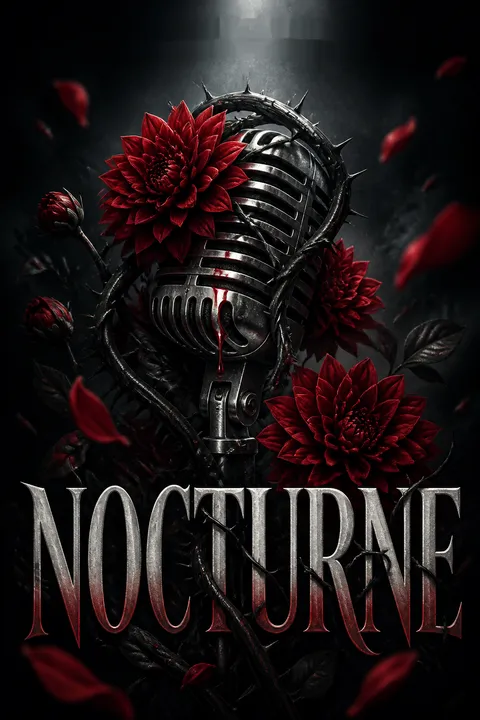
Nocturne folds a noir murder investigation into a supernatural romance without allowing either mode to neutralize the other. The historical setting supplies a city where glamour and corruption share the same streets: a singer performs for gangsters, an aspiring actress pursues access, and police attention can be bought or redirected. The supernatural plot makes this atmosphere literal. Vampires can conceal themselves among ordinary institutions, while blood rituals turn the city’s exploited women into ingredients in a private mythology of escape.
The novel’s most sustained question is whether a person can be separated from the violence done through them. Callahan’s blackouts first make him fear that he is the killer, then reveal that Dmitri has manipulated his life and used him in Betty’s murder. The book does not make that revelation morally simple. Callahan’s coercion matters, but so does his participation, and his guilt cannot be cleared by romance alone. His task is to acknowledge the full self he had denied and choose what that self will do next. Dmitri offers ancestry as destiny; Callahan’s final refusal makes choice, rather than purity, the basis of identity.
Lena’s arc similarly turns on the difference between independence and isolation. She has learned to use beauty, performance, and secrecy to survive, but those defenses leave her alone with Betty’s diary and the danger surrounding it. Her bond with Callahan gives her a partner without making her his property, although their possessive erotic language deliberately brushes against the abusive dynamics she faces with Marco. The novel’s treatment of compulsion and sexual manipulation makes that tension consequential: desire can be genuine while circumstances still undermine consent.
The story’s final promise is therefore not that power becomes harmless, or that justice is complete. Cohen remains, the murders have damaged real lives, and the future still contains threats. Instead, Lena and Callahan build a shared life and consider using their abilities against the structures that enabled the crime. Their emerging partnership offers a provisional ethic: acknowledge appetite, refuse inherited authority, and make choices with others rather than treating them as instruments.
Review Summary
Nocturne received mostly positive reviews, praised for its atmospheric 1940s noir setting, vampire lore, and blend of true crime with paranormal romance. Readers enjoyed the chemistry between Lena and Callahan, the murder mystery plot, and cameos from characters in other Halle novels. Some found the romance predictable or underdeveloped, but most appreciated the spicy scenes and engaging storytelling. The book's unique combination of vampires, historical fiction, and the Black Dahlia case resonated with many readers.
People Also Read








Characters
Lena Reid
Red-haired stage survivorLena is a gifted nightclub singer whose poise is carefully constructed from ambition, charm, and vigilance. She wants a career that lets her be seen, yet she keeps her personal history guarded and studies every room for shifts in danger. Her generosity toward Anne and her loyalty to Betty reveal a tenderness that her theatrical confidence can conceal. She is also pragmatic: she lies when the truth could endanger her, negotiates with dangerous men, and resists being treated as anyone’s possession. Lena’s central tension is between self-protection and connection. Her friendship with Betty and growing partnership with Callahan test whether she can let someone close without surrendering her independence.
Victor Callahan
War-scarred investigatorCallahan is a former soldier and boxer turned private investigator, trained to turn confusion into evidence. His discipline helps him work through corruption and gruesome crime scenes, but it also gives him a way to avoid grief, especially the loss of his wife, Catherine. He respects victims whom the press dismisses and is willing to challenge police assumptions, though his protective impulses can harden into possessiveness. His attraction to Lena unsettles his professional detachment, while his unexplained blackouts threaten the identity he has built around self-control. Callahan is driven by a need to understand people and events, but his deepest test is whether he can accept what he is without surrendering responsibility for what he does.
Elizabeth Short
Hopeful actress and courierElizabeth, whom Lena calls Betty, is an aspiring actress who has come to Los Angeles seeking recognition and a stable future. Her hope is not simple naivety: she notices danger, records details, and tries to plan an escape when the work she has taken becomes frightening. Money and opportunity keep pulling her back toward people she distrusts. Her friendship with Lena gives her a rare confidante, though each woman keeps parts of herself private. Elizabeth’s diary preserves her intelligence and apprehension, restoring a fuller person to a case that newspapers turn into a spectacle.
Virginia West
Protective half-sisterVirginia is Elizabeth’s half-sister, practical and determined to protect Betty’s dignity after the murder. The sisters were raised apart and had only recently found one another, which leaves Virginia with the painful sense that she has not done enough. She hires Callahan because she distrusts the police and refuses to let newspaper gossip stand in for an investigation. Virginia’s restraint is not indifference; it is a means of staying useful while grief threatens to overwhelm her.
Abraham Van Helsing
Ancient vampire physicianAbe is a physician and long-standing protector of the vampire community around Los Angeles. He offers Lena a sanctuary, a safer way to feed, and counsel grounded in centuries of experience. His preference for coexistence makes him a counterweight to vampires who treat humans as prey, though his caution can frustrate Lena when she wants immediate action. He is caring without being naïve: he knows that secrecy and restraint are necessary for survival, but he does not confuse survival with moral innocence.
Valtu Aminoff
Legendary vampire musicianValtu is a charismatic, centuries-old vampire musician whose notoriety is matched by an irreverent manner and a history of loss. He flirts, jokes, and speaks bluntly, but his experience gives him an unusually clear view of how time changes love and attachment. He encourages Lena to recognize her feelings while warning her that immortality does not spare anyone grief. His musical talent and formidable physical presence make him both an artist and a dependable ally in danger.
Marco Russo
Gangster’s possessive enforcerMarco is a powerful associate of Mickey Cohen and Lena’s volatile boyfriend. His charm can return quickly after an outburst, but he treats affection as ownership and uses intimidation to preserve control. His position in Cohen’s organization makes him dangerous beyond his capacity for violence. Marco represents the everyday coercion that thrives beneath the glamour of the Emerald Room, where Lena’s safety and livelihood are entangled with the men who claim authority over her.
Mickey Cohen
Hollywood crime bossCohen is a compact, polished gangster whose influence reaches into clubs, police work, and local politics. He prefers to present threats as reasonable business and regards people around him as assets. Lena’s singing benefits his club, while Marco’s work serves his organization, so her independence is tolerated only when it suits him. Cohen’s power makes him a continuing danger even when he is not directly present.
Dmitri Ivanov
Ritual-minded patriarchDmitri is a cultivated, commanding figure at the center of a Russian family with unusual knowledge of vampire traditions. He believes the world is failing and that his kind should escape it rather than coexist with humans. His calm manner gives his cruelty an administrative quality: people become specimens, sacrifices, and pieces in a plan. Dmitri’s conviction that ancestry determines nature makes him a direct ideological contrast to characters who insist that choices matter more than blood.
Katya Ivanov
Predatory blonde conspiratorKatya is a striking, socially adept member of the Ivanov family who uses charm and supernatural influence to disarm others. She treats desire as something to manipulate and sees people as interesting when they can be tested or used. Her confidence hides a calculating mind, and her interest in Lena is as much strategic as personal. Katya’s polished appearance makes her menace easy to underestimate.
Tatiana Ivanov
Elegant ritual conspiratorTatiana is Katya’s brunette sister, an elegant and composed participant in the family’s schemes. She helps draw Callahan into their orbit and moves comfortably through the Ivanovs’ cultivated world of secrecy and appetite. Her restraint is tactical rather than compassionate. Like her sister, Tatiana regards other people’s limits as obstacles to be overcome.
Konstantin
Calculating vampire brokerKonstantin is a dangerous vampire who operates within Cohen’s criminal world and keeps his own interests close. He is observant, physically formidable, and adept at presenting survival as his only principle. His proposals force Lena and Callahan to distinguish useful cooperation from trustworthy loyalty. Konstantin is neither a simple ally nor a straightforward enemy; he measures every relationship by what it might secure.
Ray Coleman
Overburdened police detectiveColeman is an LAPD detective assigned to the Short case and an old acquaintance of Callahan. Exhausted by public pressure and a flood of false leads, he still recognizes that the murder has been treated carelessly. He shares information when he can, but institutional limits and political pressure constrain his choices. Coleman’s concern for a daughter Elizabeth’s age keeps the case personal beneath his professional fatigue.
Adonis
Colony’s formidable protectorAdonis is a physically imposing member of Abe’s vampire circle, distinguished by his quiet manner and powerful ability to influence human minds. He protects Lena without demanding that she become helpless in return. His strength is matched by a practical understanding of when to evade danger and when to confront it. Among the colony’s more experienced members, he is one of the most direct.
Ezra
Experienced colony allyEzra is an easygoing but capable member of Abe’s circle, accustomed to helping vampires navigate the human world. He offers Lena support without treating her as fragile, and works alongside the others when danger escalates. His humor softens the colony’s more severe moments, while his experience makes him a reliable participant in its plans.
Catherine Callahan
Callahan’s formative partnerCatherine was Callahan’s wife, a nurse whose steadiness and directness helped ground him before the war. Her memory remains central to the grief he rarely discusses and to the life he believes he has already mourned.
Anne
Underpaid club attendantAnne works at the Emerald Room and raises two children after losing her husband during the war. Lena quietly brings her food, making their small exchanges a rare, practical expression of care in a predatory workplace.
Joey
Cautious stage managerJoey manages the Emerald Room stage and watches over Lena backstage. He is alert to the club’s shifting dangers and knows when discretion is safer than asking questions.
Sylvia Winters
Earlier murder victimSylvia is a waitress whose earlier death shares key evidence with Elizabeth’s case. Her rare blood type and links to a foreign man reveal that Betty was not the first victim.
Jeanne French
Nurse caught in the patternJeanne is an Army nurse whose murder brings Callahan and Lena to her roommate, Margaret Wilson. Her work, friendship, and recent relationship give investigators a human trail through a case designed to obscure its victims.
Dr. Goldman
Clinical ritual surgeonGoldman is a former surgeon whose precision serves the Ivanovs’ violent rites. He approaches torture with the detached attention of a medical procedure, turning professional skill into an instrument of control.
Charles Manson
Unsettling counterculture figureCharles appears briefly in the epilogue as a human figure gathering vulnerable followers in San Francisco. His invasive attention unsettles Lena and the vampires around her, who recognize that danger does not require supernatural origins.
Plot Devices
Elizabeth’s diary
Clue hidden in plain sightBetty’s diary records her courier work for Cohen, her growing fear of the Europeans, the warehouse address, and the symbols she saw there. Lena keeps it hidden because it contains both evidence and information that could expose Lena’s own identity. When an intruder steals it, the loss intensifies the mystery and confirms that someone is monitoring her. Later discoveries in the boardinghouse and warehouse allow Callahan and Lena to continue following Betty’s trail even without the diary. The device turns private writing into a posthumous testimony, while showing how dangerous it is to control who gets to read a dead woman’s account.
The blood ritual
Murder as a sequenceThe Ivanovs select victims with rare blood and assign their deaths distinct ritual functions. Sylvia Winters, Elizabeth Short, Jeanne French, and finally Lena are not random casualties in Dmitri’s plan. Their blood and bodies are meant to prepare a passage to the Red Realm. The ritual links the cases, explains the markings and blood collection, and gives the investigation a deadline. It also reveals the violence inside Dmitri’s ideology: he describes escape and species survival as noble aims while treating individual lives as expendable materials.
Blackouts and transition
A self becomes evidenceCallahan’s headaches, heightened senses, missing hours, and blood-stained clothing first appear to be signs of stress or illness. As he turns thirty-five, the gaps worsen and acts of violence occur beyond his conscious memory. The blackouts conceal his emerging vampire nature and make him fear that he may be responsible for Betty’s murder. Dmitri later weaponizes this division, using bloodline compulsion to command him. Callahan’s progress depends on integrating rather than denying the instincts that surface, so the device drives both the mystery and his psychological arc.
Compulsion
Desire turned into controlVampires can influence human minds, and the Ivanovs possess especially forceful versions of this ability. Lena uses a limited form to question Vivian and manage threats, while Adonis redirects Cohen’s men during their escape. The Ivanovs use stronger compulsion, drugs, and staged seduction to bring Lena and Callahan to their mansion and manipulate their behavior. Dmitri’s bloodline command can overpower Callahan more deeply than ordinary influence. The device makes consent and agency central to the romance and thriller, requiring the characters to distinguish genuine choice from behavior produced under coercion.
Shared blood
Intimacy becomes an anchorLena and Callahan’s exchange of blood is both a way to feed and a source of heightened connection. When Callahan is newly transformed, Lena’s blood helps return him to awareness; later, the exchange strengthens his ability to resist Dmitri’s command and helps him integrate his human and vampire selves. The bond does not remove the need for judgment or consent, and it cannot undo the harm Callahan has caused. It gives the pair a tangible means of trust, one that becomes important whenever supernatural influence threatens to divide them.
About the Author
Other books by Karina Halle








Download PDF
Download EPUB
.epub digital book format is ideal for reading ebooks on phones, tablets, and e-readers.








