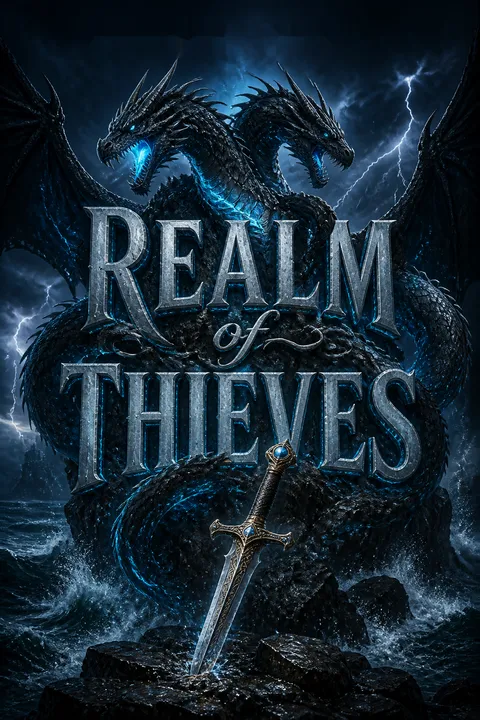


Plot Summary
Prologue
After rebel leaders Branne and Sonja Aihr defy Esland’s Saints of Fire, the Black Guard executes Branne and sends his twelve-year-old daughter to the Daughters of Silence. The convent shaves her head, strips away her name, and calls her the Daughter of Pain.
She remembers her mother being sent as a human sacrifice to the dragons, and her father’s warning that the Saints’ own hunger for power could destroy the world. The girl hides her rage and plans to escape. She does not yet know what the Harbringer has glimpsed in her future, only that obedience will not save her.
The opening makes institutional violence intimate before expanding it into a political danger. Brynla’s parents resist a regime that calls punishment devotion, and their deaths leave her with both grief and a practical inheritance: distrust of authority. The convent’s renaming ritual tries to turn a child into a category, but the name Daughter of Pain instead becomes a record of what the institution has done to her. Her father’s warning also frames the religious prophecy as a possible political instrument, not merely a belief. The prologue’s tension comes from the gap between what Brynla can understand as a child and what her survival will later expose.
The Egg Thief’s Last Raid
Nine years after escaping the convent, Brynla Aihr makes a living stealing dragon eggs for Sorland’s Dalgaard syndikat. She needs the payment for food, for her aunt Ellestra, and for treatment of the monthly pain that keeps interrupting her work. On a new raid to the Midlands, her boatman refuses to cross the magical wards, forcing Brynla and her dog Lemi to swim the rest of the way.
Lemi can shift through space and sniff out nests; Brynla has no suen-given powers, only hard-earned fighting skill. She enters anyway, knowing that returning empty-handed could put her and her family in danger. Then Lemi vanishes from her side, and a cloaked stranger appears on the shore.
Brynla’s work is dangerous, but the story makes clear that danger is also her economic reality. The egg trade offers food and the possibility of medical care, while Dalgaard’s threats make refusal costly. Her lack of suen does not make her passive: she compensates with training, judgment, and a relationship with Lemi built on mutual reliance. The decision to cross the wards is therefore not a simple appetite for adventure. It is a survival calculation made under coercive conditions, one that places her body inside the same exploitative system she hopes to outlive.
A Dragon’s Mercy
The stranger disappears before Brynla can identify him, but Lemi leads her to a nest containing two pink elderdrage eggs. A mother dragon returns as Brynla carries one away. She falls, crushing the egg, and watches the dragon pin Lemi beneath a claw. A masked archer drops the beast with a tranquilizer arrow, then uses an unexplained healing gift to restore Lemi.
He identifies himself as Andor Kolbeck, a Norland syndikat heir who has watched Brynla for months. Andor wants her and Lemi working for his house, which is competing with Dalgaard. Brynla refuses, so he makes the threat personal: she must come with him or be handed to the Black Guard.
The rescue binds gratitude to coercion before either character can decide what the other means to them. Andor saves Lemi, an act that makes his healing power and Brynla’s attachment to her dog immediately consequential, then turns that rescue into leverage. Brynla’s refusal is not a failure to understand the danger; it is a defense of her right to choose who profits from her labor. Andor, meanwhile, treats strategic insight as permission to control her. Their conflict begins with a genuine alliance of need buried inside an unequal bargain.
Across the White Sea
Brynla attacks Andor on the volcanic shore, but he overpowers her and takes her aboard his ship. When she wakes below deck, she refuses his offer and kicks him hard enough to escape to the top deck. With a stolen knife in hand, she threatens to jump rather than work for him. She does jump, and Lemi follows.
Andor dives into the rough sea with a rope tied around his waist and hauls them both back aboard. He binds Brynla’s wrists, but promises that House Kolbeck will protect Ellestra and eventually give Brynla a way out. The ship continues toward Norland, carrying a captive who has not agreed to trust the man who saved her.
Brynla’s repeated attempts to escape show how little an attractive offer can mean when the person making it has removed the option of refusal. Andor’s dive into the sea complicates his coercion: he risks himself to keep her alive, but still returns her to restraint. His idea of protection is sincere enough to motivate action, yet it remains paternalistic because he decides what she needs before listening to her terms. Their growing dependence is real, but the imbalance is not erased by courage or attraction.
A Hostage at Stormglen
At Menheimr, Brynla sees Norland’s abundant water, forests, and open markets for the first time, but the wonder does not make her forget that Andor brought her there against her will. His family’s castle, Stormglen, offers a warmer welcome from his sister Solla than from his uncle Kjell or father Torsten, the cold head of House Kolbeck.
At dinner, the family questions Brynla’s ties to Dalgaard and her life as a Freelander. Andor draws a knife on Kjell when he insults her. The meal also reveals the family’s varied suen powers and its internal hierarchy: Vidar is the favored heir, Steiner the scientific mind, and Andor the reckless son whose schemes his father distrusts.
Stormglen’s comforts make captivity harder to name, not less real. Brynla is fed and given a room, yet the Kolbecks debate her value as though she were an asset at auction. Andor’s defense of her signals a personal loyalty, but it also exposes how readily he answers insult with force. The family’s hierarchy offers a parallel to Brynla’s own history of institutional control: status determines who is believed, protected, or used. Her attention to the household is therefore practical. She must learn its rules before she can decide how to survive them.
The Power That Will Not Work
Solla helps Brynla bathe and dress, while a rainstorm gives Brynla her first experience of clean water falling from the sky. She remains intent on escape, but meets Steiner, the youngest Kolbeck, in his laboratory. He tests a refined dose of suen after learning that the substance has never affected her, even though it empowers Andor’s family and most dragon thieves.
Nothing changes. Brynla also realizes Andor’s healing gift may explain how he revived Lemi, and asks whether he could treat her recurring pain. Andor cannot promise a cure, haunted by his failure to save his mother. Meanwhile, his raven Moon reaches Ellestra with word that Brynla is safe and will return.
The contrast between Brynla’s suen immunity and the Kolbecks’ inherited advantages makes power feel less like a universal ladder than a system of unequal access. She has survived without magic, yet her body carries a chronic pain that other people have dismissed as ordinary. Andor’s healing ability looks like a possible answer, but his fear of failing again shows that powers do not free their bearers from shame. His family’s willingness to study Brynla also has two faces: scientific curiosity can recognize her difference while still treating her as a problem to solve.
A Better Tomorrow, Unforced
On their next Midlands raid, Brynla warns Andor that the valley he chose is vulnerable to fire tornadoes. A deathdrage drives the nesting blooddrages from their eggs, and the pair collect what they can before the storm closes in. When flames and a sandstorm trap them, they shelter in a cave.
Brynla’s pain becomes severe, and Andor finally explains how his mother died after he failed to heal her. He puts his hand on Brynla’s abdomen and takes the pain into himself, giving her relief. After the storm passes, he offers to take her back to the Banished Land without conditions. Brynla chooses to stay long enough to find Ellestra and build a safer future.
The cave reverses the terms of their relationship without pretending the earlier coercion never happened. Andor’s confession explains why healing has become a test of his worth, while Brynla’s request gives him a chance to act without being promised success. He accepts the possibility of failure and still helps her. His offer to release her matters because it restores a choice he previously took away. Brynla’s decision to remain is not surrender to romance; it is an active judgment that trust can begin when another person stops insisting on control.
Home Under the Mountain
As the ship approaches Esland, Brynla drinks with the crew, admits she is frightened of leaving the Dark City, and kisses Andor while drunk. He stops before they go further. The next morning he kisses her again when she is sober, then joins her and a small party on the trek across the Burning Sands.
Brynla guides them through the hidden entrance to the Dark City, where she presents Andor as her cousin to pass the guards. Ellestra greets them by putting knives to Andor’s throat, then embraces Brynla. The reunion shows Andor how much of Brynla’s life he never understood. Over tea, Ellestra challenges his promise of a better future and asks what he expects in return.
Brynla’s return makes belonging more complicated than simply escaping a harsh place. The Dark City is poor and dangerous, but it is also her community, with customs and relationships that Andor’s wealth cannot replace. His willingness to follow her into it is a first step toward seeing her world on its own terms. The kisses mark mutual desire, but the older woman’s suspicion keeps desire from being mistaken for trust. Ellestra asks the question Andor has avoided: whether a life offered in exchange for labor is truly freedom.
The Price of Returning
During Andor’s conversation with Ellestra, armed men enter the house disguised as someone she knows. Ellestra opens the door and is stabbed. Brynla wakes to the attack, kills two assailants, and watches Andor kill another, but Ellestra dies before he can reach her. Grief leaves Brynla unable to leave the body.
Andor believes the attackers may be agents of Dalgaard or Esland’s Black Guard and fears more are coming. Brynla refuses to abandon her aunt, so Andor injects her with a tranquilizer and carries her out in a water cart. Lemi helps him evade suspicious neighbors. Back aboard ship, Brynla wakes furious and bereaved, unable to forgive the choice that saved her life.
The attack transforms a rescue plan into a new source of guilt. Brynla wanted to protect Ellestra by bringing her somewhere safer, but the journey itself exposes her aunt to danger. Andor’s decision to remove Brynla prevents another attack from taking her too, yet his unilateral use of the drug repeats the original violation of her agency. The scene refuses an easy moral division: he is trying to save her, and he is again deciding for her. Her anger is not ingratitude. It is an attempt to retain some control while grief has made the world unrecognizable.
The Convent’s Hidden Prize
Back at Stormglen, Brynla withdraws while Andor’s family debates who sent the killers. He eventually tells his siblings about Ellestra’s claim that a slangedrage egg can grant immortality and may be hidden in the convent. Brynla learns that he kept this plan from her, then agrees to join the heist because it gives her a way to strike back at the institution that imprisoned her.
After grief overwhelms her, she attends a vision session with Sae Belak, the Kolbecks’ Truthmaster. In the resin’s flames she sees a lava woman, a two-headed blue dragon, and a body. Vidar explains that he once saw Brynla with Andor and Lemi in the Midlands, giving the vision added weight.
The promised egg turns private grief into a political contest, but Brynla’s decision to participate serves more than the Kolbecks’ ambitions. The convent is both the site of her childhood trauma and the institution she wants to confront on her own terms. Sae’s ritual offers a structured place for grief, while the vision complicates her skepticism without simply asking her to believe. Andor’s withheld plan repeats an old pattern of deciding what information Brynla can handle. Her anger at that secrecy matters even as she chooses the mission.
Daughter of Pain Returns
Brynla, Andor, and Kirney enter the convent through an underground spring. In its passages, they find a young servant whose tongue has been cut out, proof that the Daughters’ enforced silence has become literal mutilation. Brynla disguises herself in a Sister’s veil and moves toward the Harbringer’s rooms.
She captures Sister Marit, the woman who once whipped her, and cuts her tongue before leaving her alive with Kirney’s incapacitating touch. In the Harbringer’s chamber, Brynla finds the egg beneath a carved two-headed dragon. The Harbringer recognizes her, admits she arranged Ellestra’s murder, and hints that Brynla’s blood makes her unlike other people. Lemi attacks the Harbringer, whose body later moves again.
Brynla’s return to the convent is an act of agency, but the method exposes how trauma can reproduce the violence it opposes. Seeing a servant mutilated makes her past present again; she retaliates against Sister Marit by silencing her in turn. The act gives her a moment of power, yet it also unsettles her own moral boundary. The Harbringer’s confession links private loss to political surveillance, revealing that Brynla was never simply forgotten. Her unexplained bloodline suggests that the regime feared something it could not fully control.
A Dragon Beneath the Convent
While Brynla searches for the egg, Andor follows a veiled Sister who says she must feed a dragon. Beneath the convent he finds a chained, immense creature and cages holding prisoners, some already dead. The Sisters call the dragon Magni and feed it captive people as offerings. Andor interrupts the ritual, and the beast swallows the woman before retreating.
He carries an elderly prisoner to safety while Brynla and Kirney arrive with Lemi. Brynla explains that the Harbringer survived Lemi’s attack, and Andor reveals the convent’s hidden dungeon. Together they free the captives and escape through a stable in a stolen carriage, racing through Lerick as the Black Guard gives chase.
The dungeon reveals that the convent’s public discipline conceals a second, more brutal economy: human bodies are being offered to a dragon in the name of religion. Naming the creature Magni allows the Sisters to sanctify what is plainly captivity and feeding. Andor’s choice to interrupt the ritual rather than pursue the egg shifts the heist’s priorities toward people in immediate danger. The freed prisoners also make escape a collective responsibility. Brynla and Andor are no longer merely stealing power from an institution; they are taking its captives out with them.
Deathdrage’s Fatal Bite
After escaping Esland, the group reaches the Midlands so Steiner can attempt to preserve a fertilized dragon egg. Brynla and Andor find a deathdrage nest and take one egg, but the returning mother attacks before they can retreat. Her teeth pierce Andor’s chest, and he dies. Brynla uses arrows lodged in the dragon’s hide to climb its neck and drives both swords into its skull.
As she cradles Andor, the two-headed blue slangedrage from her vision emerges from a nearby cave. It ignores Lemi, gently lifts Andor’s body, and carries him toward a lava pool. A woman made of molten rock rises from the pool and recognizes Brynla, revealing herself as the mother Brynla believed had died.
The deathdrage attack strips away the tactical distance that has helped Brynla survive earlier raids. She does not defeat the dragon through suen or a prepared weapon, but by turning its own wounds into a route to its head. Andor’s death makes the cost of their dangerous work immediate, and Brynla’s grief echoes the losses that have shaped her life since childhood. The slangedrage and lava woman arrive not as convenient answers but as the physical return of the vision, moving the story from political conspiracy into an older, familial mystery.
The Goddess in the Lava
The lava woman explains that she is Voldansa, a Midlands goddess and Brynla’s mother, who survived the sacrifice because dragons would not harm her. She says her body changed after a volcanic eruption and that Brynla’s dragon ancestry explains why suen never worked on her. To revive Andor, Voldansa drains the suen that gives him his healing power.
Brynla agrees, and the slangedrage lowers Andor into the lava before bringing him back unharmed. Brynla reveals that she secretly kept the immortality egg and crushed it, preventing the Kolbecks from using it. Andor forgives her. Voldansa warns that dragons remember human exploitation, but accepts that the Kolbecks may raise the surviving fertilized egg.
The resurrection is a rescue with a permanent cost, not a reset. Andor survives, but loses the very power that once defined his usefulness and carried his deepest shame. Brynla chooses his life over the possibility of future relief from her pain, refusing to treat his gift as a resource she is owed. Her destruction of the immortality egg similarly rejects power that would reproduce the syndikats’ logic of control. Voldansa’s warning places the coming dragon in a history of injury, making survival dependent on how humans respond to what they have taken.
A Family Chosen Freely
At Stormglen, Andor tells Torsten that the immortality egg was destroyed, while Steiner confirms that its yolk could not be saved. Torsten tries to seize Brynla and still expects Andor to marry Princess Frida for political advantage. Andor holds a dagger to his father’s throat until Torsten promises Brynla will be safe and welcome in the house.
Steiner then reveals the consolation prize: the fertilized deathdrage egg survived in its incubator. Three months later, Andor proposes to Brynla at Lake Efst, giving her a ring that combines Esland diamonds with glowing Norland stone. She accepts. Her future now includes Stormglen, her recovered connection to her mother, and a dangerous dragon still waiting to hatch.
Andor’s final confrontation with Torsten is not simply romantic defiance. He rejects the family’s assumption that children exist to secure alliances, and insists that Brynla’s safety cannot depend on her usefulness. The surviving dragon egg prevents the ending from becoming a clean victory: the Kolbecks still possess a creature they may not understand, and Voldansa’s warning remains active. Brynla’s acceptance of Andor’s proposal is meaningful because it follows restored choice, not captivity. The family she chooses is not free of danger, but it can be built through consent rather than ownership.
Epilogue
A year later, Andor and Brynla marry at Stormglen, while Vidar faces a political marriage to Princess Liva of House Haugen. He resents that Andor could refuse his arranged match, but keeps his own ambition hidden. On the ship returning from Esland, Vidar secretly extracted a small amount of suen from the immortality egg before Brynla destroyed it.
He has kept the pale blue substance in a locked box, convinced it may be enough to secure a future in which power belongs to him. As the wedding celebrates a new family, Vidar quietly preserves the danger the others thought they had ended.
The epilogue converts the apparent resolution into a problem of inheritance. Andor’s refusal of an arranged marriage and his father’s eventual accommodation suggest that family power can be challenged, but Vidar’s hidden vial shows how easily political ambition survives a public defeat. His resentment is not only jealousy of Andor’s freedom; it is also a belief that he can use secret knowledge more effectively than those around him. The wedding’s warmth therefore sits beside a concealed threat. The immortality egg is physically ruined, yet its extracted suen keeps its promise of domination alive in miniature, as private property and future leverage.
Analysis
Realm of Thieves makes power tangible through bodies and transactions. Suen can sharpen strength, heal injury, or promise immortality, but access is controlled by syndikats and governments that fear an empowered population. Brynla’s immunity places her outside that economy. She has no magical advantage, yet she survives through skill, attention, and reciprocal care with Lemi. The story thus questions the assumption that power is identical to capacity: the unmagicked character repeatedly changes outcomes that stronger people cannot control.
The romance develops within an unequal arrangement, so affection cannot be treated as proof that the original coercion was harmless. Andor rescues Brynla, kidnaps her, threatens her, and later risks himself for her. His development becomes convincing when he offers to let her go, accepts that she may refuse him, and ultimately challenges Torsten’s effort to dictate her place. Brynla’s growing attachment does not erase her anger or make her dependent by nature. Her consent matters precisely because she has repeatedly had choices taken from her.
Grief shapes both protagonists’ ideas of responsibility. Andor interprets his mother’s death as evidence that his gift is inadequate; Brynla fears that surviving loss means abandoning the dead. Their care for one another offers relief, not cure. The novel allows pleasure and companionship to coexist with mourning rather than making either a replacement for it. Ellestra’s death makes that distinction painful, while Sae’s ritual gives Brynla a way to honor grief without letting it consume every future action.
The dragons complicate the human claim to civilization. People imprison them, steal their eggs, extract their magic, and then fear retaliation. Voldansa’s warning that dragons remember makes breeding a deathdrage less a triumph than a moral risk. Destroying the immortality egg resists the fantasy that safety comes from becoming impossible to kill. The final concealed vial shows how fragile that resistance remains: political desire survives even when its most obvious instrument is broken.
Review Summary
Realm of Thieves receives mixed reviews averaging 3.57 stars. Readers praise the unique dragon worldbuilding—eggs grant magical powers when consumed—and the dangerous heist premise with a teleporting dog sidekick. Many enjoyed the mafia-fantasy blend and strong FMC. However, common criticisms include rushed, insta-love romance that feels surface-level, inconsistent pacing with a slow middle section, underdeveloped character connections, and contemporary dialogue that breaks immersion. Some found the plot lacking stakes and coherence, especially toward the end. While opinions vary widely, most agree the creative concept shows promise despite execution issues.
People Also Read



Characters
Brynla Aihr
Unmagicked Freelander thiefBrynla is a resourceful egg thief from the Banished Land, raised by rebel parents and hardened by the convent that imprisoned her. She relies on training, quick judgment, and her bond with Lemi rather than the suen powers that protect many other thieves. Her defiance is not simple fearlessness: she has learned that dependence can become a weapon in someone else’s hands. She wants safety for her aunt and relief from chronic pain, while carrying anger toward the institution that took her name and family. New lands unsettle and attract her in equal measure. Her strength lies in adapting without surrendering the right to choose what she serves.
Andor Kolbeck
Reckless syndikat heirAndor is a skilled dragon thief and the volatile younger son of Torsten Kolbeck. His healing gift should make him powerful, but his father’s contempt and his failure to save his mother have made him doubt his worth. He chases dangerous work partly because it is the one contribution his family cannot dismiss. Andor is impulsive, charming, and capable of real tenderness, yet he initially mistakes protecting Brynla for having the right to decide for her. His growth depends on recognizing that good intentions do not undo coercion. He wants to matter to his family, but must learn to choose his own obligations.
Lemi
Shifting egg-finderLemi is Brynla’s large, loyal dog and her closest companion. Suen has made him unusually strong and given him the ability to shift to places he can see or has visited. He can locate dragon nests by scent, tow Brynla through water, and distract dangerous creatures. Lemi’s affection is practical as well as emotional: he watches Brynla’s distress and stays close when she is in pain. He is friendly with people who earn his trust, but fiercely protective when she is threatened. His bond with Brynla gives her companionship without judgment and makes him indispensable to her work.
Ellestra Doon
Brynla’s fearless auntEllestra is Brynla’s aunt and the last close member of her family in the Dark City. She helped Brynla escape the Daughters of Silence and raised her in a community where survival depends on mutual aid and suspicion of outsiders. Sharp-tongued, capable, and difficult to intimidate, she does not mistake wealth or promises for freedom. Her protectiveness can look like hostility, especially toward Andor, but it grows from intimate knowledge of how institutions exploit the vulnerable. Ellestra values the home she has built and challenges Brynla’s assumption that leaving is automatically the same as being saved.
Torsten Kolbeck
Cold syndikat patriarchTorsten heads House Kolbeck and regards family members as instruments of the house’s political survival. He favors Vidar as heir and sees Andor’s improvisational style as a liability. His relationship with his children is shaped by command, status, and a fear of losing influence. Torsten can recognize opportunity, but he tends to measure people by what they can secure for him. His belief in political alliances makes him a formidable obstacle to Andor’s independence and to Brynla’s safety within Stormglen.
Vidar Kolbeck
Controlled family heirVidar is Andor’s older brother and the expected heir to House Kolbeck. He is disciplined, politically observant, and far more controlled than Andor, with a gift for influencing minds. His position gives him security but also binds him to the marriage and leadership duties his father assigns. Vidar often studies a room before acting, which makes him appear cold, though he is deeply invested in the family’s future. His interest in prophecy and strategy reflects a desire to shape events rather than be carried by them.
Solla Kolbeck
Telekinetic younger sisterSolla is Andor’s younger sister, gentle in manner but not easily dismissed. Her telekinetic ability gives her quiet control over a space, and she uses it to keep Brynla from escaping the castle. She offers Brynla practical kindness, including clean clothes and a private room, without pretending the situation is fair. Solla understands the pressure her family places on its children and has desires of her own that do not fit neatly within its marriage plans. Her warmth is balanced by a dry wit and a clear sense of self.
Steiner Kolbeck
Suen researcher and inventorSteiner is the youngest Kolbeck and the family’s scientific mind. Curious and meticulous, he studies how suen works and builds tools that make dangerous expeditions more survivable. His laboratory brings together magic, experimentation, and practical engineering, though he remains aware of how little is understood about the substance. Steiner is more comfortable with questions than with family politics, and his intellectual excitement can sometimes outrun caution. He treats Brynla’s unusual response to suen as a mystery worth investigating rather than a reason to dismiss her.
Sae Belak
Kolbeck TruthmasterSae Belak serves House Kolbeck as its Truthmaster, a spiritual guide who uses a resin ritual to open visions and help people confront buried truths. His gold eyes have been replaced, and his calm, unsettling manner suggests a life shaped by knowledge he does not readily share. Sae treats grief as something to witness with others rather than erase, giving Brynla a space to acknowledge pain without demanding that she be finished with it. His visions connect private experience to the wider dangers gathering around Dragemor.
Voldansa
Unworshipped Midlands goddessVoldansa is a mysterious presence associated with the Midlands, volcanic fire, and the dragons. She appears as a woman formed from molten rock and speaks with knowledge of suen, human ancestry, and the dangers of immortal power. Unlike the Saints of Fire’s public religious authorities, she is not widely worshipped by people. Her perspective is shaped by proximity to the dragons and by the long history of human confinement and exploitation. She offers aid, but makes clear that powerful gifts carry costs.
The Harbringer
Convent’s ruthless seerThe Harbringer is the senior authority at the Daughters of Silence and a feared interpreter of religious signs. She helps enforce the convent’s discipline and presents its violence as sacred duty. Her interest in Brynla goes beyond ordinary punishment, suggesting she has watched the girl’s life with a particular purpose. The Harbringer’s authority rests on the institution’s secrecy and its claim to know what the gods require. She is a personal embodiment of the power Brynla has spent years resisting.
Ruunon Dalgaard
Sorland syndikat bossRuunon is the Sjef of House Dalgaard, the Sorland syndikat that hires Brynla to steal dragon eggs. He values the strongest and most useful eggs and expects steady results from those in his employ. His business operates through threats rather than loyalty, leaving Brynla aware that failure can endanger Ellestra and Lemi as well as herself. Ruunon represents the competing criminal power that pushes Andor to recruit Brynla, and his interest in her suggests that her usefulness may exceed her skill as a thief.
Kjell Kolbeck
Andor’s hostile uncleKjell is Torsten’s brother and a senior presence in the Kolbeck household. He openly mocks Andor’s schemes and treats Brynla as an outsider unworthy of respect. His aggression helps expose the family’s internal cruelty, while his position gives his insults political weight. Kjell believes strength and obedience matter more than compassion, and he is quick to interpret Andor’s independent choices as a threat.
Kirney
Andor’s trusted crewmanKirney is Andor’s right-hand man and a steady presence on the Kolbeck expeditions. His suen gift allows him to temporarily incapacitate people through touch, making him useful when the crew wants to avoid killing. He follows Andor into dangerous territory but is practical enough to question the risks. Kirney helps Brynla during the convent heist and treats the mission as a shared responsibility rather than Andor’s personal adventure.
Toombs
Kolbeck ship captainToombs captains Andor’s ship and serves as one of the crew’s most grounded voices. He is jovial, fond of his homemade rum, and more openly moral than many people in the Kolbeck household. Though suspicious of Brynla at first, he recognizes how much Andor cares for her and worries about the danger that attachment brings. Toombs’s loyalty is personal rather than political, which makes him an important counterweight to Torsten’s expectations.
Eydis
Freed convent prisonerEydis is a young captive freed from beneath the convent. She helps the escape group navigate the route out and chooses to leave Esland with them rather than risk being imprisoned again. Her decision begins a new life among people she has only just met.
Princess Frida
Andor’s intended political brideFrida is the princess of Altus Dugrell whom Torsten expects Andor to marry as part of a political alliance. She is largely absent from the action, but the proposed match represents the dynastic obligations Andor resists.
Princess Liva
Vidar’s intended brideLiva is the princess of House Haugen selected as Vidar’s future wife. Her expected marriage reflects the Kolbecks’ use of family ties to extend political influence across realms.
Plot Devices
Dragon eggs and suen
Magic traded for powerDragon eggs contain suen, a substance that grants abilities to those who ingest it. Syndikats control the illegal trade, selling its advantages to rulers and armies while keeping ordinary people from acquiring power. Different eggs produce different effects, and no one fully understands how suen works. The substance drives the raids, gives Andor his healing gift, and explains why Brynla’s inability to use it is so unusual. Its benefits always carry political consequences: whoever controls the eggs can influence who is strong enough to rule or resist.
The Midlands wards
A dangerous boundaryMagical wards surround the volcanic Midlands and contain the dragons, but egg thieves can cross them. The barrier makes the island both a prison for dragons and a source of the power humans covet. Its presence shapes the syndikats’ territories, the risks of every raid, and the fear that the wards could eventually fail. The border is not merely a line on a map: crossing it forces characters into a place where weather, time, and ordinary survival become unreliable.
Lemi’s shifting
A living escape routeLemi can shift himself through space to a visible place or somewhere he has visited before. He also uses his heightened strength and sense of smell to find nests and protect Brynla. The ability repeatedly changes the practical terms of an escape: Lemi can reach the ship, retrieve help, or return to Brynla when ordinary distance would make that impossible. His loyalty also gives Brynla a source of companionship that is not based on contracts or political advantage.
The immortality egg
Power no ruler should ownA rare slangedrage egg is believed to grant immortality to anyone who consumes its suen. Rumors place one in the convent, making it a prize for Dalgaard, Kolbeck, and the Saints of Fire. The egg’s promise turns a covert theft into a struggle over the future of entire realms. Brynla’s vision and her mother’s knowledge complicate the prize: the egg may be real, but immortality could help engineer the catastrophe described in prophecy. Brynla’s choice to destroy it prevents the Kolbecks from claiming its full power.
Sae’s vision resin
A window through timeSae Belak uses a prepared resin whose smoke can induce prophetic visions. The ritual gives Brynla an image of a lava woman, a two-headed blue dragon, and a body, while Vidar recalls a separate vision of Brynla, Andor, and Lemi in the Midlands. These images are uncertain until events begin to match them. The visions do not supply a complete plan or remove the characters’ responsibility; they make the future feel partly visible while leaving its meaning open to interpretation.
About the Author
Other books by Karina Halle






Download PDF
Download EPUB
.epub digital book format is ideal for reading ebooks on phones, tablets, and e-readers.








