


Plot Summary
The Vanguard's Hidden Army
Torj Elderbrock, the Bear Slayer, and fellow Warsword Wilder Hawthorne track the People’s Vanguard through Tver, expecting a small rebel band and finding a force armed with dangerous alchemy. They fight through the temple’s chemical fumes and capture a captain with a truth serum Wren made before Torj left her.
The prisoner reveals that Queen Reyna of Aveum is being held at a coastal shipping yard, while the Vanguard recruits people from communities devastated by war. Its followers believe rulers and Warswords have lost their right to govern. Torj gets the location he needs, but the captain’s certainty that every reign ends turns the rescue mission into evidence of a wider uprising.
The rebels’ appeal is built from real injuries: villages still bear the costs of the shadow war, while the old order appears distant and secure. Torj hears this argument through an enemy captain, but cannot dismiss it as mere propaganda. His response is still martial and immediate, a sign of how deeply his identity is tied to defending the existing realm. Wren’s serum, meanwhile, reaches the battlefield in her absence. Her work continues to shape events even when she is separated from the man who carries it.
A Queen's Poisoned Warning
At the dry docks, Torj and Wilder find Queen Reyna bound among rebels preparing boats. They attack, but the masked leader, Lord Silas, counters with a vial that can strip away Warsword strength and escapes in a spreading cloud of alchemical smoke. Torj shields Reyna from a volley of darts, unaware that several pierce his back.
Once free, the queen is weak, her magic gone, and her words about gold turning to silver in fire and embers echo a prophecy she once shared with the Embervale sisters. She also reports that Silas has captured a female Warsword. The rescue saves Reyna from captivity, but the enemy has left her carrying a threat that ordinary healing may not undo.
Silas stages an escape that leaves his enemies with a problem rather than a victory. Reyna’s missing magic demonstrates that the Vanguard’s weapons can reach beyond the battlefield and into the political structure of the kingdoms. The prophecy adds uncertainty without offering a usable plan: its images acquire weight, but their meaning remains contested. Torj’s unnoticed dart wound plants a quieter danger beneath the public crisis. His reflex to shield Reyna protects her, yet also makes his own body the place where the enemy’s strategy takes hold.
The Rose That Wouldn't Repeat
At Drevenor Academy, Wren Embervale is meant to recreate the counter-alchemy that saved Prince Zavier, but weeks of experiments produce no reliable result. Her earlier cure depended on silvertide rose leaves gathered in Delmira, and she cannot tell whether she misidentified the plant or whether something about its original growing conditions mattered.
The failure feeds her guilt: her old work on magic-targeting manacles helped give the Vanguard a foundation for its weapons. Farissa refuses to let Wren shoulder the research alone, examines her notes, and concludes that the answer may lie in the land where Wren first found the rose. Wren leaves for Delmira to gather fresh samples and try again.
Wren’s scientific crisis is inseparable from moral injury. She sees her earlier invention not as neutral knowledge but as a tool whose consequences escaped her control, and that guilt makes each failed experiment feel like another injury inflicted on the realm. Farissa counters this self-punishment by turning blame into a research question. The decision to return to Delmira is both practical and psychological: Wren must revisit the place where she survived the war, but now she goes not to escape responsibility, rather to understand what her work can still repair.
The Guard Comes Back
On the voyage to Delmira, Wren’s sister Thea tells her that Torj once described feeling Wren’s emotions and magic, and that a book on magical bonds may explain the connection. Wren has little time to follow the clue before she reaches Harenth and meets her new guard: Torj himself, sent by Guild Master Audra after the replacement Warsword, Cahira, was captured and died from dark alchemy.
Torj reports that another Warsword is missing and that he and Wilder have faced repeated ambushes. Thea leaves to escort Reyna toward Aveum, while Wren continues with Torj, strategist Kipp Snowden, and alchemist Dessa Chamberlain. The reunion puts the unresolved bond and heartbreak directly into the path of their mission.
The reunion forces private grief into public duty. Wren and Torj have not resolved why he ended their relationship, yet danger makes him her assigned protector again, restoring the very closeness both have tried to escape. Thea’s discovery of the bond book gives Wren a concrete question to pursue, but Torj’s silence keeps that question emotionally charged. Cahira’s fate and the missing Warsword sharpen the stakes: the old safeguards are failing, and Wren’s work may be needed before she can make sense of what she and Torj have lost.
Elmridge Catches Fire
The travelers find signs of the Vanguard’s reach before they reach Delmira. A hungry man named Paden follows them for a bounty, but Wren gives him remedies for his sick daughter and money rather than letting Thea punish him. Farther along, the group finds farmers hanged as traitors. Near Elmridge, Wren and Torj infiltrate a rally where speakers turn local grievances into suspicion of outsiders and royal loyalists.
When the crowd hunts a supposed spy, the pair are trapped in an alley. Torj breaks through a burning wall after shoving Wren to safety, then collapses from his burns. Wren treats him with her kit, and their attraction resurfaces amid anger about his secrecy and her failing storm control.
Paden’s encounter gives the political crisis a human scale: he is not a committed fanatic, but a father trying to buy care for his child. Wren’s mercy recognizes the coercion built into poverty, while Thea’s instinct to use force reflects a warrior’s narrower calculus of threat. The rally shows how leaders convert genuine hardship into collective accusation. Torj’s rescue of Wren repeats his protective reflex, but it does not settle the conflict between them. Care remains real; so does the harm caused when protection becomes a substitute for honesty.
Delmira Has Bloomed
Wren expects Delmira’s familiar wasteland and instead finds green slopes, a blue lake, a living stream, and trees rising around the palace ruins. Near her old cottage, she locates the silvertide rose she once harvested, now flowering in abundance. She takes careful samples with Dessa, including soil, while Torj warns that renewed fertility will make the kingdom a prize.
Before they can return to Drevenor, he reveals another assignment: investigate a Harenth noble suspected of leaking academy secrets. Wren resents the delay, but Kipp sees a chance to gather allies. The restored land solves one mystery only to create a larger one: its sudden prosperity could draw every ambitious power toward Delmira.
Delmira’s recovery changes the meaning of Wren’s return. The land she associated with grief and punishment is not merely a setting for her research; it has become a resource whose value can redraw political boundaries. Her instinct is to touch and protect what has grown, while Torj sees the strategic danger immediately. Neither response is wrong. The tension between a homeland as a living place and as an asset previews the conflict Wren will face as an heir: ownership may preserve Delmira, but it can also turn its renewed life into another instrument of power.
A Ball, A Body, A Book
At Lord Hullet’s formal ball, Kipp disguises Wren and Torj as a married couple so they can search the manor while he and Dessa distract the guests. Wren recognizes Perseus Graymoor, a corrupt man she had once marked for her own private justice, but Torj stops her from acting. In the study, they find royal family records stamped with Drevenor’s seal and a hidden laurel ornament, suggestive but not decisive evidence of a leak.
Darian Devereux, Torj’s estranged childhood friend, interrupts the search and flirts with Wren, provoking Torj’s jealousy. Graymoor is later found dead, though Wren proves she did not poison him. Back at the inn, Wren finds the bond book in Torj’s pack and begins investigating their connection.
The ball makes performance a practical tool and an emotional hazard. Torj and Wren must imitate intimacy while their real relationship is wounded, and the false marriage lets Torj express a possessiveness he has no right to claim. Darian’s arrival exposes the history Torj has kept separate from Wren’s life. Meanwhile, the evidence in the study is deliberately ambiguous, preventing the investigation from collapsing into a simple accusation. Graymoor’s death unsettles Wren’s former identity as the Poisoner: she has the means and motive, but not the act, and her past cannot be used as a convenient explanation for every crime.
The Historian Opens Wounds
Back at Drevenor, Wren learns that Prince Zavier plans an opus on human transmutation, an attempt to understand whether the dead can be restored. She also discovers that academy historians are recording the shadow war in ways that misrepresent her sister Anya. When chronicler Magnus Crane presses her about Sam and Ida, the two alchemists killed during the war, Wren’s panic surges and she faints onto her belt of vials.
Torj carries her back to her room and removes the glass from her cuts. Their closeness turns into a kiss, but when Wren pushes for an explanation of their bond, Torj finally admits they were soul bonded and that he severed it during the attack to stop his wound from killing her.
The historian’s demand for testimony shows how public memory can repeat violence when it treats survivors as evidence rather than people. Wren’s body responds before she can produce a composed account, exposing the cost of the academy’s insistence on documentation. Torj’s intervention is tender, but the deeper rupture is not the wound from the war; it is his decision to make a life-altering choice for Wren without her consent. His motive was to save her, yet the secrecy deprives her of agency. Love explains the choice, but does not absolve its cost.
The Bond He Severed
Torj explains that the soul bond made them share pain, dreams, emotions, and at times thoughts. When his injury during Silas’s attack began to kill Wren through their connection, he cut the bond rather than let her die with him. Wren understands the fear behind his decision and forgives him, but she cannot accept that he hid the truth and decided for her.
Their intimacy resumes before the hurt is healed, leaving both uncertain about what closeness now promises. Around them, Darian reappears at Drevenor and presses for Wren’s attention, while Torj struggles to keep his jealousy from becoming another form of control. The bond remains a question, not yet a repaired agreement between equals.
This rupture distinguishes rescue from consent. Torj’s choice was made under mortal pressure, and its immediate result was Wren’s survival, but the aftermath reveals that good intentions do not erase a partner’s right to understand what has been done to them. Wren’s forgiveness is not a return to the earlier relationship; she separates compassion for his fear from confidence in his judgment. Their desire makes the separation harder, not simpler. The scene asks whether a connection can be loving when one person treats protection as permission to decide for both.
A Kingdom Exposed
At a council meeting, King Leiko’s allies accuse Dessa of treason after she is found with silvertide petals and Wren’s map of Delmira. The king’s guard threatens her, and Wren realizes the secret has become impossible to contain. She confirms that Delmira has revived and that the rose came from its soil.
The revelation enrages rulers who fear the land will be seized, while Audra warns that invading without the heir’s consent would violate the peace accords. Wren’s storm magic rises beyond her control. Torj steadies her hands, and Wren decides to summon Thea. The exposure saves Dessa from being left alone with the accusation, but makes Delmira’s value a public contest among the kingdoms.
Wren’s choice to disclose the rose is a refusal to preserve secrecy at the cost of a friend’s safety. The council’s reaction reveals that the ruling powers can invoke law while treating a newly valuable territory as an object to be secured. Audra’s insistence on consent offers a legal boundary, but it cannot settle who will defend Delmira or who will profit from it. Wren’s uncontrolled lightning makes visible how political pressure enters the body. She is not simply deciding what to reveal; she is learning that every act of disclosure redistributes risk.
Storm Makes a Garden
After Wren sends for Thea, grief and political fear overwhelm her in the meadow. She unleashes a storm, and Torj enters the gale to hold her without recoiling from her power. The meadow soon bursts with wildflowers. Back in the conservatory, Wren, Thea, and Dessa compare rose samples from places Wren visited during the years after the war.
The plants from those locations flourish, while other Delmirian samples do not. The pattern leads them to Wren’s storm magic: the land’s recovery follows her presence and grows more quickly as her power matures. Thea recognizes the scale of the discovery, then admits she is frightened by what claiming their homeland may demand of her.
Wren’s storm is both a loss of control and an act of expression: she releases sorrow that years of discipline have kept compressed. Torj’s response matters because he does not treat her power as a threat to be restrained; he stays close enough for her to return to herself. The flowers that follow turn an emotional event into a testable pattern, linking personal change with material transformation. The sisters’ discovery complicates inheritance. Wren’s magic may restore the land, but that gift makes her and her family responsible for deciding how its abundance will be governed.
The Thread Finds Torj
After Zavier’s magic erupts and he is sedated, Torj and Wilder enter a concealed laboratory beneath an abandoned cobbler’s shop to retrieve samples of the Vanguard’s alchemy. The workshop seals them inside with toxic vapors. Wren feels Torj’s distress through the bond she thought he had destroyed and races there with Thea.
Fighting alongside the Warswords, she sees the enemy substance separate magical energy from blood, revealing what her cure must target. She uses poisons and lightning to clear the laboratory, then throws Torj’s dagger to stop an alchemist preparing another attack. At the fight’s end, Wren chooses to restore the golden thread rather than flee its danger. Their shared power returns, and they escape with crucial samples.
The rescue joins Wren’s scientific inquiry to her emotional life without making either one secondary. Her bond does not merely summon her to Torj; it gives her information about the hidden laboratory and helps her reach him in time. Yet the decisive act is still hers: she observes the alchemy, identifies its target, and fights with her own expertise. Restoring the thread is not a passive submission to fate. Wren acts with new knowledge and chooses the connection that Torj once severed without her. Their renewed strength comes from cooperation, not from one partner absorbing the other.
The Cure Restores a Queen
With samples from the hidden laboratory and a clearer understanding that the Vanguard’s alchemy attacks magic itself, Wren completes her counter-alchemy. Before the academy’s masters, she demonstrates its effect on royal blood and then gives it to Queen Reyna, whose condition has worsened since her capture. Reyna first regains her sense of self, then feels her seer power return.
She repeats the prophecy about gold becoming silver, iron, embers, and ancient power, leaving its meaning unresolved. Wren’s work earns the masters’ serious attention, though the realm still faces a political crisis. Soon after the demonstration, word arrives that the People’s Vanguard has marched into Delmira and Silas has claimed its throne.
The cure’s success is a scientific achievement with immediate political consequences. Wren has moved from guilt over alchemy’s misuse to a disciplined practice capable of countering it, and the live test makes that change publicly legible. Reyna’s recovery also complicates the prophecy: it does not function as a finished answer, but returns at the moment when Wren’s agency has widened. The announcement of Silas’s occupation prevents triumph from becoming closure. Knowledge can alter the balance of power, but it cannot protect a kingdom unless someone is willing and able to govern it.
Wren Claims Delmira
With the Vanguard advancing, Wren tells the rulers that Delmira needs a queen. Thea, who has spent her life as a Warsword, formally yields her place to her younger sister, and Wren claims the throne. She appoints Kipp as royal adviser while he begins contacting families with ties to Delmira.
Because the new queen lacks an army and funds, Kipp raises marriage alliances as a way to secure support; Zavier agrees to a marriage of alliance in name. Before the public announcement, Wren wakes Zavier from his prolonged sedation. He reveals that Silas is his brother, Andor Terling, and that he came to Drevenor hoping to understand and stop him. The personal revelation makes the conflict both political and familial.
The transfer of the crown is not a simple rise to power. Thea gives up a role she loves because she believes Wren is better placed to protect their homeland, while Wren accepts a burden she had not sought. Kipp’s practical response exposes the material limits of legitimacy: a rightful heir still needs money, allies, and defenses. Zavier’s confession adds intimacy to the war’s architecture, showing that the antagonist is not an abstract tyrant to him but a brother he has failed to reach. Knowledge sharpens the stakes without resolving the moral fracture between them.
A Betrothal with Barbs
At Highguard’s town hall, Zavier presents Wren as Queen of Delmira, and Darian Devereux takes her hand as her declared betrothed. Torj sees the ceremony, believes she has chosen Darian, and rides away rather than face the apparent loss. At dusk, Wren explains that Lord Lucian Devereux has revealed a slow toxin in Torj’s blood, delivered by the darts at Reyna’s rescue.
Lucian is using Torj’s life to force Wren into marriage with his son and gain access to Delmira. The engagement is a counterplay: it buys time to find an antidote and lets Wren test who can be trusted. Torj keeps his promise to meet her, gives her his dagger, and agrees to stand beside his queen.
The public betrothal weaponizes romance as political camouflage. Wren deliberately stages the appearance of choosing Darian because Lucian has made Torj’s survival a bargaining chip, and the plan depends on Torj experiencing the betrayal as real. Her strategy mirrors his earlier decision to sever the bond: both act to save the other, but Wren now gives Torj the truth and asks him to participate. The distinction matters. Their partnership does not eliminate sacrifice; it changes sacrifice from unilateral control into shared risk. The ending offers allegiance, not safety, as the first condition of their next fight.
Analysis
Thorns & Fire places its central conflict at the meeting point of private care and public power. Wren’s alchemy can save a queen, but the same tradition of technical knowledge has furnished the Vanguard with tools to suppress magic. The question is not whether knowledge is good or dangerous in itself, but who controls it, who bears its risks, and whether its makers remain accountable after it leaves their hands. Wren’s struggle to reproduce the cure is therefore also a struggle to stop defining herself solely through the harms that followed her earlier work.
The restored Delmira intensifies that problem. Its fertility is at once a living wonder, a possible means of healing, and a resource that rulers and rebels may try to seize. Wren must decide what stewardship means when every faction can justify possession as protection. Her claim to the throne does not magically resolve the history of unequal rule. Rather, it gives her a position from which she can choose whether power will remain hoarded or be made answerable to the people who depend on it.
The romance between Wren and Torj develops along a parallel ethical line. Torj’s instinct to sacrifice himself is sincere, but his decision to cut their bond without Wren’s knowledge reveals the danger of treating love as permission to choose for someone else. Wren’s eventual restoration of the bond is not simply surrender to fate. It follows investigation, confrontation, and a conscious choice to share risk. Their connection becomes strongest when neither partner is reduced to protector or protected.
The book also challenges the clean moral divisions left by war. The Vanguard’s grievances draw strength from real abandonment, even as its methods reproduce coercion and violence. Wren’s response is neither to defend every old institution nor to excuse rebellion. She has to imagine a different use of authority while confronting an enemy who understands that resentment can be organized. The ending offers no settled peace: it offers a queen, a threatened Warsword, a public deception, and a partnership that has learned that survival requires both strategy and trust.
Review Summary
Thorns & Fire is a highly anticipated and well-received sequel in the Ashes of Thezmarr series. Readers praise the captivating storytelling, character development, and intense romance between Wren and Torj. The book is filled with political intrigue, magical mysteries, and found family dynamics. Many reviewers highlight the author's ability to create tension, angst, and yearning between the main characters. While some felt it was a slower-paced "filler" book, most were enthralled by the plot twists and emotional depth. The cliffhanger ending left readers eagerly anticipating the final installment.
People Also Read

Characters
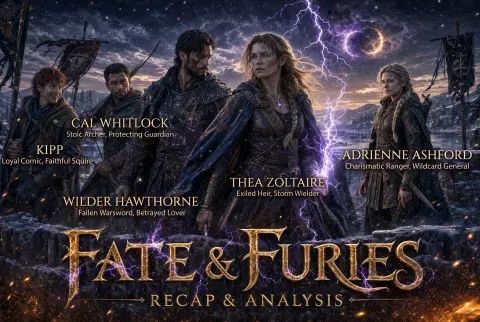
Wren Embervale
Storm-wielding alchemistWren is an alchemist, poisoner, and heir to Delmira whose sharp intelligence is matched by an equally sharp sense of responsibility. She wants to make useful things that protect people, yet her earlier inventions have been adapted into weapons, leaving her prone to treating every failure as a personal moral debt. Her instinct is to work harder and disclose less, especially when grief or fear threatens her control. She is also capable of changing course: she learns to ask for help, to trust her own observations, and to make decisions openly rather than carrying every consequence alone. Her relationship with Torj draws out both her desire for intimacy and her insistence that love cannot replace honesty or consent.
Torj Elderbrock
Warsword and protectorKnown as the Bear Slayer, Torj is a formidable Warsword whose instinct is to put his body between danger and the people he loves. He measures his worth through usefulness, duty, and the ability to endure pain, a code shaped by a violent childhood and years spent protecting others. That code can become a flaw when he decides that shielding someone gives him the right to make choices for them. With Wren, he is tender, jealous, and deeply afraid of being the source of her suffering. His struggle is to offer protection without turning it into control, and to believe that love can include vulnerability, explanation, and the possibility of being refused.
Thea Embervale
Warsword and Wren's sisterThea is Wren’s elder sister, a powerful storm wielder and Warsword who prefers action to prolonged reflection. Her loyalty is fierce, often expressed through training, blunt advice, and a readiness to confront threats directly. Beneath that confidence is a woman who values the freedom she fought to win and fears what renewed duty may take from her. Thea can see when Wren is hiding pain, but she also knows that strength does not mean never breaking. Her bond with Wren is both intimate and practical: she challenges her sister, protects her, and helps her think through the future of their shared homeland.
Kristopher Snowden
Strategist and loyal friendUsually called Kipp, Kristopher is a strategist whose humor and appetite for taverns conceal a careful eye for alliances, information, and opportunity. He is loyal to Wren and her circle, but not merely as a cheerful companion; he understands how institutions and social networks can be used to move resources. His history as an underestimated shieldbearer makes him sensitive to people who assume that strength must look like a weapon. He needles Torj, keeps secrets when strategy demands it, and can shift from comic relief to political calculation without losing his warmth. His friendship gives Wren a source of practical counsel that does not depend on royal authority.
Odessa Chamberlain
Alchemist and Wren's friendDessa is an alchemist whose quiet competence often gets obscured by her uncertainty about whether she belongs among warriors and royals. She supports Wren’s research, notices details others overlook, and brings a thoughtful perspective to the silvertide investigation. Her opus concerns preserving memory to help her father, reflecting her desire to turn personal loss into practical care. Dessa values friendship, but she is also learning to protect time for her own work and ambitions. Her steadiness gives Wren a companion who can question an assumption without competing for authority.
Wilder Hawthorne
Warsword and Torj's allyWilder, known as the Hand of Death, is Torj’s closest comrade and an experienced fighter whose dry humor masks sound judgment. He can recognize when Torj is hiding behind duty and is willing to challenge him without abandoning their friendship. His relationship with Thea is built on mutual respect and shared experience, while his partnership with Torj is grounded in years of fighting side by side. Wilder sees the danger posed by the Vanguard early and understands that strength alone will not answer an enemy who uses alchemy to disable it.
Zavier Terling
Prince and troubled alchemistZavier is the returned heir of Naarva and an adept alchemist whose dry wit often keeps others at a distance. He is curious about difficult, taboo questions, particularly human transmutation, because his family history leaves him unwilling to accept loss as final. His royal position makes him both a political ally and a person burdened by expectations he did not choose. He trusts Wren and Dessa enough to work alongside them, but grief and guilt can overwhelm his control. His attempt to understand his brother reflects a complicated hope that knowledge might repair what loyalty and force could not.
Silas the Kingsbane
Vanguard's masked leaderSilas leads the People’s Vanguard, a movement that recruits among communities still damaged by the shadow war. He presents himself as a liberator from rulers and Warswords, while relying on coercion, fear, and alchemy that can suppress the powers of his opponents. His methods make him dangerous not only as a battlefield commander but as a political organizer who can turn genuine hardship into loyalty. He uses masks, toxins, and staged encounters to control what his enemies see. His careful cultivation of followers suggests a leader who understands that power depends on both force and the story people are persuaded to believe.
Darian Devereux
Nobleman and Torj's rivalDarian is a wealthy nobleman with wide influence and a history of childhood friendship with Torj. His charm is polished, but he often uses it to provoke, test, or unsettle the people around him. He understands the value of reputation and political access, and his family’s wealth gives him opportunities most people cannot claim. Torj’s account of their shared past makes Darian more than a romantic rival: he is a living reminder of the class difference and personal betrayals that shaped Torj. Wren approaches him with curiosity and caution rather than accepting his flirtation at face value.
Lord Lucian Devereux
Power-seeking noble patriarchLucian is Darian’s father, a Tverrian nobleman who presents himself as a reliable ally to the crown while pursuing greater influence. He speaks in the language of stability and military readiness, but treats other people’s lives and loyalties as pieces in a political arrangement. His relationship with Darian is marked by conflict and competition, suggesting a household where authority is enforced as much through pressure as affection. Lucian’s interest in Delmira reflects the broader appetite of powerful men to possess whatever can increase their wealth, military reach, or control.
Audra
Guild Master of ThezmarrAudra leads the Warswords and serves as a stern, strategically minded authority within Thezmarr. She is accustomed to making decisions under pressure and understands the political cost of moving too quickly. Though she has spent years shaping Wren and Thea’s lives, she recognizes their agency and works to uphold her promises to them. Audra’s caution can look like withholding, but it comes from a responsibility to protect an institution and a realm at once. She is a mentor who trusts discipline, yet knows that the old rules cannot meet every new threat.
Farissa Tremaine
Master Alchemist and mentorFarissa is Wren’s former mentor and a master alchemist who combines exacting standards with a deep understanding of what students can realistically carry. She recognizes that Wren has been treated as though she should already have all the answers, and redirects her toward collaboration rather than self-punishment. Farissa’s knowledge of plants, alchemy, and academy politics makes her an essential guide, but she does not simply solve problems for Wren. She encourages inquiry, accepts uncertainty, and helps Wren distinguish a productive mistake from a reason to condemn herself.
Queen Reyna
Seer Queen of AveumReyna is the Queen of Aveum, a ruler whose seer abilities give her a perspective beyond ordinary political calculation. She is composed and observant, yet her captivity reveals the vulnerability beneath royal status. Her visions have influenced choices made during the war, including her decision to trust Torj with command. Reyna’s knowledge is valuable but incomplete: prophecy offers images and warnings rather than clear instructions. She seeks to protect her kingdom while acknowledging that she does not always control what her visions mean.
Callahan
Warsword and royal guardUsually called Cal, Callahan is a younger Warsword who serves as Zavier’s guard. He is direct, loyal, and increasingly willing to challenge Torj rather than defer to his former mentor. His concern for Zavier makes him attentive to the cost of carrying royal duty, while his familiarity with Torj allows him to speak plainly about the damage Torj causes when he acts without explanation. Cal’s steadiness helps connect the academy’s political circle with the Warswords who must defend it.
Cahira
Warsword assigned to WrenCahira is a newer Warsword selected to replace Thea as Wren’s temporary guard. Her appointment reflects Audra’s effort to protect Wren without keeping two powerful sisters together as an easy target. She represents the generation of warriors expected to defend a realm whose old assumptions about Warsword strength are no longer secure.
Anya Embervale
Wren and Thea's elder sisterAnya is Wren and Thea’s eldest sister, whose memory shapes how they understand family, courage, and the cost of war. The sisters struggle to speak about her because doing so brings grief close to the surface. Wren is particularly protective of Anya’s legacy when historians repeat an inaccurate account of her role in the conflict.
Samra and Ida
Wren's fellow alchemistsSamra and Ida were Wren’s close companions at Thezmarr and fellow alchemists who helped shape her sense of belonging. Their shared work and private games remain part of Wren’s memory, and she carries their influence into her research. When a chronicler presses Wren about them, it exposes how deeply the war’s losses still affect her.
Plot Devices
The Soul Bond
Shared pain and powerThe bond links Wren and Torj across physical distance, allowing them to sense emotions and, at times, share dreams, memories, and thoughts. When Torj is gravely wounded, the connection transfers his pain to Wren and threatens her life. Torj believes severing it is the only way to save her, but the connection eventually returns because their love remains. It operates as both a magical mechanism and a test of the couple’s ethics: connection can create extraordinary mutual strength, but it cannot substitute for informed choice.
Dark Alchemy
Magic-suppressing weaponThe People’s Vanguard combines poisonous alchemy with remnants of shadow magic to create a substance that weakens Warsword strength and silences royal magic. It appears on weapons and is also forced into Queen Reyna’s body, where its effects worsen over time. The substance shifts the conflict away from a simple contest of swords and magical force: its effects must be understood and countered through alchemical research. Wren’s earlier work informs the enemy’s methods, making the search for a cure both a technical challenge and a reckoning with the consequences of her own inventions.
The Silvertide Rose
A clue to the cureThe silvertide rose is a hardy plant Wren first collected in Delmira and used as a binding ingredient in the counter-alchemy that saved Zavier. Her inability to reproduce that cure leads her back to the plant’s original growing place. In Delmira, the rose flourishes alongside a wider resurgence of life, and Wren’s experiments eventually show that the important variable is not simply the soil or the plant. The rose turns botanical observation into a trail toward the relationship between Wren’s storm magic, the land, and the cure.
Reyna's Prophecy
A warning without instructionsReyna’s vision describes gold turning to silver in a blaze of iron and embers, with forgotten power rising afterward. Its imagery connects to Torj’s changed hair and scars, Wren’s magic, and the ancient force associated with their bond. The prophecy recurs at moments when characters think they have reached an answer, but Reyna’s response makes clear that its fulfillment may not be complete. It adds pressure to decisions without removing the need for them: prophecy frames the possibilities, while Wren and Torj still have to choose how to act.
The Devereux Betrothal
Political cover and leverageWren’s public betrothal to Darian is presented as an alliance that can strengthen her claim to Delmira. In private, the arrangement also conceals a plan to buy time after Lucian Devereux reveals that Torj carries a slow-acting poison. Lucian hopes to use Torj’s life to force Wren into a marriage that would give his family access to Delmira’s revived resources and royal magic. The apparent romance therefore becomes a strategic performance, requiring Torj to believe the separation long enough for Wren to protect him and investigate who can be trusted.
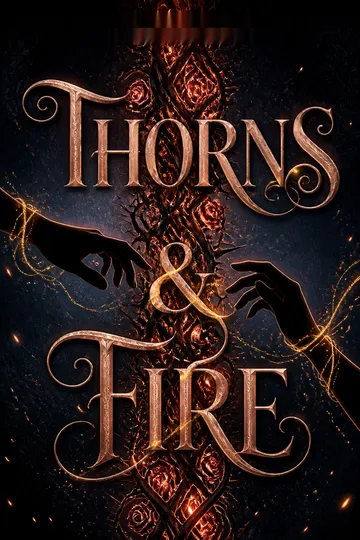
The Ashes of Thezmarr Series

About the Author
Other books by Helen Scheuerer





Download PDF
Download EPUB
.epub digital book format is ideal for reading ebooks on phones, tablets, and e-readers.








