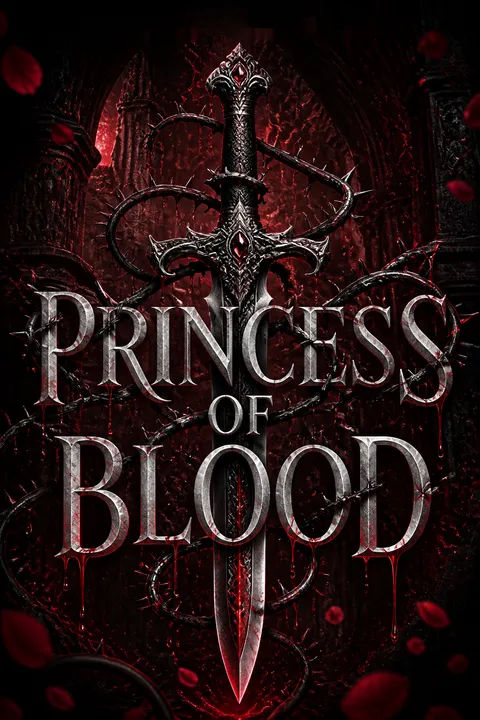


Plot Summary
A House Reborn in Blood
After killing King Osric, Kenna wakes changed: the human servant is now an immortal faerie and the sole princess of Blood House, massacred centuries earlier. At its entrance, a spiked door tests her bloodline, while the Blood Shard accepts her intention to claim Lara, her former mistress, and Anya, her rescued childhood friend, as the house’s first new members.
Inside, torches awaken across six deserted floors, illuminating weapon racks and a fountain running with blood. The beauty comforts Kenna, but the house’s old magic makes her power feel inseparable from its appetite for violence. She settles the exhausted women in her rooms, newly responsible for two people whose wounds she cannot yet mend.
The house’s resurrection makes Kenna’s elevation tangible, but not triumphant. She inherits an institution whose welcome is built into its magic and whose history is written in a blood-filled fountain. Her first exercise of authority is not conquest but shelter: she chooses Lara and Anya, despite the Shard’s warning that membership is consequential. That choice establishes a governing ethic before she understands politics. At the same time, the house’s comfort and violence arrive together, making power feel less like a crown than a responsibility with an appetite.
A Princess Before Breakfast
At dawn, Anya recognizes Kenna but recoils from her faerie sheen, unsure whether either of them is real. Kenna does not press for trust; she offers food and discovers Anya has chosen a servant’s room and the floor, where sleep seems less dangerous. Lara, stripped of Earth House, resents being treated as helpless, and Kenna sees how little she can repair with a title.
Then Lord Kallen of Void arrives with an invitation to discuss Osric’s successor. Kenna remembers his old blackmail and his connection to the rebellion, but refuses to support either Drustan of Fire or Hector of Void without evidence they would rule well. She dresses for court in red and carries Caedo openly, trying to make uncertainty look like strength.
Kenna’s new status cannot make intimacy safe on command. Anya’s mistrust is not a rejection Kenna can reason away, and Lara’s pride resists being recast as a dependent. These reactions expose the difference between possessing authority and knowing how to use it gently. Kallen’s summons pulls Kenna from private care into public choice, while her refusal to endorse either prince signals an emerging independence. The red dress and visible dagger are not proof of confidence; they are the deliberate performance of someone who knows the room will judge her before it listens.
Thirty Days Before War
At a secret council with Kallen, Hector, Drustan, and Light faerie Gweneira, the rival factions argue over leadership before they can agree on a shared patrol. Earth princess Oriana refuses to attend, sending a note that keeps her house neutral.
Kenna demands proof that either prince deserves her support, and Drustan’s contempt nearly turns the dispute violent. Before the council can settle anything, Illusion emissary Ulric delivers Princess Imogen’s claim to the throne and her declaration of a month-long Accord.
The old custom formally suspends open war, but Kallen explains that it also gives every faction time to prepare. Imogen’s invitation to a silvered state dinner sets the new contest in motion, with appearances now as dangerous as weapons.
The Accord does not solve the succession crisis; it changes the terms on which it can be fought. Imogen gains time and public legitimacy by presenting restraint as generosity, while her rivals must decide whether refusing her ceremony will make them seem reckless. Kenna’s demand for policies is morally serious but also structurally inconvenient: she must judge rulers in a court that treats negotiation as performance. Oriana’s neutrality offers a counterpoint, yet her absence leaves Kenna to make choices rather than hide behind inherited authority.
Oriana's Water Trap
Kenna goes to Earth House to confront Oriana for abandoning Lara and refusing the council. The princess will not meet her until an invisible Illusion attacker disorients Kenna at the water tunnel and sends her into a deadly current. Kenna nearly drowns before Oriana hauls her onto an island above the underground city.
Oriana insists she saved Kenna to prevent Earth House’s defenses from serving another faction, not out of affection, and warns that the secret catacombs will not remain open to her. Kenna learns that Osric once sealed a back entrance into Blood House with Princess Cordelia’s blood. Oriana’s rescue complicates her claim of neutrality, but her refusal to change leaves Kenna with no ally there.
Oriana’s rescue exposes the limits of her neutrality: she intervenes when her own house’s rules are implicated, then frames that intervention as principle rather than care. Kenna sees the contradiction but cannot force Oriana to admit it. The near drowning also demonstrates that her new body does not make her invulnerable, especially when an enemy can manipulate what she perceives. Power expands her capacity to act while enlarging the number of ways she can be ambushed. The hidden entrance becomes both strategic leverage and a reminder that history can be physically buried without being undone.
The Human Levels Open
Kenna visits the human workrooms expecting the prisoners to flee now that Osric’s border wards have vanished. Instead, Maude explains that many have no safe home to return to, and they distrust a faerie promising freedom. Triana, who had seen Kenna die in the throne room, recognizes her and embraces her; Maude remains guarded but agrees to bring them both to Blood House.
In the catacombs, Kenna uses her hidden key to guide them safely through the city, only to find Kallen watching. He deduces that the tunnels helped her cheat during the trials. Rather than expose her, he asks to accompany her on future spying trips. Kenna agrees, keeping the key and its advantage between them.
Freedom is not a door that opens equally for everyone. Maude’s refusal to leave is grounded in the likelihood that her village would reject her, while Triana’s trust depends on recognizing the person beneath Kenna’s altered body. Kenna begins to understand that rescue requires more than removing a barrier; it must include somewhere safe to go. Kallen’s discovery creates a familiar exchange of leverage, but it also shifts their relationship from blackmailer and informant toward uneasy collaboration. The key offers agency, yet the choice to share its use becomes Kenna’s first political negotiation on her own terms.
A Queen Buys Applause
At Imogen’s first silvered dinner, Kenna watches the new ruler declare herself queen before Mistei’s assembled houses. Imogen presents enchanted apples from Illusion House that induce euphoria, and the crowd welcomes the pleasure even as Kenna suspects it is a calculated gift.
Drustan and Hector continue vying for her support, each promising policies, while Kenna refuses to be hurried into choosing. Later, Drustan dances with her and defends his past decisions, including the betrayal that led to Selwyn’s death.
Kenna admits she cannot separate her anger at Drustan from her own guilt over helping his cause. She then steps onto the dais and publicly invites the mistreated and homeless to join Blood House, making her small house a challenge to Imogen’s spectacle.
Imogen understands that comfort can secure consent as efficiently as fear, especially after Osric’s brutal rule. Her apples offer a crowd the sensation of liberation without changing who holds power. Kenna counters not with a rival pageant but with a concrete invitation to defect, turning spectacle into an institutional commitment. Her argument with Drustan also complicates moral judgment: she condemns his choices while recognizing her own participation in the costs. The scene marks a shift from seeking a worthy ruler to trying a different kind of rule herself, one measured by who is allowed inside.
One Hundred Seventeen Arrive
By morning, 117 people have answered Kenna’s invitation: mostly humans and Underfae, plus five Noble Fae from Earth House. She and Lara interview them rather than treating allegiance as automatic. A sylph named Jory shows the scars where Osric damaged his wings, while pixie Maela reveals the hand lost for feeding a starving infant.
Their accounts persuade Lara to welcome them, and Kenna gives Lara the authority to admit new members herself. Lara hears the Blood Shard answer her for the first time, a small return of magic after the trials stripped her power. The arrivals fill the once-empty house with competing needs and new hope. Kenna’s sanctuary has become a community, and keeping it safe now requires more than her own strength.
The interviews turn refuge from a promise into a practice. Kenna and Lara must listen to people whose histories cannot be reduced to house colors, and their decisions begin to distribute authority rather than concentrate it. Lara’s new ability is especially significant because it does not restore the magic she lost; it grants a different form of participation. The community is built from people with unequal power and overlapping injuries, so its safety depends on rules that apply inward as well as outward. Kenna’s appeal has succeeded, but every new member makes her responsibility less symbolic and more difficult to evade.
Iron Finds the New Princess
During a clandestine survey of Light House, Kallen and Kenna follow Sun Soldiers planting crystal lenses and carrying a venomous salamander. When the soldiers release it near Blood House, Kallen kills the creature, but its escort attacks them.
A soldier’s iron armor drains Kenna’s magic when she tries to seize his heart; he breaks her hand and stabs her before Kallen kills the attackers. Kenna survives by restarting her healing power, and Kallen carries her inside.
He explains that cold-forged iron suppresses faerie magic, then begins teaching her to fight without relying on Caedo. At the council, the allies learn that Drustan has promised the Nasties access and freedom in exchange for support, while Hector negotiates for troops from Queen Briar.
The attack punctures Kenna’s belief that new power can substitute for experience. Iron is not merely a weapon but a technology for making magical beings vulnerable, and its use against her exposes a gap in the knowledge she needs to govern. Kallen responds by teaching practical survival rather than offering reassurance, converting protection into preparation. Meanwhile, the alliance’s bargains reveal that every promise of reform is attached to strategic calculation. Kenna’s house is growing, but its security depends on forces and choices beyond her command.
A Garden Full of Threats
At Imogen’s garden party, Kenna publicly threatens Markas, the Illusion candidate who helped terrorize her during the trials, and refuses Drustan’s attempt to discipline her for breaking decorum. Lara admits she wants to confront Markas herself, no longer content to be protected from every conflict.
Kenna then approaches Imogen, Torin, and Rowena directly, naming the salamander attack without offering proof they can use against her. Imogen takes her on a very public walk, making their conversation look like an alliance while probing Kenna’s desires and offering protection in exchange for loyalty.
Kenna refuses to let Imogen define what she wants. The exchange teaches her that even an honest confrontation can be staged and repurposed by the person with the better audience.
Kenna’s bluntness unsettles a court accustomed to coded speech, but directness does not make her immune to manipulation. Imogen can convert Kenna’s willingness to engage into a public image of closeness, showing how political meaning is assigned by witnesses as much as by participants. Lara’s wish to face Markas marks an important move away from inherited helplessness, although her desire for vengeance remains entangled with shame. The scene asks whether refusing the court’s language is enough to escape its logic. Kenna learns that she must manage not only what she says, but what others can make it appear to mean.
Gweneira's Poisoned Wine
At a later gathering, Kenna sees Ulric take a flask from Rowena and secretly dose a glass intended for Gweneira. She uses her body magic to freeze Gweneira’s arm before the Light faerie can drink, then warns her that the wine is poisoned. Gweneira recognizes the attempt as part of Imogen’s effort to force Light House under Torin and Rowena, while Torin and Rowena have watched the exchange closely enough to prevent a counterattack.
Kenna’s warning saves Gweneira from an immediate death but cannot protect her faction indefinitely. At another event, Imogen’s public indulgence and overspending begin to draw criticism even among her own supporters. The Accord’s glittering celebrations now carry unmistakable signs of a struggle for survival.
The poisoned glass condenses Mistei’s politics into an intimate act: a social courtesy becomes a delivery system for murder. Kenna’s power proves most useful not as a weapon but as a brief interruption, buying Gweneira the chance to choose what to do next. Yet the rescue cannot undo the balance of force, and the would-be killers remain in place. Imogen’s lavish generosity also starts to show its cost. The section contrasts immediate bodily danger with slower political erosion, revealing that a ruler can lose support through excess even while appearing to command every room.
The Melee Crowns Imogen
Imogen abruptly turns a silvered ball into a melee among the six house leaders, promising a boon to the winner and disqualification at first blood. Kenna makes temporary truces with Hector and Drustan, then uses her new body magic to hinder stronger fighters.
She wounds Torin and forces him from the floor, but Imogen’s illusions disorient the combatants. Kenna sees Hector apparently beheaded, though in reality Torin cuts his thigh and eliminates him.
Drustan falls next, and Imogen kicks Kenna down and draws a shallow line across her throat, winning the contest. Kenna leaves the floor bruised and exhausted, but the crowd has seen her stand against powerful rulers. The following morning, dozens of Noble Fae come to Blood House seeking shelter.
Imogen turns violence into theater while controlling the rules, audience, and interpretation of the result. Kenna’s survival is not a clean victory; she is both physically defeated and politically enlarged. The illusion of Hector’s death shows how perception can become a weapon that attacks the mind as directly as a blade attacks the body. Yet the crowd’s response to Kenna’s resistance brings new members to her house. The scene exposes a paradox of leadership in Mistei: compassion attracts people, but they also need to believe their protector can endure the spectacle of force.
Hector's Hidden Children
After the melee, new Noble Fae join Blood House, including people fleeing the rising power of Torin and Rowena. Hector invites Kenna to a concealed refuge beneath Void House, where he and Kallen have protected children born across house lines for more than two centuries.
These changelings are taught to control their mixed magic rather than being traded for human infants. Hector reveals that Una is his daughter with Eluna, an Illusion asrai whom his father killed after discovering their forbidden love.
Hector’s father forced him to watch, then concealed the crime behind a rumor that Hector had abused her. Kenna understands that Hector’s harsh reputation hides a long commitment to protecting the vulnerable. His account gives her a reason to consider him beyond his policies or his claim to the throne.
Hector’s hidden refuge makes his political position legible through sustained action rather than promises. The children are not an abstract argument for reform; they are lives preserved through secrecy, discipline, and risk. Eluna’s murder explains why Hector’s public hardness cannot be read as a simple absence of feeling, while the false rumor shows how power can weaponize reputation to bury inconvenient truths. Kenna’s judgment shifts because she sees what Hector has protected when no audience could reward him. The revelation also redefines Una’s place in the story without making her identity a political credential alone.
Kallen's Buried Crimes
On a later trip through the catacombs, Kenna and Kallen find that Oriana’s thorn magic is spreading through the passages, threatening the route Kenna depends on. As Kenna massages Kallen’s injured shoulder, he finally explains how Osric tortured him into reporting on others and how fear drove him to betray some faeries, including innocents.
He also describes the secret work he and Hector began to save changeling children, though he refuses to treat those rescues as absolution for his past. Kenna argues that his choices matter alongside his crimes. Kallen cannot accept her judgment and leaves abruptly, revealing how deeply he has learned to equate love with danger and any good deed with an insufficient payment for harm.
Kallen’s confession resists the comforting division between victim and perpetrator. Osric coerced him, but Kallen acknowledges the moments when fear and self-preservation made him participate in harm. His refusal to count the children he saved as moral credit reveals a punitive inner accounting: no amount of care can balance an imagined debt. Kenna offers a more complex view, not innocence but moral plurality. The spreading thorns mirror the narrowing space Kallen allows himself emotionally. Even as the catacombs close, the greater danger is his insistence that connection must be withheld to prevent another loss.
Anya Turns Against Sleep
Anya avoids sleep by drinking, terrified that Osric’s illusions will return in nightmares. Her exhaustion finally sends her into Wilkin’s room, where she tries to pull an axe from the wall while insisting the dead king must be killed. When Kenna restrains her, Anya knocks her into the fireplace and burns her hand before realizing what she has done.
She confesses that Osric showed her visions of Kenna dying, often through Anya’s own actions. Kenna understands that leaving Anya alone has allowed her trauma to deepen. Rather than offer another comforting gift, she orders Anya to sleep and uses Blood magic to quiet her mind. Once Anya is safe, Kenna retreats into the catacombs and weeps over the limits of her power.
Anya’s violence is not framed as a sudden reversal of character but as the consequence of being deprived of sleep, safety, and confidence in reality. Kenna’s compassion has become avoidance: by respecting Anya’s demand for distance, she fails to see how dangerously isolated her friend has become. The sleep spell is ethically uneasy because it helps Anya while overriding her immediate agency. Kenna’s breakdown afterward registers that cost. Her power can alter bodies, but it cannot erase the history that has made Anya afraid of her own mind.
A Witness Behind the Grate
Unable to stop thinking about the people still trapped in Osric’s brothel, Kenna spies through a grate and sees Torin and Rowena force an Illusion sylph to dance in metal shoes heated red-hot. Kenna could use her magic, but doing so would expose her and risk breaking the Accord before her house is ready. She freezes as the sylph suffers, then watches Torin kill her when she tries to escape.
Later, Kenna tells Kallen what she witnessed and condemns herself for choosing the larger strategy over one life. Kallen neither absolves her nor condemns her; he recognizes the cost of choosing among terrible outcomes. Their fight turns intimate, and they kiss, but an enchanted bird catches their private moment, making Kallen flee in alarm.
Kenna’s paralysis is the book’s clearest test of whether benevolent intent survives political calculation. She does not fail to recognize cruelty; she recognizes the consequences of intervening and chooses not to act. The sylph’s death remains a specific loss rather than a statistic absorbed into strategy. Kallen’s response offers companionship without erasing responsibility, which is why it matters more than simple reassurance. Their interrupted kiss repeats the danger of intimacy in Mistei: anything privately valued can become information, leverage, or a target.
Bones Give Anya a Weapon
Kenna follows the house’s magic to Anya and finds her among thousands of skeletons from Blood House’s ancient massacre. Anya studies the skulls to imagine what Osric made his victims endure, then demands a way to stop feeling like one of them. Kenna offers weapons and training instead of another attempt to soothe her.
Anya accepts, agreeing to sleep and reduce her drinking so she can learn to fight. Their plan does not erase Anya’s trauma, but it gives her a goal she chose herself. Elsewhere, Kenna’s divided feelings about leadership sharpen: she can no longer pretend that shelter alone will protect everyone. She must decide which of two imperfect claimants will lead the coming war.
The bone chamber turns an abstract history of massacre into a physical inheritance Anya can touch. Her demand is not to become innocent again; it is to regain the ability to act. Kenna’s offer respects that distinction, while the conditions around sleep and alcohol acknowledge that agency also depends on the body’s survival. The scene marks a shift in their friendship: Kenna stops assuming that care must look gentle, and Anya begins defining what help means to her. Their choices remain fragile, but they are no longer imposed by Osric’s version of the story.
Drustan Claims the Crown
As Kenna reviews the rival princes’ policies, Drustan admits that he used seduction to recruit allies, including Kenna, though he insists his desire for her was also genuine. Their history remains painful, especially because his betrayal helped lead to Selwyn’s death. When Kenna later confronts him in private, he accuses her of choosing Hector and insists the crown belongs to him.
His rage and scorching magic frighten her; she holds his heart with her Blood power until he regains control and apologizes. His claim that the throne is his right, rather than a duty he must earn, makes Kenna recognize that his ambition has overtaken his stated ideals. She cannot yet announce her choice, but she knows she cannot give him her support.
Drustan’s honesty initially repairs some of the damage between them, but it cannot compensate for the power he believes he is owed. The confrontation exposes the gap between a reformer’s declared goals and his private relationship to authority. Kenna’s ability to hold his heart literalizes the asymmetry of the moment, yet she uses it to restrain rather than punish him. Her judgment is not based on whether Drustan has ever cared about people; it is based on whether he can accept limits when his own desire is challenged. The answer changes the succession decision.
Light House Falls
Rowena’s poison reaches Gweneira, who collapses after Torin takes control of Light House. General Murdoch carries her to Blood House, where Kenna uses her magic to keep Gweneira’s heart and lungs moving and force the poison from her body. Nearly a hundred Light refugees follow, and Lara helps admit them while Gweneira urges the group to let their enemies believe she is dead.
Before the masquerade, Kenna tells Kallen she has chosen Hector. He welcomes the decision, then finally explains why he fears loving her: as a teenager, he trusted a girl with his secrets, and Osric forced him to kill her. Kenna refuses his self-condemnation, and Kallen chooses to stay close instead of fleeing.
The fall of Light House turns Kenna’s sanctuary into a political center, because saving Gweneira also gives the defeated faction somewhere to regroup. Her magic is now used for sustained care, not simply restraint or attack, and Lara’s authority makes that care collective. Kenna’s choice of Hector follows from evidence gathered in secret, while Kallen’s confession reveals how a history of coercion has distorted his ability to accept love. The scene joins political and intimate trust without making them identical: Kenna can choose a king for public reasons and still insist that Kallen’s fear does not get to decide their relationship.
The Accord Breaks in Blood
At the masquerade, Ulric has a sprite force drugged wine down Kenna’s throat, then uses an illusion to make her see Drustan stabbing Kallen. Kenna snaps Drustan’s neck with her magic; when the vision clears, he lies truly dead. Torin declares the Accord broken, arrests Kenna in iron, and then murders Imogen to seize the crown.
Sun Soldiers and Illusion loyalists attack, turning the ballroom into a battlefield. Kenna sees Hector captured and Kallen apparently dead beneath a heap of bodies, but Una escapes with Kallen’s body in a cocoon of shadow. Rowena has Kenna’s arm severed to remove Caedo, then reattaches it before drugging her. Kenna ends the book a prisoner in Light House, unsure whether Kallen survived.
The final catastrophe weaponizes the book’s central vulnerabilities at once: illusion corrupts perception, iron disables power, and public spectacle turns an engineered crime into accepted truth. Kenna’s killing of Drustan is both a genuine action and the result of deliberate deception, leaving guilt and culpability painfully entangled. Torin’s coup reveals that the Accord was useful cover, not a peace project. Caedo’s removal strips Kenna of her most familiar defense, while her captivity reverses the sanctuary she built. The ending refuses resolution: she has to survive without knowing whether the person who taught her survival is alive.
Analysis
Princess of Blood treats political change as a problem of shelter: who can enter, who gets believed, and who is expected to endure harm for the sake of a future victory. Kenna’s first exercise of sovereignty is to admit Lara and Anya, then widen the house until humans, Underfae, outcasts, and dissident Noble Fae can seek safety there. The sanctuary is not an uncomplicated solution. Its residents bring different needs, and Kenna’s desire to protect them repeatedly collides with her limited knowledge, political isolation, and willingness to sacrifice the immediate for the strategic.
The book distrusts both easy innocence and easy condemnation. Kenna has helped Drustan’s rebellion and enjoys vengeance; Kallen has been both coerced and complicit; Hector’s brutal public reputation conceals a sustained effort to protect forbidden children. Their histories challenge the court’s habit of treating reputation as moral fact. Yet understanding a person’s motives does not undo what they have done. Kenna’s hardest decisions arise from this gap between explanation and repair, especially when she watches a victim die rather than risk starting a war before her people are ready.
The romances echo the political plot without replacing it. Drustan uses charisma to build allegiance and admits that desire was part of his strategy with Kenna. Kallen, shaped by torture and betrayal, treats affection as a danger that must be denied. Kenna’s demand for honesty draws out both men, but she does not mistake intimate feeling for proof of fitness to rule. She rejects Drustan when his private claim to the crown reveals entitlement, and chooses Hector because his hidden protection of changelings gives his reformist promises a history of action.
The ending then turns the book’s central uncertainty against Kenna. Ulric’s illusion and poison make her commit a real act under false perception; Torin uses it to frame her and launch his coup. The result is not simply a defeat but a cruel demonstration that ethical intention cannot control how an action is publicly interpreted. Kenna’s new community has made another future imaginable, but the book ends with her imprisoned, Caedo removed, and Kallen’s survival uncertain. Hope remains an undertaking, not a guarantee.
Review Summary
People Also Read







Characters
Kenna
Reluctant Blood princessA resourceful young woman raised in poverty, Kenna learned to survive by reading people, improvising, and refusing to accept the limits others set for her. Her transformation into a faerie gives her command of Blood magic and a house to lead, but not the political experience or emotional certainty her new position seems to require. She is drawn to people in danger and feels responsible for the consequences of every choice, a combination that makes her compassionate and vulnerable to guilt. Kenna’s bluntness disrupts Mistei’s coded court, while her instinct to protect individuals can conflict with the larger calculations of leadership. She wants change to be real, not merely promised, and must learn what that demand costs.
Lara
Disowned Earth heirLara is the former heir of Earth House and Kenna’s onetime mistress, a proud faerie whose upbringing taught her to equate status with safety. Losing her magic and place in her family leaves her unsure what she can offer, so she sometimes reaches for old habits of command rather than admit her fear. Beneath her sharp tongue is a loyal friend who values dignity and wants to be admired for more than beauty or birth. She struggles to accept care without feeling diminished, but she is capable of learning, strategizing, and making room for people she once would have overlooked. Her friendship with Kenna is intimate enough to survive anger, secrecy, and changing power.
Anya Hayes
Kenna’s wounded oldest friendAnya grew up beside Kenna in the human village of Tumbledown, sharing childhood games, private jokes, and an enduring bond. Her warmth and generosity once made her a source of steadiness for Kenna, but captivity and torture have left her wary of touch, sleep, and the distinction between memory and present danger. She is not simply a person waiting to be restored to her former self; she is angry, frightened, and trying to determine what kind of person she can become now. Anya’s recovery depends on being heard rather than managed. Her friendship with Kenna remains real, but trauma changes the ways she can express trust.
Kallen
Void’s watchful spymasterKallen is a reserved Void faerie known for gathering information, moving through shadows, and carrying out dangerous work with controlled precision. Years of service under Osric have taught him to treat trust as a liability and his own emotions as vulnerabilities others can exploit. He is strategic and observant, yet his restraint conceals a persistent moral unease about the violence he has committed. Kallen respects people who act from conviction, even when he cannot share their faith in goodness. His connection with Kenna unsettles his defenses because she challenges him directly without simplifying his past. He is capable of tenderness, but finds it difficult to believe tenderness can survive contact with power.
Hector
Volatile Void claimantHector is the prince of Void House, a formidable fighter whose restless energy and blunt manner make him seem more comfortable in conflict than in court. He is fiercely loyal to his sister Una and to Kallen, though he rarely expresses affection plainly. Unlike Drustan, Hector does not try to charm Kenna into admiration; he wants to be judged by his courage, strength, and decisions. His roughness is not proof of indifference, but neither does good intent make him easy to trust. Hector’s willingness to act on behalf of vulnerable people sits alongside a hard pragmatism shaped by a violent family history. He views leadership as work, not merely recognition.
Una
Hector’s formidable confidanteUna is a capable Void faerie and Hector’s closest family ally, combining a fighter’s directness with a quieter gift for reading other people. She is protective without being submissive, and she often challenges Hector when his anger threatens to take over a situation. Her loyalty is rooted in shared history and chosen responsibility, not blind agreement. Una understands that secrets can preserve lives, but she also recognizes the emotional cost of keeping them. She treats Kenna with cautious interest, testing whether the new princess’s principles can withstand Mistei’s compromises.
Drustan
Charismatic Fire claimantDrustan, prince of Fire House, is a brilliant organizer and a practiced charmer whose ideals helped draw allies into rebellion. He is skilled at making people feel chosen, and he uses warmth, flirtation, and political calculation as different forms of persuasion. His commitment to changing Mistei is real, but ambition and grief complicate that commitment. Kenna’s former intimacy with him makes it difficult for her to judge his public promises without remembering what he cost her personally. Drustan believes leadership requires hard decisions, and he can defend those decisions persuasively. The question he raises is whether someone who wants to improve a system can still become attached to the power needed to control it.
Imogen
Illusion’s pleasure-loving queenImogen is a distant relative of Osric who presents herself as a more generous ruler through lavish gatherings, rare gifts, and public celebration. Her preference for pleasure is not simple frivolity; she understands that people who feel indulged may accept authority more readily than people who feel terrorized. Imogen is perceptive about desire and enjoys discovering what motivates others, whether to reward it or turn it into leverage. She can be charming and candid, but her softness is inseparable from political calculation. Her rule asks whether abundance can change the nature of power, or merely make its demands more appealing.
Oriana
Defiant Earth princessOriana is Lara’s mother and the princess of Earth House, a composed ruler who prizes tradition, restraint, and political neutrality. She believes long histories must be considered before passion is allowed to dictate action, and she distrusts the promise that a new monarch can end an old cycle. Her composure can look like wisdom, but it also shields her from choices that might require visible risk. Oriana’s relationship with Lara is burdened by expectations she has mistaken for protection. She remains difficult to read because her principles, fear, and private attachments do not always point in the same direction.
Gweneira
Light House’s rebel strategistGweneira is a Light faerie who helped Drustan’s rebellion and seeks influence within a house divided over its future. Delicate in appearance and disciplined in manner, she can speak about violent subjects without losing her composure. Her opposition to the old leadership is rooted in a belief that Light House has betrayed its own standards of justice. Gweneira is both politically alert and personally guarded, making her a valuable ally but also someone whose plans are not always visible. Her connection with Lara grows through conversation, shared political curiosity, and a mutual refusal to accept that loss of status means loss of worth.
Torin
Ambitious Light contenderTorin is a Light House leader whose imposing presence and disciplined manner make him a credible rival for power. He is calculating rather than impulsive, and he treats weakness as an opportunity others have failed to defend. His close partnership with Rowena gives him a reliable confidante and a shared political purpose. Torin values order, but his idea of order leaves little room for vulnerability or dissent. To Kenna, he represents the danger of a ruler who can present coercion as stability and assume that strength grants the right to decide everyone else’s fate.
Rowena
Torin’s smiling consortRowena is Torin’s long-standing partner, a beautiful Light faerie whose bright manners can conceal a cold appetite for control. She and Torin have built a relationship that appears affectionate and mutually devoted, while also functioning as a political unit. Rowena is interested in novelty and sensation, and she has little regard for the suffering of people she considers beneath her. Her sweetness is not mere disguise; it is a social instrument that lets her make cruelty seem playful or inconsequential. She poses a particular challenge to Kenna because her threats often arrive wrapped in hospitality.
Aidan
Fire sprite and friendAidan is a Fire sprite and Kenna’s longtime friend from their years serving powerful faeries. His gift lets him sense other people’s desires, a talent that makes him perceptive but does not free him from loyalty to Fire House. He cares for Kenna and tries to support her even when his obligations place him on the opposite side of a political choice. Aidan’s humor and warmth preserve traces of the simpler friendship they shared before Kenna became a princess. His divided loyalties show how a person can love a friend and still belong to a community with competing demands.
Edric
Fire House’s brave lordEdric is a Fire lord, an able dancer and soldier, and Aidan’s beloved. His easy humor makes him approachable, but he takes the cause of changing Mistei seriously. Edric is willing to risk himself for allies, even when the political situation is uncertain. His relationship with Aidan is shaped by both affection and the constraints of house loyalty, which neither can simply wish away.
Maude
Cautious human elderMaude is a human captive whose long years in Mistei have made her wary of promises from faeries. She is practical, sharp-minded, and protective of the other humans, especially those who have less experience surviving the court. Her distrust is not cynicism for its own sake; it comes from knowing that escape can lead to rejection and hardship outside Mistei. Maude accepts help only when she believes it answers a real need, making her a valuable counterweight to Kenna’s optimism.
Triana
Human survivor and mediatorTriana is a human survivor who responds to Kenna with trust after recognizing her, and she helps other captives consider a life beyond servitude. She is generous without being naïve, quick to comfort Anya and to translate between people who do not share a language. Triana prefers useful work and companionship to being treated as fragile. Her practical kindness helps make Blood House feel like a community rather than a collection of rescued people.
Ulric
Imogen’s polished emissaryUlric is an Illusion lord and a close adviser to Imogen, skilled in court etiquette and the management of appearances. His calm manner makes him useful in negotiations where open hostility would be costly. He is closely connected to the ambitious factions within Illusion House and approaches power with a cool, unsentimental eye. His polished civility makes it difficult for other characters to know whether he is offering courtesy, warning, or both.
Dallaida
Queen of the NastiesDallaida leads the Nasties, the feared beings who live in Mistei’s lowest levels. She is powerful, unpredictable, and determined to win greater freedom for her people. Her willingness to bargain with rival factions makes her useful to some and dangerous to all. Dallaida’s political aims complicate the simple division between civilized faeries and monsters.
Alodie
Earth House’s senior servantAlodie is an asrai who oversees service in Earth House and once shared a friendly bond with Kenna. Her sense of duty keeps her close to Oriana’s household even when she recognizes the pain its decisions cause. She represents the many people whose daily loyalty is shaped by obligation rather than agreement.
Lady Rhiannon
Earth House power brokerRhiannon is a prominent Earth faerie and the mother of Talfryn, whose death leaves her grieving and politically alert. She resents Oriana’s strict neutrality and is willing to listen to rival factions if they offer a way to protect her house and honor her losses. Her presence shows that grief can make a person more politically active rather than more passive.
Plot Devices
The Sacred Shards
Power tied to intentionThe Shards are fragments of ancient magic connected to Mistei’s houses and their rulers. The Blood Shard gives Kenna immortality, Blood magic, and a direct relationship with the resurrected Blood House. It can answer questions, admit members, and connect a house to those who live within it, but it does not simply dictate how its princess should rule. Kenna must form intentions and make choices herself. This device turns political authority into a magical relationship, while preserving the central uncertainty of whether power can be used well merely because its source is sacred.
Caedo
A weapon with a hungerCaedo is a sentient, shape-shifting dagger bonded to Kenna by blood. It can become a blade, bracelet, necklace, or clawed covering, and it feeds on blood while sharing thoughts with her. Its strength gives Kenna a weapon she can use despite her lack of training, but its appetite and taste for violence can intensify her own anger. Caedo is not a moral guide or a simple tool. Kenna has to set limits on what it may do, especially when her emotions make revenge feel easier than restraint.
The Accord
Peace used as preparationThe Accord is a traditional, month-long suspension of open war declared during political upheaval. Imogen invokes it to delay an immediate challenge to her claim and present herself as a measured ruler. The period does not end covert violence, threats, or political maneuvering; it gives rival houses time to recruit, gather resources, and shape public opinion. Silvered gatherings reinforce the appearance of peace, but the custom’s true force depends on whether the houses choose to honor it. The Accord provides the story’s clock and makes restraint itself a contested political act.
The Earth Catacombs
A hidden route and advantageA network of secret passages runs beneath Mistei, concealed from most faeries and accessible through hidden doors and keys. Kenna uses the routes to move people, gather information, and spy on rival houses without crossing guarded public corridors. The passages were created and controlled through Earth House’s history, so access is also a point of conflict with Oriana. They offer Kenna a rare strategic advantage in a world where other leaders possess armies, allies, and centuries of experience. Their vulnerability to Oriana’s growing thorn magic shows that hidden resources can be taken away.
Cold-Forged Iron
Magic’s physical restraintCold-forged iron suppresses faerie magic when it touches a faerie or when magic is cast against an iron-clad target. Light House uses it in shackles, armor, and nets, allowing trained soldiers to force magical opponents into physical combat. Its existence changes Kenna’s understanding of her own strengths: Blood magic and Caedo cannot guarantee safety if an enemy knows how to shut them down. The device also exposes the material infrastructure behind faerie power, showing that supernatural ability has limits and that those limits can be deliberately exploited.
About the Author



Download PDF
Download EPUB
.epub digital book format is ideal for reading ebooks on phones, tablets, and e-readers.








