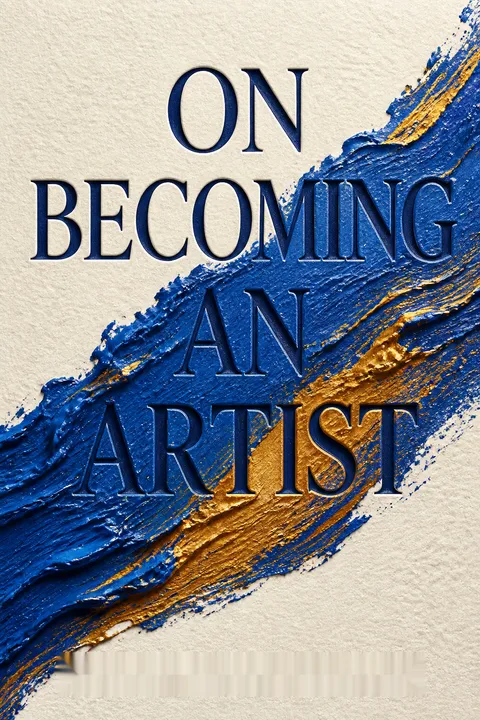


Key Takeaways
Become an artist by creating, not by waiting for permission
Start before certainty. Langer’s case begins with an unlikely confession: she had barely considered painting before telling an artist friend she might try it. Friends supplied canvases and urged her not to judge the work as she made it. Her first picture, a girl riding through woods, was painted on a wooden shingle. She enjoyed making it before she knew whether it was any good, and that pleasure persuaded her to keep going.
Value the experience. The book is not a guide to becoming a professional artist. It argues that taking up painting, music, writing, or another creative activity can make everyday life more vivid. The starting point is participation, not proof of talent or a promise of acclaim.
The opening story usefully shifts the measure of success from public recognition to lived experience. That resembles research on intrinsic motivation, where activities can be sustaining when the activity itself is rewarding rather than merely a route to status. The distinction matters: a hobby can enrich a life even if its products never leave the kitchen table. Still, beginning is not equally easy for everyone. Time, money, disability, and access to instruction shape who can take creative risks. The invitation is most powerful when understood as permission to start within real constraints, not as a claim that constraints do not exist.
Practice mindfulness by noticing distinctions your routines erase
Notice what changes. Langer uses mindfulness to mean actively noticing new distinctions, including how an object or event changes with context and perspective. Mindlessness is reliance on fixed categories, repeated routines, or information accepted without question. A familiar drive can happen on autopilot; a childhood rule about table settings can feel absolute long after its rationale has been forgotten.
Keep labels flexible. In one experiment, people were told an unfamiliar object was a dog’s chew toy. Some heard that it was one; others heard it could be one. When asked to find an eraser, only the second group thought to use the object. A conditional label left room to see another use. In creative work, the same habit means staying curious about what a material, image, or first attempt might become.
This account connects attention with cognitive flexibility: a category can speed recognition, but it can also hide alternatives. The chew-toy example makes that tradeoff tangible. In modern terms, labels shape what information people search for, so tentative language can preserve room for revision. There is a practical limit, however. Some routines protect attention and safety, and not every familiar detail deserves renewed scrutiny. The useful skill is not permanent hypervigilance. It is noticing when the situation has changed enough that an old label or routine may no longer fit.
Treat praise and criticism as perspectives, not verdicts
Evaluation depends on context. Langer argues that judgments of art reflect the viewers, their criteria, and their moment in history, not just the work itself. Manet’s paintings were rejected by a major Paris exhibition in 1863 and attacked for departing from academic expectations, yet they helped define a new direction in art. Langer’s own painting was selected for a local juried show, but that success made her anxious about whether she could be accepted again.
Keep creating anyway. Compliments can become as controlling as criticism if they dictate what someone makes next. Langer began repeating a color people praised, then noticed that approval was steering her choices. Feedback can offer information, but it cannot settle a person’s worth or determine the only valid way to make art.
The argument resonates with the sociology of taste: institutions and audiences help establish what counts as excellent, and those standards can shift. Manet’s reception is a vivid reminder that rejection may reveal a mismatch with prevailing criteria rather than a final judgment of merit. Yet subjective evaluation does not make all criticism useless. A viewer may identify a technical problem or an effect the artist did not intend. The more productive distinction is between feedback as data and feedback as a verdict. Artists can listen closely without handing over authorship.
Turn mistakes into information instead of evidence against yourself
A mistake interrupts the plan. Langer defines a mistake as an unplanned result, not automatically a failure. When rain came through her open windows, she chose to treat the wet floors as an unexpected assist with mopping. In art, a thin wash accidentally covered a painting she meant to erase. The ghostly image held her interest, so she added a glass of wine and kept it.
Use the interruption. In one drawing study, people asked to incorporate errors enjoyed the task more, and judges preferred their drawings. A similar writing exercise found that participants who worked a mistaken word into their essays were rated more highly than comparison groups. These findings do not make every error useful. They suggest pausing before erasing, quitting, or turning an imperfect result into a judgment of personal ability.
This is close to the logic of exploratory research: unexpected results can expose assumptions and open a new line of inquiry. The important step is not celebrating error for its own sake, but converting surprise into usable information. The studies described are suggestive, though their short, artificial tasks cannot establish that mistakes improve every creative product. In high-stakes settings, errors may carry real costs and require correction. The transferable practice is to separate noticing an error from condemning the person who made it, then decide whether repair, adaptation, or a fresh attempt best serves the task.
Ask who made the rule before letting it define your limits
Rules have authors. Langer urges readers to ask who created a rule, under what conditions, and for whose needs. A warning that says keep off the grass can seem like an impersonal command; identifying the person who wants the grass protected makes the rule’s purpose available for consideration. That does not mean rules should be ignored. It means their usefulness depends on context.
Examples narrow imagination. In a bridge-building study, 92 percent of participants shown one model copied its design. People shown two models, or none, produced a wider range of solutions. A single example had quietly posed as the correct answer. In creative work, seeing multiple approaches can make choice visible and loosen the belief that there is only one proper way to proceed.
This insight has a strong connection to design justice, the idea that standards and systems often encode the assumptions of whoever created them. Asking who benefits can reveal why a supposedly neutral norm fits some people better than others. The bridge task shows how quickly a demonstration can become an anchor. Yet expertise and rules also preserve hard-won knowledge, especially where safety matters. A sound approach is neither obedience nor rebellion by default. It is to understand the rule’s purpose, test whether its original conditions still apply, and adapt responsibly.
Use other people as sources of methods, not measures of worth
Comparison hides context. A single performance cannot reveal someone’s full ability. The other person may have more practice, different goals, or a better day. Langer describes a visitor who saw her paintings and concluded that painting must be easy for her, because he had completed only a few canvases himself. He treated visible output as a ranking rather than asking what the activity was for.
Learn without ranking. Comparisons can sometimes provide useful information, but they often reduce a complex skill to one scale and invite self-doubt. Langer’s research found that frequent social comparison was associated with more negative feelings, including regret, blame, and procrastination. Looking at accomplished artists can still help when the question is how they worked or what choices they made, rather than whether the beginner measures up.
The distinction resembles a broader one in education: benchmark information can guide practice, while status comparison can make learning feel like a test of identity. A role model is most useful when the process becomes visible, including effort, tools, and intermediate drafts. The reported association between comparison and negative feelings does not prove comparison alone causes distress; people who already feel distressed may compare more. Nor can comparison be eliminated from competitive settings. Its value depends on whether it supplies actionable information or merely turns another person into a measuring stick.
Replace talent tests with small, learnable skills
Break the mystery apart. Langer says people often call a skill talent because they cannot see its component parts or the practice behind a finished result. When she helped a friend draw a dog, asking her to reposition one leg made the image more recognizable. That was not proof of an innate gift. It was a small observation the beginner could use.
Ask how, not whether. In one study, people who believed they lacked artistic ability drew faces with or without a few anatomical pointers. Those given guidance saw improvement across three drawings, but many still believed art required talent. Langer recommends focusing first on the methods a task requires. Improvement may come from practice and attention, even when the eventual level of skill is uncertain.
This reframing is compatible with skill-learning research, which emphasizes practice and feedback rather than treating expertise as a mysterious trait. It also makes a beginner’s next step more concrete: identify a component that can be observed and improved. The book sometimes presses beyond that useful point, especially when it suggests people have equal talent for everything. People differ in interests, physical capacities, and learning rates. Those differences need not bar participation, but they matter when predicting expert performance. Enjoyment and professional mastery are distinct goals, and creative practice can be worthwhile without pretending otherwise.
Look again at what familiarity taught you to overlook
Knowing can narrow vision. Familiar labels help people navigate the world, but they can replace attention to the particular thing in front of them. In a study involving a common coin, most participants could not reliably identify its accurate design among similar images, despite having handled coins often. They knew what a penny was for, not necessarily what it looked like.
Expect the unexpected. In a change-blindness experiment, people asked for directions sometimes failed to notice when the person speaking to them was switched during a brief interruption. Their attention was on the request, not the stranger’s identity. Langer’s practical suggestion is to approach a familiar object, person, or activity with some uncertainty. That small shift can reveal details an established category has filtered out.
The examples fit research on selective attention: people do not register every visible detail, because attention is allocated to whatever the task makes relevant. That is efficient, but it creates blind spots when a supposedly irrelevant detail becomes important. The point is not that expertise always makes people less perceptive. Expertise can sharpen attention within a domain, while also making familiar expectations harder to question. A useful exercise is to alternate between the whole and the parts: first identify the scene, then deliberately inspect one feature the task did not require.
Engage first, and preference may follow attention
Attention can create interest. Langer’s experiments suggest that people may enjoy something more after noticing more about it. Participants who initially disliked rap or classical music were asked to identify new features while listening. Those prompted to notice more reported greater liking. In another study, people asked to invent a personally meaningful title for a Monet painting spent longer looking at it and liked it more than people given a title or no title.
Bring curiosity to people, too. In a study with children, those asked to generate several possible strengths and weaknesses of people with disabilities were less likely to avoid a disabled child as a partner. Langer’s point is that active attention can turn a person or object from a flat category into a richer encounter.
This connects with the mere exposure effect, the finding that repeated contact can increase liking, while adding a mechanism: attention may make exposure more informative and personally meaningful. It also offers a constructive route to reducing stereotyping, because individuating details complicate broad group labels. Still, increased attention does not guarantee affection or agreement. Some encounters reveal genuine incompatibility, and a forced search for positive traits can feel patronizing. The strongest use is curiosity without a required emotional outcome: notice more, learn more, and allow preference to change rather than demanding that it do so.
Make a workable choice, then learn from what it becomes
Choices begin in ignorance. Langer challenges the idea that every good decision requires exhaustive cost-benefit analysis. The information to consider, the possible consequences, and their meanings can expand without a natural stopping point. A first purchase of an unfamiliar tool, for example, can teach someone what features matter better than prolonged speculation can.
Create options as you go. Langer distinguishes active deciding, which generates alternatives beyond those initially presented, from passive deciding, which chooses only among a supplied set. She proposes an arational view of decisions: a choice need not emerge from a complete calculation to be made thoughtfully. Select something that seems workable, attend to what happens, and revise when new information appears. The decision becomes a beginning of learning, not a final verdict on judgment.
This is a useful counterweight to decision paralysis. In complex, changing situations, exhaustive analysis can consume resources without producing certainty, while a reversible choice can generate information that was unavailable beforehand. The idea aligns with iterative design, where prototypes are used to learn before committing to a final solution. The limitation is that some choices are irreversible or impose costs on other people. In those cases, careful forecasting and consultation matter. The principle is not to choose casually, but to match the depth of analysis to the stakes, reversibility, and available evidence.
Analysis
Langer’s central move is to relocate creativity from the exceptional object to the quality of attention involved in making it. A painting can matter because its creator remained engaged, even if it violates conventional standards. This reframing addresses a familiar trap: people judge their imagined final product before acquiring experience with the activity, then mistake that forecast for evidence of incapacity. Mindful practice interrupts that cycle by treating uncertainty as information still to be discovered.
The book’s experimental examples give the argument texture. Familiar labels can close off uses, one model can constrain solutions, and actively noticing features can shift both aesthetic preference and social perception. These are compelling demonstrations of how attention and framing influence experience. They are not universal laws. Many reported studies use narrow tasks or small, context-specific samples, and results about brief drawing exercises cannot establish how creativity develops across a lifetime. The experiments support the plausibility of Langer’s mechanisms more strongly than sweeping claims about talent, health, or happiness.
The most valuable practical distinction is between evaluation as useful feedback and evaluation as identity judgment. A critique can improve a drawing; a rejection can reveal that a particular jury preferred other work. Neither has to become a verdict on the maker. Likewise, questioning rules does not require discarding expertise. It means recovering the context that made a rule sensible and checking whether it still applies.
The book is most persuasive when it recommends small experiments: try an unfamiliar material, redraw a detail, ask what else an error could mean, or look at an ordinary object more carefully. It is less persuasive when it implies that all limits are mostly mental. Structural barriers, unequal resources, and real differences in ability remain. Mindful creativity cannot erase those conditions, but it can help prevent inherited standards from being mistaken for the only possible definition of a worthwhile creative life.
Review Summary
People Also Read







Glossary
Mindfulness
Noticing new distinctionsLanger uses mindfulness to mean actively noticing new features and distinctions, rather than relying automatically on fixed categories or routines. A mindful person remains sensitive to context and perspective, and can revise an understanding when circumstances change. This is a practical mode of attention, not necessarily a meditative state.
Mindlessness
Automatic, fixed thinkingMindlessness is a state in which behavior or judgment is governed by familiar routines, fixed categories, or information accepted without examination. The person may fail to notice that the context has changed or that another interpretation is available. Langer argues that mindlessness often develops by habit or default, rather than deliberate choice.
Personal renaissance
A more engaged lifeA personal renaissance is Langer’s term for an awakening into a more creative, purposeful, and engaged way of living. Creative activity can provide practice in being present, responding flexibly, and making choices rather than following old scripts. The phrase describes a change in how life is experienced, not a requirement to become a professional artist.
Active-deciding
Generating more optionsActive-deciding means considering the options initially offered while also generating additional alternatives and dimensions for comparison. Langer contrasts it with passive-deciding, which selects only among a prearranged set. Creating options can make a decision more responsive to personal needs and can increase a sense of control.
Arational
Decision beyond calculationLanger uses arational to describe decision making that is neither conventionally rational nor irrational. Rather than requiring a complete cost-benefit calculation, an arational approach accepts that information and consequences are incomplete and open to interpretation. A person can make a workable choice, learn from its effects, and revise without claiming certainty.
Cognitive commitment
A point of decisionA cognitive commitment occurs when a person encounters information that prompts a sense of this is the one, effectively settling a choice. Langer argues that people often make such commitments before constructing a full rationale, then explain or defend the choice afterward. The term highlights how a decision can become fixed even when its basis is incomplete.
About the Author
Other books by Ellen J. Langer

Download PDF
Download EPUB
.epub digital book format is ideal for reading ebooks on phones, tablets, and e-readers.








