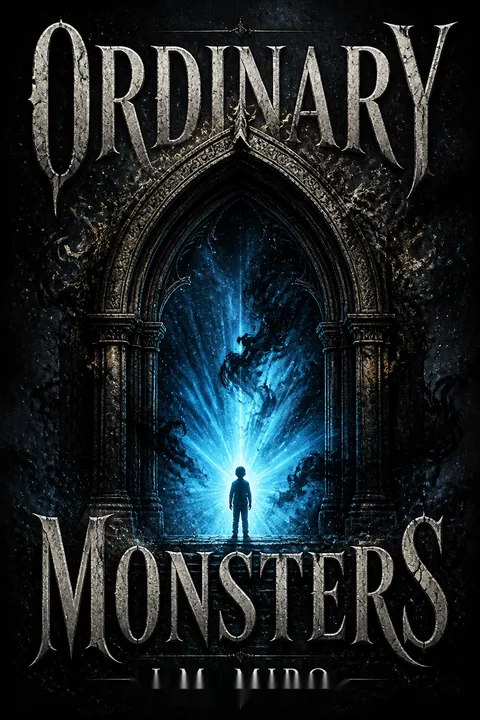


Plot Summary
Prologue
In 1874, fleeing the wealthy employer she has killed in self-defense, sixteen-year-old Eliza Grey climbs into a freight car and finds a dead woman beside a glowing newborn. She takes the baby, names him Marlowe, and builds a hard, makeshift family with him, the giant sideshow performer Brynt, and Reverend Walker.
As Marlowe grows, his blue light accompanies a frightening power: in a rage, he can melt flesh. Eliza hides this from the world, but the men hunting her find her again. When a bounty hunter arrests her, Marlowe touches his arm and reduces him to a mass of ruined flesh. Knowing the pursuit will never stop, Eliza leaves the sleeping boy with Brynt and disappears into the fog.
Eliza’s rescue is an act of recognition between two people the world has already treated as disposable. She gives Marlowe care without knowing what he is, while his frightening power makes that care increasingly dangerous. Her final departure is loving and devastating at once: she protects him by surrendering the place she has made for herself beside him. The prologue also establishes the book’s moral tension between difference and monstrosity. Marlowe’s gift can destroy, but the first person to fear what it may make him is the mother who has taught him that choice matters.
The Boy Who Cannot Die
In Natchez, sixteen-year-old Charlie Ovid waits manacled in a warehouse after a white overseer dies in a fall. The sheriff’s men have beaten and shot him, but his body keeps healing, so they plan to bury him alive rather than admit they cannot execute him. Alice Quicke, a former Pinkerton operative turned private detective, and her English partner, Frank Coulton, arrive under orders from the Cairndale Institute.
When the judge refuses to release Charlie, they return after dark. A deputy catches them in the cell; Charlie stabs him with a blade he has hidden inside his own arm, then escapes with Alice and Coulton. His violence horrifies Alice, but she chooses to take him anyway, setting their dangerous journey to England in motion.
Charlie’s rescue begins with a contradiction: his body can recover from wounds, but that capacity has made him more available for cruelty, not less. The town’s threat to bury him alive converts legal punishment into an effort to erase an inconvenient fact. Alice’s decision to return matters because she acts without a guarantee that Charlie will trust her or behave safely. The killing of the deputy is both self-defense and a trauma Charlie will carry. The scene introduces the novel’s central ethical question through action: whether a person’s unusual ability makes them a danger to others, or whether danger is often imposed on them first.
The Shining Boy
Coulton sends Alice alone to the Beecher and Fox Circus, where she finds Brynt and the pale, silent child Eliza raised as Marlowe. A birthmark identifies him as Stephen Halliday, the infant missing from a powerful Scottish family. Brynt resists giving him up, while Alice’s papers threaten legal consequences for the circus.
Marlowe chooses the name and guardian he knows, not the family Alice describes, and his refusal forces her to confront the cost of her assignment. Before leaving Remington, she visits the asylum where her mother lived and learns that Rachel died years earlier. That loss sharpens her guilt over lying to Marlowe, but she still takes him east, toward New York and the passage to England.
The circus encounter makes identity a contest between paperwork and attachment. Alice can prove Marlowe’s legal name, but the proof does not create trust or erase Brynt’s years of care. Brynt’s resistance is not simple possessiveness; she understands that sending a child toward powerful adults may expose him to new forms of control. Alice’s discovery that her mother is dead intensifies the scene without making her suddenly sentimental. She knows what it means to lose a family tie through neglect, yet she repeats a smaller version of that injury by deceiving Marlowe. The conflict asks whether good intentions can justify taking someone’s choices away.
Smoke Across the Rails
In New York, a man made of soot and shadow attacks Alice and Marlowe in their lodging house. They escape across the rooftops, and Marlowe heals Alice’s injured knee by taking the pain into his own body.
At the docks, he identifies the pursuer as Jacob Marber, the same frightening figure who has stalked him before, and sees him watching as their ship leaves. On the voyage to England, Marber boards their train. The litch Walter Laster also escapes his restraints, turning the carriages into a battlefield.
Brynt, who has secretly followed the boy from America, joins the fight and throws Walter from the train, sacrificing herself to keep him from reaching Marlowe. Alice is wounded, but Marlowe’s power drives Marber back as the train separates from the attacked cars.
The attack turns Marlowe’s gift from a private terror into an act of care: he heals Alice by accepting her pain, at real cost to himself. Alice’s protectiveness grows out of that exchange, not out of abstract duty. Brynt’s return completes the emotional break begun when she let the boy leave. She has followed him across an ocean, and her intervention proves that surrendering him did not mean withdrawing her love. The train’s physical division also divides the group’s fates: the children survive, but Coulton is lost in the carnage and the safety of ordinary travel is exposed as an illusion.
Komako’s First Loss
The story moves back to 1873, when Jacob Marber is still a young Cairndale agent. In cholera-stricken Tokyo, he meets Komako Onoe, a dustworker who uses swirling dust to make figures dance for her sick younger sister, Teshi. Jacob recognizes that Teshi is already dead and being held in the world by Komako’s love.
When Teshi wanders into a mob that believes her a demon, Jacob shields the sisters while Komako uses her gift openly to extinguish a torch and blind their attackers. She later accepts Teshi’s death, and Jacob brings her toward Cairndale. A stowaway girl called Ribs joins the voyage. On board, the drughr manipulates Jacob’s grief for his dead twin and alters his talent, beginning his transformation into its servant.
Komako’s story gives the later conflict a human history before it becomes a battle over artifacts and portals. Her love keeps Teshi near, but love cannot reverse death; accepting that limit is an act of care, not abandonment. Jacob sees the same wound through his own bereavement and mistakes the drughr’s promises for a way to repair it. The parallel is precise: both siblings are lost, but Komako grieves by releasing her sister, while Jacob is tempted to make grief into a project of control. His corruption begins not in abstract evil but in a longing that refuses to accept the finality he has already witnessed.
A Litch in London
In London, Charlie reaches the Cairndale house with Coulton, but the drugged, chained Walter Laster escapes and attacks him. Charlie fights through the streets until he knocks Walter from a bridge into the Thames. Injured and lost, he is found by two young scavengers, Gilly and Jooj, and taken to a warehouse where a gang of children works for the cruel Mr. Plumb.
Charlie helps them steal cargo, then intervenes when Plumb bends Gilly’s finger for losing a crate. A blow opens Charlie’s face; the wound closes before the children, who recoil and call him a monster. Charlie runs back into the fog. Coulton finds him on a bridge and brings him home, where Alice and Marlowe have arrived from America.
Charlie’s London ordeal repeats Natchez in a new key: even among children who have been abandoned, visible difference can turn a potential ally into an object of fear. His choice to defend Gilly costs him the fragile welcome he had just begun to receive. The healing that once kept him alive now isolates him, because the children interpret what they see through the same category used by his captors. Coulton’s return matters less as rescue than as recognition. He does not ask Charlie to prove he is harmless before bringing him back. The moment begins Charlie’s slow movement from solitary survival toward a chosen, if uneasy, community.
Cairndale’s Hidden Rules
At Cairndale, Charlie and Marlowe meet Komako, Ribs, Oskar, and their strict blind teacher, Miss Davenshaw. Lessons explain the five kinds of talent and the cost of using them, while the institute’s wards keep outsiders away. Alice learns that her childhood religious leader, Adra Norn, was not a supernatural talent, and that her mother’s faith in Norn helped end in tragedy.
Charlie discovers a file naming his father, Hywel Owydd, as a former Cairndale strong whose talent faded before he disappeared in London. Komako and Ribs then reveal that students have vanished without farewell. Charlie agrees to help them investigate, using his toughness to climb into Berghast’s study and search the records.
Cairndale offers shelter, but its order is built on restricted knowledge. The lessons promise that talent can be trained, while the rules insist that students remain divided and obedient. Charlie’s father’s file makes the institution intimate in a way its grand history cannot: Charlie’s search for belonging becomes a search for the person who left the same house before him. Alice’s conversation about Adra Norn exposes another kind of authority, religious certainty, as something that can exploit vulnerable people without possessing any miracle. The students’ investigation begins because the official account of safety no longer matches the evidence of empty beds and unfinished lives.
The Spider’s Warning
Charlie, Marlowe, Komako, Ribs, and Oskar break the rule against visiting the glyphic, an ancient being called the Spider, beneath the monastery on Cairndale’s island. The Spider’s roots restrain most of them, but it allows Marlowe to approach and shows him Alice in danger. It confirms that Jacob seeks the boy and warns that Jacob is the finder, not an easy target.
The encounter also gives Komako and Oskar fragments of a vision: the Spider is dying, and a sign points toward Albany Chandlers in Edinburgh. The children decide the missing students may be connected to that place. Their choice to investigate takes them beyond the institute’s protection and toward the adults’ concealed operations.
The Spider’s vision changes the children’s investigation from curiosity into a race against institutional collapse. Marlowe’s access to the glyphic is unusual, but the scene does not make that access reassuring: he sees Alice at risk and receives knowledge without the means to prevent it. The other children gain only fragments, which leaves them acting under uncertainty rather than following a complete prophecy. Their decision to go to Edinburgh reveals a growing distrust of adult explanations. The Spider is both a guardian and a dependent being, and the fact that Cairndale’s safety rests on its failing body makes the refuge’s order feel precarious rather than permanent.
The Nursemaid’s Secret
In London, Alice and Margaret Harrogate track down Susan Crowley, the nursemaid who once carried Marlowe away from Cairndale. Susan explains that Berghast sent talents through the orsine to map the land of the dead, using a protective artifact that was eventually lost.
During one expedition, Marlowe’s mother gave birth there; Jacob killed the parents, took the infant, and returned him through the passage. Susan stole the child from Cairndale to protect him, then survived an attack that left her scarred.
She gives Harrogate the two weir-bents, strange keys capable of releasing and containing a powerful creature. Harrogate hopes the keys can help stop Jacob, while Alice learns the child’s history is far stranger than the family story she told him.
Susan’s account reframes Marlowe’s disappearance as a chain of adults claiming to protect a child while making decisions over his head. Berghast’s experiments, Jacob’s intervention, and Susan’s escape each arise from a different motive, yet all leave the child displaced. The weir-bents embody that same ambivalence: they are instruments of protection, but also restraints on a living being. Alice has been carrying a lie about Marlowe’s identity; the fuller truth does not erase that betrayal, but it clarifies the danger that made the lie useful to the adults around him. Knowledge arrives as both revelation and accusation.
The Keys Unleashed
Harrogate releases the keywrasse, a many-eyed creature bound to the weir-bents, and leads Alice through Limehouse following a trail of mutilated bodies. In a sewer chamber they find Jacob, weakened but alert, and Alice sees Frank Coulton transformed into a litch under his influence. Marber recognizes the weir-bents and seizes the wooden key after Harrogate’s pistol wounds him.
The keywrasse attacks, but the drughr tears open a passage between worlds and escapes with Jacob and Coulton before Alice can stop them. Harrogate survives with severe injuries, but the wooden key is gone. The creature can no longer be safely controlled, and the women return to London knowing Jacob’s next target is Cairndale.
This confrontation makes the cost of treating people as tools impossible to ignore. Coulton, once the humane guide who rescued Charlie, is now reduced to a predatory body acting under another’s power. Alice’s grief is complicated by the fact that she must fight the friend she trusted. The keywrasse offers force without moral clarity: it can save them, but its restraint depends on keys whose control is slipping away. Harrogate’s injury and the stolen key leave the women with knowledge but little leverage. The fight does not resolve the threat; it reveals how much the institution’s plans have underestimated the beings they mean to contain.
The Baby in the Boxcar
A return to 1874 shows Jacob entering Cairndale through an underground tunnel with Walter’s help, determined to take the infant he believes Berghast will exploit. Jacob’s relationship with the drughr is already compromised, but he intends to hide the child rather than deliver him to her.
Susan Crowley, the nursemaid, has independently decided to flee with the baby after Berghast announces he will send him away. Jacob steals the infant first, then the child’s bright blue power overwhelms him on the hillside.
Susan finds the baby after Jacob is thrown aside and escapes toward Edinburgh. She eventually boards a freight train, where her strength fails and she dies beside him. Eliza finds that same crying, glowing baby, linking the opening rescue to the larger struggle.
The flashback complicates the simplest account of Jacob as a child-killer. His attempt to take the infant begins as a distorted rescue, born of distrust in Berghast and recognition of the child’s vulnerability, but his alliance with the drughr makes even protective intentions dangerous. Susan’s flight repeats Eliza’s later choice to shelter a foundling, connecting two women separated by circumstance and knowledge. The freight car becomes a hinge between private acts of care and the institution’s wider struggle. The same baby is successively treated as a weapon, a ward, and a helpless child, while the adults’ motives determine which identity they see.
The City Beneath London
Berghast sends Charlie and Marlowe through the orsine to retrieve a protective glove lost in the land of the dead. There they walk a drowned, overgrown version of London, evade spirits, and find a room where Charlie sees ghostly images of his parents and learns the ring he inherited is another artifact.
Jacob finds the boys in the hidden room and returns the glove, then tells Marlowe that the drughr is his mother and that Jacob once stole him to spare him. Jacob binds Marlowe and leaves to confront Berghast. Charlie’s hands begin trembling and losing color, so he returns alone with the glove. Berghast identifies Charlie’s ring as a second artifact but refuses to send a rescue party, leaving Marlowe trapped in the dead world.
The journey strips away ordinary measures of time and memory. Charlie’s encounter with his parents offers emotional recognition without restoring a relationship; the dead can appear, but they cannot return the childhood he lost. Jacob’s confession similarly complicates the story without absolving him: he once tried to protect Marlowe, yet still binds the child and abandons him to pursue Berghast. Charlie’s return is a painful exercise of limits. His body warns him that he cannot stay, but the adult decision to leave Marlowe behind becomes a guilt he cannot remember making clearly. Berghast’s refusal confirms that the institution values the artifact above the boy.
The Chandlers’ Captives
In Edinburgh, Komako, Ribs, and Oskar find Albany Chandlers, where Mrs. Ficke and her brother Edward keep several missing students alive in locked rooms. The children have been grotesquely altered after Berghast tried to restore their lost talents and remake them as replacement glyphics. Mrs. Ficke, herself an exile, cares for them because Cairndale abandoned them, though she still owes Berghast a debt.
She reveals his true plan: he means to draw the drughr into Cairndale and absorb its power, not destroy it. Meanwhile Charlie returns from the orsine, learns Berghast will not rescue Marlowe, and reunites with his friends. Marlowe also emerges from the dead world, exhausted, and Berghast takes him into his study as a lure.
The discovery at the chandlers turns the missing-student mystery into evidence of institutional violence. Berghast’s effort to preserve Cairndale has crossed into manufacturing replacement guardians from children whose talents have failed. Mrs. Ficke’s care for them is not a neat counter-institution; she remains entangled in debt and secrecy, but she refuses to let the abandoned become disposable. Her revelation about Berghast changes the meaning of his earlier work: protection is only part of his motive, and power is the deeper ambition. Marlowe’s return offers temporary relief, immediately compromised when Berghast treats him as bait rather than as a child who needs rest.
Cairndale Catches Fire
Jacob breaches Cairndale’s weakened wards while the institute burns and the old talents attempt to hold him back. Walter, driven by Jacob’s commands, reaches the island and tears out the glyphic’s throat, killing the guardian and ending the wards.
Charlie finds the dying body and removes its heart, but spirits seize and consume it before he can seal the orsine. At the cistern, Berghast wounds Marlowe and uses the glove to draw the drughr upward, hoping to absorb its power.
Alice and the children fight through Jacob, Walter, and the collapsing manor; the keywrasse attacks Jacob, while Alice shoots the litch Coulton at his own plea. Charlie stabs Berghast, who falls into the orsine. Marlowe then closes the passage, trapping himself beyond it as Cairndale collapses.
The climax gathers the novel’s competing ideas of care into one physical crisis. Walter’s loyalty to Jacob is exploited until it destroys the guardian who once protected Cairndale; Berghast’s stated defense of the institute is revealed as inseparable from his desire to appropriate the drughr’s power. Charlie’s failure to preserve the glyphic’s heart forces the decisive act onto Marlowe, whose unusual connection to the orsine lets him close it at the cost of remaining inside. Alice’s killing of Coulton is not victory but an act of mercy for someone whose body and agency have been taken. Cairndale’s destruction follows from adults’ efforts to control what they fear.
The Door Still Waits
After the island collapses, Charlie finds Miss Davenshaw alive among the ruins, but his healing talent is gone; Berghast’s grip has stripped it from him. He and Davenshaw leave Scotland before authorities arrive and take shelter at the abandoned Cairndale house in Nickel Street West.
Alice, Komako, Ribs, Oskar, and other surviving students later find them there. They tell Charlie that fifteen young talents escaped and are being sheltered by Susan Crowley, while the keywrasse has helped them flee.
The burned remains of Berghast’s journal point toward a second orsine, a passage that may still lead to Marlowe. Though Charlie is now ordinary and cannot know whether Marlowe survived, he insists on finding that door. Alice agrees to join the search.
The ending refuses the easy consolation of restored powers or a reunited family. Charlie’s lost healing gift places him alongside the exiles his father became, but it does not erase the relationships he has built or the knowledge he has earned. His insistence on searching for Marlowe transforms grief into a practical commitment, while Alice’s agreement shows that chosen kinship survives institutional ruin. The second orsine keeps the story unresolved without making the sacrifice meaningless: Marlowe sealed one breach and bought the living time, but the surviving characters now inherit the work of finding him. Hope here is not certainty. It is a plan made together.
Epilogue
Charlie and Miss Davenshaw leave the ruined Cairndale before the authorities arrive, carrying Berghast’s damaged journal to London. Charlie discovers that his healing is gone, but the loss feels smaller beside Marlowe’s sacrifice. Weeks later Alice, Komako, Ribs, and Oskar find them at Nickel Street West.
Alice explains that Susan Crowley is sheltering the surviving young talents. The journal contains a reference to another orsine, another route into the world of the dead. Charlie decides he will search for it and bring Marlowe back. Alice agrees to go with him, turning the survivors’ grief into a shared undertaking.
The epilogue gives survival a modest, unsentimental form. Cairndale is gone, the adults who organized its protections are dead or missing, and Charlie’s body no longer offers the invulnerability that once defined him. Yet he is not returned to the isolation with which he began. The others arrive because they have chosen one another, and Alice’s agreement makes that chosen family active rather than merely comforting. The second orsine is a narrative opening, but also an ethical one: the survivors must decide what kind of refuge to build after witnessing how the old one failed. Their hope depends on knowledge, cooperation, and the refusal to treat Marlowe as expendable.
Analysis
Ordinary Monsters repeatedly asks whether protection becomes another form of violence when the protected person has no say. Eliza, Brynt, Susan, Alice, and even Jacob each try to save Marlowe, but their choices differ sharply: some recognize his need for attachment, while others turn him into evidence, leverage, or a route to power. Cairndale embodies this contradiction. It shelters children persecuted elsewhere, teaches them to control dangerous gifts, and quietly subjects them to surveillance and experimentation. Its collapse is therefore not simply the defeat of a refuge. It exposes a refuge whose safety has depended on hidden costs and a single guardian’s failing body.
The novel’s treatment of grief is equally concrete. Komako accepts that love cannot restore Teshi; Jacob cannot accept that limit and follows the drughr’s promise of reunion into corruption. Charlie’s search for his father meets only partial records and a brief vision, not a recovered family history. Marlowe’s sacrifice offers no easy resurrection, only a possibility that he remains alive beyond the sealed passage. These losses resist the fantasy that knowledge or power can undo death. The characters’ meaningful choices are instead acts of care made under limits: returning for a prisoner, sheltering a foundling, refusing to abandon a friend, or accepting another person’s claim to choose.
The book also questions how institutions manufacture monstrosity. Charlie is called a monster when his wounds close; the altered students at Albany Chandlers are victims of an experiment meant to make replacement guardians; the drughr is terrifying, but Berghast’s ambition proves no less dangerous. Appearance and ability never settle moral worth. By the end, Charlie has lost the talent that once defined his body, yet he remains capable of loyalty, judgment, and action. The closing search for another orsine shifts heroism away from exceptional power toward shared responsibility. The survivors cannot restore Cairndale or guarantee Marlowe’s return, but they can refuse the secrecy and disposability that helped destroy it.
Review Summary
Ordinary Monsters receives mixed reviews with an average 3.78/5 rating. Readers praise its atmospheric Victorian gothic setting, complex characters, and unique magic system about children with supernatural "talents" attending Cairndale Institute. Many appreciate the emotional depth and memorable scenes, noting the book stays with them long after finishing. However, critics cite significant issues: excessive length (672 pages), slow pacing, sprawling cast, and confusing plot elements. Some find it derivative of X-Men and similar works, while others struggle with the 24+ hour audiobook. Despite flaws, fans value its world-building and found-family themes, eagerly anticipating the trilogy's continuation.
People Also Read

Characters
Marlowe
The shining childRaised by Eliza Grey and then loved by Brynt, Marlowe is a quiet, watchful child who has spent his life being moved between adults with competing claims over his future. His blue glow accompanies a power that can heal by transferring pain and can also become frighteningly destructive. He worries about losing control and about being different, yet he notices other people’s fears with unusual care. His attachment to Brynt and his growing bond with Charlie give him a sense of family that does not depend on blood or legal papers. Marlowe’s central drive is not power but belonging without surrendering the right to choose who he becomes.
Charlie Ovid
The unbreakable survivorCharlie is a young Black man who has survived poverty, racism, violence, and the loss of his mother by relying on vigilance and self-containment. His body heals from wounds, but he still feels the pain, and his talent cannot repair grief or shame. He carries his mother’s ring as his last link to her and becomes determined to understand the father he never knew. Charlie distrusts easy promises, particularly from powerful adults, yet his impulse to defend weaker children repeatedly draws him into relationships. His bond with Marlowe unsettles his belief that needing nobody is safer, and gives his survival a purpose beyond simply enduring.
Alice Quicke
The hard-edged detectiveAlice is a former Pinkerton operative whose bluntness, physical courage, and investigative skill have helped her survive a world designed to underestimate women. Cairndale hires her to locate unusual children, and she begins the work with little knowledge of what the institute truly is. Her own childhood under her mother’s religious obsession has left her skeptical of claims about miracles and wary of anyone who uses belief to control others. Alice dislikes attachment because it creates another way to be hurt, but her care for Marlowe and loyalty to Coulton draw her into risks she cannot dismiss as merely professional. She trusts actions more than explanations and keeps revising her judgment when evidence changes.
Jacob Marber
The fallen dustworkerJacob is a gifted dustworker shaped by an impoverished childhood and the death of his twin brother, Bertolt. He was once brought to Cairndale by Henry Berghast and taught to use his talent, then sent out to find other children like himself. His grief leaves him vulnerable to the drughr’s promise that the dead can be reached again. Jacob is intelligent, persuasive, and capable of tenderness, but those qualities coexist with a growing willingness to decide other people’s fates for them. He sees himself as protecting the weak from institutions that exploit them, even as his methods increasingly reproduce the violence he claims to oppose.
Brynt
Marlowe’s fierce guardianBrynt is a giant, tattooed American performer who has spent much of her life among people whom ordinary society treats as curiosities. Her physical strength is matched by a practical tenderness, especially toward Marlowe, whom she helps raise after Eliza disappears. She knows that difference attracts both fear and exploitation, so she teaches the boy caution while trying not to make him ashamed of himself. Brynt has lived through loss and displacement, and she recognizes that affection is not ownership. Her bond with Marlowe gives her a home inside a life spent traveling, while her blunt humor keeps grief from becoming the only language she has.
Komako Onoe
The disciplined dustworkerKomako is a Japanese girl whose talent lets her shape and animate dust. She grew up caring for her younger sister, Teshi, in a Tokyo theater, learning early to hide her gift from people who might call it witchcraft. Grief and guilt make her guarded, sometimes sharp with anyone who tries to get close. At Cairndale she becomes a student and a protector of the younger children, while her friendship with Ribs gives her room to be less solemn. Komako distrusts simple answers because she has seen love fail to cure illness and institutions fail to keep promises. Her control of dust reflects a deeper effort to control what grief can make her do.
Henry Berghast
Cairndale’s brilliant directorBerghast is the powerful, intellectually restless director of Cairndale, a man whose long experience has made him both formidable and difficult to read. He studies talents and the passage between worlds with the conviction of a scientist who believes knowledge can prevent catastrophe. His manner is controlled, his attention intense, and his language often makes personal decisions sound like necessary policy. He believes the institute protects children, but he also treats their abilities as resources in a larger design. The tension between his genuine responsibility and his ambition makes him difficult to classify as either guardian or enemy. He is most dangerous when convinced that his purpose excuses his methods.
Margaret Harrogate
Cairndale’s London agentMargaret Harrogate manages Cairndale’s affairs in London, finding children, maintaining records, and handling the practical consequences of the institute’s secrecy. A prominent birthmark and a lifetime of being judged by appearances have made her unsentimental about other people’s discomfort. She is capable of tenderness, but expresses it through work, discipline, and the effort to keep vulnerable people alive. Her loyalty to Berghast is long-standing, though not unquestioning; she notices when his purposes begin to change. Margaret’s grief over her own childless life makes her especially sensitive to the costs adults impose on children while claiming to protect them.
Frank Coulton
The gruff rescuerCoulton is an English investigator and Alice’s partner in locating children for Cairndale. His gruff manner and bright waistcoats conceal a steady sense of fairness; he treats Charlie with respect in a world that rarely offers it. His strength talent can make his body exceptionally dense, though using it brings a suffocating sensation. Coulton prefers practical kindness to grand declarations and earns trust by returning for people when doing so is dangerous. His history with Jacob gives him insight into the man Jacob once was, but it also makes his loyalty to Cairndale personally complicated.
Eleanor Ribbon, called Ribs
The invisible streetwise girlRibs is a sharp-tongued young talent who can make herself invisible. She has survived by relying on quick observation, nerve, and a willingness to go where more cautious people will not. Humor is her shield, but it is also how she tests whether others can tolerate her without trying to manage her. She is close to Komako and becomes an unexpected ally to Charlie, whose earnestness she teases but respects. Ribs resists authority and dislikes being treated as a child, yet she is more loyal than her jokes suggest. Her skill makes her an ideal scout and a habitual eavesdropper.
Oskar Czekowisz
The lonely makerOskar is a shy Polish boy who can animate a creature from dead flesh and other remains. His companion, Lymenion, follows his movements and gives him a presence that others often find frightening. Oskar’s deepest fear is being left alone, a fear he rarely states directly. At Cairndale he hopes for friendship but worries that his talent and his companion will repel people. His gentleness contrasts with the grotesque appearance of what he creates. Oskar often notices emotional details others overlook, and his loyalty grows into courage when his friends need him.
Abigail Davenshaw
The blind governessMiss Davenshaw teaches and disciplines Cairndale’s young talents. Blind since birth, she navigates through sound, touch, memory, and an exact knowledge of the manor. Her strictness is not coldness; she believes children need education and practical control over gifts that can frighten or injure them. She refuses to flatter students or excuse them from learning, but treats their difference as part of nature rather than evidence of monstrosity. Her own unusual education gave her intellectual independence, and she brings that independence to a place where even its leaders expect obedience.
The drughr
The hunger beyond deathThe drughr is an ancient, predatory presence associated with the world beyond Cairndale’s sealed passage. It approaches through dreams, shadows, and the people it influences, offering them what they most desperately want. Its power and motives remain difficult for ordinary characters to understand, which makes it more unsettling than a conventional enemy. It feeds on talents and seeks a stronger foothold in the living world. The drughr is not merely a monster to be fought; it exploits grief, fear, and the human wish to undo loss, turning intimate vulnerabilities into instruments of control.
Walter Laster
Jacob’s litch companionWalter is a lonely, sickly man whose devotion to Jacob grows from a rare experience of friendship. His body changes after death, leaving him fast, pale, and predatory, while his mind remains caught between affection, confusion, and the voices that influence him. Walter’s need to be wanted makes him vulnerable to Jacob’s promises, even when Jacob’s actions place him in danger. His story reflects the book’s concern with what remains of a person when the body and memory are altered, and whether loyalty can survive when the person receiving it no longer returns it.
Susan Crowley
The protective nursemaidSusan Crowley nurses Marlowe as an infant at Cairndale and becomes determined to protect him from the adults who treat him as a problem to manage. Her own child died young, leaving her acutely aware of how quickly a dependent life can be taken from its caregiver. Susan is not an expert in the institute’s strange powers, but she trusts her judgment when Berghast’s plans feel wrong. Her willingness to flee with Marlowe comes from practical care rather than grand ideas about destiny. She is one of the people whose ordinary compassion redirects the course of the larger conflict.
Eliza Grey
The fugitive foster motherEliza is a poor, uneducated young woman escaping abuse when she finds Marlowe in a freight car. She has little security herself, yet responds to the helpless infant with fierce, uncomplicated care. Her upbringing has taught her that the vulnerable are often treated as property, which makes her protectiveness quietly defiant. Eliza raises Marlowe with Brynt’s help and tries to teach him that his power does not decide his character. The danger surrounding her eventually forces her to leave him, making her love inseparable from a painful act of relinquishment.
Teshi Onoe
Komako’s beloved sisterTeshi is Komako’s younger sister, a playful child whose illness gradually makes her distant from ordinary life. She adores Komako’s dust figures and sees wonder where her sister sees risk. Her closeness to the dead and her persistent coldness suggest that her condition is more complicated than a common illness, though neither girl has the knowledge to explain it. Teshi’s dependence gives Komako a reason to hide her talent and a painful limit to confront. Her presence shapes Komako’s later caution, grief, and reluctance to trust people who claim they know what is best.
Mrs. Ficke
The exile alchemistMrs. Ficke is a former Cairndale talent who now runs Albany Chandlers and pursues alchemical work outside the institute’s approval. Her body bears the signs of a hard life, and she uses a mechanical claw to compensate for a missing hand. She is suspicious, plainspoken, and unwilling to accept pity, but she shows practical tenderness toward the altered students in her care. Her loyalty to Berghast is bound to an old debt rather than admiration. Mrs. Ficke understands that institutions can preserve people and still damage them, so she builds a small refuge for those the institution discards.
Lymenion
Oskar’s flesh companionLymenion is the flesh creature Oskar makes from dead material. He mirrors Oskar’s gestures, communicates with him without ordinary speech, and remains his most constant companion. Others may find his shape and smell disturbing, but his manner is loyal and gentle unless Oskar is threatened. Lymenion gives physical form to Oskar’s fear of loneliness, while also demonstrating that an unsettling appearance does not determine a creature’s character.
Mr. Thorpe, the glyphic
The island’s living guardianKnown to the students as the Spider, Mr. Thorpe is an ancient glyphic whose roots and perception extend through Cairndale and its island. He can sense the web connecting talents and help locate children who have not yet been found. His presence maintains the wards and helps keep the passage between worlds closed. The students fear and revere him, but he is also a being carrying an immense burden. His warnings are delivered through dreams and visions, which makes his guidance powerful but never simple to interpret.
Hywel Owydd
Charlie’s absent fatherHywel Owydd was a Welsh talent at Cairndale whose strength ability disappeared before he vanished in London. Charlie knows him first through an incomplete file and the ring he gave Charlie’s mother. His absence has shaped Charlie’s questions about where he belongs, though the records offer no satisfying account of why he left or what became of him.
Adra Norn
The charismatic preacherAdra Norn leads a women’s religious community and attracts followers through conviction, force of personality, and claims about divine power. Alice’s mother becomes devoted to her, and the childhood Alice spends at Bent Knee Hollow leaves lasting marks on her understanding of faith and authority. Norn’s influence rests on people’s need for safety and meaning, making her dangerous even without supernatural abilities.
Edward Albany
The quiet shopkeeperEdward Albany runs a chandlery in Edinburgh with his sister, Mrs. Ficke. He is large, quiet, and seems to understand people more through routine and gesture than conversation. Though capable of violence when protecting the shop, he also handles the vulnerable students in his care with surprising gentleness.
Bailey
Berghast’s silent servantBailey is Berghast’s imposing manservant, secretary, and keeper of the institute’s less visible routines. His silence and watchfulness make the children wary, and he carries out orders without offering explanations. He represents the practical machinery that allows Berghast’s authority to reach into every room of Cairndale.
Plot Devices
The Cairndale talents
Gifts with bodily costsTalents are unusual abilities connected to dead tissue, divided into five broad kinds: clinks, casters, turners, dustworkers, and glyphics. Charlie’s body regenerates, Komako manipulates dust, Ribs becomes invisible, and Oskar animates a flesh companion. The gifts can be trained, but using them causes pain and may shorten a talent’s life. Some abilities fade as their users reach adulthood, making exiles of those who lose them. The category system helps the institute teach and classify its students, but it also shows how easily useful knowledge can become a means of controlling people.
The orsine
A passage between worldsThe orsine is a living boundary between Cairndale and the land of the dead. Mr. Thorpe, the glyphic, helps keep it sealed, while Cairndale’s wards protect the manor and its residents. The passage can be opened, crossed, and, under extraordinary conditions, closed. Time and memory behave differently on its far side, where spirits gather in a shifting city shaped like a ruined version of the living world. The orsine makes the novel’s mysteries literal: grief, memory, and mortality become places characters can enter, but crossing does not guarantee a safe return.
The weir-bents
Keys that bind a creatureThe weir-bents are two strange vessels shaped like keys. One can release the keywrasse through a locked door, while the other can return it to confinement. The creature is intelligent and capable of changing size and form, making it both a potential ally and a danger. Alice’s exposure to Jacob’s dust gives her a connection to the keys and the creature, though that connection brings no simple command over it. Their function complicates the idea of a weapon: using them may help stop a threat, but it also means deciding whether a powerful being should remain captive.
The glyphic’s web
A network for finding talentsThe glyphic senses connections among talents and follows their disturbances like a spider feeling movement in a web. This ability helps Cairndale locate children scattered across the world and gives the institute a means of finding people who have no official records. The same network allows visions and warnings to reach the students, though these arrive as fragments that demand interpretation. Because the glyphic also sustains Cairndale’s wards, the institute’s protection depends on one aging being whose work cannot continue indefinitely.
The artifacts
Tools for crossing and changingThe black iron-and-wood glove and Charlie’s mother’s altered ring are artifacts connected to the passage between worlds. The glove protects a wearer crossing the orsine and contains knowledge that Berghast has sought for years; the ring helps Charlie survive the dead world. Their dark materials resemble the weir-bents, but their purposes are different. The artifacts link Charlie’s personal history to Cairndale’s buried experiments, turning an inherited keepsake into evidence and protection. They also give Berghast a means to pursue power, so their value depends on who uses them and why.
The Talents Trilogy Series
Download PDF
Download EPUB
.epub digital book format is ideal for reading ebooks on phones, tablets, and e-readers.








