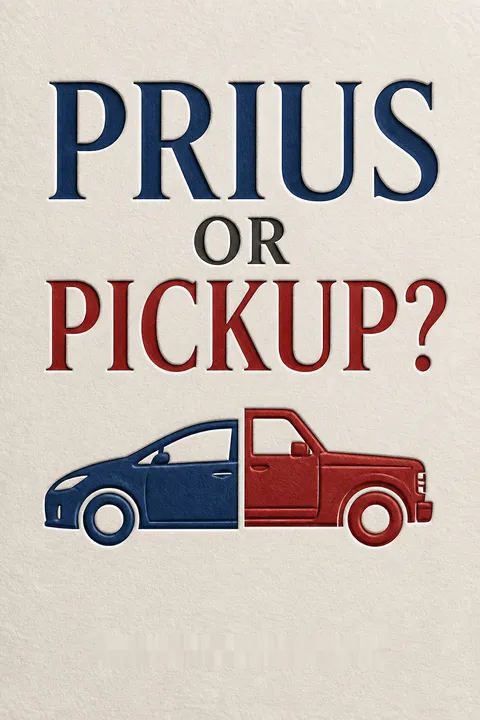


Key Takeaways
Treat Prius-versus-pickup tastes as clues to worldview, not mere consumer quirks
A deeper pattern. The book argues that familiar choices, from cars and meals to music and baby names, can reveal how safe or dangerous people feel the world to be. Those preferences are not usually political statements. Rather, the same outlook shapes both lifestyle and voting. In a 2016 survey, nearly 80 percent of Trump supporters chose the view that threats should be the priority; nearly 80 percent of Clinton supporters chose the view that the world is mostly welcoming.
Two outlooks, one divide. The authors call the poles fixed and fluid. Fixed people favor familiarity, caution, and boundaries; fluid people are more open to novelty and difference. The categories describe tendencies, not every individual. The central claim is that private taste and public politics increasingly echo the same underlying orientation.
The useful shift is from treating cultural preferences as superficial to seeing them as social signals with emotional meaning. A car or dinner choice can hint at what someone values, but it cannot reliably diagnose an individual. The book's strongest claim concerns broad patterns across groups, not a rule for reading strangers. That distinction matters: once tastes become political shorthand, people may mistake a cue for a complete account of someone's character. The framework helps explain why politics feels personal, while also warning against turning every preference into evidence for a stereotype.
Use child-rearing priorities to map how people manage uncertainty
Four revealing choices. Researchers ask people to choose which quality matters more for a child: independence or respect for elders, obedience or self-reliance, curiosity or good manners, and considerateness or good behavior. Choosing the first quality in each pair signals a more fluid outlook; choosing the second signals a more fixed one. The choices reveal not just a view of parenting, but a belief about whether children need latitude to explore or firm guidance to stay safe.
A spectrum, not two camps. Across the authors' surveys, roughly 42 percent fell on the fixed side, 32 percent on the fluid side, and 26 percent in the middle. The strictest labels apply to people choosing all four qualities from one side. Most people are not pure examples of either type, and the middle group is often closer to fixed views on race and immigration than fluid observers expect.
The questions are powerful because they translate an abstract worldview into ordinary trade-offs. They also make the model easy to study at scale, unlike laboratory measures requiring specialized equipment. Still, parenting preferences can reflect culture, personal experience, and ideas about good manners, not only threat sensitivity. The categories are best used as a compact map of tendencies, not as a psychological verdict. Their value lies in showing how beliefs about safety and social order can appear in answers that respondents may not think of as political.
Treat biological differences as predispositions, not political destiny
Bodies respond differently. Research discussed in the book links conservative identification, on average, with stronger attention to threatening images and stronger startle and disgust responses. In one eye-tracking experiment, conservatives spent substantially longer than liberals looking at threatening images relative to positive ones. Other studies linked stronger startle responses with more racial resentment among white participants, and stronger disgust responses with more negative views of homosexuality.
Context still matters. The authors connect these differences with personality traits: openness to new experiences tends to align with fluid outlooks, while conscientiousness and preference for order tend to align with fixed ones. But physiology does not dictate a person's beliefs. Family, community, and life experience also shape political development, and the laboratory studies often relied on small samples. The argument is about tendencies that can interact with environment, not an inborn party affiliation.
This distinction between predisposition and destiny is essential. It offers a way to understand why political disagreement can feel immediate and bodily without excusing prejudice or treating political identity as fixed by biology. The evidence also calls for restraint: small laboratory studies can illuminate mechanisms, but they cannot establish the political character of an entire population on their own. The authors strengthen their case by connecting experimental findings with larger surveys, yet the safest conclusion remains probabilistic. A reflex may shape the first reaction; social norms and conscious choices shape what follows.
Notice how parties turned cultural outlook into political identity
A historical realignment. Mid-century party conflict centered more on taxes, spending, and government programs, leaving people with different worldviews inside both parties. The upheavals of the 1960s and 1970s changed the terrain. Republicans increasingly appealed to tradition, hierarchy, and resistance to cultural change; Democrats increasingly embraced civil rights, feminism, and changing social norms. In 1969, 18 of 22 Southern senators were Democrats. By the start of the 2017 Congress, 19 of the 22 were Republicans.
Labels do not explain everything. The authors distinguish operational ideology, views about the size and role of government, from symbolic ideology, the identity expressed through labels such as liberal or conservative. Many voters who call themselves conservative favor government spending on particular programs, yet still vote Republican because the party fits their cultural outlook. By 2016, 71 percent of fluid respondents identified as Democrats, while 60 percent of fixed respondents identified as Republicans.
This account explains why party identity can remain stable even when a party's economic program does not match a voter's preferences. Political identity can bundle policies with religion, tradition, and group belonging, making it easier to recognize than a consistent theory of government. The history also complicates simple stories about voters changing: party leaders and platforms changed, too. The framework is persuasive when it separates economic policy from cultural identity, though those dimensions are not fully independent. A voter may care about both, and the balance can shift with events and party cues.
Ask whether opponents fear disorder or fear exclusion
Different problems, different cures. Fixed people are more likely to see danger in disorder and change, and to favor hierarchy, firm rules, and decisive leaders. Fluid people are more likely to see exclusion and discrimination as the danger, and to favor openness and negotiation. The same proposal can therefore look protective to one side and threatening to the other. The book illustrates this with foreign policy: 75 percent of fluid respondents preferred diplomacy to projecting strength, while 60 percent of fixed respondents preferred projecting strength.
Certainty has political appeal. A preference for cognitive closure, meaning a desire for clear answers and reduced ambiguity, can make direct, uncompromising leadership attractive. Related divides appear in views of biblical interpretation and constitutional interpretation: fixed respondents favor literal readings more often, while fluid respondents are more open to interpreting texts in changing contexts. Each side can mistake the other's preferred remedy for evidence of bad faith.
This is a practical tool for understanding disagreement: identify the threat each side believes it is preventing before debating its proposed solution. It does not require pretending that all claims are equally sound. It does make room for the possibility that people can reach opposing conclusions from different priorities, rather than from sheer malice. The framework also has limits. Calls for order can preserve unjust hierarchies, while appeals to openness can understate real security concerns. Understanding motives is a starting point for judgment, not a substitute for evaluating consequences.
Restore everyday contact across the neighborhoods politics has sorted
Daily life separates people. Fluid Americans are more likely to prefer dense cities; fixed Americans are more likely to prefer suburban and rural settings. Work, education, and religion reinforce the pattern. So do smaller tastes: coffee shops, food, entertainment, and cars can all sort people into familiar cultural worlds. In 1976, fewer than one-quarter of Americans lived in counties where one presidential candidate won by at least 20 points; by 2012, more than half did.
Contact can loosen stereotypes. The authors describe evidence that personal interaction can reduce prejudice, along with a door-to-door study in which conversations about transgender people improved attitudes by about 10 points, with the change still present three months later. Robert Putnam's distinction helps explain the stakes: bridging social capital connects people across groups, while bonding social capital strengthens ties within a group. Homogeneous routines tend to build the second more readily than the first.
The argument connects geography and social psychology: distance leaves stereotypes less likely to meet correction. Contact is not automatically harmonious, and the book itself shows that residential choice reflects more than politics. Yet structured interaction can give people a specific person and story to consider, rather than an imagined outgroup. The practical implication is not that everyone must share a neighborhood or hobby. It is that institutions, schools, and local groups can create repeated, meaningful contact where daily life otherwise keeps citizens apart.
Recognize party loyalty as a powerful source of social prejudice
Teams become personal. In the Robbers Cave experiment, researchers randomly divided boys at summer camp into two groups, then set them against each other in competitions. The boys quickly developed hostility toward the rival group. The authors use the study to explain how political parties can become more than policy coalitions: when worldview and party identity align, the other side can feel like a threatening social group.
Party bias has spread. In 1960, only about 4 to 5 percent of Democrats and Republicans said they would be concerned if a child married someone from the other party. By 2010, about one-third of Democrats and nearly half of Republicans expressed concern. In a separate experiment, partisans often favored a less-qualified scholarship applicant from their own party over a more-qualified opponent. The authors call this kind of partisan hostility partyism.
The camp study makes tribalism vivid because the boys began as strangers with no inherited grievance. Political parties, unlike arbitrary camp teams, do represent real policy differences, but social identity can magnify those differences until opponents seem morally alien. That matters for hiring, family relationships, and civic trust, not only elections. The caution is that partyism should not be used to claim that other forms of prejudice have disappeared. The book's comparison is about intensity in particular measures, not a ranking that makes racial or religious discrimination harmless.
Do not mistake partisan confidence for evidence-based conviction
Beliefs follow belonging. Motivated reasoning is the tendency to interpret information in ways that protect existing beliefs and identities. The book gives a striking economic example: just after Donald Trump won the 2016 election, the share of Republicans who said the economy was improving tripled, from 16 percent to 48 percent. No new economic report appeared in those few days; the election result had changed.
Media intensify the loop. Partisan news can reinforce views, and conversations can spread its effects to people who never watched the original report. In one study described by the authors, people exposed to partisan material made same-party discussion groups more extreme; groups that included both parties reduced this secondhand effect. The book also notes an uneven media landscape, with many conservatives relying heavily on Fox News while liberal audiences used a broader mix of sources.
The strongest insight here is social: information travels through relationships, not just screens. A person can absorb a partisan frame from a friend without choosing a partisan news source directly. That makes mixed groups valuable as a check on rapid consensus. At the same time, the evidence does not mean every partisan is unreachable or every source outside the mainstream is false. Corrections can improve factual beliefs without changing political choices. Accuracy, trust, and action are related, but they are not the same outcome.
Expect fear to pull the political middle toward coercive answers
Threat changes priorities. The authors argue that fear can make people across the worldview spectrum more willing to trade civil liberties for protection. Among fluid respondents who feared terrorism, support for torture rose from about 20 percent to nearly 70 percent; support for warrantless wiretapping rose from 17 percent to 50 percent. Fixed respondents were already more supportive of security-first policies, so fear moved the fluid and mixed more dramatically toward them.
The middle is not automatically liberal. On race and immigration, mixed respondents often held views closer to the fixed than to the fluid. The book also reports that only 45 percent of mixed respondents considered a strong leader unconstrained by Congress and elections very bad, compared with 70 percent of fluid respondents. This helps explain why appeals to safety and force can attract support beyond a narrow group of committed authoritarians.
This insight is a warning against assuming democratic principles remain equally strong under pressure. People may endorse due process or free expression in the abstract, then accept restrictions when danger feels immediate. The authors' account makes fear a political condition, not merely a personality trait. It also suggests why leaders benefit from portraying ambiguous situations as emergencies. The data describe attitudes in specific surveys, however, and should not be read as proof that fear always produces authoritarian preferences. Institutions and public debate can still constrain what leaders do.
Remember that group identity can outweigh worldview in minority voting
Worldview does not decide alone. African Americans are among the groups most likely to express fixed answers to the parenting questions, yet they overwhelmingly vote Democratic. The authors explain this mismatch through group identity: Republican appeals and policies have often seemed hostile to Black Americans, so worldview alone cannot predict their party choice. Similar pressures shape Latino and Asian American voting, especially as Republican rhetoric has become more restrictive toward immigrants.
Identity responds to treatment. In one experiment, Asian American participants who experienced a subtle suggestion that they might not be citizens identified more strongly with Democrats afterward. The broader point is not that all minorities share one outlook, but that perceived welcome or hostility affects political belonging. The book also argues that economic debates, including welfare and health care, have become entangled with racial assumptions about who benefits and who deserves help.
This is an important correction to any two-camp model. A worldview may shape policy preferences, while a group's history with a party shapes whether that party feels like a viable home. The same person can favor hierarchy in family life and reject a party perceived as threatening their community. The framework is most useful when it tracks both forces instead of treating group identity as an exception. It also clarifies why racial politics can influence debates presented as purely economic without implying that every supporter holds the same motive.
Watch political entrepreneurs turn latent fear into new party fault lines
Europe offers a warning. The book finds a similar fixed-fluid divide in Germany, France, Britain, and Denmark, especially around immigration and national identity. In Germany's 2017 election, 28 percent of fixed respondents voted for the Alternative for Germany, compared with 2 percent of fluid respondents. The Green Party drew 25 percent of fluid voters and 2 percent of fixed voters. The authors argue that populist leaders did not create public unease from nothing; they made existing concerns more politically salient.
Conflict can also win rights. The book does not argue that all polarization is harmful. Disruptive movements helped secure civil rights, women's rights, and LGBT rights. Its closing challenge is to reduce destructive tribalism without confusing social peace with justice. Possible sources of change include cross-group contact, new grassroots movements, and shifts in political incentives that make leaders answer for division rather than profit from it.
The European comparison shows how political divisions can travel across countries while taking local forms. The common mechanism is not identical policy, but the elevation of identity and belonging into central political questions. The conclusion's nuance is valuable: reducing hostility should not mean silencing conflicts that expose unequal treatment. A healthier goal is to preserve principled disagreement while preventing opponents from being cast as enemies. That requires more than better manners. Institutions and political incentives shape whether leaders gain from cooperation or from keeping fear active.
Analysis
The book's central contribution is to connect political polarization with a broader psychology of safety, order, and openness. Its fixed-fluid distinction explains why political identities can feel more intimate than policy preferences: a party can seem to defend not only a preferred government, but a preferred way of living. The four parenting questions make that argument unusually concrete, while the book's examples trace the same divide from reflexes and religious commitments to neighborhoods, media, and elections.
The model is strongest as an account of alignment, not as a claim that two psychological types exhaust political life. The authors repeatedly acknowledge mixed outlooks, minority group identities, and the role of party elites. Those qualifications matter. Their own evidence shows that worldview does not mechanically determine party choice, and the political meaning of a parenting answer may vary across racial and cultural settings. A measure that works well in one population should not be treated as a universal diagnostic without further validation.
Causality is another important limit. The book argues that worldview shapes both political and nonpolitical preferences, but some of the cited evidence is correlational. Parties, communities, and media can also teach people which preferences belong together. The most plausible account is therefore reciprocal: predispositions shape political attraction, while party identity and social environments reinforce those predispositions. This helps explain why a pattern can become powerful without being inevitable.
The book is also normatively useful because it resists the comforting idea that democratic danger comes only from a fringe. Fear can make ordinary people accept coercive remedies, while majority opinion can remain less inclusive than fluid voters assume. Yet understanding this mechanism must not flatten moral distinctions. Explaining why exclusion feels protective does not excuse exclusion, and recognizing the value of conflict does not justify permanent tribal hostility. The lasting lesson is to examine which perceived threat a political appeal activates, whose safety it promises, and whose rights it places at risk.
Review Summary
Prius or Pickup? explores America's political divide through the lens of "fixed" and "fluid" worldviews. The authors argue that these perspectives shape consumer choices, political affiliations, and social attitudes. While some readers found the premise insightful and well-supported by data, others criticized the book for oversimplification and bias. Many appreciated the book's analysis of polarization but felt it lacked solutions. The writing style received mixed reviews, with some finding it repetitive. Overall, readers found the book thought-provoking, even if not all agreed with its conclusions.
People Also Read








Glossary
fixed worldview
caution and order orientationA worldview in which the world is perceived as relatively dangerous and unpredictable. People with this orientation tend to favor familiarity, hierarchy, clear rules, and caution toward outsiders or social change. In the book, the term describes a tendency linked to political preferences, not a diagnosis or a claim that every person in this category thinks alike.
fluid worldview
openness to changeA worldview in which the world is perceived as comparatively safe to explore. People with this orientation tend to value curiosity, independence, social change, and openness to people who differ from them. The book uses fluid to describe one end of a spectrum, not a guarantee of tolerance or flexibility in every political dispute.
mixed worldview
middle of the spectrumA position between fixed and fluid worldviews, generally reflected in a mixture of answers to the four child-rearing questions. Mixed respondents are not simply halfway between the two poles on every political issue. The authors find that on race and immigration, their views are often closer to fixed respondents' views than fluid respondents expect.
worldview
basic outlook on lifeA person's underlying beliefs about the nature of the world and the priorities of a good society. In this book, worldview especially concerns how dangerous or safe people perceive their surroundings to be, and how they think people should respond. It is shaped by psychological tendencies, personal experience, and social environment, and can influence both political and everyday preferences.
parenting questions
four worldview indicatorsA set of four survey questions asking respondents to choose between paired qualities they value in children: independence or respect for elders, obedience or self-reliance, curiosity or good manners, and considerateness or good behavior. The pattern of choices offers researchers a concise measure of fixed or fluid tendencies, especially beliefs about order, independence, and how children should navigate risk.
cognitive closure
preference for clear answersA psychological preference for definite answers and reduced ambiguity. The book links a stronger need for closure with a desire for order and certainty, which can make firm rules, literal interpretations, and decisive leadership more appealing. The term describes a tendency in how people respond to uncertainty, not an inability to reason or consider evidence.
symbolic ideology
political identity labelA person's broad self-description as liberal or conservative, often tied to cultural values and identity. The book distinguishes this from operational ideology, or preferences about the scope and spending of government. A person may identify symbolically as conservative while favoring public spending on particular programs, then vote according to the party that better fits their cultural outlook.
operational ideology
policy preferences on governmentA person's views about specific government actions, including taxation, spending, and the size or scope of public programs. The book contrasts operational ideology with symbolic ideology, the political label people use to express a broader identity. The distinction helps explain why self-described conservatives or liberals may hold policy preferences that do not match their label.
partyism
prejudice across party linesStrong negative bias toward people who identify with the opposing political party. The authors use the term for hostility that goes beyond policy disagreement and affects judgments about marriage, trust, or who deserves opportunities. Their evidence suggests that partisan identity can operate like a powerful group boundary, though it does not replace or erase racial, religious, or other forms of prejudice.
motivated reasoning
belief-protecting interpretationThe tendency to interpret new information in ways that support existing beliefs or identities, and to explain away information that threatens them. In the book, intense partisan loyalty increases this tendency: people may assess the same economy, war, or government program differently depending on which party holds power. It can persist even when people accept a factual correction.
biopolitics
biology and political beliefA field of research studying links between human biology and political attitudes. The studies discussed in the book examine differences such as attention to threat, startle responses, disgust sensitivity, and brain structure. The authors present these as correlations and predispositions that interact with experience and socialization, not as biological proof that people are born into political parties.
Robbers Cave experiment
study of group conflictA social psychology experiment in which boys at a summer camp were randomly divided into two groups, encouraged to develop group identity, and then placed in competition. Hostility grew quickly between the groups. The authors use the study to illustrate how group allegiance can generate rivalry and prejudice, even when the original division has little history or substantive meaning.
FAQ
1. What is Prius Or Pickup?: How the Answers to Four Simple Questions Explain America's Great Divide by Marc Hetherington about?
- Explores America’s divide: The book investigates the deep political and cultural divisions in the United States, focusing on how Americans’ worldviews shape their political identities and behaviors.
- Worldview politics concept: Hetherington and Weiler argue that these divides are rooted in fundamental differences in how people perceive the world—whether as dangerous or safe to explore.
- Beyond politics: The book shows that these worldviews influence not just political choices, but also everyday preferences like cars, music, and where people live.
- Global context: It also draws parallels to similar political realignments in Europe, highlighting the global relevance of worldview-based divides.
2. Why should I read Prius Or Pickup? by Marc Hetherington and Jonathan Weiler?
- Fresh perspective on polarization: The book moves beyond traditional ideological explanations, offering psychological and cultural insights into why American politics is so polarized.
- Understanding the “why”: It helps readers grasp the underlying reasons for political and social divides, not just the surface-level issues.
- Practical implications: The framework provided is useful for citizens, policymakers, and anyone interested in bridging divides or understanding democratic challenges.
- Global relevance: The analysis applies to democracies worldwide, making it valuable for understanding political trends beyond the U.S.
3. What are the key takeaways from Prius Or Pickup? by Marc Hetherington and Jonathan Weiler?
- Worldview divides drive politics: The fixed vs. fluid worldview split is central to understanding modern American partisanship and polarization.
- Everyday life is political: These worldviews shape not only voting but also lifestyle choices, deepening social segregation.
- Media and information reinforce divides: Partisan and social media amplify worldview differences, making compromise and understanding harder.
- Bridging the gap is challenging: Solutions require recognizing psychological roots, fostering contact, and changing political incentives.
4. What are the “fixed” and “fluid” worldviews in Prius Or Pickup? and how do they shape American politics?
- Fixed worldview: Characterized by wariness, preference for order, hierarchy, and tradition; aligns with Republican politics and values security and strong leadership.
- Fluid worldview: Marked by openness, tolerance, curiosity, and a sense of safety; aligns with Democratic politics and values diversity and change.
- Spectrum and mixed types: Most Americans fall somewhere in between, but polarization pushes people toward the extremes.
- Political alignment: These worldviews now map closely onto party identification, explaining much of the current partisan divide.
5. How do the four parenting questions in Prius Or Pickup? reveal Americans’ worldviews?
- The four questions: The book asks which qualities are more important for children: independence vs. respect for elders, obedience vs. self-reliance, curiosity vs. good manners, and being considerate vs. being well-behaved.
- Measuring worldview: Answers to these questions indicate whether someone has a fixed or fluid worldview, reflecting their perception of the world as dangerous or safe.
- Predicting politics: Parenting preferences strongly correlate with political identity, with fixed answers aligning with conservatives and fluid answers with liberals.
- Psychological insight: These questions tap into deeper traits like fear, trust, and need for order, providing a high-definition measure of worldview.
6. How does Prius Or Pickup? explain the rise of Donald Trump and similar leaders?
- Appeal to fixed worldview: Trump’s rhetoric and promises to restore order resonated with those who see the world as dangerous and crave strong leadership.
- Fear and stress effects: Under threat or stress, even some fluid or mixed individuals gravitate toward authoritarian-leaning leaders.
- Polarization and rationalization: Intense partisan loyalty led many to rationalize Trump’s extreme behavior, maintaining support despite controversies.
- Broader trend: The book connects Trump’s rise to global patterns, where populist leaders exploit worldview divides.
7. What evidence does Marc Hetherington use in Prius Or Pickup? to support the worldview theory?
- Parenting preference surveys: The four parenting questions have been validated across multiple surveys and countries to classify worldviews.
- Feeling thermometer scores: Data from the American National Election Study show growing negative feelings toward the opposing party, indicating political hatred.
- Cross-national comparisons: Surveys from Europe demonstrate similar worldview divides influencing politics, confirming the theory’s broader applicability.
- Biopolitics research: The book references physiological studies linking fear responses to political attitudes.
8. How does Prius Or Pickup? describe the impact of media and information on worldview polarization?
- Media fragmentation: Partisan news and social media create echo chambers, reinforcing existing beliefs and demonizing the other side.
- Asymmetric media diets: Conservatives tend to consume more partisan media, making them more susceptible to misinformation, while liberals have a more diverse media diet.
- Motivated reasoning: Exposure to partisan media increases the tendency to interpret facts in ways that fit one’s worldview.
- Secondhand effects: Even those not directly consuming partisan media are influenced through social networks, spreading polarization.
9. How do worldview differences in Prius Or Pickup? affect Americans’ everyday life choices and social interactions?
- Residential sorting: Fixed individuals prefer homogenous, suburban or rural areas, while fluid individuals gravitate toward diverse, urban environments.
- Occupational and educational choices: Fixed people often work in traditional, hierarchical professions with less formal education; fluid people pursue creative, academic, or professional careers with higher education.
- Lifestyle preferences: Worldview shapes choices in cars (pickup vs. Prius), pets, food, music, and entertainment, reinforcing social segregation.
- Religious and social life: Fixed individuals are more religious and attend church regularly, while fluid individuals are more secular or spiritual.
10. What does Prius Or Pickup? say about the relationship between worldview and attitudes toward race, immigration, and culture?
- Fixed worldview and wariness: Those with fixed worldviews are more wary of racial and cultural diversity, expressing negative attitudes toward immigrants and minorities.
- Fluid worldview and openness: Fluid individuals are more accepting of diversity and support multiculturalism and equal rights.
- Mixed worldview alignment: Mixed individuals often side with the fixed on issues of race and immigration, making fluid attitudes less common in the broader electorate.
- Stability of attitudes: These attitudes are stable over time and shape party coalitions.
11. What are the political and social consequences of worldview politics in Prius Or Pickup? for American democracy?
- Erosion of democratic norms: The alignment of worldview and partisanship increases tolerance for antidemocratic preferences and decreases support for checks and balances.
- Institutional challenges: Leaders exploit worldview divisions to attack democratic institutions, threatening governance stability.
- Polarization and gridlock: Intense partisan hatred leads to legislative dysfunction and undermines the government’s ability to address issues.
- Rise of partyism: Negative feelings toward the opposing party now exceed racial or ethnic prejudices, affecting social and family relationships.
12. What solutions or paths forward does Prius Or Pickup? by Marc Hetherington and Jonathan Weiler suggest for overcoming America’s great divide?
- Understanding worldviews: Recognizing the psychological and cultural roots of divides is essential for meaningful dialogue and reducing polarization.
- Encouraging contact: Increasing genuine interaction between fixed and fluid individuals can reduce prejudice and build empathy.
- Bridging social capital: Reviving community organizations and activities that bring diverse groups together can foster trust and understanding.
- Changing incentives: Political elites are unlikely to change without new incentives, but shifts in economic conditions, crises, or grassroots movements could reorient politics away from worldview-based divides.
Download PDF
Download EPUB
.epub digital book format is ideal for reading ebooks on phones, tablets, and e-readers.








